
Life, 1913-10-30 · page 28 of 40
Life — October 30, 1913 — page 28: what you’re looking at
What you’re looking at
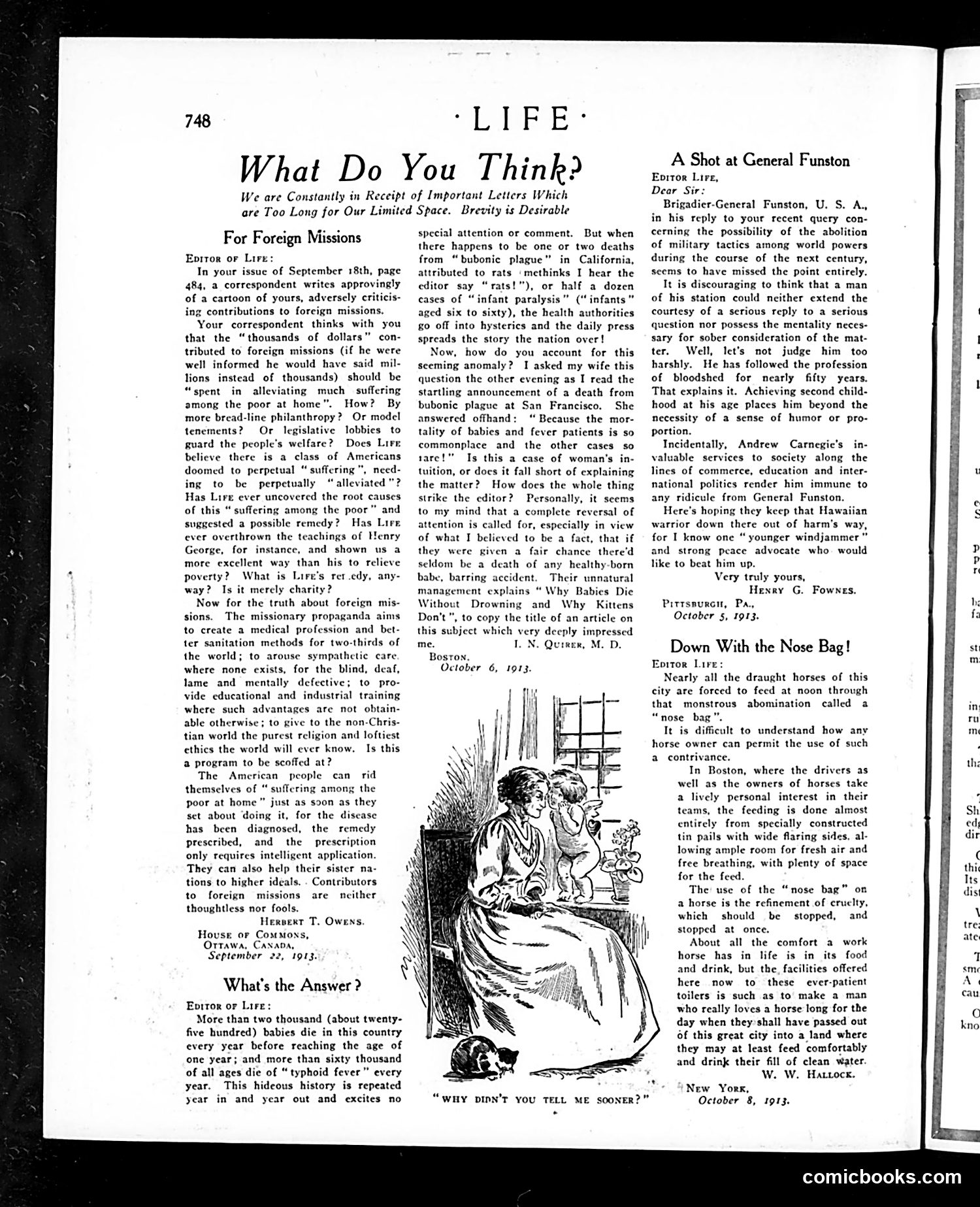
This page presents readers' letters debating two social issues: **"For Foreign Missions"** features a heated exchange about charitable priorities. A Canadian correspondent (Herbert T. Owens) defends missionary work abroad, arguing it provides medical care, sanitation, and education to two-thirds of the world's population. He challenges Life's earlier cartoon criticizing foreign aid while domestic poverty exists, demanding: what's *Life's* alternative solution? **"Down With the Nose Bag"** complains about horses forced to wear restrictive feeding devices in Boston, calling it cruel. The accompanying sketch shows a woman asking a man, "Why didn't you tell me sooner?"—implying neglected animal welfare concerns. **"What's the Answer?"** questions why rare diseases (bubonic plague, infantile paralysis) receive sensational press coverage while endemic killers—infant mortality and typhoid fever—cause thousands of yearly deaths with barely a mention. The writer suggests the public's attention is irrationally skewed toward dramatic but statistically minor threats. All three letters represent typical early-20th-century Progressive Era debates: foreign aid versus domestic poverty, animal welfare, and public health priorities.
📄 Transcribed text from this page (OCR, searchable)
Machine-transcribed from the original scan — historical spelling and the odd misread are preserved.
LOBE What Do You Think? Ve are Constantly in Receipt of Important Letters Which are Too Long for Our Limited Space. For Foreign Missions Eprtor oF Lire: In your issue of September 18th, page 484, a correspondent writes approvingly of a cartoon of yours, adversely criticis- ing contributions to foreign missions. Your correspondent thinks with you that the “thousands of dollars” con- tributed to foreign missions (if he were well informed he would have said mil- lions instead of thousands) should be “spent in alleviating much suffering among the poor at home”. How? By more bread-line philanthropy? Or model tenements? Or legislative lobbies to guard the people's welfare? Does Lire believe there is a class of Americans doomed to perpetual “ suffering", need- ing to be perpetually “alleviated "? Has Lire ever uncovered the root of this “ suffering among the poor” suggested a possible remedy? Has Lire ever overthrown the teachings of Henry George, for instance, and shown us a more excellent way than his to relieve poverty? What is Live's rer.edy, any- way? Is it merely charity? Now for the truth about foreign mis- sions. The missionary propaganda aims to create a medical profession and bet- ter sanitation methods for two-thirds of the world; to arouse sympathetic care. where none exists, for the blind, deaf, lame and mentally defective; to pro- vide educational and industrial training where such advantages are not obtai able otherwise; to give to the non-Chris- tian world the purest religion and loftiest ethics the world will ever know, Is this a program to be scoffed at? The American people can rid themselves of “ suffering among the poor at home” just as soon as they set about doing it, for the disease has been diagnosed, the remedy prescribed, and the prescription only requires intelligent application. They can also help their sister na- tions to higher ideals. . Contributors to foreign missions neither thoughtless nor fools. Hervert T. Owe House or Commoxs, Ortawa, Canada, September 22, 1913. What's the Answer ? Eprtor or Lire: More than two thousand (about twenty- five hundred) babies die in this country every year before reaching the age of one year; and more than sixty thousand of all ages die of “typhoid fever” every year. This hideous history is repeated year in and year out and excites no are Brevity is Desirable But when two deaths special attention or comment. there happens to be one or from “bubonic plague” in California, attributed to rats ‘methinks I hear the editor say “rats!"), or half a dozen cases of fant paralysis” (“infants aged six to sixty), the health authorities go off into hysterics and the daily press spreads the story the nation over! Now, how do you account for this sceming anomaly? I asked my wife this question the other evening as I read the startling announcement of a death from bubonic plague at San Francisco. She answered offhand: “ Because the mor- tality of babies and fever patients is so commonplace and the other cases so sare!" Is this a case of woman's in- tuition, or docs it fall short of explaining the matter? How does the whole thing strike the editor? Personally, it seems to my mind that a complete reversal of attention is called for, especially in view of what I believed to be a fact, that if they were given a fair chance there'd seldom be a death of any healthy-born babe, barring accident. Their unnatural management explains “ Why Babies Die Without Drowning and Why Kittens to copy the title of an article on ject which very deeply impressed T..N. Quteer, M.D. this sul me. Boston. October 6, 1913. “WHY DIDN'T YOU TELL ME SOONER? A Shot at General Funston Eortor Lire, Dear Sir: Brigadier-General Funston, U. S. A., in his reply to your recent query con- cerning the possibility of the abolition of military tactics among world powers during the course of the next century, seems to have missed the point entirely. Tt is discouraging to think that a man of his station could neither extend the courtesy of a serious reply to a serious question nor possess the mentality neces- sary for sober consideration of the mat- ter, Well, let's not judge him too harshly. He has followed the profession of bloodshed for nearly fifty years. That explains it. Achieving second child- hood at his age places him beyond the necessity of a sense of humor or pro- portion. Incidentally, Andrew Carnegie’s in- valuable services to society along the lines of commerce, education and inter- national politics render him immune to any ridicule from General Funston. Here's hoping they keep that Hawaiian warrior down there out of harm's way, for I know one “ younger windjammer” and strong peace advocate who would like to beat him up. Very truly yours, Hexry G. Fownes. Pitrsaurc, Pa., October §, 1913. Down With the Nose Bag! Eprtor Lire: Nearly all the draught horses of this city are forced to feed at noon through that monstrous abomination called a “nose bag”. It is difficult to understand how any horse owner can permit the use of such a contrivance. In Boston, where the drivers as well as the owners of horses take a lively personal interest in their teams, the feeding is done almost entirely from specially constructed tin pails with wide flaring sides, al- lowing ample room for fresh air and free breathing, with plenty of space for the feed. The use of the “nose bag” on a horse is the refinement of cruelty, which should be stopped, and stopped at once, About all the comfort a work horse has in life is in its food and drink, but the, facilities offered here now to these ever-patient toilers is such as to make a man who really loves a horse long for the day when they shall have passed out of this great city into a land where they may at least feed comfortably and drink their fill of clean water. W. W. Hatrock. New York, October 8, 1913. comicbooks.com