
Life, 1913-10-30 · page 24 of 40
Life — October 30, 1913 — page 24: what you’re looking at
What you’re looking at
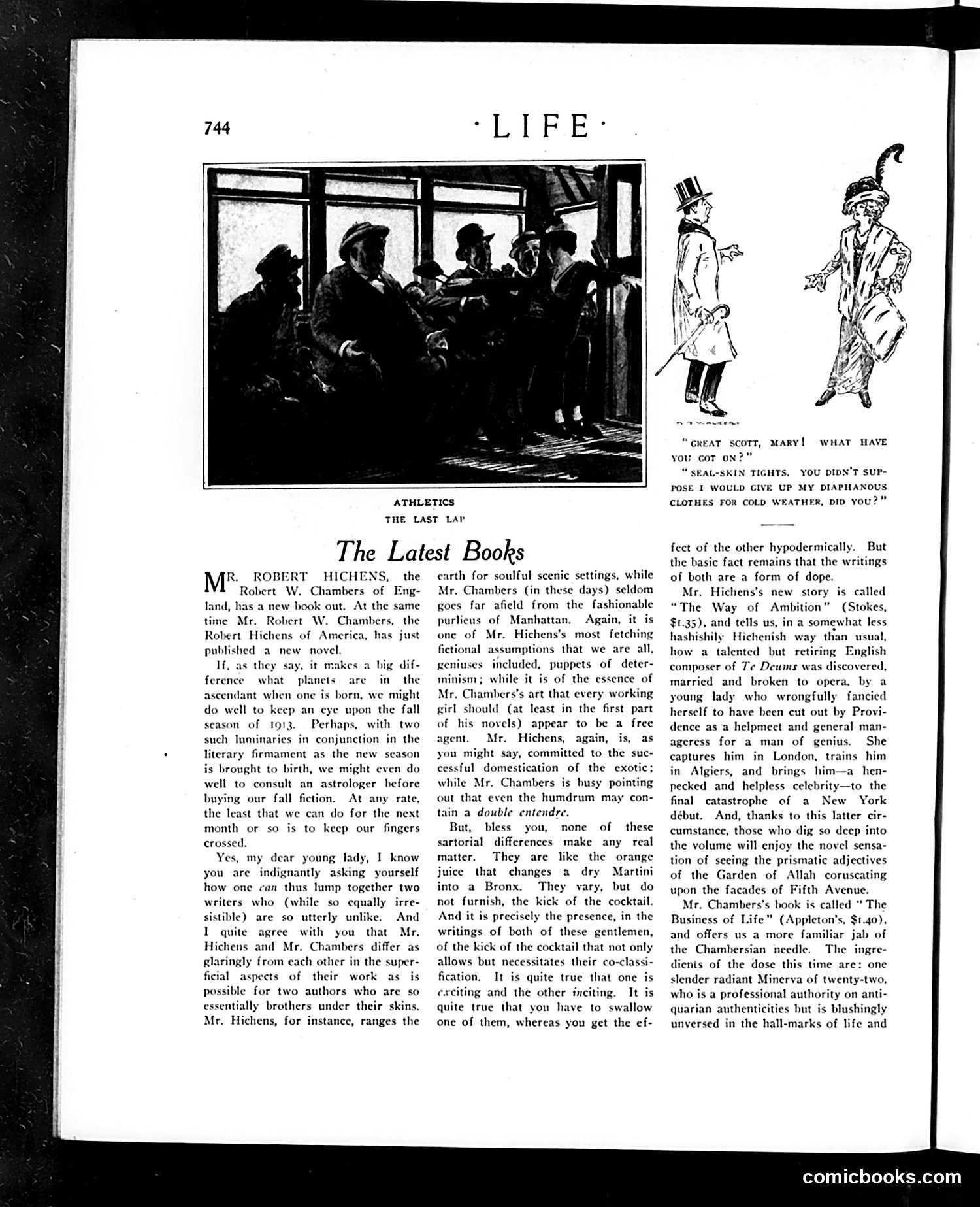
This page from *Life* magazine (circa 1913) compares two contemporary novelists: British author Robert Hichens and American author Robert W. Chambers. The reviewer humorously notes they share the same name pattern but write very differently—Hichens explores exotic global settings and determinism, while Chambers focuses on Manhattan's fashionable circles and free will. The reviewer's central metaphor is that both authors' works function like cocktails: addictive, pleasurable "dope" for readers despite their superficial differences. Hichens's new novel follows an English composer manipulated by an ambitious woman; Chambers's offers familiar romantic melodrama. The cartoon above shows densely packed subway/transit riders, captioned "Athletics: The Last Lap"—likely satirizing urban crowding. The sketch to the right depicts fashionable people debating whether seal-skin tights constitute appropriate cold-weather attire—mocking society's vanity over practicality. Both reinforce *Life*'s satirical focus on contemporary urban American life.
📄 Transcribed text from this page (OCR, searchable)
Machine-transcribed from the original scan — historical spelling and the odd misread are preserved.
ATHLETICS THE LAST Lar The Latest Books M* ROBERT HICHENS, the Robert W. Chambers of Eng- land, has a new book out. At the same time Mr. Robert W. Chambers, the Robert Hichens of America, has just published a new novel. If, as they say, it makes a big dif- ference what planets are in’ the ascendant when one is born, we might do well to keep an cye upon the fall season of 1913. Perhaps, with two such luminaries in conjunction in the literary firmament as the new season is brought to birth, we might even do well to consult an astrologer before buying our fall fiction. At any rate, the least that we can do for the next month or so is to keep our fingers crossed. Yes, my dear young lady, I know you are indignantly asking yourself how one can thus lump together two writers who (while so equally irre- sistible) are so utterly unlike. And I quite agree with you that Mr. Hichens and Mr. Chambers differ as glaringly from each other in the super- ficial aspects of their work as is possible for two authors who are so essentially brothers under their skins. Mr. Hichens, for instance, ranges the earth for soulful scenic settings, Mr. Chambers (in these days) seldom goes far afield from the fashionable purlieus of Manhattan. Again, it is one of Mr. Hichens’s most fetching fictional assumptions that we are all, geniuses included, puppets of deter- minism; while it is of the essence of Mr. Chambers’s art that every working girl should (at least in the first part of his novels) appear to be a free agent. Mr. Hichens, again, is, as you might say, committed to the suc- cessful domestication of the exotic; while Mr. Chambers is busy pointing out that even the humdrum may con- tain a double entendre. But, bless you, none of these sartorial differences make any real matter. They are like the orange juice that changes a dry Martini into a Bronx, They vary, but do not furnish, the kick of the cocktail And it is precisely the presence, in the writings of both of these gentlemen, of the kick of the cocktail that not only allows but necessitates their co-classi- fication. It is quite true that one is ing and the other inciting. It is quite true that you have to swallow one of them, whereas you get the ef- exe CREAT SCOTT, MARY! WHAT HAVE you cot on?” “ SEAL-SKIN TIGHTS, YOU DIDN'T SUP- POSE I WOULD GIVE UP MY DIAPHANOU! CLOTHES FOR COLD WEATHER, DID you?” But tings fect of the other hypodermically. the basic fact remains that the wi of both are a form of dope. Mr. Hichens’s new story is called “The Way of Ambition” (Stokes, $1.35), and tells us, in a somewhat less hashishily Hichenish way than usual, how a talented but retiring English composer of Te Deums was discovered, married and broken to opera, by a young lady who wrongfully fancied herself to have been cut out by Provi- dence as a helpmect and general man- ageress for a man of genius. She captures him in London, trains him in Algiers, and brings him—a_hen- pecked and helpless celebrity—to the final catastrophe of a New York début. And, thanks to this latter cir- cumstance, those who dig so deep into the volume will enjoy the novel sensa- tion of seeing the prismatic adjectives of the Garden of Allah coruscating upon the facades of Fifth Avenue. Mr. Chambers’s book is called “ The Business of Life” (Appleton’s, $1.40), and offers us a more familiar jab of the Chambersian needle. The ingre- dienis of the dose this time are: one slender radiant Minerva of twenty-two, who is a professional authority on anti- quarian authenticities but is blushingly unversed in the hall-marks of life and comicbooks.com