
Life, 1913-10-30 · page 22 of 40
Life — October 30, 1913 — page 22: what you’re looking at
What you’re looking at
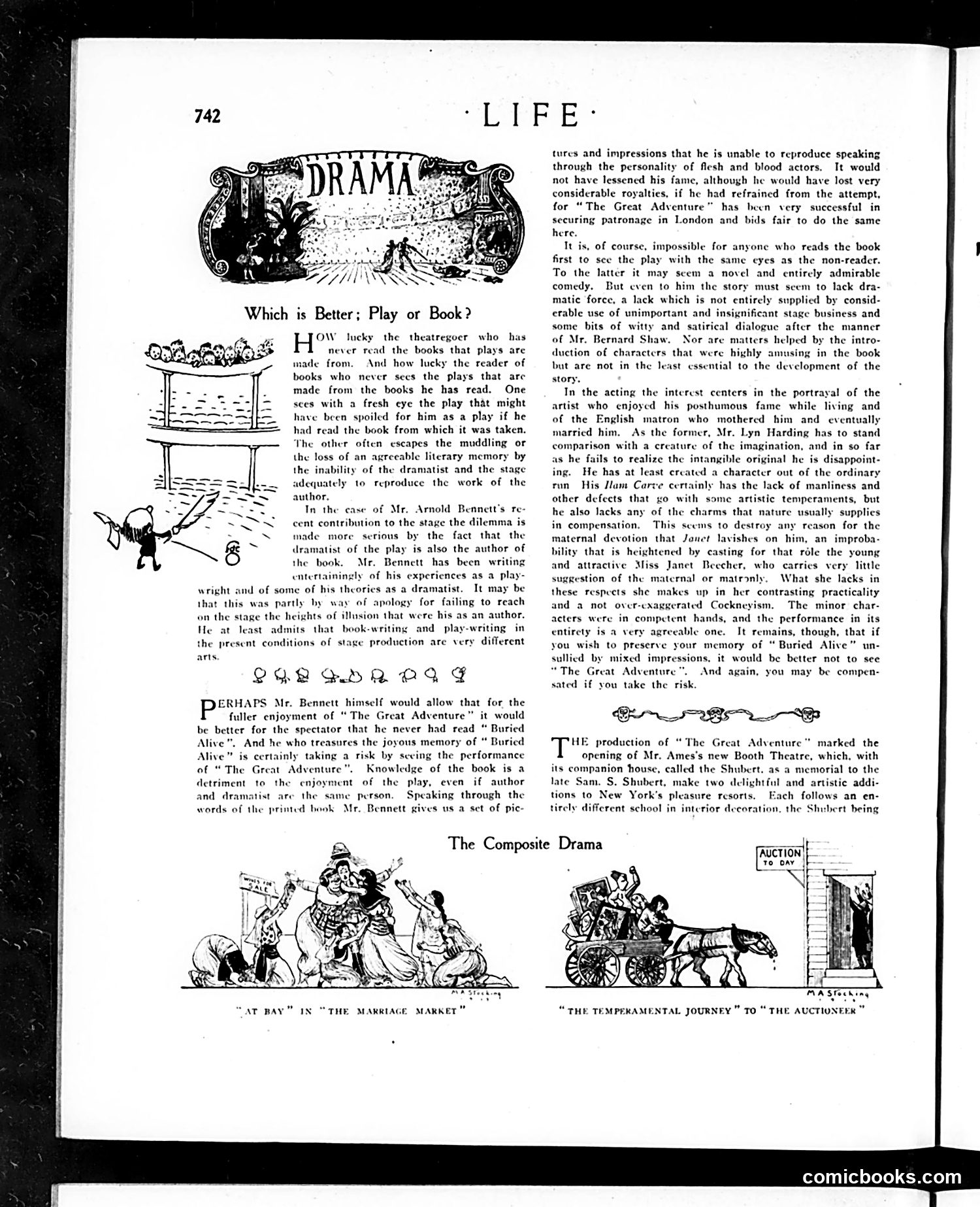
This page discusses whether Arnold Bennett's play "The Great Adventure" (adapted from his novel "Buried Alive") is better experienced as a book or theatrical performance. The article argues that **knowing the source material diminishes enjoyment of the stage adaptation**. The critic contends that Bennett, writing as author and dramatist, cannot translate the rich "pictures and impressions" of his prose into convincing live performance. Reading the book first prevents viewers from seeing the play "with the same eyes as the non-reader." The review criticizes specific casting choices—particularly actor Lyn Harding's portrayal of the artist protagonist, which the critic finds disappointing compared to "a creature of the imagination." It also questions why actress Janet Beecher was cast as the maternal figure, as she appears too young and attractive to believably inspire maternal devotion. The bottom illustrations show comedic scenes from other dramatic productions ("At Bay" and "The Temperamental Journey"), representing "The Composite Drama" — apparently examples of theatrical offerings. This reflects early 20th-century theater criticism and the common debate about literary adaptations.
📄 Transcribed text from this page (OCR, searchable)
Machine-transcribed from the original scan — historical spelling and the odd misread are preserved.
RE“ Which is Better; Play or Book? OW lucky the theatregoer who bas never read the books that plays are ade from. And how lucky the reader of books who never secs the plays that are made from the books he has read. One sees with a fresh eye the play that might © been spoiled for him as a play if he read the book from which it was taken. The other often escapes the muddling or the loss of an agreeable literary memory by the inability of the dramatist and the stage adequately to reproduce the work of the author. In the case of Mr. Arnold Bennett's re- cent contribution to the stage the dilemma is made more serious by the fact that the dramatist of the play is also the author of the book. Mr. Bennett has been writing entertainingly of his experiences as a play- wright and of some of his theories as a dramatist. It may be that this was partly by way of apology for failing to reach on the stage the heights of illusion that were his as an author. He at least admits that book-writing and play-writing in the present conditions of stage production are very different OG Ade eadag ERHAPS Mr. Bennett himself would allow that for the fuller enjoyment of “The Great Adventure” it would be better for the spectator that he never had read “ Buried Alive". And he who treasures the joyous memory of “ Buried Alive” is certainly taking a risk by sccing the performance of “The Great Adventure”. Knowledge of the book is a detriment to the enjoyment of the play, even if author and dramatist are the same person. Speaking through the words of the printed book Mr. Bennett gives us a set of pic- arts. tures and impressions that he is unable to reproduce speaking through the personality of flesh and blood actors. It would not have lessened his fame, although he would have lost very considerable royalties, if he had refrained from the attempt, for “The Great Adventure” has been very successful in securing patronage in London and bids fair to do the same here. It is, of course, impossible for anyone who reads the book first to sce the play with the same eyes as the non-reader. To the latter it may scem a novel and entirely admirable comedy. But even to him the story must seem to lack dra- matic force, a lack which is not entirely supplied by consid- erable use of unimportant and insignificant stage business and some bits of witty and satirical dialogue after the manner of Mr. Bernard Shaw. Nor are matters helped by the intro duction of characters that were highly amusing in the book but are not in the least essential to the development of the story. In the acting the interest centers in the portrayal of the artist. who enjoyed his posthumous fame while living and of the English matron who mothercd him and eventually married him. As the former, Mr. Lyn Harding has to stand comparison with a creature of the imagination, and in so far as he fails to realize the intangible original he is disappoint- ing. He has at least ercated a character out of the ordinary run His Jlam Carve certainly has the lack of manliness and other defects that xo with some artistic temperaments, but he also lacks any of the charms that nature usually supplies in compensation. This scems to destroy any reason for the maternal devotion that Jouet lavishes on him, an improba- bility that is heightened by casting for that réle the young and attractive Miss Janet Beecher, who carries very little suggestion of the maternal or matronly, What she lacks in these respects she makes up in her contrasting practicality and a not over-cxaggerated Cockneyism. The minor char- acters were in competent hands, and the performance in its entirety It remains, though, tbat if you wish to preserve your memory of “ Buried Alive” un- sullied by mixed impressions, it would be better not to see “The Great Adventure”, And again, you may be compen- sated if you take the risk. QB HE production of “ The Great Adventure” marked the opening of Mr. Ames’s new Booth Theatre, which, with its companion house, called the Shubert. as a memorial to the late Sam. S. Shubert, make two delightful and artistic addi- tions to New York’s pleasure resorts. h follows an en- tirely different school in interior decoration, the Shubert being A very agreeable one. The Composite Drama “AT BAY IN “THE MARRIAGE MARKET” TVA Sieching “THE TEMPERAMENTAL JOURNEY ” TO “ THE AUCTIONEER ™ comicbooks.com