
A complete issue · 40 pages · 1913
Life — August 14, 1913
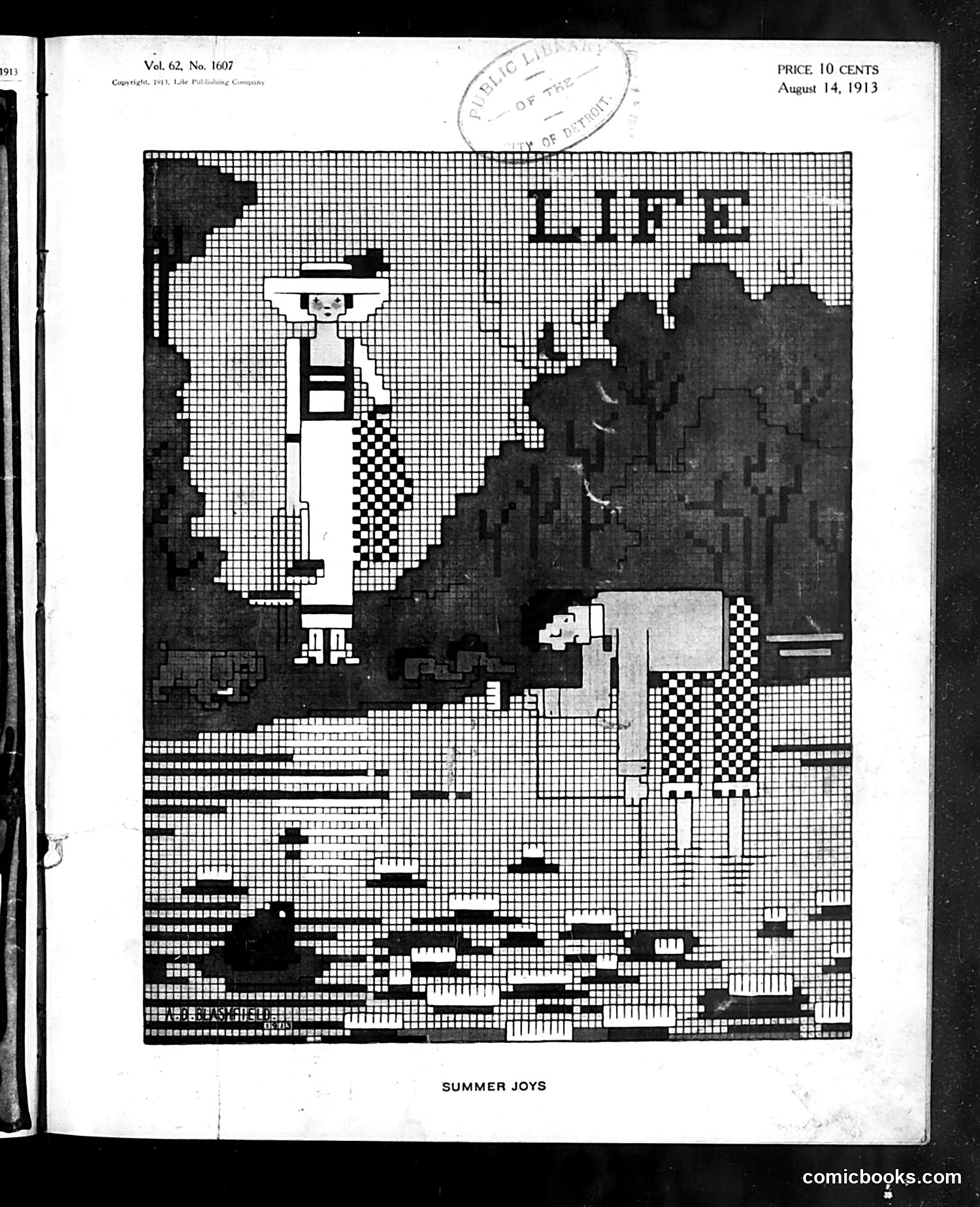
This illustration depicts a fashionable woman in 1913 summer attire standing against a cityscape. The pixelated/gridded art style was typical of Life's satirical graphics. The woman wears a wide-brimmed hat, striped jacket, and checkered skirt—representing contemporary high fashion. The title "Summer Joys" likely satirizes the leisure activities and social life available to wealthy urban women during summer months. The contrast between the elegantly-dressed figure and the darker cityscape behind her may suggest irony about summer pleasures in hot, crowded cities, or commentary on class distinctions in early 20th-century American society. The precise satirical target remains somewhat unclear from the image alone.
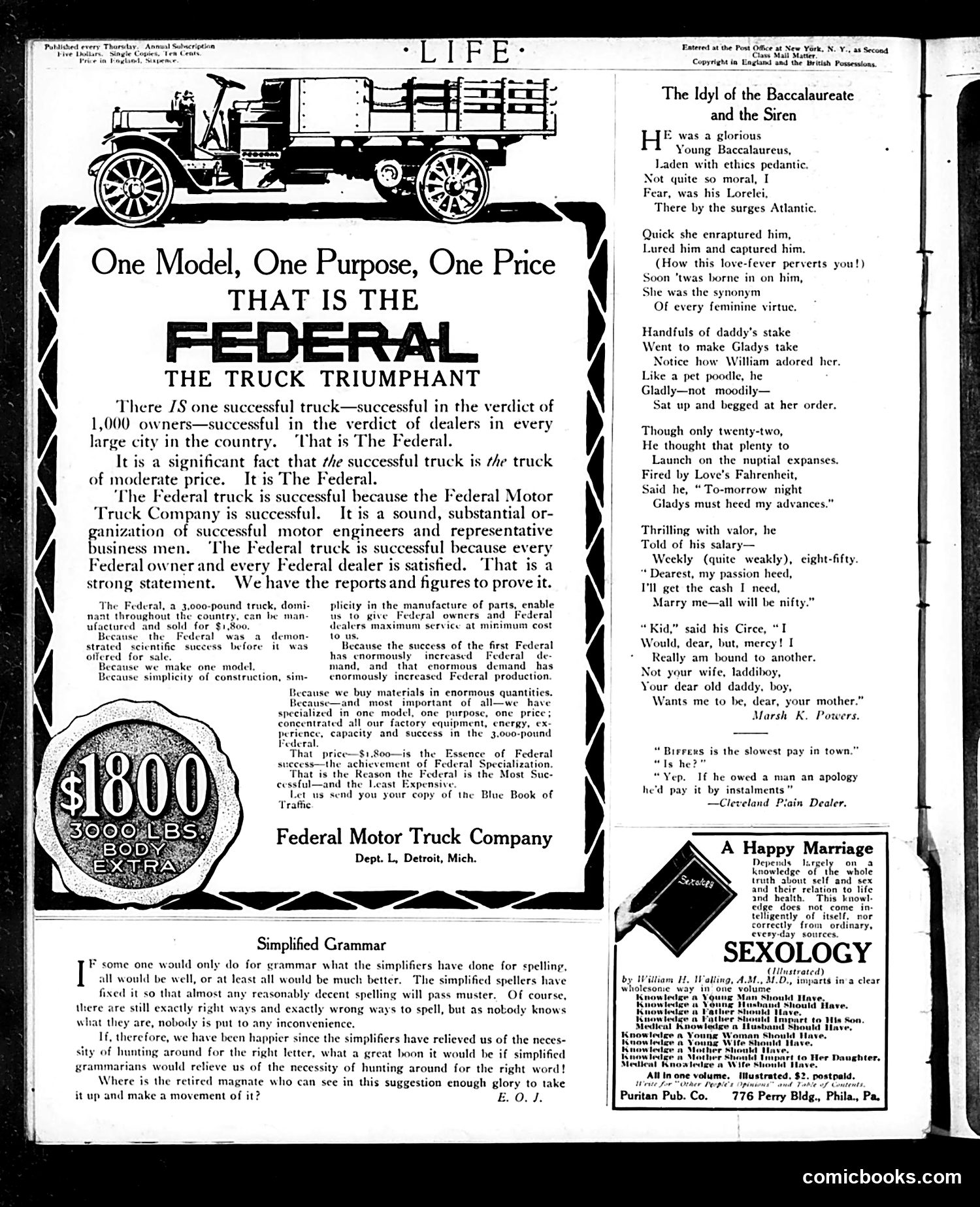
This Life magazine page is **primarily advertising and light satirical content**, not political commentary. The main feature is a Federal Motor Truck Company advertisement emphasizing the truck's success: "One Model, One Purpose, One Price." The ad highlights the Federal's popularity among 1,000 owners and dealers nationwide, positioning it as the successful truck of "moderate price." The right side contains two unrelated pieces: a humorous poem titled "The Idyl of the Baccalaureate and the Siren" about a young man's romantic entanglements, and an advertisement for "Sexology" books from Puritan Pub. Co. Below is an editorial piece on "Simplified Grammar" advocating for spelling reform. The page reflects early-20th-century magazine content mixing commercial promotion with light humor and educational material.
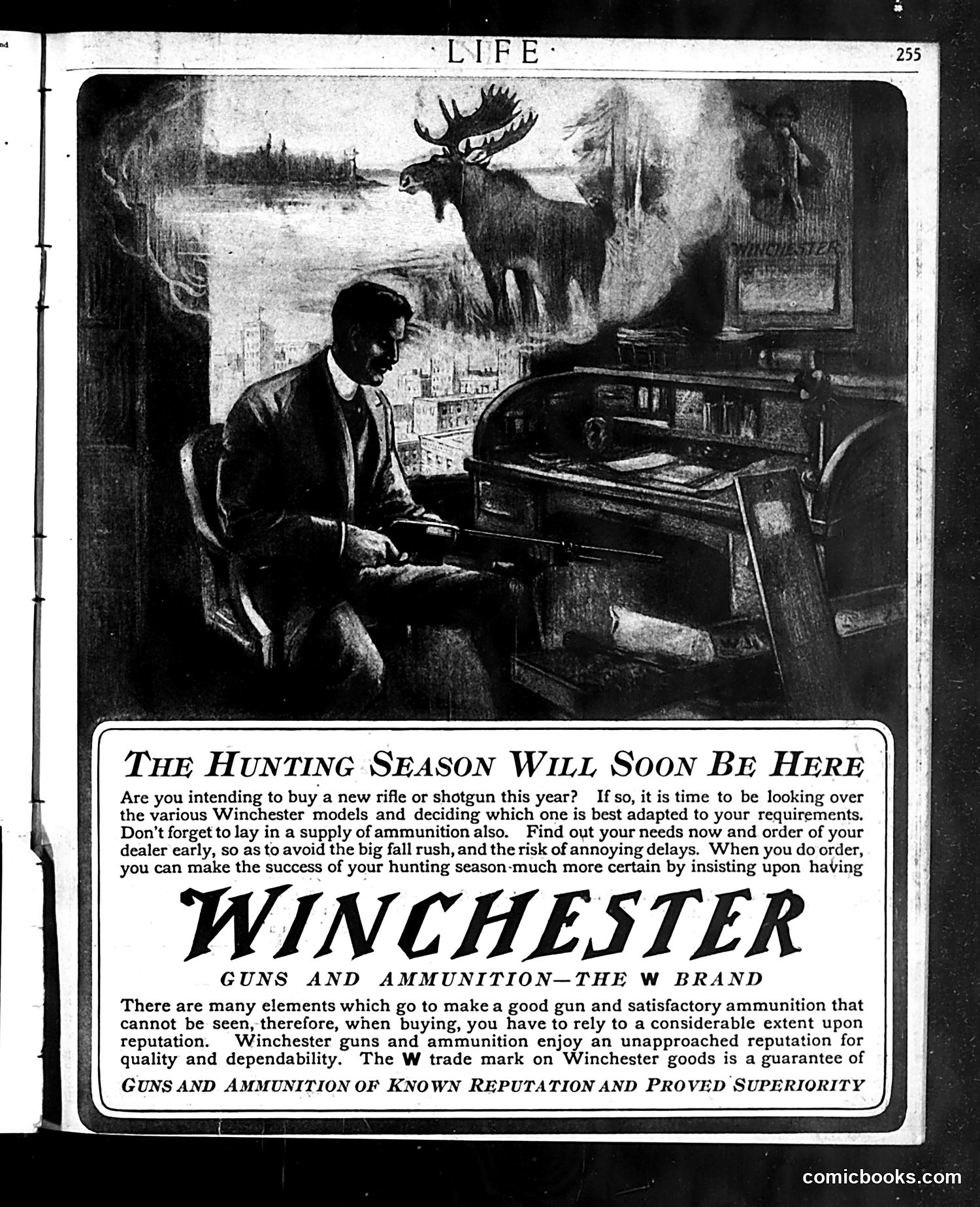
This is primarily a **Winchester firearms advertisement**, not satire or political commentary. The page shows a man at a desk with hunting rifles displayed, alongside artwork depicting a moose in a wilderness landscape. The ad's message is straightforward commercial persuasion: hunters should purchase Winchester rifles before the fall hunting season arrives, to avoid supply shortages and delivery delays. It emphasizes Winchester's reputation for quality and reliability ("known reputation and proved superiority"). There is **no political cartoon or satire present**. This is a standard early 20th-century magazine advertisement designed to encourage seasonal purchasing. The moose imagery and hunting scenes serve only to evoke the hunting context and appeal to the target audience of sportsmen and hunters.
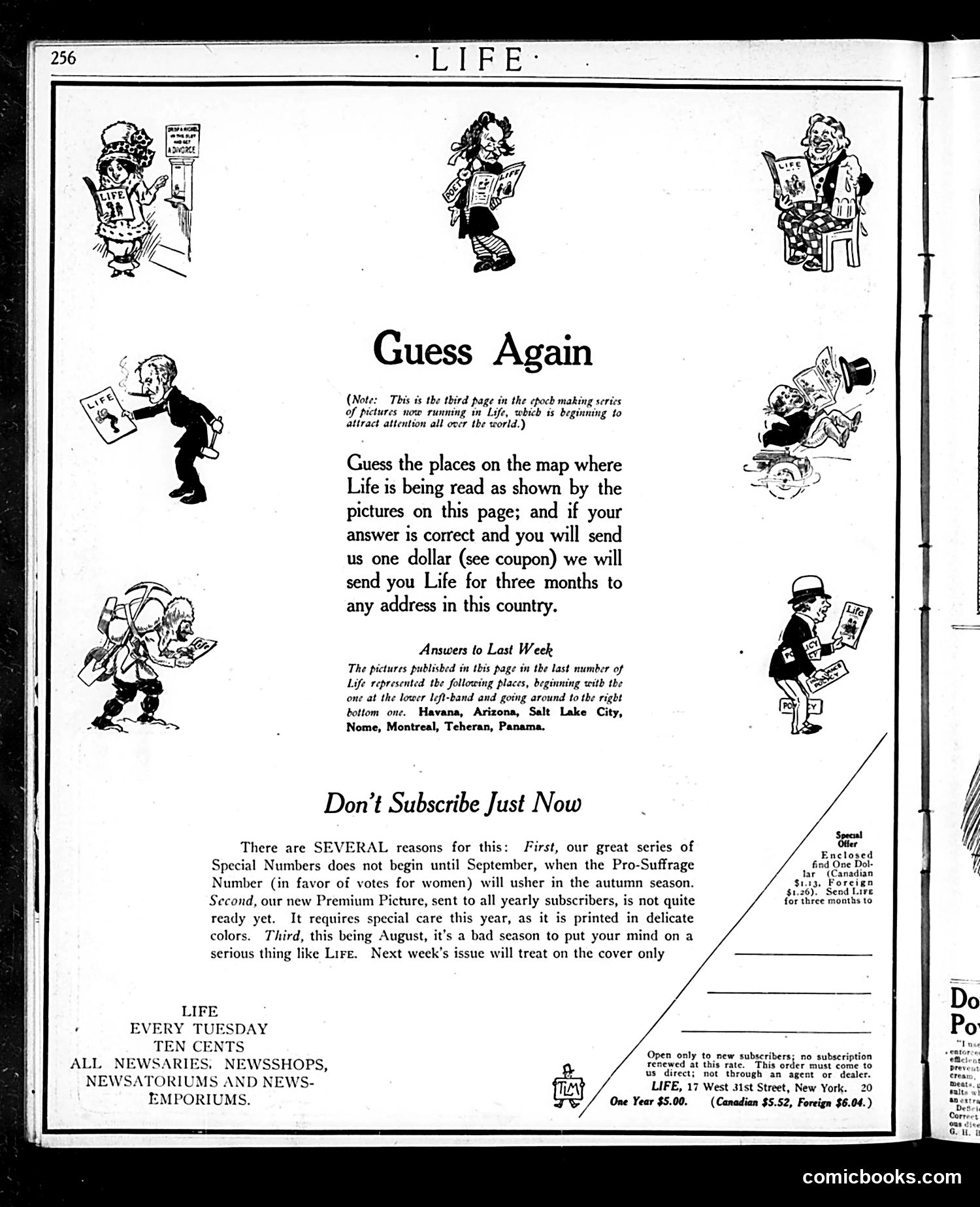
This page presents a reader-participation game where subscribers identify locations where *Life* magazine is being read, based on cartoon illustrations. The cartoons depict exaggerated character types reading the publication in various settings. The contest offers a three-month subscription to correct respondents who submit one dollar. Previous week's answers listed places including Havana, Arizona, Salt Lake City, Nome, Montreal, Teheran, and Panama—suggesting the game highlights *Life's* international readership. The text discourages new subscriptions in August, citing that special numbered issues won't begin until September (apparently related to Pro-Suffrage content) and that a premium picture isn't yet ready. The magazine cost ten cents and was available at newsstands.
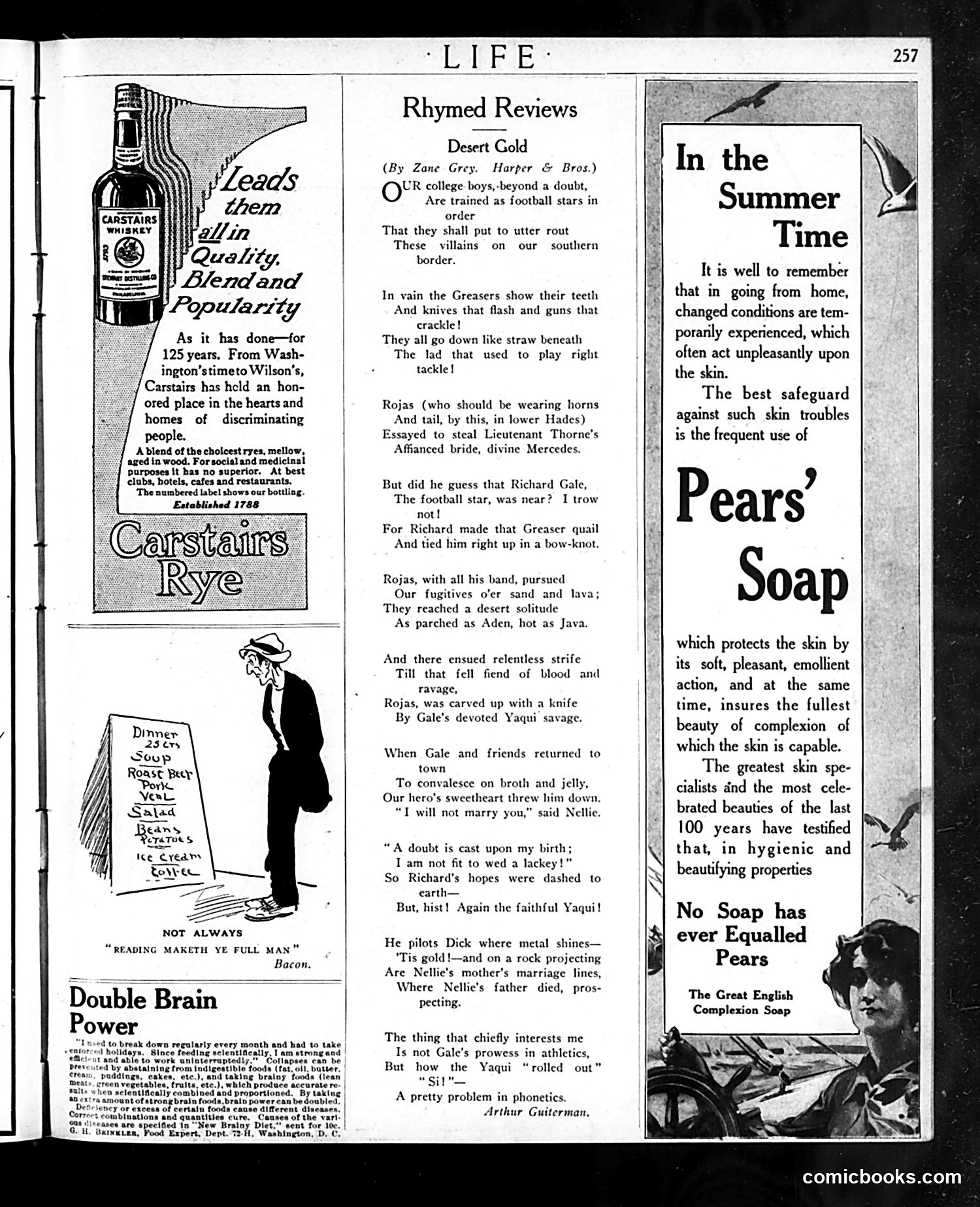
This page is primarily **advertising**, not political satire. The dominant content includes: 1. **Carstairs Rye whiskey ad** (left): Standard product advertisement emphasizing quality and popularity since 1788. 2. **Pears' Soap ad** (right): Large advertisement claiming superiority for skin care, featuring photographs of women and claiming 100 years of testimonials to its effectiveness. 3. **"Desert Gold" rhymed review** (center): A poem by Zane Grey reviewing what appears to be a Western novel or film, featuring characters named Rojas, Richard Gale, and Nellie in a desert adventure plot. 4. **Minor cartoon** (bottom left): Shows a man reading a menu, captioned "Not always reading maketh ye full man," attributing the quote to Bacon—a light joke about dining. The page reflects early 20th-century magazine advertising practices rather than political commentary.
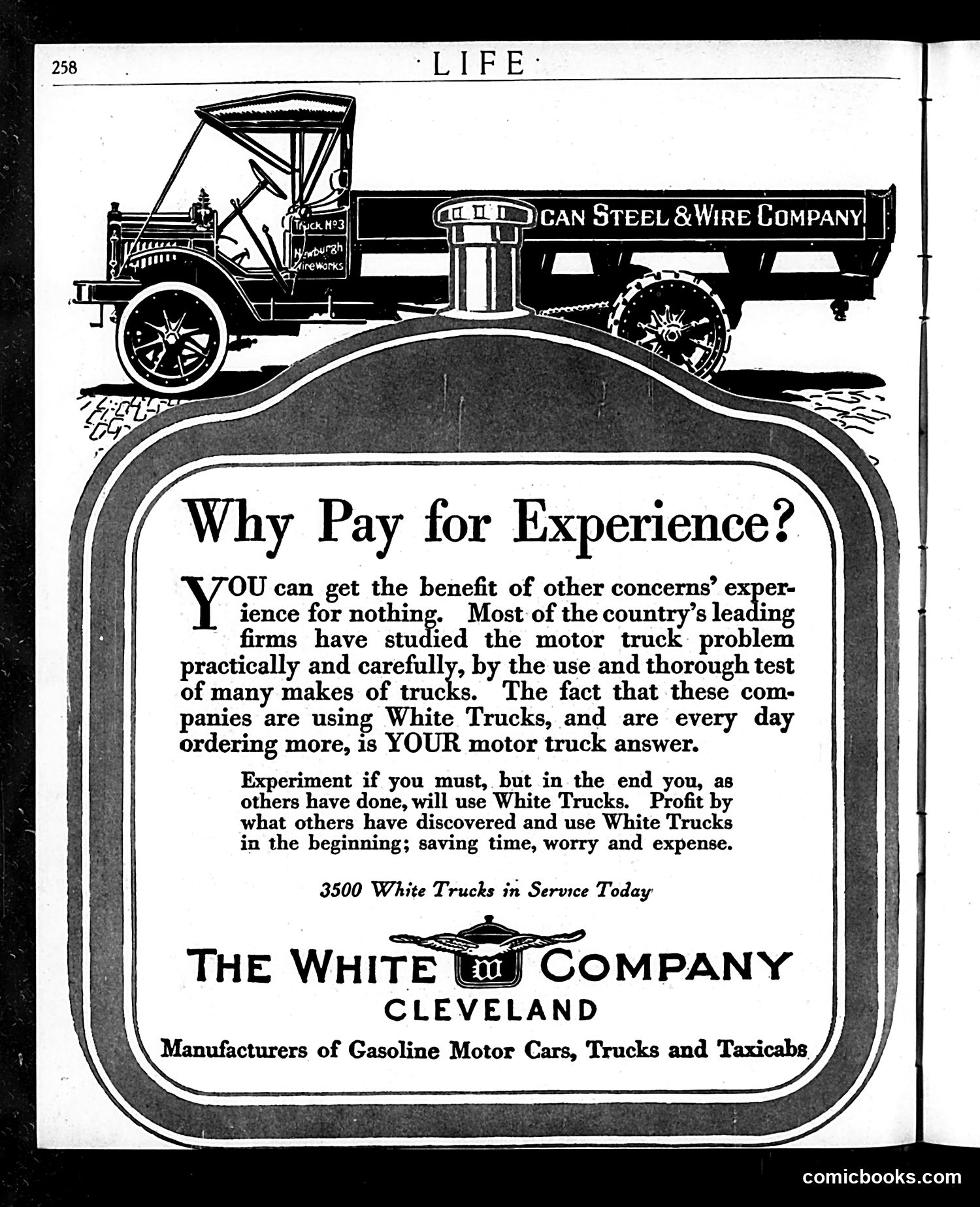
This page is **primarily an advertisement**, not satire or editorial content. It's a 1910s-era ad for The White Company of Cleveland, which manufactured motor trucks. The ad's headline "Why Pay for Experience?" argues that buyers shouldn't waste money experimenting with different truck brands—instead, they should benefit from other companies' testing by purchasing White Trucks, which 3,500 firms already used. The illustration shows a White truck carrying cargo for "Can Steel & Wire Company," serving as a real-world endorsement example. The appeal is practical: proven reliability saves "time, worry and expense." This reflects early automotive marketing's emphasis on durability and market leadership as purchasing incentives.
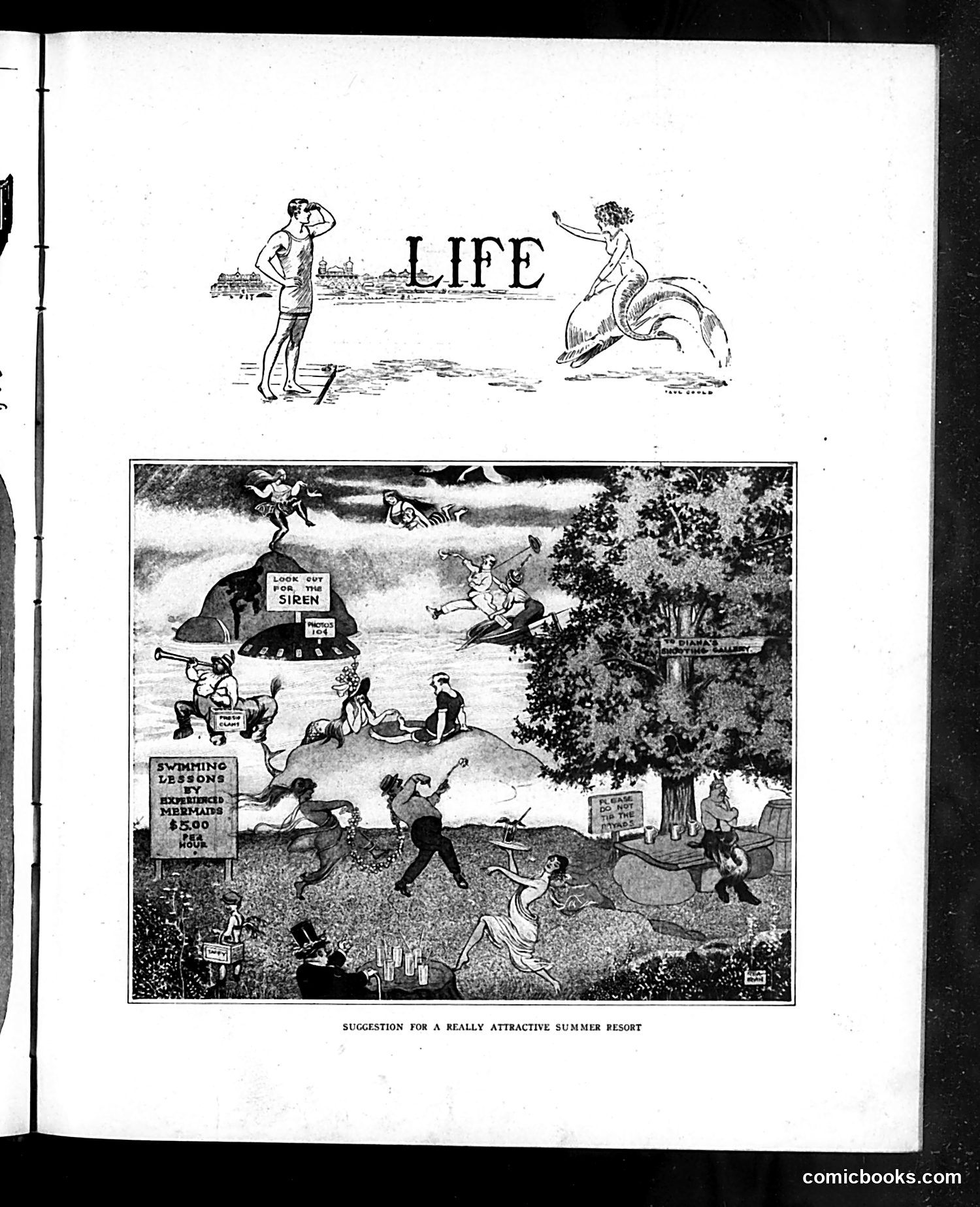
This page from *Life* magazine presents a satirical illustration titled "Suggestion for a Really Attractive Summer Resort." The cartoon depicts a chaotic seaside scene combining various recreational activities and attractions. The image shows visitors engaged in swimming, dancing, and entertainment around a central structure labeled "LOCK OUT FOR THE SIREN" with what appears to be warning signs. A mermaid figure is visible in the water. The satire suggests an "ideal" summer resort that humorously combines mundane beach activities with mythological danger (the siren), creating comedy through the juxtaposition of ordinary vacation scenes with fantastical, hazardous elements. The accompanying decorative header illustration shows a man and mermaid on a beach, reinforcing the mermaid/siren theme as the central comedic element of this leisure-time satire.
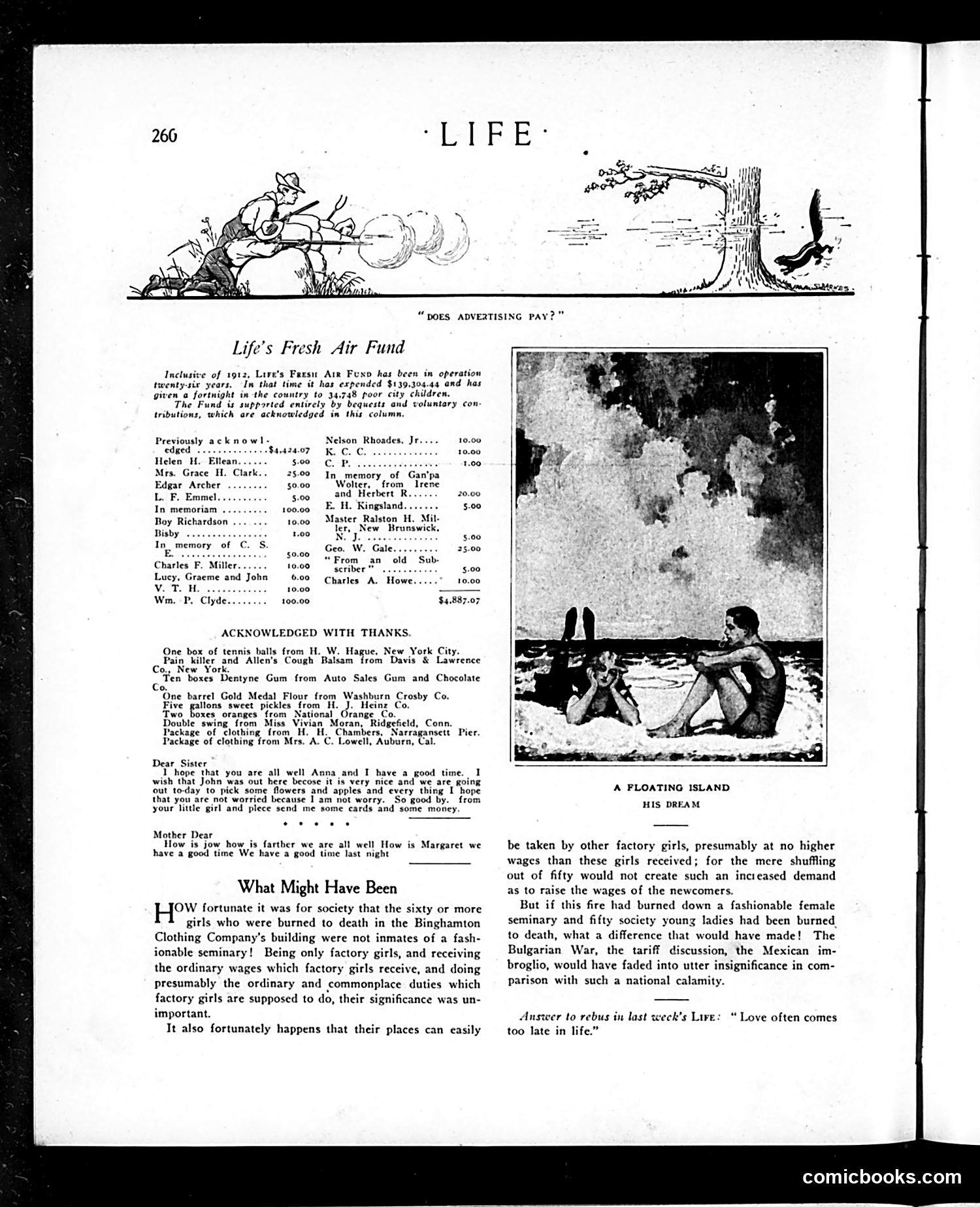
**The Cartoon Header ("Does Advertising Pay?"):** The top illustration shows a figure using a large cannon/megaphone to blast advertising messages across a landscape. A tree and squirrel are visible being blown away by the force. This satirizes aggressive advertising tactics of the era, questioning whether such forceful marketing actually achieves results or merely creates noise and disruption. **Main Content:** The page primarily documents "Life's Fresh Air Fund," a charitable initiative providing city children with outdoor experiences. It lists donors and contributions, includes a photograph labeled "A Floating Island: His Dream," and discusses a tragic factory fire. The text reflects early 20th-century Progressive Era concerns about child welfare and industrial safety standards.
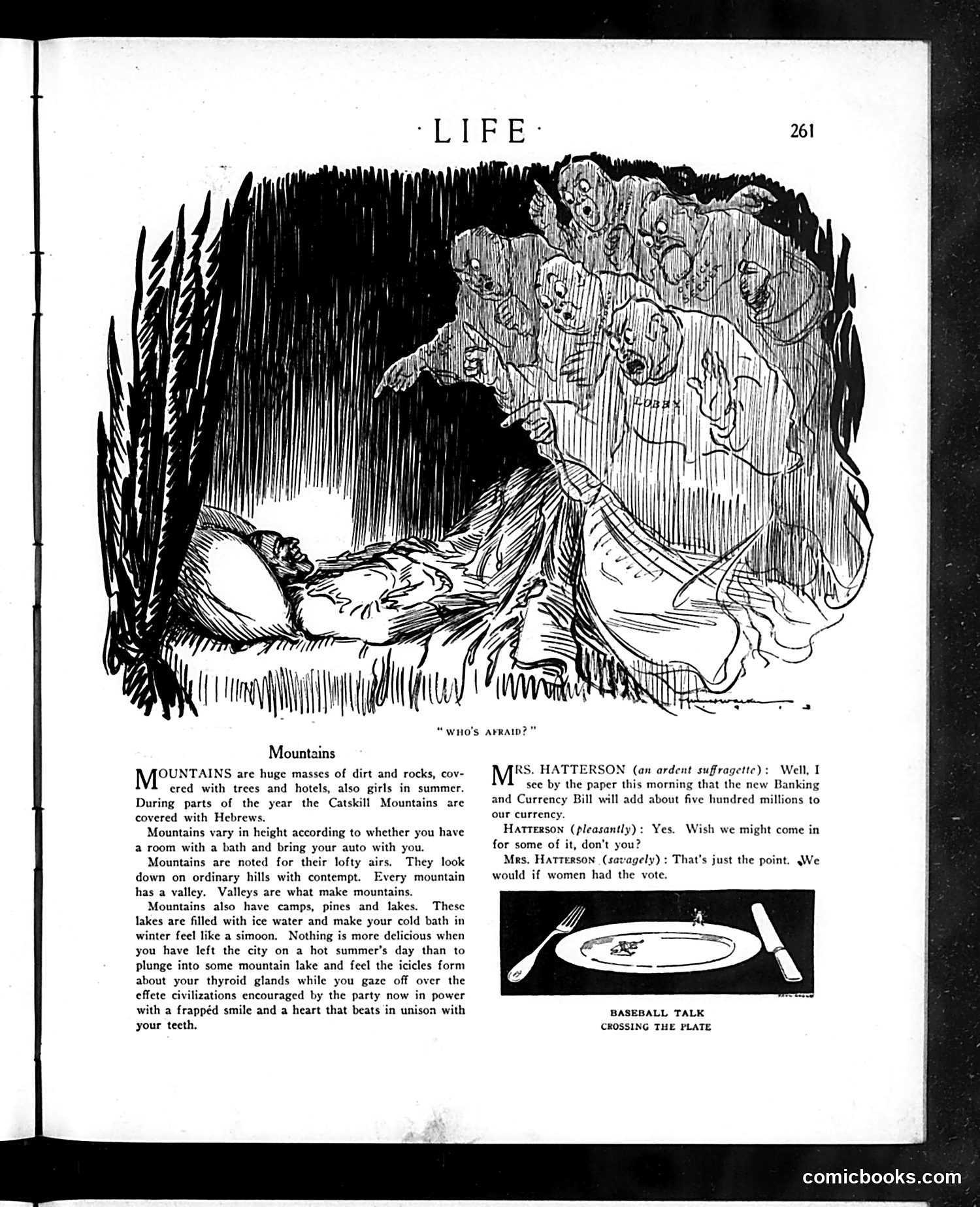
This page from *Life* magazine contains two separate pieces: **"Mountains" essay** (left): A descriptive piece celebrating mountain vacations as relief from urban life and summer heat. It references the Catskill Mountains specifically and emphasizes the physical and spiritual rejuvenation mountains provide. **"Who's Afraid?" cartoon dialogue** (right): A brief political exchange where Mrs. Hatterson, described as an "ardent suffragette," expresses concern about a Banking and Currency Bill potentially adding "hundred millions to our currency." Her husband dismisses her worry, and she responds that women's voting power could prevent such problems. The joke satirizes both suffragette activism and anxieties about monetary policy during the Progressive Era, suggesting women's political participation as a solution to financial mismanagement.
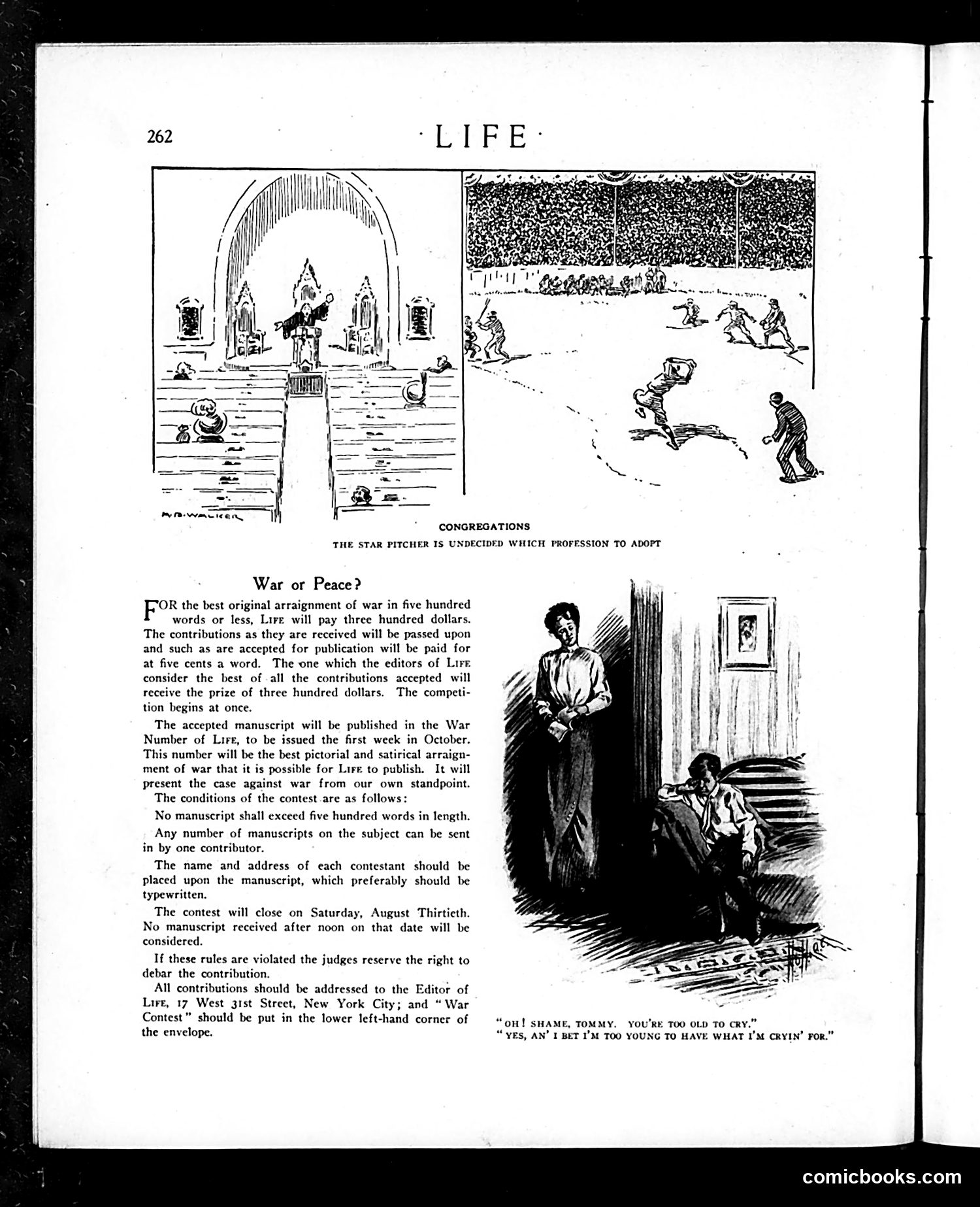
This page contains two distinct elements: **Top cartoons**: Two satirical drawings about unexpected career changes. The left image shows a religious congregation scene (labeled "CONGREGATIONS"), while the right depicts a baseball game. The caption reads: "THE STAR PITCHER IS UNDECIDED WHICH PROFESSION TO ADOPT." This jokes about uncertainty regarding career paths—suggesting even successful baseball players might consider entering the clergy. **Bottom section**: A contest announcement titled "War or Peace?" offering prizes for the best original argument about war in 500 words or less. Life magazine solicited reader submissions, paying $300 for the winning entry and $0.05 per word for accepted pieces. The accompanying illustration shows two figures in what appears to be a domestic scene, with dialogue about youth and crying. This reflects early 20th-century magazine culture mixing humor, reader engagement, and social commentary.
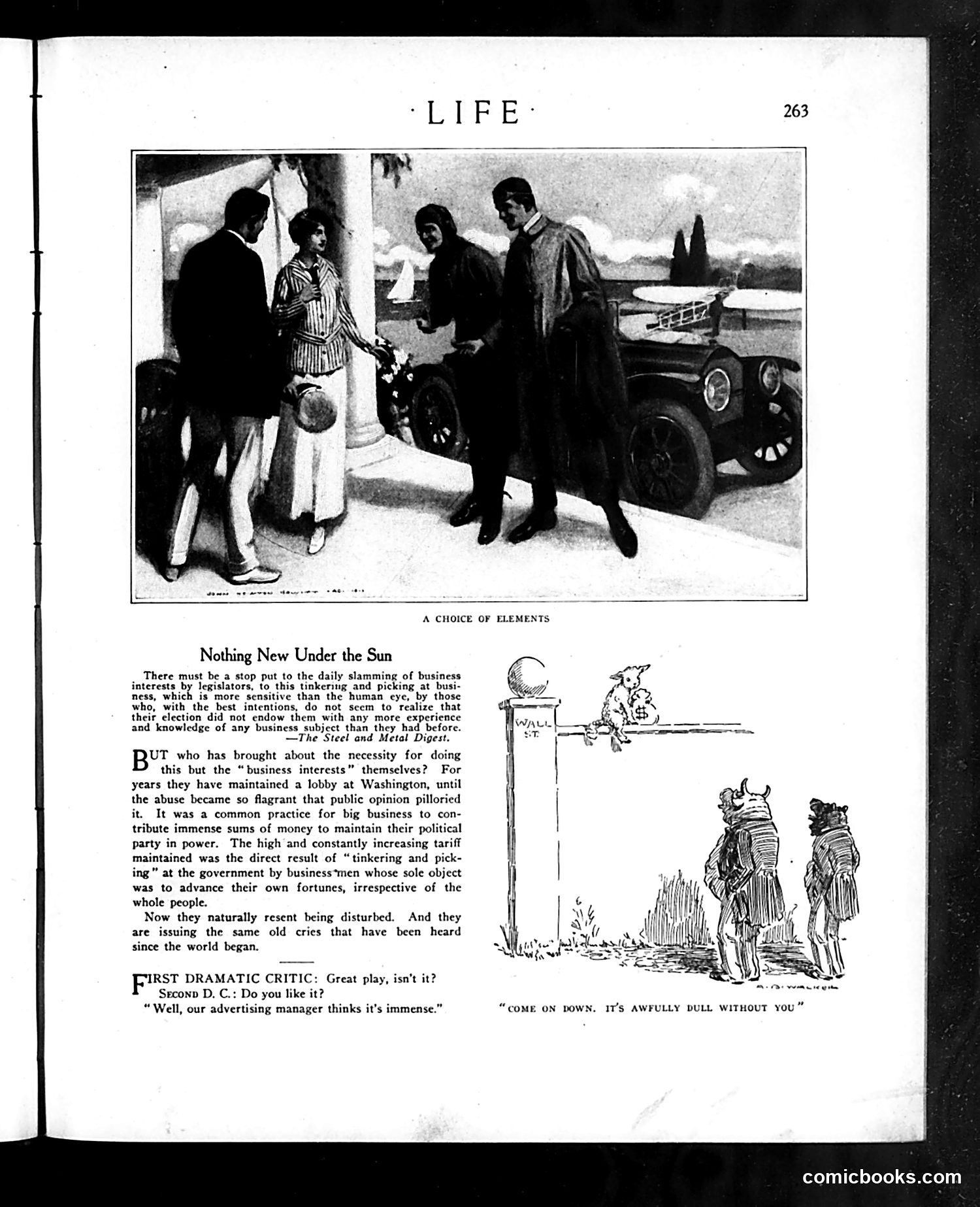
This page critiques business lobbyists and their influence on government. The article argues that despite claims of addressing "business interests," lobbyists have long maintained a Washington presence to secure tariffs and favorable policies—"tinkering and picking" at government for private gain rather than public benefit. The top photograph shows what appears to be a business transaction or negotiation involving automobiles, illustrating modern commercial activity. The cartoon below depicts anthropomorphic animals (appearing to be oxen or cattle) with one saying "Come on down. It's awfully bull without you"—a visual pun playing on "bull" (both the animal and meaning nonsense). This satirizes the absurdity of business lobbying practices, suggesting such activities are fundamentally dishonest or foolish, regardless of era.
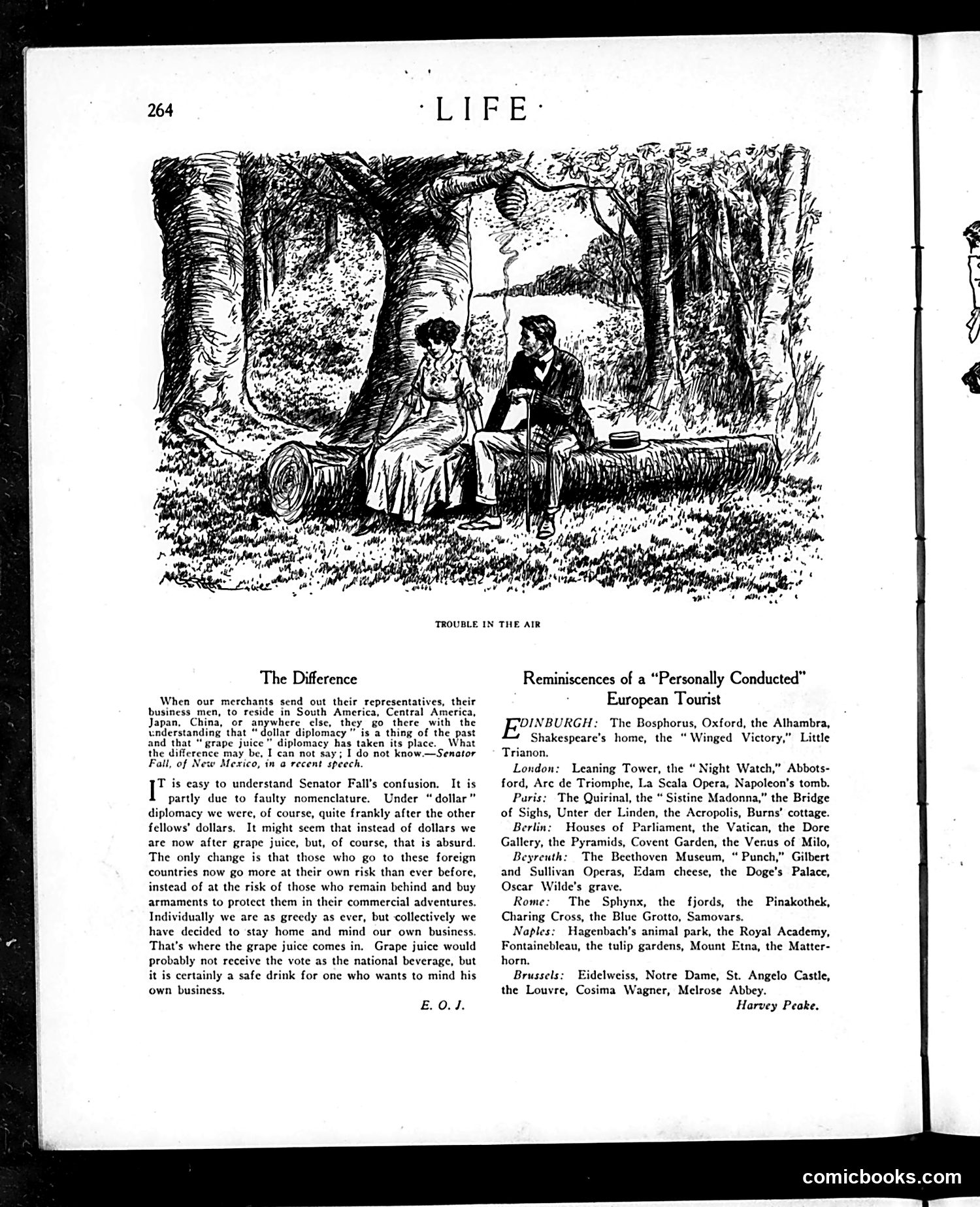
The cartoon depicts two people sitting on a log in a forest, engaged in conversation. The title "Trouble in the Air" suggests social tension or conflict. Below, the article "The Difference" critiques Senator Fall's position on "dollar diplomacy." The text argues that while America previously sent diplomatic representatives abroad to conduct foreign business, now merchants themselves are being sent instead—a shift toward direct commercial intervention. The author satirizes this as abandoning traditional diplomacy for naked commercial interest, claiming it's riskier than protecting commerce through formal channels. The second article lists European tourist attractions, appearing unrelated to the main satire. The overall page satirizes American foreign policy's shift toward prioritizing business interests over diplomatic protocol.
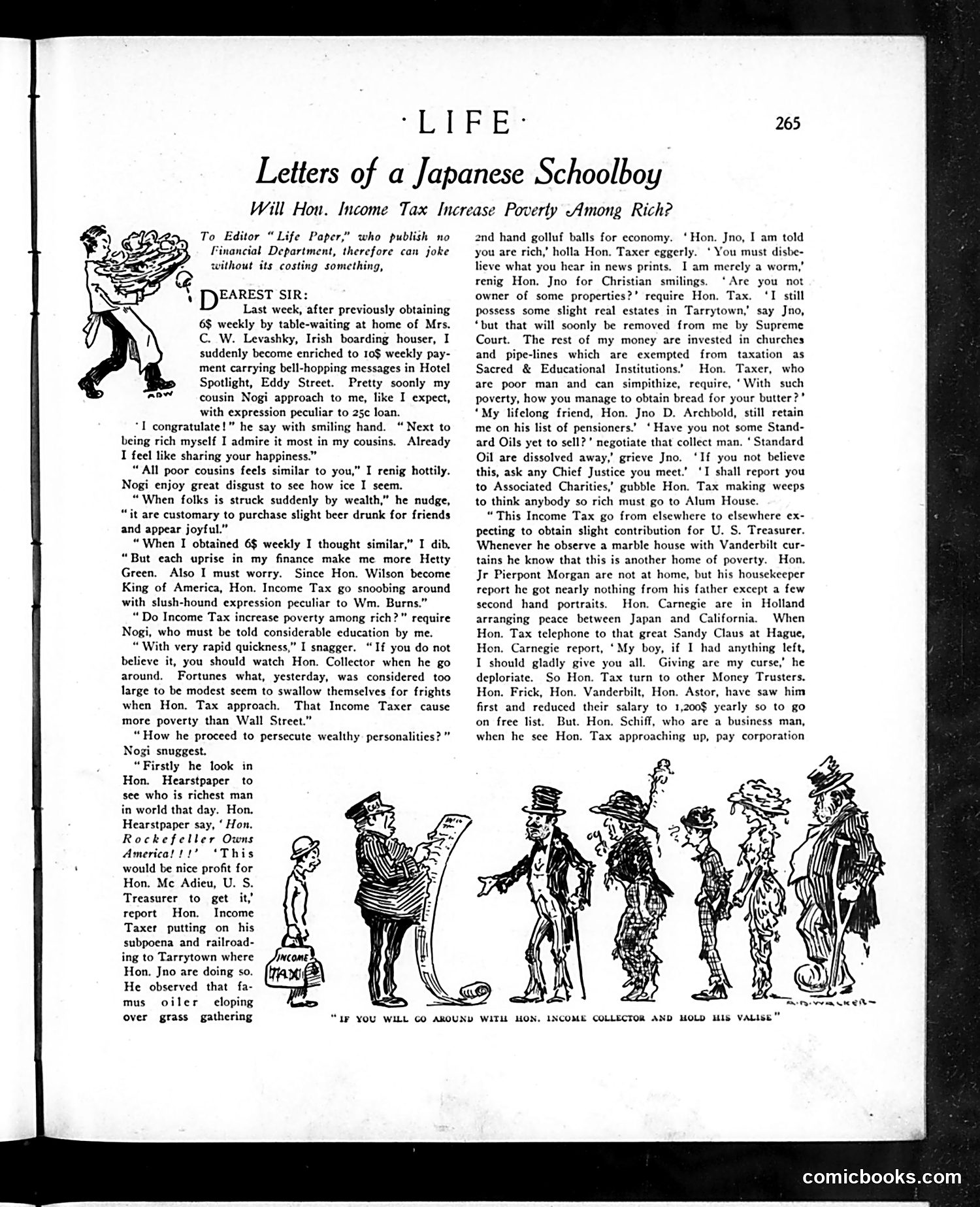
This is a satirical letter-to-the-editor piece mocking concerns about income tax increases causing poverty among wealthy people. A Japanese schoolboy writes to *Life* magazine's editor, ostensibly seeking financial wisdom from "Hon." (Honorable) figures. The satire targets wealthy Americans—including references to Rockefeller, Carnegie, and Morgan—by ironically suggesting that income taxes on the rich cause *them* poverty. The letter ridicules the wealthy's complaints, noting they own estates, churches, and oil companies yet claim hardship. The cartoon at bottom shows various impoverished figures surrounding an income tax collector, sarcastically captioned about "holding his valise"—suggesting the tax collector himself is the victim being robbed. The joke: the ultra-wealthy's claims that taxation impoverishes them are absurd and deserve mockery.
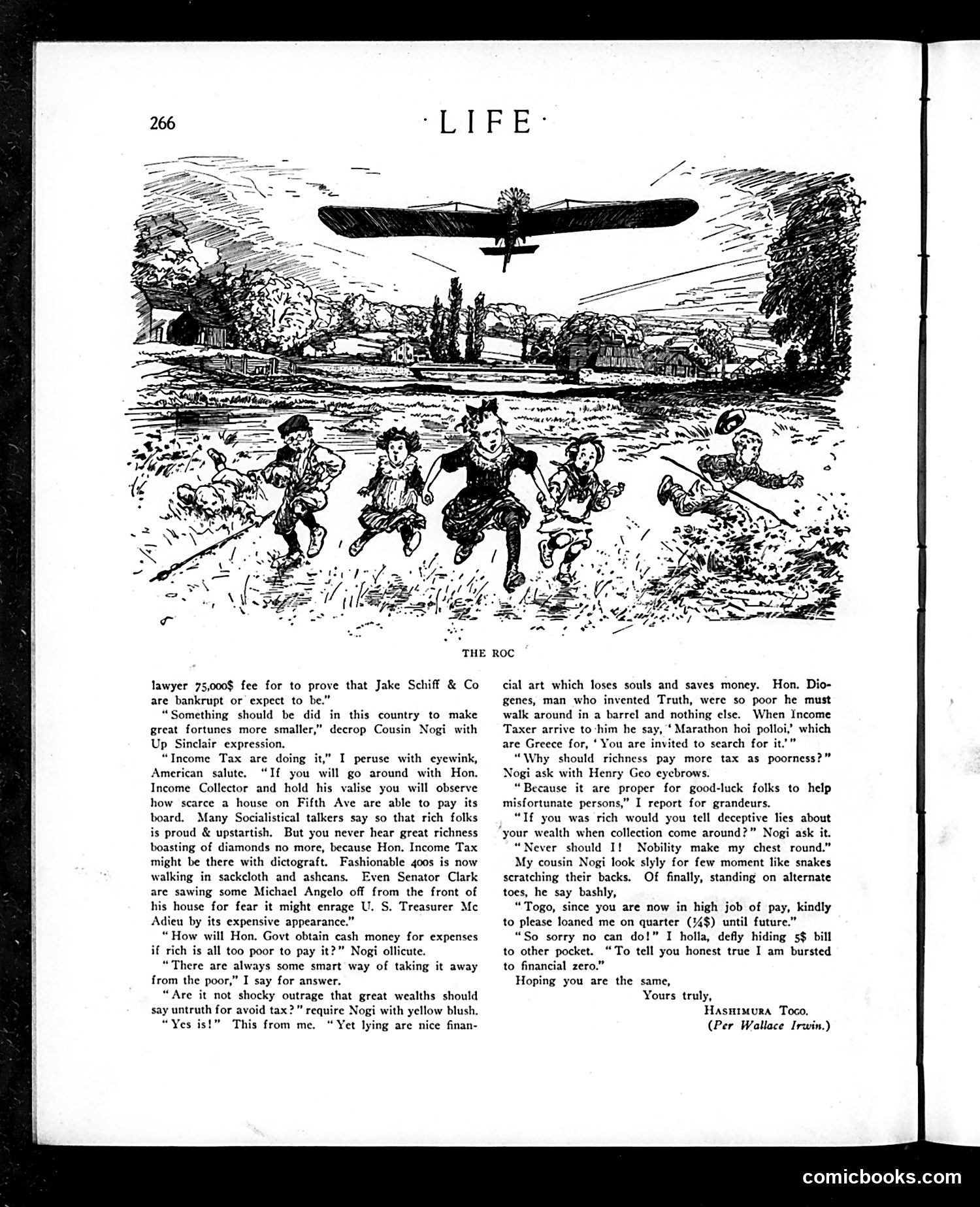
This cartoon satirizes wealthy Americans' complaints about income tax burden. The illustration shows an airplane (representing the tax burden) hovering over a pastoral landscape while figures flee in panic below. The accompanying text presents a dialogue mocking the rich. Characters like "Hon. Income Collector" and references to "Jake Schiff & Co" discuss whether wealthy people should pay higher taxes. The satire argues that the rich falsely claim poverty to avoid taxation while maintaining luxurious lifestyles ("walking in sackcloth and ashes"). The letter from "Hashimura Togo" (likely a satirical persona) further mocks the wealthy by requesting loans and claiming financial hardship despite high income—highlighting the hypocrisy of the rich avoiding tax responsibility.
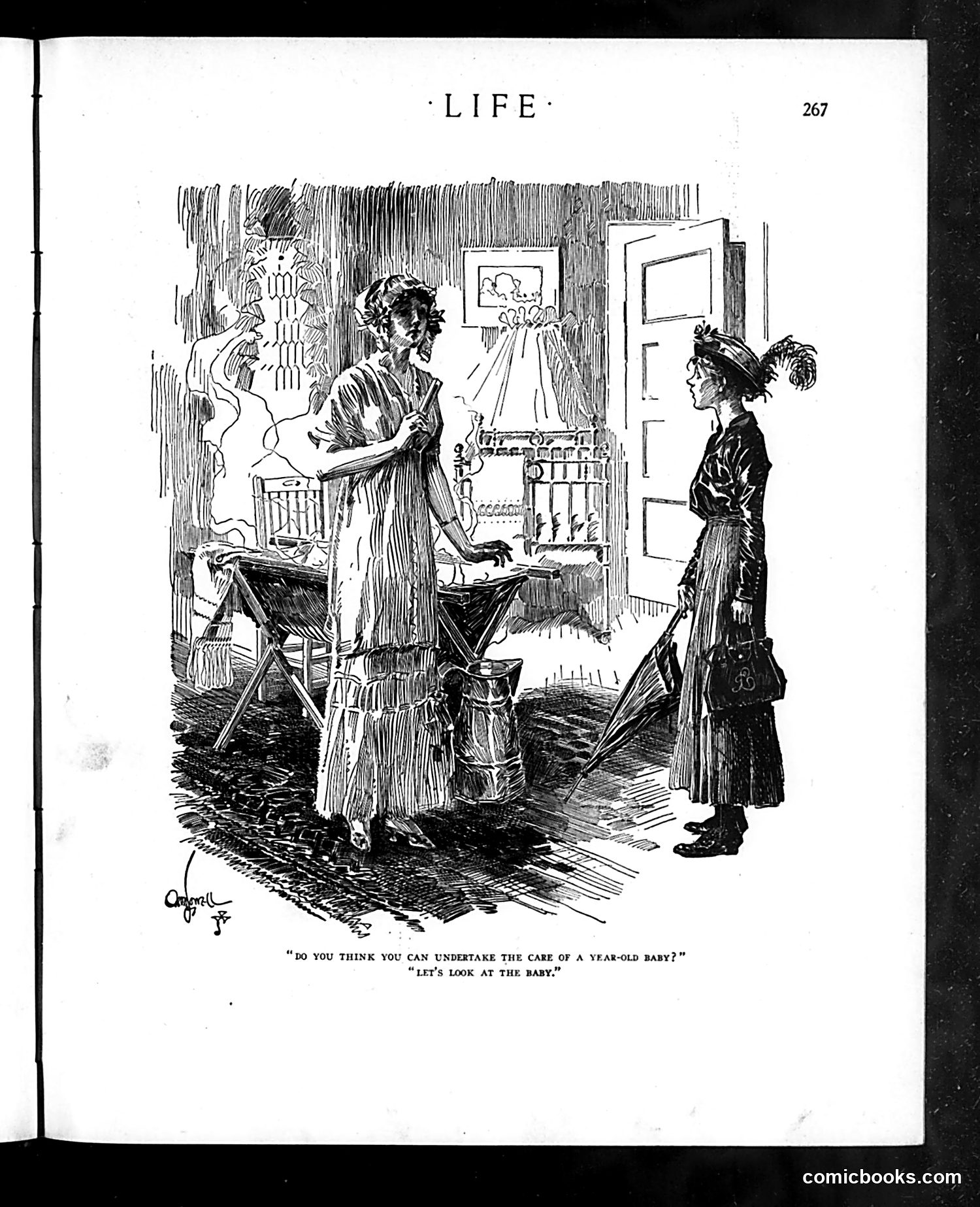
This is a single-panel cartoon satirizing gender roles and domestic competence around 1900s-era childcare. The scene shows two women in a domestic interior: one seated, holding a baby, the other standing as a visitor. The caption reads: "Do you think you can undertake the care of a year-old baby?" "Let's look at the baby." The satire targets the assumption that women—regardless of experience or capability—are automatically suited for infant care simply by virtue of their gender. The standing woman's skeptical response ("Let's look at the baby") suggests she's questioning whether childcare is truly as simple or instinctive as commonly assumed. This reflects early Progressive Era debates about whether motherhood/childcare required actual training and knowledge rather than mere feminine intuition.
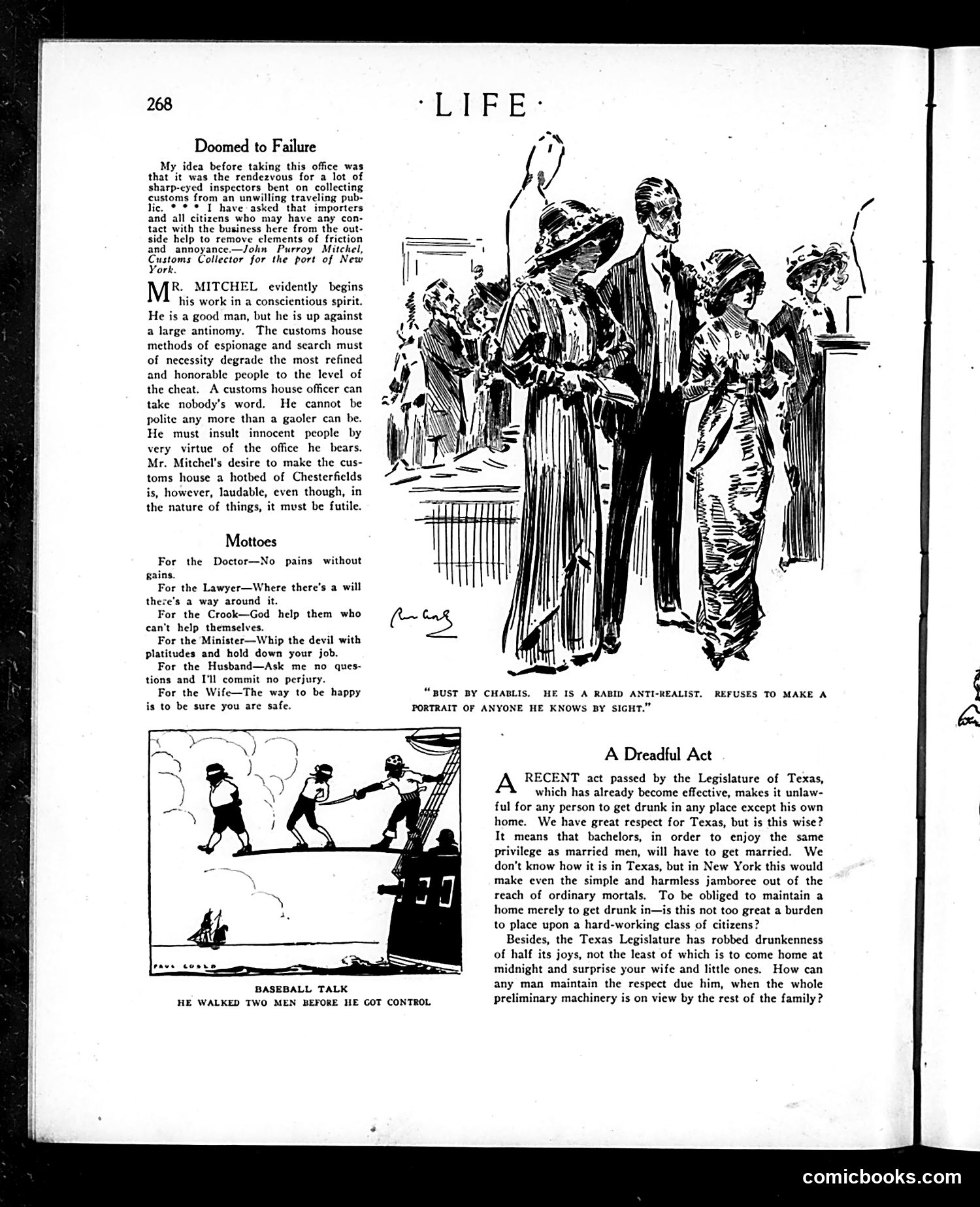
This page satirizes bureaucratic idealism confronting institutional reality. **"Doomed to Failure"** mocks John Purroy Mitchel, the newly appointed Customs Collector for New York's port, who naively believes he can eliminate corruption and "friction" from customs operations. Life argues this is impossible: customs officials must inspect and distrust travelers by definition, making politeness incompatible with the job itself. A customs officer cannot function as a genteel "Chesterfield" (gentleman). The accompanying **"Mottoes"** section provides cynical life advice for various professions, emphasizing hypocrisy and self-interest. Below is a **baseball cartoon** (captioned "He walked two men before he got control") and an unrelated piece criticizing **Texas's new anti-drinking law**, which prohibits public intoxication except at home—Life argues this absurdly forces bachelors to marry simply to drink legally. The cartoons use humor to critique governmental naïveté and overreach.
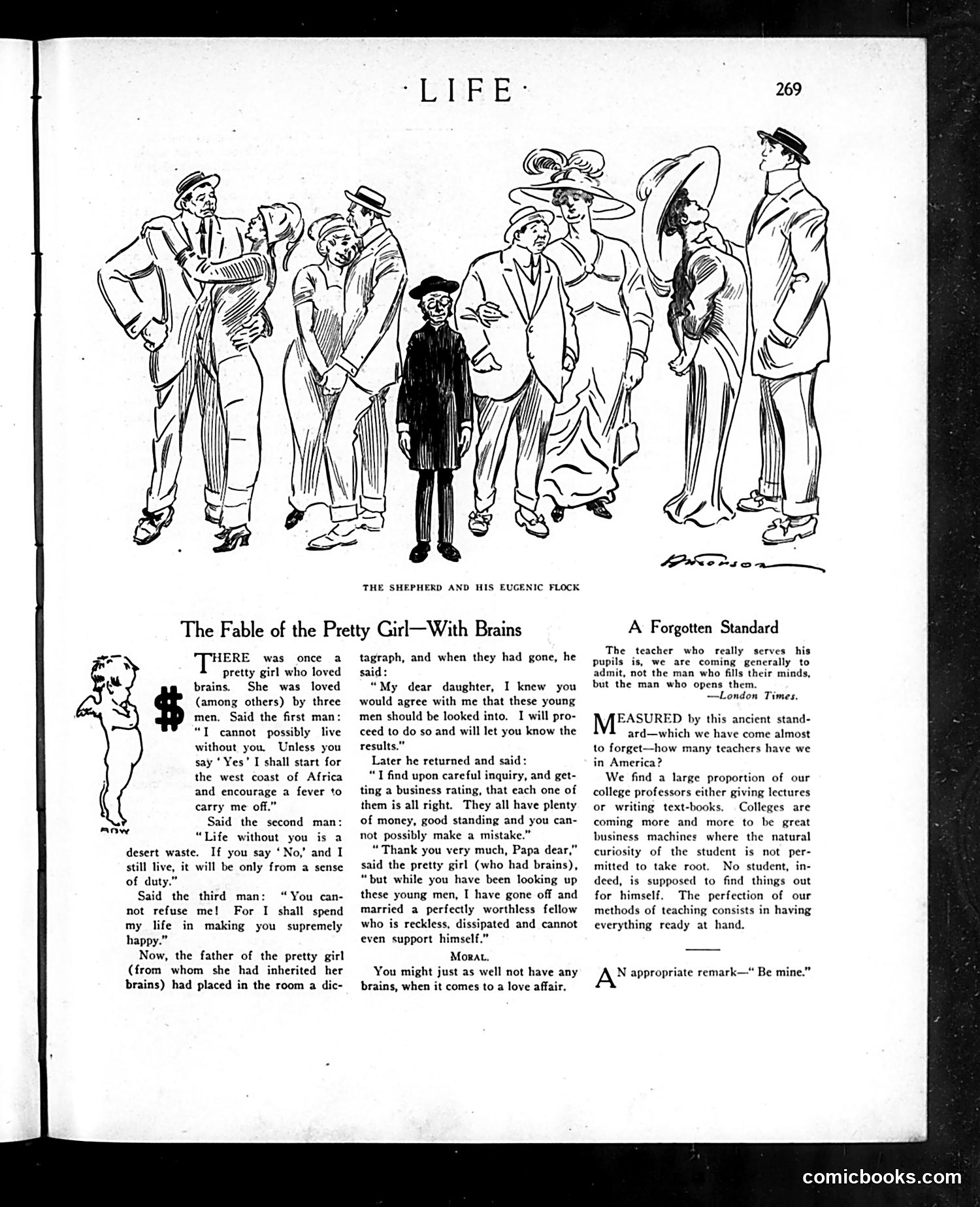
**Top Cartoon ("The Shepherd and His Eugenic Flock"):** This appears to be satirizing eugenics—the early 20th-century pseudoscience promoting selective breeding. The small dark figure in the center is surrounded by larger men in suits, suggesting manipulation of human reproduction for supposed genetic "improvement." **"The Fable of the Pretty Girl—With Brains":** This satirizes romantic courtship and women's decision-making. A wealthy father rationally investigates three suitors' financial standing and reputation, believing logic should guide his daughter's marriage choice. She ignores his rational analysis and marries an irresponsible "worthless fellow" anyway—the moral being that emotion, not intellect, governs love. **"A Forgotten Standard":** This criticizes American education as overly mechanical and lecture-based, arguing teachers should inspire curiosity rather than simply transfer information into passive students' minds. All three pieces critique how modern society privileges efficiency and rationality over human nature, intuition, and individual development.
This page discusses whether the U.S. should militarily intervene in Mexico. The article expresses relief that President Wilson is *not* rushing into Mexican involvement despite pressure from Hearst newspapers—a reference to William Randolph Hearst's sensationalist push for war. The piece critiques Ambassador Henry Lane Wilson, who has been out of the country for seventeen years in diplomatic posts (Chile, Belgium, Mexico). The author suggests Wilson may be out of touch with Wilson's "New Freedom" domestic agenda and contemporary American politics. The cartoon (showing soldiers and a birdcage) appears to satirize the debate itself—depicting the conflicting impulses around military action. The overall message: Americans are distracted by summer pleasures (sports, fashion, movies) and lack appetite for war. President Wilson's cautious restraint is praised as sensible leadership that won't be swayed into unnecessary foreign conflict.
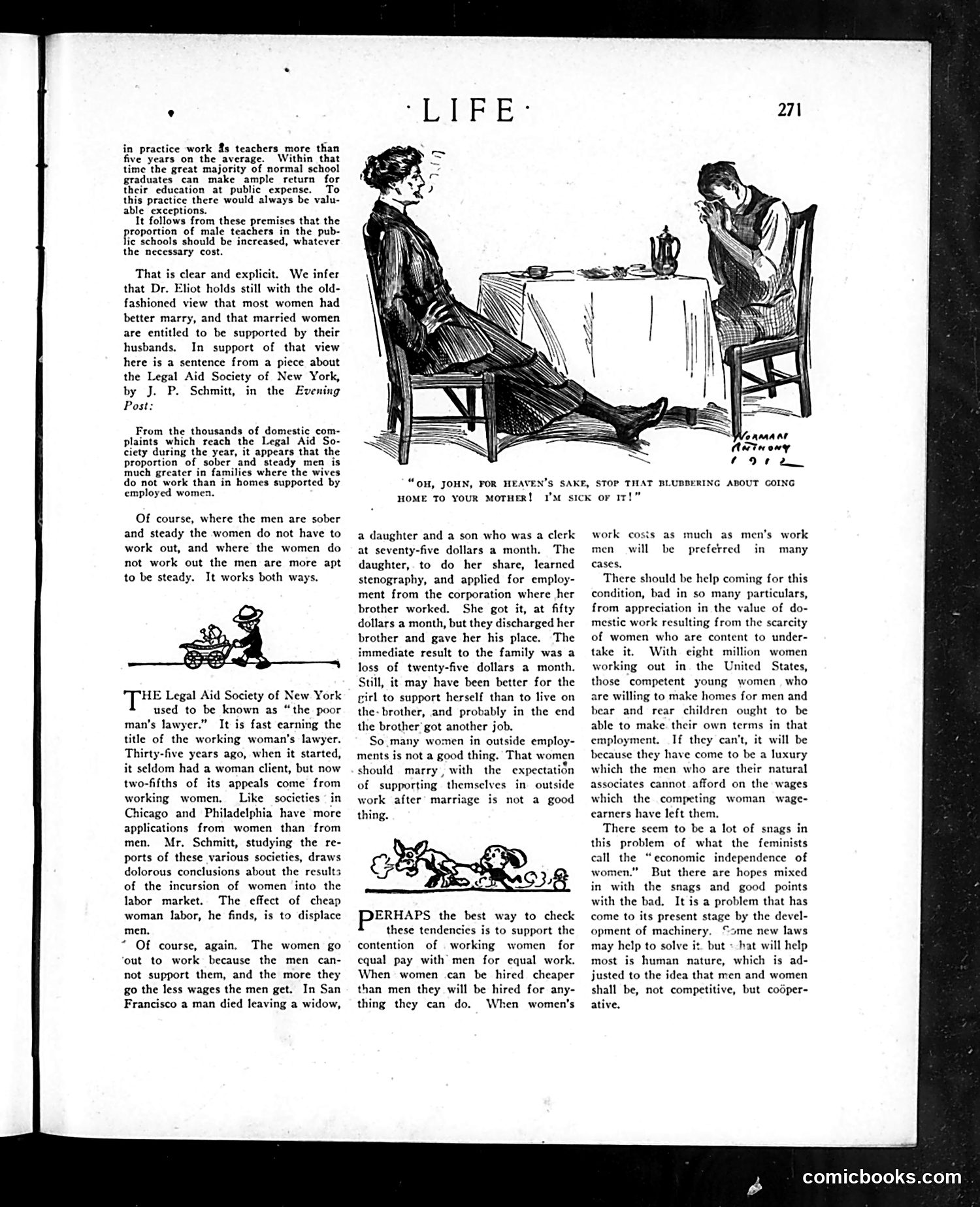
**The Cartoon:** The illustration shows a woman sitting across from a man at a table. She's telling him to stop complaining about visiting his mother, declaring she's "sick of it." The satire targets the Victorian expectation that wives should obey husbands without complaint. **The Article's Context:** The page debates women's labor participation. It references Dr. Eliot's view that women should marry and be supported by husbands rather than work. The Legal Aid Society data is cited to suggest employed women correlate with unstable families—though the author notes this reasoning works "both ways": men can't support families, so women must work. **The Point:** Life's satire exposes the contradiction: society expects women to depend on men financially while simultaneously blaming women's employment for family problems. The cartoon reinforces this hypocrisy—the husband expects obedience despite the economic pressures forcing wives into work. The article concludes that equal pay would protect women by making them less attractive as cheap labor alternatives to men.
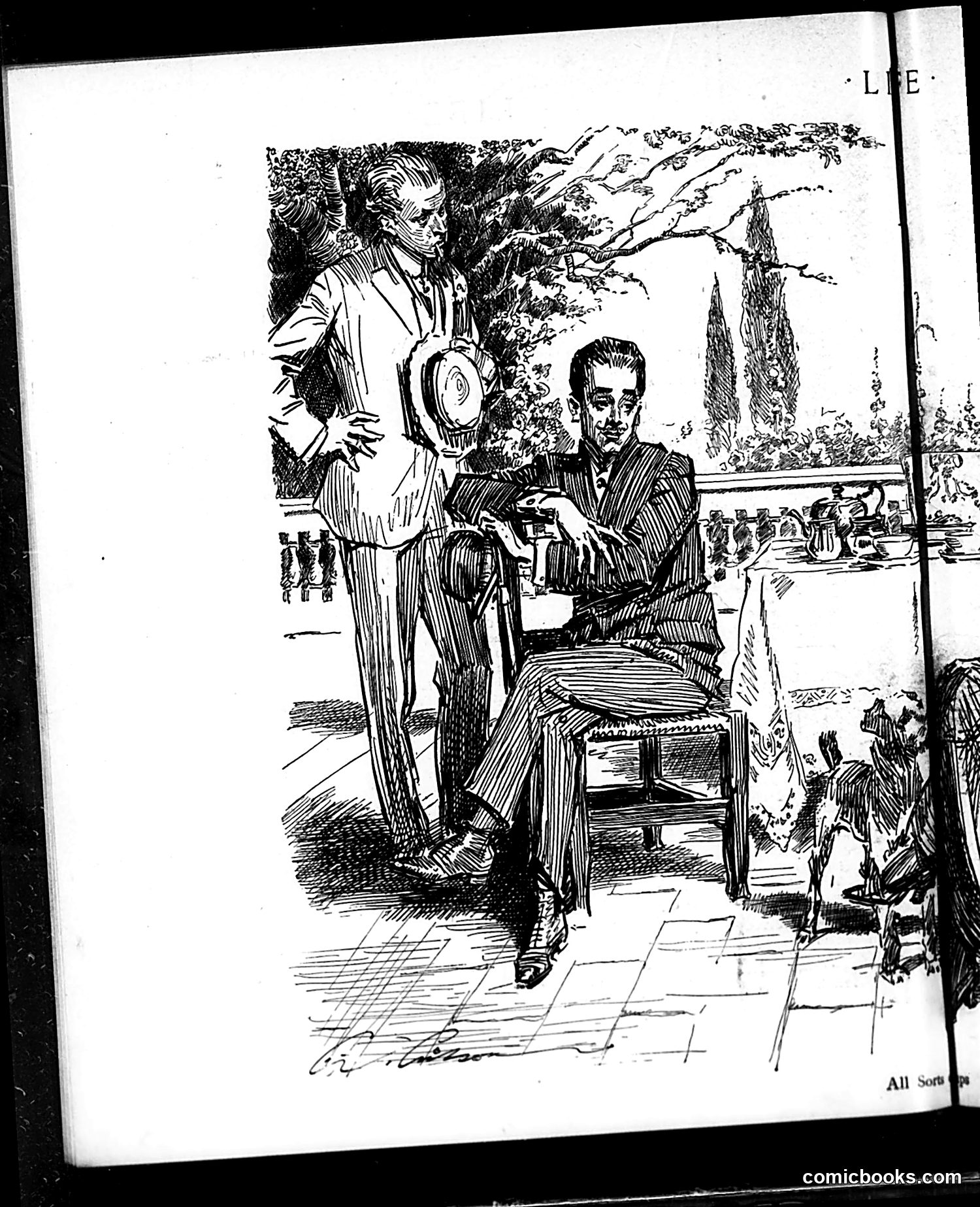
This appears to be a satirical illustration from *Life* magazine showing two men in an elegant Mediterranean or Italian garden setting. A standing figure holds what appears to be a large plate or platter, while a seated figure gestures toward it. The setting includes cypress trees, classical architecture, and attendants in the background—suggesting wealth and refinement. The satire likely concerns class pretension or social climbing, though without additional text context, the specific political or social reference remains unclear. The composition suggests commentary on affected sophistication or the performance of gentility. The signature appears to read "Lee" or similar. The page contains "All Sorts" at the bottom, indicating this was part of a miscellaneous humor section typical of *Life's* format.
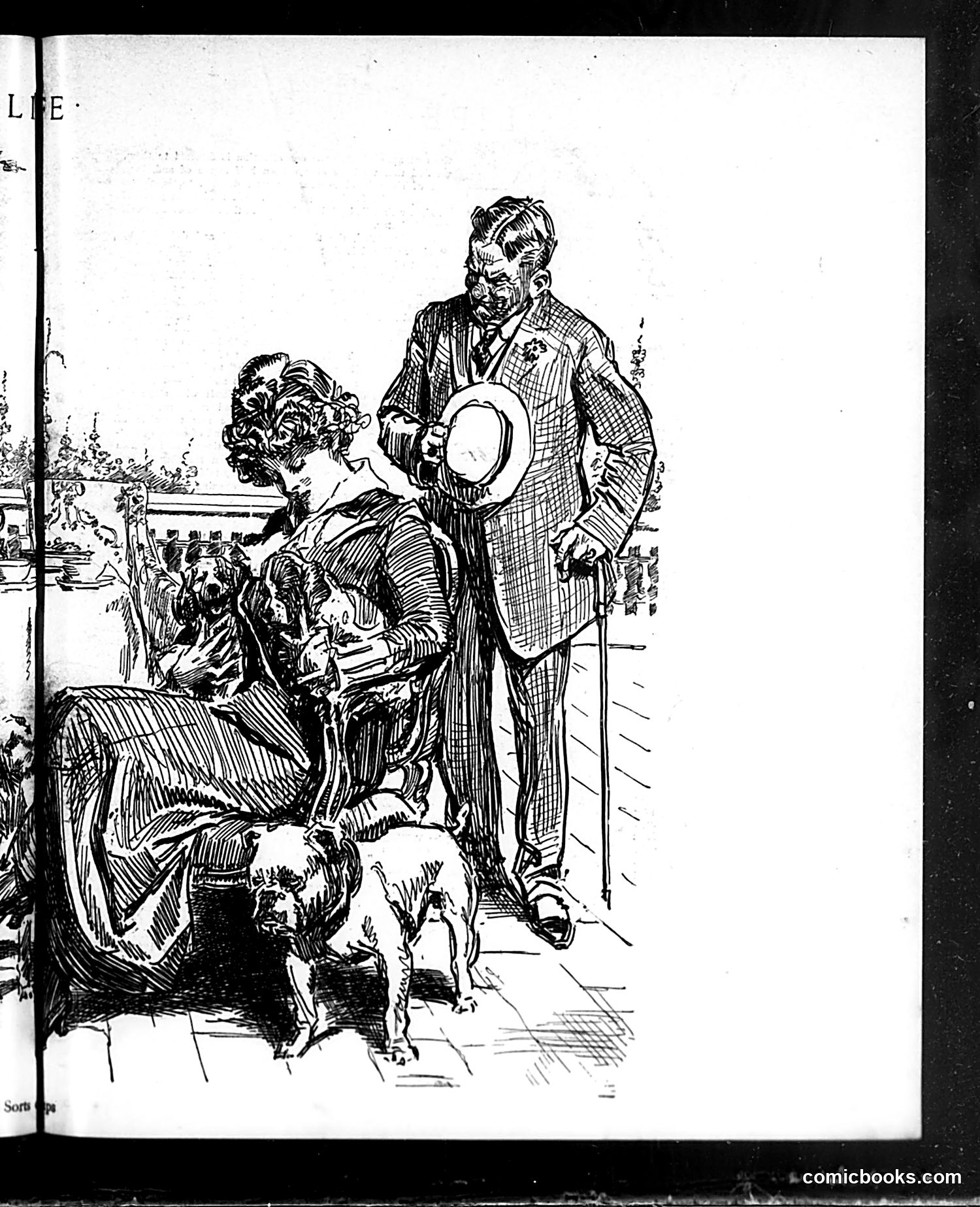
This pen-and-ink illustration depicts a social scene with three figures: a seated woman wearing a wide-brimmed hat, a standing man in a suit holding his own hat, and a small dog. The "LIFE" masthead and publication details are visible. The specific political or social reference is unclear from the image alone without additional caption text. The scene appears to satirize upper-class social interaction or etiquette, possibly depicting a moment of social awkwardness or pretension typical of Life magazine's satirical commentary on American society and manners. The artistic style—detailed cross-hatching and expressive linework—is characteristic of early-to-mid 20th century American editorial illustration. However, without visible caption text explaining the specific joke or reference, the exact satirical point remains uncertain.
This page features a "Latest Books" review section discussing Sigmund Freud's *The Interpretation of Dreams*, which appears to have recently become a popular sensation among the general public. The central point of the text's satire is the paradox of esoteric academic work suddenly catching public attention. The author notes that Freud's dense psychological treatise—originally written for specialists—has achieved unexpected popularity, which the text attributes to hitting a "psychological moment." The review explains Freud's dream theory for lay readers: dreams fulfill repressed wishes, the psyche's "censor" disguises forbidden desires through symbolism and stage-dressing, and the dreamer deceives itself about the dream's true meaning. The implicit satire targets both intellectualism and pop-psychology faddism: the public's fascination with Freud appears as a form of fashionable pretension, seizing upon sophisticated ideas without deep understanding. The decorative "Confidential Book Guide" header frames these reviews as insider cultural commentary for aspirational readers.
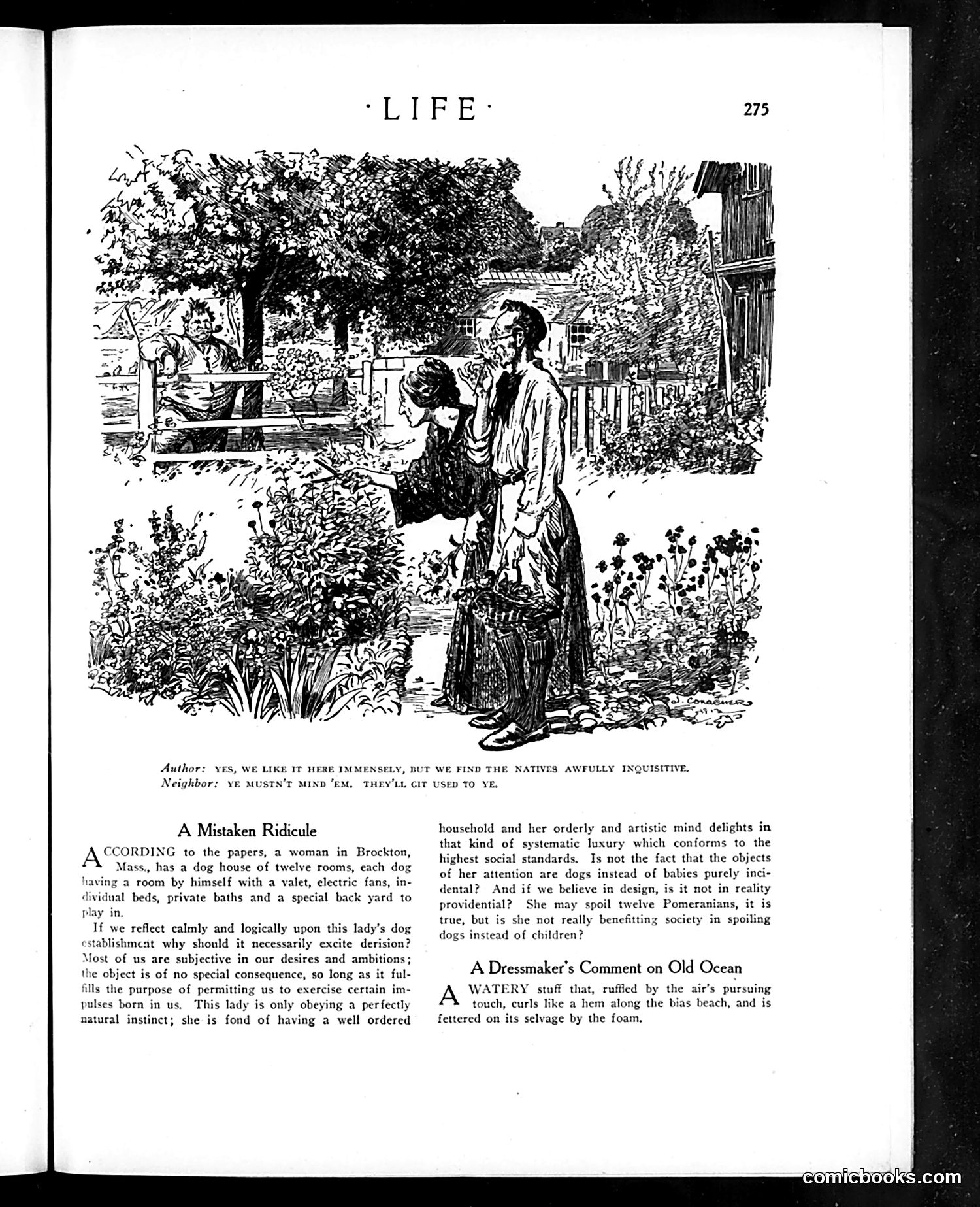
This page contains two satirical pieces: **"A Mistaken Ridicule"** mocks a wealthy Massachusetts woman who built a twelve-room doghouse with individual amenities (valets, electric fans, private baths) for each dog. The satire uses mock-serious logic to defend her extravagance: if she enjoys systematic luxury and orderliness, does it matter that her "objects of attention" are dogs rather than children? The joke's bite lies in suggesting that spoiling dogs instead of children is actually *socially beneficial*—a cutting critique of both wealthy eccentricity and misplaced priorities. **"A Dressmaker's Comment on Old Ocean"** presents a brief poetic observation, treating the ocean's waves as fabric design (hem, bias, selvage)—a humorous perspective from someone whose profession shapes how she perceives the world. The cartoon depicts two people in a garden; the dialogue suggests tension between newcomers and nosy locals—likely illustrating social friction during America's early 20th-century migration patterns or urban expansion.
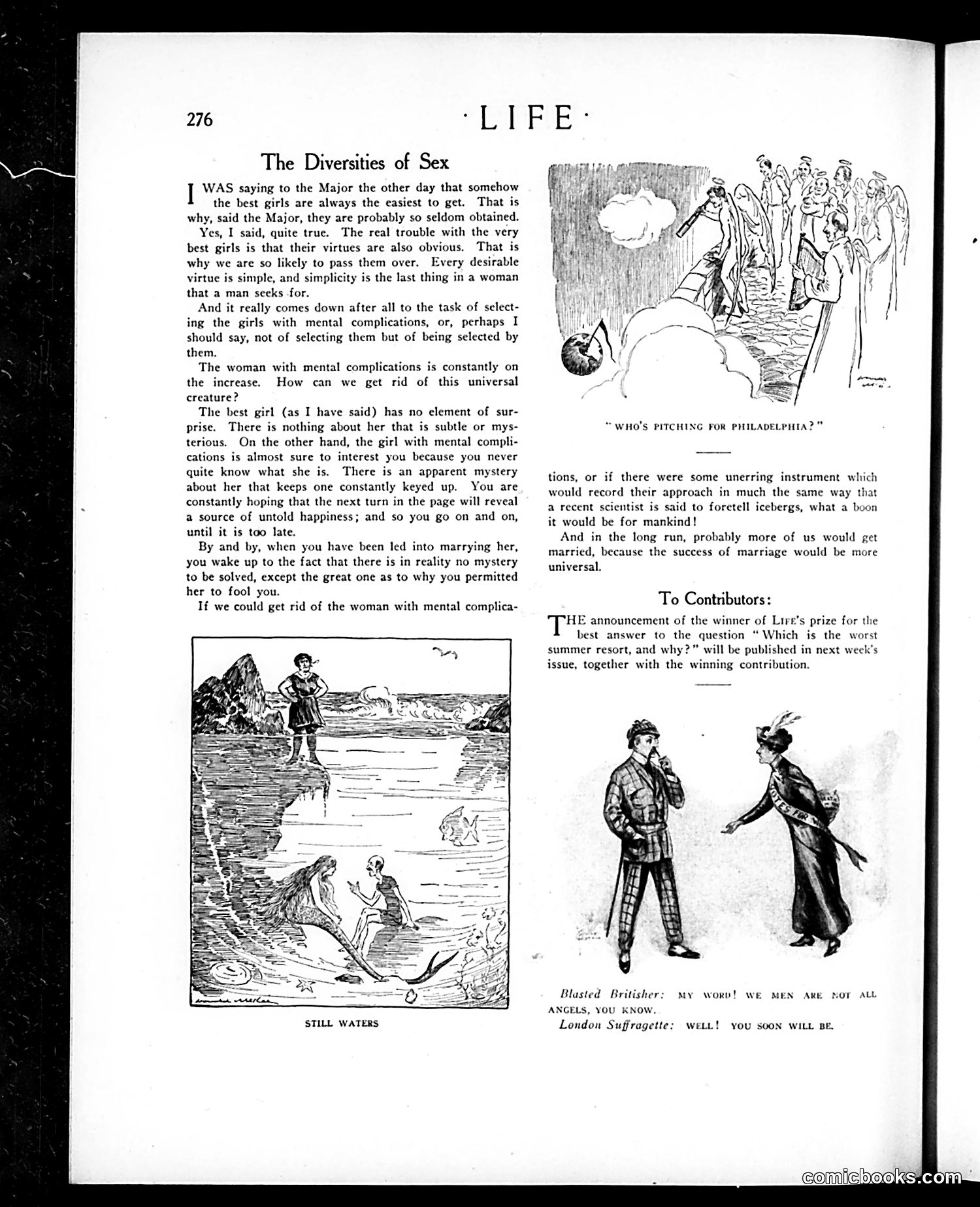
This satirical piece critiques contemporary courtship and marriage through a male narrator's conversation with "the Major." The author argues that virtuous, simple women are undesirable because they lack "mystery," while complicated women who play hard-to-get paradoxically attract men through their inscrutability. The joke's bitter twist: once married, these "mysterious" women reveal themselves as ordinary, leaving husbands wondering why they were fooled. The accompanying cartoons illustrate romantic/marital themes: "Still Waters" depicts courtship scenes, while "Who's Pitching for Philadelphia?" shows a baseball reference (unclear context). The bottom exchange between a "Blasted Britisher" and "London Suffragette" references the women's suffrage movement—she threatens men will become "angels" (dead/emasculated) when women gain equality. This reflects early-20th-century anxiety about changing gender roles.
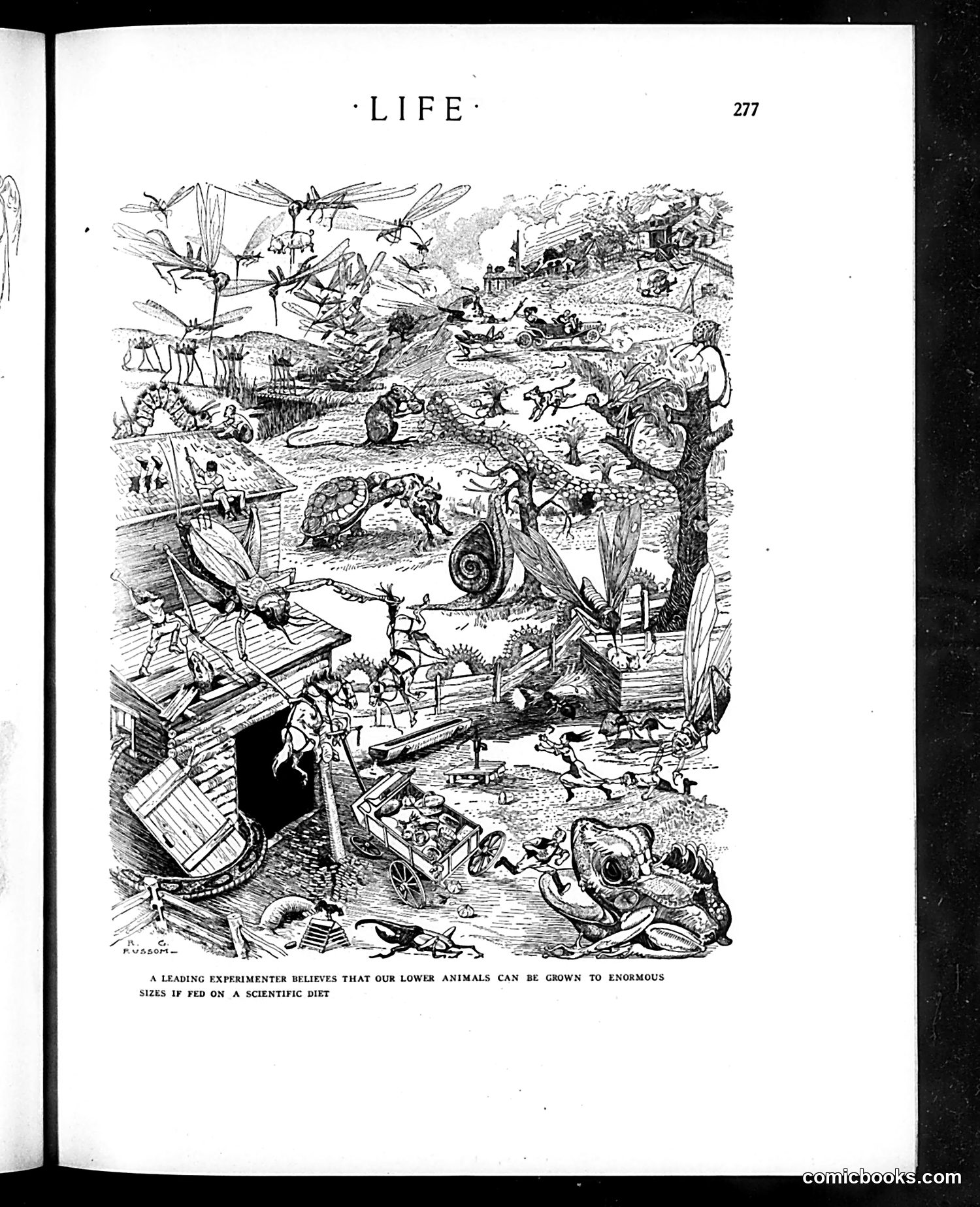
This is a satirical illustration mocking scientific experimentation on animal growth through specialized diets. The cartoon depicts a fantastical landscape where insects and small creatures have grown to giant, monstrous proportions—enormous dragonflies, slugs, beetles, and other animals tower over a rural village and farmland below. The satire targets a "leading experimenter" (unnamed, but likely referencing contemporary scientists conducting dietary experiments) whose theories about scientifically-enhanced growth are presented as absurd. The exaggerated scale of the creatures suggests the ridiculousness of such claims. This reflects early 20th-century skepticism toward emerging scientific claims about nutrition and animal husbandry, presenting the possibility of giant insects as darkly comedic speculation about unintended consequences of experimental feeding practices.
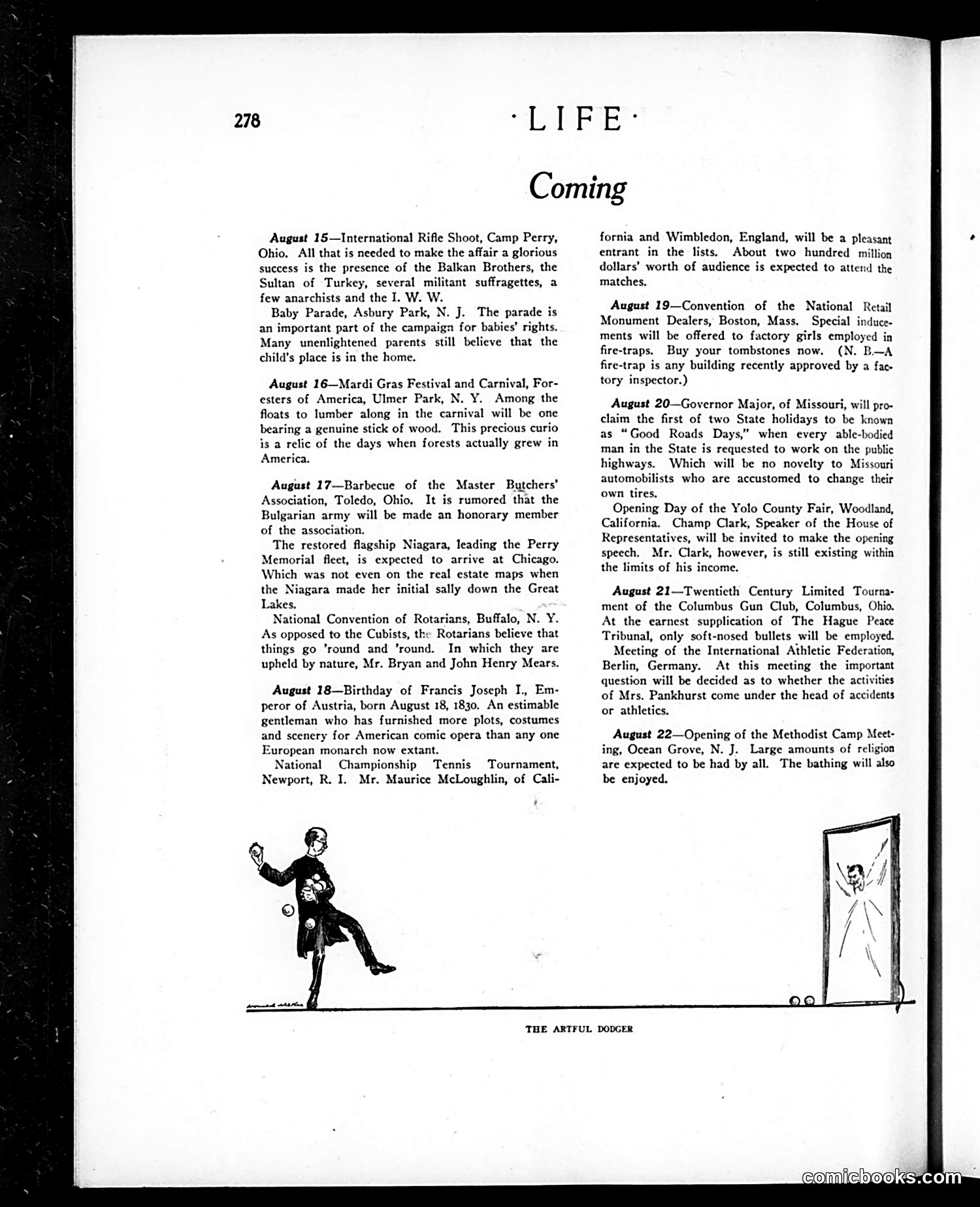
This page from Life magazine presents a humorous "Coming Events" calendar for August, mixed with biting social commentary. The cartoon at bottom shows a figure dodging a ball—likely representing evasion or avoidance. The text satirizes contemporary issues: militant suffragettes and anarchists at a rifle shoot; the irony that forests no longer exist in America; Austria's Emperor Francis Joseph as a supplier of comic opera plots; and Mrs. Pankhurst's militant suffragism being classified as "athletics" rather than activism. The sharpest barbs target social hypocrisy—factory girls being sold tombstones while working in fire-traps, and Missouri's "Good Roads Days" mocking drivers already accustomed to fixing their own vehicles. Throughout, Life employs sardonic wit to critique American industrial conditions, gender politics, and political absurdities of the era (likely 1910s).
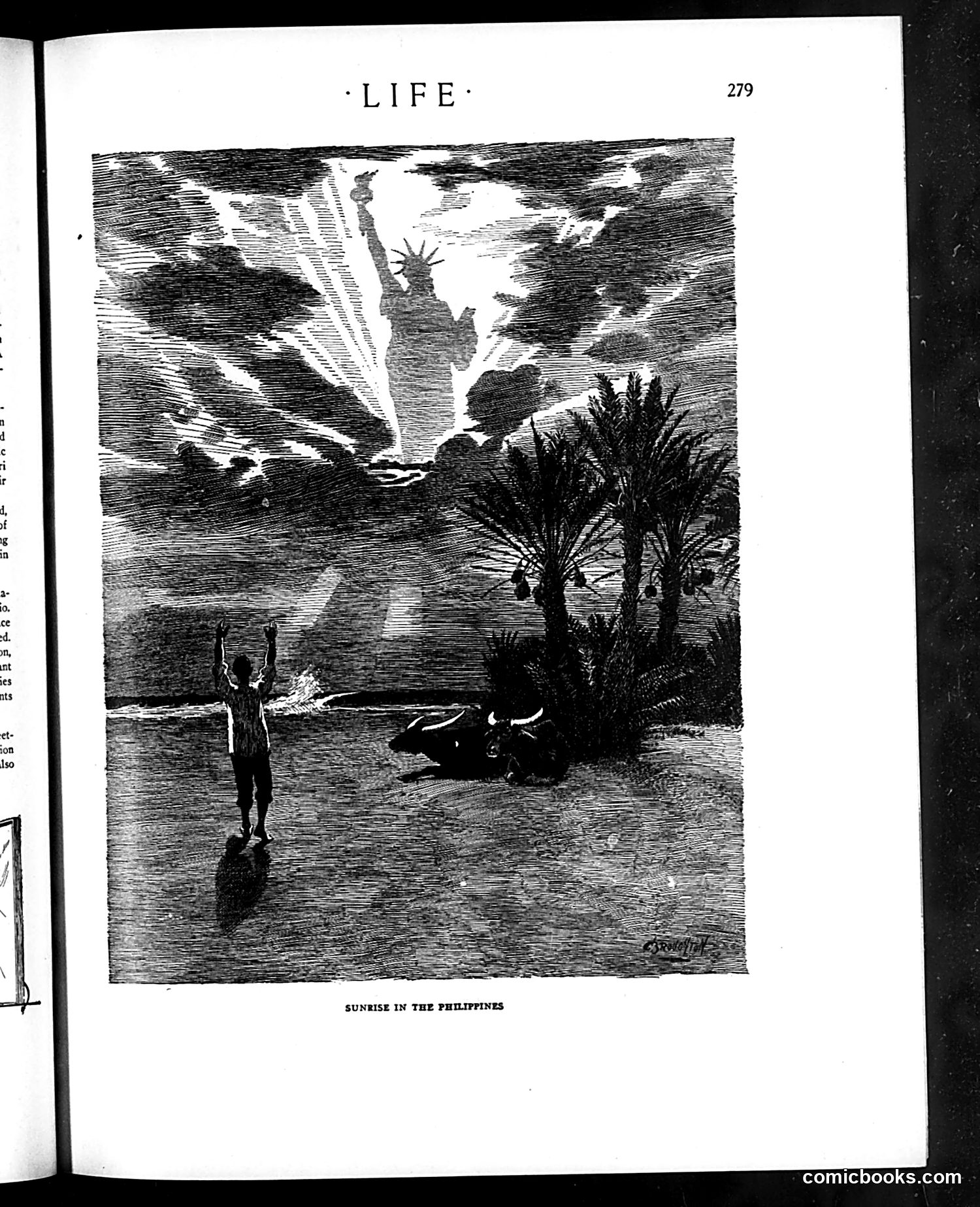
This engraving depicts a figure standing in water with arms raised in worship or celebration toward the Statue of Liberty, which appears miraculously in the sky above a tropical Philippine landscape. Palm trees and what appears to be a water buffalo are visible. The image satirizes American imperialism and the rhetoric surrounding the Philippine-American War (1899-1902). The cartoon suggests that Americans presented their colonial occupation as enlightenment and liberation—"bringing" American ideals and democracy to the Philippines. The Statue of Liberty appearing as a divine vision over Philippine lands mocks this missionary zeal, implying the U.S. imposed its values rather than genuinely liberating Filipinos. The satire targets American exceptionalism and imperial justifications.
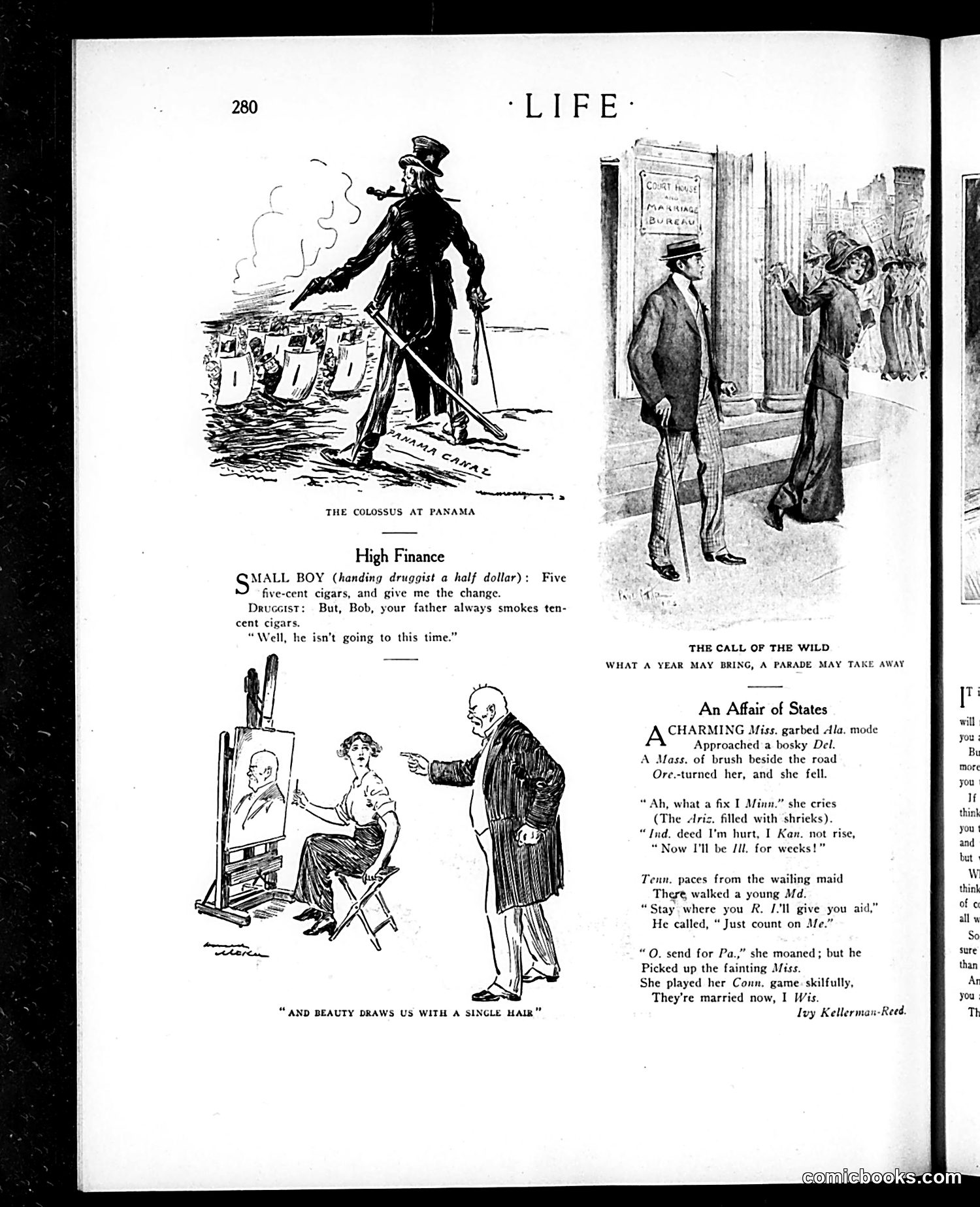
This Life magazine page contains three satirical pieces: **"The Colossus at Panama"** depicts Uncle Sam straddling the Panama Canal—a reference to America's construction and control of this strategic waterway, presenting U.S. imperial ambition as monumental power. **"High Finance"** jokes about economic class through a boy buying cheap cigars instead of his father's expensive ones, satirizing working-class versus wealthy consumption habits. **"An Affair of States"** is a clever wordplay poem using U.S. state abbreviations as puns (Miss, Del, Mass, Ore, Minn, Kan, Ill, Tenn, Md, R.I., Pa, Conn, Wis) to tell a romance story—a young woman falls, a man rescues her, and they marry. It's light satirical humor playing with geography and language rather than substantive political critique. The page reflects early-20th-century American life, imperial confidence, and genteel magazine humor targeting educated readers familiar with state names and classical references.
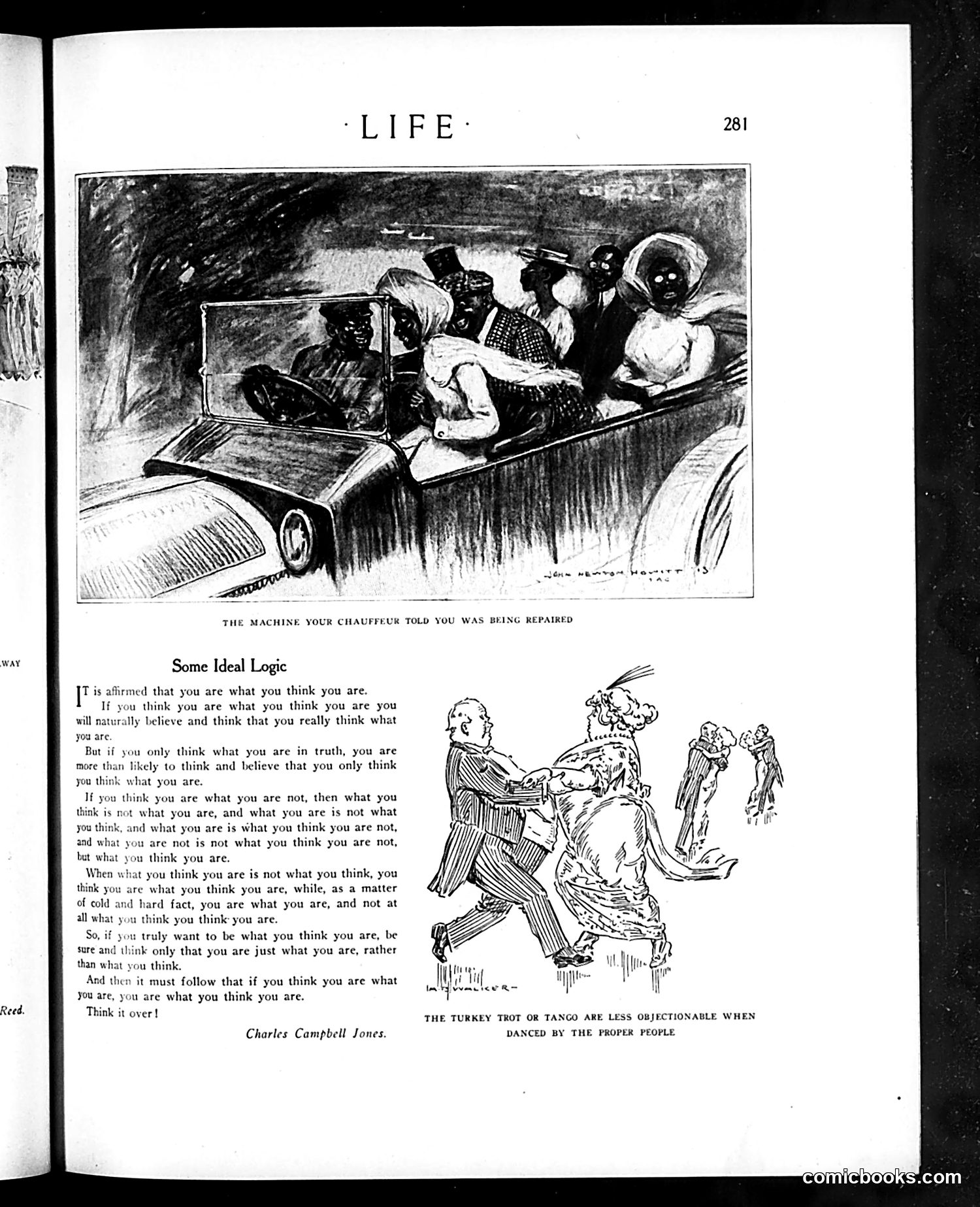
**Top Cartoon:** "The Machine Your Chauffeur Told You Was Being Repaired" depicts wealthy passengers in an automobile, implying the vehicle's repair was a pretense—likely the chauffeur used the car for personal outings with companions, a satirical jab at servant dishonesty. **"Some Ideal Logic" Essay:** A philosophical piece by Charles Campbell Jones presenting circular, tongue-in-cheek reasoning about identity and self-perception. It's deliberately convoluted wordplay meant to mock abstract philosophy or self-help thinking popular in the era. **Bottom Cartoon:** "The Turkey Trot or Tango Are Less Objectionable When Danced by the Proper People" shows couples dancing these then-scandalous dances. The satire mocks upper-class hypocrisy: the same dances condemned as immoral when performed by working or immigrant classes become "acceptable" when performed by wealthy, respectable people. It critiques class-based moral double standards.
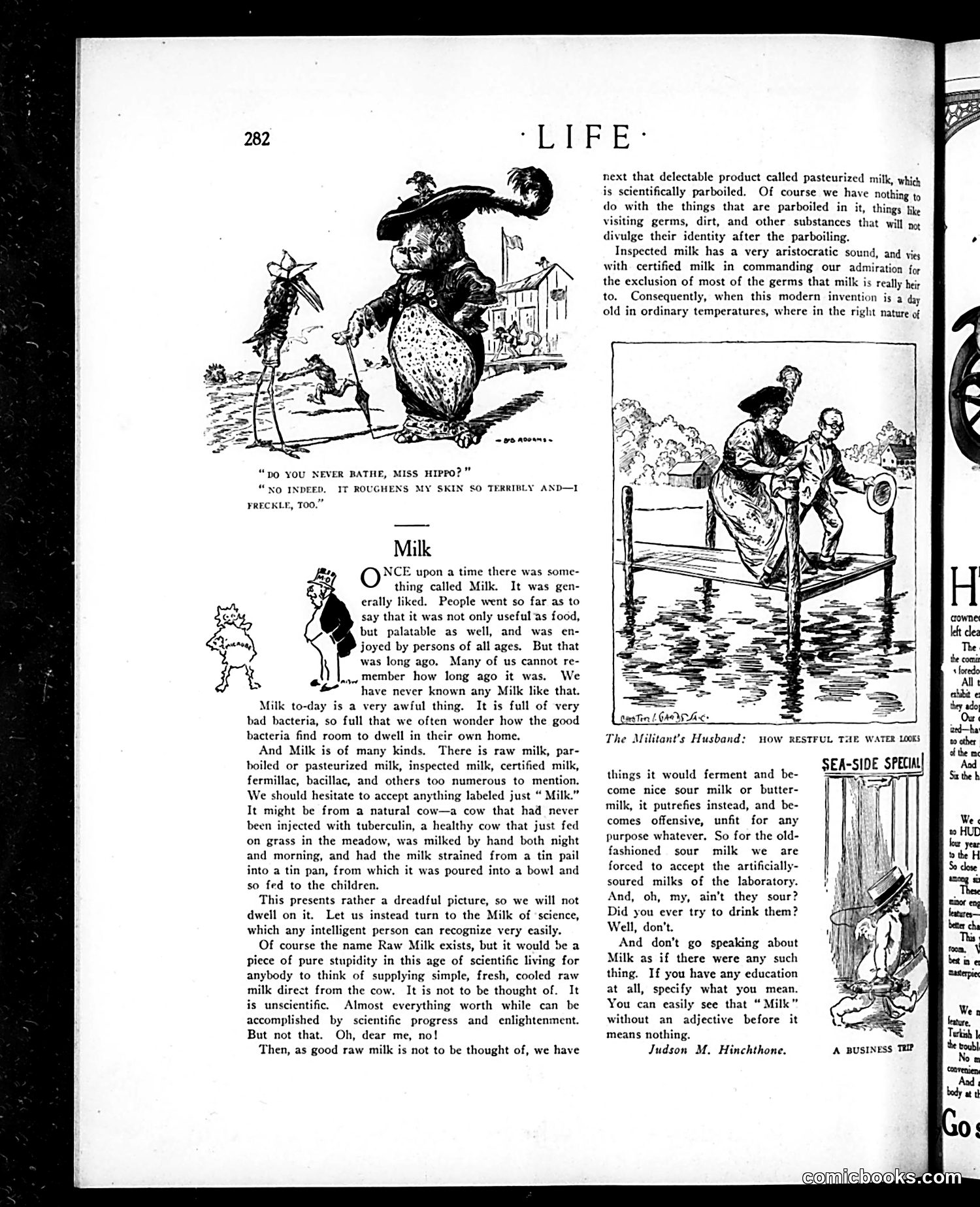
This page contains satirical commentary on early 20th-century food safety anxieties, particularly regarding milk production. **The Hippo Cartoon**: A humorous image of a hippopotamus refusing to bathe, claiming it roughens her skin and causes freckles. This is a nonsensical joke playing on vanity—the humor lies in applying human beauty concerns to an animal. **The "Milk" Essay** by Judson M. Hinchthone: This is the page's main satire. It mocks the proliferation of milk classifications and scientific pasteurization processes that had recently emerged. The author ironically celebrates "scientific progress" while criticizing how modern treatments (pasteurization, inspection, certification) had actually made milk *worse*—now it spoils and becomes undrinkable rather than naturally souring into useful buttermilk. The satire targets the tension between scientific modernization and practical results: consumers faced confusing product varieties and arguably inferior outcomes compared to traditional raw milk. The piece ridicules how modern science created problems it then claimed to solve, and how "milk" without a qualifier had become meaningless.
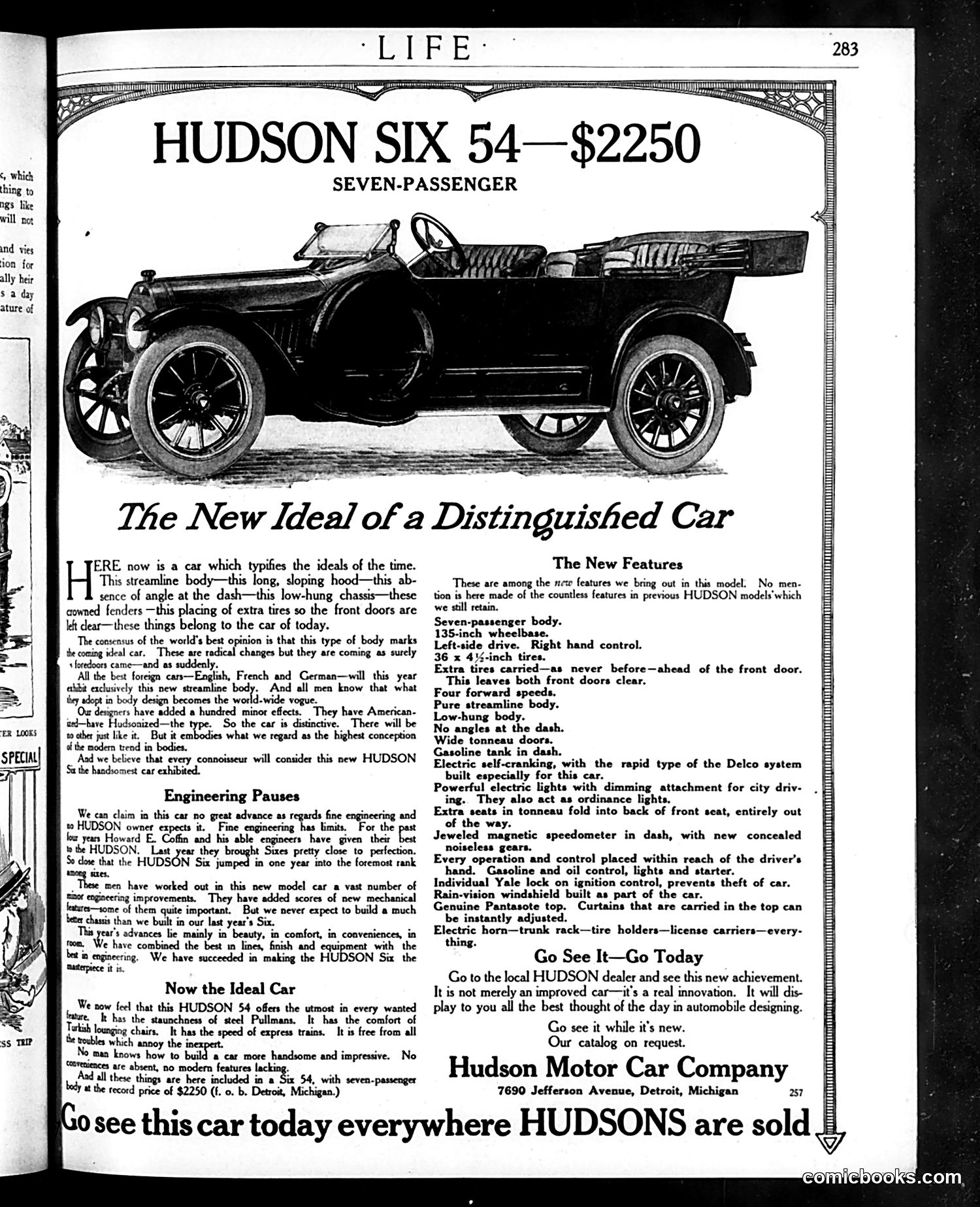
This is **not a political cartoon or satire** — it's a straightforward automobile advertisement from Life magazine's advertising section (page 283). The Hudson Motor Car Company is marketing their new Six 54 model, a seven-passenger touring car priced at $2,250. The advertisement emphasizes modern design features: streamlined body, low-hung chassis, left-side drive, electric self-cranking, and powerful electric lights. The text claims this represents "the ideal of the time" and compares the Hudson favorably to European luxury cars. It appeals to connoisseurs and those wanting the latest automotive conveniences. For a modern reader: this represents early 1910s-era automotive marketing, when such features were genuinely innovative. The price ($2,250) was substantial — roughly equivalent to $60,000-70,000 today. The advertisement's confident tone reflects the era's optimism about technological progress and consumer automobiles as status symbols.
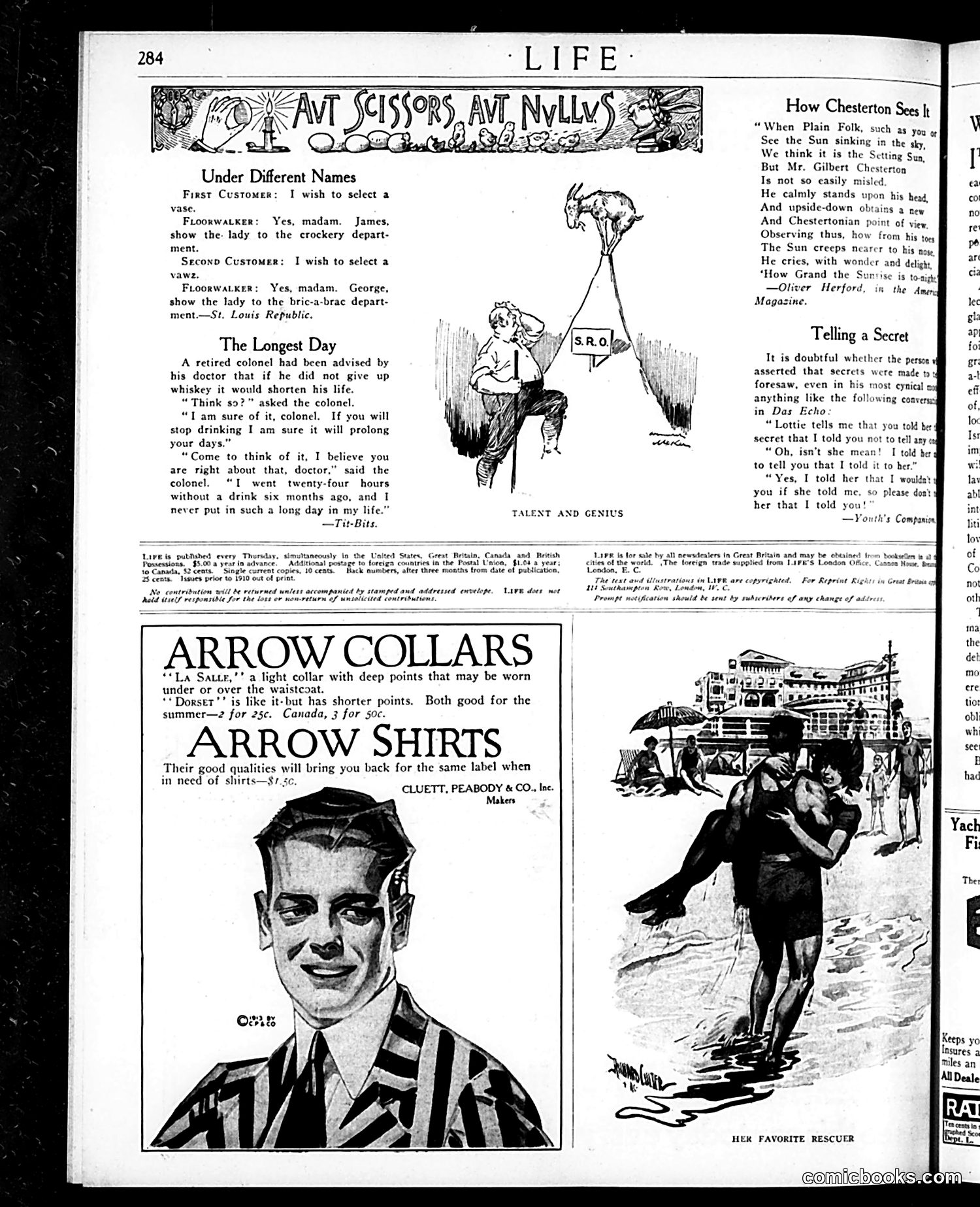
This page contains three brief humorous anecdotes typical of early 20th-century American satire: **"Under Different Names"** jokes about class-based language: a store clerk uses different terminology ("vase" vs. "vawz") depending on customer appearance, implying snobbery based on how customers pronounce words. **"The Longest Day"** presents a doctor-patient joke: a colonel claims that stopping drinking for 24 hours felt so long it actually *extended* his lifespan—dark humor about alcohol dependency. **"How Chesterton Sees It"** references G.K. Chesterton, the famous English writer known for paradoxical thinking. The satire mocks his reputation for inverting conventional perspectives—suggesting he'd literally stand on his head to achieve philosophical novelty rather than simply observing the sunset normally. The page also includes advertisements for Arrow Collars and Arrow Shirts, which were major American menswear brands of the era, featuring an illustration of a smartly-dressed man.
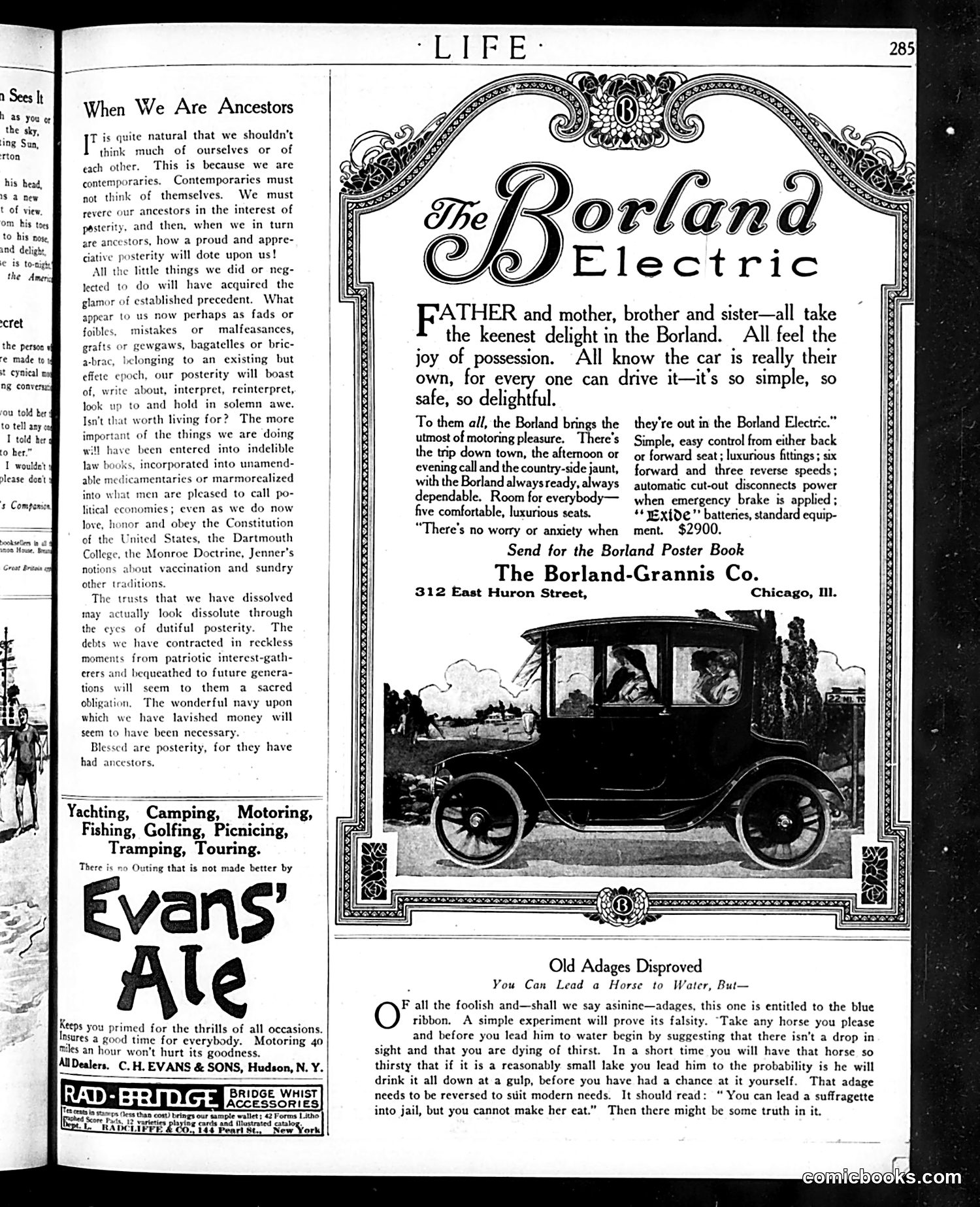
This page is primarily **advertising and light satirical essays**, not political cartooning. The main content includes: 1. **"When We Are Ancestors"** (left essay): A humorous meditation on how future generations will romanticize our current era's flaws—treating today's "fads or foibles" as established precedent worthy of reverence. The satire mocks our tendency to valorize the past uncritically. 2. **"The Borland Electric"** (center/right): A car advertisement emphasizing the vehicle's simplicity and family appeal, featuring an image of an early electric automobile. 3. **"Old Adages Disproved"** (bottom): A tongue-in-cheek essay claiming the saying "you can lead a horse to water" is false, ending with a joke about "suffragettes" (women's rights activists)—a topical reference suggesting you could lead a suffragette somewhere against her will. The page also advertises Evans' Ale and other products. There are no political cartoons here—rather, gentle social satire typical of *Life* magazine's editorial voice.
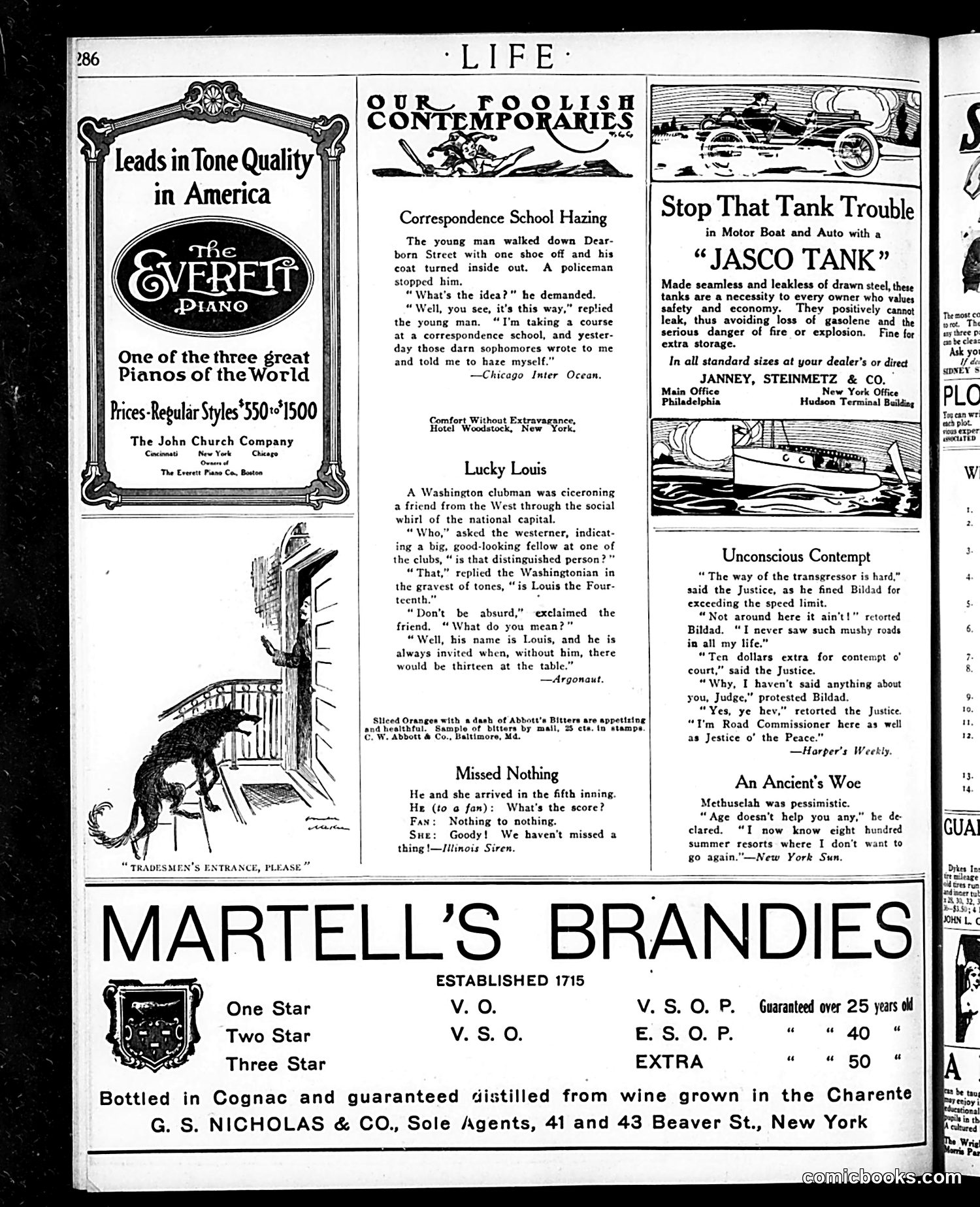
This is primarily an **advertising page** with several short humorous anecdotes in the "Our Foolish Contemporaries" section. **Main Cartoons/Jokes:** 1. **"Correspondence School Hazing"**: Satire on the absurdity of mail-order education. A student literally hazed *himself* following written instructions from a correspondence school, producing the literal but ridiculous result of walking around with one shoe off and coat inside-out. 2. **"Lucky Louis"**: A Washington social joke playing on the superstition that thirteen at a table brings bad luck. A man named Louis is always invited to dinners—not for distinction, but because his presence makes fourteen, avoiding the unlucky number. 3. **"Missed Nothing"**: Baseball joke about arriving late to a scoreless game and missing nothing of consequence. 4. **"Unconscious Contempt"**: A speed-limit violator unknowingly offends a judge who serves dual roles (Road Commissioner and Justice), earning an extra fine for "contempt." The page emphasizes early-20th-century concerns: correspondence education's credibility, superstitions, and small-town authority figures' pettiness.
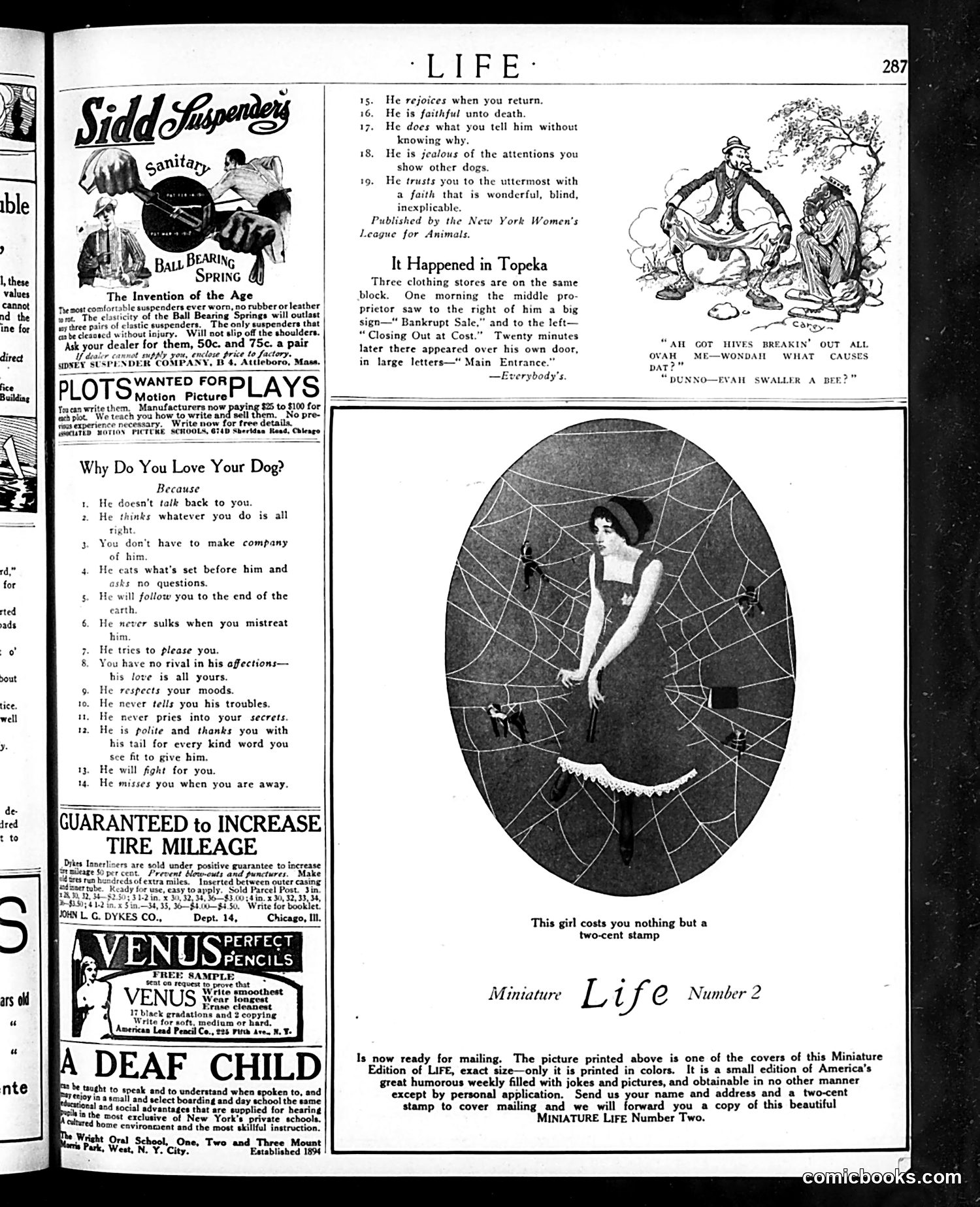
This page mixes advertisements with satirical content typical of Life magazine's format. **Main Cartoon ("It Happened in Topeka"):** A joke about commercial desperation. When two neighboring clothing stores advertise "Bankrupt Sale" and "Closing Out at Cost," the middle store owner responds with a sign reading "Main Entrance"—a absurdist counter-strategy suggesting his store is so popular it needs directional signage. The satire targets retail competition and merchant anxiety during economic uncertainty. **"Why Do You Love Your Dog?" list:** Satirizes human relationships by contrasting them unfavorably with dogs. Dogs don't "talk back," "pry into secrets," or "tell you troubles"—qualities implicitly presented as annoying in people, especially women (given the "New York Women's League for Animals" credit). The piece gently mocks human social friction while celebrating canine obedience and unconditional devotion. **Other content:** Mostly period advertisements (suspenders, tire liners, pencils, film schools) and a promotion for a miniature edition of Life itself. The page reflects early 20th-century anxieties about commerce and modest gender commentary through animal comparison.
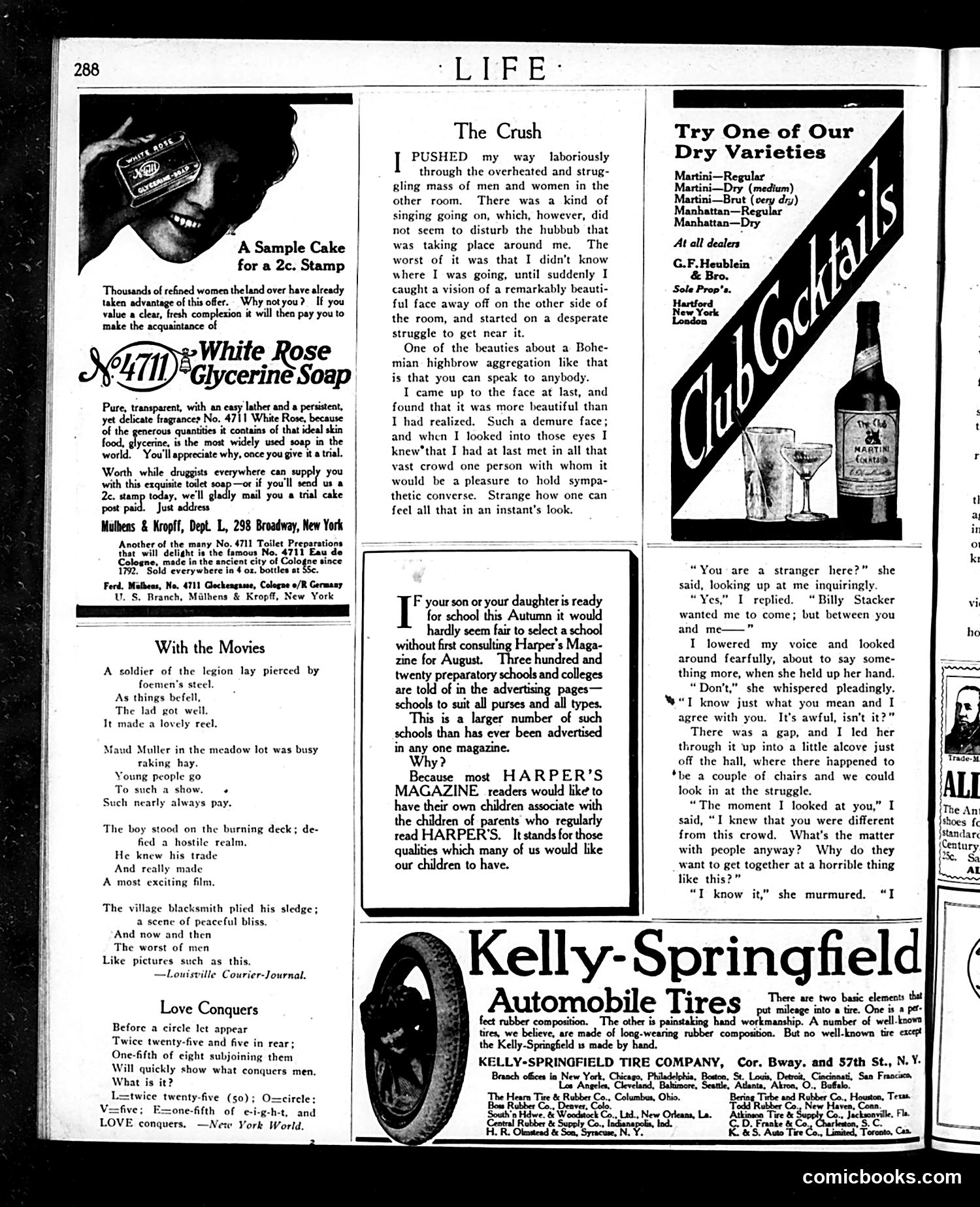
This page is primarily **advertising**, with a short fiction piece ("The Crush") as filler content. **Main advertisements:** - **White Rose Glycerine Soap**: Targets women seeking clear complexions; offers free sample for 2¢ stamp - **Harper's Magazine**: Appeals to middle/upper-class parents selecting preparatory schools, emphasizing that HARPER'S readers represent a desirable social class - **Heublein cocktails**: Promotes pre-mixed "dry varieties" (Martini, Manhattan, etc.) to consumers - **Kelly-Springfield Automobile Tires**: Standard product advertisement **"The Crush" fiction snippet**: A humorous romantic vignette about a narrator at a "Bohemian highbrow aggregation" party spotting an attractive woman across the room. The brief excerpt emphasizes immediate attraction and shared worldly cynicism between strangers. **Historical context for modern readers**: These ads reflect 1920s consumer culture targeting affluent audiences—personal grooming, education status-signaling, cocktail consumption (likely post-Prohibition), and automobiles. The content assumes readers' purchasing power and social aspirations.
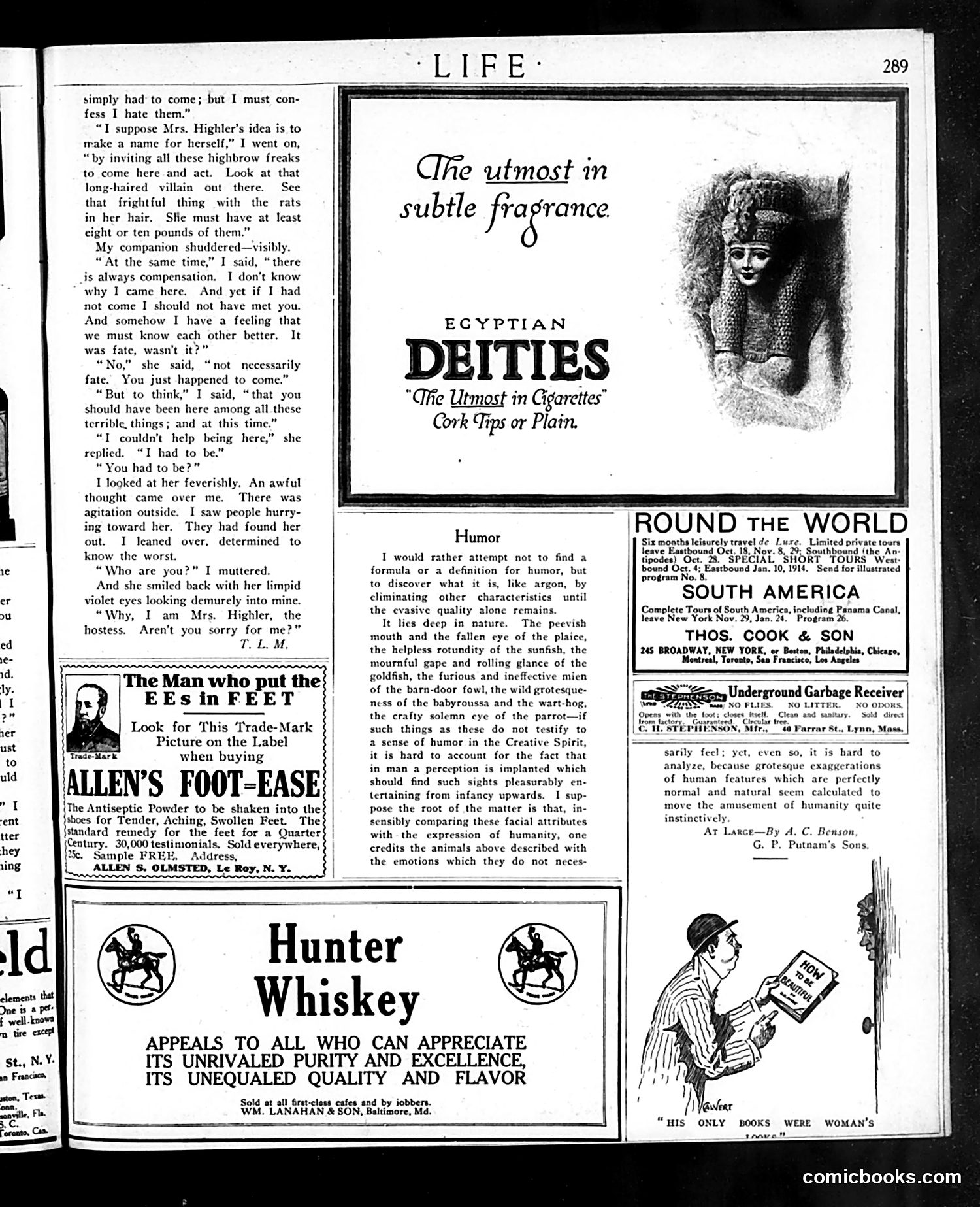
This page is primarily **advertising and filler content** rather than political satire. The main narrative excerpt at top depicts a flirtation scene at what appears to be an artistic salon or theatrical event, with the twist ending that the mysterious woman is actually the hostess Mrs. Highler—a mild romantic joke about mistaken identity. The advertisements include: - **Allen's Foot-Ease** (foot powder) - **Egyptian Deities** cigarettes - **Hunter Whiskey** - Travel services and garbage receivers The only substantive editorial content is a short essay on **humor**, arguing that the sense of humor originates in observing animals' facial expressions and mannerisms—comparing their appearance to human expression to find them comedic. This is a typical early-1900s Life magazine page: mixing light fiction, advertisements, and brief philosophical musings without overt political commentary.
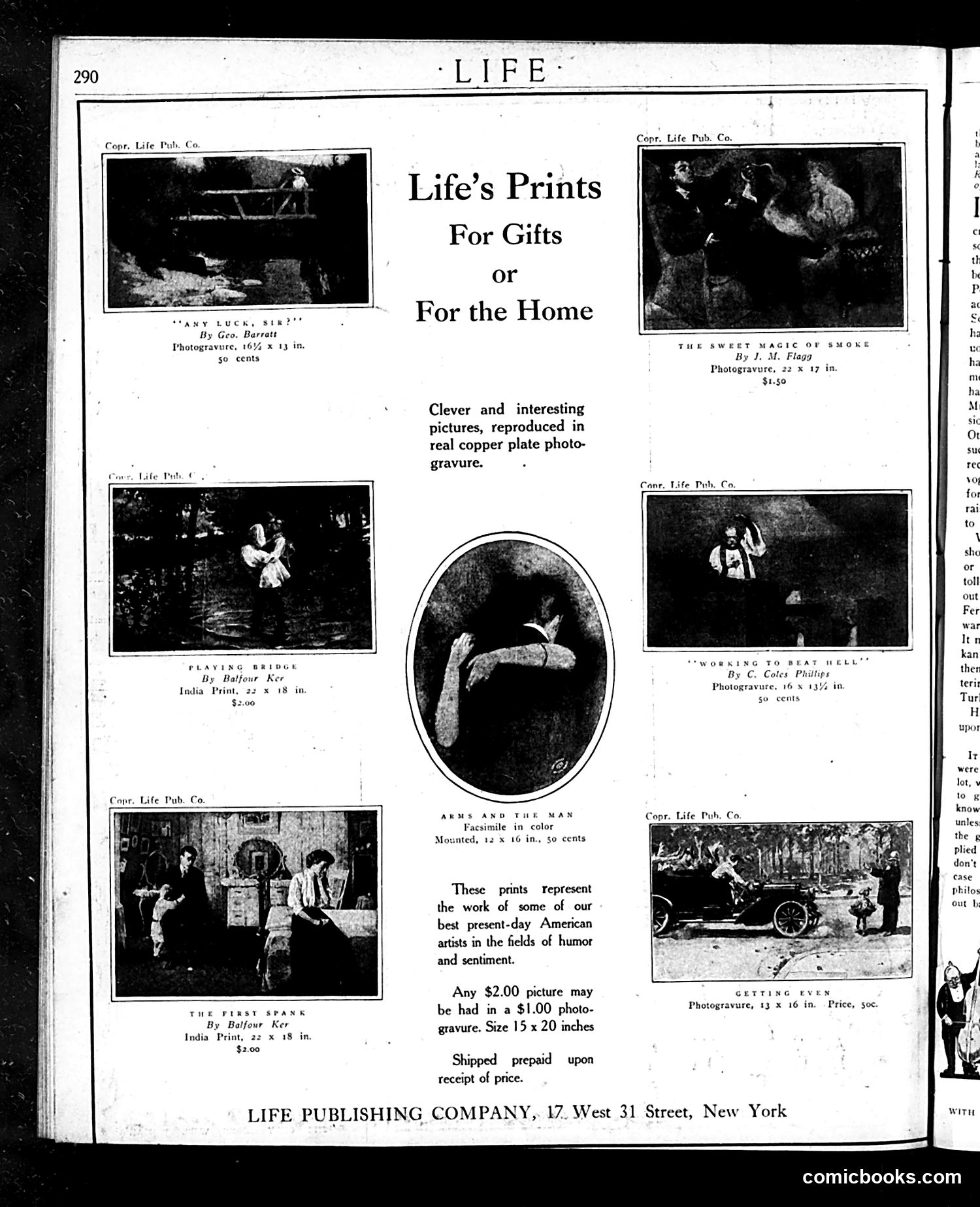
This is primarily an **advertisement page**, not political satire. Life Publishing Company marketed affordable art prints for home decoration, featuring work by contemporary American artists. The prints shown depict genteel domestic and social scenes: "Any Luck, Sir?" (fishing), "Playing Bridge" (card games), "The First Spank" (child-rearing), and "Getting Even" (unclear situation). These represent the magazine's stated focus on "humor and sentiment" appealing to middle-class American homes. The pricing structure—$2.00 originals available as $1.00 photogravures in 15x20 inch format—made art accessible to ordinary households. The "Arms and the Man" reference appears to be Shaw's play, reproduced as color facsimile. This reflects early 20th-century consumer culture: mass-produced "quality" art for domestic display was a growing market segment. The page demonstrates how *Life* monetized its reputation for clever illustration and refined taste.
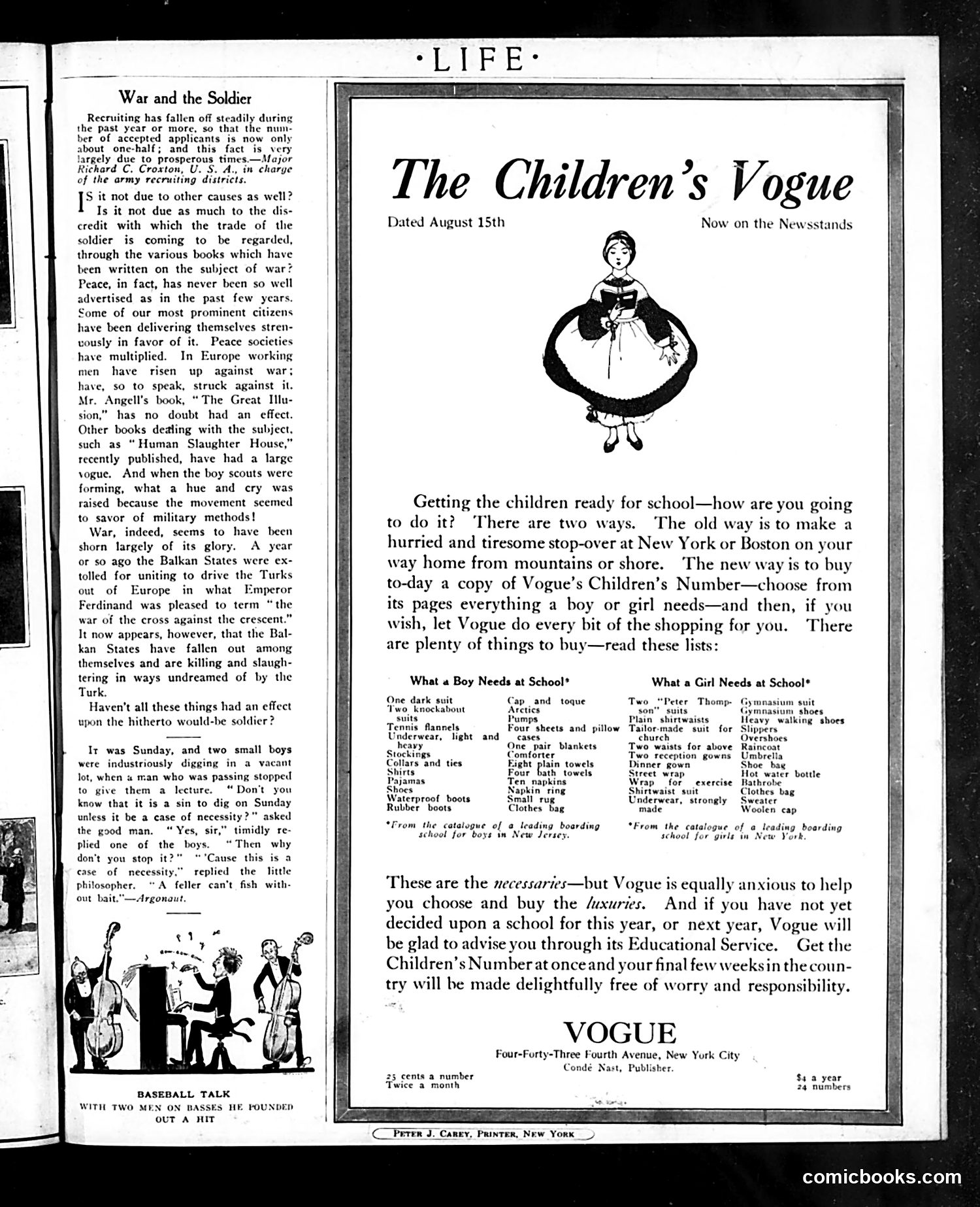
This page contains two distinct elements: **Left Column - "War and the Soldier":** A satirical essay arguing that military recruitment has declined not due to economic prosperity (as officials claim) but because peace advocacy has become fashionable. The piece references anti-war books like Norman Angell's "The Great Illusion" and criticizes how pacifism, peace societies, and anti-militarism have made soldiering seem dishonorable. It includes a humorous anecdote about a boy digging on Sunday, illustrating moral flexibility. The bottom cartoon about baseball appears unrelated. **Right Column - Advertisement:** Vogue magazine advertises its "Children's Number" (August 15th issue) as a shopping guide for school supplies. It lists necessities and luxuries for boys and girls preparing for boarding school, positioning Vogue as a convenient alternative to traveling to New York or Boston to shop in person. **Context:** This appears to pre-WWI (likely 1910-1912), when peace movements were genuinely influential in America. The satire suggests progressive anti-war sentiment was undermining traditional military recruitment.
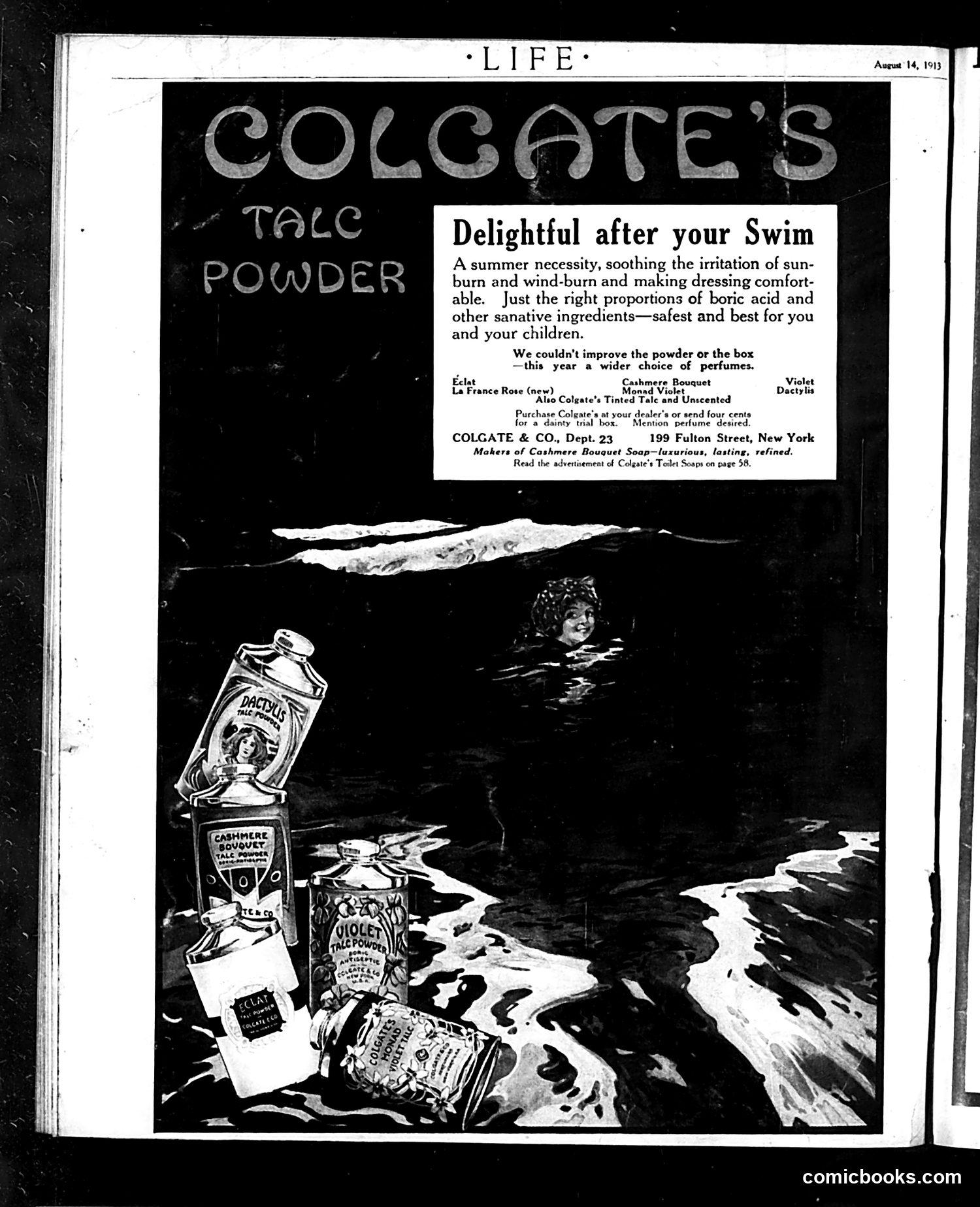
This is **primarily an advertisement**, not a political cartoon. It's a full-page ad for Colgate's Talc Powder from August 14, 1913, appearing in *Life* magazine. The image shows swimming-related product bottles arranged on a beach, with a woman swimming in the background. The ad promises the powder soothes sunburn and wind-burn after swimming—positioning it as a "summer necessity." Multiple perfume varieties are advertised (Cashmere Bouquet, Violet Dactyl, etc.). The only potentially satirical element is subtle: the ad's claim that they "couldn't improve the powder or the box—this year a wider choice of perfumes" implies that previous years' versions were already perfect, yet they're now offering new options anyway. This gently mocks typical advertising hyperbole about perpetual "improvements." Otherwise, this is straightforward early 20th-century consumer marketing targeting women and families, emphasizing safety ("safest and best for you and your children") alongside luxury and variety.