
Life, 1913-08-14 · page 22 of 40
Life — August 14, 1913 — page 22: what you’re looking at
What you’re looking at
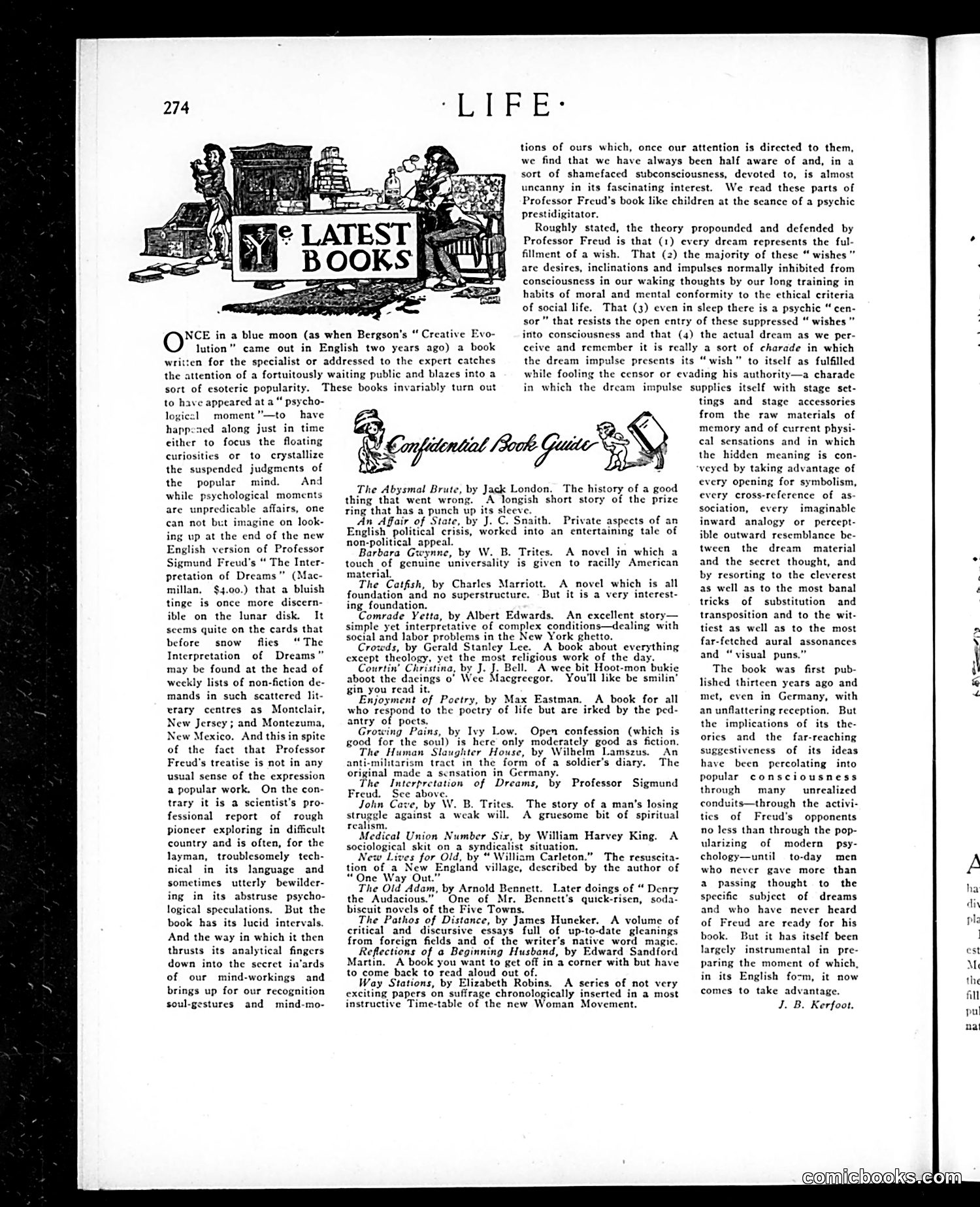
This page features a "Latest Books" review section discussing Sigmund Freud's *The Interpretation of Dreams*, which appears to have recently become a popular sensation among the general public. The central point of the text's satire is the paradox of esoteric academic work suddenly catching public attention. The author notes that Freud's dense psychological treatise—originally written for specialists—has achieved unexpected popularity, which the text attributes to hitting a "psychological moment." The review explains Freud's dream theory for lay readers: dreams fulfill repressed wishes, the psyche's "censor" disguises forbidden desires through symbolism and stage-dressing, and the dreamer deceives itself about the dream's true meaning. The implicit satire targets both intellectualism and pop-psychology faddism: the public's fascination with Freud appears as a form of fashionable pretension, seizing upon sophisticated ideas without deep understanding. The decorative "Confidential Book Guide" header frames these reviews as insider cultural commentary for aspirational readers.
📄 Transcribed text from this page (OCR, searchable)
Machine-transcribed from the original scan — historical spelling and the odd misread are preserved.
sa Ll cal oa NCE in a blue moon (as when Bergson’s “' Creative Evo- lution” came out in English two years ago) a book written for the specialist or addressed to the expert catches the attention of a fortuitously waiting public and blazes into a sort of esoteric popularity. These books invariably turn out to have appeared at a“ psycho- lo; moment "—to have happ-aed along just in time @ either to focus the floating Confit ot (300k: . curiosities of to crystallize 2 , the suspended judgments of ! the popular mind. And while psychological moments The Abysmal Brute, by Jack London. The history of a good f thing that went wrong. A longish short story of the prize ¢¥efY cross-reference of as- tions of ours which, once our attention is directed to them, we find that we have always been half aware of and, in a sort of shamefaced subconsciousness, devoted to, is almost uncanny in its fascinating interest. We read these parts of Professor Freud's book like children at the seance of a psychic prestid Roughly stated, the theory propounded and defended by Professor Freud is that (1) every dream represents the ful- fillment of a wish. That (2) the majority of these “ wishes” are desires, inclinations and impulses normally inhibited from consciousness in our waking thoughts by our long tr: ig in habits of moral and mental conformity to the ethical criteria of social life. That (3) even in sleep there is a psychic “ cen- sor” that resists the open entry of these suppressed “ wishes” into consciousness and that (4) the actual dream as we per- ceive and remember it is really a sort of charade in which the dream impulse presents its “ wish" to itself as fulfilled while fooling the censor or evading his authority—a charade in which the dream impulse supplies itself with stage sct- tings and stage accessories from the raw materials of memory and of current physi- cal sensations and in which the hidden meaning is con- veyed by taking advantage of every opening for symbolism, are unpredicable affairs, one ing that has a punch up its sleeve. sociation, every imaginable can not but imagine on look- English version of Professor 902 -Political_ appeal. An Afair of State, by J. C. Snaith. Private aspects of an inward analogy or percept ing up at the end of the new English. political crisis, worked into an entertaining tale of ible outward resemblance be- Barbara Gwynne, by W. B. Trites. A novel in which a tween the dream material Sigmund Freud's “The Inter- touch of genuine universality is given to racilly American and the secret thought, and pretation of Dreams” (Mac- material. millan, $4.00.) that a bluish tinge is once more discern- jing foundation. ible on the lunar disk. It The Catfish, by Charles Marriott. A novel which is all foundation and no superstructure. But it is a very interest- by resorting to the cleverest as well as to the most banal tricks of substitution and Comrade Yetta, by Albert Edwards, An excellent story— transposition and to the wit- seems quite on the cards that simple yet interpretative of complex conditions—dealing with tiest as well as to the most before snow flies “The weekly lists of non-fiction de- aboot the saciaas o' Wee mands in such scattered lit- 817,200 Kean 1 social and labor problems in the New York ghetto. 4 ‘ Crowds, by Gerald Stanley Lee. A book about everything Interpretation of Dreams except theology, yet the most religious work of the day, may be found at the head of Courtin’ Christina, by J. J. Bell. A wee bit Hoot-mon bukic Macgregor. You'll like be smilin’ far-fetched aural assonances and “visual puns.” The book was first pub- lished thirteen years ago and Enjoyment of Poetry, by Max Eastman. A book for all ™et, even in Germany, with erary centres as Montclair, who respond to the poctry of life but are irked by the ped- an unflattering reception. But New Jersey; and Montezuma, antry of pocts, New Mexico. And this in spite of the fact that Professor Growing Pains, by Ivy Low. ; : good for the soul) is here only moderately good as fiction, Fis and the far-reaching The Human Slaughter House, by Wilhelm Lamszus. An tiveness of its ideas ; 4 :. the implications of its the- Open confession (which is eee eon oF ee Freud's treatise is not in any anti-militarism tract in the form of a soldier's diary. The have been percolating into usual sense of the expression _Figinal made a sensation in Germany. _ P The Interpretation of Dreams, by Professor Sigmund a popular work. On thecon- Freud. See above. trary it is a scientist's pro- John Cave, by W. B. Trites. fessional report of rough struggle against a weak will. pioneer exploring in difficult. *¢alism. country and is often, for the layman, troublesomely tech- New Lives for Old, by Medical Union Number Six, by William Harvey King, A DO le sociological skit on a syndicalist situation. ularizing of modern psy- popular consciousness through many — unrealized The story of a man’s losing = conduits—through the activi- A gruesome bit of spiritual tics of Freud's opponents no less than through the pop- n Carleton.” The resuscita chology—until to-day men nical in its language and tion of a New England village, described by the author of who never gave more than sometimes utterly bewilder- One Way Out. The Old Adam, by Arnold Bennett. Later doings of “Denry Passing thought to the ing in its abstruse psycho- the Audacious.”" One of Mr. Bennett's quick-risen, soda- SPecific subject of dreams logical speculations, But the biscuit novels of the Five Towns. and who have never heard book has its lucid intervals. And the way in which it then ; from foreign fields and o: thrusts its analytical fingers The Pathos of Distance, by James Huneker. A volume of of Freud are ready for his critical and discursive essays full of up-to-date gleanings the writer's native word magic. ; ' Reflections of a Beginning Husband, by Edward Sandford largely instrumental in pre- book. But it has itself been down into the secret in‘ards Martin. A book you want to get off in a corner with but have paring the moment of which, of our mind-workings and to come back to read aloud out of. Way Stations, by Elizabeth Robins. A series of not very in its English fo-m, it now brings up for our recognition —_ exciting papers on suffrage chronologically inserted in a most Comes to take advantage. soul-gestures and mind-mo- instructive Time-table of the new Woman Movement. J. B. Kerfoot. a — pu