
Life, 1913-08-14 · page 19 of 40
Life — August 14, 1913 — page 19: what you’re looking at
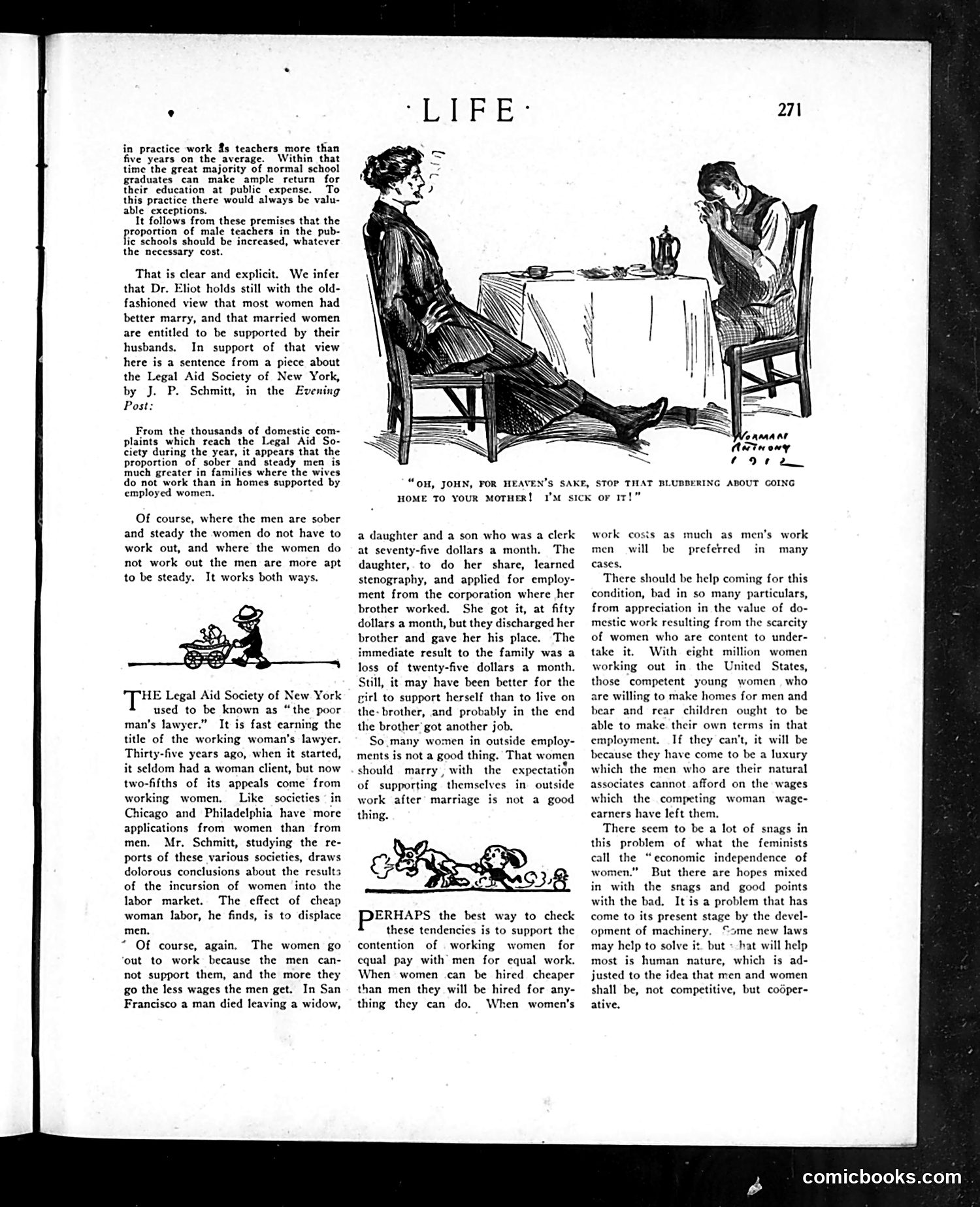
What you’re looking at
**The Cartoon:** The illustration shows a woman sitting across from a man at a table. She's telling him to stop complaining about visiting his mother, declaring she's "sick of it." The satire targets the Victorian expectation that wives should obey husbands without complaint. **The Article's Context:** The page debates women's labor participation. It references Dr. Eliot's view that women should marry and be supported by husbands rather than work. The Legal Aid Society data is cited to suggest employed women correlate with unstable families—though the author notes this reasoning works "both ways": men can't support families, so women must work. **The Point:** Life's satire exposes the contradiction: society expects women to depend on men financially while simultaneously blaming women's employment for family problems. The cartoon reinforces this hypocrisy—the husband expects obedience despite the economic pressures forcing wives into work. The article concludes that equal pay would protect women by making them less attractive as cheap labor alternatives to men.
📄 Transcribed text from this page (OCR, searchable)
Machine-transcribed from the original scan — historical spelling and the odd misread are preserved.
in practice work &s teachers more than five years on the average. Within that time the great majority of normal school graduates can make ample return for their education at public expense. To this practice there would always be valu- able exceptions. It follows from these premises that the roportion of male teachers in the pub- jic schools should be increased, whatever the necessary cost. That is clear and explicit. We infer that Dr. Eliot holds still with the old- fashioned view that most women had better marry, and that married women are entitled to be supported by their husbands. In support of that view here is a sentence from a piece about the Legal Aid Society of New York, by J. P. Schmitt, in the Evening Post: From the thousands of domestic com- plaints which reach the Legal Aid So- ciety during the year, it appears that the proportion of sober ‘and steady men is much greater in families where the wives do not work than in homes supported by employed women, Of course, where the men are sober and steady the women do not have to work out, and where the women do not work out the men are more apt to be steady. It works both ways. THE Legal Aid Society of New York used to be known as “the poor It is fast earning the title of the working woman's lawyer. Thirty-five years ago, when it started, it seldom had a woman client, but now two-fifths of its appeals come from man’s lawyer.” working women. Like socicties in Chicago and Philadelphia have more applications from women than from men. Mr. Schmitt, studying the re- ports of these various societies, draws dolorous conclusions about the results of the incursion of women into the labor market. The effect of cheap woman labor, he finds, is to displace men, * Of course, again. The women go ‘out to work because the men can- not support them, and the more they go the less wages the men get. In San Francisco a man died leaving a widow, “OH, JOHN, FOR HEA HOME TO YOUR MOTHER! a daughter and a son who was a clerk at seventy-five dollars a month. The daughter, to do her share, learned stenography, and applied for employ- ment from the corporation where her brother worked. She got it, at fifty dollars a month, but they discharged her brother and gave her his place. The immediate result to the family was a loss of twenty-five dollars a month. Si it may have been better for the girl to support herself than to live on the- brother, and probably in the end the brother got another job. So many women in outside employ- ments is not a good thing. That women should marry, with the expectation of supporting themselves in outside work after marriage is not a good thing. PERHAPS the best way to check these tendencies is to support the contention of working women for equal pay with’ men for equal work. When women can be hired cheaper than men they will be hired for any- thing they can do. When women's 'S SAKE, STOP THAT BLUBBERING ABOUT GOING I'M sick or iT!” work costs as much as men’s work men will be preferred in many cases, There should be help coming for this condition, bad in so many particulars, from appreciation in the value of do- mestic work resulting from the scarcity of women who are content to under- take it. With eight million women working out in the United States, those competent young women who are willing to make homes for men and bear and rear children ought to be able to make. their own terms in that employment. If they can't, it will be because they have come to be a luxury which the men who are their natural associates cannot afford on the wages which the competing woman wage- earners have left them, There seem to be a lot of snags in this problem of what the feminists call the “economic independence of women.” But there are hopes mixed in with the snags and good points with the bad. It is a problem that has come to its present stage by the devel- opment of machinery. sme new laws may help to solve it. but + hat will help most is human nature, which is ad- justed to the idea that men and women shall be, not competitive, but codper- ative. comicbooks.com oe