
A complete issue · 44 pages · 1913
Life — July 17, 1913
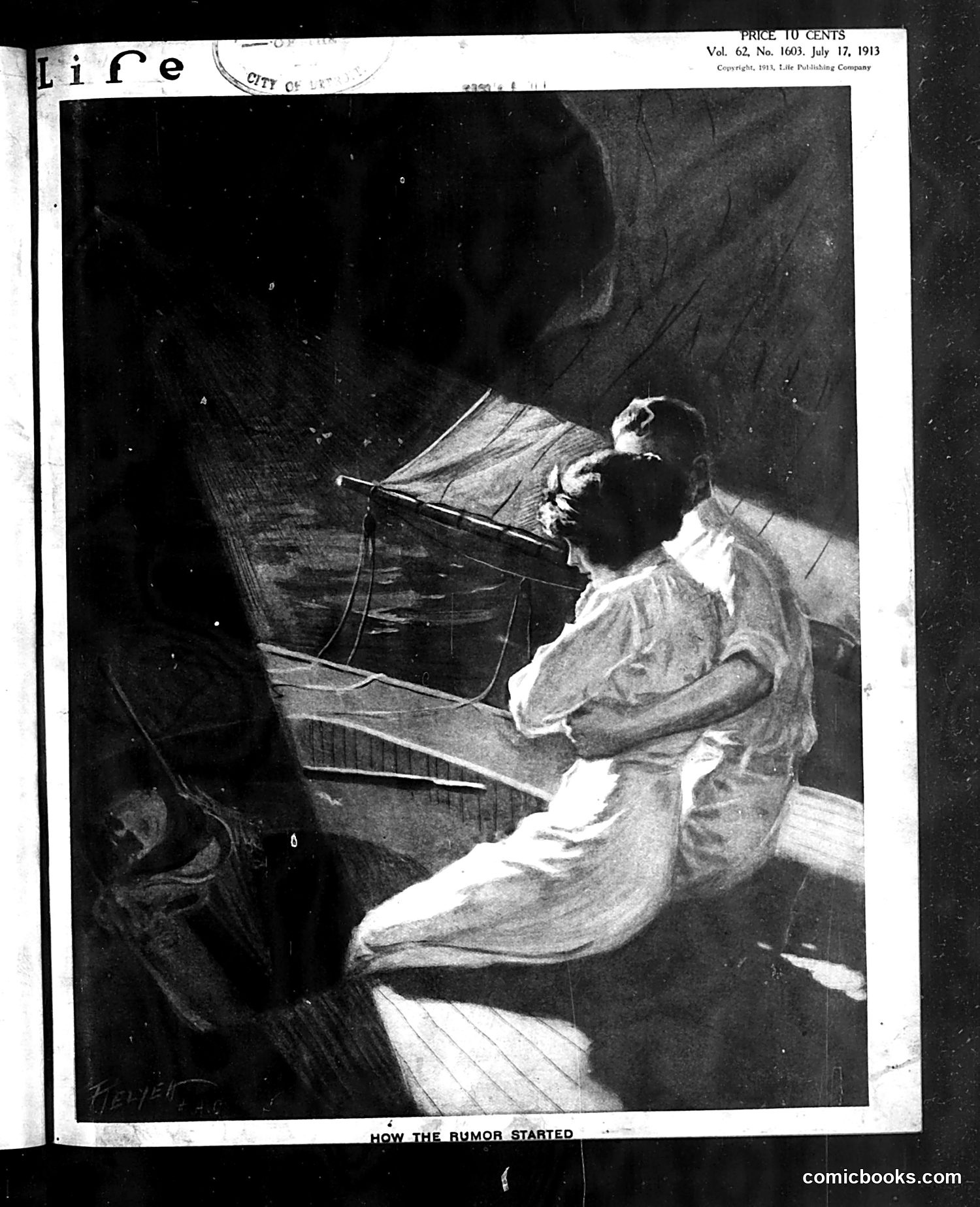
This Life magazine cartoon (July 23, 1913) depicts a scene titled "How the Rumor Started," showing a man in light clothing reclining and appearing to whisper or speak to another figure in darker clothing beside him. The image illustrates the satirical concept of how gossip or rumors spread—suggesting that idle conversation or careless talk between two people is the origin point of broader rumors circulating through society. The cartoon likely comments on the social phenomenon of rumor-mongering prevalent in early 20th-century culture, where private remarks between individuals could escalate into public scandal or misinformation. Without additional context, the specific figures or event referenced remain unclear, though the composition clearly demonstrates Life's satirical approach to social behavior and communication.
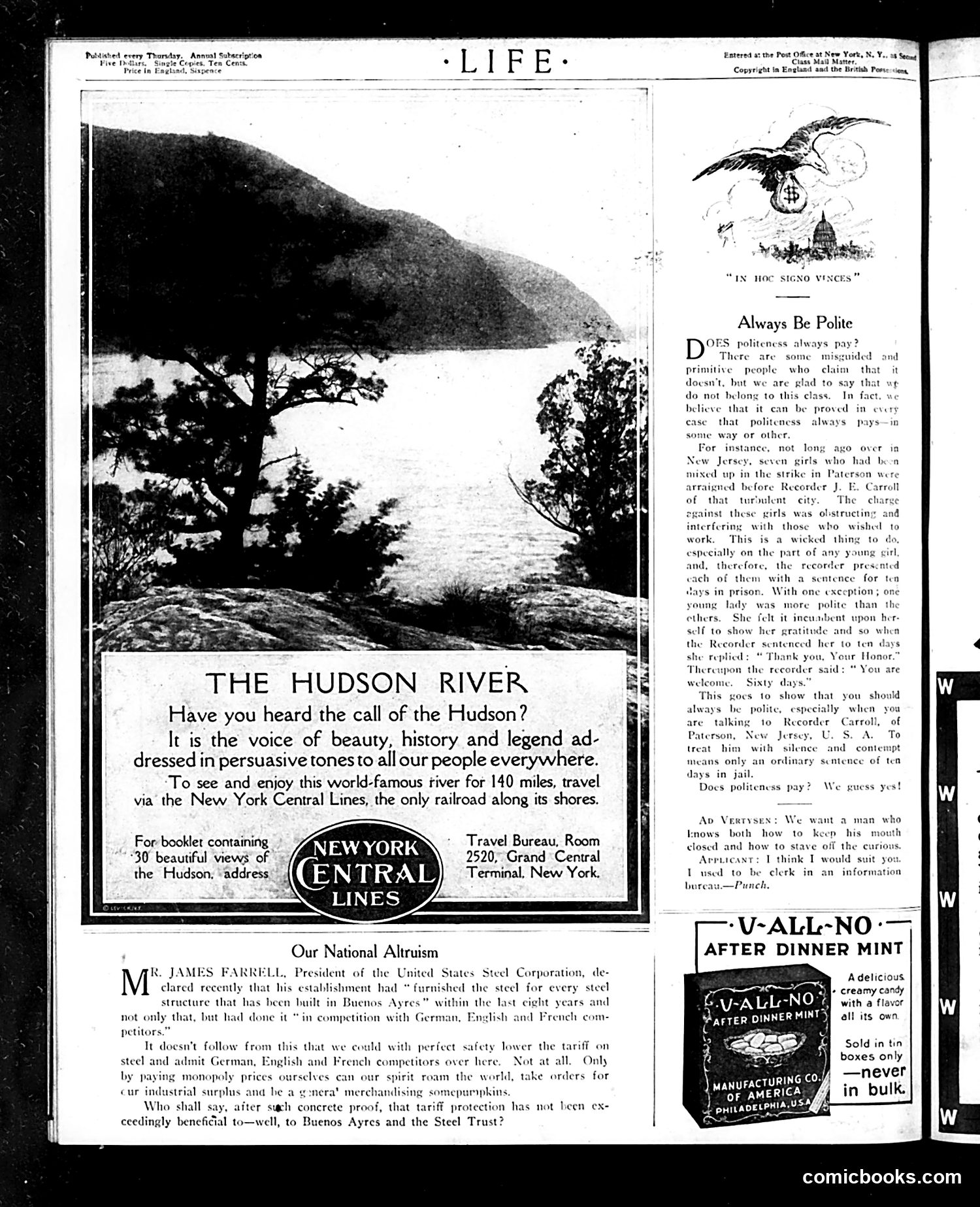
This page is primarily **advertising and editorial content** rather than political satire. The main advertisement promotes the Hudson River via New York Central Lines, emphasizing its natural beauty and historical significance—a tourism pitch. The editorial piece "Always Be Polite" discusses whether politeness pays, using an anecdote about seven New Jersey girls arrested before Recorder J.E. Carroll. One girl received a lighter sentence (ten days instead of sixty) for her polite demeanor and gratitude. The piece concludes politeness is worthwhile, especially when dealing with authority figures like Recorder Carroll. "Our National Altruism" argues that U.S. Steel Corporation's domestic competition proves American industry needs tariff protection—a protectionist economic argument. The page contains period advertising for U-All-No After Dinner Mints, a candy product.
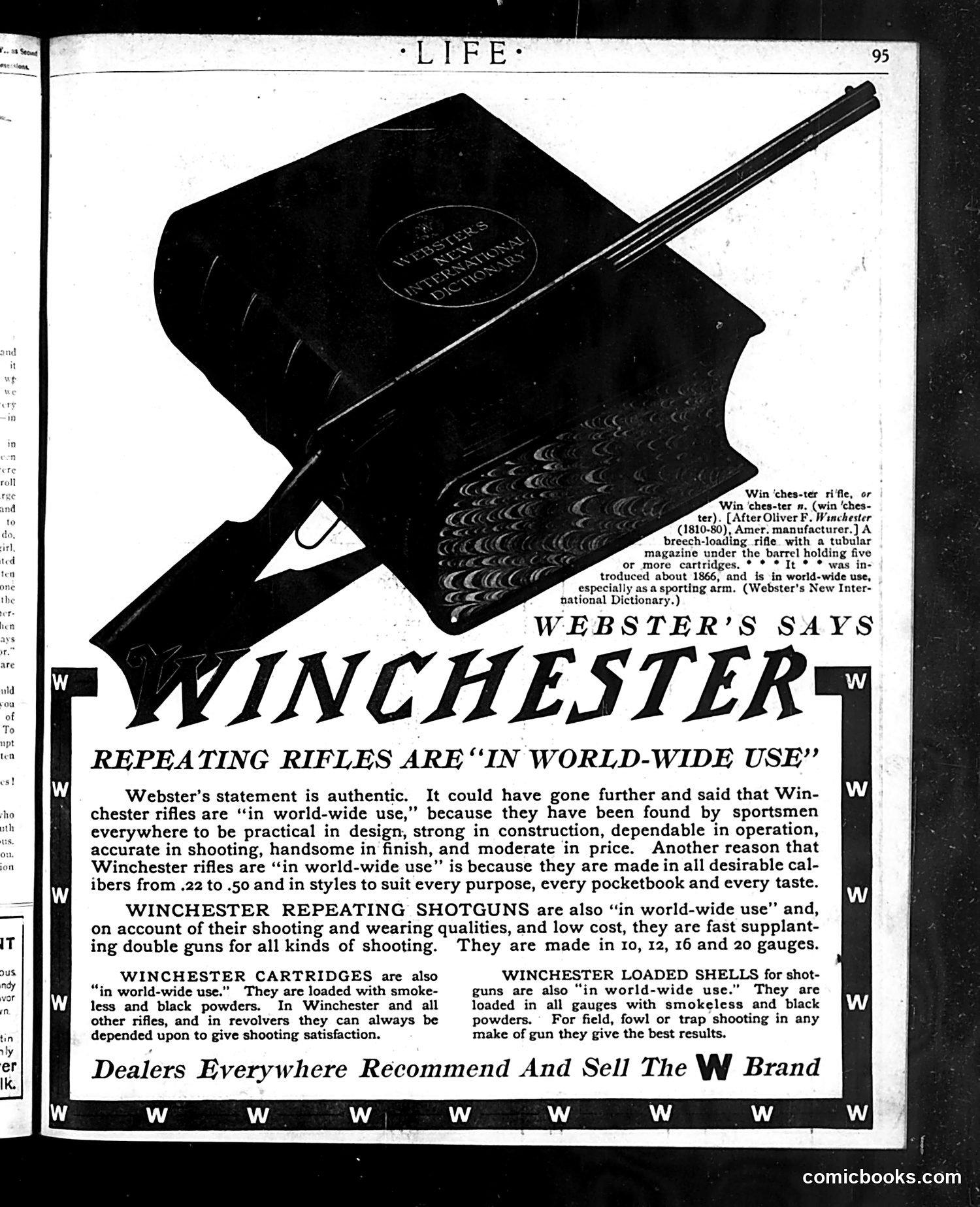
This page is **primarily a Winchester firearms advertisement**, not a political cartoon. It occupies page 95 of *Life* magazine and promotes Winchester repeating rifles, shotguns, cartridges, and ammunition. The advertisement features a large illustration of a Winchester rifle and uses Webster's Dictionary definition to establish credibility, claiming Winchester products are "in world-wide use." The copy emphasizes the rifles' practical qualities: reliable design, durability, accuracy, affordability, and availability in multiple calibers. The bottom promises "Dealers Everywhere Recommend And Sell The W Brand." While *Life* was satirical, **this particular page contains no satire or political commentary**—it's straightforward commercial promotion typical of early 20th-century magazine advertising.
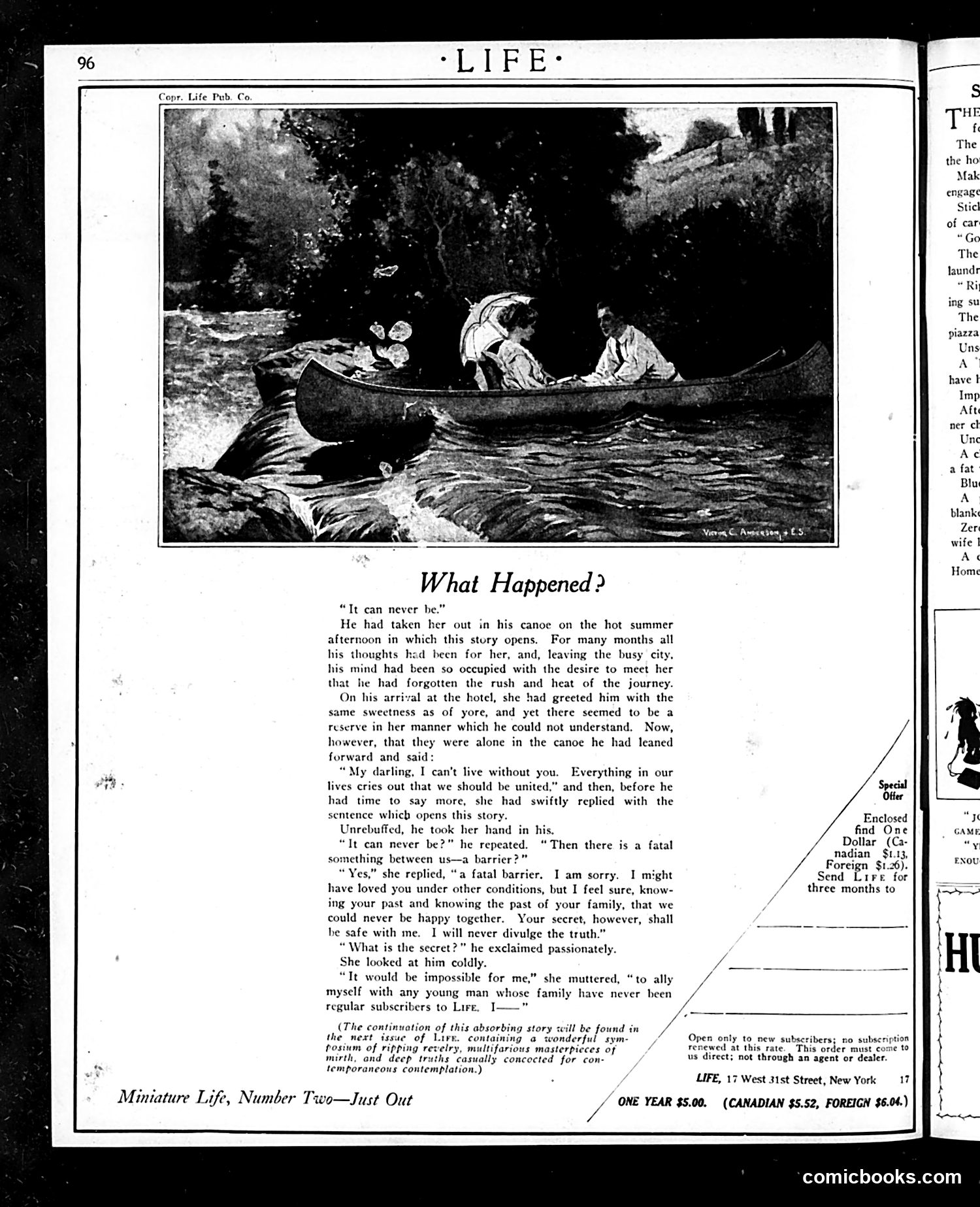
This page presents a serialized romantic story rather than political satire. The narrative follows a man who took a woman canoeing, professing his love and desire for marriage. However, she refuses him, citing a "fatal barrier" between them—apparently related to her family's lack of being "regular subscribers to Life." The humor is **self-promotional advertising disguised as fiction**. Life magazine is literally using a romantic rejection as a punchline to encourage subscriptions. The woman's refusal pivots on the magazine subscription itself, making the entire narrative a tongue-in-cheek advertisement for the publication. This reflects early 20th-century magazine marketing practices where entertainment and advertising were deliberately intertwined for comedic effect.
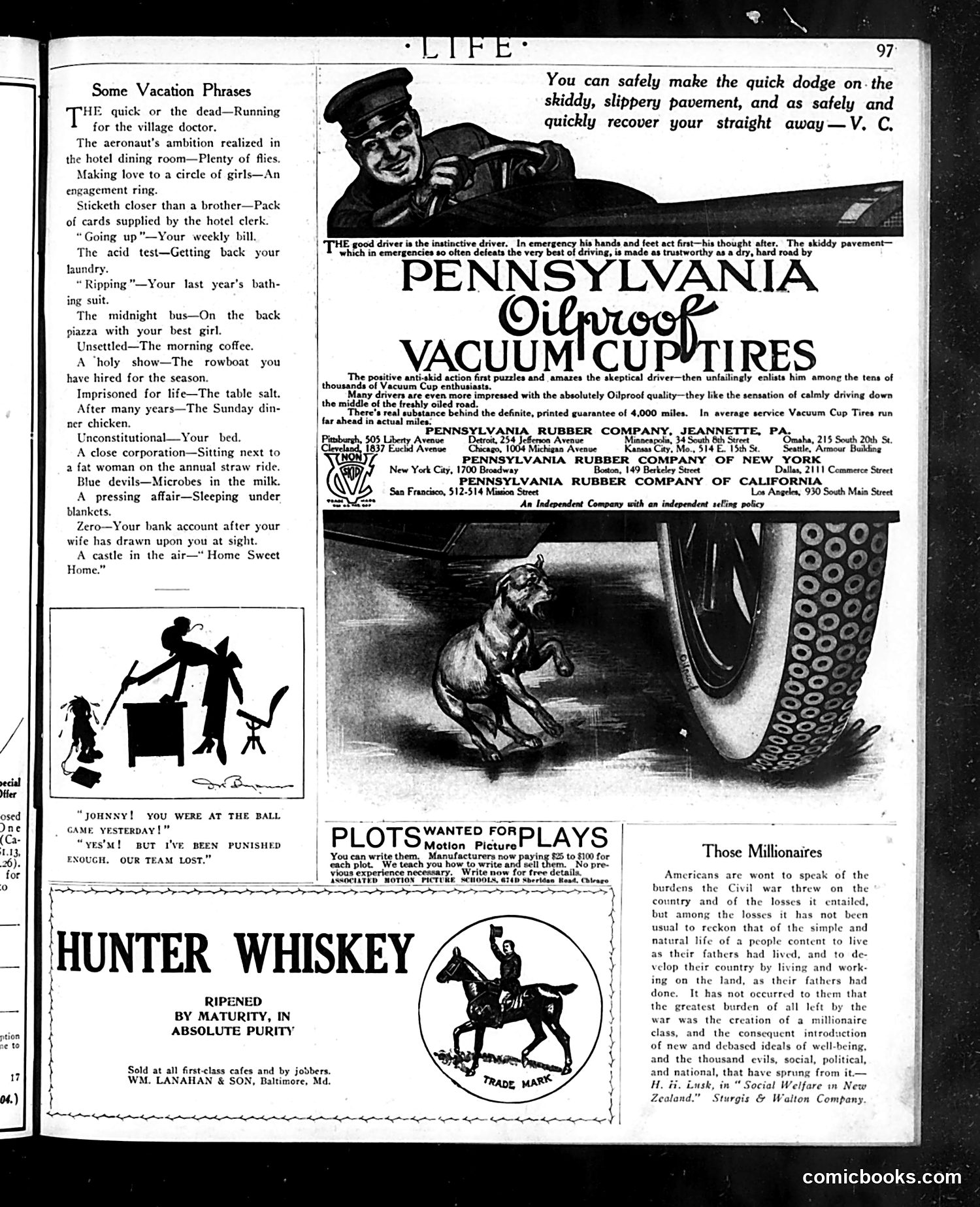
This page is primarily **advertising**, not satirical content. The dominant feature is a Pennsylvania Oilproof Vacuum Cup Tires advertisement showing a dog barely escaping beneath a car tire—illustrating the tires' safety benefits on slippery pavement. The left column contains humorous "vacation phrases" (puns on common expressions), accompanied by a small cartoon of someone emptying a laundry basket, unrelated to the phrases. Additional advertisements include Hunter Whiskey and a call for film plot submissions. The only editorial content is a brief article titled "Those Millionaires," discussing post-Civil War economic development and burdens on wealthy Americans—a commentary on wealth distribution rather than satire. This is a typical early-20th-century magazine page mixing advertising, light humor, and brief opinion pieces.
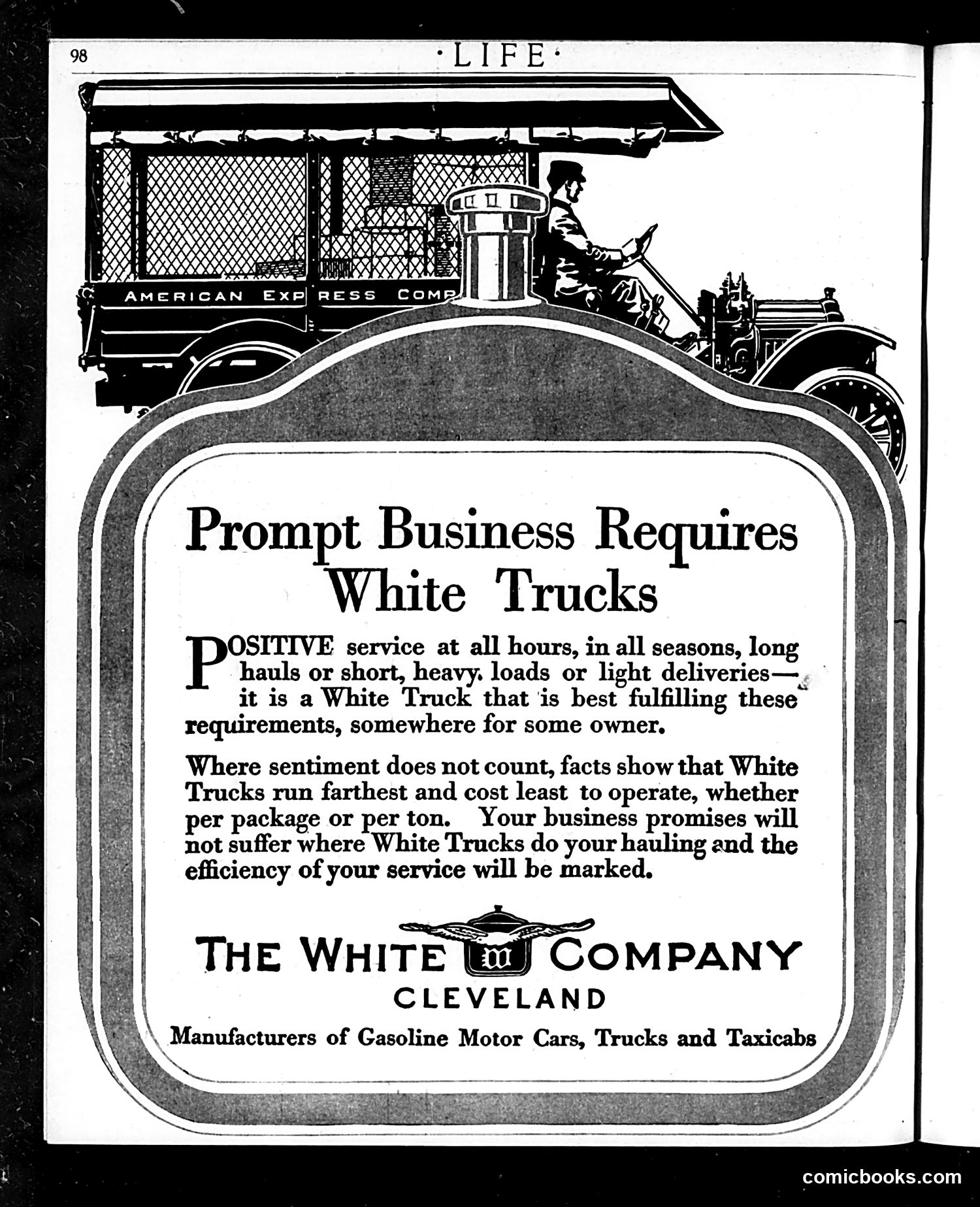
This is a **straightforward advertisement**, not political satire. The White Company of Cleveland marketed gasoline-powered trucks and taxicabs. The illustration shows an early motor truck (circa 1910s-1920s based on styling) operated by the American Express Company. The ad makes a business case: White Trucks offer reliable service across all conditions and seasons, handle various load sizes, and operate at lower cost than alternatives—whether measured per package or per ton. The phrase "where sentiment does not count, facts show" appeals to business owners to prioritize efficiency over brand loyalty. The ad positions White Trucks as the practical choice for prompt commercial delivery. There is no political cartoon or satire present on this page.
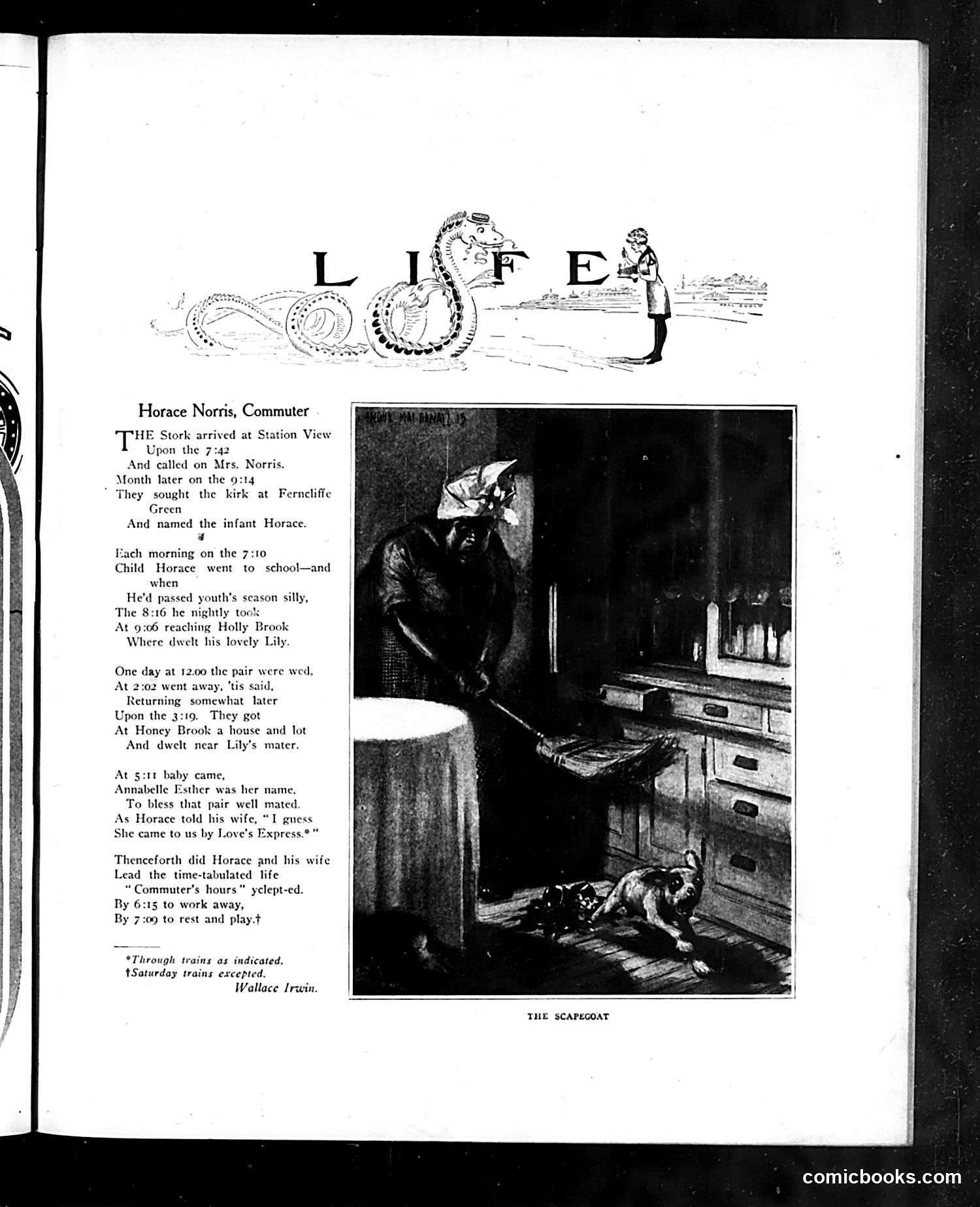
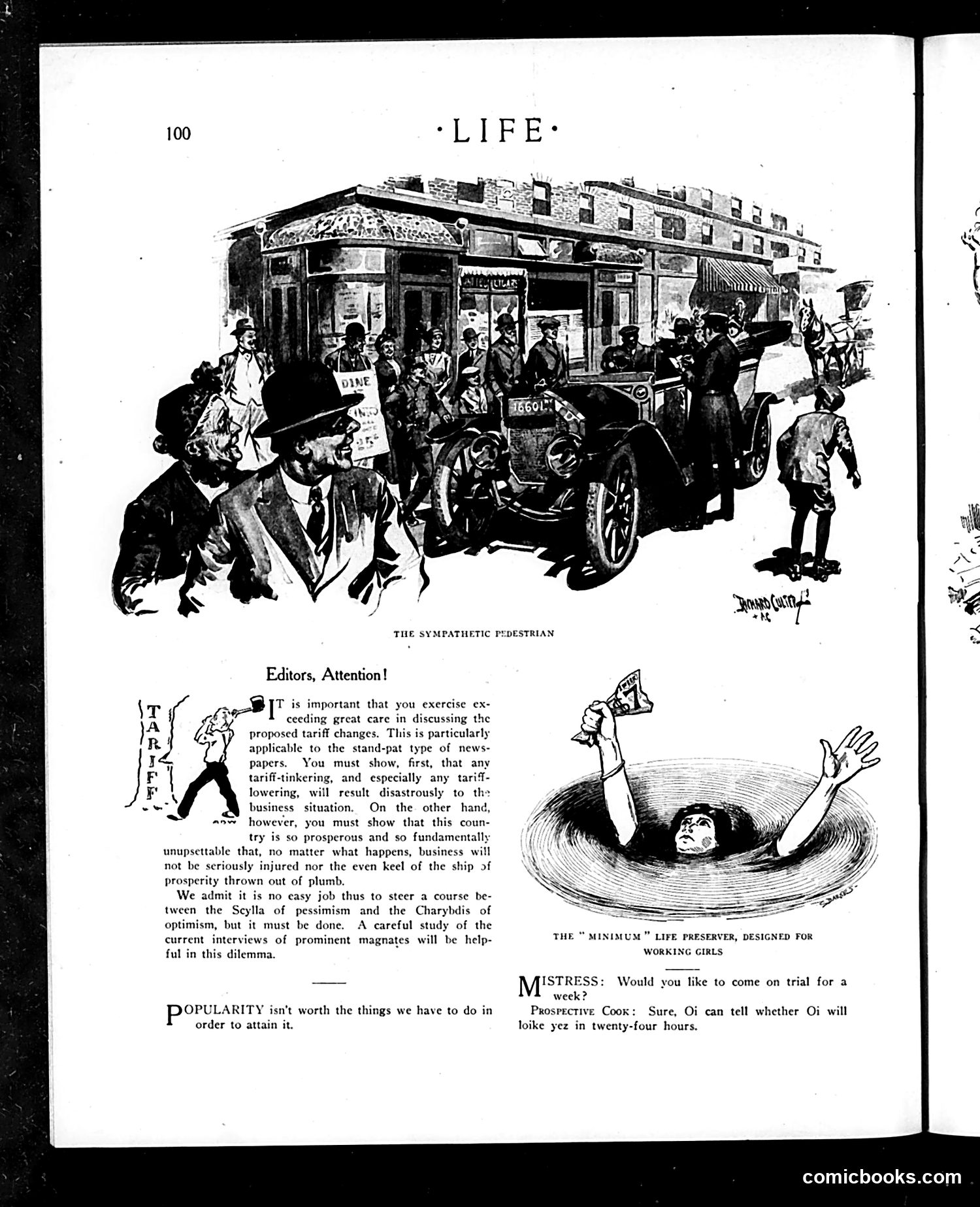
The top cartoon, "The Sympathetic Pedestrian," depicts a crowded street scene with an early automobile surrounded by pedestrians and onlookers—capturing early-20th-century attitudes toward cars as novel, dangerous spectacles. Below, an editorial titled "Editors, Attention!" warns newspaper editors to carefully frame tariff debates, advising balanced coverage between pessimism and optimism to avoid alarming the business community or appearing dismissive of concerns. A small cartoon shows a woman in a life preserver labeled "The 'Minimum' Life Preserver, Designed for Working Girls"—satirizing inadequate safety provisions for female workers. The bottom dialogue between a "Mistress" and "Prospective Cook" humorously depicts domestic servant hiring, with the cook confidently claiming she can determine a candidate's suitability within twenty-four hours.
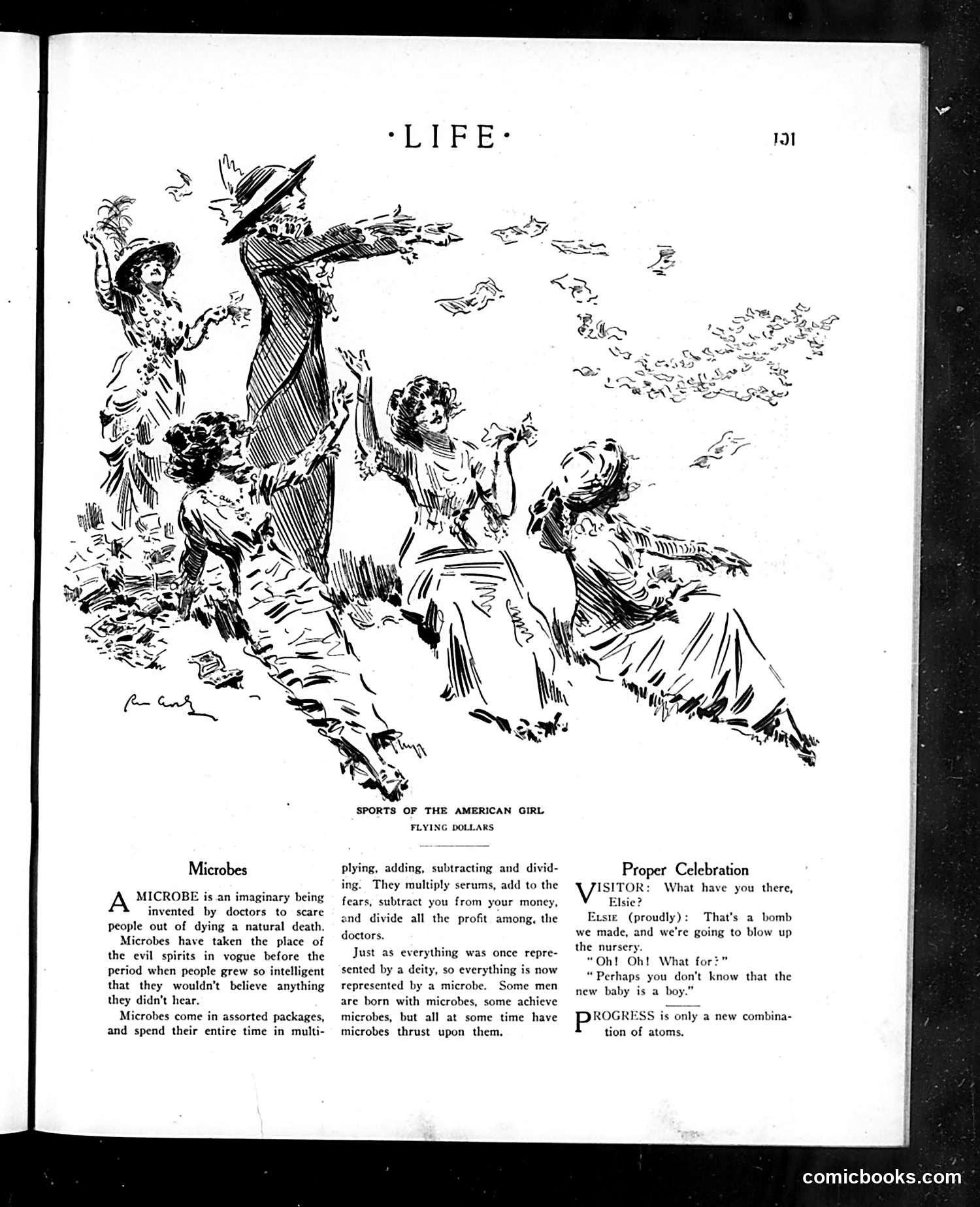
This satirical illustration depicts wealthy American women literally throwing money into the air—"flying dollars." The cartoon critiques conspicuous consumption and frivolous spending by the leisure class, particularly women with disposable income. The accompanying text humorously explains two concepts: "Microbes" (imaginary beings invented by doctors to scare people into unnecessary medical treatments) and "Proper Celebration" (discussing a new baby, with the dark joke that "progress is only a new combination of atoms"). The overall page satirizes early-20th-century American excess, medical quackery, and upper-class women's perceived wastefulness during an era of significant wealth inequality.
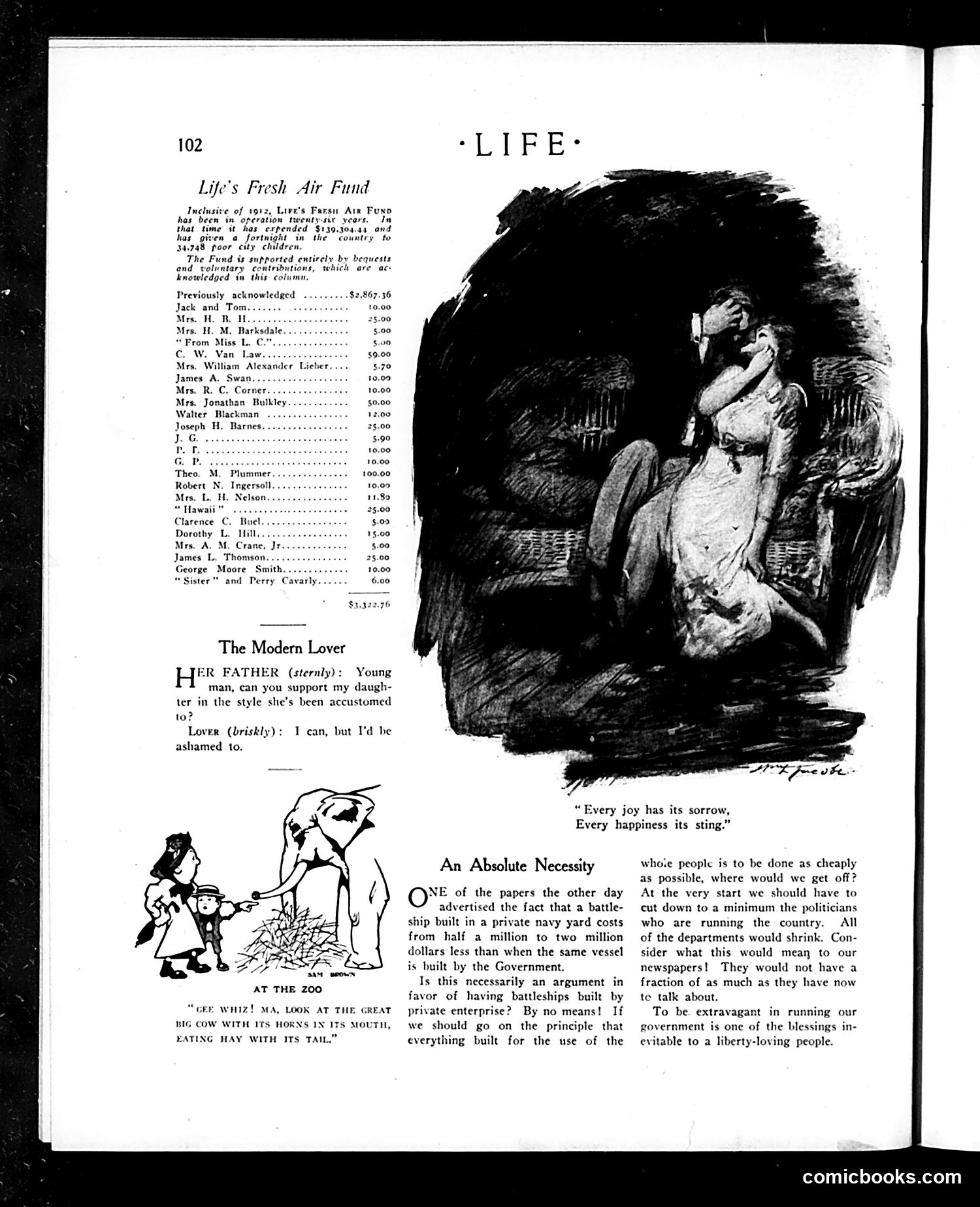
This page contains several distinct pieces: **"Life's Fresh Air Fund"** lists charitable donations supporting a fund that provides fresh air/outdoor experiences for poor children—a common Progressive-era charity. **"The Modern Lover"** is a brief comic dialogue satirizing contemporary courtship, where a young man tells a father he cannot afford to support his daughter in her accustomed lifestyle. The joke critiques either the young man's poverty or his lack of ambition. **"At the Zoo"** is a captioned cartoon showing a child and adult at an elephant exhibit, with the child exclaiming about the animal's eating habits—simple humor for family audiences. **"An Absolute Necessity"** argues for government-built battleships over private shipyard construction, claiming private enterprise is inefficient and wasteful. This reflects early 20th-century debates over military-industrial policy and government spending.
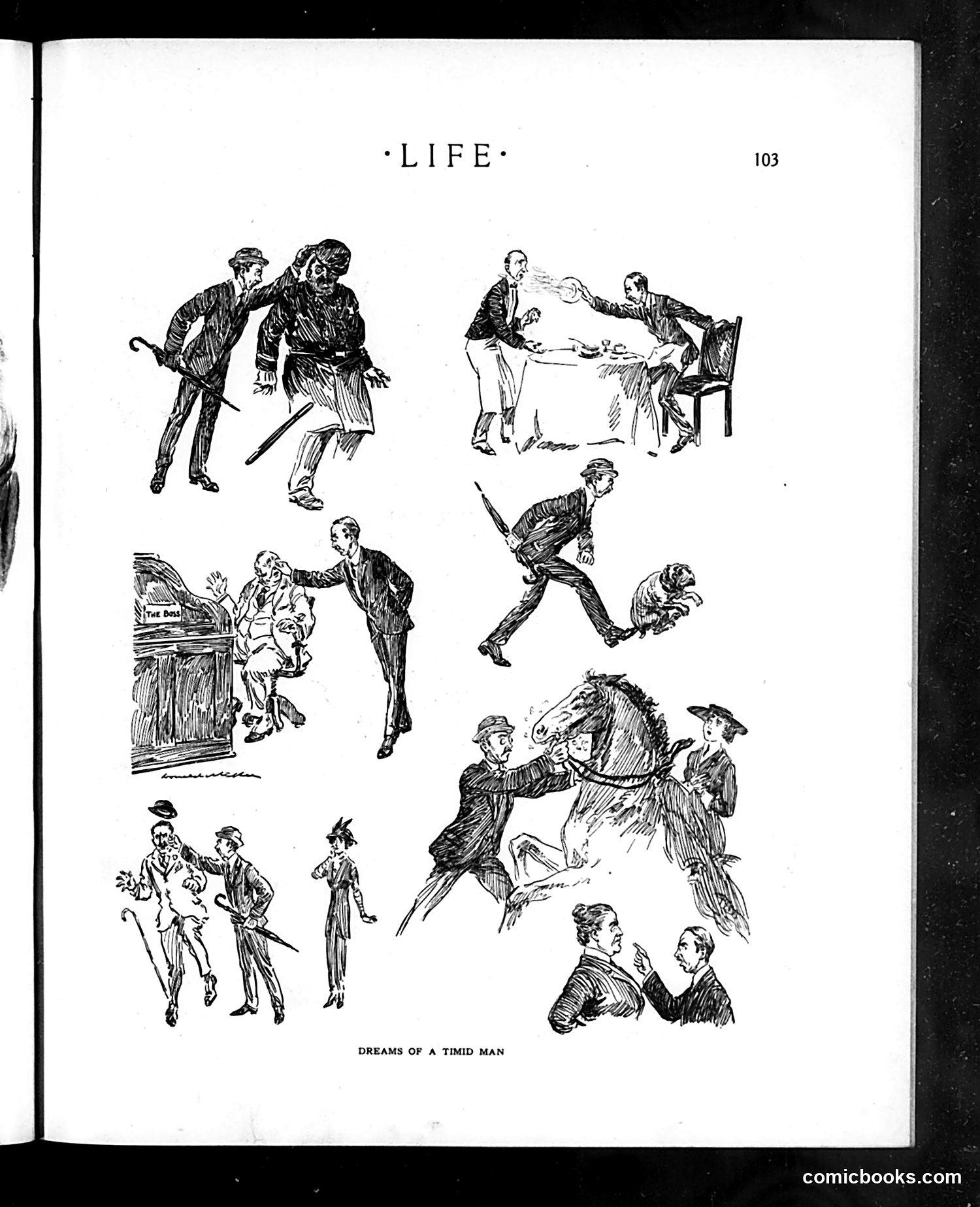
This satirical illustration depicts various anxieties of a nervous or cowardly man through sequential vignettes. The scenes show him: - Confronted by an aggressive older man with a cane - Being served papers (legal trouble) - Fencing or fighting someone - Encountering a rearing horse he cannot control - Running from confrontation - Being verbally attacked by two men The caption "Dreams of a Timid Man" suggests these represent his nightmares or fears rather than actual events. The satire targets masculine anxieties about physical courage, legal vulnerability, and social standing—common subjects in early 20th-century *Life* magazine humor. The multiple scenarios humorously exaggerate the worries that plague an overly cautious man, mocking the gap between his paranoid fantasies and presumably mundane reality.
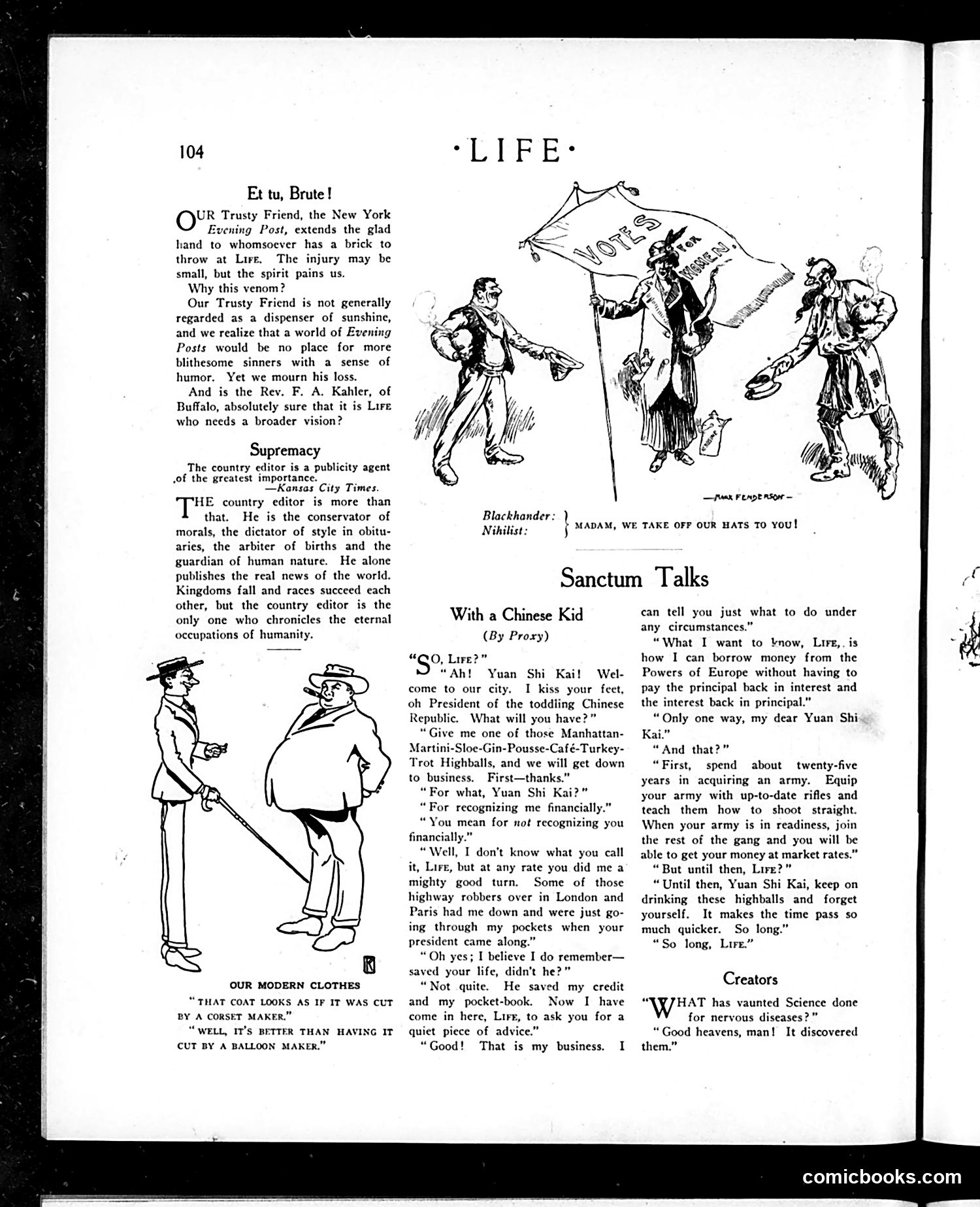
This *Life* magazine page contains satirical commentary on American media and politics. The top cartoon mocks the *New York Evening Post* for criticizing *Life* magazine, questioning why the Post—not known for humor—attacks a satirical publication. The accompanying text defends *Life*'s role as a commentator on social morality. The lower cartoon titled "Our Modern Clothes" shows two men discussing fashion, with one noting a coat "looks as if it was cut by a corset maker" and another quipping it's "better than having it cut by a balloon maker"—likely satirizing overly restrictive or exaggerated tailoring trends of the era. The "Sanctum Talks" section features humorous dialogues between *Life* editors and contributors, maintaining the magazine's satirical voice throughout.
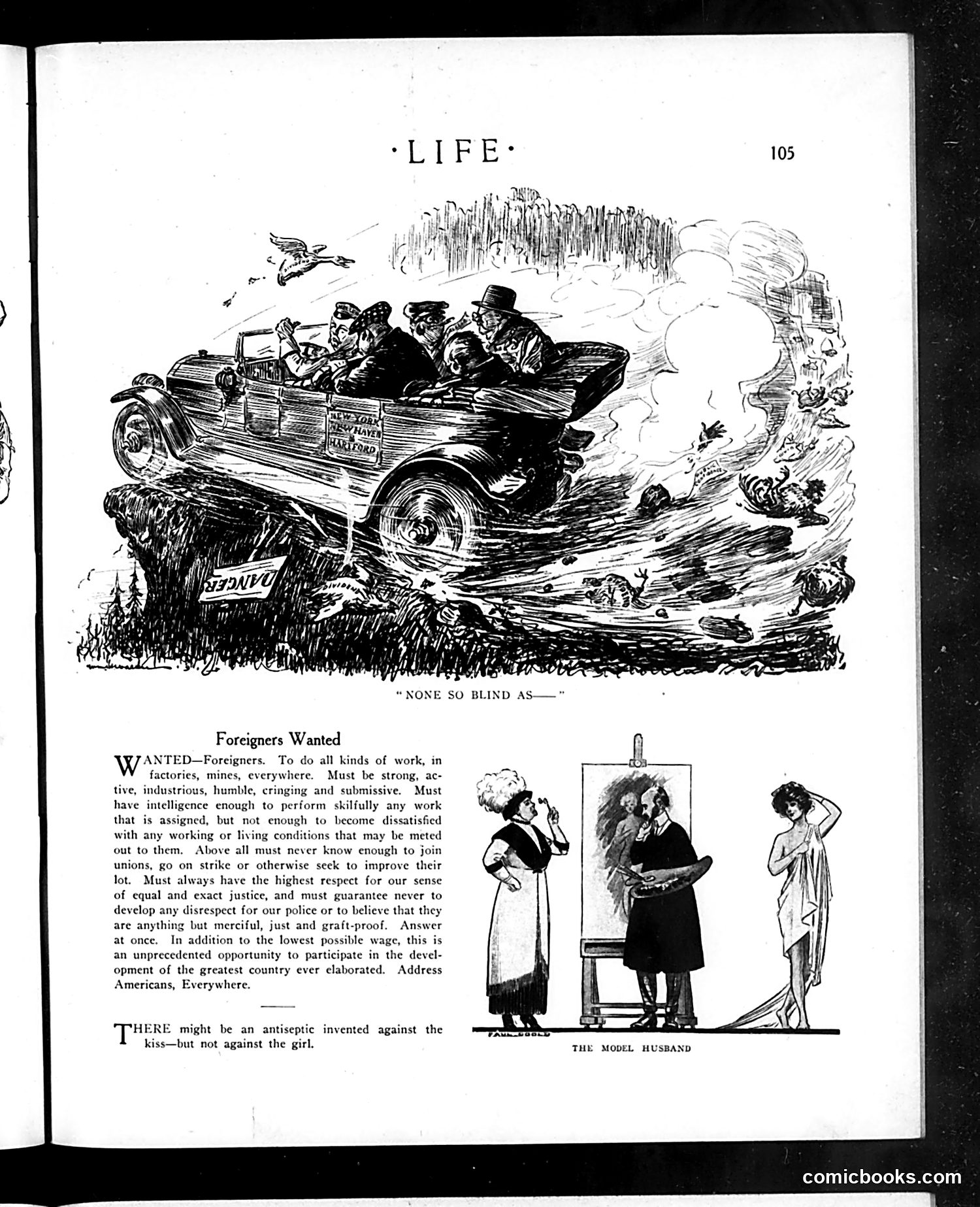
**Top Cartoon ("None So Blind As"):** A reckless automobile careens over a cliff with multiple passengers. The caption suggests willful ignorance or refusal to see danger—likely satirizing either dangerous driving practices or political/social blindness of the era. **"Foreigners Wanted" Text & Illustrations:** This section ironically advertises for foreign workers while listing exploitative demands: they must work everywhere, remain submissive, never unionize, and accept poor conditions. The satire criticizes American labor practices and xenophobia by exposing the hypocrisy of wanting foreign labor while denying workers' rights. **"The Model Husband" Illustration:** Shows a woman being measured/displayed like merchandise, sarcastically commenting on idealized notions of wifely submission and objectification in marriage. Both sections mock contemporary American attitudes toward labor and gender.
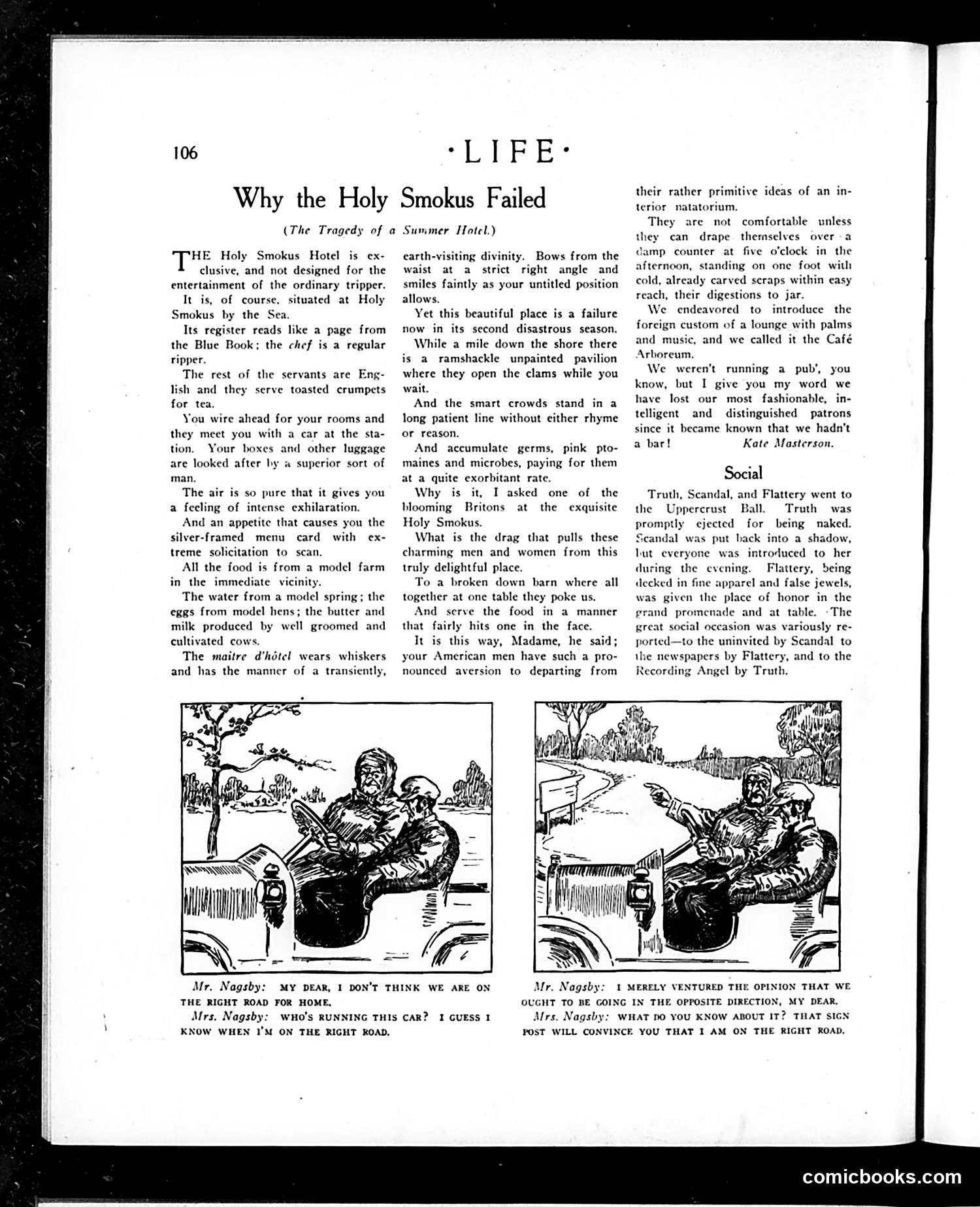
This page satirizes the Holy Smokus Hotel, a seaside resort that promises elegance but fails to deliver. The text mocks its pretensions—a "maître d'hôtel" with affected manner, food from a "model farm," silver-framed menus—while the actual experience involves crowded conditions, questionable hygiene ("accumulate germs, pink ptomaines and microbes"), and clam-opening chaos. The two cartoon panels show Mr. and Mrs. Nogsby lost while driving, disagreeing about directions. The humor derives from a common marital dynamic: the husband insists they're on the right road while the wife doubts him, and a road sign confirms her skepticism. Together, the article and cartoons exemplify *Life* magazine's satirical approach: exposing the gap between genteel pretense and messy reality in American leisure and domestic life.
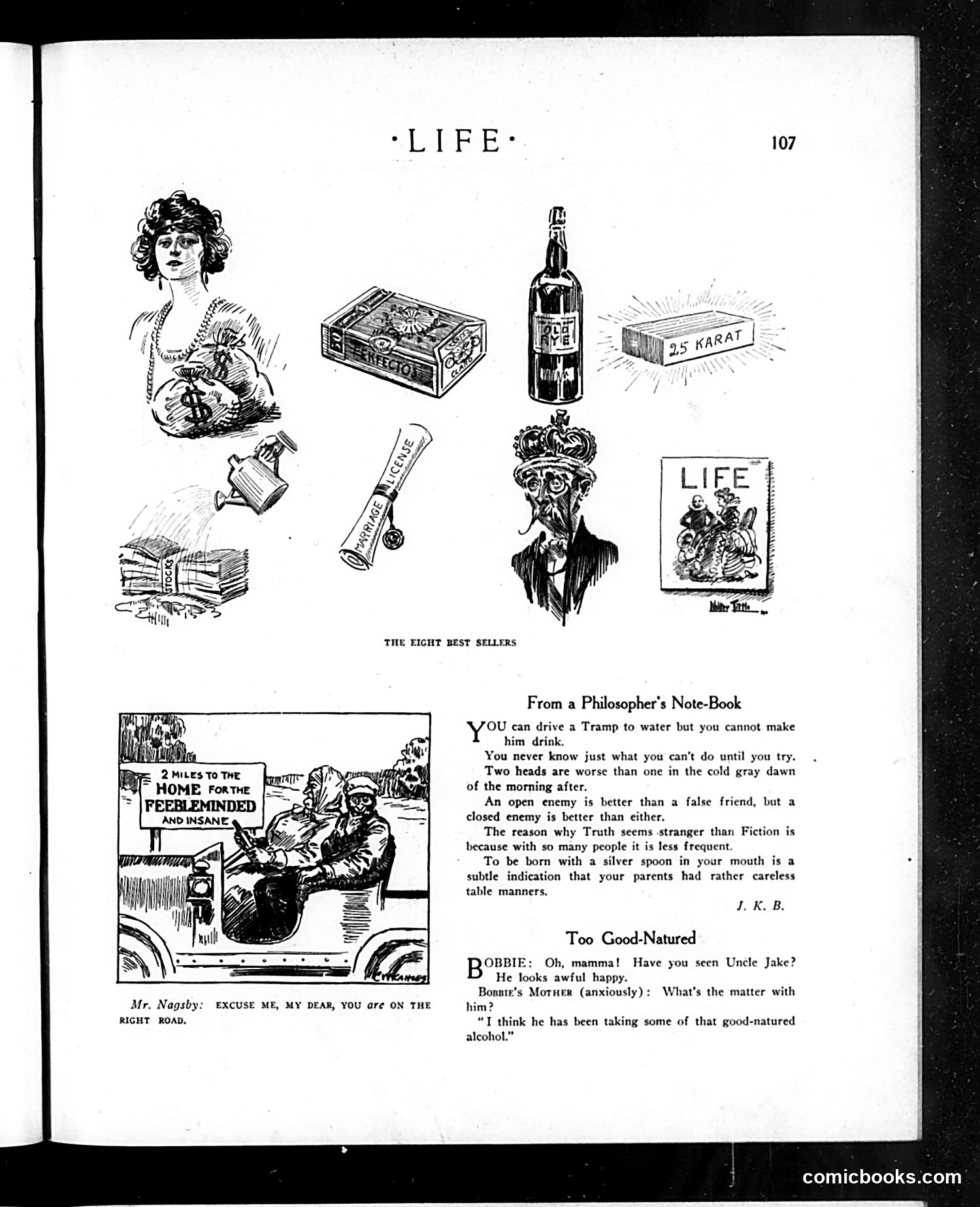
This page contains early 20th-century satirical humor typical of *Life* magazine's format. **Top Section ("The Eight Best Sellers"):** Shows illustrations of popular consumer goods and luxury items—perfume, jewelry, wine, cigars—satirizing materialism and consumer culture of the era. **"Mr. Naughty" Cartoon:** A domestic humor piece depicting a man on the "right road" (likely referring to moral or marital correctness), with the woman correcting his direction—standard gender-role comedy of the period. **"Philosopher's Note-Book":** Cynical aphorisms mocking pretentious philosophy and social conventions (e.g., jokes about hangovers, false friends, wealth's dubious benefits). **"Too Good-Natured":** A brief comic dialogue where "Uncle Jake" appears happy because he's been drinking alcohol. The humor relies on the period's common joke equating alcohol with artificial cheerfulness—a reference pre-dating Prohibition's strictness but reflecting ongoing temperance debates.
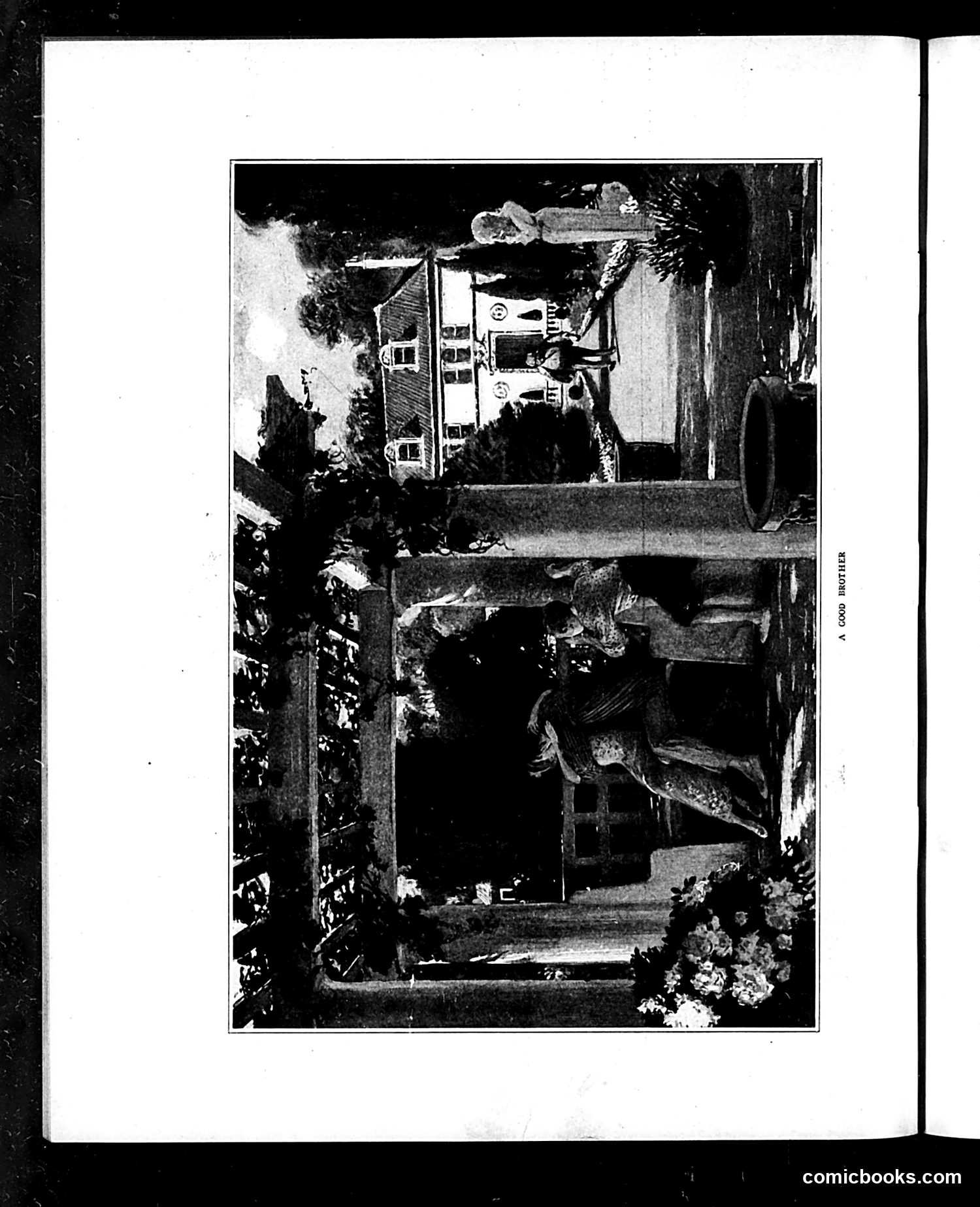
This appears to be a black and white photograph or illustration, likely from early 20th-century *Life* magazine, showing what seems to be a domestic or family scene. The image is rotated and difficult to parse clearly, but depicts an interior space with figures and furnishings. The caption "A Good Brother" suggests the cartoon comments on familial relationships or brotherly conduct. Without clearer visibility of specific details, expressions, or visible text within the image itself, I cannot definitively identify the particular social commentary, historical figures, or satirical point being made. The humor likely depends on context specific to the publication's era that isn't immediately apparent from this reproduction.
This is the opening of a serialized short story, not a political cartoon. The narrative satirizes changing gender roles in early 20th-century America. The plot concerns businessman Willets, who leaves his office to visit Miss Banler, a woman he met casually. Expecting a romantic afternoon, he instead meets her *secretary*—and finds their intellectual conversation so engaging that he loses track of time entirely. The story's title and setup suggest the secretary represents the "feminine pioneer": the educated, independent working woman emerging in that era. The satire targets Willets' shallow expectations (a romantic dalliance) being upended by a woman's professional competence and intellectual substance. The secretary's substantive engagement contrasts with Miss Banler's absence on business. This reflects contemporary anxieties and fascinations about women entering the workforce and challenging traditional domestic roles.
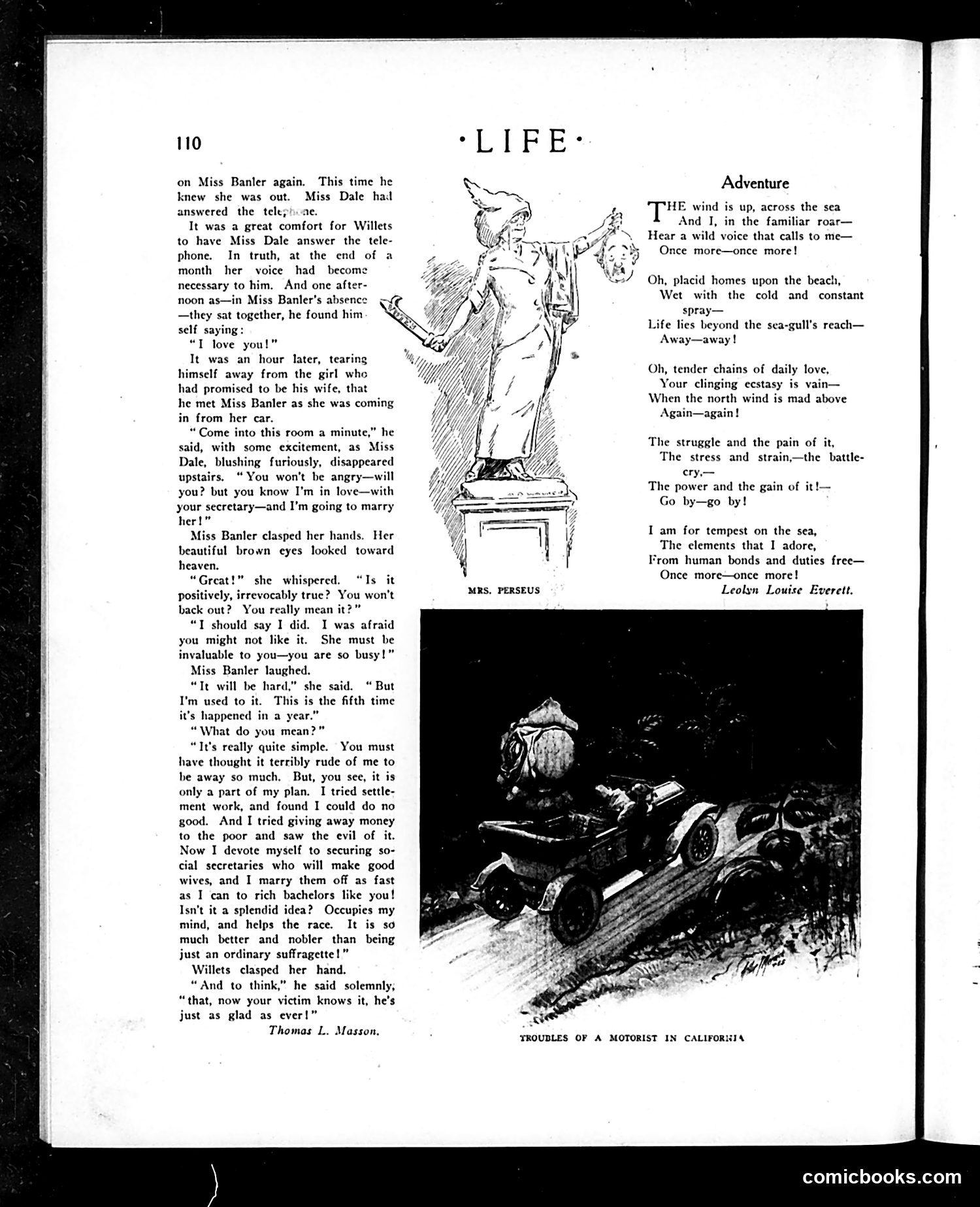
This page contains two distinct pieces: **Left side - Comic narrative by Thomas L. Masson:** A satirical story about a wealthy bachelor (Willets) who falls in love with his secretary (Miss Dale). When he excitedly announces his engagement to his employer Miss Banler, she reveals her scheme: she deliberately absents herself to enable her secretaries to marry rich bachelors, then replaces them. This is her fifth such occurrence in a year. The joke targets early-20th-century feminism—Miss Banler dismisses traditional suffragette activism as inferior to her "eugenic matchmaking," essentially admitting to manufacturing marriages for social climbing while framing it as noble work. **Right side - Poem "Adventure" by Leolyn Louise Everett:** Romantic verses celebrating escape from domestic life and societal obligations, with imagery of tempests and freedom. Accompanied by two illustrations: a classical statue (Mrs. Perseus) and a motorist crash scene in California. The page juxtaposes domestic/marital themes with escapist fantasy, likely reflecting period anxieties about changing gender roles and women's independence.
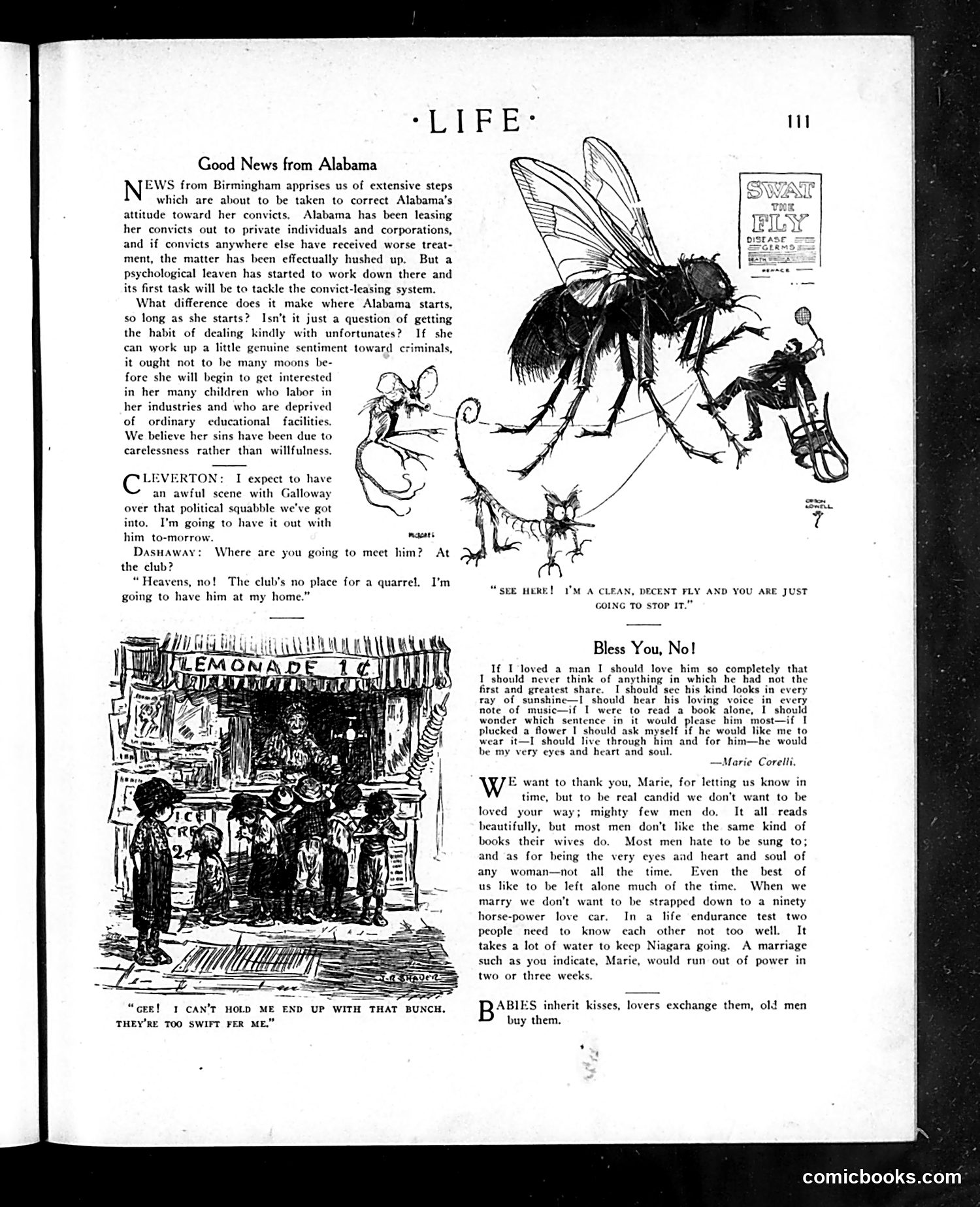
**"Good News from Alabama"** addresses Alabama's convict-leasing system—a post-Civil War practice where the state leased imprisoned workers (disproportionately Black men) to private corporations and individuals, often under brutal conditions. The article expresses cautious optimism that reform efforts have begun, suggesting Alabama's callousness toward convicts stems from "carelessness rather than willfulness" and might extend to improving treatment of child laborers in industry. **The cartoon featuring the giant fly** illustrates the convict-leasing problem through metaphor: the large insect represents the oppressive system; the small figures (including someone on a bicycle) are victims. The caption "See here! I'm a clean, decent fly" suggests the system presents itself as legitimate while causing harm. **"Bless You, No!"** satirizes Marie Corelli's romantic ideal of complete marital devotion, arguing that healthy marriages require independence and occasional solitude—not total enmeshment. The editors advocate for sustainable love over consuming passion.
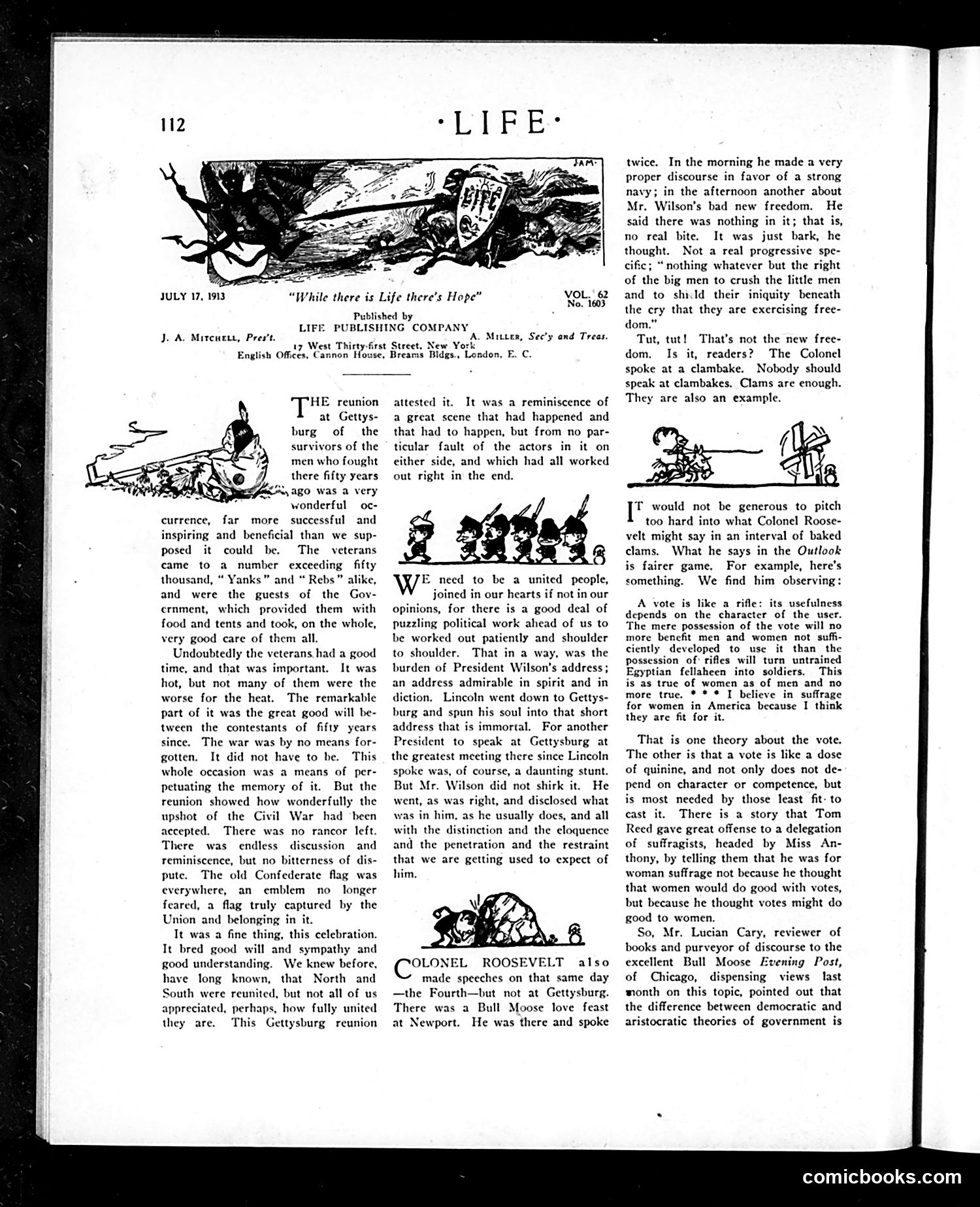
This page discusses the 50th anniversary reunion at Gettysburg of Civil War veterans (1863-1913). The main article praises President Wilson's dignified speech there, comparing it favorably to Lincoln's famous address. It celebrates the reconciliation between North and South, noting the Confederate flag now appears without fear—"a flag truly captured by the Union." The satire targets **Theodore Roosevelt**, who was speaking the same day at a clambake in Newport as leader of the **Bull Moose Party** (Progressive Party, established 1912). Roosevelt criticized Wilson's "New Freedom" policies, calling them toothless—mere "bark" allowing big men to crush little men while claiming freedom. The cartoonist mocks Roosevelt for making political speeches at a clambake ("Nobody should speak at clambakes. Clams are enough"), suggesting the venue undermines his seriousness. The piece implies Roosevelt is grandstanding while Wilson demonstrated statesmanship.
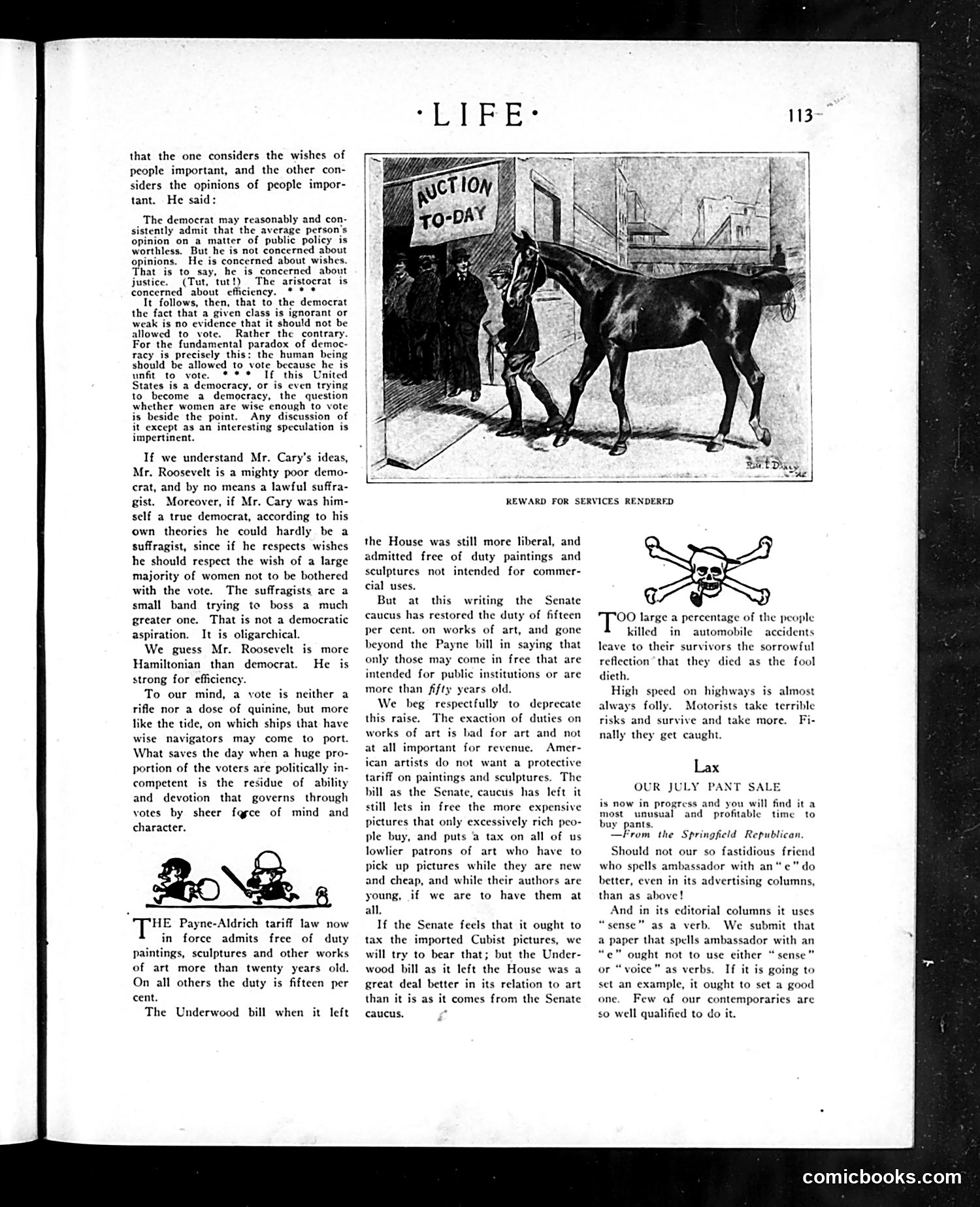
**Main Cartoon:** The sketch shows a horse being led to auction with a "AUCTION TO-DAY" sign, labeled "REWARD FOR SERVICES RENDERED." This satirizes politicians or public figures being "sold off" or discarded after their usefulness ends—likely referencing contemporary political corruption or the disposal of political allies. **Political Context:** The page debates democracy and voting rights, quoting someone named "Mr. Cary" on whether average citizens are wise enough to vote. The text critiques both President Roosevelt (called insufficiently democratic) and women's suffragists (called oligarchical for imposing votes on unwilling women). This reflects early 1910s debates over women's suffrage and democratic theory. **Secondary Issues:** The page discusses tariff policy on imported artwork, lamenting Senate restrictions on duty-free art imports. It also warns against dangerous highway speeds in automobiles—an emerging social concern. The satire targets political hypocrisy and the tension between democratic ideals and actual practice.
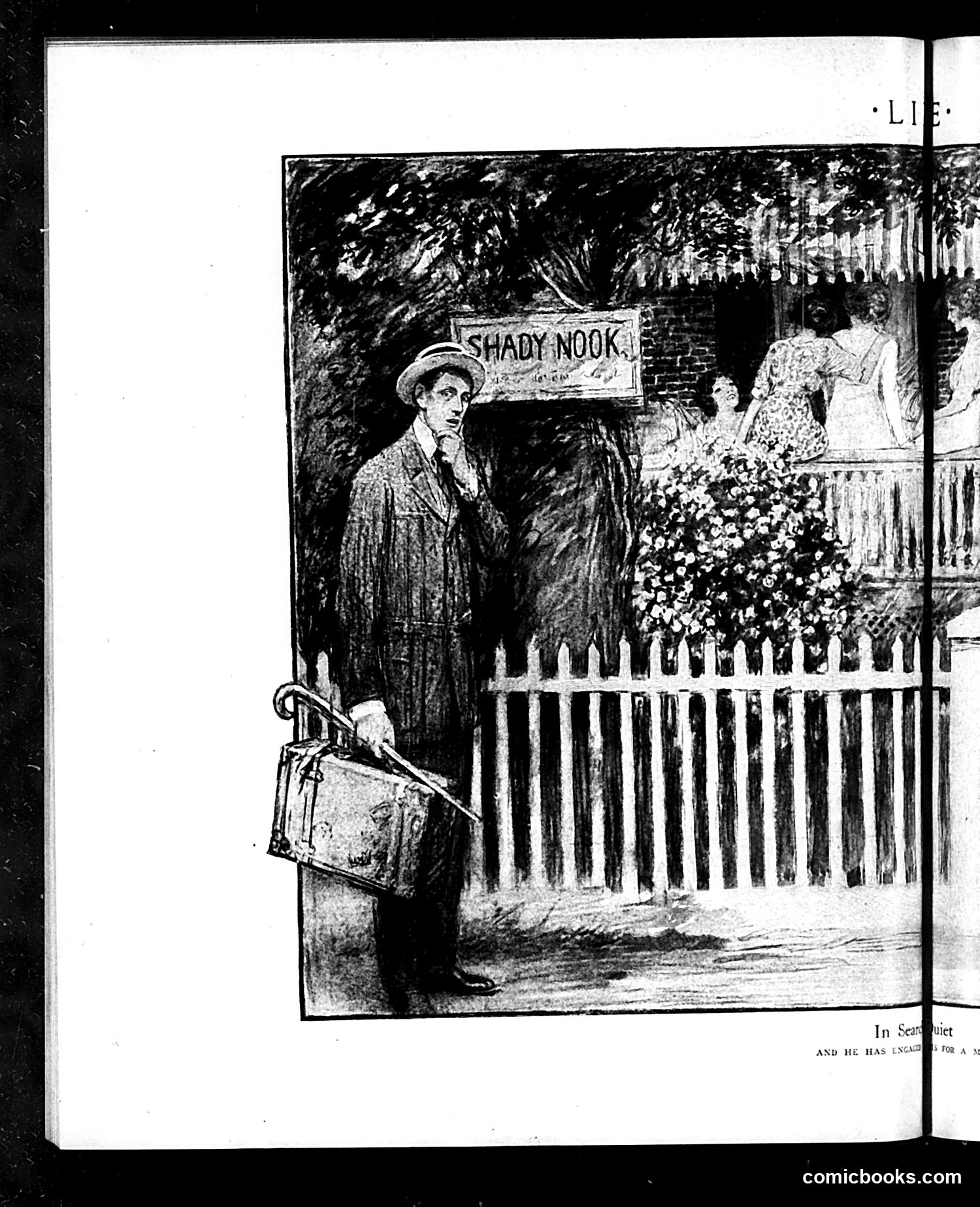
This appears to be a satirical illustration from *Life* magazine depicting a man in a bowler hat and overcoat standing outside a location marked "SHADY NOOK." He carries a suitcase, suggesting he's arriving for an illicit rendezvous. The sign and his furtive posture indicate deception—the "shady nook" being a disreputable establishment. Beyond the visible sign and figures, the OCR text is largely corrupted and illegible, making it impossible to identify the specific political or social figures being satirized or to determine the precise joke's context. The cartoon likely mocks infidelity, corruption, or moral hypocrisy typical of *Life*'s social satire from the early 20th century, but without legible caption text, the exact target and meaning remain unclear.
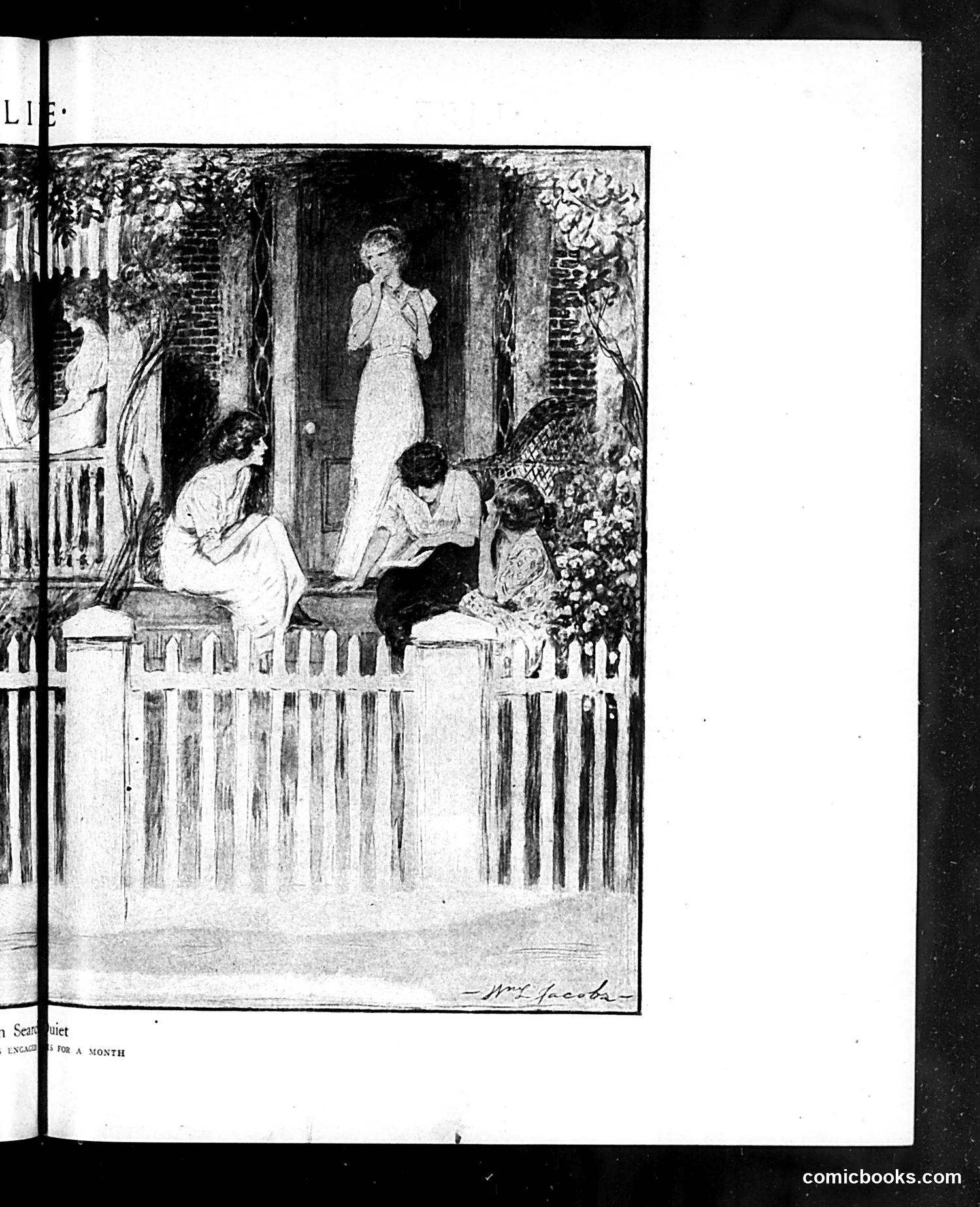
This appears to be an illustration from *Life* magazine showing a domestic scene on a porch. Several women in light-colored dresses are gathered, with one standing in a doorway and others seated or standing nearby. The setting suggests an upper-middle-class home with decorative elements like flowering vines. The OCR text is largely illegible, but partial phrases suggest this may be satirizing domestic life or social conventions—possibly about courtship, marriage, or women's leisure activities. The sketch's refined style and domestic subject matter are typical of *Life*'s social satire from the early 20th century. Without clearer text or caption, I cannot definitively identify the specific social commentary or who these figures represent. The illustration likely mocks contemporary attitudes about women's social roles or romantic customs.
This is a book review column, not a political cartoon. The page discusses the state of American fiction circa 1913. The critic celebrates a shift in American letters: previously, American books were so poor that reviewers had to rely on English, French, and German works. Now, the critic notes with satisfaction, American literature is improving dramatically. The reviews highlighted—particularly "Comrade Yetta" by Albert Edwards—exemplify what the critic calls the "new fiction": socially conscious works examining labor conditions, immigrant life, and reform movements on New York's East Side. The critic praises this emerging realism as having "scientific and religious" as well as artistic grounding. The "Confidential Book Guide" header is decorative; the actual content is straightforward literary criticism celebrating American letters' maturation toward serious social engagement rather than melodramatic escapism.
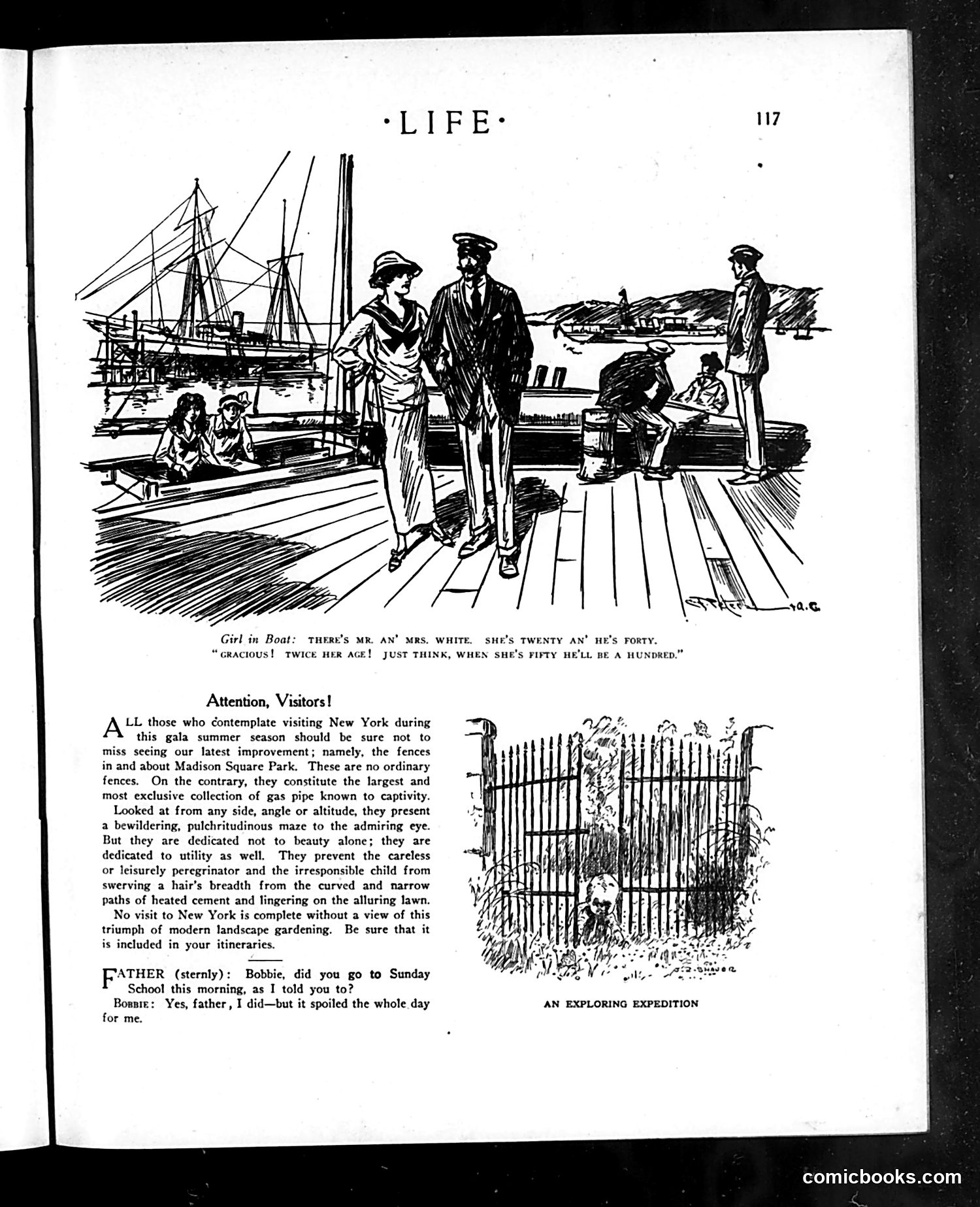
**Top Cartoon - "Girl in Boat":** A young woman comments on an older couple (Mr. and Mrs. White), noting the age gap with mild shock. The joke satirizes May-December marriages: she's twenty, he's forty, and the math humorously illustrates the widening age disparity—when she reaches fifty, he'll be one hundred. This mocks both the marriages themselves and society's acceptance of them. **"Attention, Visitors!" Article:** Heavy sarcasm. Life sarcastically praises Madison Square Park's new gas-pipe fencing as a major tourist attraction and "triumph of modern landscape gardening." The real point: the fences are ugly, utilitarian eyesores designed merely to restrict public access and prevent children from enjoying the lawn. The ornate language masks bitter criticism of the park's deterioration and exclusionary policies. **"Father and Bobbie" Comic:** A brief joke about a child forced to attend Sunday School finding it so unpleasant it ruined his entire day—poking fun at mandatory religious observance and its joyless effect on children.
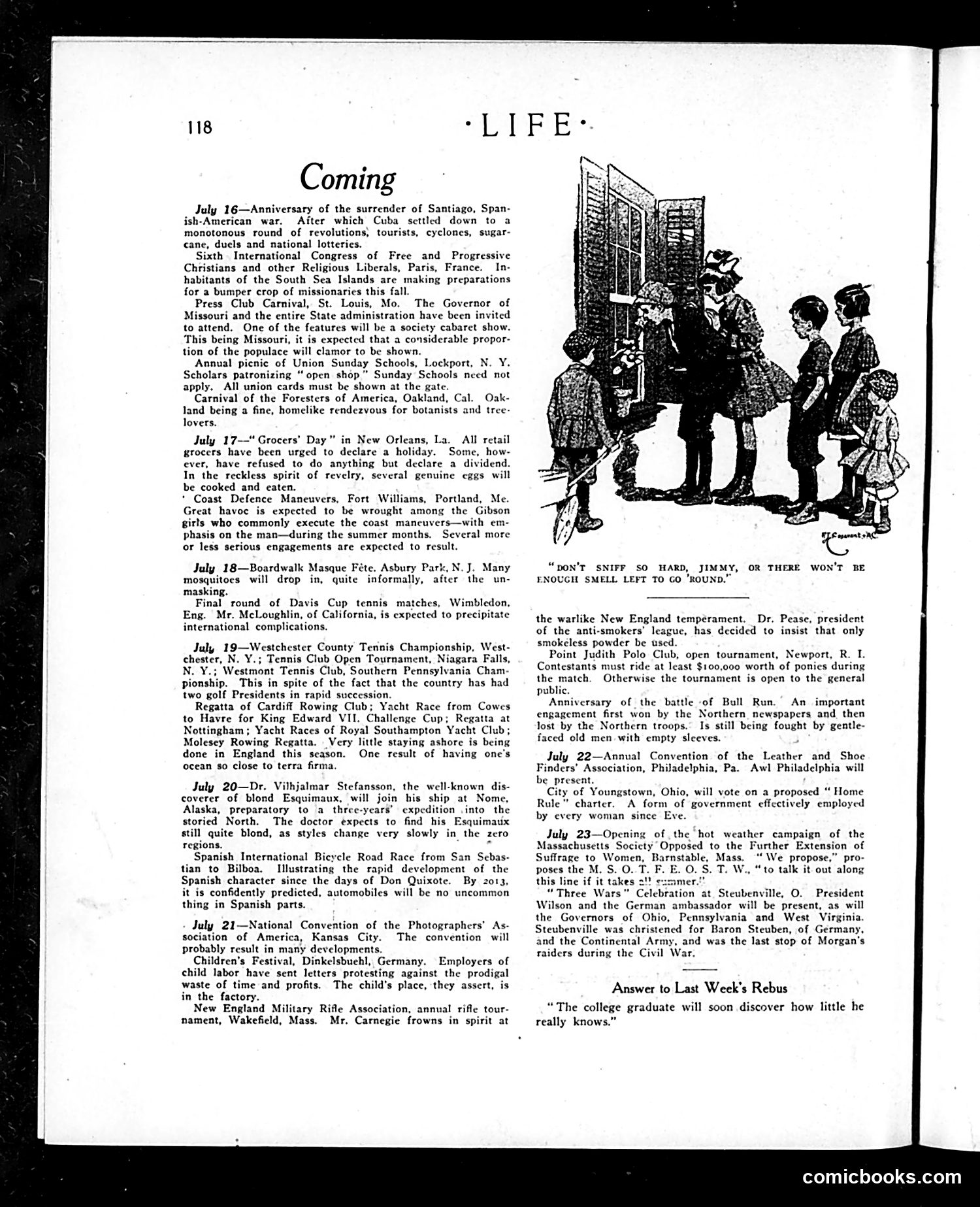
This single-panel cartoon depicts two adults (likely parents or guardians) scolding a child named Jimmy for sniffing something too enthusiastically. The caption warns him not to use up the smell by sniffing too hard, implying there's a limited supply to share. The joke appears to be a humorous domestic scene playing on children's tendency to investigate things through smell. The satire likely targets parental exasperation or the absurdity of rationing sensory experiences—treating a smell as if it's a consumable resource that can be "used up." The cartoon accompanies Life magazine's "Coming" events column, which itself uses satirical commentary on upcoming social and cultural events. The style is typical of early 20th-century American humor magazines, employing gentle, family-friendly satire about everyday life rather than overtly political commentary.
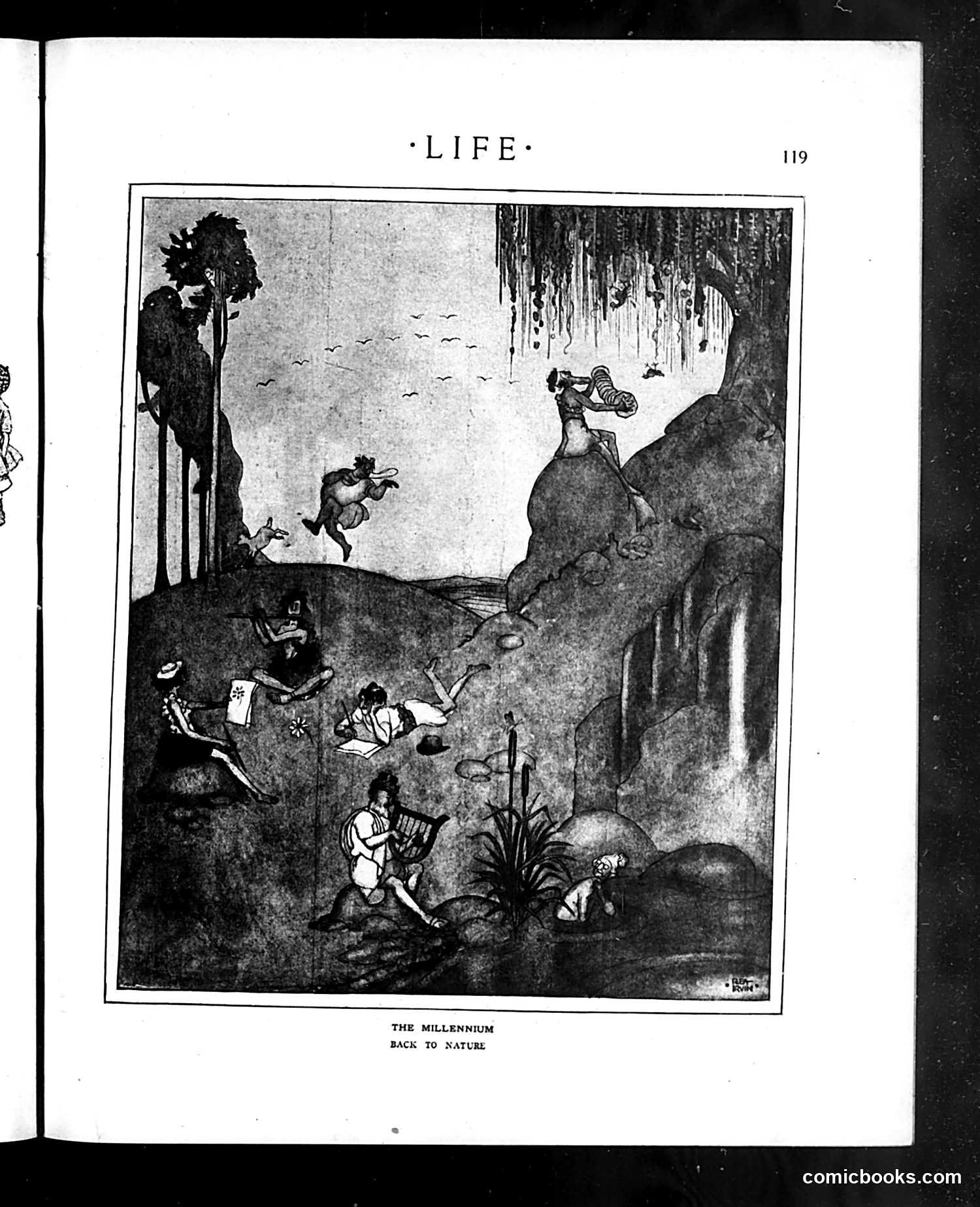
This illustration satirizes the "Back to Nature" movement—a early 20th-century trend where affluent urbanites romanticized primitive living and wilderness retreat. The cartoon depicts wealthy figures (identifiable by their formal dress and ornaments visible in the foreground) attempting rustic pursuits in a landscape setting. The title "The Millennium" suggests ironic commentary: the artist mocks the idea that returning to nature represents some idealized future state. The satire likely critiques the movement's naïveté and class pretension—wealthy people playing at rusticity while maintaining their urban refinements. The mountainous terrain and various figures scattered across the scene emphasize the disconnect between romantic ideology and practical reality. This reflects Life magazine's characteristic social commentary on contemporary trends and fashionable affectations.
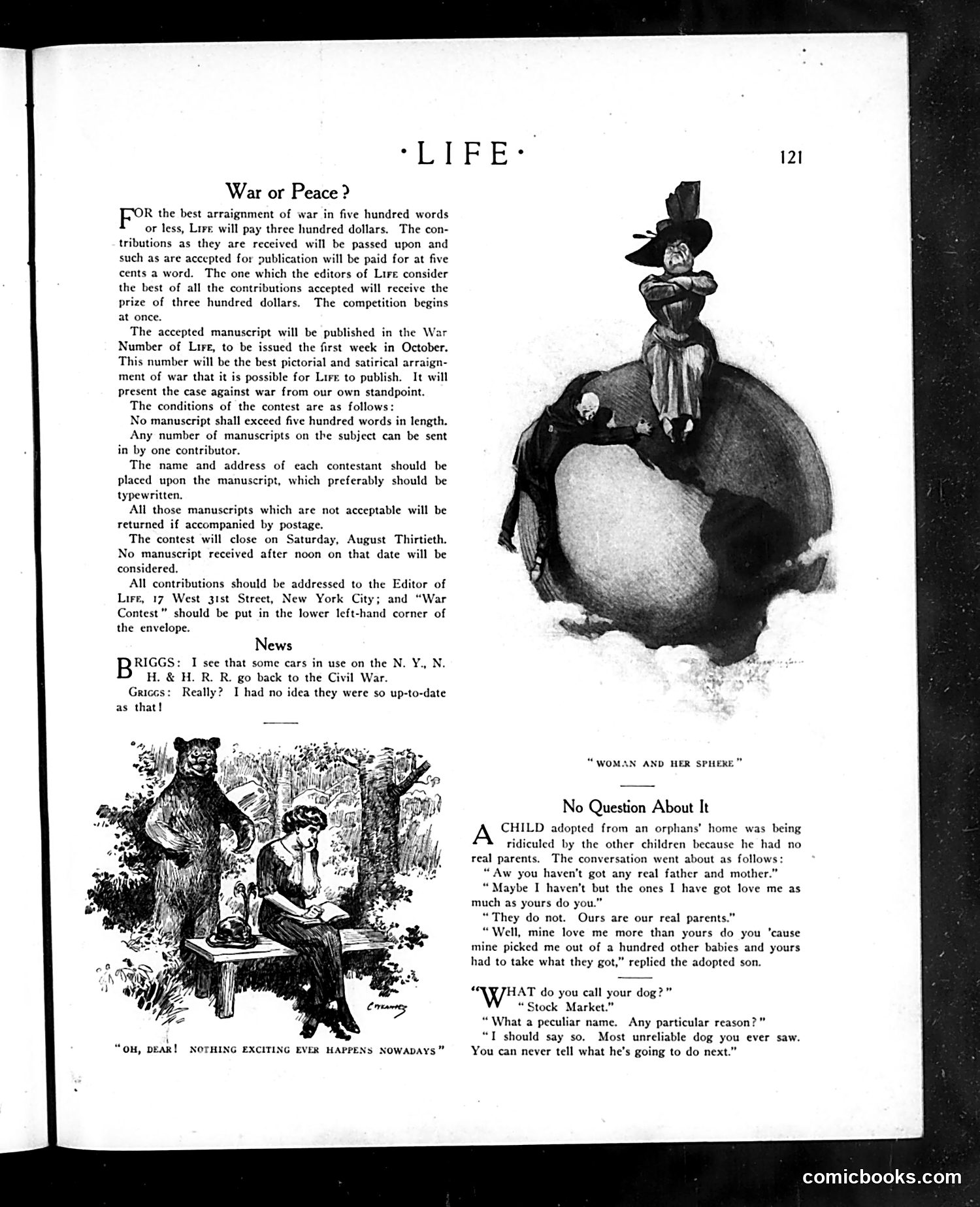
This Life magazine page contains a war-opposition contest announcement and two humor pieces. **"War or Peace?" Contest**: Life solicits anti-war essays (500 words max) for a special October "War Number," offering prizes up to $300. This reflects early 20th-century pacifist sentiment before American WWI entry. **"News" Section**: A brief joke about outdated railroad cars from the Civil War era, satirizing poor maintenance or backward infrastructure. **"Woman and Her Sphere"**: Two separate anecdotes. The first presents an adopted child's witty rebuttal to peers mocking his lack of biological parents—arguing chosen children are more valued. The second is a quip about a dog named "Stock Market" because it's unpredictable, likely referencing market volatility and economic anxiety of the period. The cartoons use working-class or domestic scenarios to make satirical points about contemporary American concerns: war, infrastructure, family, and economic uncertainty.
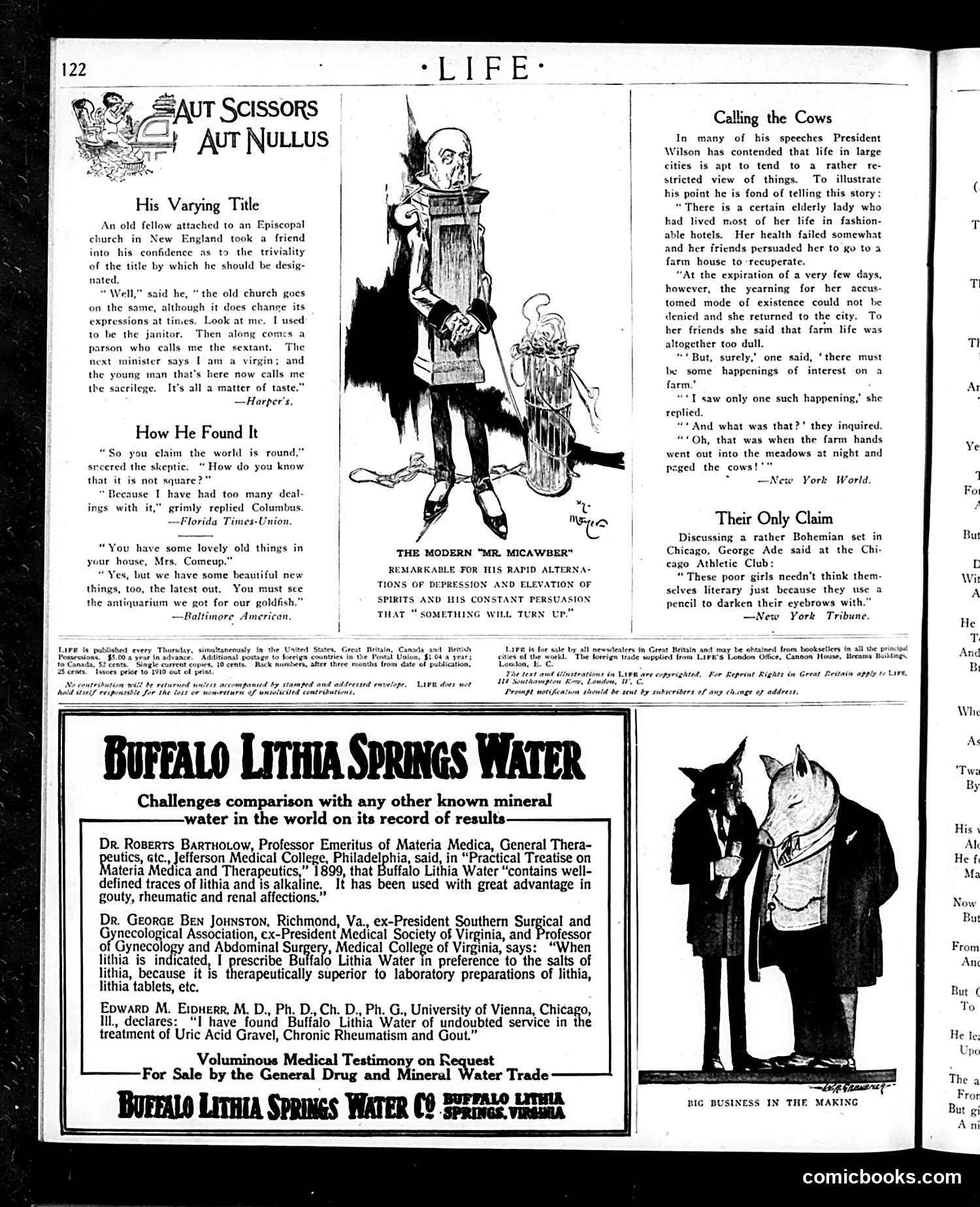
This page presents a cartoon and humorous anecdotes from *Life* magazine, a satirical publication. **The Main Cartoon:** Labeled "The Modern 'Mr. Micawber,'" it depicts a tall, skeletal figure alternating between elation and despair—his posture shifts dramatically between the two stances shown. The character embodies perpetual emotional volatility, always expecting circumstances to improve. Micawber is Charles Dickens's famously optimistic but impractical character who repeatedly insists "something will turn up." The cartoon satirizes a modern type of person who cycles through unrealistic hope and depression without taking action. **The Anecdotes:** The page includes three humorous pieces mocking urban attitudes, gender stereotypes, and pretension—typical of *Life*'s satirical voice. These target city dwellers' disconnection from rural life and young women feigning literary sophistication. The page also contains period advertisements for Buffalo Lithia Springs Water, typical of early-20th-century magazine content.
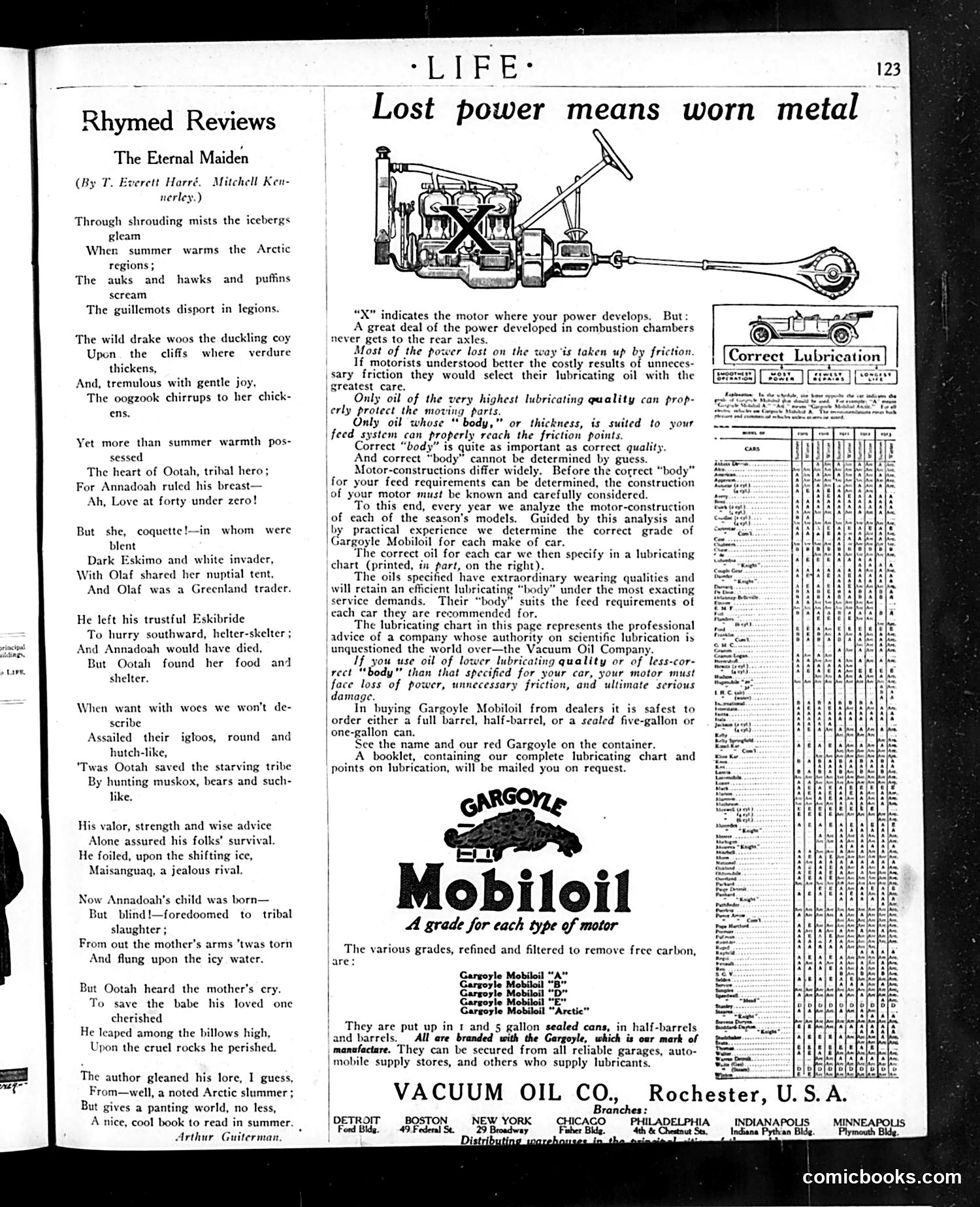
This page contains two distinct elements: **Left side - "The Eternal Maiden" (poem review):** A satirical rhymed review of what appears to be a melodramatic Arctic romance novel. The poem mocks the overwrought narrative of Ootah, an Inuit hero who loves Annadoah (a mixed-race woman), loses her to a European trader, then heroically saves the tribe from starvation. The final irony—their child is born blind and will be killed by tribal custom—exemplifies the page's gentle mockery of sentimental Victorian adventure fiction. The reviewer concludes it's entertaining summer reading. **Right side - Gargoyle Mobiloil advertisement:** A substantial commercial promoting motor oil, using technical language about engine friction, "body" (viscosity), and the company's proprietary lubrication charts for different car models. This represents the magazine's revenue source. The juxtaposition is typical of *Life*'s format: literary satire alongside advertising, with no thematic connection between content and commerce.
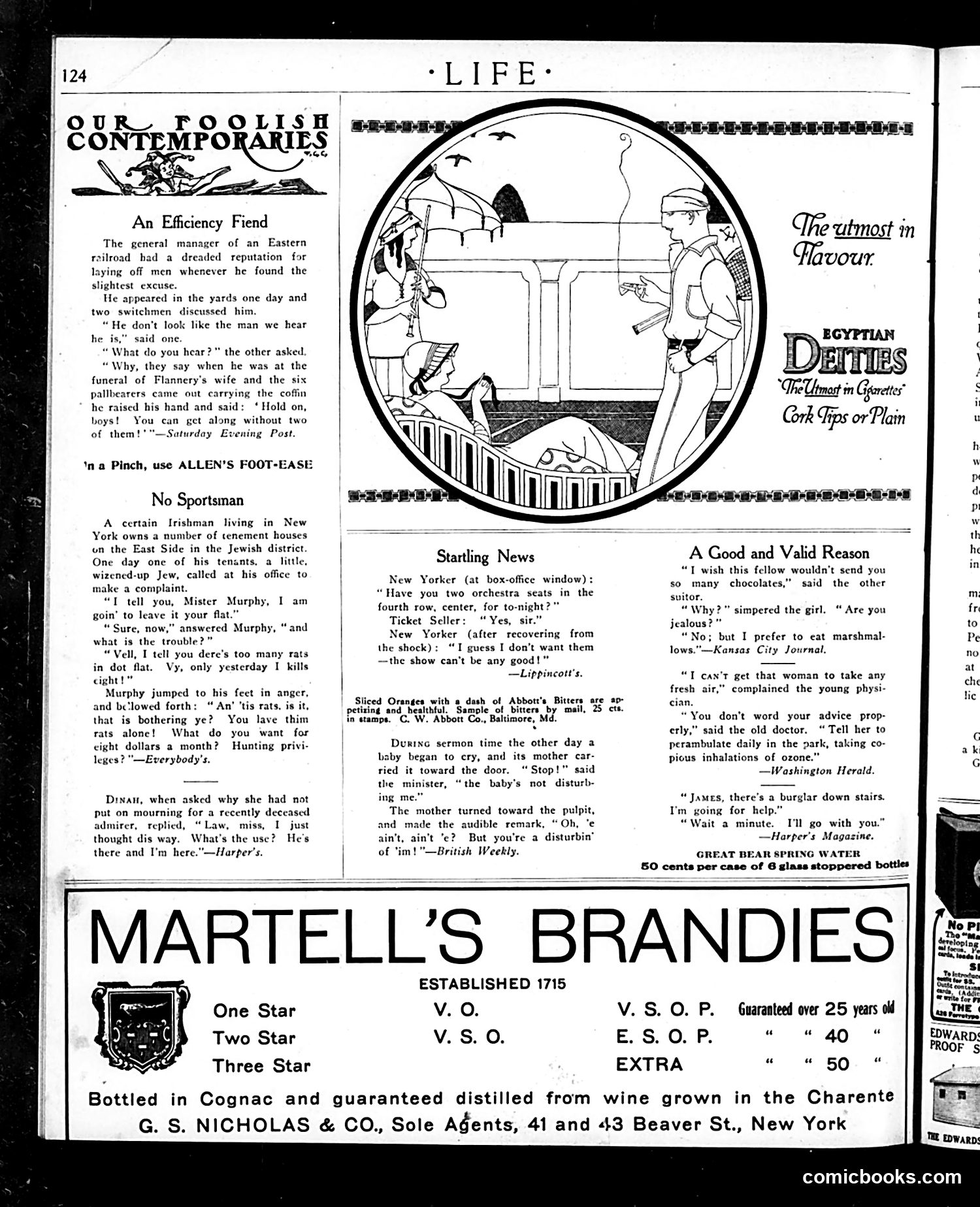
This page from *Life* magazine contains multiple brief humorous anecdotes typical of early 20th-century satirical journalism, interspersed with advertisements. The main cartoon/story "An Efficiency Fiend" satirizes ruthless corporate management—specifically a railroad executive notorious for firing workers at any opportunity. The joke culminates in an anecdote where he allegedly told pallbearers at a funeral they could manage with fewer people, reducing even a funeral cortege to cut costs. Other brief jokes mock various social types: an Irish landlord indifferent to his tenant's rat problem, a woman untroubled by a deceased suitor's death, and everyday absurdities like a theatergoer shocked to get decent orchestra seats. The humor reflects period anxieties about efficiency-obsessed industrial management, immigrant life in tenements, and courtship customs. The cartoons use exaggeration and wordplay typical of *Life's* satirical format, targeting recognizable social figures and behaviors rather than specific named individuals. The page is primarily advertisement space, with Martell's Brandies dominating the lower section.
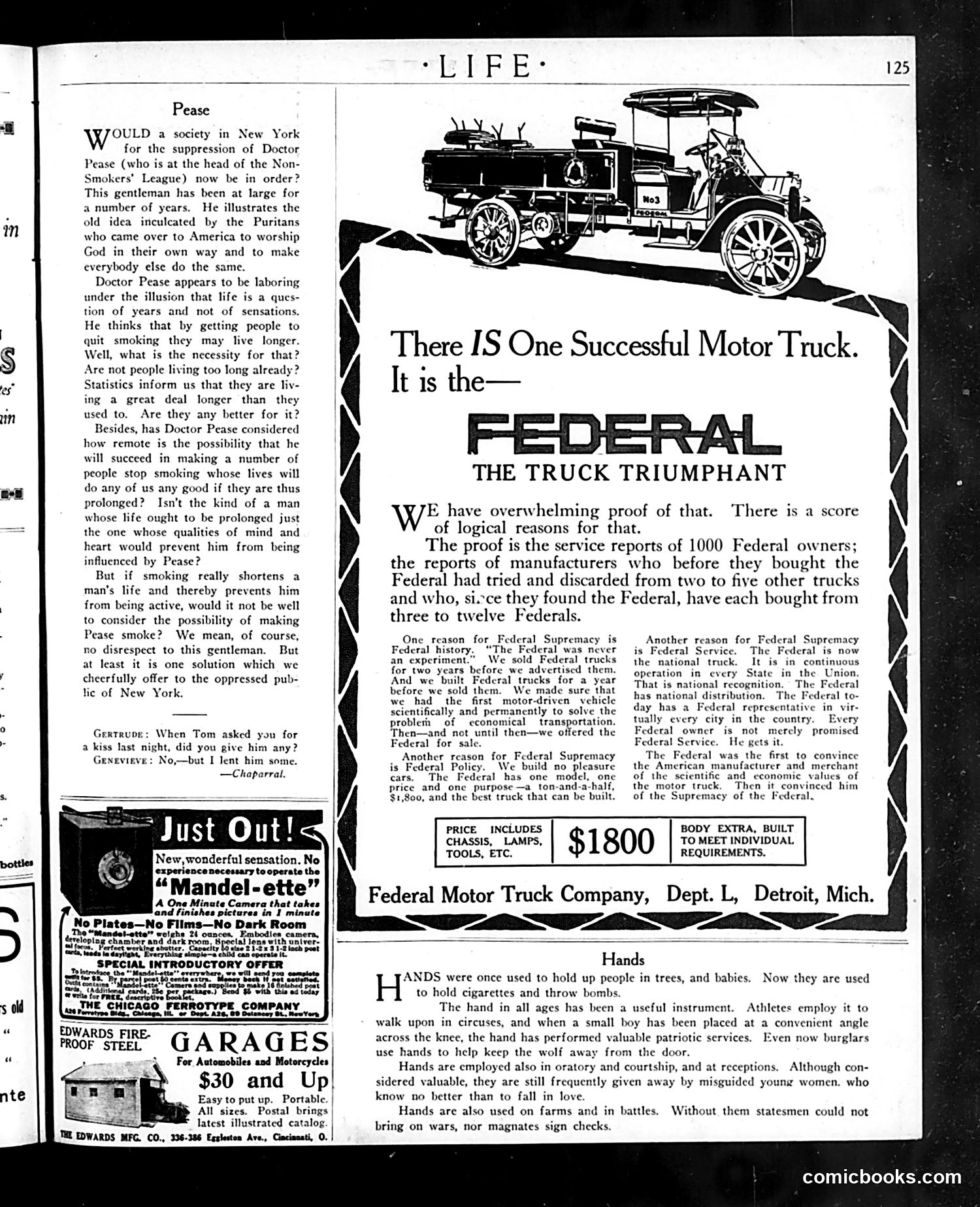
This page contains **satirical commentary on anti-smoking activism** alongside a **commercial advertisement**. ## The Pease Cartoon/Editorial The text mocks **Doctor Pease**, head of the Non-Smokers' League, comparing him to rigid Puritans who impose their morality on others. The satire argues that: - Pease wrongly believes extending life through smoking cessation is worthwhile - People already live longer than before—implying this isn't necessarily good - Interfering with personal freedoms (smoking) is tyrannical, even if well-intentioned The humor relies on **libertarian individualism**: the writer sarcastically suggests Pease himself should smoke rather than restrict others' choices. This reflects early 20th-century resistance to Progressive-era health reformism. ## The Federal Motor Truck Advertisement The dominant right-hand page advertises Federal trucks at $1,800, emphasizing reliability through service reports from 1,000 owners and manufacturer testimonials. ## Minor Content The "Hands" essay discusses historical uses of hands, while lower sections advertise a film camera and steel garages.
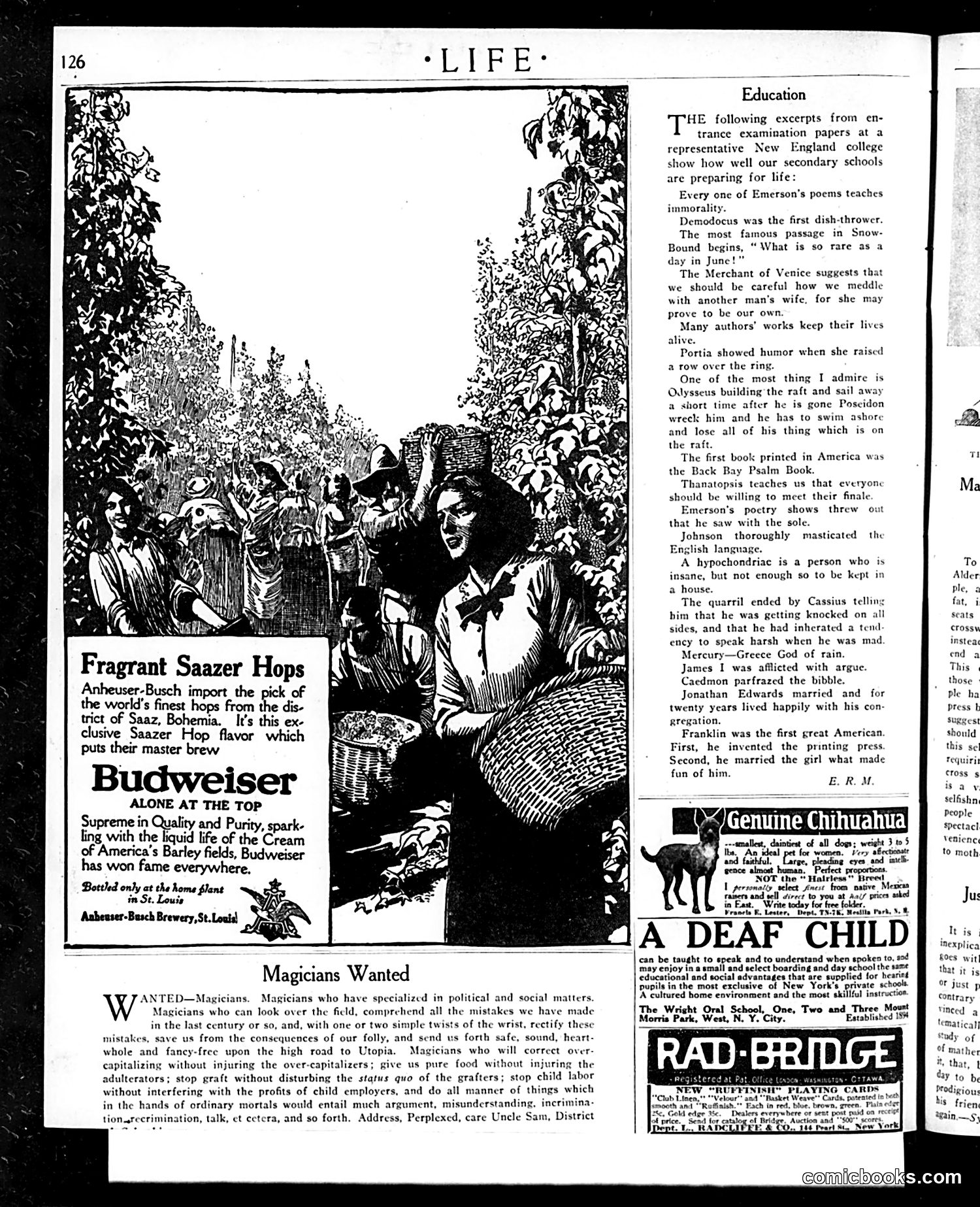
This page satirizes American secondary education through fake college entrance exam answers. The "Education" section presents deliberately absurd student responses to literature and history questions—evidence that schools are failing to prepare students for intellectual life. Examples of the humor: students claim "Emerson's poems teach immorality," define a hypochondriac as "insane, but not enough so to be kept in a house," and state "Mercury [is the] Greece God of rain." The satire suggests students are either illiterate or their teachers are incompetent. The accompanying "Magicians Wanted" advertisement (likely tongue-in-cheek) sarcastically requests magicians who can fix society's problems—implying that fixing education and social ills requires actual magic, not ordinary solutions. The page critiques both educational standards and, implicitly, the gap between what schools claim to teach and what students actually learn.
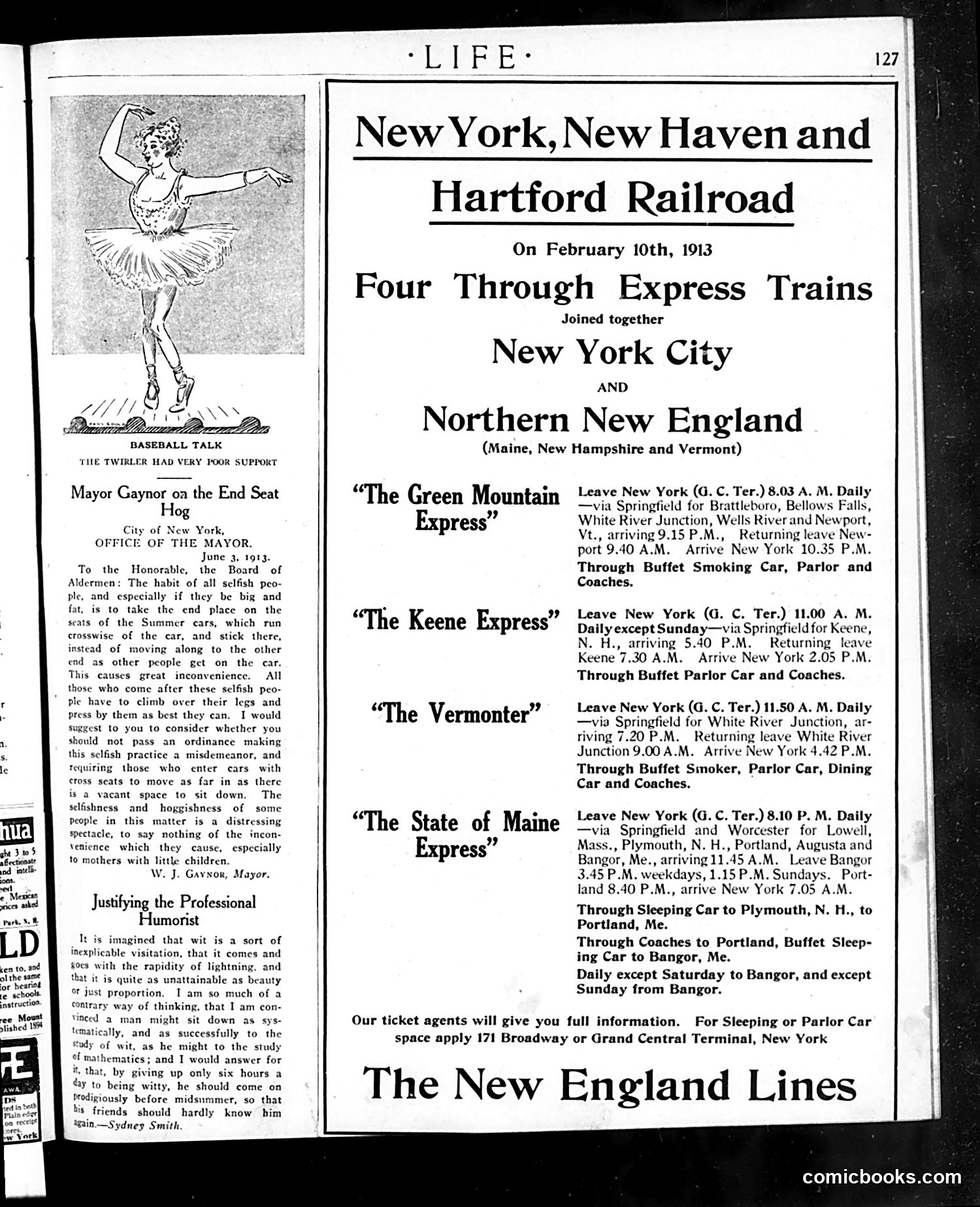
This page mixes social commentary with railroad advertising. The main cartoon satirizes New York Mayor William Gaynor, shown as an overweight ballet dancer labeled "The Twirler Had Very Poor Support." The joke is ironic: Gaynor's official letter (reproduced below) complains about selfish, "big and fat" people hogging end seats on streetcars—yet the cartoon depicts Gaynor himself as precisely that figure, suggesting he's guilty of the very behavior he's condemning. The secondary content includes a quote defending professional humorists and a substantial railroad advertisement for the New York, New Haven and Hartford Railroad, promoting four express trains to New England. The satire critiques Gaynor's hypocrisy and self-unawareness, using visual caricature to underscore his letter's moral tone.
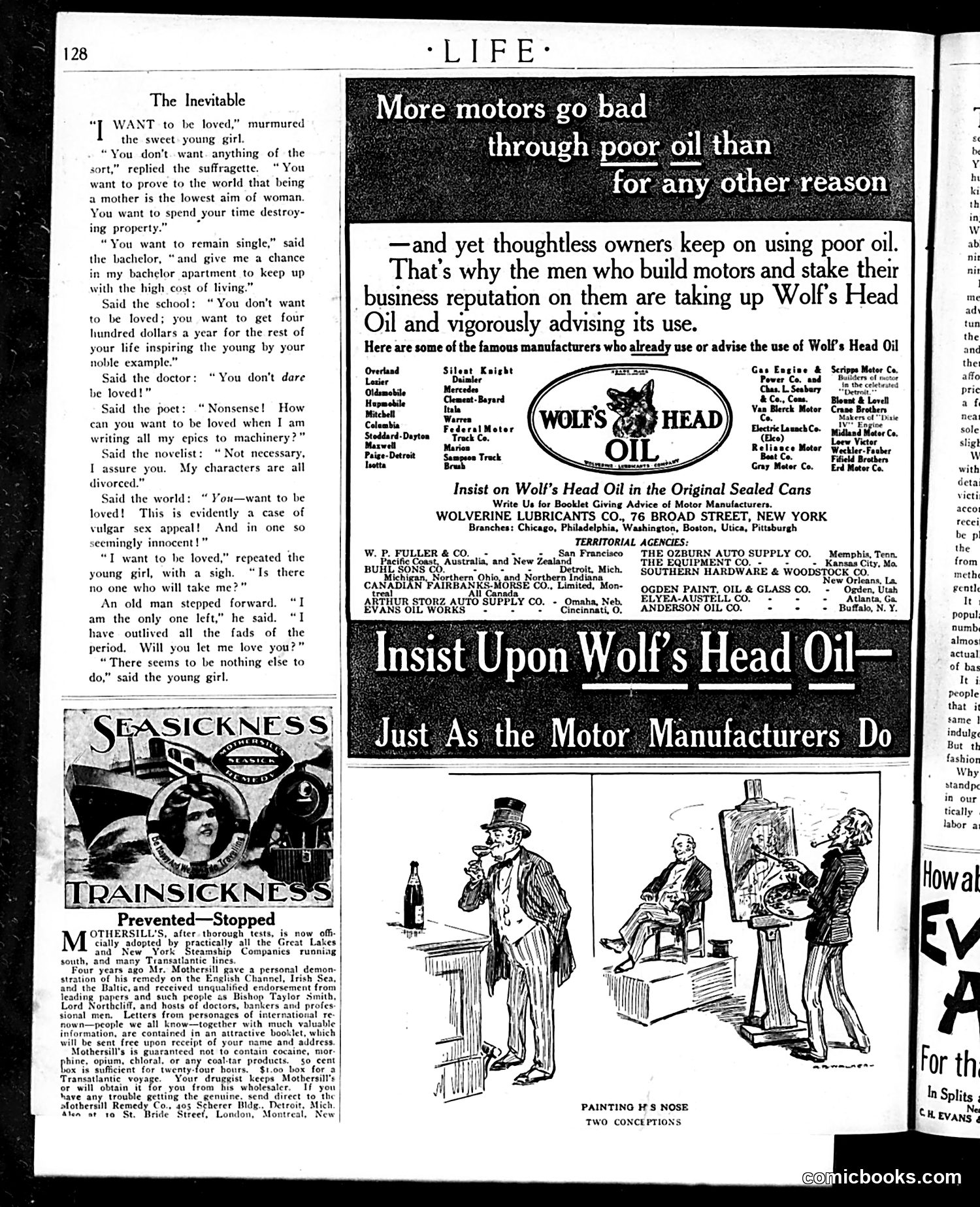
**Main Content:** This page features a satirical short story titled "The Inevitable" mocking early 20th-century social movements and expectations around women's roles. **The Satire:** A young woman declares "I want to be loved," but is confronted by various representatives of modern society—a suffragette, bachelor, school administrator, doctor, and poet—each interpreting her desire through their own ideological lens. The suffragette accuses her of wanting motherhood; the bachelor sees her as competition for living costs; the school wants her as an inspirational worker; the doctor dismisses sentiment; the poet suggests marriage is obsolete. Only an elderly man remains willing to accept her simply as she is. The joke critiques how contemporary movements (feminism, modernism, commercialism) had become so dogmatic that genuine human emotion became lost in ideology. **Secondary Content:** The page includes unrelated period advertisements for seasickness remedy and motor oil—typical of Life's mixed editorial/commercial format.
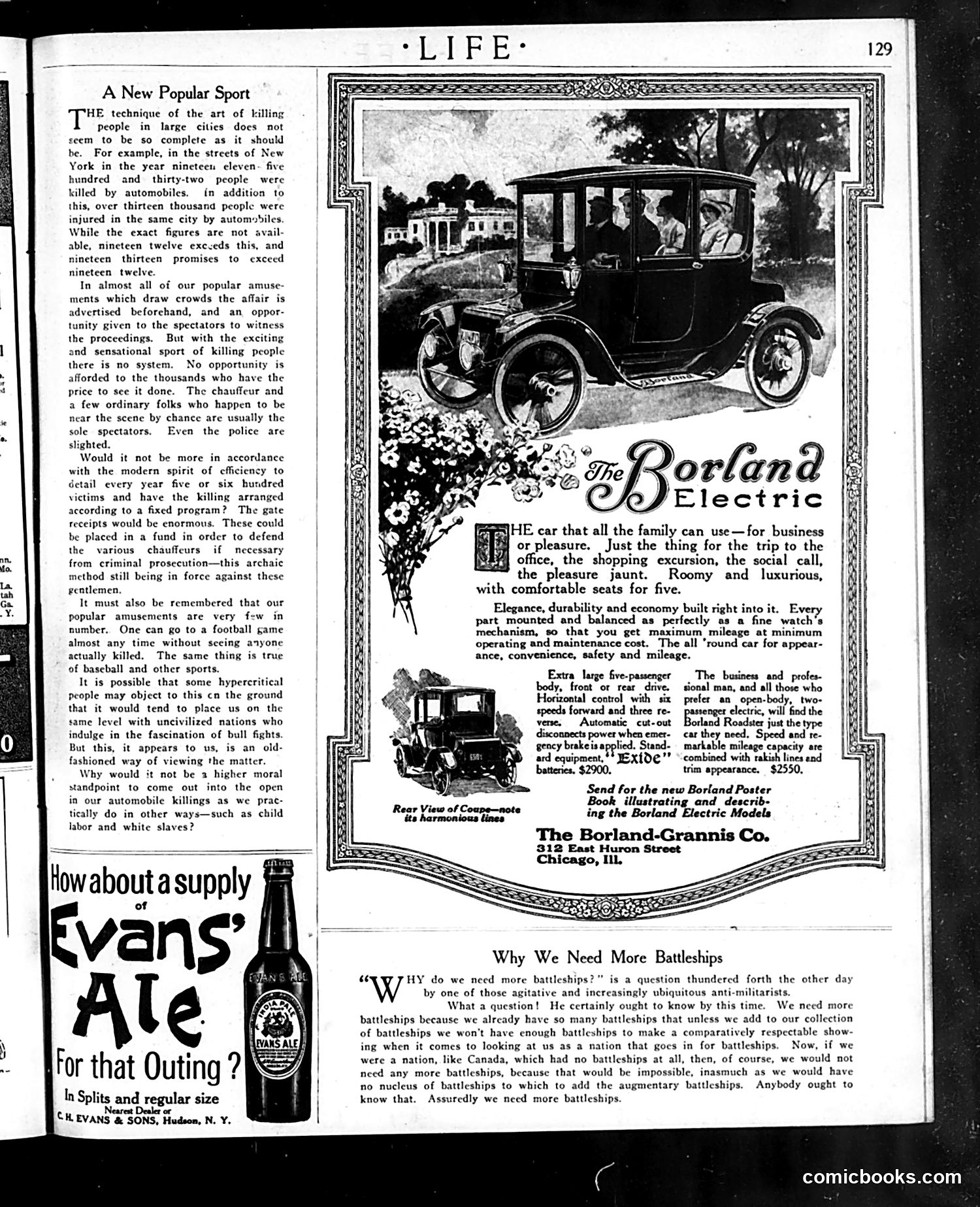
This page contains two distinct satirical pieces: **"A New Popular Sport"** (left column): This is biting social satire about automobile fatalities. In 1911-1913, cars were killing hundreds annually in cities like New York. The author sarcastically proposes treating traffic deaths as *entertainment*—scheduling them, charging admission, organizing them "according to a fixed program" like public spectacles. The joke exposes the absurdity and tragedy of normalizing these deaths while doing nothing systematic to prevent them. It's a dark critique of society's indifference to automotive casualties. **"Why We Need More Battleships"** (bottom): A brief satire mocking militaristic arguments for naval expansion. The author uses circular logic—"we need battleships because we have battleships"—to ridicule pro-military advocates' reasoning. **The Borland Electric Car Advertisement** dominates the right side, promoting an electric automobile as safe and family-friendly—ironically placed opposite the dark humor about car deaths, creating unintended ironic juxtaposition.
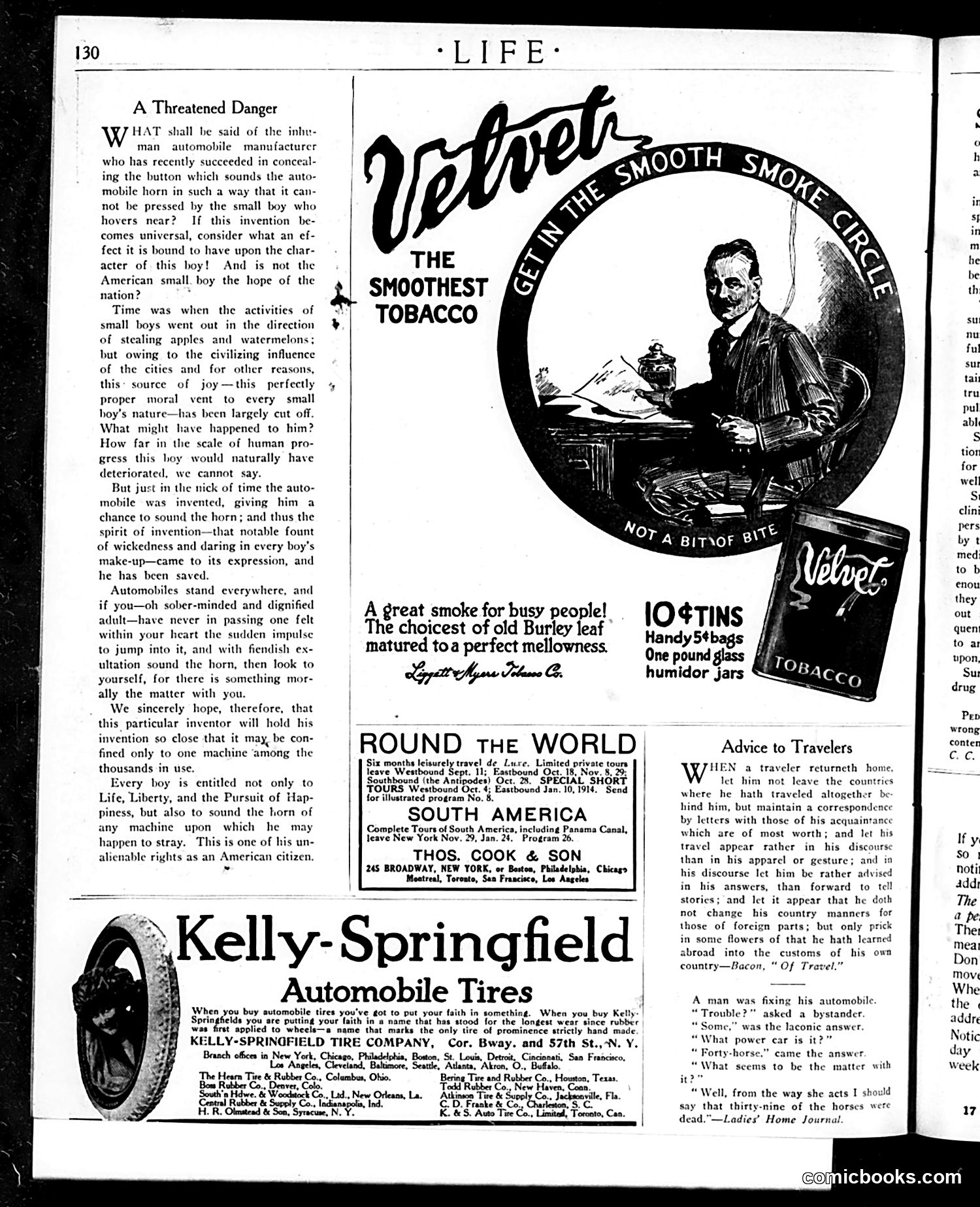
This page contains satirical commentary on American boyhood and early automobile culture. **"A Threatened Danger"** (left column): The essay humorously laments an automobile manufacturer's invention of a horn that cannot be easily pressed. The satire critiques American society's anxiety about youth misbehavior. The piece argues that automobile horns have morally saved boys by channeling their destructive impulses (once directed at stealing apples) into harmless horn-honking. Hiding the horn button would allegedly deprive boys of this vital outlet, threatening their character development and, absurdly, "the hope of the nation." This reflects genuine Progressive Era anxieties about urbanization, juvenile delinquency, and whether modern technology could civilize (or corrupt) youth. **Advertisements**: The page features typical period ads for Velvet tobacco, Kelly-Springfield tires, and travel services—products marketed to adults and middle-class consumers. The humor derives from treating boyish horn-honking as a serious moral issue worthy of national concern.
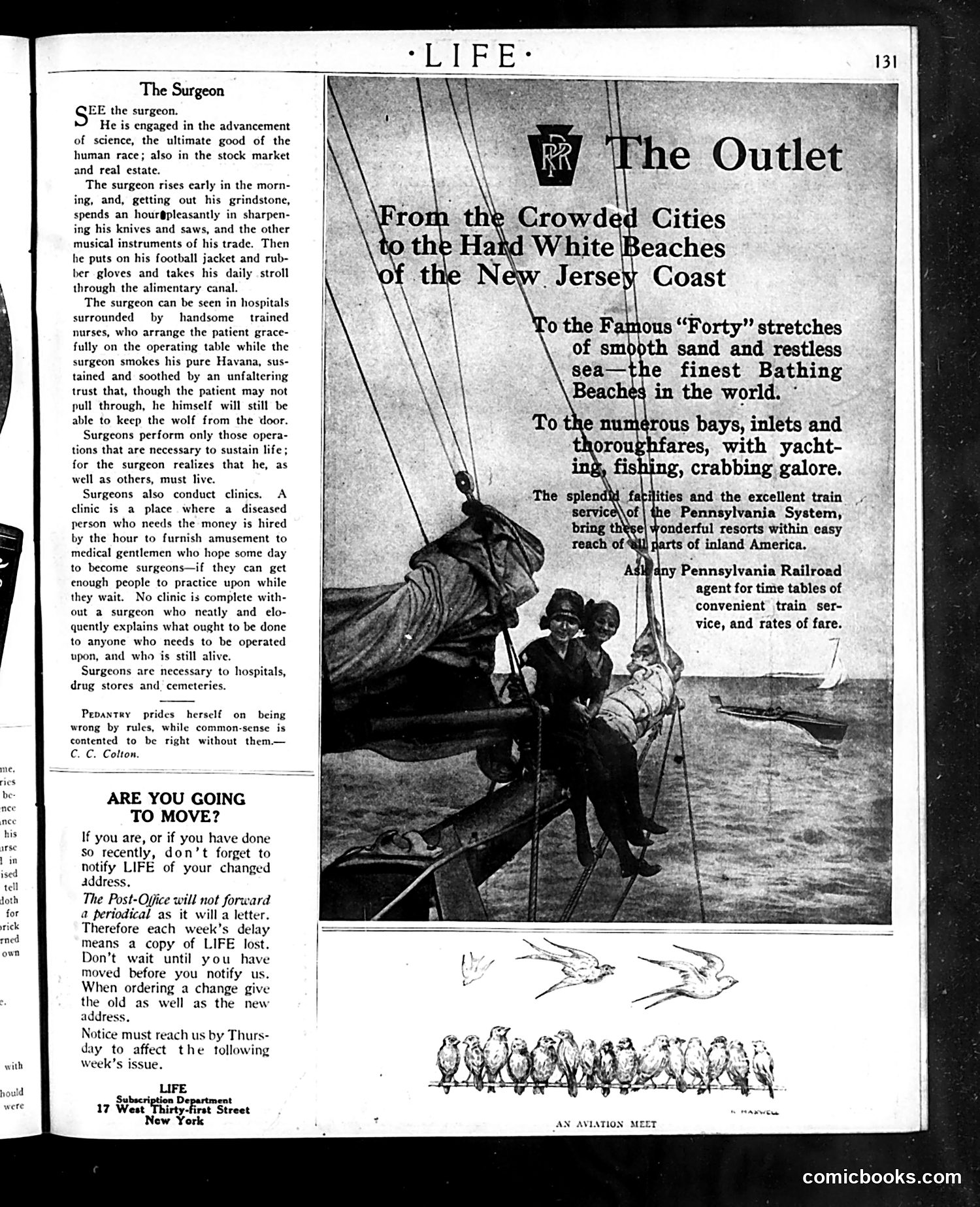
This page contains two distinct elements: **Left side:** A satirical essay titled "The Surgeon" mocking the medical profession. The piece employs heavy irony to critique surgeons as self-interested, portraying them as profit-driven professionals who conduct unnecessary operations, exploit poor patients at teaching clinics, and prioritize financial security over patient welfare. The dark humor suggests surgeons view medical practice as a path to wealth ("stock market and real estate") rather than genuine healing. References to keeping "the wolf from the door" and the blunt statement that "surgeons are necessary to hospitals, drug stores and cemeteries" underscore the cynical tone. **Right side:** A Pennsylvania Railroad advertisement promoting beach destinations and resorts in New Jersey, featuring an illustration of people on a sailboat. This is standard promotional material. The juxtaposition of cynical medical commentary with leisure advertising is characteristic of Life's satirical format, using contrast for effect. The surgeon piece reflects early 20th-century skepticism toward professionalism and commercialism in medicine.
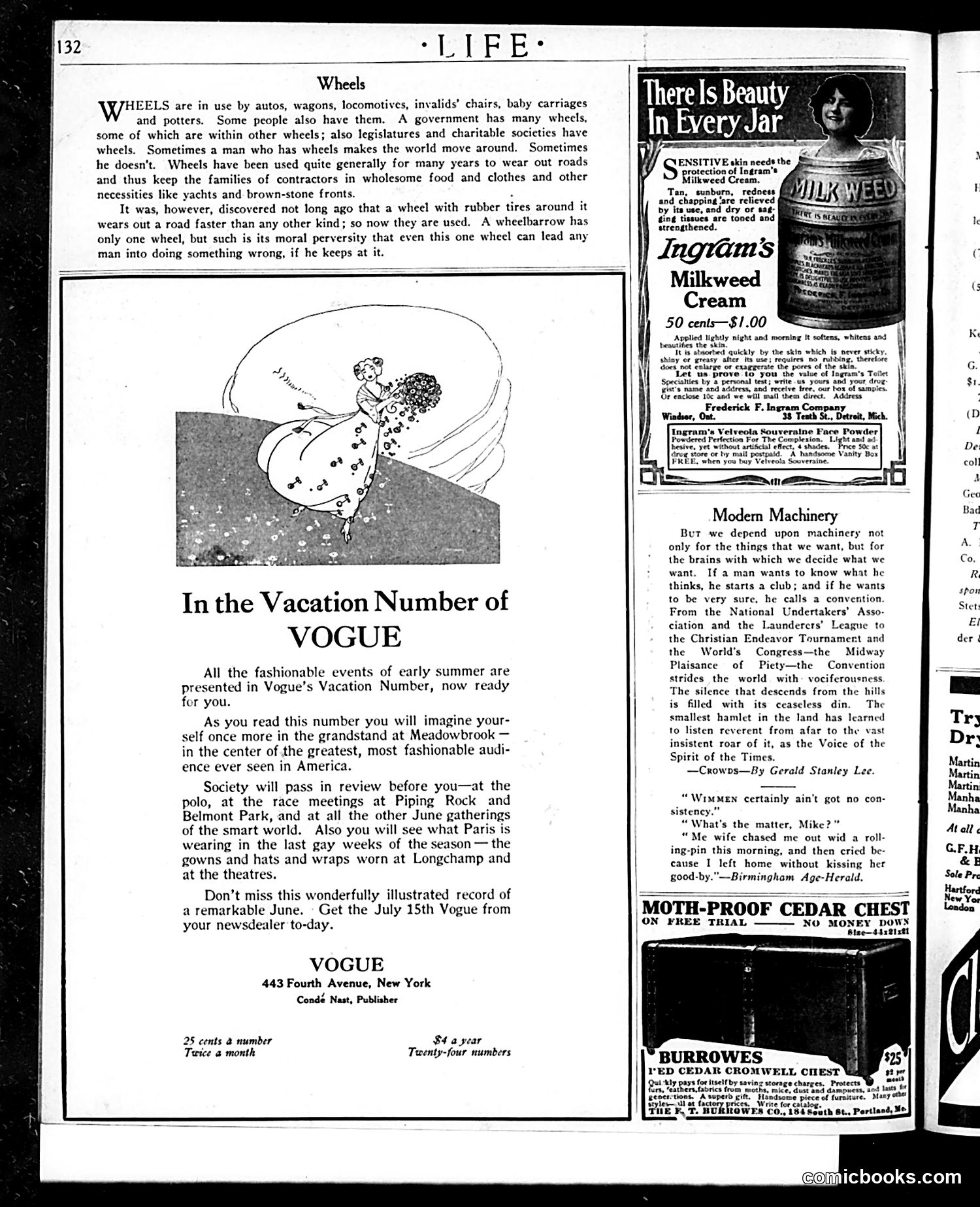
This page contains **satirical commentary on modern American society** rather than political cartoons. The main article, "Wheels," uses the humble wheelbarrow as a metaphor for how even simple tools can lead people astray—a humorous observation on human folly and moral weakness. The larger section promotes **Vogue's Vacation Number**, celebrating elite summer social gatherings (polo at Meadowbrook, races at Belmont Park). This advertises fashionable leisure activities accessible only to wealthy society. The "Modern Machinery" section satirizes **America's convention culture**—the proliferation of organized clubs and congresses (Undertakers' Association, Launderers' League, Christian Endeavor). The author critiques how Americans outsource thinking to these collective bodies rather than individual judgment, sarcastically calling conventions "the Voice of the Spirit of the Times." The page also includes period advertisements (Ingram's Milkweed Cream, Burrowes Cedar Chest) and a joke about marital discord, typical of era humor. Overall, the satire targets upper-class pretension and America's growing organizational bureaucracy.
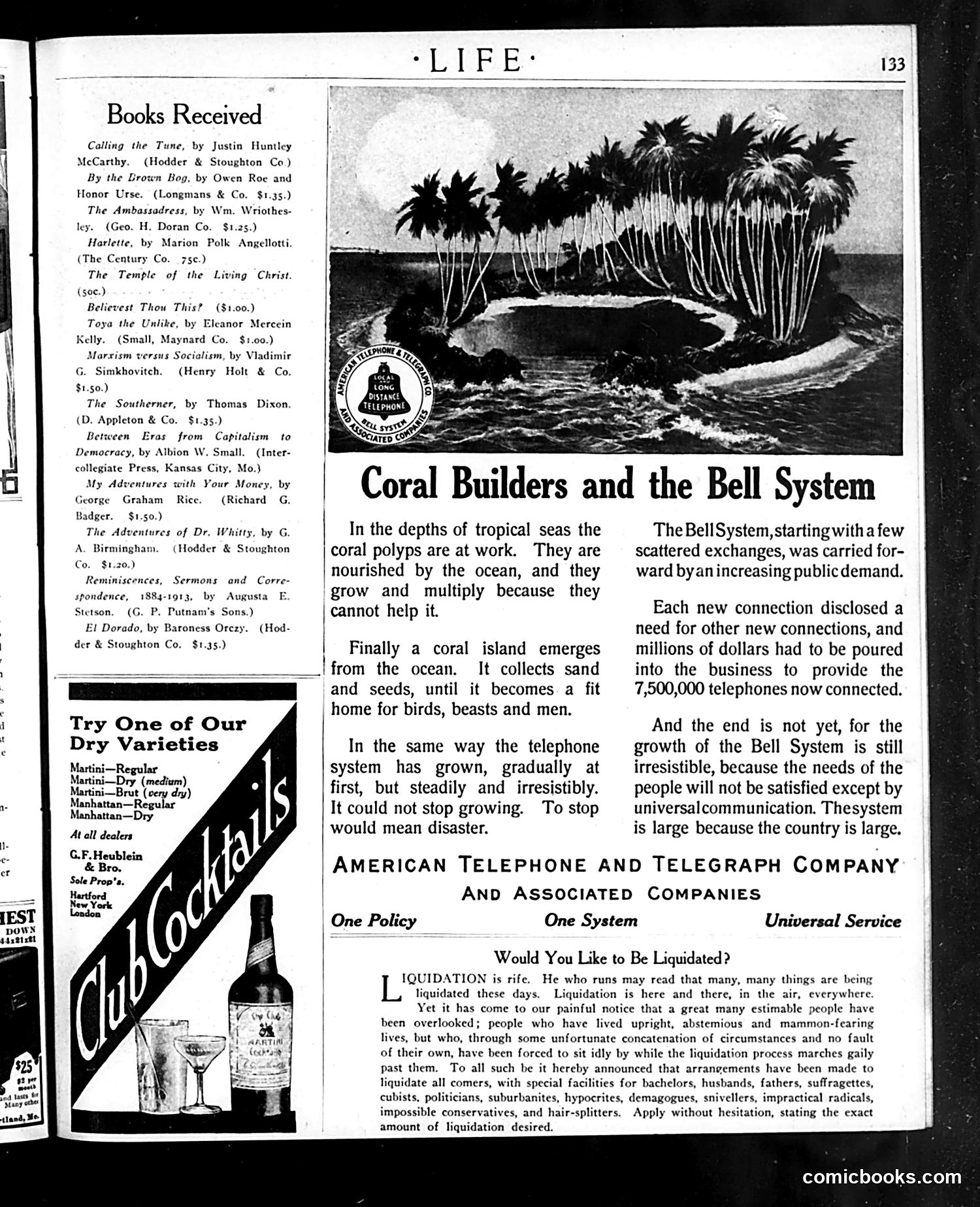
This page combines corporate advertising with satirical commentary typical of early 20th-century Life magazine. **The Main Content:** AT&T's "Coral Builders and the Bell System" is a corporate advertisement using a natural-growth metaphor. It compares coral polyps building islands to the telephone system's "irresistible" expansion, justifying AT&T's dominance and massive investment (7.5 million phones connected) as inevitable progress driven by public demand. **The Satire:** The adjacent piece, "Would You Like to Be Liquidated?" mocks this corporate language. "Liquidation" was a real 1920s business term (shutting down companies, settling accounts), but Life sarcastically offers to liquidate various social types—bachelors, suffragettes, "impossible conservatives," radicals—presenting elimination as a service. **The Point:** Life attacks AT&T's self-justifying rhetoric about unstoppable growth while satirizing broader social anxieties about corporate power and which groups society deemed expendable. The pairing suggests skepticism toward monopolistic claims of inevitability. The page also includes a book list and a Heublein cocktail advertisement.
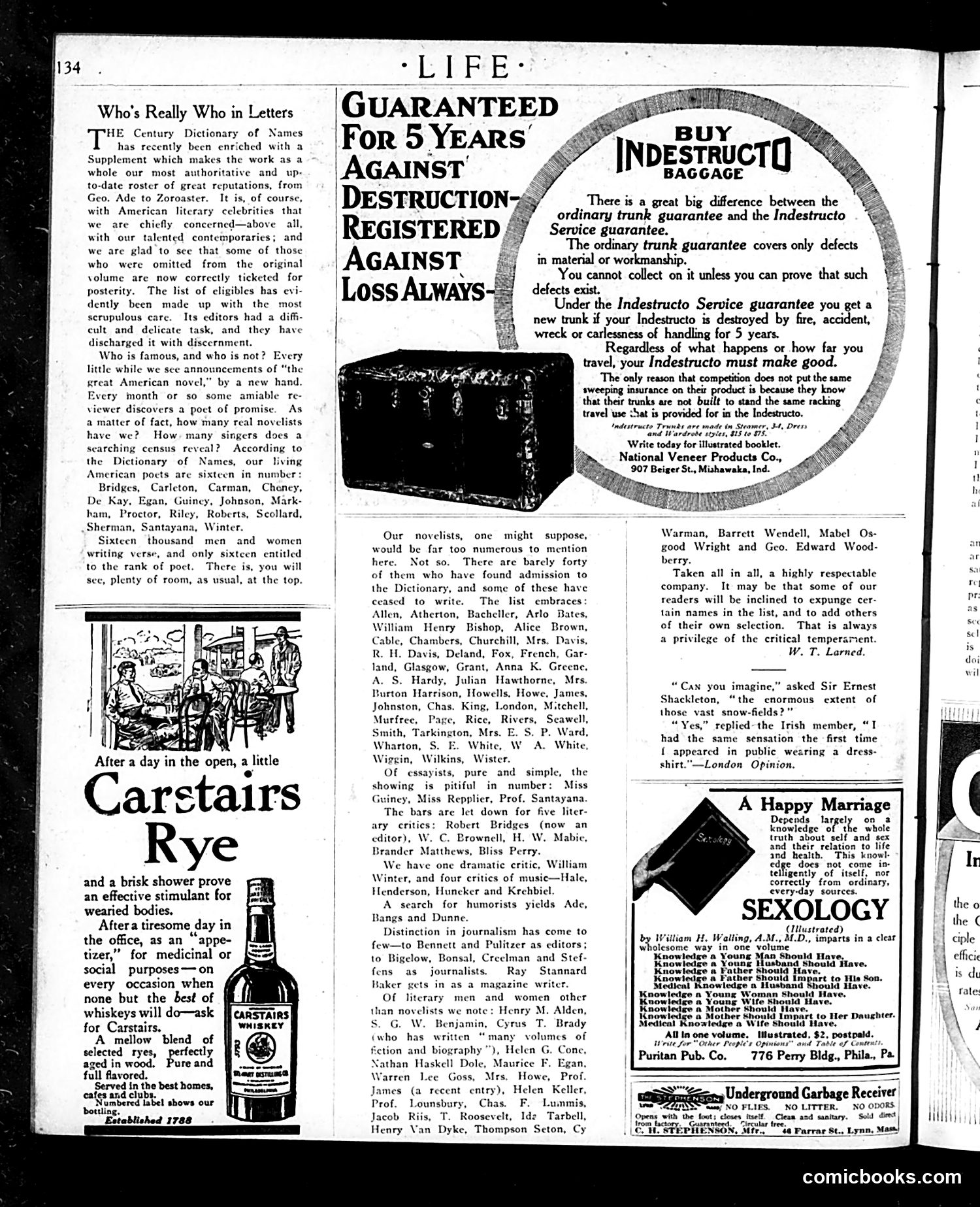
This page primarily contains **literary criticism and advertising** rather than political cartoons. The main article discusses the Century Dictionary of Names' newly published supplement, focusing on how few American writers achieve true literary fame. The author notes that while thousands write poetry, only sixteen American poets merit inclusion. Similarly, only about forty novelists have achieved recognition. The piece lists these elite writers (Riley, Santayana, Cable, etc.) and comments that this scarcity leaves "plenty of room, as usual, at the top"—a gentle satire on American literary pretension and the gap between aspiring and acclaimed writers. The **advertisements** include Carstairs whiskey (promoting its mellowness and respectability) and Indestructo baggage/trunks (emphasizing superior construction with a five-year destruction guarantee). A separate ad discusses "A Happy Marriage" through a book on Sexology. The page offers no political cartoons—it's a mixed editorial and advertising page typical of *Life* magazine's format during this period.
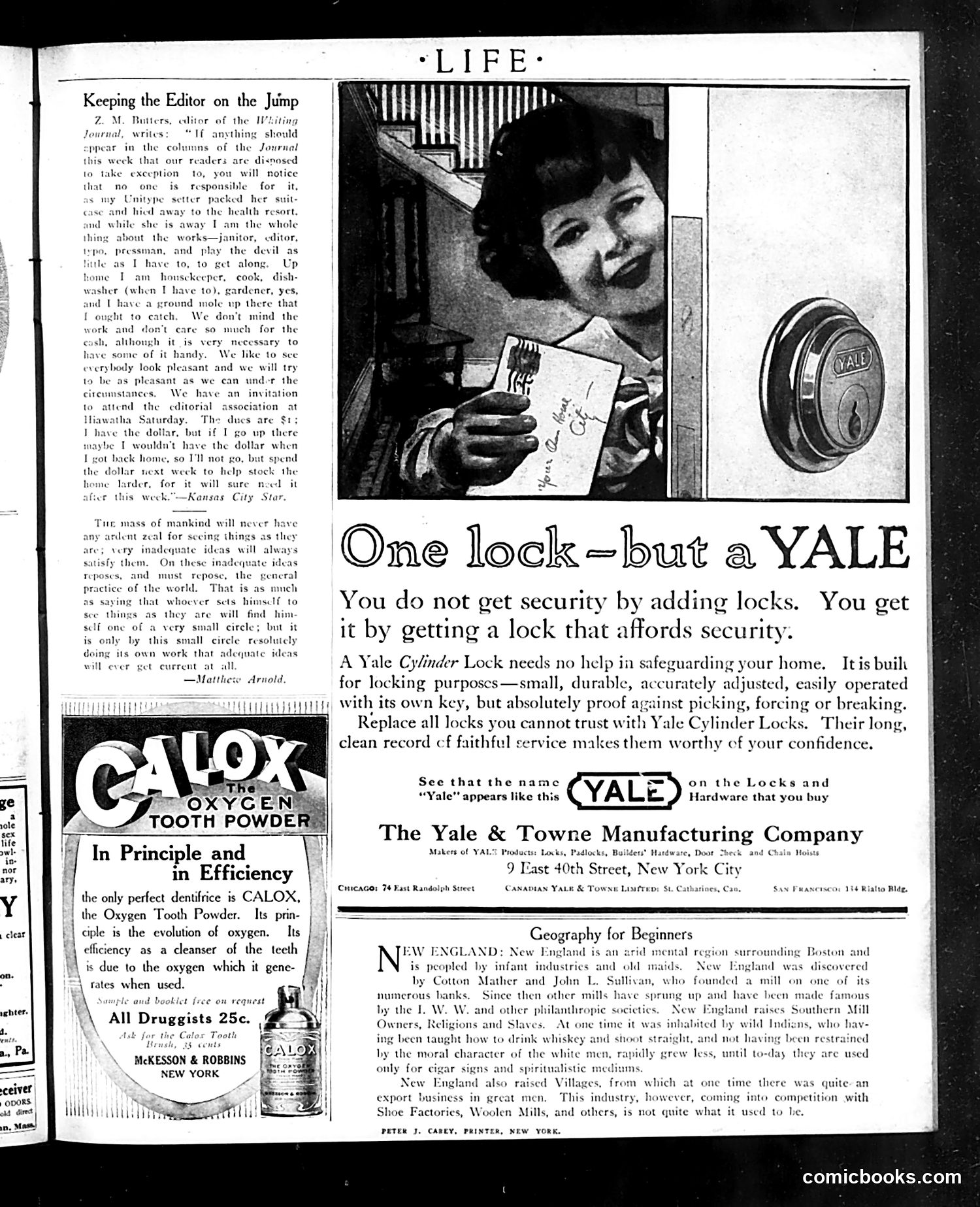
This page is primarily **advertising and filler content** rather than political satire. The main elements are: **"Keeping the Editor on the Jump"**: A humorous letter from Z.M. Butters, editor of the Whiting Journal, complaining that his typewriter operator abandoned her job for a health resort, leaving him to single-handedly manage the entire newspaper operation—janitor through editor. The joke targets the impractical chaos of small-town journalism when staff vanishes. **Advertisements**: Yale locks and Calox tooth powder dominate the page with standard product pitches. **"Geography for Beginners"**: A satirical piece mocking New England as a region of "infant industries and old maids," referencing Cotton Mather and John L. Sullivan (boxer), with jabs at the Industrial Workers of the World (I.W.W.) and Native Americans reduced to "cigar signs." The humor is period-typical regional mockery. The page reflects early 20th-century American magazine format: editorial complaints mixed with advertising and light satire without deeper political commentary.
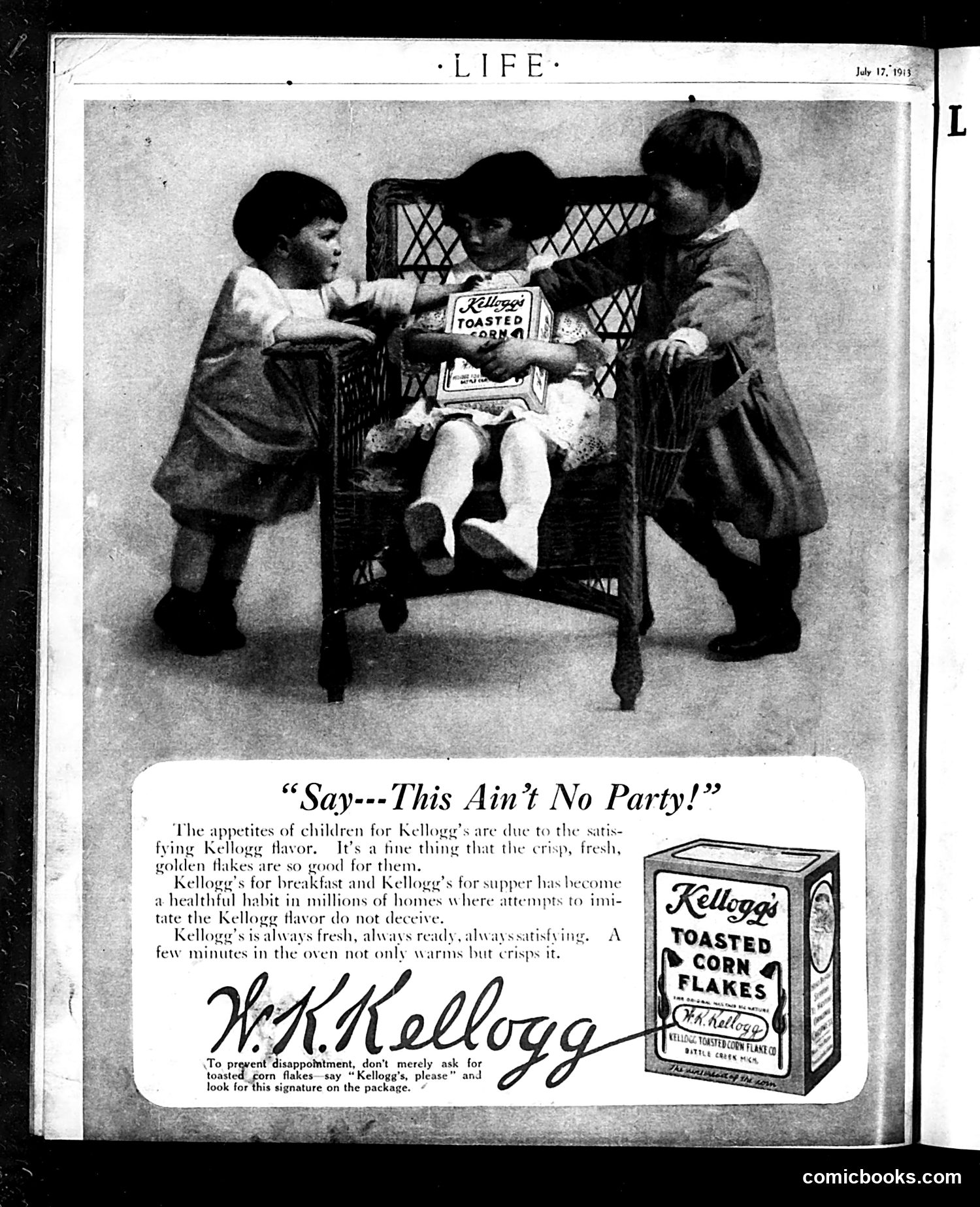
This is **not satire or political commentary**—it's a straightforward product advertisement for Kellogg's Toasted Corn Flakes. The image shows three children gathered around a baby in a high chair, with the child holding a Kellogg's box. The headline "Say---This Ain't No Party!" is a colloquial joke: the children appear to be fighting over or eagerly reaching for the cereal, suggesting it's so desirable they're competing for it rather than sharing civilly. The advertising copy emphasizes the cereal's appeal to children, its freshness, and the importance of asking for "Kellogg's" specifically by name—warning against imitations. The signature line emphasizes brand identity as protection against deceptive competitors. The "party" reference is simply a lighthearted play on the chaotic scene of children's enthusiasm for the product.