
Life, 1913-07-17 · page 38 of 44
Life — July 17, 1913 — page 38: what you’re looking at
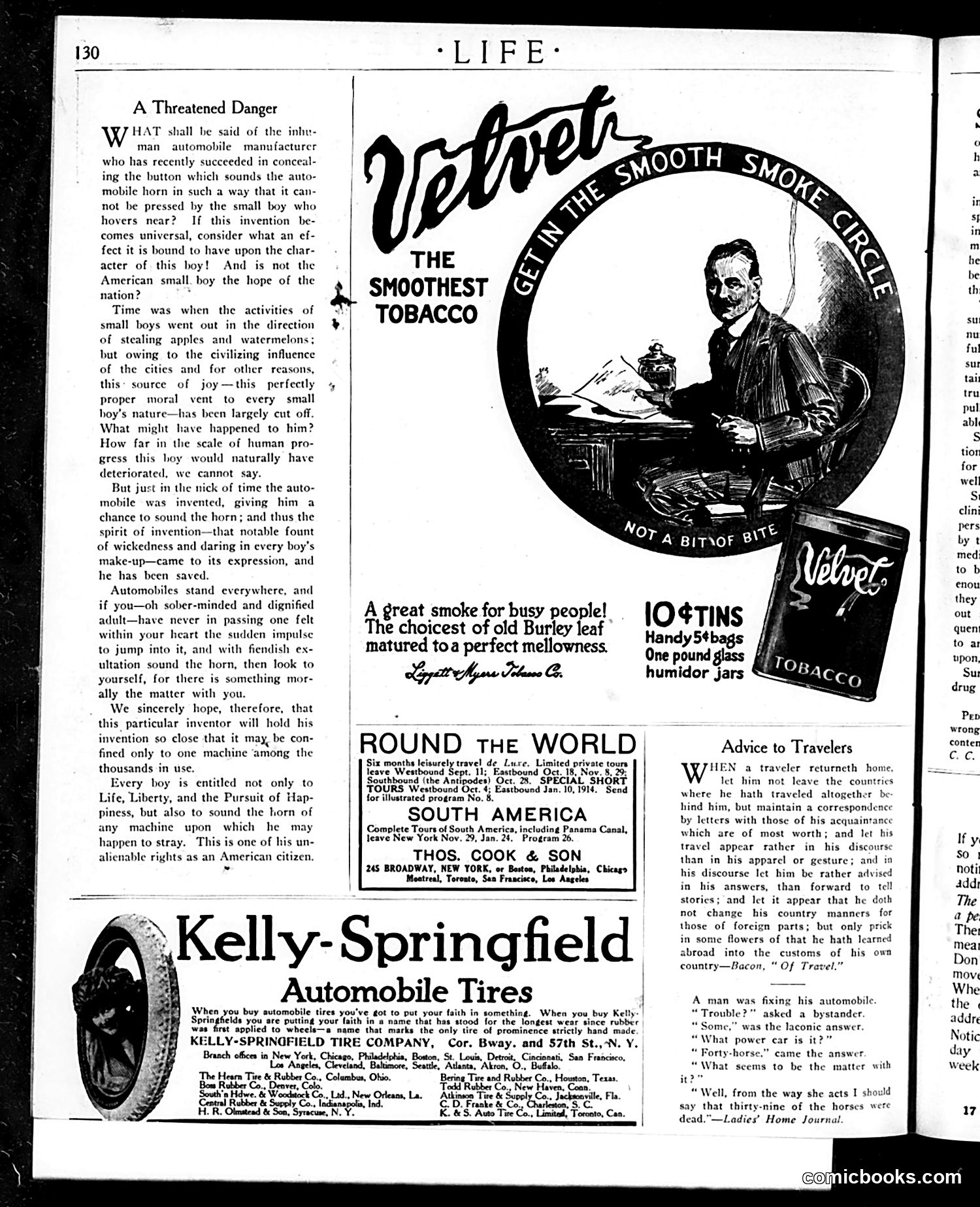
What you’re looking at
This page contains satirical commentary on American boyhood and early automobile culture. **"A Threatened Danger"** (left column): The essay humorously laments an automobile manufacturer's invention of a horn that cannot be easily pressed. The satire critiques American society's anxiety about youth misbehavior. The piece argues that automobile horns have morally saved boys by channeling their destructive impulses (once directed at stealing apples) into harmless horn-honking. Hiding the horn button would allegedly deprive boys of this vital outlet, threatening their character development and, absurdly, "the hope of the nation." This reflects genuine Progressive Era anxieties about urbanization, juvenile delinquency, and whether modern technology could civilize (or corrupt) youth. **Advertisements**: The page features typical period ads for Velvet tobacco, Kelly-Springfield tires, and travel services—products marketed to adults and middle-class consumers. The humor derives from treating boyish horn-honking as a serious moral issue worthy of national concern.
📄 Transcribed text from this page (OCR, searchable)
Machine-transcribed from the original scan — historical spelling and the odd misread are preserved.
A Threatened Danger WHAT stall be said of the inte man automobile manufacturer who has recently succeeded in conceal- ing the button which sounds the auto- mobile horn in such a way that it can- not be pressed by the small boy who hovers near? If this invention be- comes universal, consider what an ef- fect it is bound to have upon the char- acter of this boy! And is not the THE American small. boy the hope of the SMOOTHEST nation? Time was when the activities of — ») TOBACCO small boys went out in the direction of stealing apples and watermelons; but owing to the civilizing influence of the cities and for other reasons, this: source of joy—this perfectly Proper moral vent to every small hoy’s nature—has been largely cut off. What might have happened to him? How far in the scale of human pro- gress this boy would naturally have deteriorated, we cannot say. But just in the nick of time the auto- mobile invented, giving him a chance to sound the horn; and thus the spirit of invention—that notable fount of wickedness and daring in every boy’s make-up—came to its expression, and he has been saved. Automobiles stand everywhere, and if you—oh sober-minded and dignified A great smoke for busy people! adult—have never in passing one felt within your heart the sudden impulse The choicest of old Burley leaf Handy 5¢bags to jump into it, and with fiendish ex- matured toa perfect mellowness. gag pound glass aor ultation sound the horn, then look to G, oe h, he 2 humidor jars Se 4 Sur yourself, for there is something mor- F ally the matter with you. rug We sincerely hope, therefore, that | Pep this particular inventor will hold his ons invention so close that it may, be con- | ROU N D THE WORLD ols fined only to one machine ‘among the , } I yi i " | Sout! ind (the Anti les) ct. 28. ict him not leave the countries sry boy" is entitled “nots only. t0 TOURS Westbound Oct. 4; Eastbound Jan. 10, 1914. Send where he hath traveled aliogethier be Life, Liberty, and the Pursuit of Hap- for illustrated program No. 8. ¢ piness, ne also to sound we pon of SOUTH AMERICA area bat sales alo correspondene happen to stray. This is one of his un travel appear rather in his discourse y alicnable rights as an American citizen. THOS. COOK & SON than in his apparel or gesture; and in So 1 - coe anette tie eee his discourse let him be rather advis noti en in his answers, than forward to tell addi stories; and let it appear that he doth The not change his country manners for a pe those of foreign parts; but only prick The: in some flowers of that he hath learned nga abroad into the customs of his own Don country—Bacon, “ Of Travel.” in nove Whe A man was fixing his automobile the , When you buy your fai : “ Troubli ked a bystander. 4 Springfelds you are putting your faith i stood for the longest wear since rubber “ Some,” was the I io addre was firet applied to wheels—a name that marks the only tire of prominence strictly hand made. ome; ‘was the Jaconic: answer: Notic Forty-horse.” came the answer day KELLY-SPRINGFIELD TIRE COMPANY, Cor. Bway. and 57th St.,-N. Y. “What power car is it?” Branch offices in New York, Chicago, Philadelphia, Boston, St. Louis, Detroit, Cincinnati, San ae es Los Buffalo, “What scems to be the matter with Week Pind Sher ol ee & Robber Ce Columbus, Ohio. Tipe os it? ‘Angeles, Cleveland, Baltimore, Seattle, Aulanta, Akron, ©. Series Wonkon Cy Lid., New Orleans, K Jacksonville, Fla. “Well, from the way she acts I should ‘8 i S le, Fla. . va ec shou Grape Rebbe & Seon Co fnchenaet nd. D. nlien 8. that thirty-nine of the horses were 17 Olmsted yrecuse, dead."—Ladies’ Home Journal. [comicbooks.com