
Life, 1913-07-17 · page 20 of 44
Life — July 17, 1913 — page 20: what you’re looking at
What you’re looking at
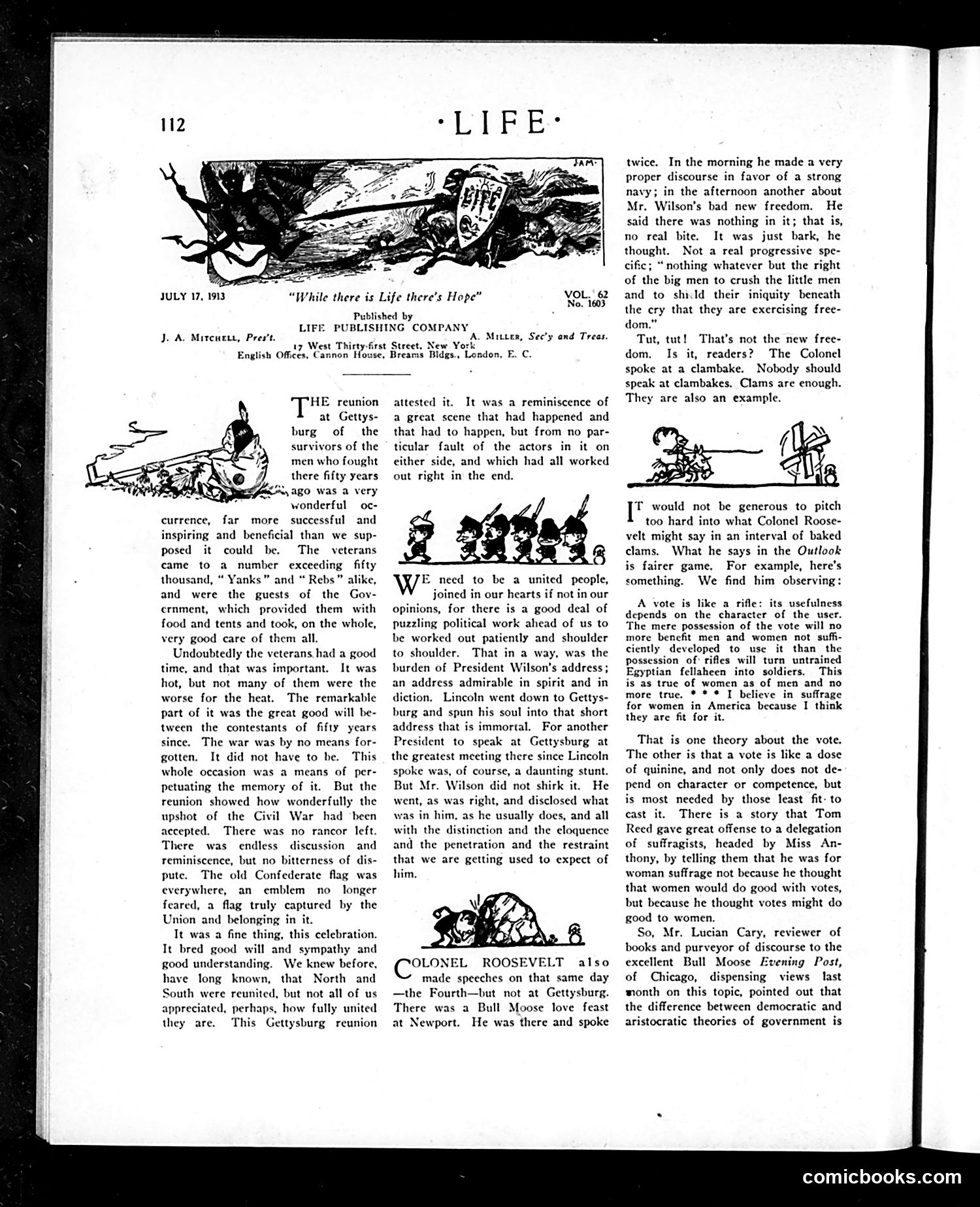
This page discusses the 50th anniversary reunion at Gettysburg of Civil War veterans (1863-1913). The main article praises President Wilson's dignified speech there, comparing it favorably to Lincoln's famous address. It celebrates the reconciliation between North and South, noting the Confederate flag now appears without fear—"a flag truly captured by the Union." The satire targets **Theodore Roosevelt**, who was speaking the same day at a clambake in Newport as leader of the **Bull Moose Party** (Progressive Party, established 1912). Roosevelt criticized Wilson's "New Freedom" policies, calling them toothless—mere "bark" allowing big men to crush little men while claiming freedom. The cartoonist mocks Roosevelt for making political speeches at a clambake ("Nobody should speak at clambakes. Clams are enough"), suggesting the venue undermines his seriousness. The piece implies Roosevelt is grandstanding while Wilson demonstrated statesmanship.
📄 Transcribed text from this page (OCR, searchable)
Machine-transcribed from the original scan — historical spelling and the odd misread are preserved.
JULY 17, 1913 “While there is Life there’s Hope” No. 1603 Published by LIFE J. A. Mitcurtt, Pres’t. PUBLISHING COMPANY A. Miter, Sec’y and Treas. 17 West Thirty-first Street. New York: English Offices, Cannon House, Breams Bldgs., London, E. C. HE reunion at Gettys- burg of the survivors of the men who fought there fifty years <. ago was a very wonderful oc- currence, far more successful and inspiring and beneficial than we sup- posed it could be. The veterans came to a number exceeding fifty thousand, “ Yanks” and “ Rebs” alik and were the guests of the Go ernment, which provided them with food and tents and took, on the whole, very good care of them all. Undoubtedly the veterans. had a good time, and that was important. It was hot, but not many of them were the worse for the heat. The remarkable part of it was the great good will be- tween the contestants of fifty years since. The war was by no means for- gotten. It did not have to be, This whole occasion was a means of per- petuating the memory of it. But the reunion showed how wonderfully the upshot of the Civil War had been accepted. There was no rancor left. There was endless discussion and reminiscence, but no bitterness of dis- pute. The old Confederate flag was everywhere, an emblem no longer feared, a flag truly captured by the Union and belonging in It a fine thing, this celebration. It bred good will and sympathy and good understanding. We knew before, have long known, that North and South were reunited, but not all of us appreciated, perhaps, how fully united they are. This Gettysburg reunion attested it, It was a reminiscence of a great scene that had happened and that had to happen, but from no par- ticular fault of the actors in it on either side, and which had all worked out right in the end. need to be a united people, joined in our hearts if not in our opinions, for there is a good deal of puzzling political work ahead of us to be worked out patiently and shoulder to shoulder. That in a way, was the burden of President Wilson's address ; an address admirable in spirit and in diction. Lincoln went down to Gettys- burg and spun his soul into that short address that is immortal. For another President to speak at Gettysburg at the greatest meeting there since Lincoln spoke was, of course, a daunting stunt. But Mr. Wilson did not shirk it. He went, as was right, and disclosed what was in him, as he usually does, and all with the distinction and the eloquence and the penetration and the restraint that we are getting used to expect of him. L ROOSEVELT also made speeches on that same day —the Fourth—but not at Gettysburg. There was a Bull Moose love feast at Newport. He was there and spoke twice. In the morning he made a very proper discourse in favor of a strong navy; in the afternoon another about Mr. Wilson’s bad new freedom. He said there was nothing in it; that is, no real bite. It was just bark, he thought. Not a real progressive spe- cific; “nothing whatever but the right of the big men to crush the little men and to shild their iniquity beneath the cry that they are exercising free- dom.” Tut, tut! That's not the new free- dom. Is it, readers? The Colonel spoke at a clambake. Nobody should speak at clambakes. Clams are enough. They are also an example. SS T would not be generous to pitch too hard into what Colonel Roose- velt might say in an interval of baked clams. What he says in the Outlook is fairer game. For example, here's something. We find him observing: A vote is like a rifle: its usefulness depends on the character of the user. The mere possession of the vote will no more benefit men and women not suffi- ciently developed to use it than the possession of: rifles will turn untrained Egyptian fellaheen into soldiers. This is as true of women as of men and no more true. * * * I believe in suffrage for women in America because I think they are fit for it. That is one theory about the vote. The other is that a vote is like a dose of quinine, and not only does not de- pend on character or competence, but is most needed by those least fit- to cast it. There is a story that Tom Reed gave great offense to a delegation of suffragists, headed by Miss An- thony, by telling them that he was for woman suffrage not because he thought that women would do good with votes, but because he thought votes might do good to women. So, Mr. Lucian Cary, reviewer of books and purveyor of discourse to the excellent Bull Moose Evening Post, of Chicago, dispensing views last month on this topic, pointed out that the difference between democratic and aristocratic theories of government is comicbooks.com