
Life, 1913-07-17 · page 24 of 44
Life — July 17, 1913 — page 24: what you’re looking at
What you’re looking at
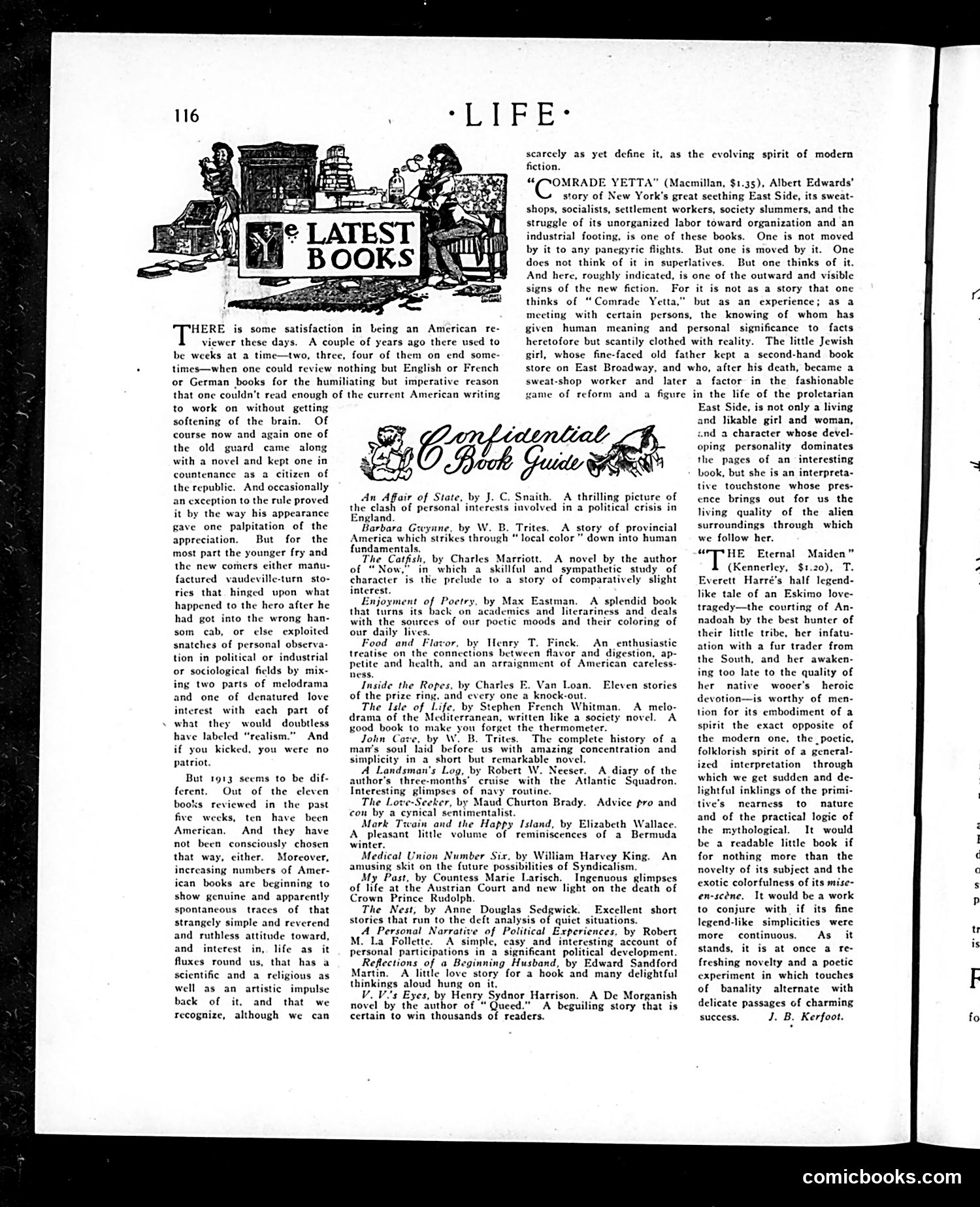
This is a book review column, not a political cartoon. The page discusses the state of American fiction circa 1913. The critic celebrates a shift in American letters: previously, American books were so poor that reviewers had to rely on English, French, and German works. Now, the critic notes with satisfaction, American literature is improving dramatically. The reviews highlighted—particularly "Comrade Yetta" by Albert Edwards—exemplify what the critic calls the "new fiction": socially conscious works examining labor conditions, immigrant life, and reform movements on New York's East Side. The critic praises this emerging realism as having "scientific and religious" as well as artistic grounding. The "Confidential Book Guide" header is decorative; the actual content is straightforward literary criticism celebrating American letters' maturation toward serious social engagement rather than melodramatic escapism.
📄 Transcribed text from this page (OCR, searchable)
Machine-transcribed from the original scan — historical spelling and the odd misread are preserved.
SLR HERE is some satisfaction in being an American re- viewer these days. A couple of years ago there used to be weeks at a time—two, three, four of them on end some- times—when one could review nothing but English or French or German books for the humiliating but imperative reason that one couldn't read enough of the current American writing scarcely as yet define it, as the evolving spirit of modern fiction. “(OMRADE YETTA” (Macmillan, $1.35), Albert Edwards’ story of New York’s great seething East Side, its sweat- shops, socialists, settlement workers, society slummers, and the struggle of its unorganized labor toward organization and an industrial footing, is one of these books. One is not moved by it to any panegyric flights. But one is moved by it. One docs not think of it in superlatives. But one thinks of it. And here, roughly indicated, is one of the outward and visible signs of the new fiction. For it is not as a story that one thinks of “Comrade Yetta,” but as an experience; as a meeting with certain persons, the knowing of whom has given human meaning and personal significance to facts heretofore but scantily clothed with reality. The little Jewish girl, whose fine-faced old father kept a second-hand book store on East Broadway, and who, after his death, became a sweat-shop worker and later a factor in the fashionable me of reform and a figure in the life of the proletarian to work on without getting softening of the brain. Of course now and again one of the old guard came along with a novel and kept one in countenance as a citizen of the republic. And occasionally an exception to the rule proved it by the way his appearance gave one palpitation of the appreciation. But for the most part the younger fry and the new comers either manu- factured vaudeville-turn sto- rics that hinged upon what happened to the hero after he had got into the wrong han- som cab, or else exploited snatches of personal observa- tion in political or industrial or sociological fields by mix- ing two parts of melodrama and one of denatured love interest. with each part of < what they would doubtless have labeled “realism.” And if you kicked, you were no patriot. But 1913 seems to be dif- ferent. Out of the eleven books reviewed in the past five weeks, ten have been American, And they have not been consciously chosen that way, either. Moreover, increasing numbers of Amer- ican books are beginning to show genuine and apparently spontaneous traces of that strangely simple and reverend and ruthless attitude toward, and interest in, life as it fluxes round us, that has a scientific and a religious as well as an artistic impul: back of it, and that w recognize, although we can tO Sick Gace by J. C. Snaith. A thrilling picture of An Affair of State terests involved in a political crisis in the clash of personal land. Barbara Gwynne, by W. B. Trites. A story of provincial America which strikes through “local color ” down into human fundamental The Ca by Charles Marriott. A novel by the author of “Now,” in. which a skillful and sympathetic study of character ‘is the prelude to a story of comparatively slight interest. Enjoyment of Poetry, by Max Eastman. A splendid book that turns its back on academics and literariness and deals with the sources of our poetic moods and their coloring of our daily live Food and Flavor, by Menry T. Finck. An enthusiastic treatise on the connections between flavor and digestion, ap- petite and health, and an arraignment of American careless- Van Loan. Eleven stories y one a knock-out. by Stephen French Whitman. A melo- drama of the Mediterranean, written like a society novel. A xood book to make you forget the thermometer. John Cave, by W. B. Trites. The complete history of a man’s soul laid before us with amazing concentration and simplicity in a short but remarkable novel. A Landsman's Log, by Robert W. Neese author's three-months' cruise with the Atlantic Squadron. Interesting glimpses of navy routine. The Love-Seeker, by Maud Churton Brady. Advice pro and con by a cynical sentimentalist. Mark Twain and the Happy Island, by Elizabeth Wallace. A_ pleasant little volume of reminiscences of a Bermuda winter. Medical Union Number Six, by William Harvey King. An amusing skit on the future possibilities of Syndicalism. My Past, by Countess Marie Larisch. Ingenuous glimpses of life at the Austrian Court and new light on the death of Crown Prince Rudolph. The Nest, by Anne Douglas Sedgwick. Excellent short stories that run to the deft analysis of quict situations. A Personal Narrative of Political Experiences, by Robert M. La Follette. A simple, casy and interesting account of Personal participations in a significant political development. Reflections of a Beginning Husband, by Edward Sandford Martin. A little love story for a hook and many delightful thinkings aloud hung on it. V. V.'s Eyes, by Henry Sydnor Harrison. A De Morganish novel by the author of “Queed.” A beguiling story that is certain to win thousands of readers. A diary of the East Side, is not only a living and likable girl and woman, and a character whose devel- oping personality dominates the pages of an interesting Look, but she is an interpreta- tive touchstone whose pres- ence brings out for us the living quality of the alien surroundings through which we follow her. 7 HE Eternal Maiden” (Kennerley, $1.20), T. Everett Harré’s half legend- like tale of an Eskimo love- tragedy—the courting of An- nadoah by the best hunter of their little tribe, ber infatu- ation with a fur trader from the South, and her awaken- ing too late to the quality of her native wooer's heroic devotion—is worthy of men- tion for its embodiment of a spirit the exact opposite of the modern one, the _poctic, folklorish spirit of a general- ized interpretation through which we get sudden and de- lightful inklings of the primi- tive’s nearness to nature and of the practical logic of the mythological. It would be a readable little book if for nothing more than the novelty of its subject and the exotic colorfulness of its mise- en-scéne, It would be a work to conjure with if its fine legend-like simplicitics were more continuous. As it stands, it is at once a re- freshing novelty and a poetic experiment in which touches of banality alternate with delicate passages of charming success. J. B. Kerfoot. comicbooks.com