
Life, 1913-07-17 · page 21 of 44
Life — July 17, 1913 — page 21: what you’re looking at
What you’re looking at
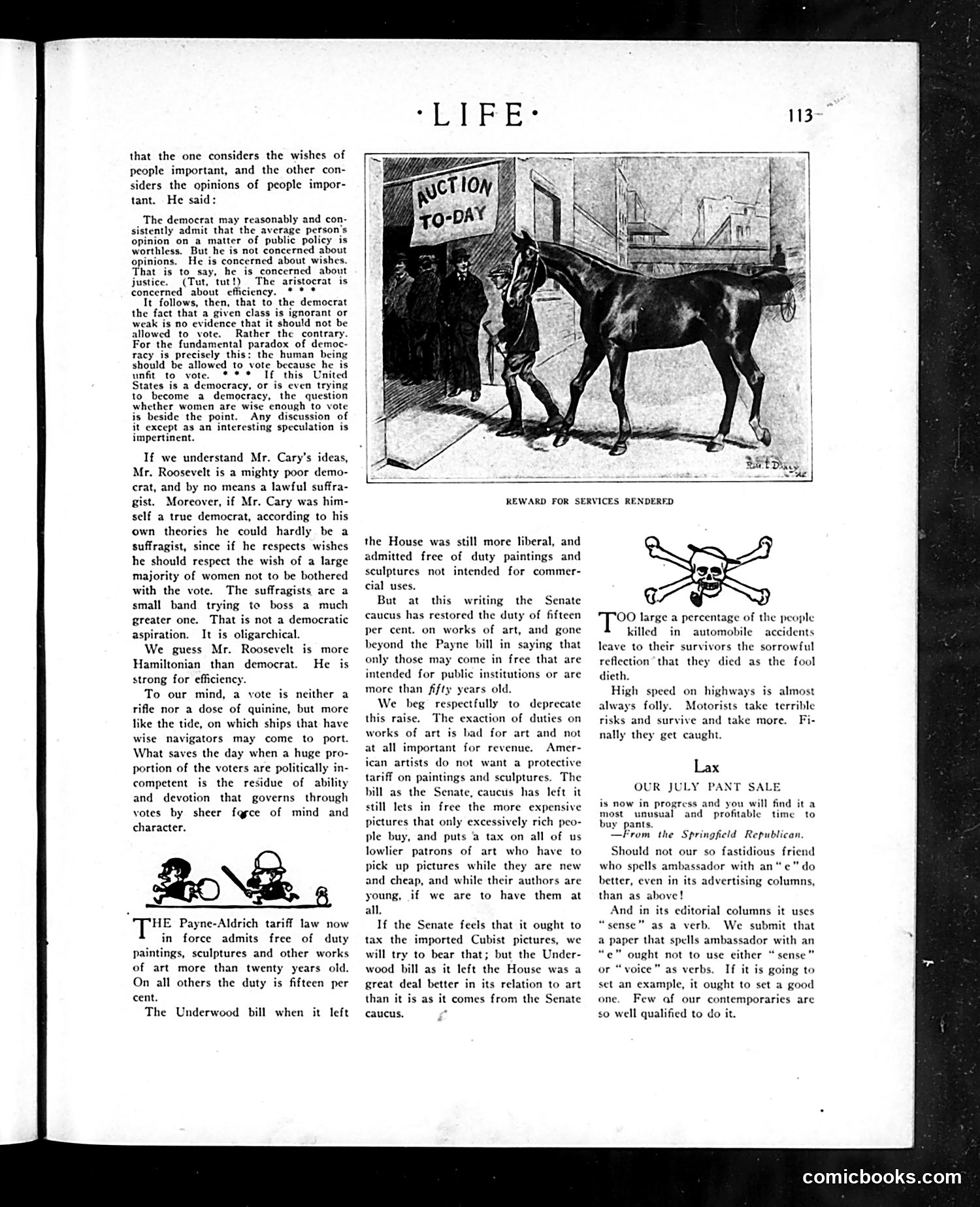
**Main Cartoon:** The sketch shows a horse being led to auction with a "AUCTION TO-DAY" sign, labeled "REWARD FOR SERVICES RENDERED." This satirizes politicians or public figures being "sold off" or discarded after their usefulness ends—likely referencing contemporary political corruption or the disposal of political allies. **Political Context:** The page debates democracy and voting rights, quoting someone named "Mr. Cary" on whether average citizens are wise enough to vote. The text critiques both President Roosevelt (called insufficiently democratic) and women's suffragists (called oligarchical for imposing votes on unwilling women). This reflects early 1910s debates over women's suffrage and democratic theory. **Secondary Issues:** The page discusses tariff policy on imported artwork, lamenting Senate restrictions on duty-free art imports. It also warns against dangerous highway speeds in automobiles—an emerging social concern. The satire targets political hypocrisy and the tension between democratic ideals and actual practice.
📄 Transcribed text from this page (OCR, searchable)
Machine-transcribed from the original scan — historical spelling and the odd misread are preserved.
that the one considers the wishes of people important, and the other con- siders the opinions of people impor- tant. He said: The democrat may reasonably and con- sistently admit that the average person's opinion on a matter of public policy is worthless. But he is not concerned about opinions. He is concerned about wishes. That is to say, he is concerned about justice. (Tut, tut!) The aristocrat is concerned about efficiency. * * * It follows, then, that to the democrat the fact that a given class is ignorant or weak is no evidence that it should not be allowed to vote. Rather the contrary. For the fundamental paradox of democ- racy is precisely this: the human being should be allowed to vote because he is unfit to vote. *** If this United States is a democracy, or is even trying to become a democracy, the question whether women are wise enough to vote is beside the point. Any discussion of it except as an interesting speculation is impertinent. If we understand Mr. Cary’s ideas, Mr. Roosevelt is a mighty poor demo- crat, and by no means a lawful suffra- gist. Moreover, if Mr. Cary was him- self a true democrat, according to his own theories he could hardly be a suffragist, since if he respects wishes he should respect the wish of a large majority of women not to be bothered with the vote. The suffragists are a small band trying to boss a much greater one. That is not a democratic aspiration. It is oligarchical. We guess Mr. Roosevelt is more Hamiltonian than democrat. He is strong for efficiency. To our mind, a vote is neither a rifle nor a dose of quinine, but more like the tide, on which ships that have wise navigators may come to port. What saves the day when a huge pro- portion of the voters are politically in- competent is the residue of ability and devotion that governs through votes by sheer fagce of mind and character. BO ims a § HE Payne-Aldrich tariff law now in force admits free of duty paintings, sculptures and other works of art more than twenty years old. On all others the duty is fifteen per cent. The Underwood bill when it left REWARD FOR SERVICES RENDERED the House was still more liberal, and admitted free of duty paintings and sculptures not intended for commer- cial uses. But at this writing the Senate caucus has restored the duty of fifteen per cent. on works of art, and gone beyond the Payne bill in saying that only those may come in free that are intended for public institutions or are more than fifty years old. We beg respectfully to deprecate this raise. The exaction of duties on works of art is bad for art and not at all important for revenue. Amer- ican artists do not want a protective tariff on paintings and sculptures. The bill as the Senate, caucus has left it still lets in free the more expensive pictures that only excessively rich peo- ple buy, and puts a tax on all of us lowlier patrons of art who have to pick up pictures while they are new and cheap, and while their authors are young, if we are to have them at all. If the Senate feels that it ought to tax the imported Cubist pictures, we will try to bear that; but the Under- wood Dill as it left the House was a great deal better in its relation to art than it is as it comes from the Senate caucus. . OBS T° large a percentage of the people killed in automobile accidents rr to their survivors the sorrowful reflection that they died as the fool dieth. High speed on highways is almost always folly. Motorists take terrible risks and survive and take more. Fi- nally they get caught. Lax OUR JULY PANT SALE is now in progress and you will find it a most unusual and profitable time to buy pants. —From the Springfield Republican, Should not our so fastidious friend who spells ambassador with an“ e¢” do better, even in its advertising columns, than as above! And in its editorial columns it uses “sense” as a verb, We submit that a paper that spells ambassador with an “e” ought not to use either * or “voice” as verbs. If it is going t set an example, it ought to set a good Few af our contemporaries are so well qualified to do it. sense” one. comicbooks.com