
Life, 1913-07-17 · page 17 of 44
Life — July 17, 1913 — page 17: what you’re looking at
What you’re looking at
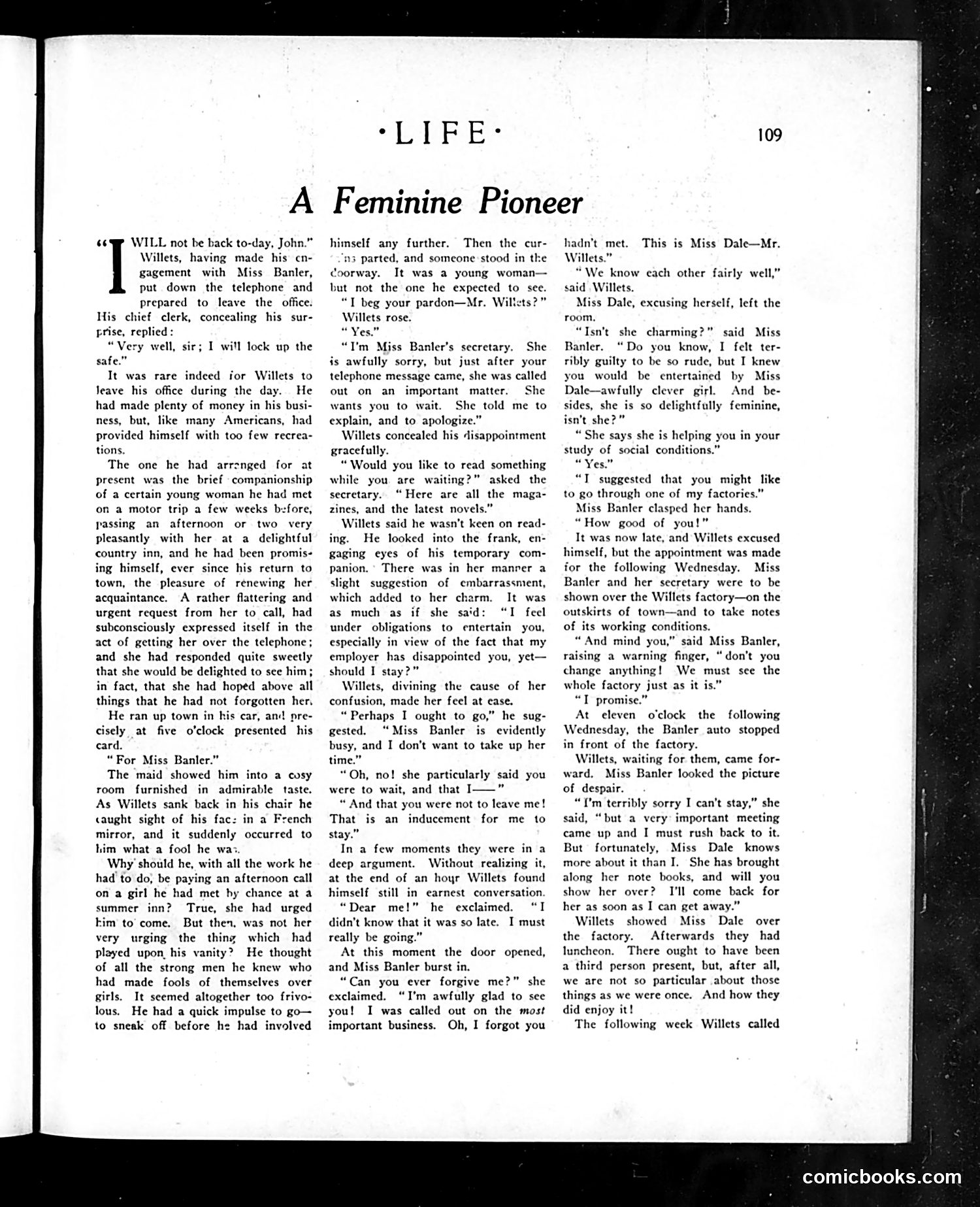
This is the opening of a serialized short story, not a political cartoon. The narrative satirizes changing gender roles in early 20th-century America. The plot concerns businessman Willets, who leaves his office to visit Miss Banler, a woman he met casually. Expecting a romantic afternoon, he instead meets her *secretary*—and finds their intellectual conversation so engaging that he loses track of time entirely. The story's title and setup suggest the secretary represents the "feminine pioneer": the educated, independent working woman emerging in that era. The satire targets Willets' shallow expectations (a romantic dalliance) being upended by a woman's professional competence and intellectual substance. The secretary's substantive engagement contrasts with Miss Banler's absence on business. This reflects contemporary anxieties and fascinations about women entering the workforce and challenging traditional domestic roles.
📄 Transcribed text from this page (OCR, searchable)
Machine-transcribed from the original scan — historical spelling and the odd misread are preserved.
“LIF E* A Feminine Pioneer “ WILL not be back to-day, John.” Willets, having made his cn- gagement with Miss Banler, put down the telephone and prepared to leave the office. His chief clerk, concealing his sur- prise, replied: Very well, sir; I will lock up the safe.” It was rare indeed for Willets to Jeave his office during the day He had made plenty of money in his busi- ness, but, like many Americans, had provided himself with too few recrea- tions. The one he had arronged for at present was the brief companionship of a certain young woman he had met on a motor trip a few weeks bzfore, passing an afternoon or two very pleasantly with her at a delightful country inn, and he had been promis- ing himself, ever since his return to town, the pleasure of renewing her acquaintance. A rather flattering and urgent request from her to call, had subconsciously expressed itself in the act of getting her over the telephone; and she had responded quite sweetly that she would be delighted to see him; in fact, that she had hoped above all things that he had not forgotten her, He ran up town in his car, and pre- cisely at five o'clock presented his card. “For Miss Banler.” The maid showed him into a cosy room furnished in admirable taste. As Willets sank back in his chair he caught sight of his fac: in a French mirror, and it suddenly occurred to him what a fool he wa;. Why should he, with all the work he had’ to do, be paying an afternoon call on a girl he had met hy chance at a summer inn? True, she had urged kim to come, But then, was not her very urging the thing which had played upon his vanity? He thought of all the strong men he knew who had made fools of themselves over girls. It seemed altogether too frivo- lous. He had a quick impulse to go— to sneak off before he had involved himself any further. Then the cur- 3 parted, and someone stood in coorway. It was a young woman— but not the one he expected to see. “I beg your pardon—Mr. Willets?” Willets rose. Yes “I'm Miss Banler’s secretary, She is awfully sorry, but just after your telephone message came, she was called out on an important matter. She wants you to wait. She told me to explain, and to apologize.” Willets concealed his disappointment gracefully. “Would you like to read something while you are waiting?” asked the secretary. “Here are all the maga- zines, and the latest novels.” Willets said he wasn’t keen on read- ing. He looked into the frank, en- gaging eyes of his temporary com- panion. There was in her manrer a slight suggestion of embarrassment, which added to her charm. It was as much as if she said: “I feel under obligations to entertain you, especially in view of the fact that my employer has disappointed you, yet— should I stay?” Willets, divining the cause of her confusion, made her feel at case. “Perhaps I ought to go,” he sug- gested. “Miss Banler is evidently busy, and I don’t want to take up her time.” “Oh, no! she particularly said you were to wait, and that I—” “ And that you were not to leave me! That is an inducement for me to stay.” In a few moments they were in a deep argument. Without realizing it, at the end of an hoyr Willets found himself still in earnest conversation. “Dear me!” he exclaimed. “I didn’t know that it was so late. I must really be going.” At this moment the door opened, and Miss Banler burst in. “Can you ever forgive me?” she exclaimed. “I’m awfully glad to see you! I was called out on the most important business. Oh, I forgot you hadn't met. This is Miss Dale—Mr. Willets.” “We know cach other fairly well,” said Willets. Miss Dale, excusing herself, left the room, “Isn't she charming?” said Miss Banler. “Do you know, I felt ter- ribly guilty to be so rude, but I knew you would be entertained by Miss Dale—awfully clever girl. And be- sides, she is so delightfully feminine, isn’t she?” “ She says she is helping you in your study of social conditions.” “Yes.” “T suggested that you might like to go through one of my factories.” Miss Banler clasped her hands. “How good of you!” It was now late, and Willets excused himself, but the appointment was made for the following Wednesday. Miss Banler and her secretary were to be shown over the Willets factory—on the outskirts of town—and to take notes of its working conditions. “And mind you,” said Miss Banler, raising a warning finger, “don't you change anything! We must see the whole factory just as it is.” “T promise.” At eleven o'clock the following Wednesday, the Banler auto stopped in front of the factory. Willets, waiting for them, came for- ward, Miss Banler looked the picture of despair. “{'m terribly sorry I can't stay,” she said, “but a very important meeting came up and I must rush back to it. But fortunately, Miss Dale knows more about it than I, She has brought along her note books, and will you show her over? I'll come back for her as soon as I can get away.” Willets showed Miss Dale over the factory. Afterwards they had luncheon. There ought to have been a third person present, but, after all, we are not so particular about those things as we were once. And how they did enjoy it! The following week Willets called comicbooks.com