
A complete issue · 45 pages · 1913
Life — June 26, 1913
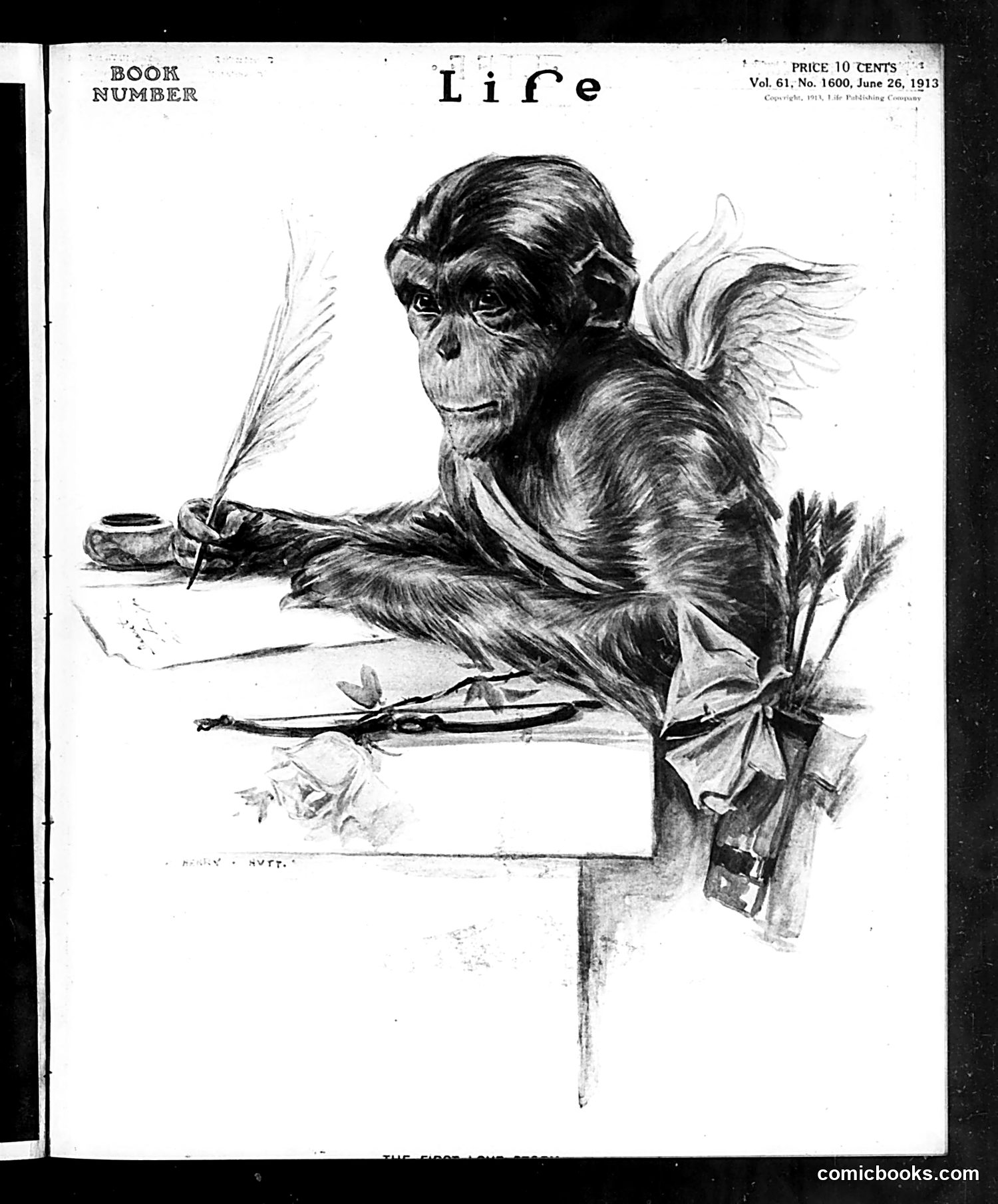
This is the cover of *Life* magazine from June 26, 1913. The illustration depicts a chimpanzee or ape seated at a desk, writing or drawing with a quill pen. The creature is dressed in human clothing and appears to be engaged in intellectual work, with writing materials and flowers visible nearby. The satire likely comments on contemporary debates about evolution, intelligence, and human nature—topics highly contested in the early 20th century following Darwin's theories. By portraying an ape performing human intellectual tasks, the cartoonist may be satirizing either human pretension or contemporary arguments about the nature of intelligence and civilization. The specific political or social target is unclear without additional context from the magazine's contents.
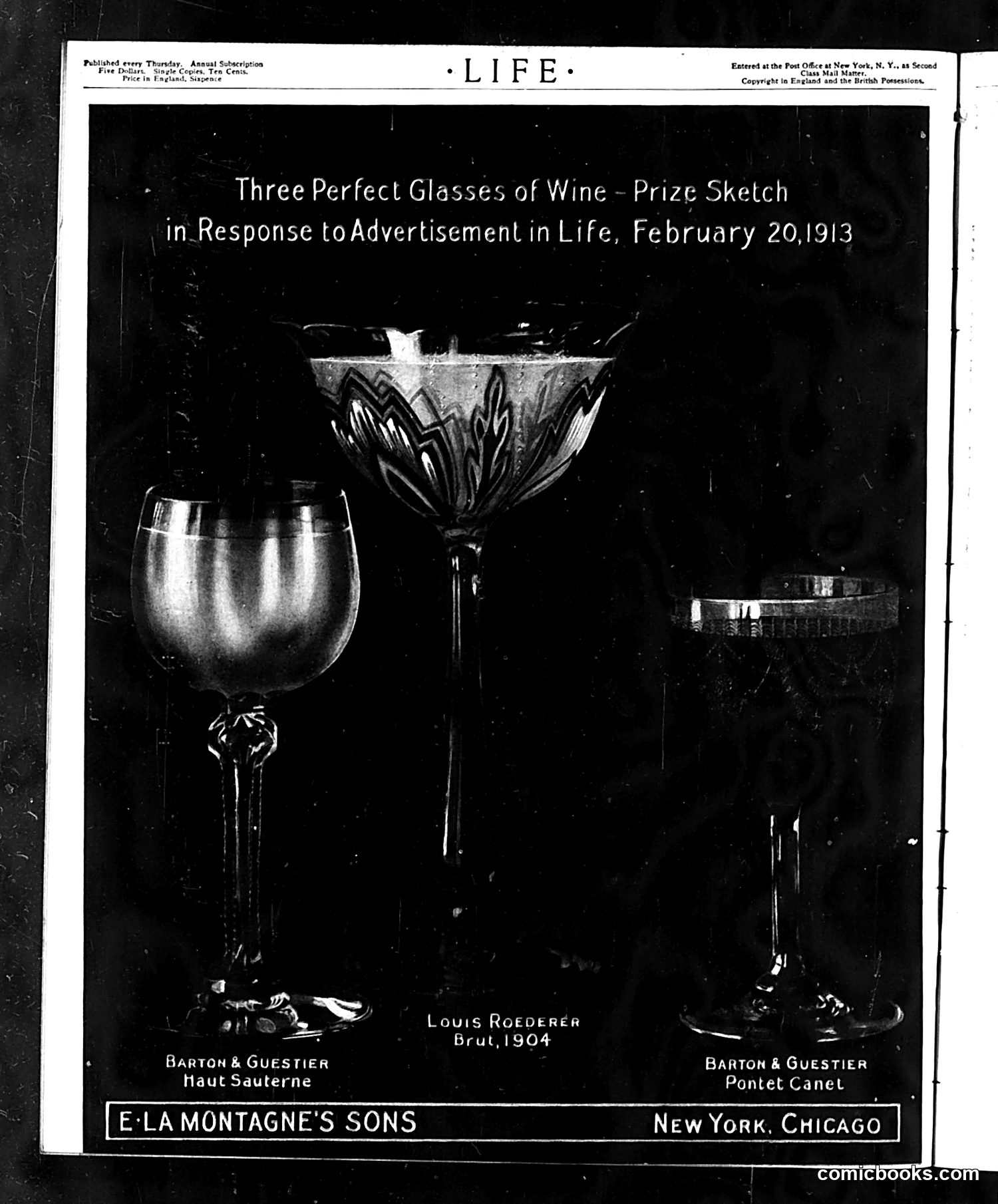
This page is **not a political cartoon or satirical commentary**—it's an advertisement, specifically a prize-winning design submission. The header indicates this was a "Prize Sketch in Response to Advertisement in Life, February 20, 1913." The image displays three elegant wine glasses showcasing different types of wine: a Barton & Guestier Haut Sauterne (left), a Louis Roederer Brut 1904 champagne (center), and a Barton & Guestier Pontet Canet (right). This appears to be promotional content for E. La Montagne's Sons, a New York and Chicago wine merchant, highlighting premium French wines through sophisticated glassware design and presentation.
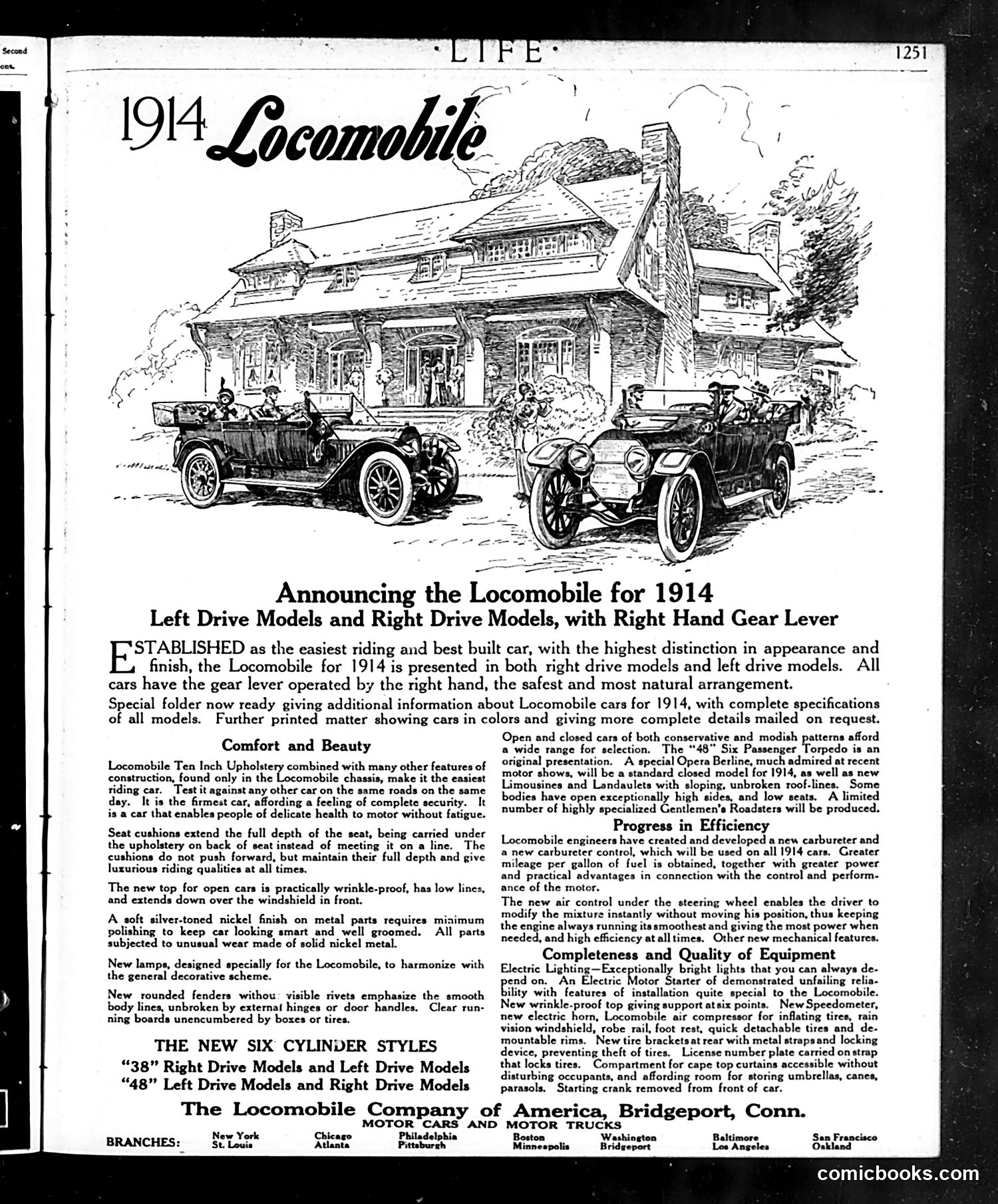
This page is **not a cartoon or satirical piece** — it's a straightforward advertisement for the 1914 Locomobile automobile, published in Life magazine. The image shows two early automobiles parked in front of a substantial house, depicting the cars as reliable, elegant vehicles suited to affluent owners. The advertisement emphasizes new features like "Left Drive Models and Right Drive Models," electric starters, improved safety mechanisms, and comfort innovations. The text highlights engineering advances: air control under the steering wheel, electric lighting, and a new carburetor system. This represents genuine automotive development from the pre-WWI era, when such features were genuinely novel selling points. There is no satire or political commentary present — it's period advertising meant to appeal to wealthy potential buyers.
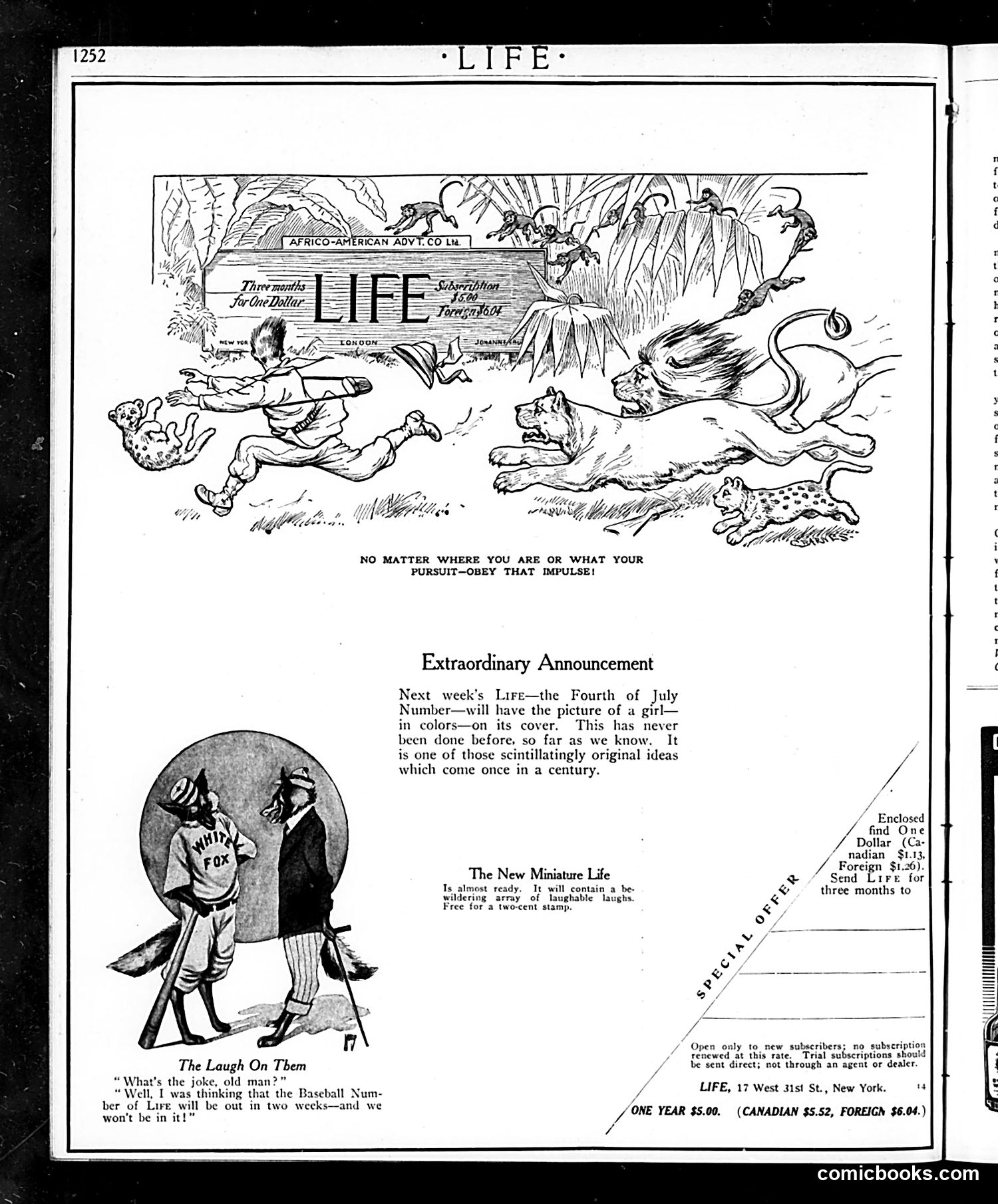
This page contains two main elements: **Top Advertisement**: An Afro-American Advertising Company advertisement for *Life* magazine itself, featuring a child chasing various animals with the motto "No matter where you are or what your pursuit—obey that impulse!" This is promotional material emphasizing the magazine's broad appeal. **Bottom Cartoon ("The Laugh On Them")**: Shows two men discussing baseball. One appears to be a businessman (possibly representing an owner or manager), the other a player wearing a "White Sox" uniform. The joke references an upcoming Baseball Number of *Life* magazine appearing in two weeks, with wordplay about the publication's Baseball Number "won't be in it"—likely satirizing either the magazine's sports coverage or contemporary baseball controversies, though the specific reference remains unclear without additional context.
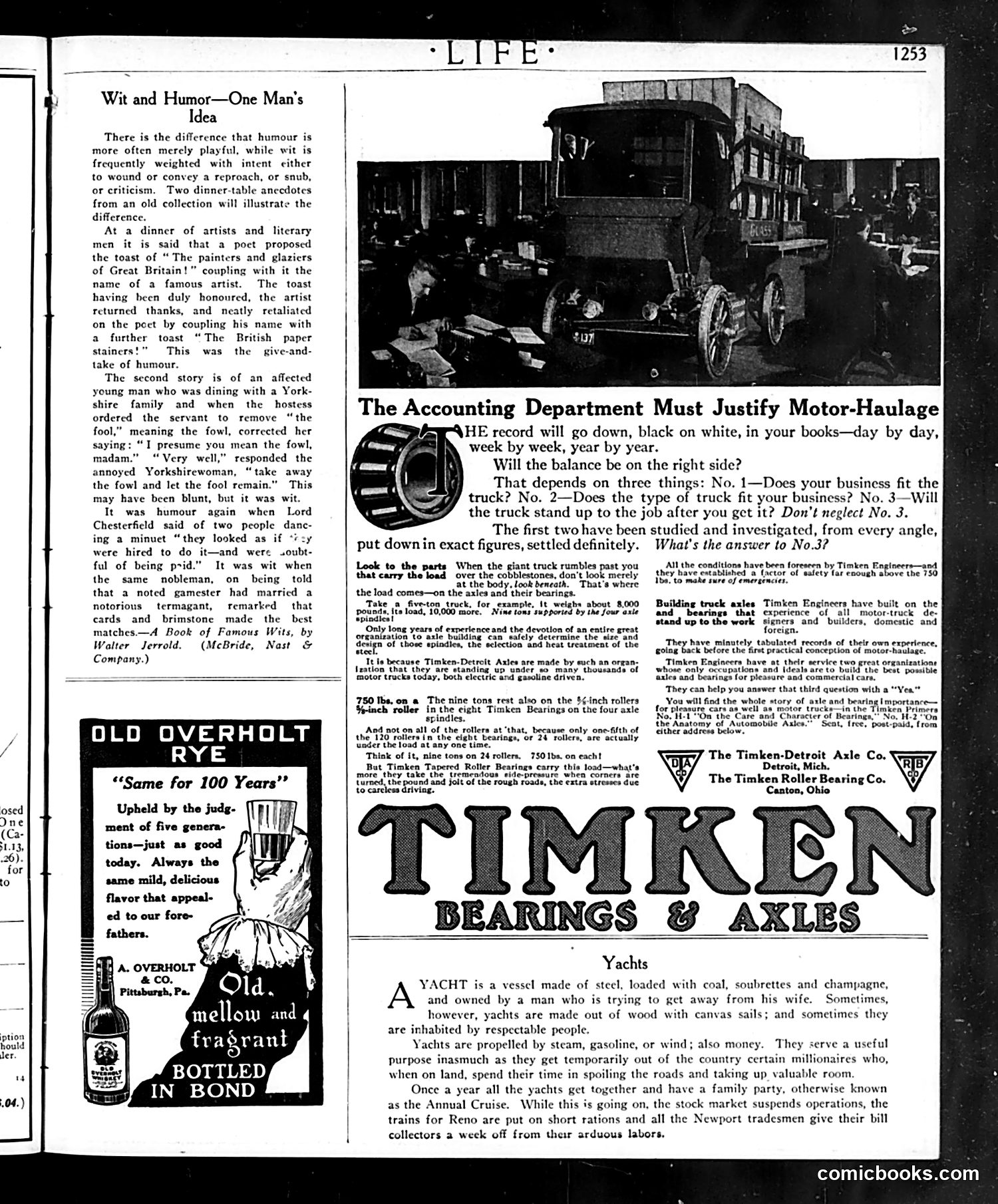
This page is primarily **advertising**, not satirical content. The dominant feature is a large Timken Bearings & Axles advertisement addressing business accounting departments, arguing that motor-truck maintenance costs justify investment in quality bearings. The left column contains brief humor anecdotes under "Wit and Humor—One Man's Idea," including jokes about artists, poets, and a Yorkshire family's fowl-related mishap. These appear to be generic witticisms rather than political satire. A secondary advertisement for Old Overholt Rye whiskey appears on the lower left, and a "Yachts" article provides general information about yacht operations. The page reflects 1920s commercial advertising strategies and period humor conventions rather than containing meaningful political or social satire.
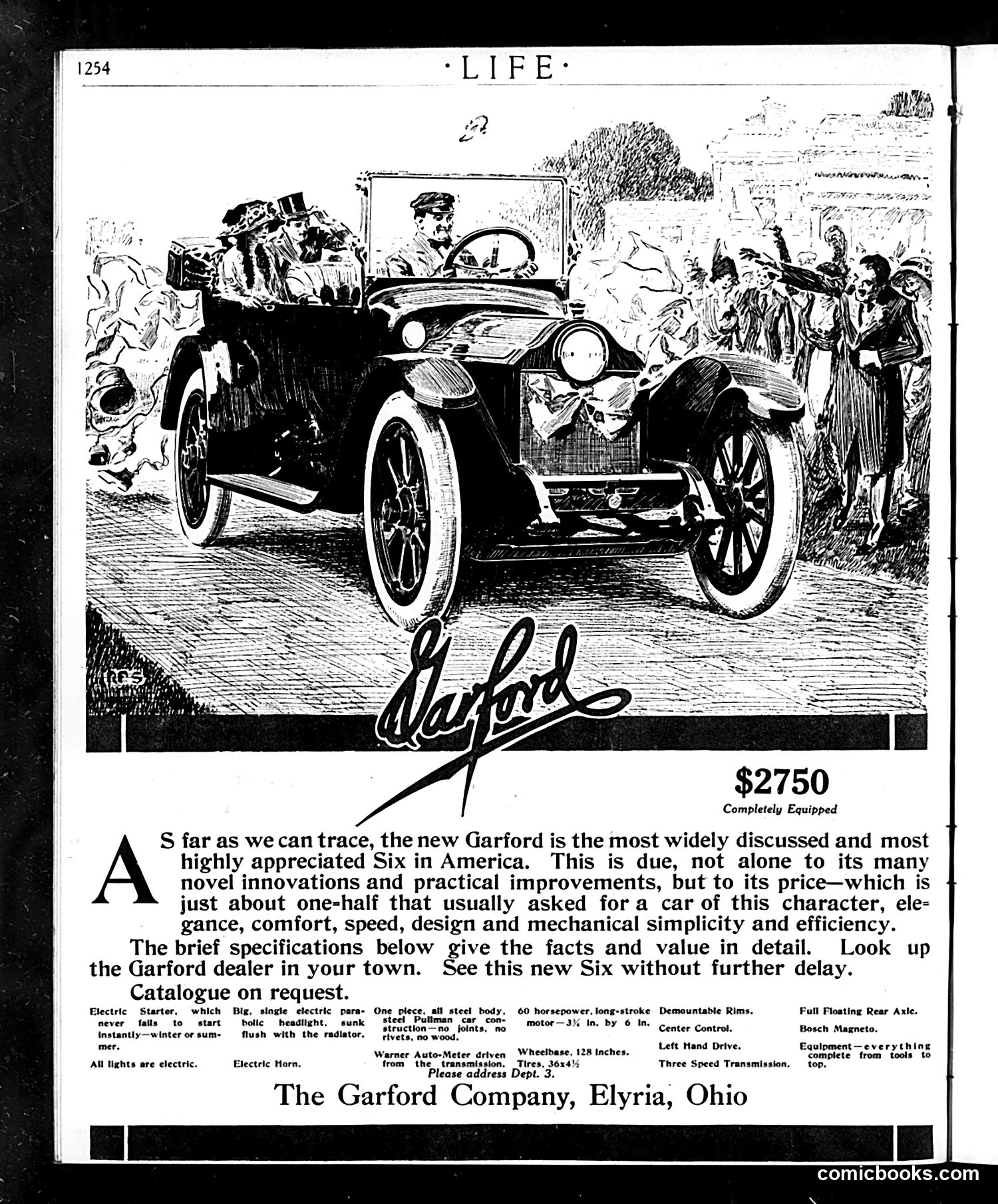
This page is primarily an **advertisement**, not satire or political commentary. It promotes the Garford automobile, manufactured in Elyria, Ohio, priced at $2,750. The illustration depicts a well-dressed couple in an early motorcar being observed by pedestrians—a common advertising trope showing the vehicle as an object of admiration and modern achievement. The text emphasizes the Garford's practicality: it claims to be "the most widely discussed and most highly projected Six in America" while costing roughly half the price of comparable luxury vehicles. The ad highlights contemporary features: electric starter, electric lights, three-speed transmission, and left-hand drive—innovations notable for the pre-WWI automotive market. This represents typical early-1900s automotive advertising targeting middle-to-upper-class buyers seeking modern conveniences and status symbols.
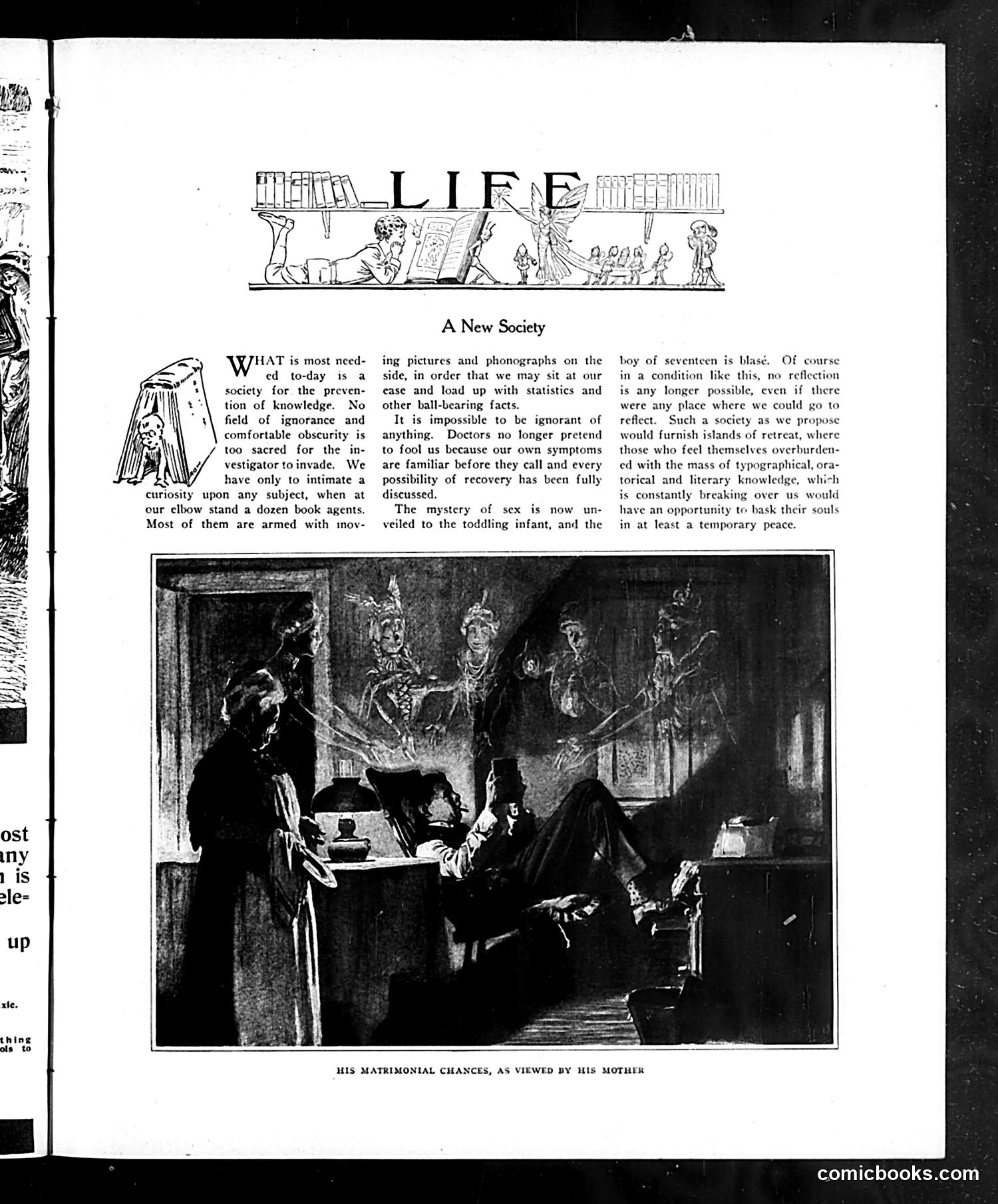
This page satirizes early 20th-century intellectualism and social reform movements. The article advocates for a "new society" based on scientific knowledge rather than tradition, claiming ignorance and "comfortable obscurity" are no longer acceptable. It explicitly mentions demystifying sex education and challenging medical authority. The illustration below—captioned "His Matrimonial Chances, as Viewed by His Mother"—appears to satirize this modern approach. It depicts a young man's matrimonial prospects being evaluated through a supernatural or spiritualist lens (note the ghostly figures on the wall), suggesting mothers still clung to old superstitions and traditional values when assessing their sons' romantic futures, despite the article's call for rational, scientific thinking.
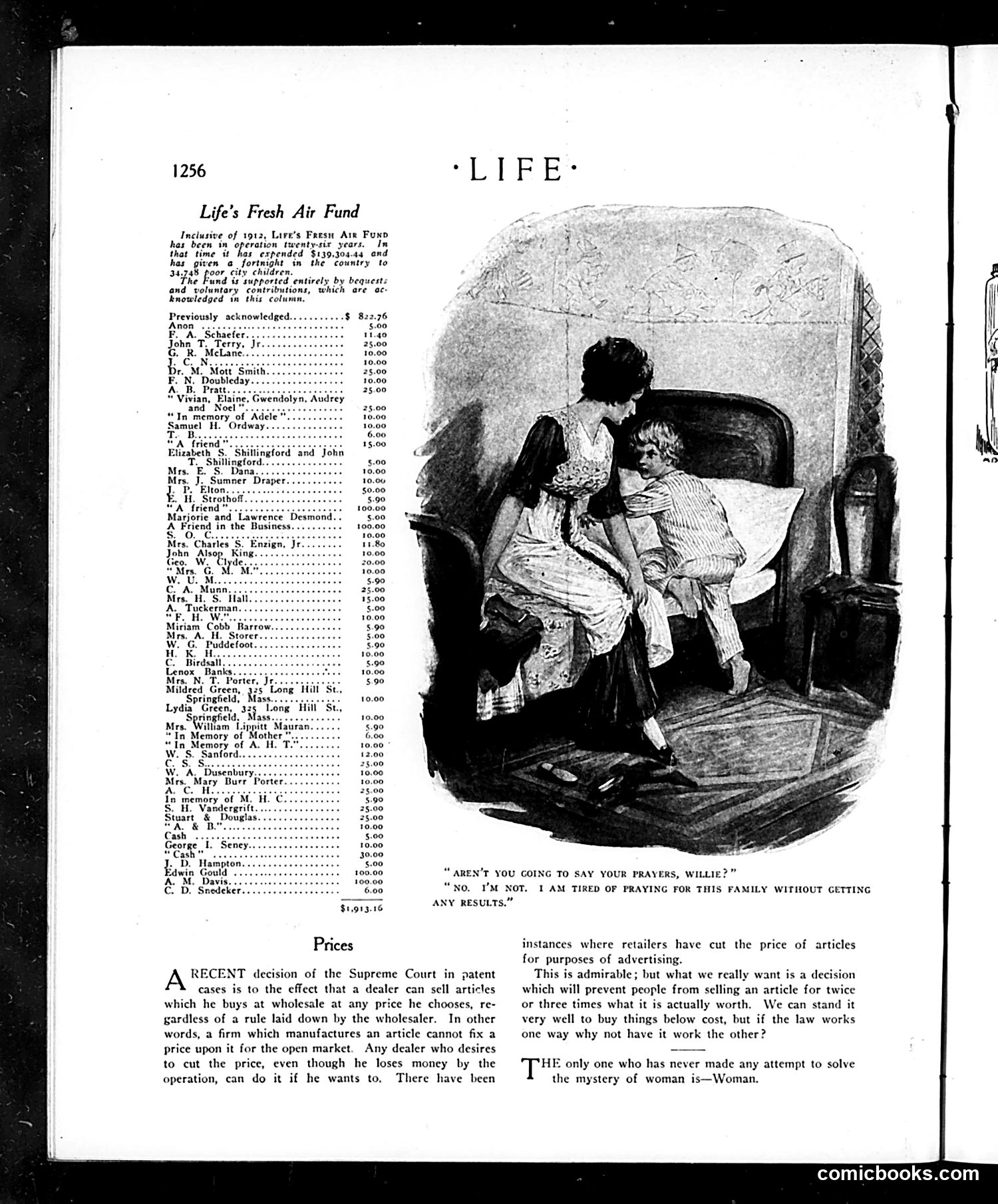
This page from *Life* magazine contains two distinct elements: **Left side:** A fundraising list for "Life's Fresh Air Fund," showing individual donations ranging from $1.00 to $100.00. The fund appears to support children's access to fresh air—a Progressive Era public health initiative addressing urban poverty. **Right side:** A cartoon depicting a woman and child at prayer beside a bed. The caption reads: "Aren't you going to say your prayers, Willie?" / "No. I'm not. I am tired of praying for this family without getting any results." **The satire:** The cartoon critiques both parental faith and economic inequality. Willie's refusal to pray unless it produces material results satirizes the disconnect between religious instruction and actual poverty relief. The adjacent fundraising list underscores the irony—charity depends on voluntary donations rather than systemic change, making prayer seem equally ineffective.
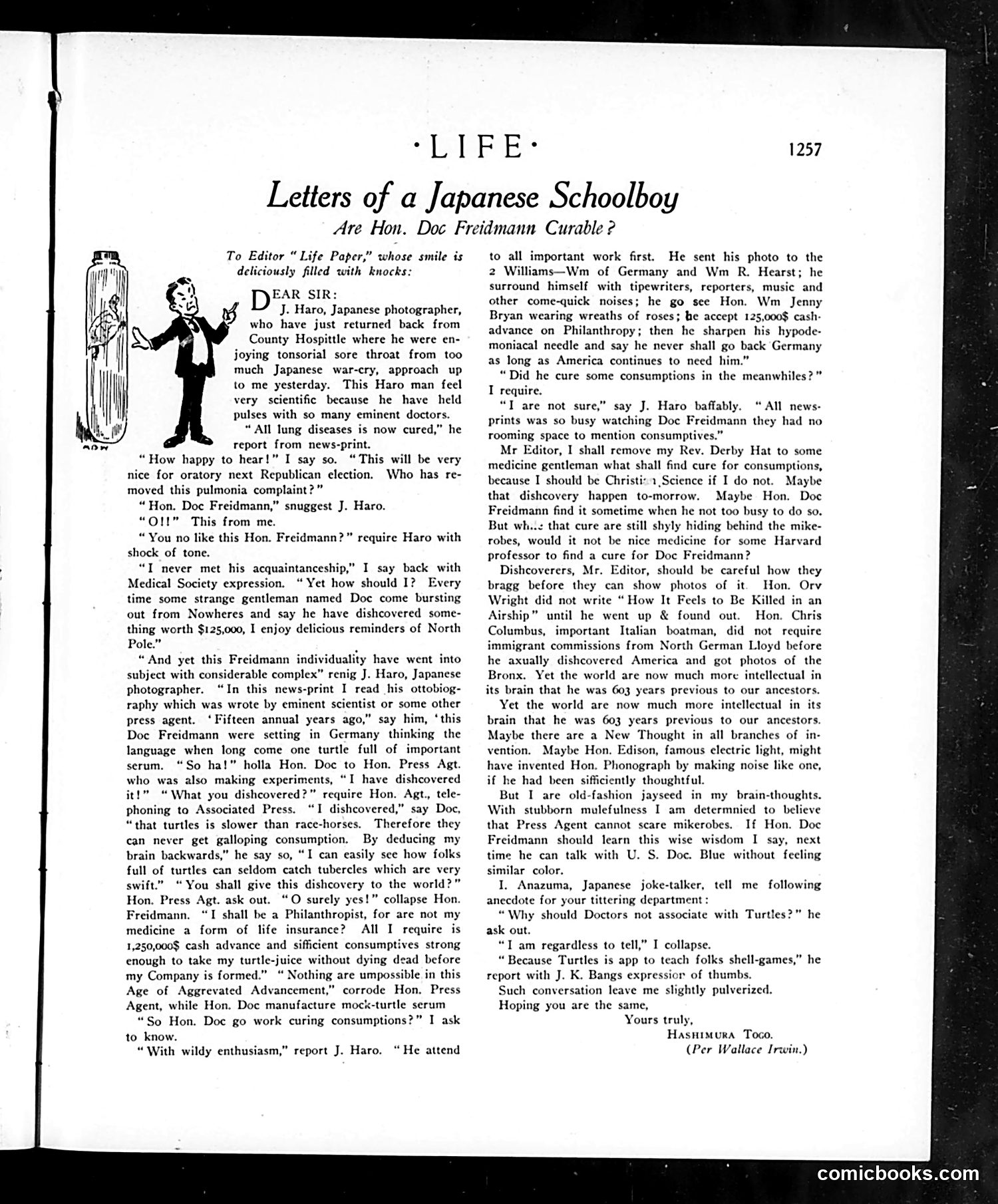
This is a satirical letter-to-the-editor mocking **Dr. Hon. Doc Freidmann**, apparently a notable but controversial public figure of the era. The cartoon shows a Japanese photographer (J. Haro) reporting absurd claims attributed to Freidmann—that he's discovered cures for all lung diseases, uses turtle juice for medicine, and manufactures "mock-turtle serum" to treat consumption (tuberculosis). The satire targets Freidmann's apparent grandiose medical claims and self-promotion. The letter's sarcastic tone—praising his "scientific" approach while listing increasingly ridiculous "discoveries"—exposes him as a charlatan or fraud. The Japanese perspective adds comedic distance, allowing the author to describe Freidmann's behavior as bizarrely exotic to American readers. The joke relies on Freidmann being recognizable to Life's contemporary audience as someone known for dubious medical claims.
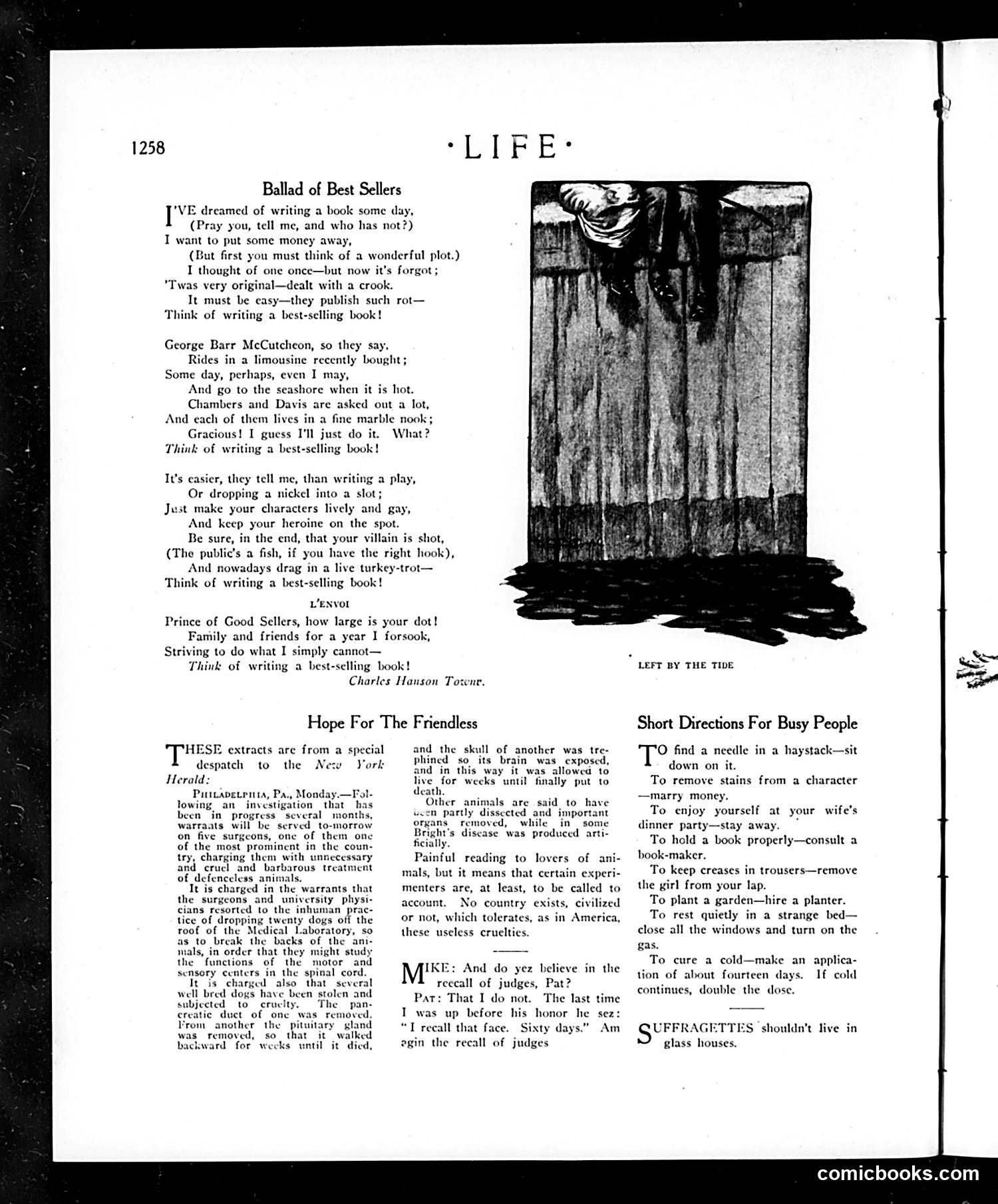
This page from *Life* magazine contains literary satire rather than political cartooning. The "Ballad of Best Sellers" mocks the then-popular ambition to write commercially successful books. The poem ridicules how aspiring authors dream of easy wealth through publishing, referencing real contemporary bestselling authors like George Barr McCutcheon. The accompanying sections—"Hope For The Friendless" (discussing animal cruelty research) and "Short Directions For Busy People" (humorous household tips)—represent typical *Life* magazine content mixing social commentary with light humor. The illustration "Left by the Tide" appears to be atmospheric artwork rather than tied to specific satire. Overall, this page targets intellectual pretension and get-rich-quick fantasies among amateur writers of the early 20th century.
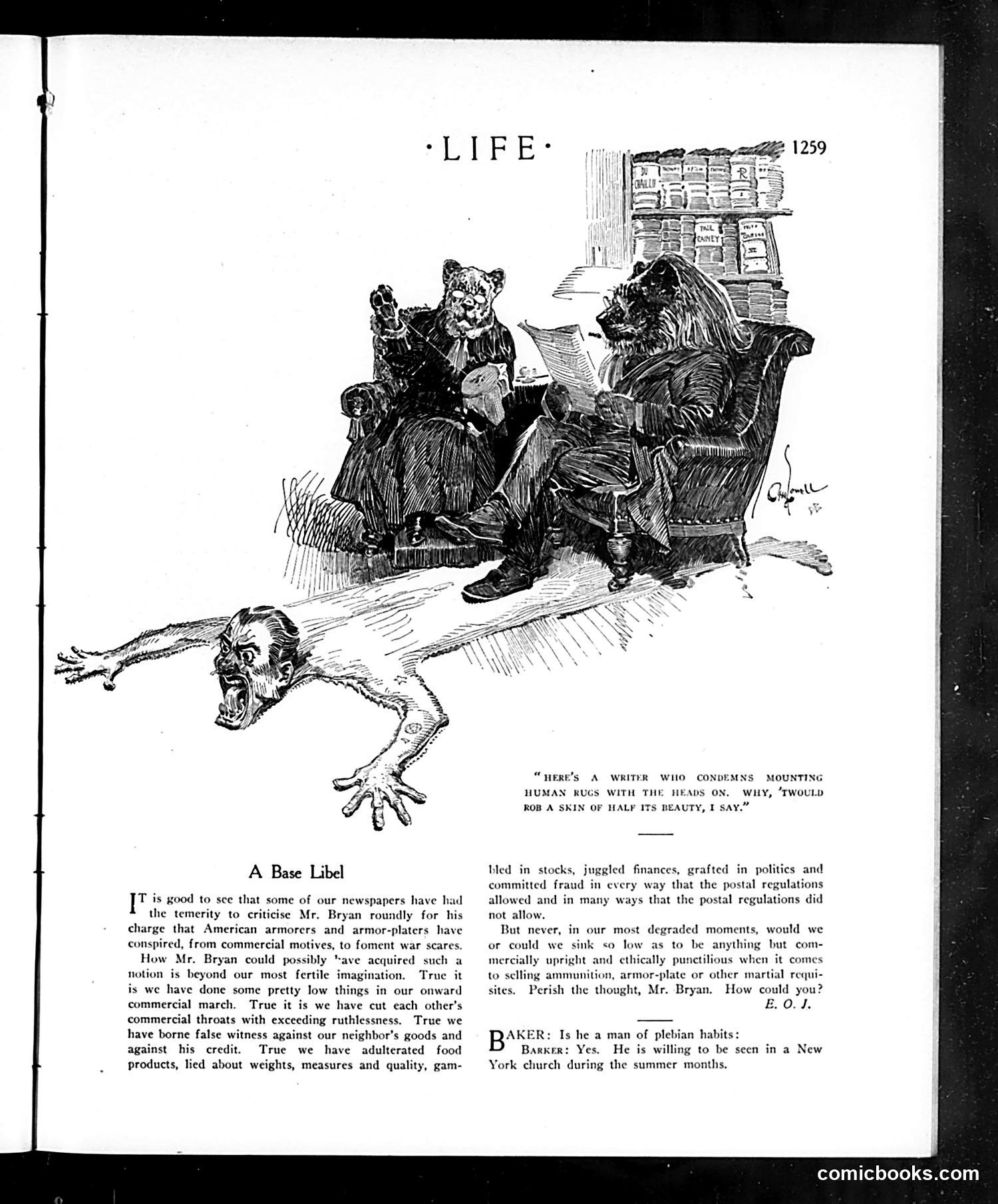
This page satirizes newspaper accusations against American armor manufacturers. The cartoon shows animals in human dress reading newspapers, with a grotesque creature sprawled below—likely representing a malicious libel or false accusation. The article defends manufacturers against charges of wartime profiteering and fraud. It acknowledges America's commercial dishonesty in various industries (food adulteration, false weights, credit fraud) but argues that ammunition and armor-plate manufacturers maintain ethical standards—they wouldn't dare compromise military equipment. The cartoon's beast represents the "base libel" itself: unfounded accusations. The animals reading newspapers suggest public consumption of these potentially false charges. The satire criticizes both reckless newspaper accusations *and* implicitly acknowledges why such accusations seem plausible given America's documented commercial corruption in other sectors.
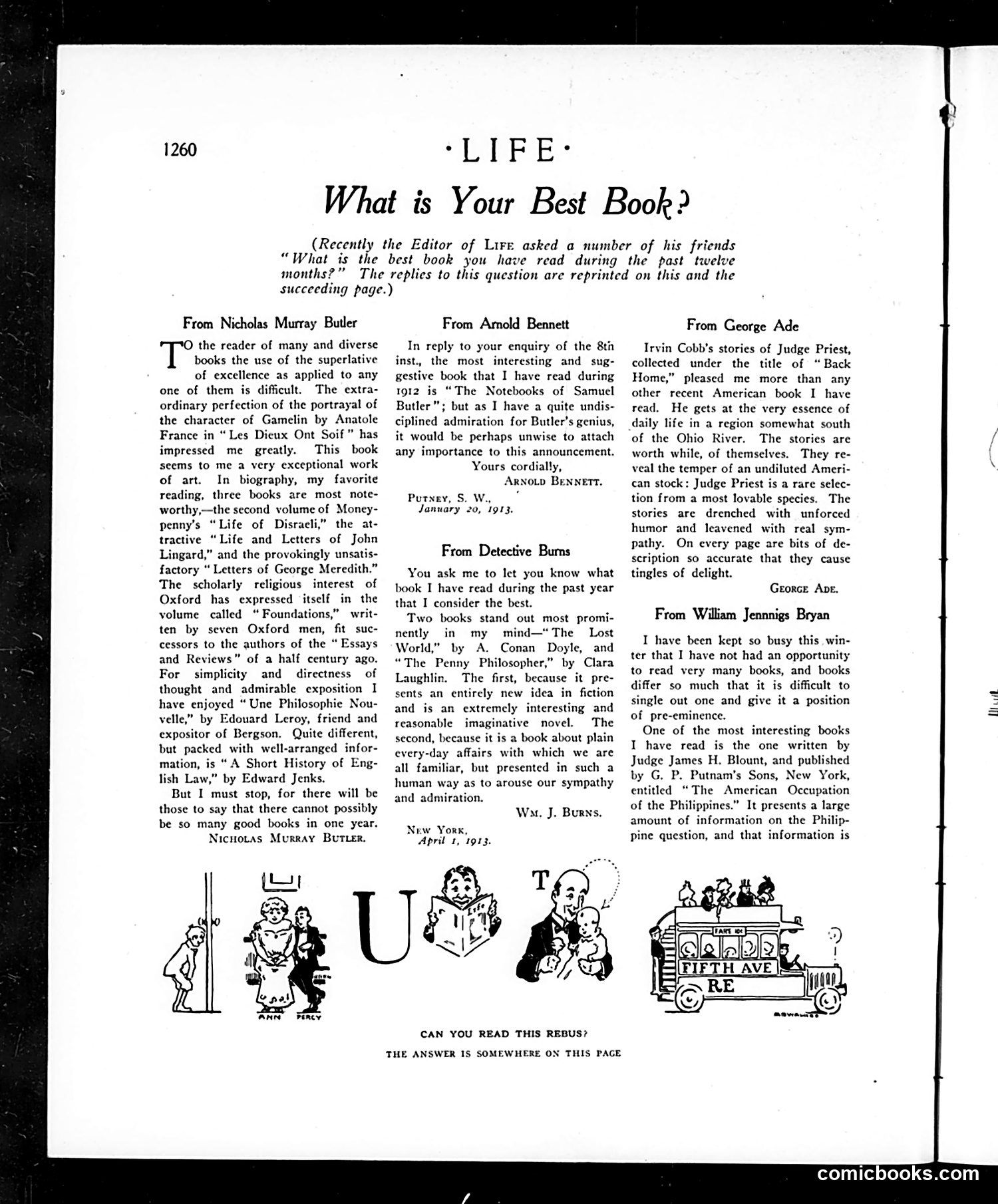
This page features book recommendations from prominent figures (Nicholas Murray Butler, Arnold Bennett, George Ade, William Jennings Bryan, and Detective Burns). The small cartoons at the bottom appear to illustrate the letter "U" through playful vignettes—characters reading, children with books, and what appears to be a mobile library or bookstore on wheels labeled "Fifth Ave." The decorative letterforms suggest this is a visual pun or rebus puzzle ("Can you read this rebus?" prompts readers). The overall page promotes reading and book culture to Life's educated audience during the 1910s. The contributors' recommendations range from classic literature to contemporary works, reflecting early 20th-century intellectual discourse about which books merit serious attention.
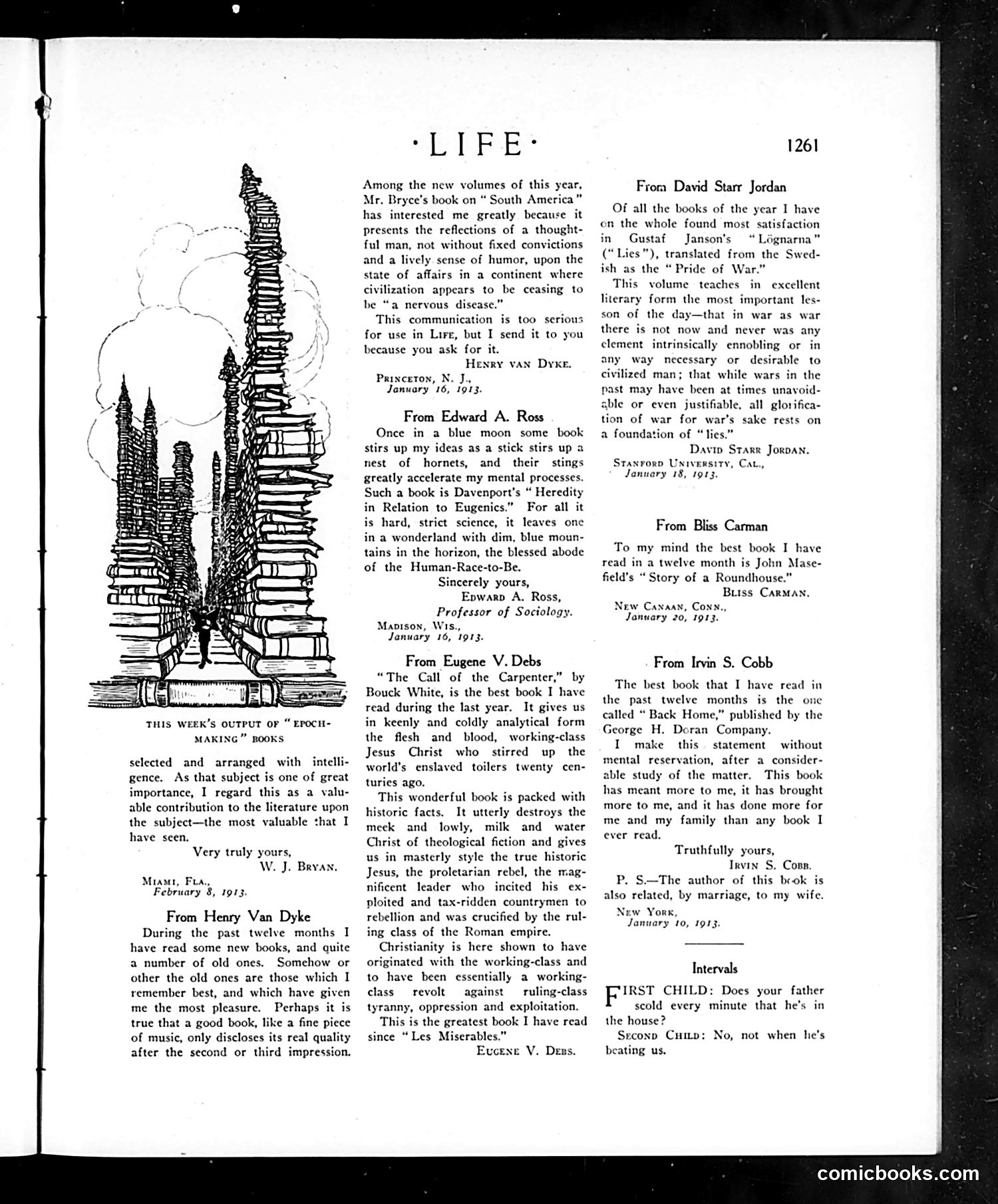
This is a satirical illustration about intellectual pretension, not a political cartoon. The drawing depicts an enormously tall stack of books precariously balanced, with a tiny human figure at the base for scale. The caption mocks publishers' tendency to market every new book as groundbreaking ("epoch-making"). The accompanying letters from readers discuss recently published books they've found meaningful—works on sociology, eugenics, and social reform. The satire suggests that while publishers hype numerous volumes as revolutionary, readers should evaluate which actually merit serious attention. The towering, unstable stack visualizes the absurdity of constant claims of literary importance in early 1910s publishing culture.
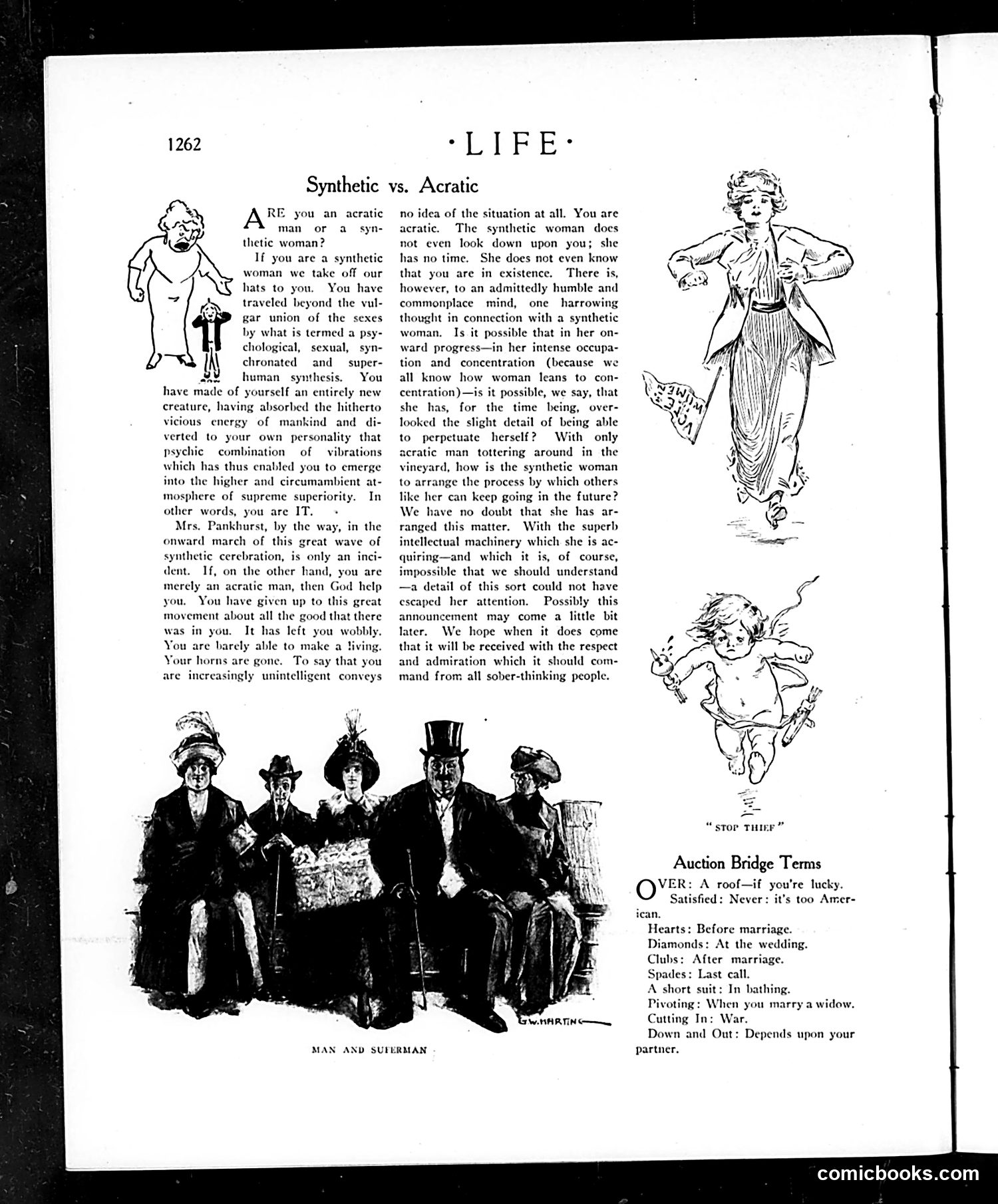
This page satirizes two opposing personality types through an argument addressed to readers. A "synthetic" woman is praised as intellectually superior—she's organized, purposeful, and self-directed, embodying modern progress. By contrast, an "acratic" man is mocked as aimless and dependent, "hardly able to make a living" with "increasingly unintelligent" behavior. The bottom illustration ("Man and Subaltern") shows five men in formal dress, likely satirizing gender dynamics of the era. The "Auction Bridge Terms" section makes wordplay jokes connecting card-game terminology to romantic/marital situations (e.g., "Hearts: Before marriage; Diamonds: At the wedding"). The overall message champions modern synthetic womanhood as superior to traditional male role models.
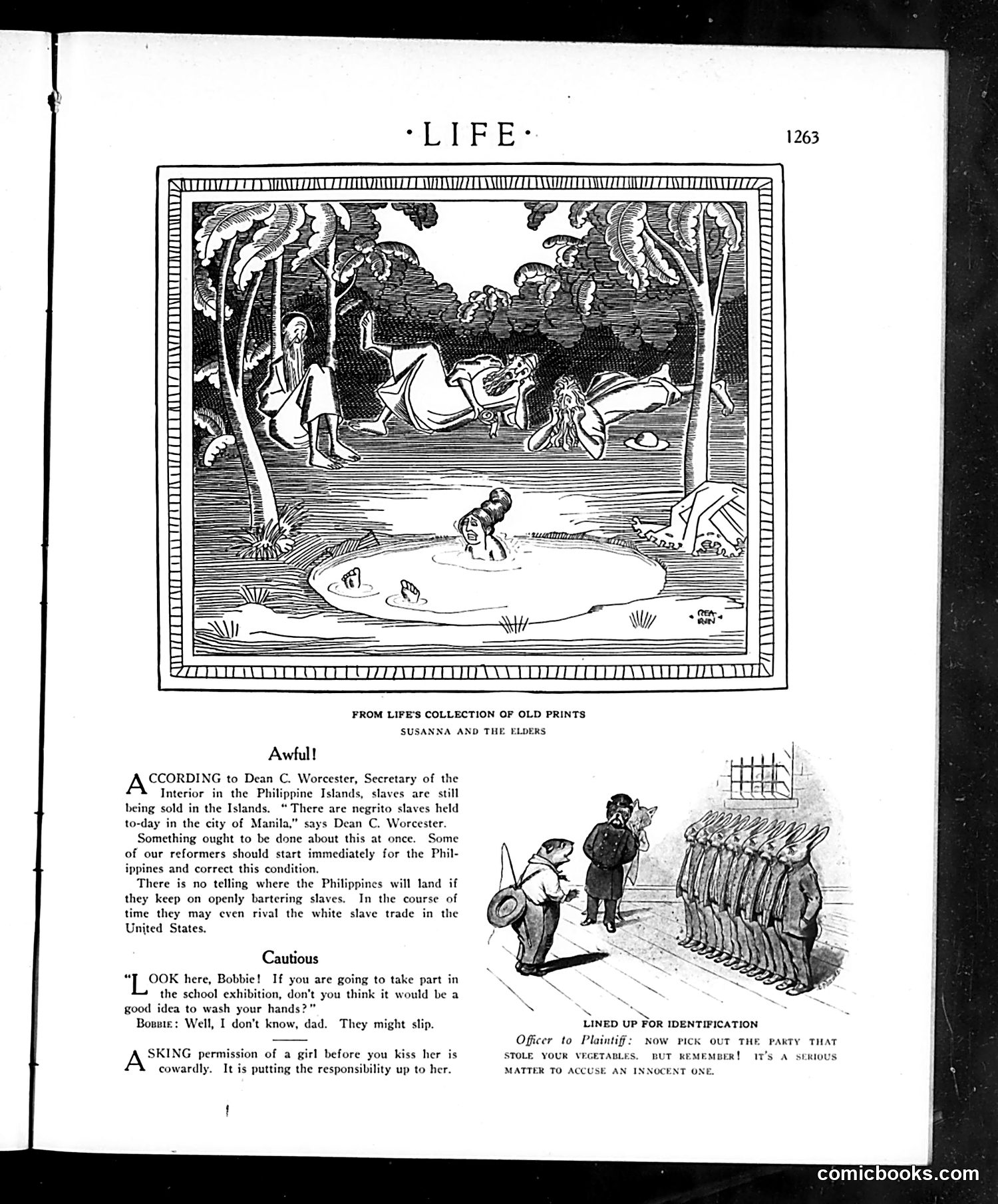
This page contains three separate satirical pieces: 1. **"Awful!"** - References Dean C. Worcester's report on slavery in the Philippine Islands. The satire criticizes American reformers for focusing on distant colonial slavery while ignoring the "white slave trade" (human trafficking) occurring in the United States itself. It's a pointed critique of selective moral outrage. 2. **"Cautious"** - A domestic humor piece where a father warns his son to wash hands before a school exhibition. The son's reply—that clean hands "might slip"—is a joke about losing grip, playing on parental anxiety. 3. **"Lined Up for Identification"** - A cartoon showing a police officer instructing a plaintiff to identify a vegetable thief from a lineup. The humor lies in the officer's overwrought warning about falsely accusing innocents in a trivial theft case, contrasting the serious legal language with the petty crime. The top illustration appears to be a classical art print ("Susanna and the Elders"), included as part of the magazine's regular art collection feature.
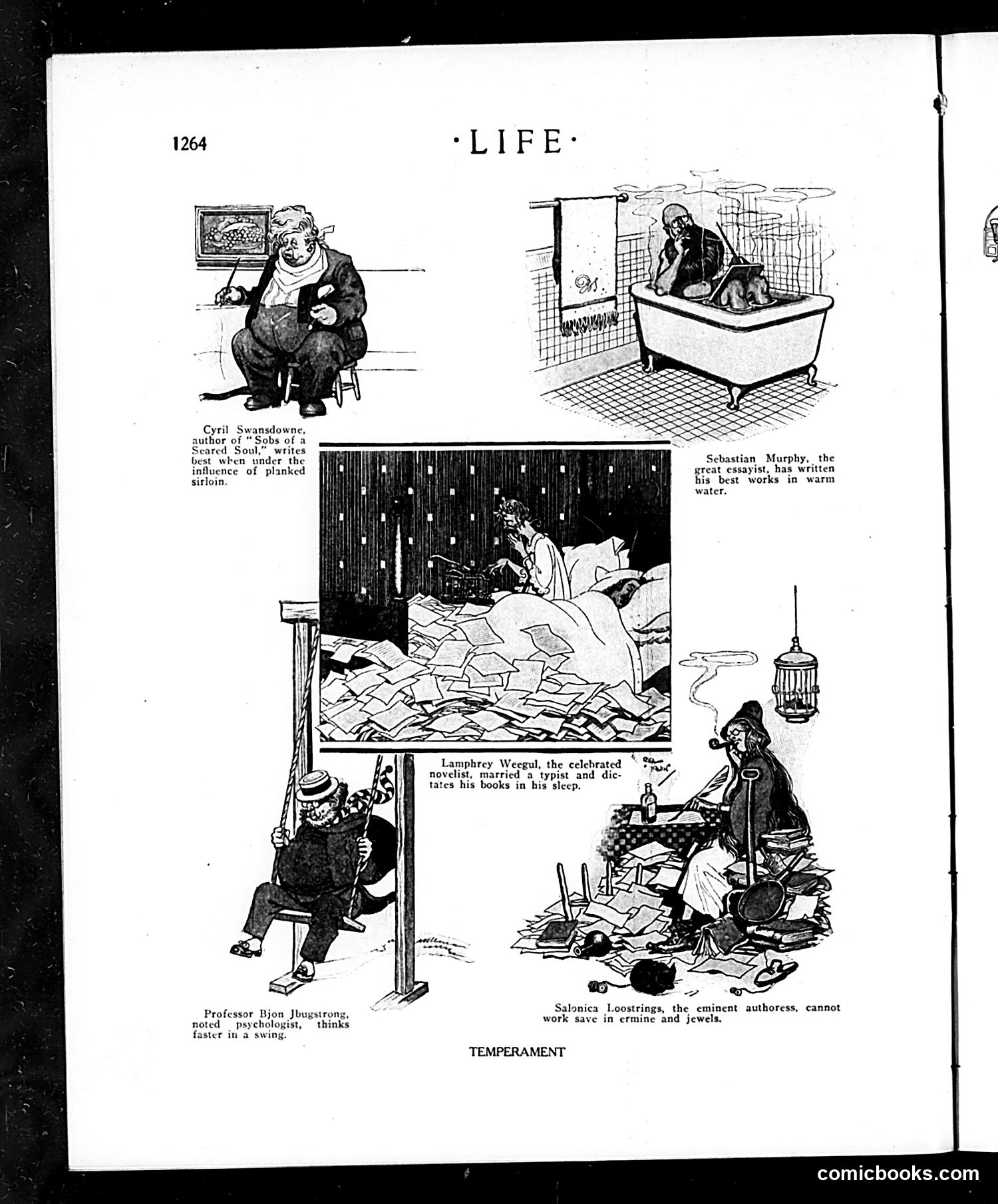
This page satirizes the affectations and eccentric habits of famous writers and intellectuals. The cartoon mocks pretentious creative types by depicting their absurd working conditions: - **Cyril Swansdowne** requires a sirloin while writing - **Sebastian Murphy** insists on warm water for his essays - **Lamphrey Weegul** dictates novels while asleep to his typist-wife - **Professor Bjon Jbugstrong** thinks faster on a swing - **Salonica Loostrings** demands ermine and jewels to work The joke is that these celebrated figures attribute their success to ridiculous, self-indulgent "requirements"—suggesting their reputations are inflated nonsense rather than genuine talent. The satire critiques both the pretentiousness of intellectuals and the public's willingness to accept their absurd justifications for creative eccentricity. It's early 20th-century social commentary on artistic vanity.
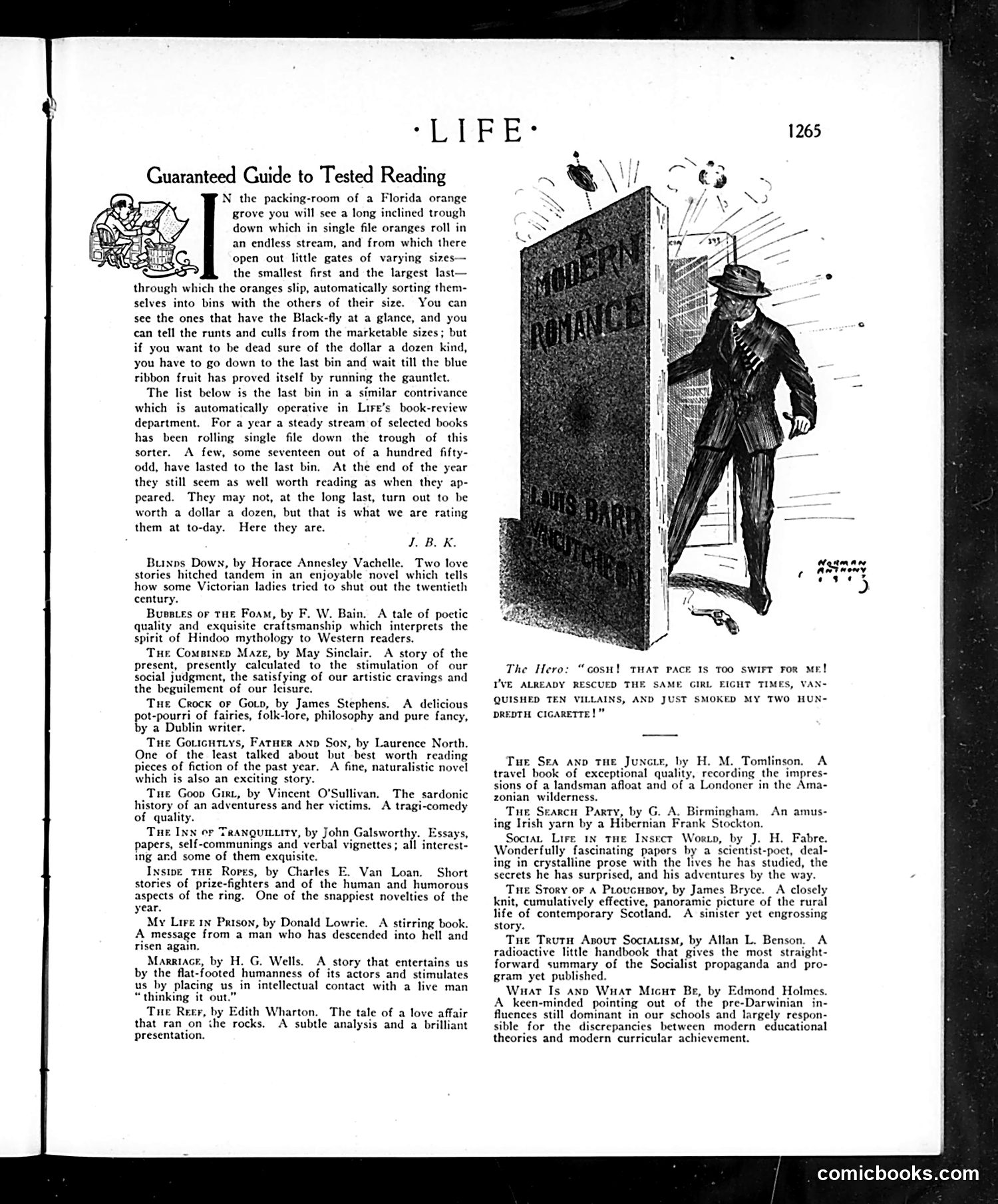
This page satirizes the publishing industry's book-review process by comparing it to an **orange-sorting machine**. The conceit: just as Florida packing houses automatically grade oranges by size through successive gates—with only the finest "blue ribbon fruit" reaching the final bin—Life's book-review department similarly filters hundreds of submissions annually, retaining only the worthiest. The cartoon's hero complains he's rescued the same girl **eight times, vanquished ten villains, and smoked two hundred cigarettes**—mocking the repetitive, formulaic adventure-story plots that get rejected. The satire targets both the flood of mediocre manuscript submissions and the magazine's rigorous editorial standards. By year's end, only 17 of 150+ books merit the "dollar a dozen" rating, making them worth reading. The humor lies in treating literary evaluation with the same mechanical precision and industrial language as produce grading—reducing subjective aesthetic judgment to objective sorting efficiency.
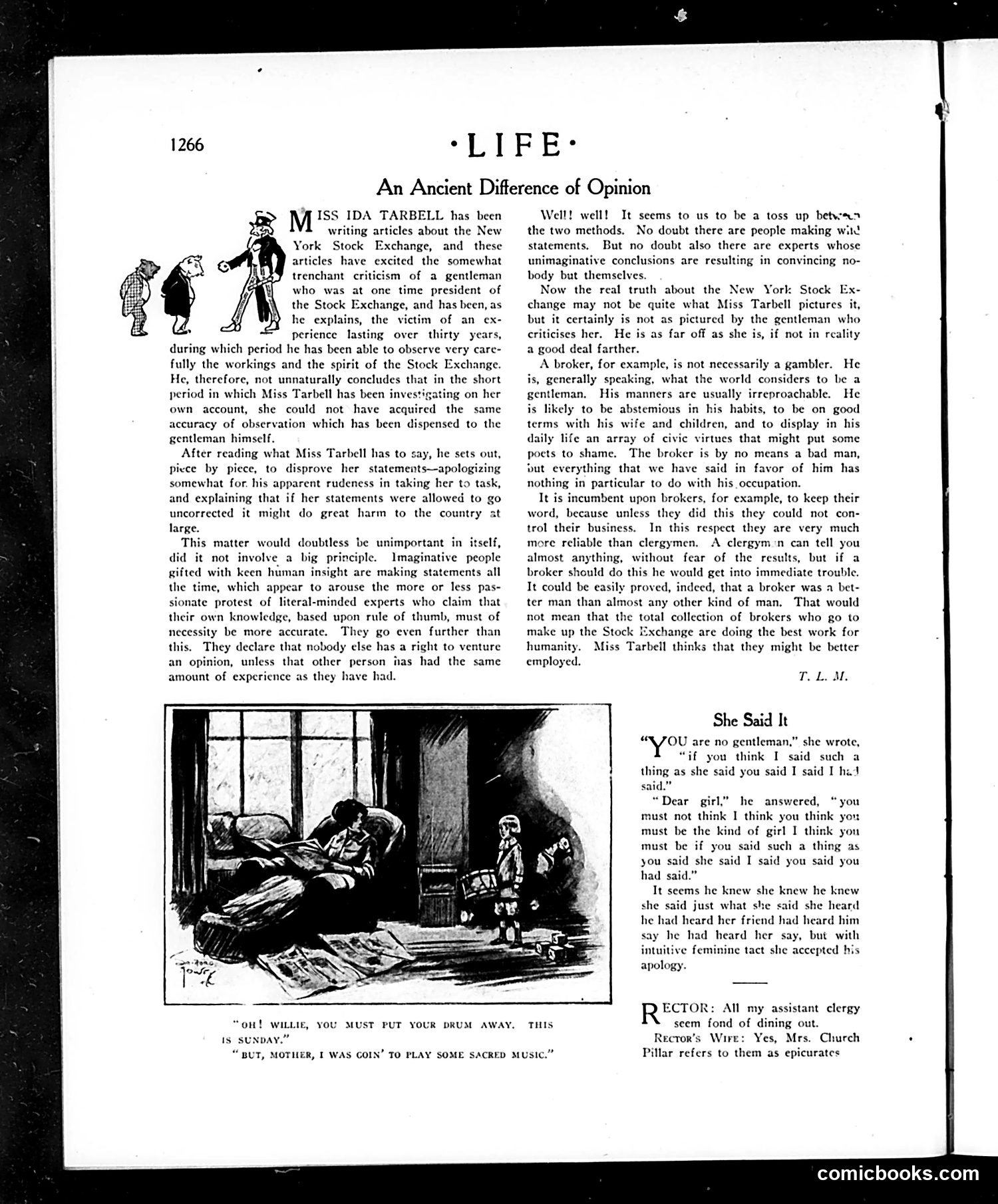
This page satirizes a debate between **Ida Tarbell** (a prominent investigative journalist) and an unnamed **former president of the New York Stock Exchange** over her critical articles about the Exchange. The satire's point: The unnamed critic dismisses Tarbell's conclusions because she lacks his thirty years of experience, arguing that only those with extensive firsthand knowledge can comment on institutions. Life's editorial counters this gatekeeping—arguing that imaginative insight and literal expertise are equally valid but different methods of understanding truth. Neither party fully captures reality. The cartoon below illustrates the absurdity of this rigid "experience requirement" through a domestic scene: a mother forbids her son from playing his drum on Sunday, but he protests he was going to play "sacred music." The point is obvious—the content matters less than the excuse. The section "She Said It" plays with nested denials and misquotations, further mocking how easily such debates devolve into semantic confusion rather than substantive disagreement.
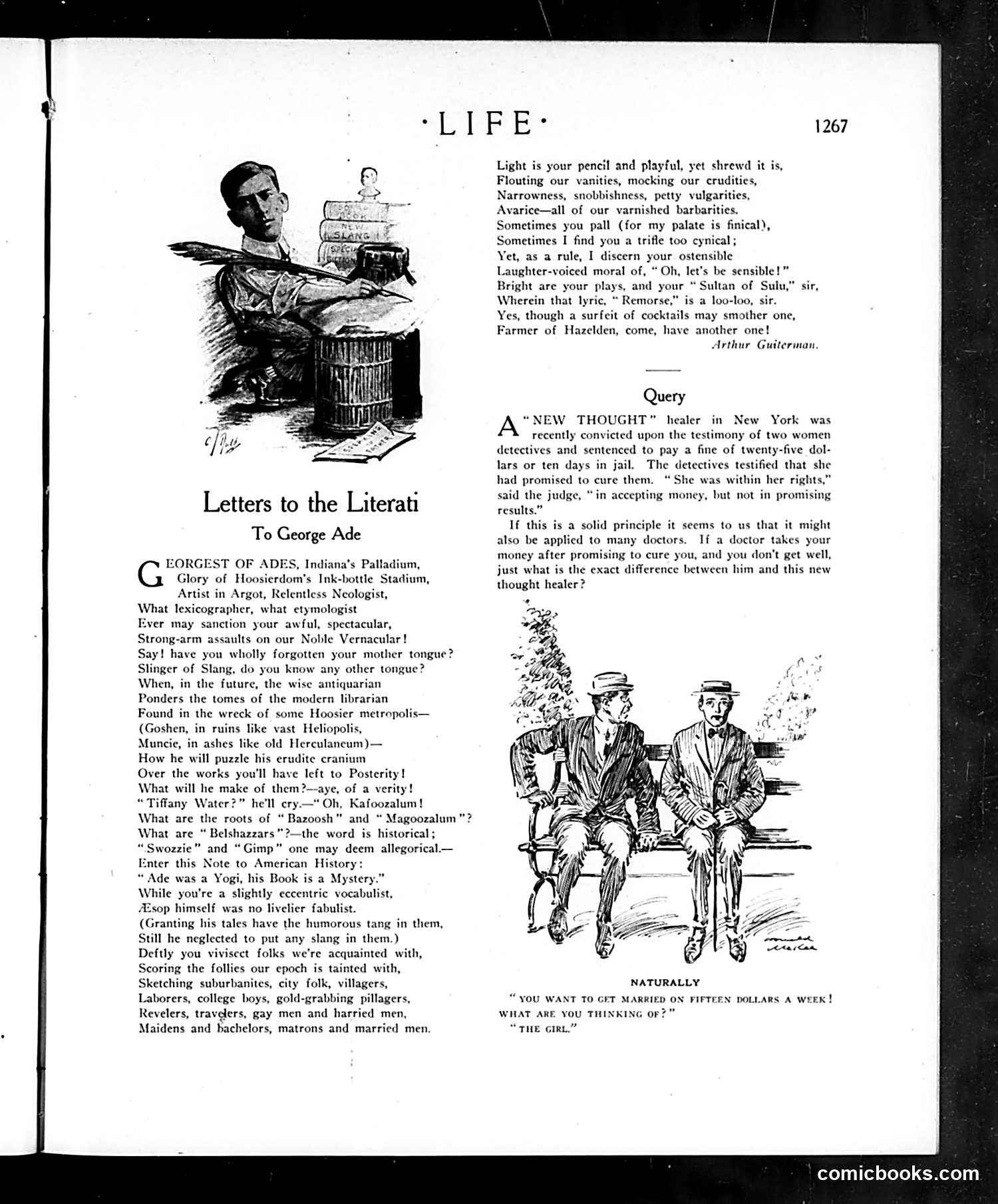
This page contains two satirical pieces targeting prominent figures of the era: **"Letters to the Literati: To George Ade"** criticizes the Indiana writer for his neologisms and slang, which the author argues debases proper English. The poem mocks Ade's invented words ("Bazoosh," "Magoozalum") and predicts future scholars will puzzle over his legacy—a humorous attack on his literary style and influence. **"Query" section** discusses a "New Thought" healer convicted in New York for fraud. The satire's point: the judge ruled she acted within her rights accepting money while promising cures. The author notes this principle logically applies to doctors too—if both take payment without delivering results, what's the moral difference? This exposes potential hypocrisy in how society treats dubious practitioners. **Bottom cartoon** depicts three men discussing marriage on fifteen dollars weekly—apparently absurd economics for the time, treating matrimony as a commodity priced beyond working-class means.
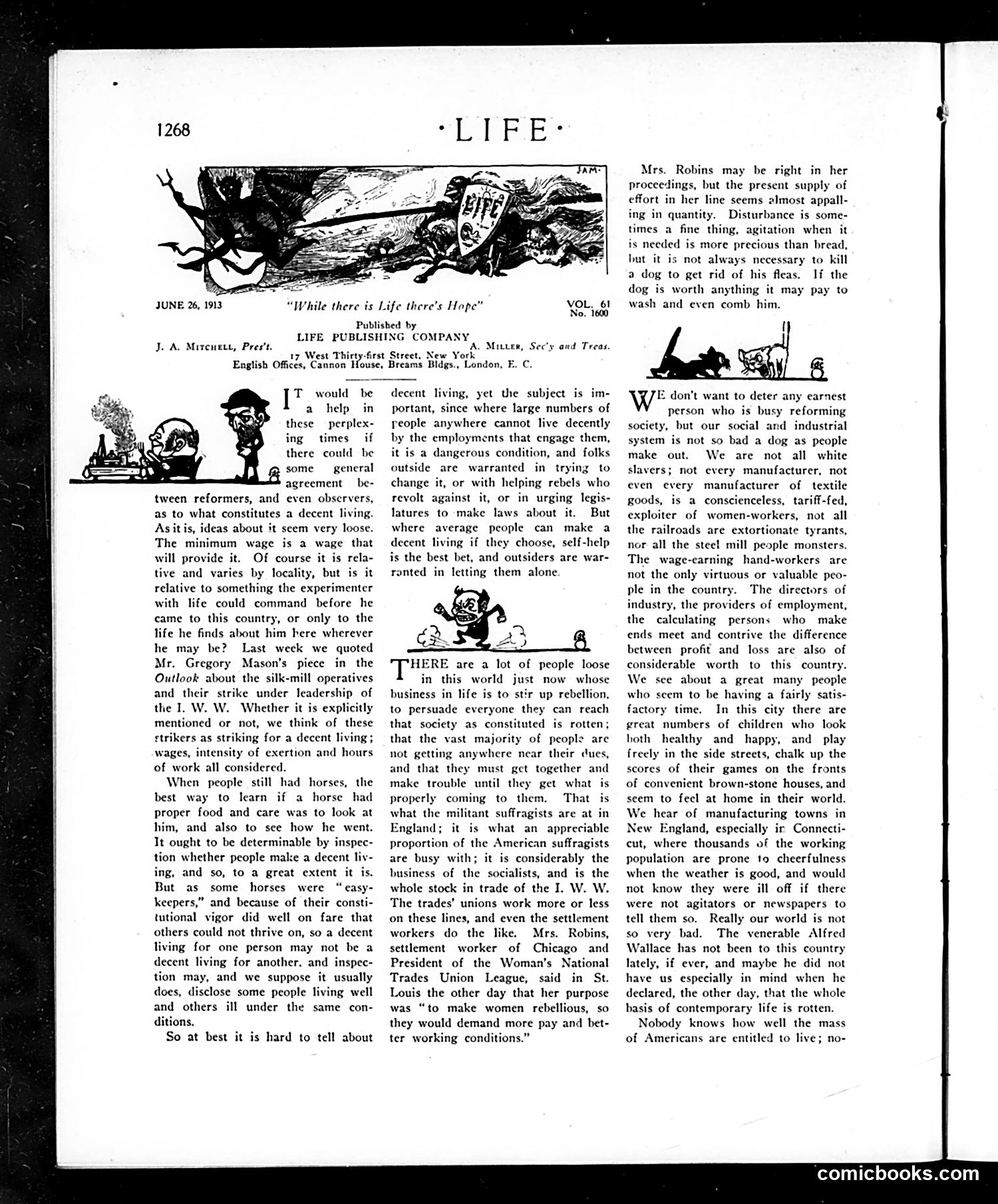
This editorial page debates labor activism and the concept of "decent living." The text critiques what it sees as excessive agitation by reform movements, particularly targeting Mrs. Florence Robins (identified as a Chicago settlement worker and president of the Woman's National Trades Union League) and her stated goal "to make women rebellious" for better wages and conditions. The author acknowledges legitimate grievances but argues that constant agitation isn't always necessary—using the metaphor of killing a dog to remove fleas when washing would suffice. The piece expresses skepticism toward the IWW (Industrial Workers of the World), socialists, militant suffragists, and trade unions, suggesting their activism is excessive given that "average people can make a decent living if they choose, self-help is the best bet." The cartoons (appearing to show labor/reform figures) reinforce this cautionary tone toward reform movements, though specific identities aren't entirely clear from the image.
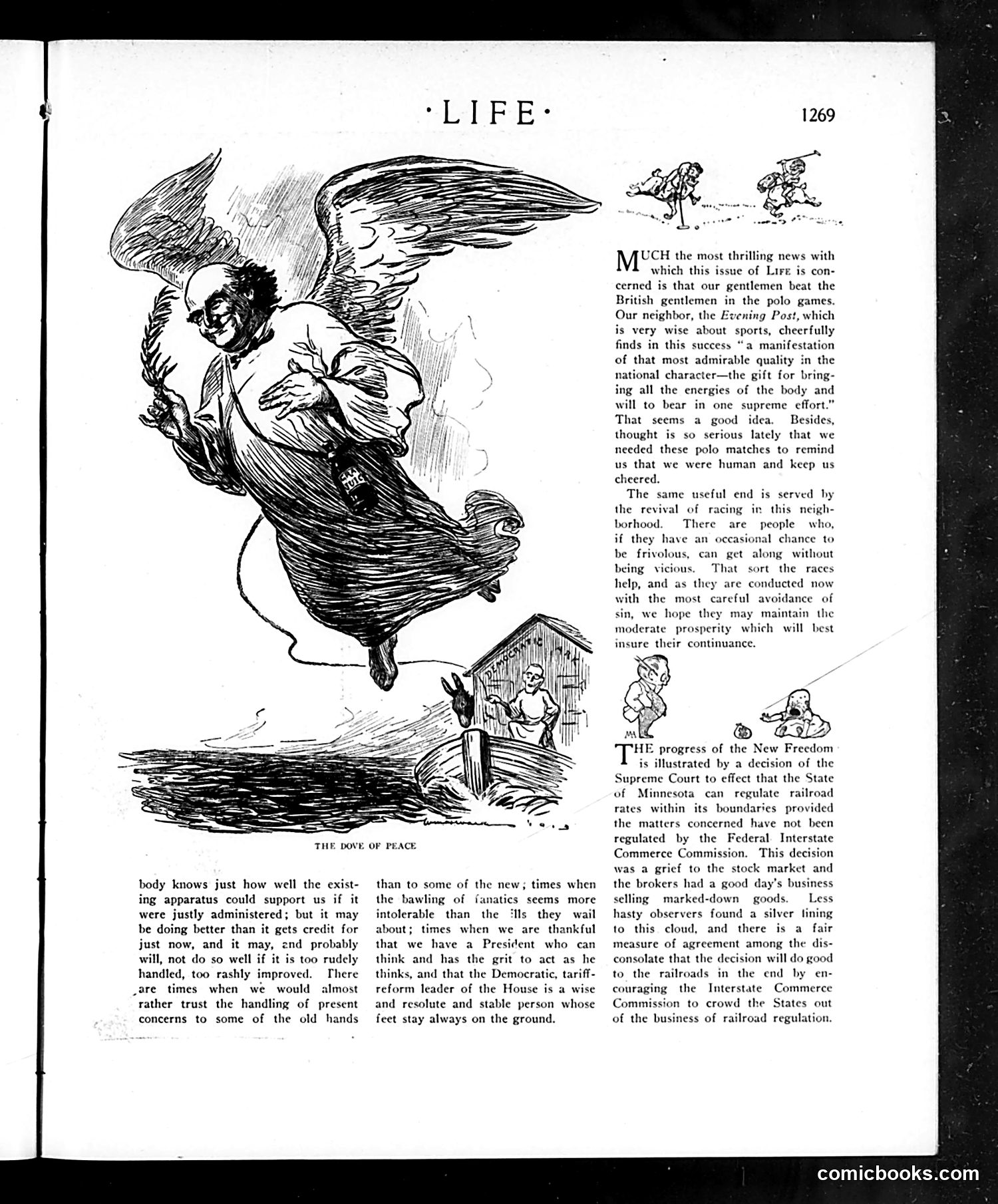
The main cartoon depicts a winged female figure (representing Peace) carrying a dove, floating above a small house. The illustration appears ironic given the surrounding editorial commentary. The page celebrates American polo players defeating British competitors, framing this as evidence of national character and vigor. It also discusses the "New Freedom" — likely referring to President Woodrow Wilson's progressive agenda — through a Supreme Court decision allowing Minnesota to regulate railroad rates independently of federal authority. The editorial adopts a cautiously optimistic, somewhat conservative tone: praising the current Democratic administration's stability while warning against rash reforms. It suggests the polo victory and horse racing provide necessary recreational outlets that keep citizens "human" and prevent social discontent. The "Dove of Peace" title ironically frames these domestic sports and political developments as peace-related, suggesting that national vitality and moderate governance maintain social harmony—a view typical of pre-WWI American centrist commentary.
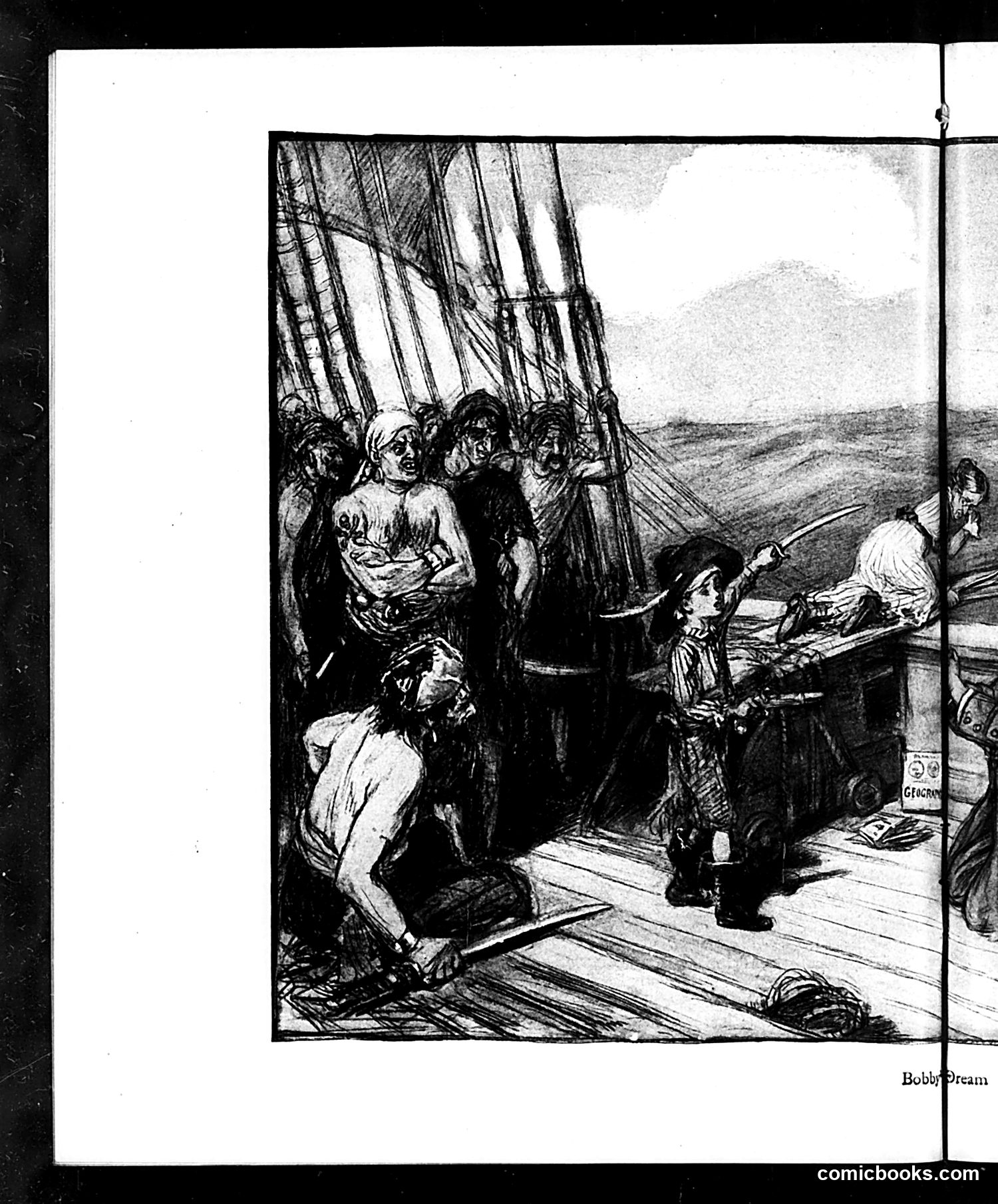
This appears to be an illustration titled "Bobby Dream" depicting a scene aboard a sailing ship. The image shows several figures on deck, including what appears to be a child and various sailors or crew members beneath billowing sails. The composition suggests a narrative scene rather than a satirical political cartoon. The OCR text is largely illegible, consisting primarily of garbled characters and symbols that don't form coherent words—likely a scanning artifact rather than actual page content. Without legible accompanying text, I cannot reliably identify the specific political or social references, historical figures, or satirical intent this illustration may have contained. The maritime setting and presence of what appears to be a young protagonist ("Bobby") suggests this may be an adventure narrative, but the precise meaning and context remain unclear from the available information.
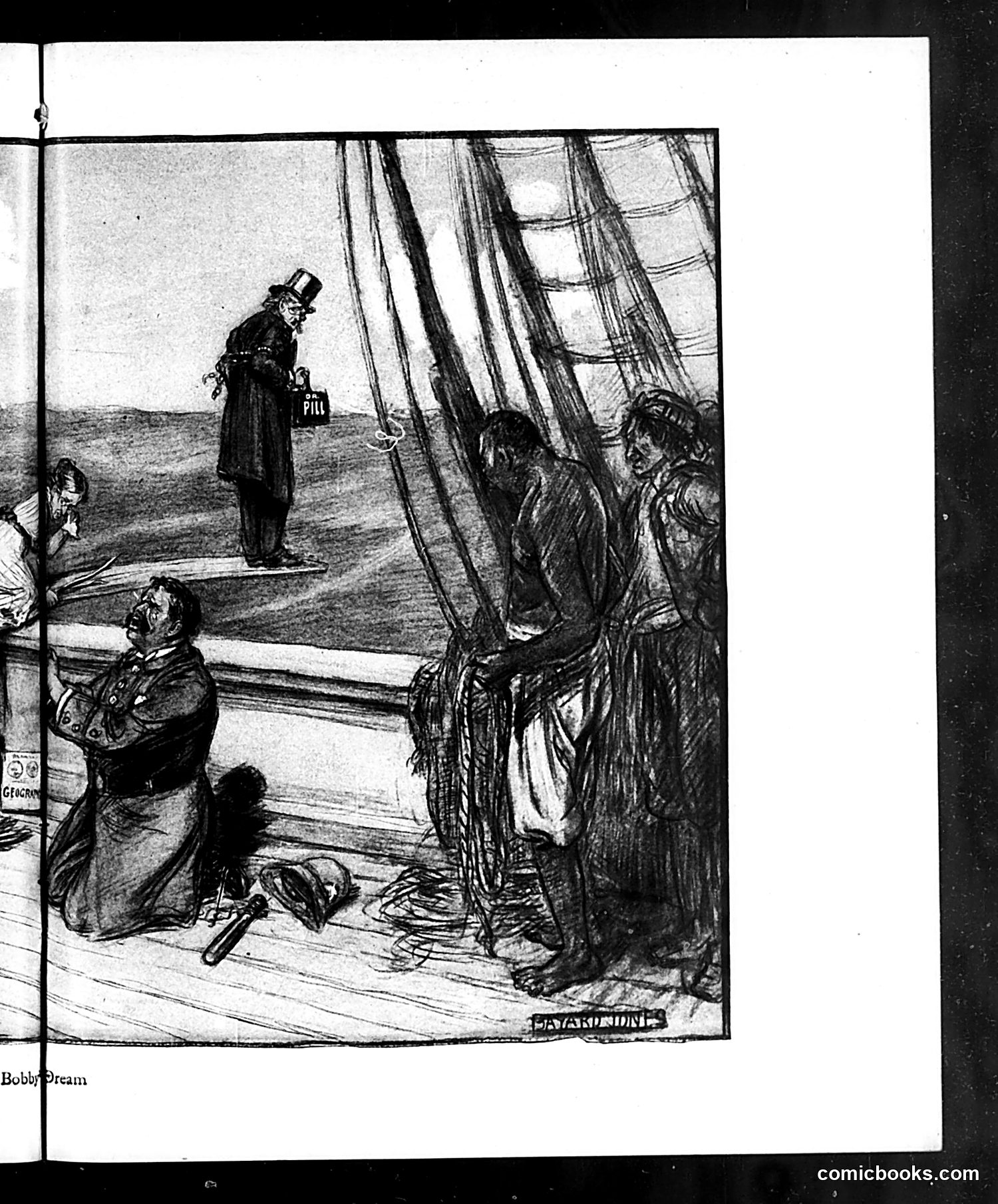
This appears to be a satirical maritime scene, likely from an early 20th-century *Life* magazine. The image shows a well-dressed gentleman in a top hat standing on deck while sailors work around him. The composition suggests social commentary about class hierarchy aboard ship—the genteel figure maintains distance and authority while working-class crew members labor with ropes and rigging. The title "Bobby Dream" (visible at bottom left) is unclear in meaning. Without additional context about the publication date or accompanying article text, I cannot identify the specific political or social reference this cartoon makes. It may satirize attitudes about wealth, labor relations, or maritime industry practices of the era, but the exact target remains uncertain from the image alone.
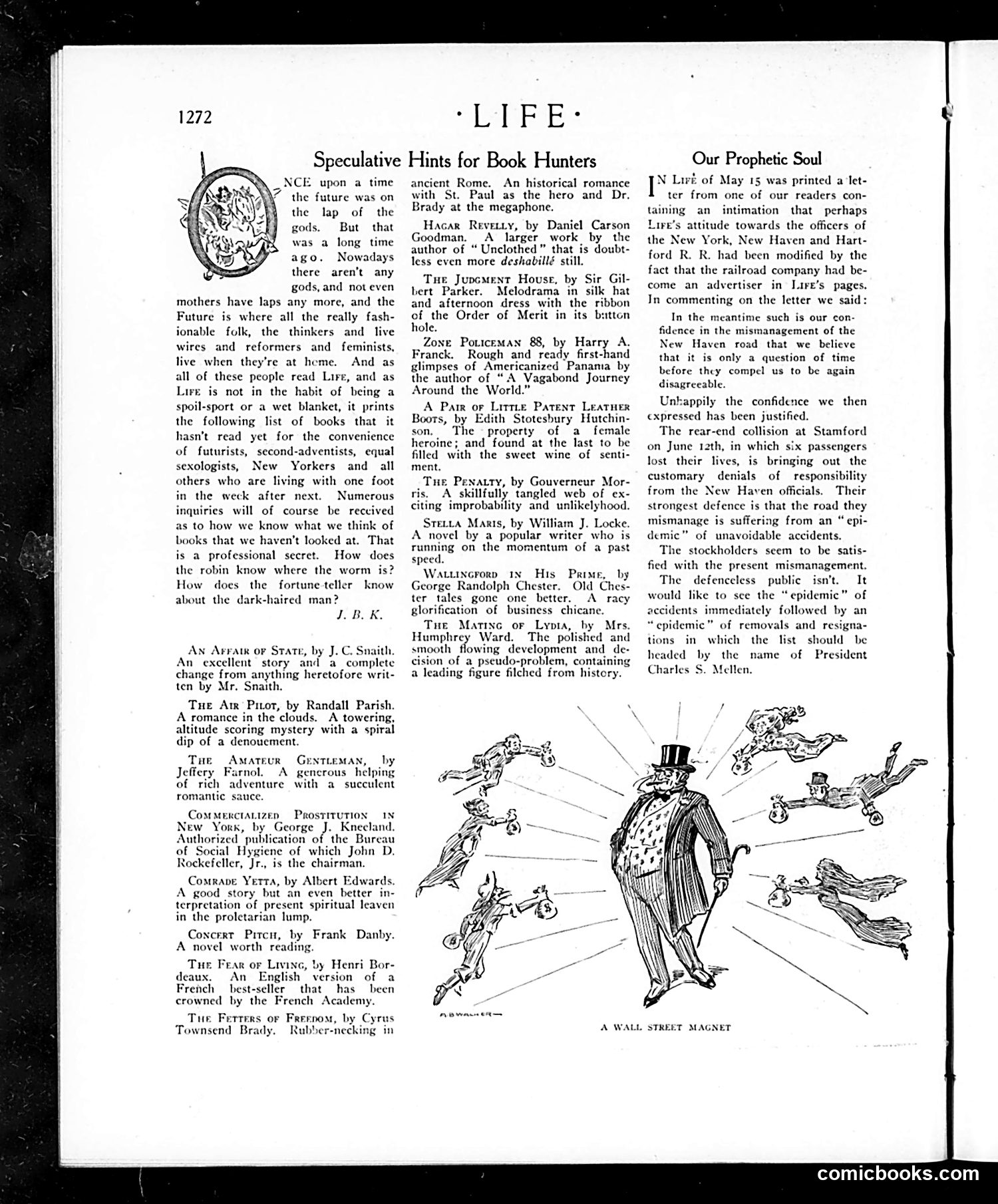
This 1910s Life magazine page satirizes Wall Street's magnetic attraction for opportunists and hangers-on. The central figure—a well-dressed plutocrat in top hat—magnetically draws various small figures toward him: businessmen, workers, and social climbers depicted as metal filings. The satire critiques how wealth concentrates power and attracts self-interested parties. The figures appear to represent different classes and types drawn irresistibly to financial power, suggesting corruption or moral compromise in pursuit of money. The accompanying "Speculative Hints for Book Hunters" section humorously lists unread books for "futurists, second-adventists, equal sexologists, New Yorkers"—mocking contemporary intellectual trends. The editorial note about railroad advertising influence on editorial judgment adds meta-commentary on magazine independence versus commercial interests, reinforcing the page's underlying critique of how money shapes institutions.
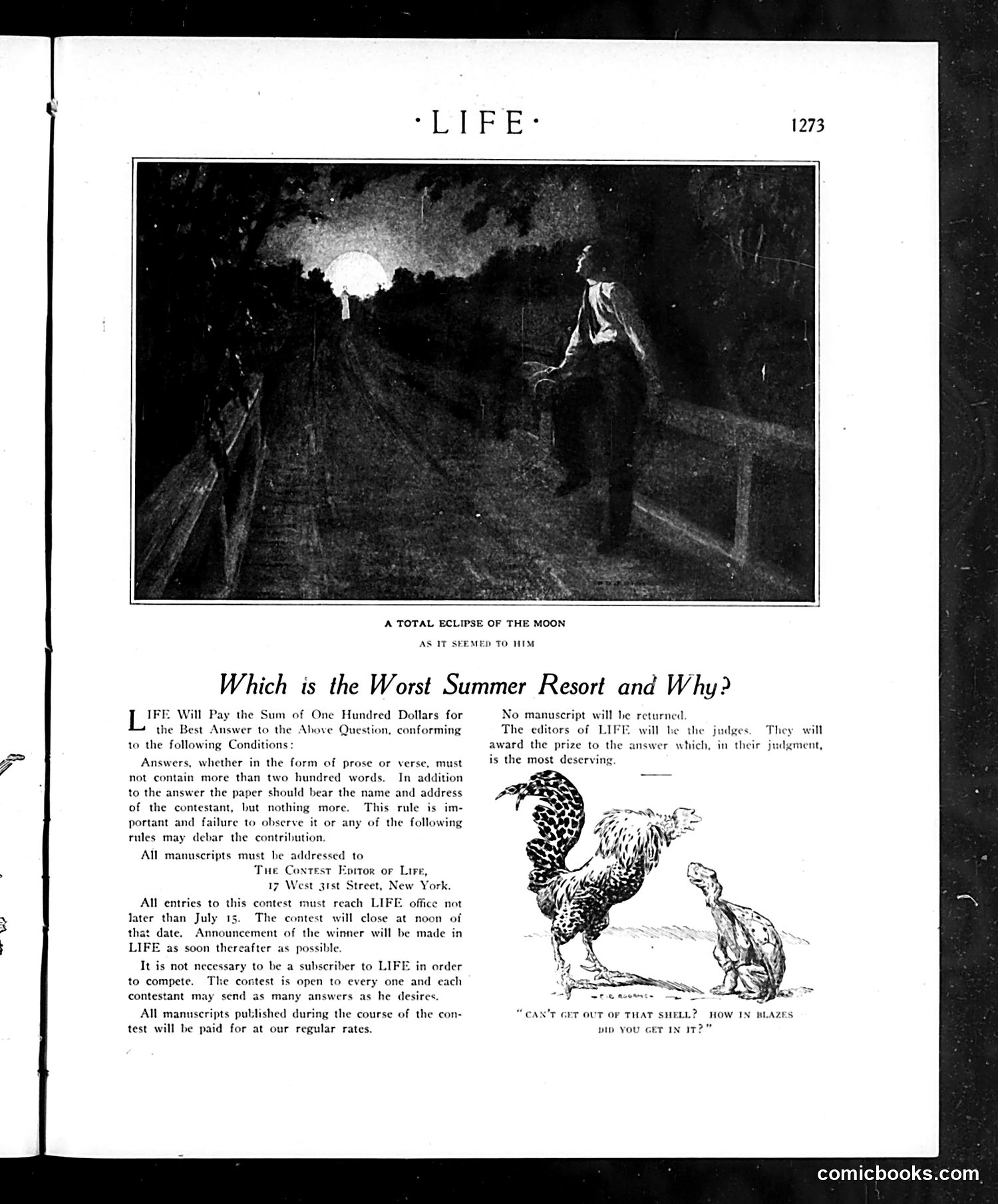
This page combines two unrelated items: **Top Image**: A nighttime scene showing a lunar eclipse, captioned "A Total Eclipse of the Moon As It Seemed to Him." The illustration depicts someone observing the moon from a rural setting with wooden fences. The humor likely plays on romantic or dramatic interpretations of natural phenomena—the eclipse appearing dramatically ominous or significant to an observer, when it's simply an astronomical event. **Bottom Section**: A contest announcement offering $100 for the best answer to "Which is the Worst Summer Resort and Why?" accompanied by an unrelated cartoon showing a rooster and rabbit, with dialogue about being stuck in a shell—appearing to be filler artwork. The page is primarily a **contest announcement** rather than editorial content, typical of Life's era. The modest prize amount ($100) suggests early-20th-century publication. The scattered nature of the imagery reflects the magazine's format mixing commentary, contests, and cartoons.
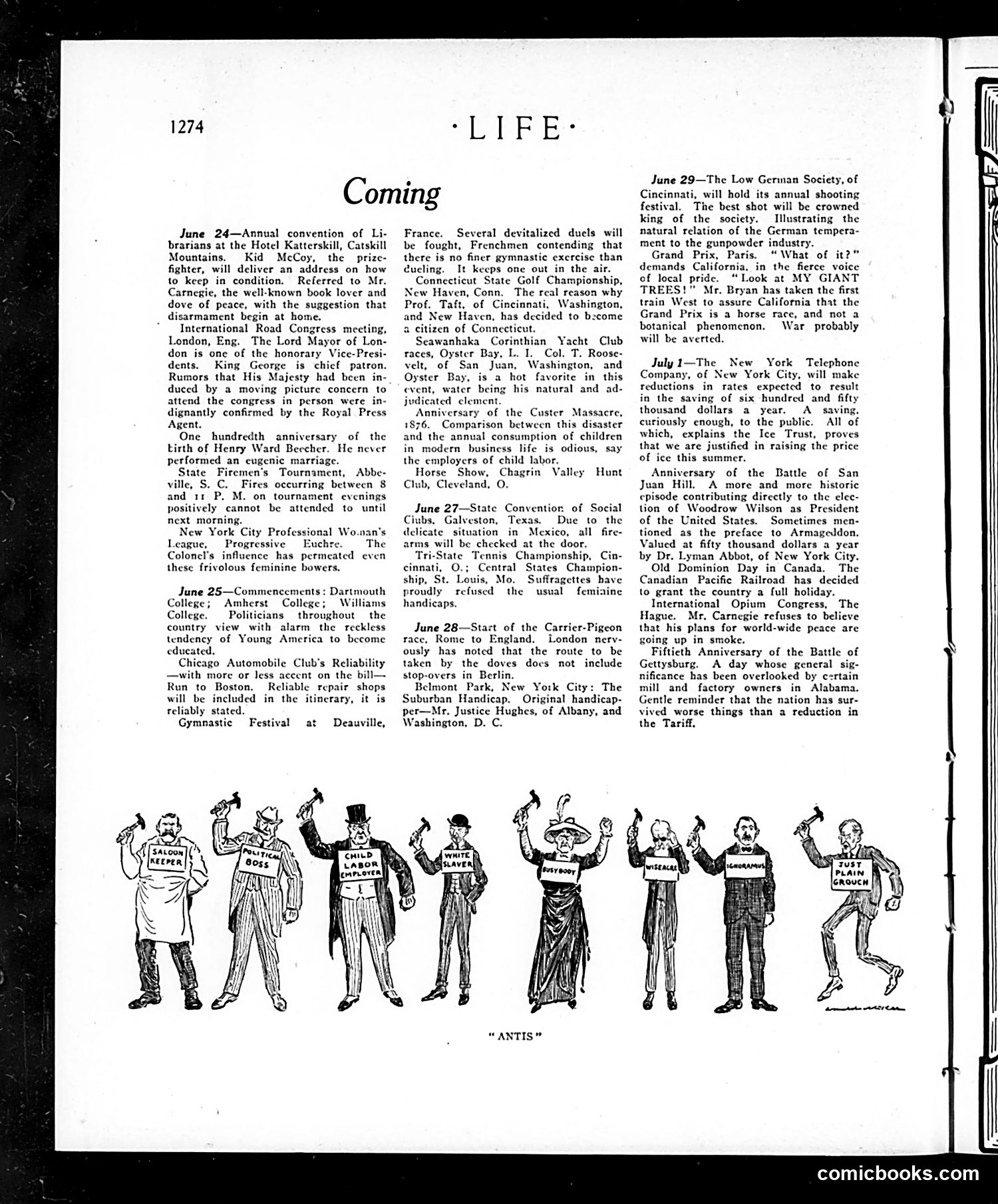
This cartoon illustrates various types of opponents to women's suffrage, labeled as "ANTIS." Each figure holds a hammer raised menacingly, representing different anti-suffrage arguments or constituencies: The figures appear to represent various social groups opposing women's voting rights—including what seem to be working-class men, clergy, politicians, and society women. The repeated hammer imagery suggests these diverse groups, despite their differences, all wielded the same blunt force against suffrage. The cartoon's point: anti-suffrage sentiment cut across class and gender lines, uniting seemingly incompatible groups in opposition. The uniform hammers paradoxically emphasize how varied their actual motivations were—from economic fears to traditional social views. This reflects the intense suffrage debates of the 1910s, when the movement faced organized, multifaceted resistance before women gained voting rights in 1920.
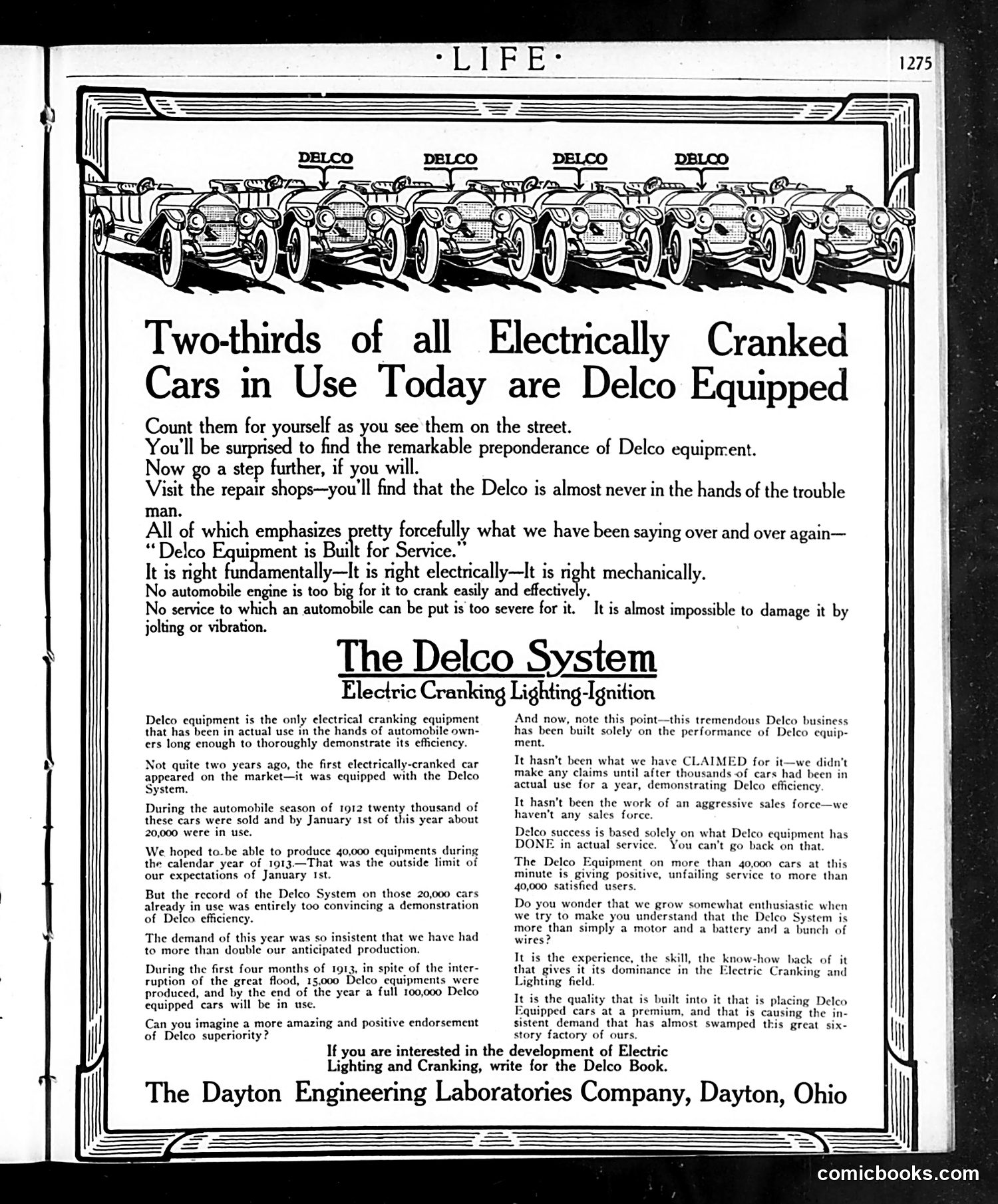
This is a **full-page advertisement**, not satirical content. It promotes Delco electrical systems for automobiles, featuring a row of illustrated cars at the top labeled "DELCO." The ad makes market claims typical of early 1910s automobile advertising: that two-thirds of electrically-cranked cars use Delco equipment, and that this dominance proves superior reliability. The text emphasizes that success comes from actual performance ("what Delco equipment has DONE in actual service"), not aggressive marketing—a claim designed to suggest authentic superiority over competitors. Key historical context: Electric starters were revolutionary technology (the ad notes the first electrically-cranked car appeared "not quite two years ago"), replacing hand-cranking. Delco, made by Dayton Engineering Laboratories Company, was apparently the market leader. The ad's statistics about production doubling reflect genuine early automotive industry boom conditions circa 1913. For modern readers: this represents pre-mass-advertising era marketing—emphasizing product performance and user testimonials rather than emotional appeals or lifestyle branding.
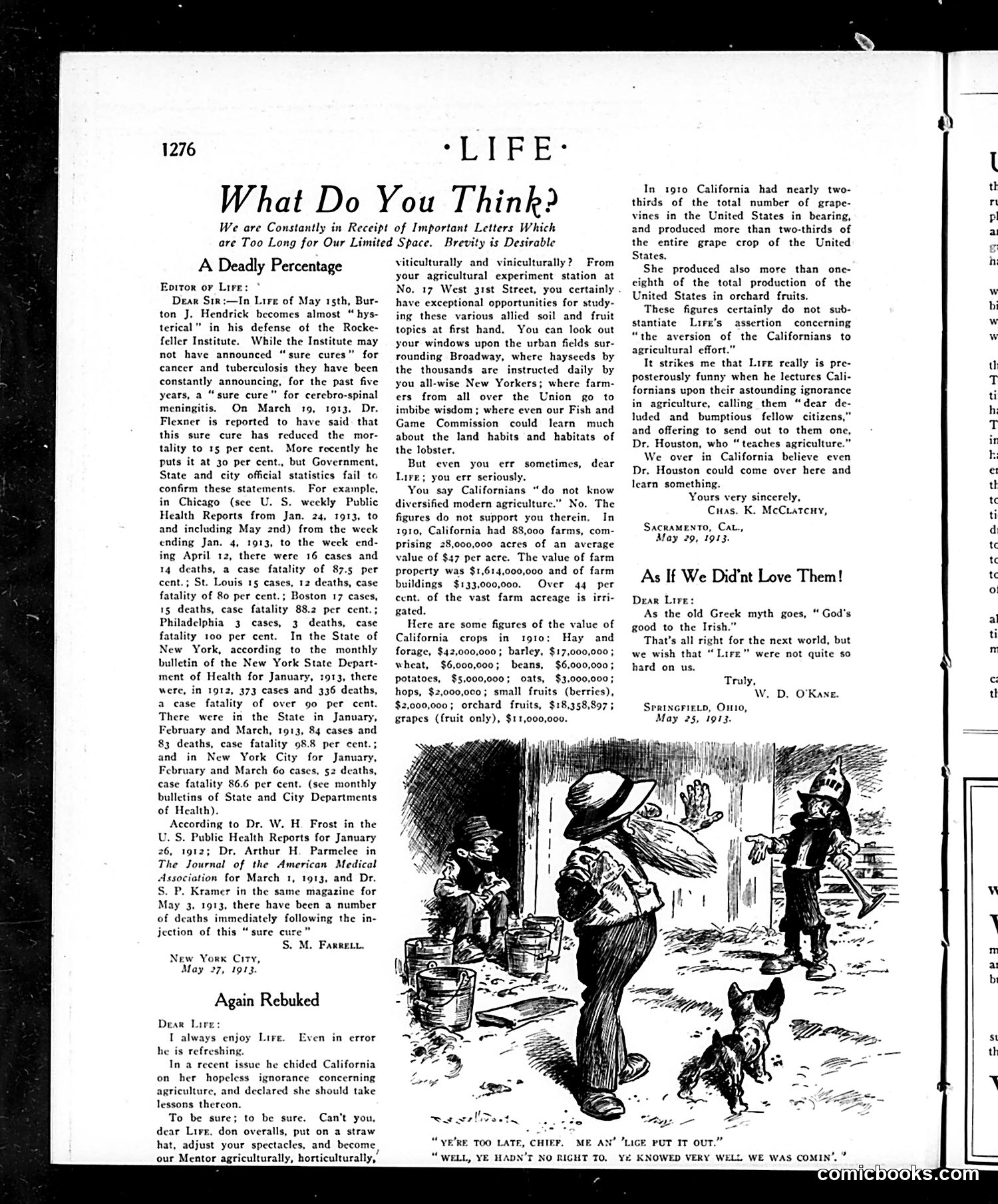
This page features a **readers' letters section** with a cartoon at the bottom depicting what appears to be **law enforcement or authority figures arriving too late to a scene**. The caption reads: "We're too late, chief. He as 'lice put out.' Well, ye hadn't no right to. Ye knowed very well we was comin'." The cartoon likely satirizes **police inefficiency or corruption**—officers arrive after a criminal has fled, with the implication they were either deliberately delayed or incompetent. The dialogue suggests foreknowledge of the arrest, hinting at collusion or negligence. The page itself consists of reader responses debating California agriculture and criticisms of the Rockefeller Institute's claimed "cure" for cerebrospinal meningitis, with one letter presenting mortality statistics suggesting the cure's effectiveness was overstated. These represent typical **Life magazine satire**: deflating institutional authority and exposing statistical deception through rigorous fact-checking.
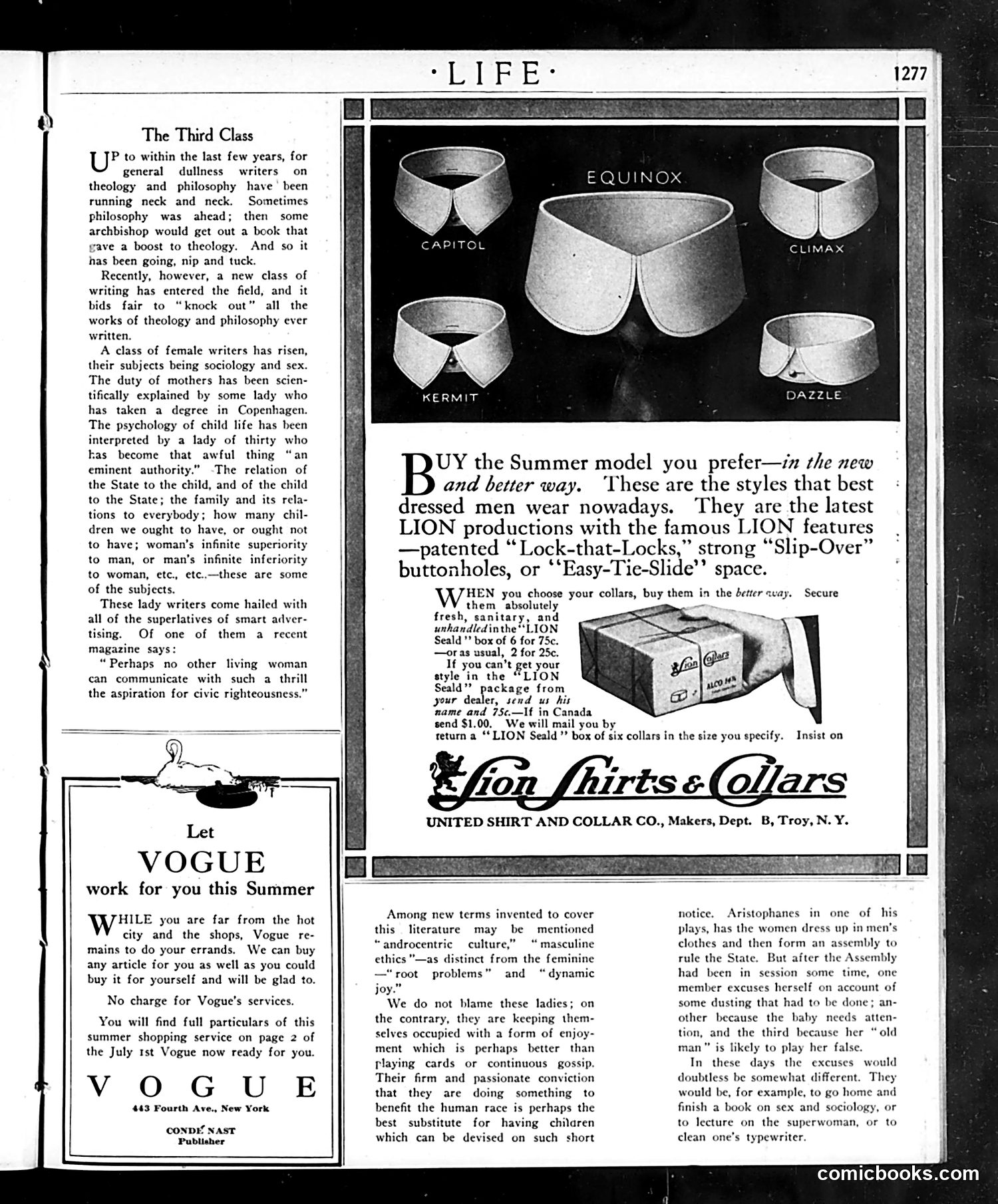
This satirical essay mocks the emergence of female intellectuals writing on sociology and sex—a new literary phenomenon that Life claims surpasses even theology and philosophy in "general dullness." The piece ridicules women with academic credentials (like "a lady of thirty who has taken a degree in Copenhagen") who position themselves as authorities on motherhood, child psychology, and state relations. Life dismisses their work as self-important, noting the ironic "superlatives of smart advertising" used to promote them. The satire peaks in the final section, which references Aristophanes' ancient Greek play where women dress as men to rule the state—but must leave their assembly for domestic duties (dusting, childcare, unfaithful husbands). Life suggests modern female intellectuals would make similar excuses, only substituting books on "sex and sociology," lectures on "the superwoman," or typewriter-cleaning. The underlying joke: these women's intellectual ambitions are presented as amusing pretension masking their "true" domestic nature—a common early-20th-century anti-feminist trope.
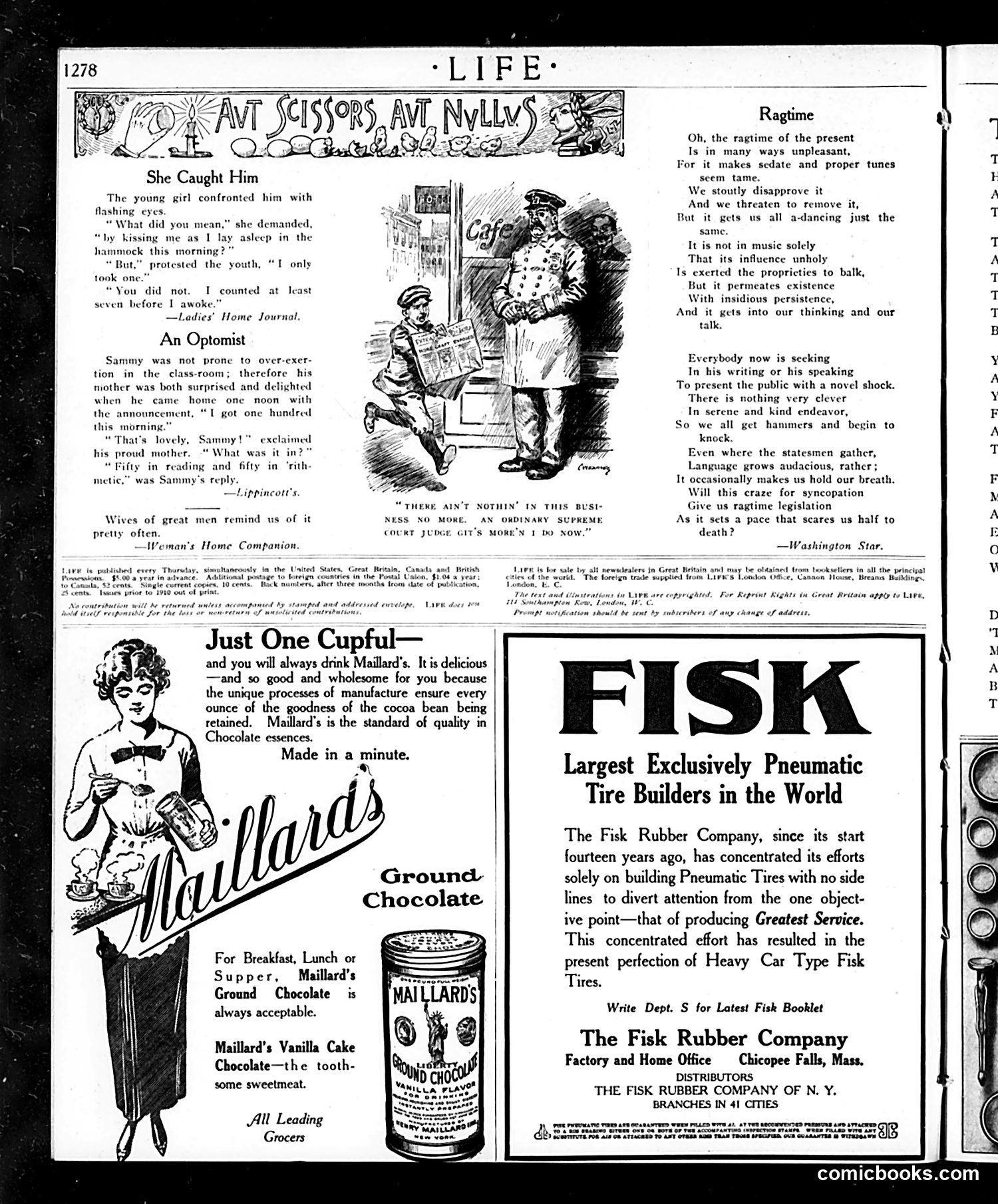
This page contains three brief humorous anecdotes and a poem satirizing "ragtime" culture, plus period advertisements. **The humor pieces** mock common social situations: a young couple's romantic misunderstanding, a student's dubious academic achievement, and male behavior in professional settings. These are lighthearted domestic comedy typical of the era's magazines. **The "Ragtime" poem** is the page's main cultural commentary. It critiques the ragtime music craze (early 1900s) as corrupting proper society—making "sedate and proper tunes seem tame" and spreading "insidious persistence" into thinking, speech, and even politics. The poem expresses anxiety that this energetic, syncopated music threatens established propriety and decorum. This reflects genuine generational conflict of the period, where ragtime was viewed by conservatives as dangerous cultural corruption. **The advertisements** (Maillard's chocolate, Fisk tires) are standard period marketing using illustrated figures and product benefits—unrelated to the editorial content.
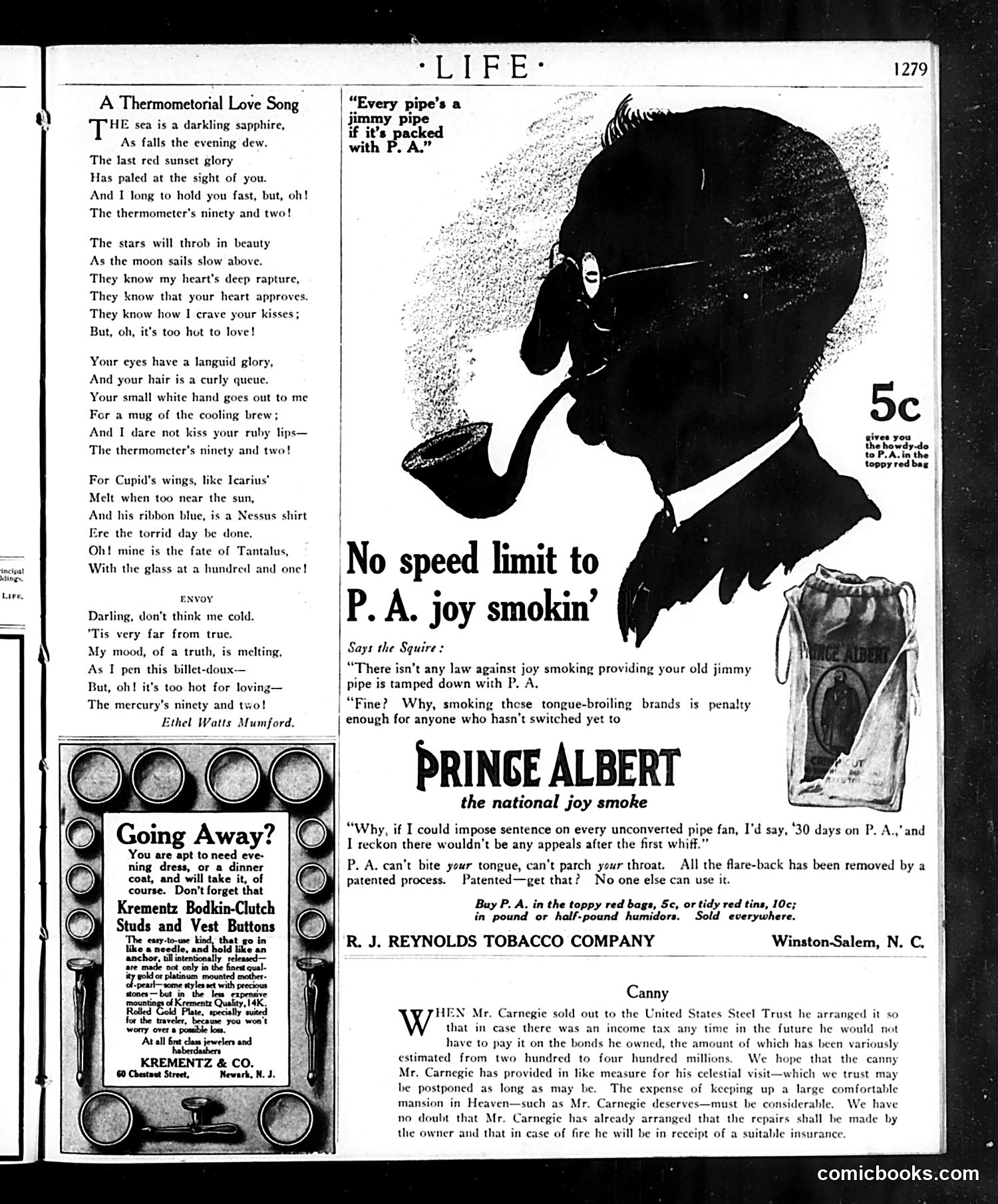
This page contains **satirical advertisements and humorous poetry** rather than political cartoons. **Main Content:** The dominant feature is a **Prince Albert tobacco advertisement** featuring a silhouetted man smoking a pipe. The ad emphasizes that P.A. tobacco won't "bite your tongue" or "parch your throat"—addressing common complaints about pipe smoking. It's framed as a lighthearted debate between characters ("the Squire") who advocate for switching to this brand. **Supporting Material:** "A Thermometorial Love Song" by Ethel Watts Mumford is a comedic poem about summer heat preventing romance—the repeated refrain "it's too hot to love" plays on the thermometer reading of 92 degrees. **Lower Content:** A brief satirical piece mocks industrialist **Andrew Carnegie**, suggesting he's so wealthy and shrewd that he's likely arranged his heavenly accommodations and insurance in advance—typical early-20th-century satire targeting the ultra-rich. The page is primarily **commercial content** (tobacco and jewelry ads) interspersed with light humor.
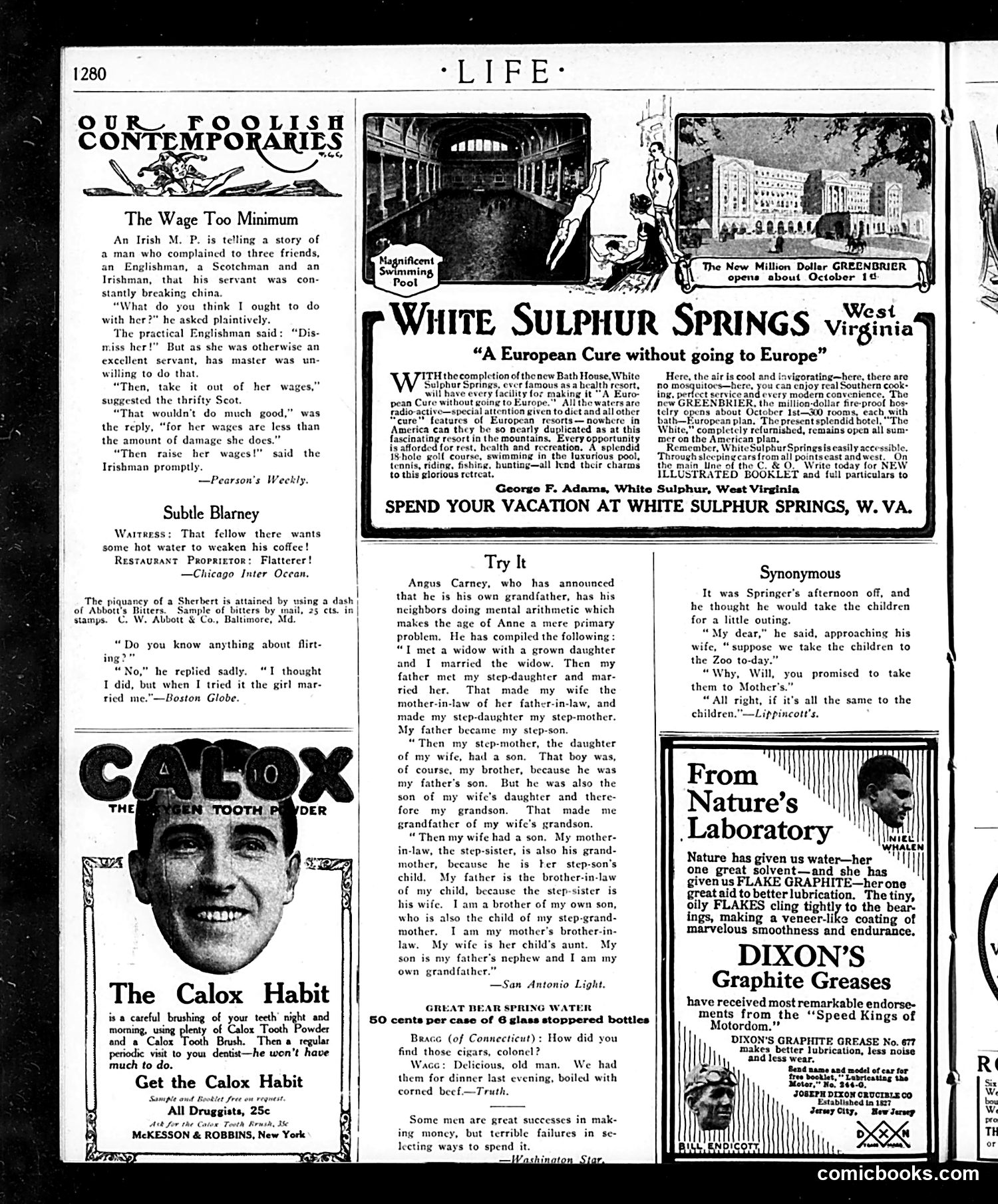
This page is primarily **advertising with humor columns**, not political cartoons. The main satirical content appears in the opening section "The Wage Too Minimum," a brief joke about a master seeking advice on a servant who breaks china. An Englishman suggests dismissal; a Scotsman proposes wage deduction; an Irishman advises raising her wages. The humor relies on **ethnic stereotypes**—portraying Irish logic as absurdly backward compared to English practicality and Scottish frugality. The rest of the page contains **product advertisements** (Calox tooth powder, Graphite grease, White Sulphur Springs resort) and filler humor items ("Subtle Blarney," "Try It"). The satirical intent of the opening joke is to mock Irish thinking as illogical or foolish, fitting the column's title "Our Foolish Contemporaries." This reflects early-20th-century American humor's casual ethnic stereotyping, where Irish characters were stock figures for depicting supposed lack of common sense.
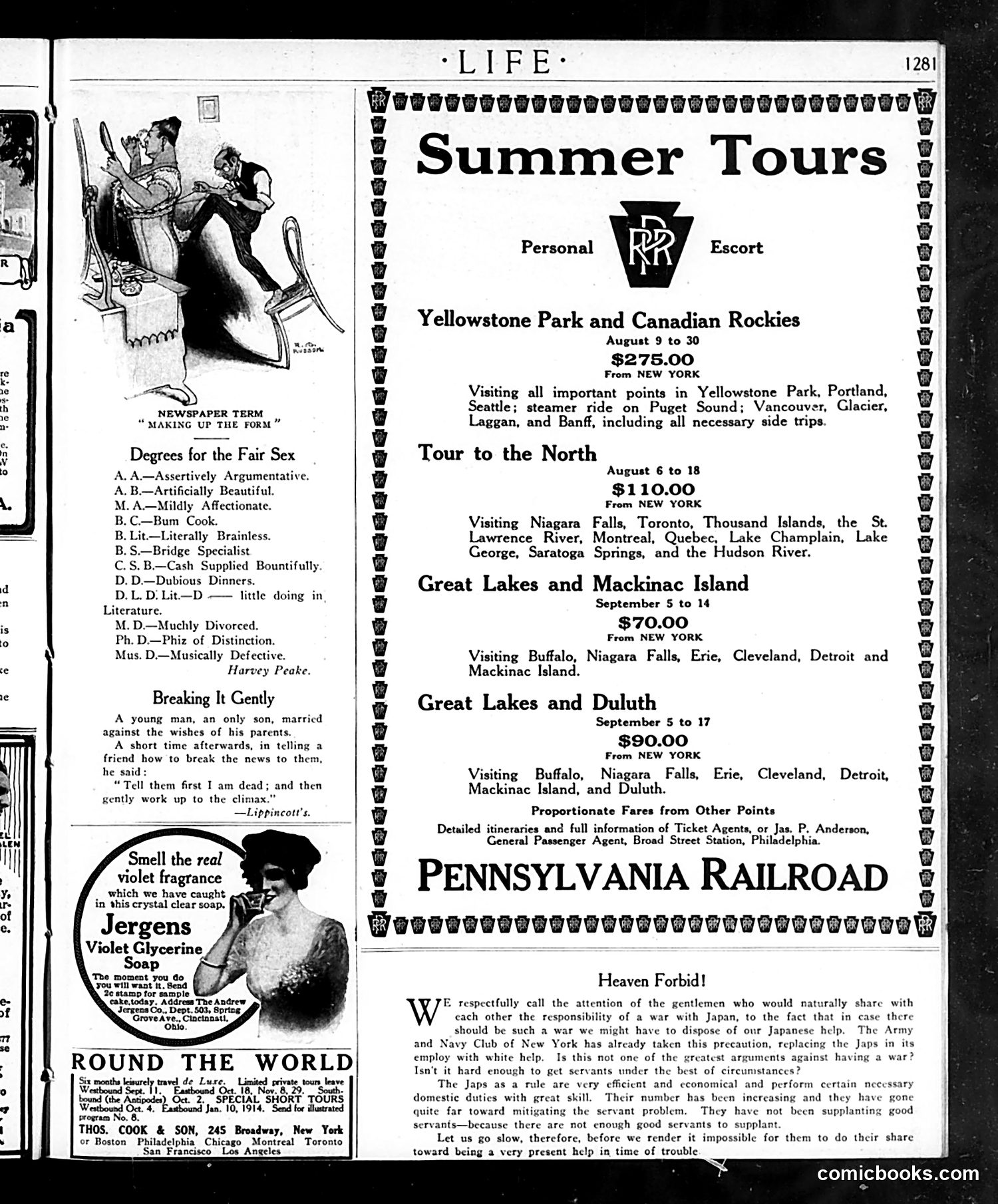
This page contains several satirical pieces typical of *Life* magazine's humor: **Top cartoon ("Making Up the Form")**: A sarcastic commentary on women, using newspaper jargon. It mocks "degrees" (qualifications) awarded to women with insulting acronyms—"Artificially Beautiful," "Literally Brainless," "Muchly Divorced," etc. The joke reflects early-20th-century sexism, presenting women as ornamental, intellectually deficient, or morally questionable. **"Breaking It Gently"**: A brief humorous anecdote about a young man advising a friend to tell his parents he's dead before revealing his marriage against their wishes—exaggerating how badly they'll take the news. **"Heaven Forbid!"**: A satirical essay defending Japanese domestic servants against potential wartime deportation (apparently the Army and Navy Club had already replaced Japanese staff). The author argues ironically that war with Japan would be disastrous because American households desperately *need* Japanese servants, since good domestic help is scarce. It's a cynical commentary on both xenophobia and American dependence on cheap immigrant labor. The page also advertises summer rail tours and soap.
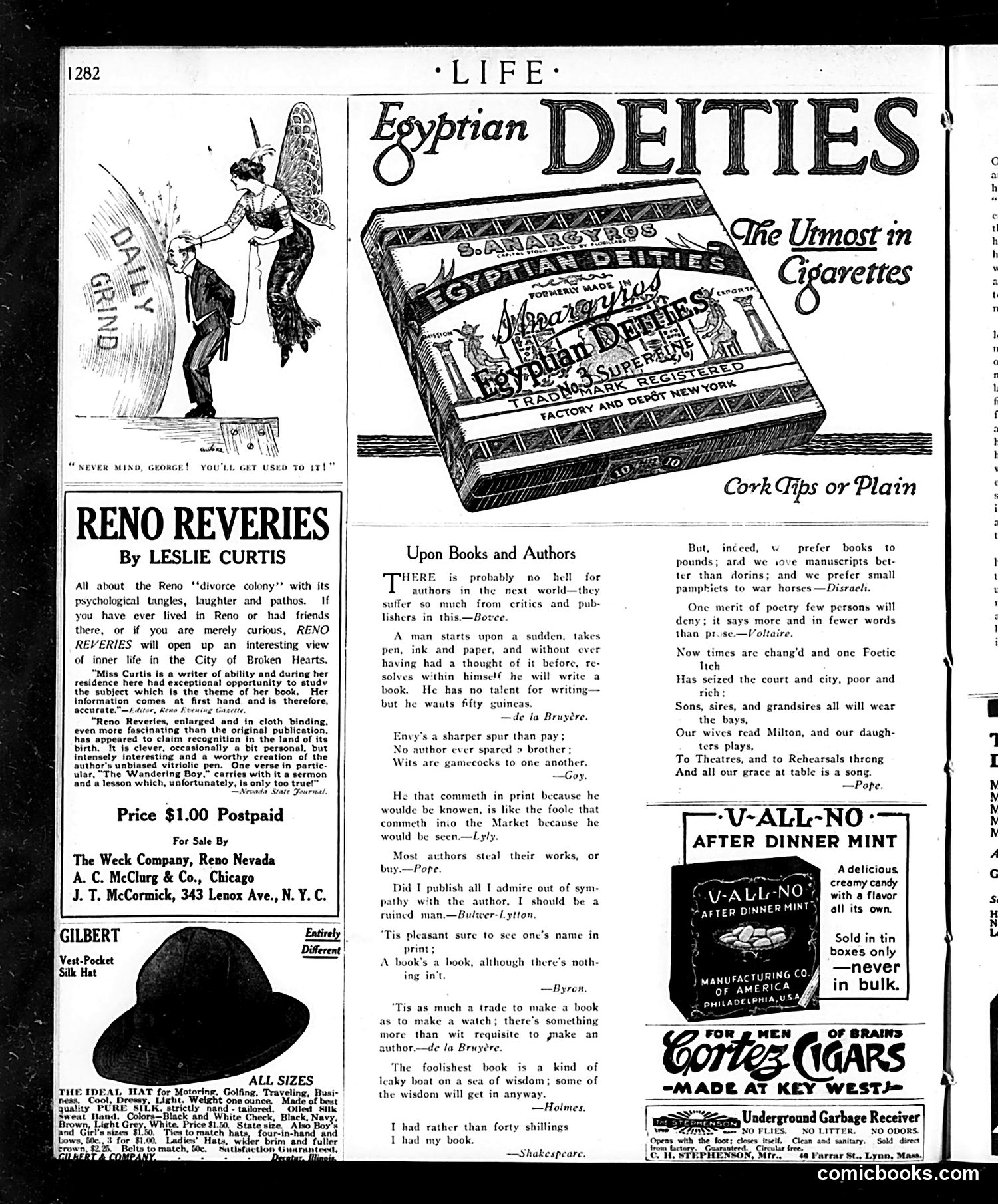
The left cartoon depicts a scene from Reno, Nevada—then famous as the "divorce colony" where people traveled to obtain divorces more easily than in their home states. A woman in fashionable dress with a large feathered hat stands over a distressed man (labeled "GEORGE"), saying "Never mind, George! You'll get used to it!"—a darkly humorous reference to the social upheaval of divorce. The accompanying advertisement promotes "Reno Reveries," a book by Leslie Curtis about life among Reno's divorcing residents, presenting it as psychologically fascinating subject matter. The rest of the page contains literary quotations about authors and books, presented as social commentary. These passages—attributed to figures like Pope, Byron, and Shakespeare—satirize authors as vain, envious, and motivated by money rather than genuine talent. The advertisements below hawk consumer goods (hats, cigarettes, mints) typical of the era, making this primarily an advertising-heavy magazine page rather than satirical content.
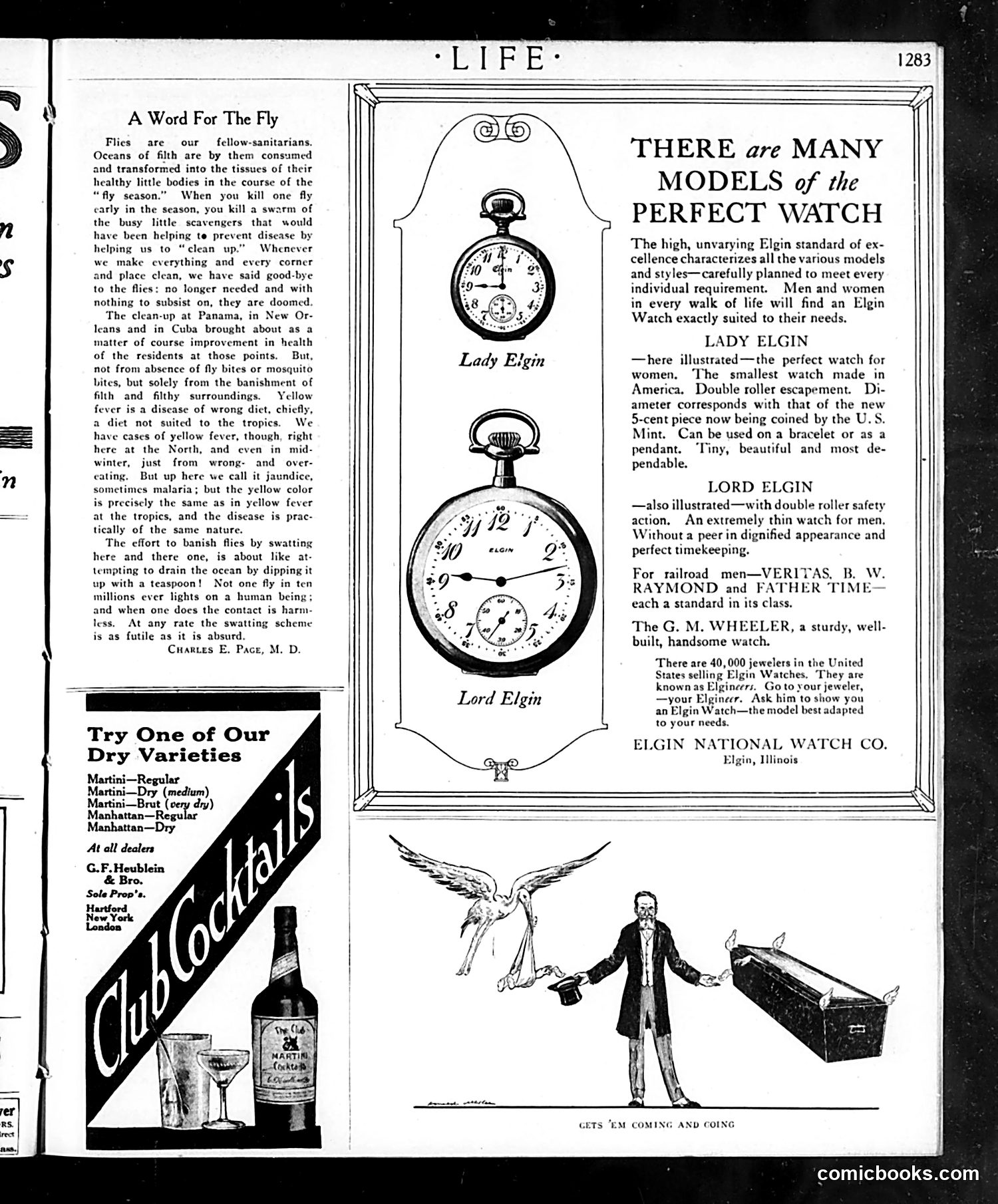
This page combines public health advocacy with period advertising. The left column features Dr. Charles E. Pace arguing that flies, despite their reputation, are beneficial "sanitarians" that consume filth and prevent disease through cleanliness rather than their absence. He dismisses the popular "fly-swatting" movement as futile and argues that yellow fever and similar diseases result from poor sanitation and diet, not fly contact. The main illustration shows a figure (appearing to be Death or a similar allegorical character) with an angel and coffin, captioned "Gets 'Em Coming and Going"—a dark joke suggesting that disease claims people regardless of prevention efforts. The right side advertises Elgin watches with separate models for men and women, claiming each suits "every individual requirement." The page reflects early-1900s progressive public health messaging promoting systematic sanitation over individual actions like swatting.
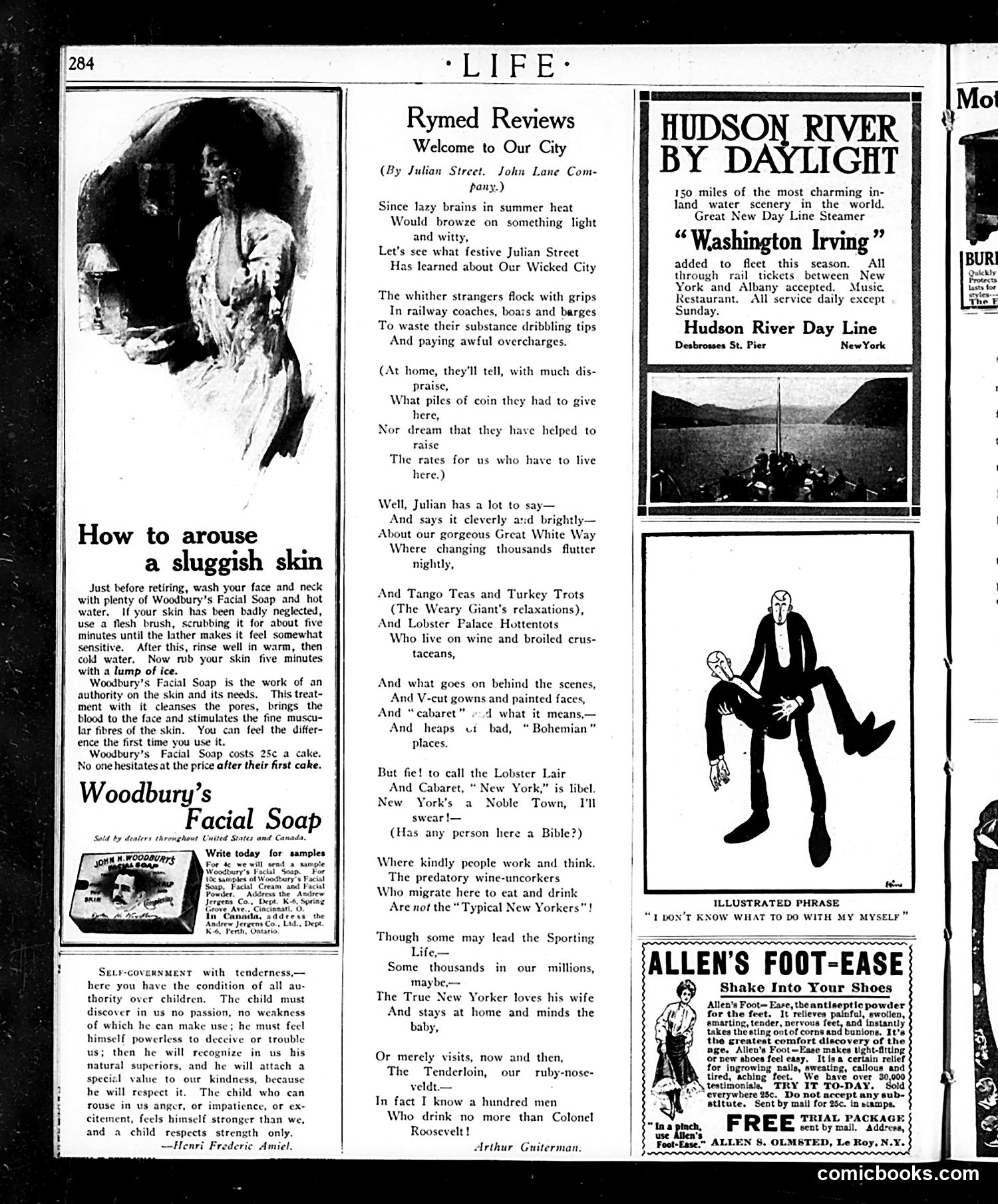
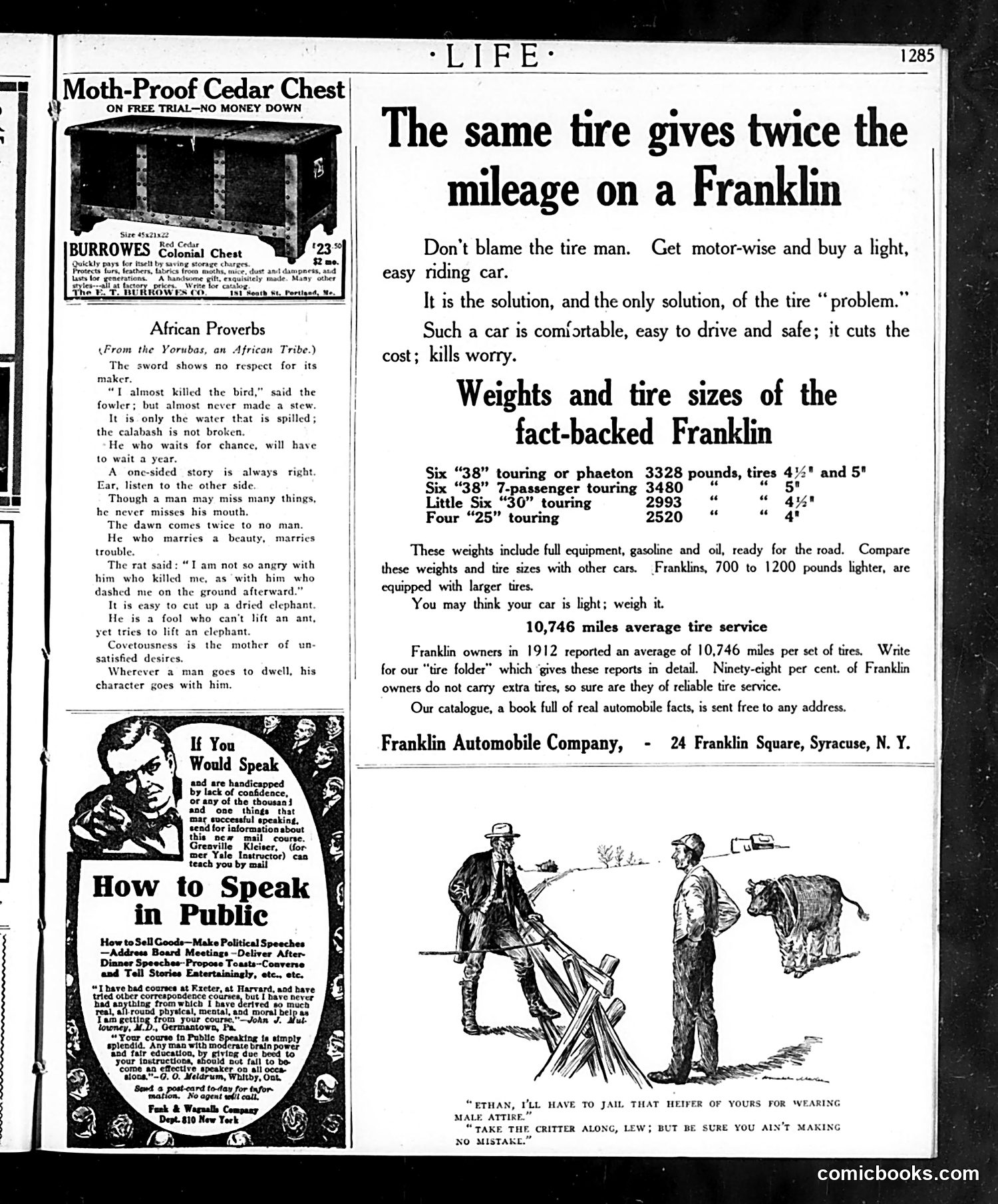
This page contains **advertisements and filler content** rather than political satire requiring historical context. The main elements are: 1. **Cedar chest ad** (top left) — routine product marketing 2. **"African Proverbs"** — a collection of traditional Yoruba sayings presented as exotic cultural curiosities, reflecting early 20th-century attitudes toward non-Western cultures 3. **"How to Speak in Public"** ad — vocational self-help course 4. **Franklin Automobile advertisement** (dominant) — touts tire longevity and lighter car weight as economic advantages 5. **Bottom cartoon** — depicts two rural men discussing a cow dressed in masculine clothing ("male attire"), making a pun on the animal's gender. One threatens to jail the other; the joke relies on wordplay rather than political reference The Franklin ad's claim that lighter cars achieve better tire mileage appears to be the page's primary content, with other items filling remaining space in this advertising-heavy publication era.
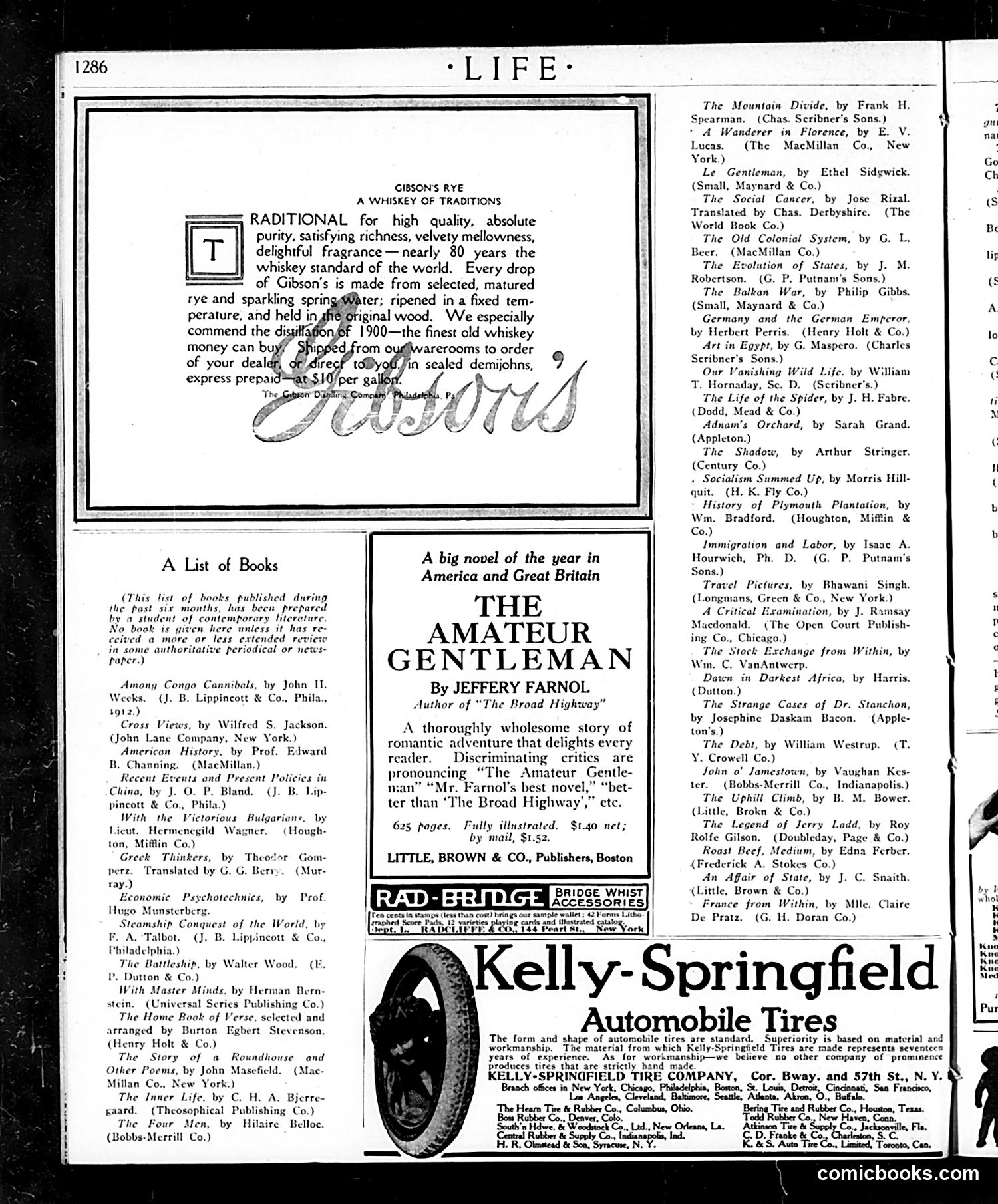
This page is primarily **advertising and book reviews** rather than political satire or cartoons. The main content includes: 1. **Gibson's Rye whiskey advertisement** — a traditional pitch emphasizing 80 years of quality, purity, and mellowness. Standard early 20th-century liquor marketing. 2. **Book reviews and listings** — contemporary literature recommendations, including novels and academic works. "The Amateur Gentleman" by Jeffery Farnol is prominently featured as "a big novel of the year in America and Great Britain." 3. **Period advertisements** — including Kelly-Springfield Automobile Tires and Rad-Bridge Whist Accessories. The page reflects early 1910s consumer culture and literary tastes but contains no political satire, caricatures, or social commentary requiring historical context to decode. It's a straightforward commercial and cultural content page.
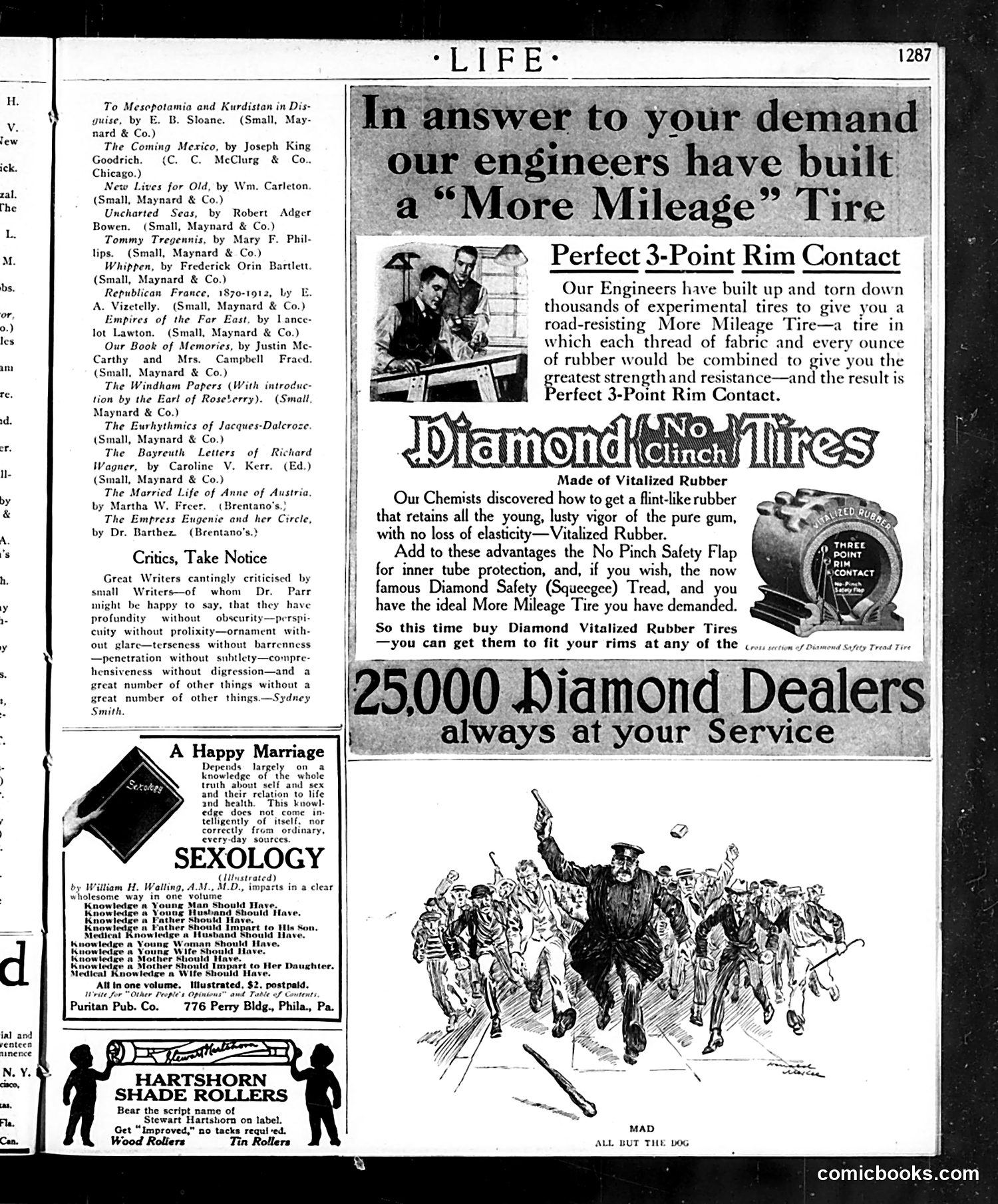
This page is primarily **advertising and book listings** from an early 20th-century *Life* magazine, not political satire. The dominant content is a **Diamond Tires advertisement** promoting "More Mileage" tires with "Perfect 3-Point Rim Contact" and "Vitalized Rubber." The ad features two men examining a tire and promises availability through 25,000 dealers. Below the tire ad is a cartoon labeled **"MAD"** with the caption "ALL BUT THE DOG"—showing a celebratory crowd scene, likely depicting jubilation or collective relief about something (unclear what specific event without additional context). The left column contains book reviews and smaller ads for *Sexology* (a marriage/sexual education guide) and Hartshorn Shade Rollers. **For modern readers:** This page shows how early 1900s magazines blended editorial content with substantial advertising. The tire ad's marketing language—emphasizing engineering superiority and nationwide dealer networks—reflects period marketing strategies. The cartoon's point remains ambiguous without knowing the referenced event.
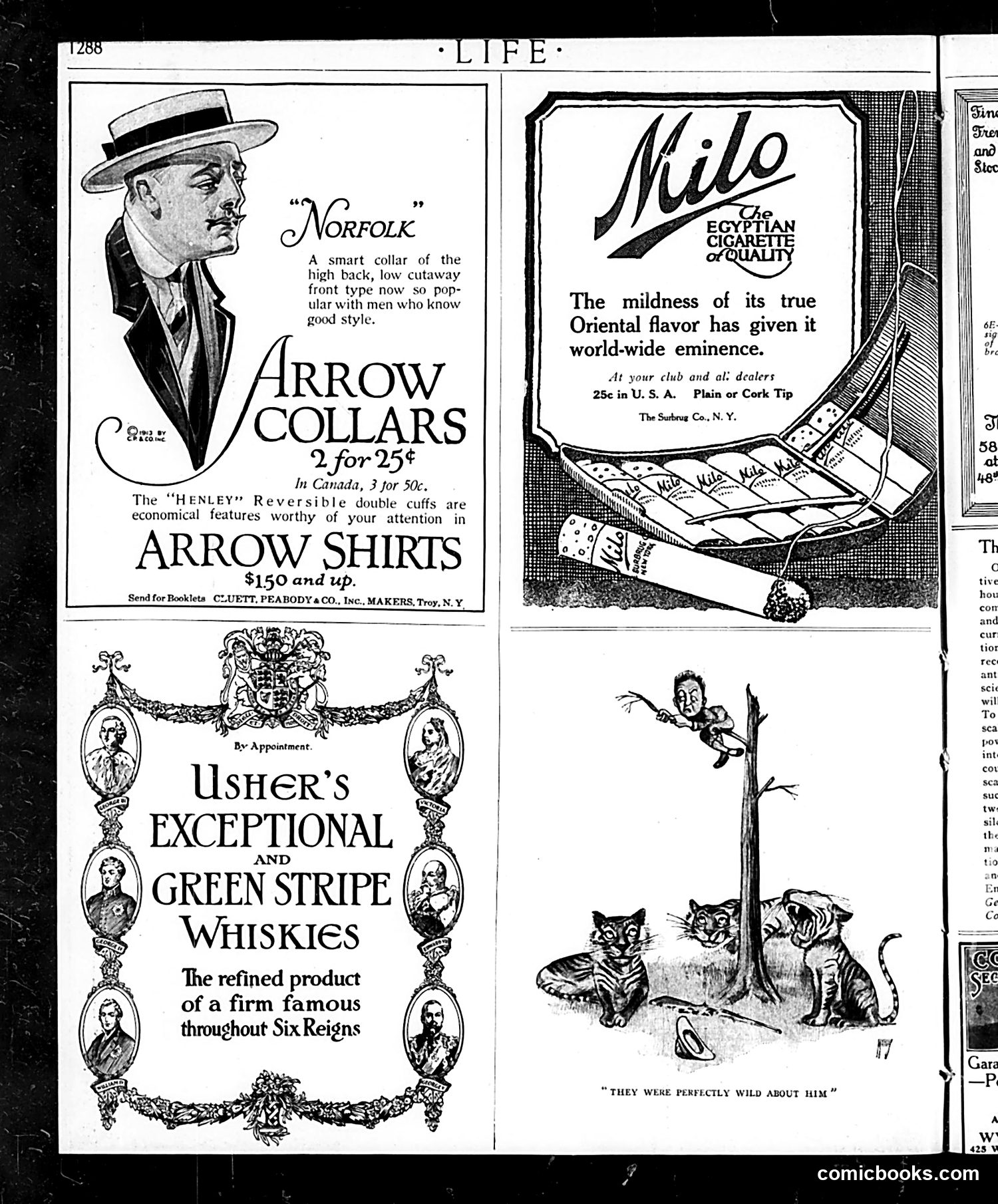
This Life magazine page is primarily **advertising**, not political satire. It contains four commercial advertisements: 1. **Arrow Collars and Shirts** — promoting the "Norfolk" collar style, marketed as fashionable menswear 2. **Milo Egyptian Cigarettes** — highlighting "Oriental flavor" and world-wide popularity 3. **Usher's Green Stripe Whiskies** — a Scottish whisky brand claiming six reigns of tradition 4. **A cartoon illustration** (bottom right) showing three cats appearing excited around a dead bird on a branch, captioned "They Were Perfectly Wild About Him" The cartoon is a **humorous domestic scene**, not political commentary. The joke plays on double meaning: the cats are "wild about" (enthusiastic over) the bird—which they've killed. It's gentle animal humor typical of early 20th-century magazine filler. The page reflects 1920s consumer culture and advertising styles rather than containing satirical commentary on current events or social issues.
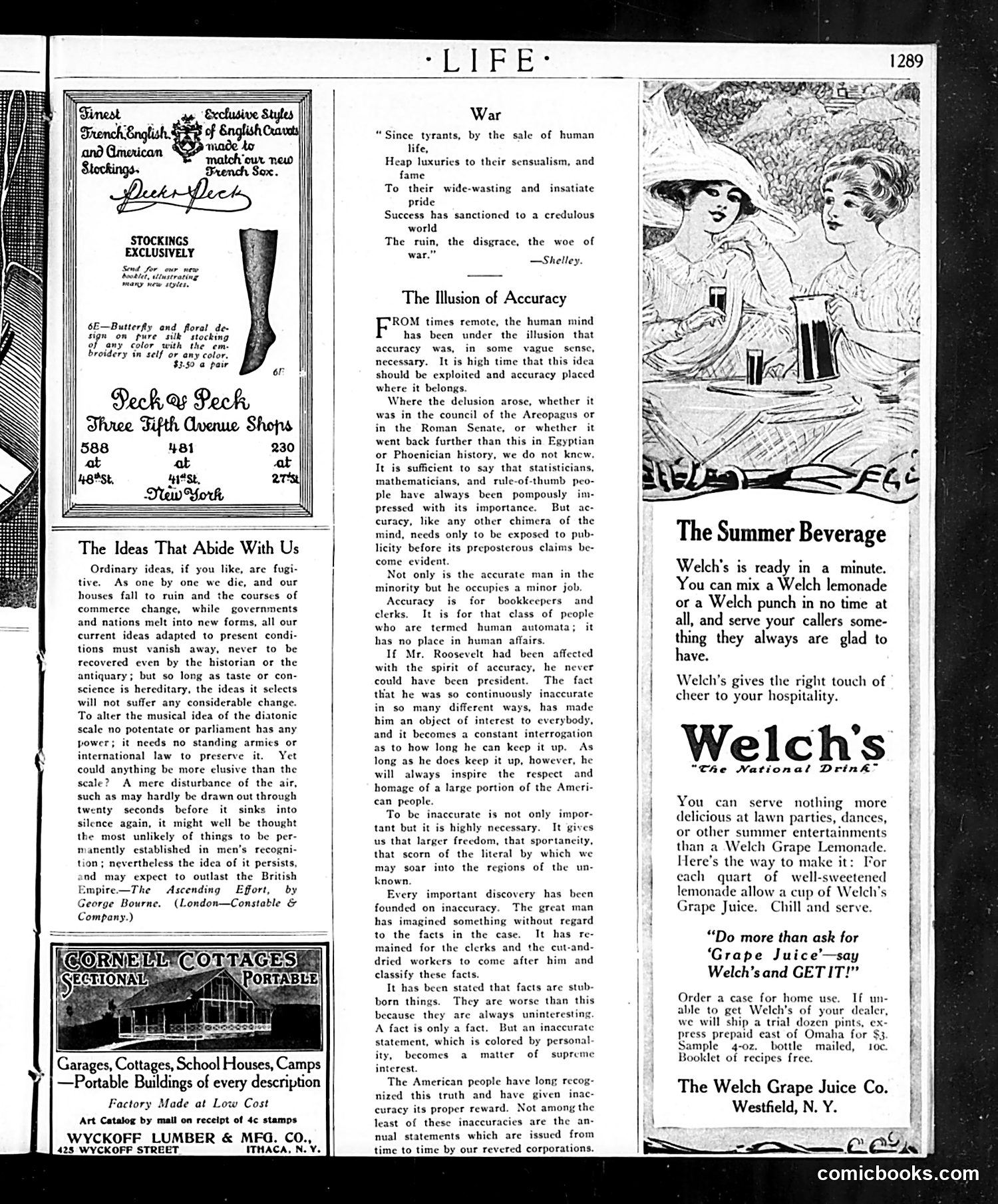
This essay argues that accuracy is overrated and unnecessary for greatness. The author dismisses accuracy as fit only for "bookkeepers and clerks"—routine work for "human automata." The piece uses **Theodore Roosevelt** as its central example, claiming his repeated inaccuracies made him an effective president. The author contends that important discoveries come from imaginative people who *ignore* facts, leaving mere clerical workers to organize details afterward. The essay advocates for "larger freedom" and dismisses accuracy's "preposterous claims." This likely reflects early-20th-century debates about pragmatism versus rigid factuality—positioning visionary leadership against pedantic precision. However, the argument reads as deliberately provocative satire, using Roosevelt's known exaggerations to mock those who valorize inaccuracy as a sign of genius or freedom.
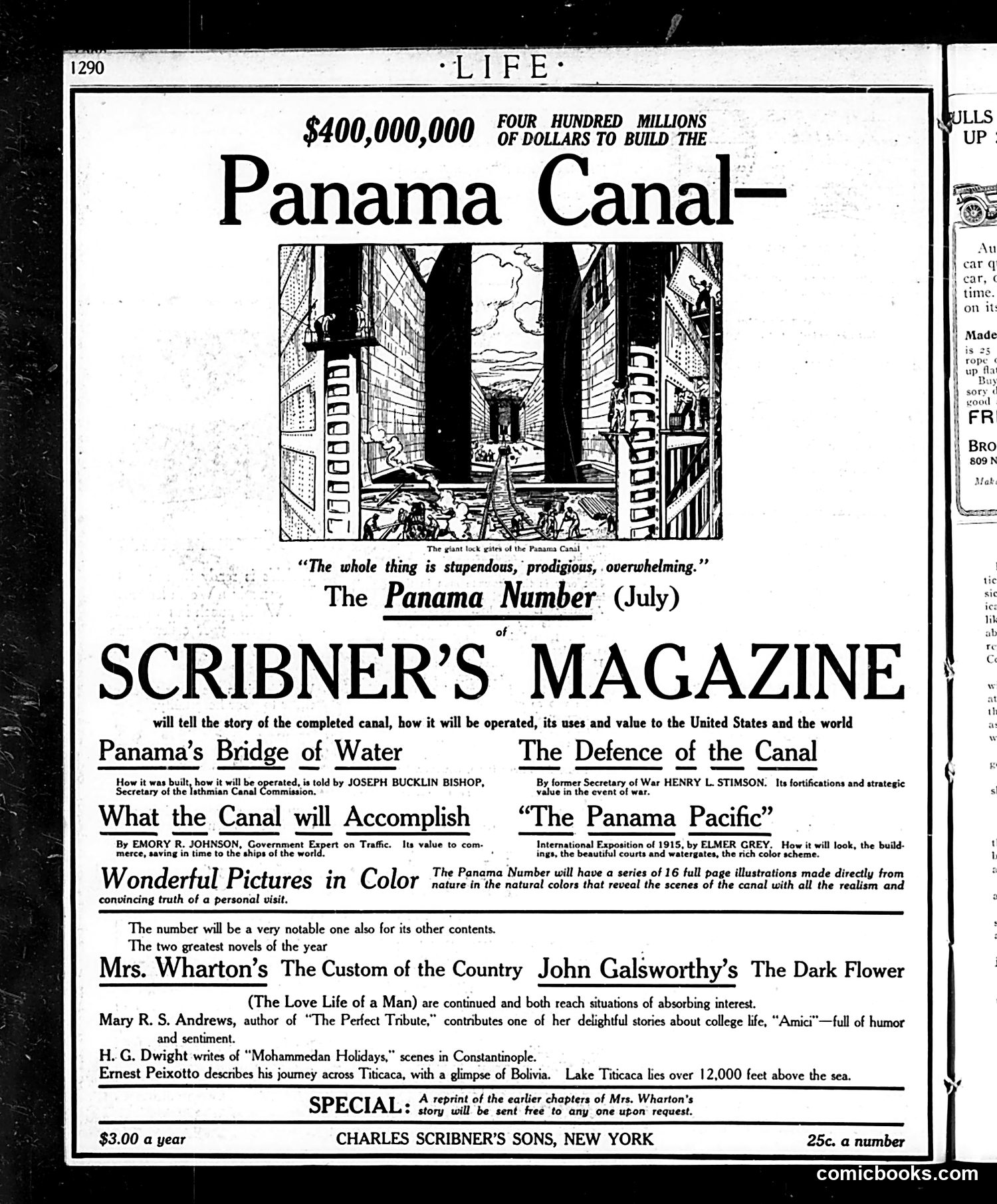
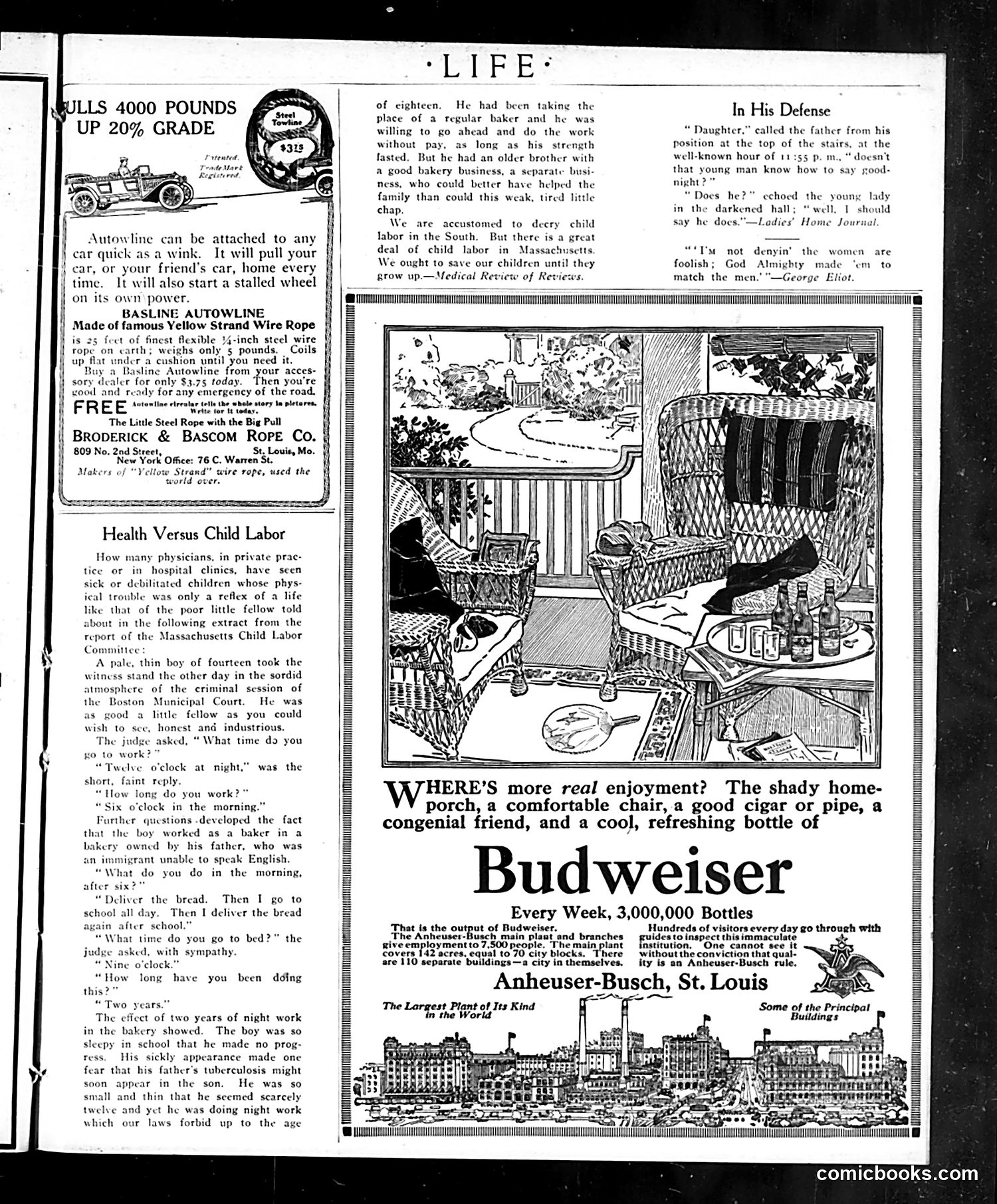
This page combines advocacy journalism with period advertising. The dominant content is a **child labor exposé** featuring testimony from a Massachusetts court case about a 14-year-old baker who works midnight to 6 a.m., then delivers bread before school—for two years. The piece criticizes the exploitation while noting the boy's deteriorating health and risk of inheriting his immigrant father's tuberculosis. It argues Massachusetts should enforce laws protecting children until age eighteen, challenging readers' assumptions that child labor is only a Southern problem. The page also includes three **humorous domestic vignettes**: "In His Defense" about a young couple's extended goodbyes, a George Eliot quote about women's foolishness, and period humor about courtship. These lighthearted pieces provide editorial balance. **Advertisements** for automotive rope and Budweiser beer fill remaining space, typical of Life's commercial support model. The juxtaposition is stark: serious child welfare advocacy sits alongside frivolous domestic comedy and luxury beer marketing—reflecting early 20th-century American magazine conventions.
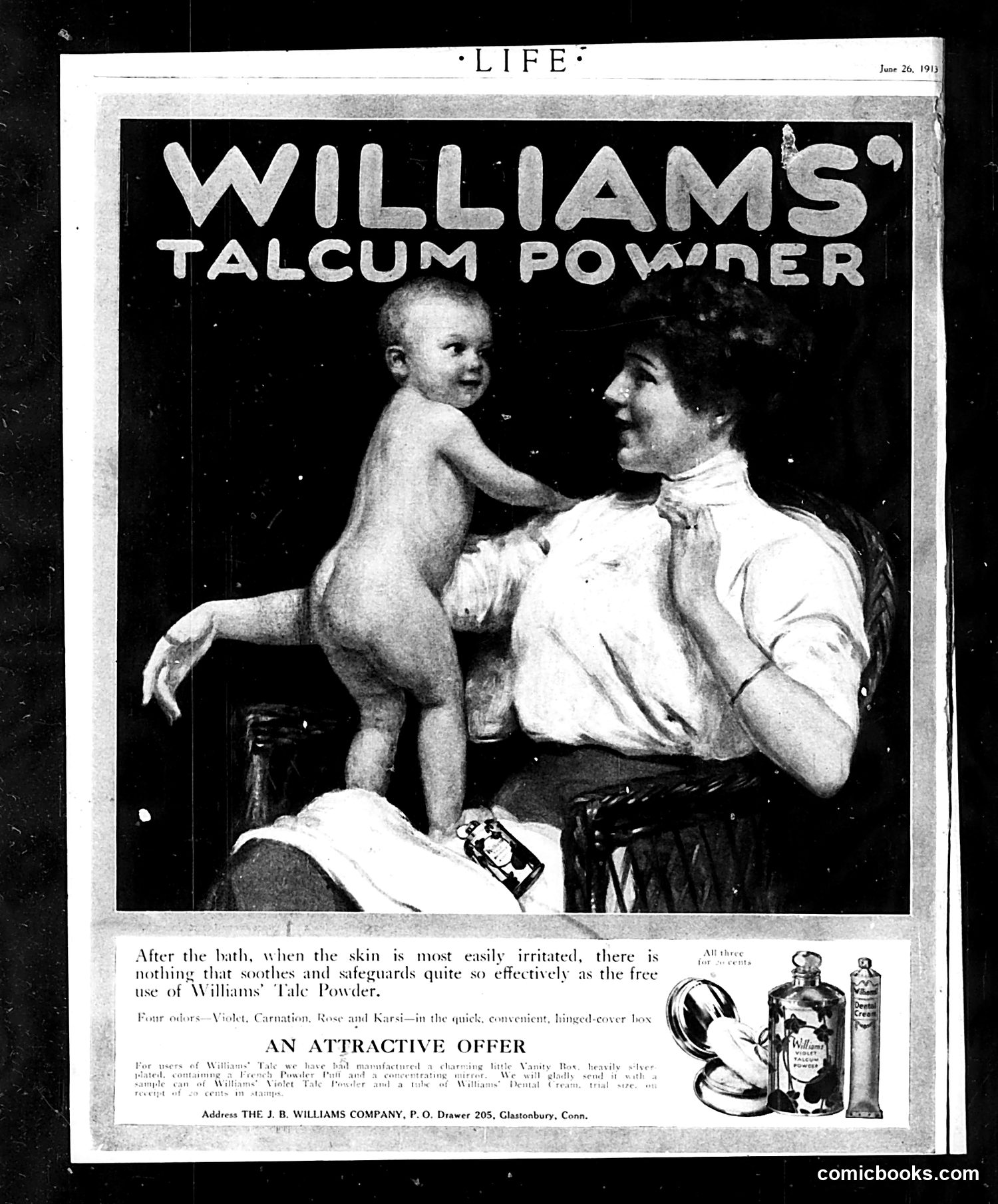
This is a period advertisement, not a political cartoon. It promotes Williams' Talcum Powder for post-bath care, marketed primarily to mothers and infants based on the image of a woman with a baby. The ad claims talcum powder soothes and protects irritated skin after bathing. It offers four scent varieties (Violet, Carnation, Rose, and Karsi) in a "hinged-over box" and mentions an attractive promotional offer—likely a vanity box—for product users. The company address is listed as Glastonbury, Connecticut. This represents early-20th-century marketing directed at domestic consumers, emphasizing hygiene and infant care as primary selling points for the product.
I can see this is a very dark, heavily degraded photograph or scan of what appears to be a page from Life magazine (dated 26, 1933 based on the visible date in the upper left). The image is almost entirely black with only faint details visible—some linear marks, possible figures or shapes in very low contrast, and scattered white spots or marks throughout. Unfortunately, the image quality is too poor for me to reliably identify any specific cartoons, caricatures, figures, or satirical content. While the OCR text mentions "comicbooks.com," this appears to be a watermark rather than page content. I cannot accurately describe the cartoon's meaning, political references, or satirical intent without being able to see the actual content clearly.