
Life, 1913-06-26 · page 18 of 45
Life — June 26, 1913 — page 18: what you’re looking at
What you’re looking at
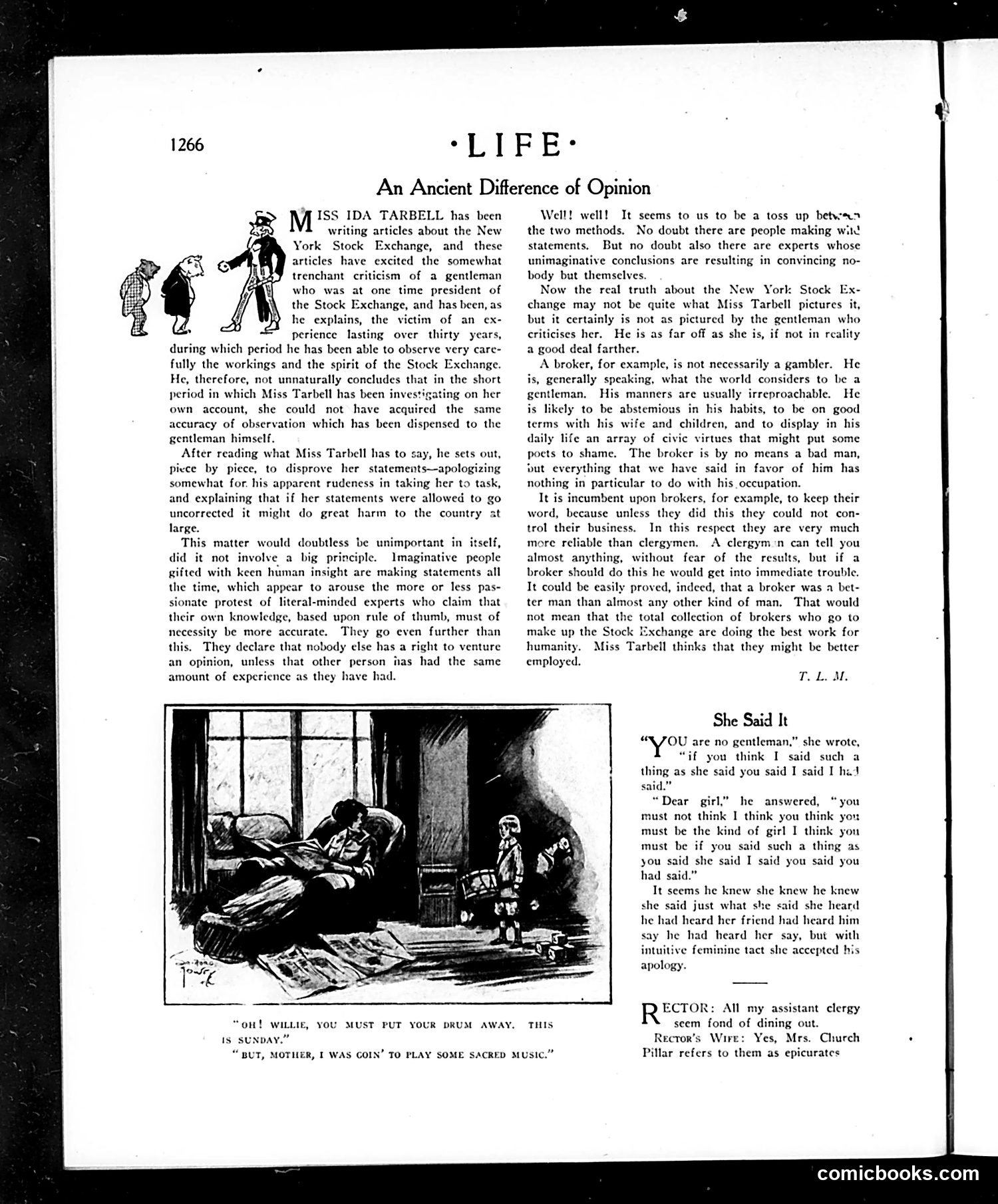
This page satirizes a debate between **Ida Tarbell** (a prominent investigative journalist) and an unnamed **former president of the New York Stock Exchange** over her critical articles about the Exchange. The satire's point: The unnamed critic dismisses Tarbell's conclusions because she lacks his thirty years of experience, arguing that only those with extensive firsthand knowledge can comment on institutions. Life's editorial counters this gatekeeping—arguing that imaginative insight and literal expertise are equally valid but different methods of understanding truth. Neither party fully captures reality. The cartoon below illustrates the absurdity of this rigid "experience requirement" through a domestic scene: a mother forbids her son from playing his drum on Sunday, but he protests he was going to play "sacred music." The point is obvious—the content matters less than the excuse. The section "She Said It" plays with nested denials and misquotations, further mocking how easily such debates devolve into semantic confusion rather than substantive disagreement.
📄 Transcribed text from this page (OCR, searchable)
Machine-transcribed from the original scan — historical spelling and the odd misread are preserved.
“LIP E* An Ancient Difference of Opinion ISS IDA TARBELL has been writing articles about the New York Stock Exchange, and these articles have excited the somewhat trenchant criticism of a gentleman who was at one time president of the Stock Exchange, and has been, as he explains, the victim of an ex- perience lasting over thirty years, during which period he has been able to observe very care- fully the workings and the spirit of the Stock Exchange. He, therefore, not unnaturally concludes that in the short period in which Miss Tarbell has been investigating on her own account, she could not have acquired the same accuracy of observation which has been dispensed to the gentleman himself. After reading what Miss Tarbell has to say, he sets out, pivce by piece, to disprove her statements—apologizing somewhat for. his apparent rudeness in taking her to task, and explaining that if her statements were allowed to go uncorrected it might do great harm to the country large. This matter would doubtless be unimportant in itself, did it not involve a big principle. Imaginative people gifted with keen human insight are making statements all the time, which appear to arouse the more or less pas- sionate protest of literal-minded experts who claim that their own knowledge, based upon rule of thumb, must of necessity be more accurate. They go even further than this. They declare that nobody else has a right to venture an opinion, unless that other person has had the same amount of experience as they have had. “onl wILLie, you pay.” MUST PUT YOUR DRUM AWAY. Is su “ BUT, MOTHER, I WAS COIN’ TO PLAY SOME SACRED MUSIC.” Well! well! It seems to us to be a toss up betwen the two methods. No doubt there are people making wit statements. But no doubt also there are experts whose unimaginative conclusions are resulting in convincing no- body but themselves. Now the real truth about the New York Stock Ex- change may not be quite what Miss Tarbell pictures it, but it certainly is not as pictured by the gentleman who criticises her. He is as far off as she is, if not in reality a good deal farther. A broker, for example, is not necessarily a gambler. He is, generally speaking, what the world considers to be a gentleman, His manners are usually irreproachable. He is likely to be abstemious in his habits, to be on good terms with his wife and children, and to display in his daily life an array of civic virtues that might put some pocts to shame. The broker is by no means a bad man, but everything that we have said in favor of him has nothing in particular to do with his occupation. It is incumbent upon brokers, for example, to keep their word, because unless they did this they could not con- trol their business. In this respect they are very much more reliable than clergymen. A clergymn can tell you almost anything, without fear of the results, but if a broker should do this he would get into immediate trouble. It could be easily proved, indeed, that a broker was a bet- ter man than almost any other kind of man. That would not mean that the total collection of brokers who go to make up the Stock Exchange are doing the best work for humanity. Miss Tarbell thinks that they might be better employed. ToL. M. She Said It “VOU are no gentleman,” she wrote, “if you think I said such a thing as she said you said I said I had said.” “Dear girl,” he answered, “you must not think I think you think you must be the kind of girl I think you must be if you said such a thing as you said she said I said you said you had said. It seems he knew she knew he knew she said just what she said she heard he had heard her friend had heard him say he had heard her say, but with intuitive feminine tact she accepted his apology. ECTOR: All my assistant clergy seem fond of dining out. Recror’s Wire: Yes, Mrs. Church Pillar refers to them as epicurates THIS comicbooks.com