
Life, 1913-06-26 · page 13 of 45
Life — June 26, 1913 — page 13: what you’re looking at
What you’re looking at
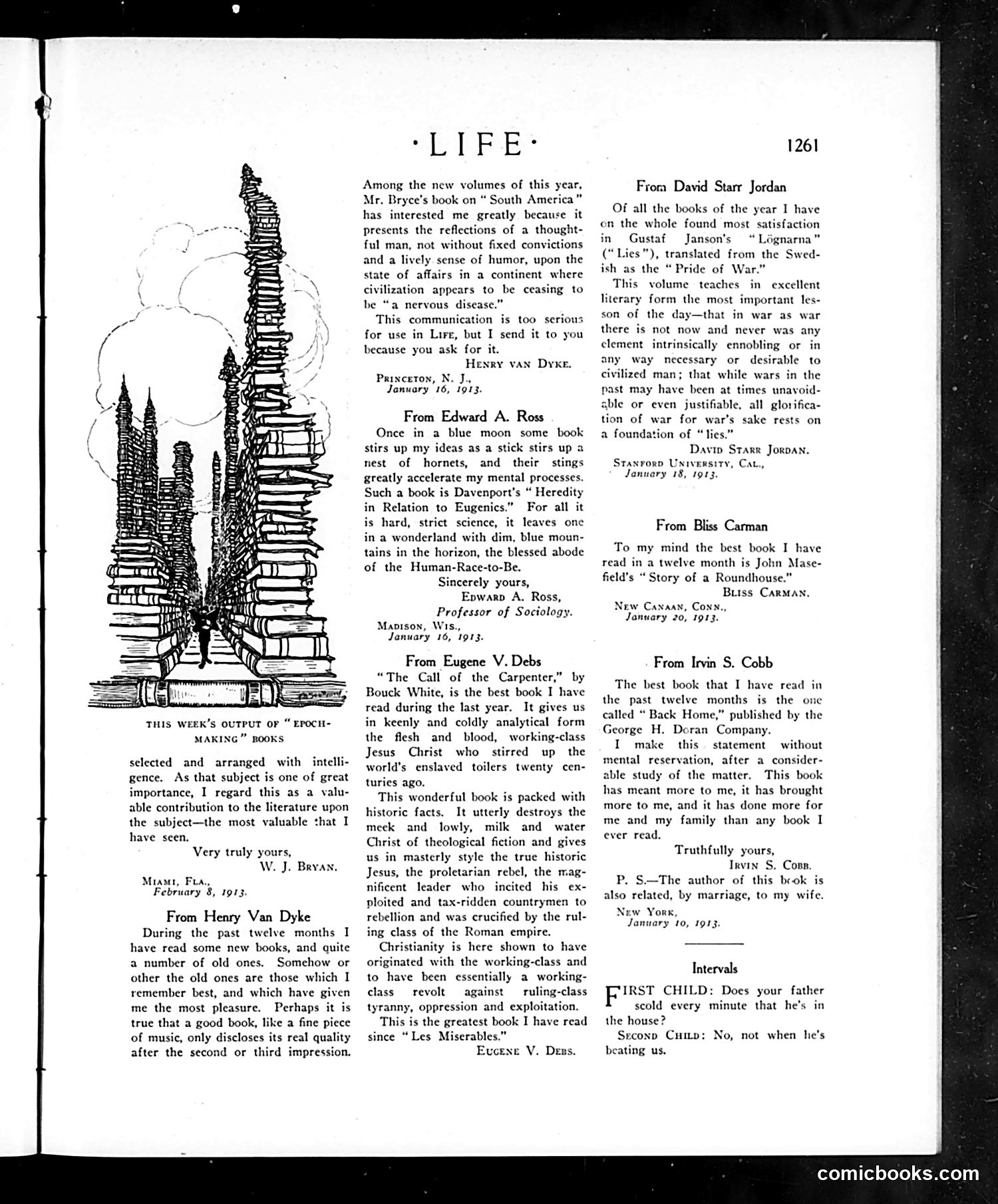
This is a satirical illustration about intellectual pretension, not a political cartoon. The drawing depicts an enormously tall stack of books precariously balanced, with a tiny human figure at the base for scale. The caption mocks publishers' tendency to market every new book as groundbreaking ("epoch-making"). The accompanying letters from readers discuss recently published books they've found meaningful—works on sociology, eugenics, and social reform. The satire suggests that while publishers hype numerous volumes as revolutionary, readers should evaluate which actually merit serious attention. The towering, unstable stack visualizes the absurdity of constant claims of literary importance in early 1910s publishing culture.
📄 Transcribed text from this page (OCR, searchable)
Machine-transcribed from the original scan — historical spelling and the odd misread are preserved.
THIS WEE OUTPUT OF “ EPOCH- MAKING” BOOKS selected and arranged with intelli- gence. As that subject is one of great importance, I regard this as a valu- able contribution to the literature upon the subject—the most valuable that I have seen, Very truly yours, W. J. Bryan, Muar, Fta., February 8, 1913. From Henry Van Dyke During the past twelve months I have read some new books, and quite a number of old ones. Somehow or other the old ones are those which I remember best, and which have given me the most pleasure. Perhaps it is true that a good book, like a fine piece of music, only discloses its real quality after the second or third impression. SE TPB* Among the new volumes of this year, Mr. Bryce’s book on “ South America” has interested me greatly because it presents the reflections of a thought- ful man, not without fixed convictions and a lively sense of humor, upon the state of affairs in a continent where civilization appears to be ceasing to be “a nervous disease.” This communication is too serious for use in Lire, but I send it to you because you ask for it. Henry van Dyke. Princeton, N. J., January 16, 1913. From Edward A. Ross Once in a blue moon some book stirs up my ideas as a stick stirs up a nest of hornets, and their stings greatly accelerate my mental processes. Such a book is Davenport's “ Heredity in Relation to Eugenics.” For all it is hard, strict science, it leaves one in a wonderland with dim, blue moun- tains in the horizon, the blessed abode of the Human-Race-to-Be. Sincerely yours, Epwarp A. Ross, Professor of Sociology. Maoison, Wis., January 16, 1913. From Eugene V. Debs “The Call of the Carpenter,” by Bouck White, is the best book I have read during the last year. It gives us in keenly and coldly analytical form the flesh and blood, working-class Jesus Christ who stirred up the world's enslaved toilers twenty cen- turies ago. This wonderful book is packed with historic facts. It utterly destroys the meek and lowly, milk and water Christ of theological fiction and gives us in masterly style the true historic Jesus, the proletarian rebel, the mag- nificent leader who incited his ex- ploited and tax-ridden countrymen to rebellion and was crucified by the rul- ing class of the Roman empire. Christianity is here shown to have originated with the working-class and to have been essentially a working- class revolt against —_ruling-class tyranny, oppression and exploitation. This is the greatest book I have read since “Les Miserables.” Eucene V. Dens. 1261 From David Starr Jordan Of all the books of the year I have on the whole found most satisfaction in Gustaf Janson’s gnarna (“Lies”), translated from the Swed- ish as the “ Pride of War.” This volume teaches in excellent literary form the most important les- son of the day—that in war as war there is not now and never was any clement intrinsically ennobling or in any way necessary or desirable to civilized man; that while wars in the past may have been at times unavoid- able or even justifiable, all glorifica- tion of war for war's sake rests on a foundation of “lie Davin Stare Joroan. Stanrorp University, Cat., January 18, 1913. From Bliss Carman To my mind the best book I have read in a twelve month is John Mase- field's “ Story of a Roundhouse.’ Biiss Carman, New Canaan, Conn., January 20, 1913. From Irvin S. Cobb The best book that I have read in the past twelve months is the onc called “ Back Home,” published by the George H. Doran Company. I make this statement without mental reservation, after a consider- able study of the matter. This book has meant more to me, it has brought more to me, and it has done more for me and my family than any book I ever read. Truthfully yours, Irvin S, Cons. P. S.—The author of this beok is also related, by marriage, to my wife. New Yor, January 10, 1913. Intervals IRST CHILD: Does your father scold every minute that he’s in the house? Seconp Cuttp: No, not when he's beating us. comicbooks.com