
Life, 1913-06-26 · page 24 of 45
Life — June 26, 1913 — page 24: what you’re looking at
What you’re looking at
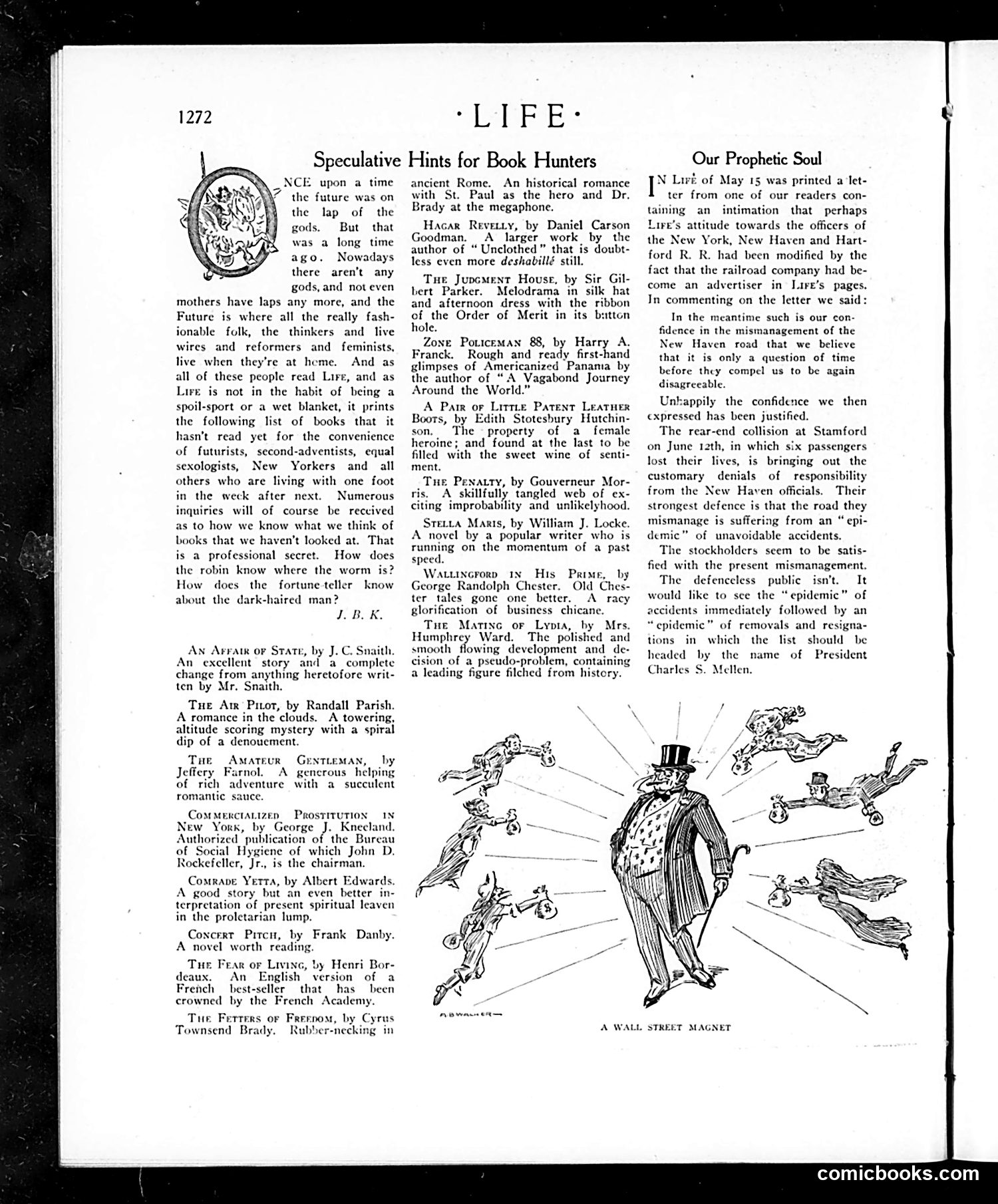
This 1910s Life magazine page satirizes Wall Street's magnetic attraction for opportunists and hangers-on. The central figure—a well-dressed plutocrat in top hat—magnetically draws various small figures toward him: businessmen, workers, and social climbers depicted as metal filings. The satire critiques how wealth concentrates power and attracts self-interested parties. The figures appear to represent different classes and types drawn irresistibly to financial power, suggesting corruption or moral compromise in pursuit of money. The accompanying "Speculative Hints for Book Hunters" section humorously lists unread books for "futurists, second-adventists, equal sexologists, New Yorkers"—mocking contemporary intellectual trends. The editorial note about railroad advertising influence on editorial judgment adds meta-commentary on magazine independence versus commercial interests, reinforcing the page's underlying critique of how money shapes institutions.
📄 Transcribed text from this page (OCR, searchable)
Machine-transcribed from the original scan — historical spelling and the odd misread are preserved.
Eee Speculative Hints for Book Hunters 2 upon a time the future was on the lap of the gods. But that was a long time ago. Nowadays there aren't any gods, and not even mothers have laps any more, and the Future is where all the really fash- ionable folk, the thinkers and live wires and reformers and feminists, live when they’re at heme. And as all of these people read Lire, and as Lire is not in the habit of being a spoil-sport or a wet blanket, it prints the following list of books that it hasn't read yet for the convenience of futurists, second-adventists, equal sexologists, New Yorkers and all others who are living with one foot in the weck after next. Numerous inquiries will of course be received as to how we know what we think of books that we haven't looked at. That is a professional secret. How does the robin know where the worm is? How the fortune teller know about the dark-haired man? does BLK. Aw Arraix or State, by J.C. Snaith. An excellent story and ‘a complete change from anything heretofore writ- ten by Mr. Snaith, Tue Atr Pitot, by Randall Parish. A romance in the clouds. A towering, altitude scoring mystery with a spiral dip of a denouement. Tue MATEUR GENTLEMAN, by Jeffery Farnol. A. generous. helping of rich adventure with a succulent romantic sauce. ComaterctaLizen. Prostitution 1s New York, by George J. Knecland. Authorized ‘publication of ‘the Bureau ygiene of which John D. jer, Jr., is the chairman. Comrave Yetta, by Albert Edwards. A good story but an even better in- terpretation of present spiritual leaven in the proletarian lump. Coxcert Pitcit, by Frank Danby. A novel worth reading. Tur Fear or Livin, by Henri Bor- deaux. An English’ version of a French best-seller that has been crowned by the French Academy. Tue Ferrers or Freroom, by Cyrus Townsend Brady. Rubber-necking in ancient Rome. An historical romance with St. Paul as the hero and Dr, Brady at the megaphone. Hacar Revetty, by Daniel Carson Goodman. A larger work by author of “ Unclothed” that is doubt- less even more deshabillé still. Tue Juvcaent House, by Sir Gil- bert Parker. Melodrama in silk hat and afternoon dress with the ribbon of the Order of Merit in its button Zone Poticeman 88, by Harry A. Franck. Rough and ready first-hand glimpses of Americanized Pananta by the author of “A Vagabond Journey Around the World.” A Parr or Littie Patent Leatuer Boots, by Edith Stotesbury Hutchin- son. The — property of a female heroine; and found at the last to be filled with the sweet wine of senti- ment. Tue Penarty, by Gouverneur Mor- ris, A skillfully tangled web of ex- citing improbability and unlikelyhood. Ste.ta Maris, by William J. Locke. A novel by a popular writer who is running on the momentum of a past speed. Watuixcrorp 1x_ His George Randolph Chester. Old Ches- ter tales gone one better. A racy glorification of business chicane. Tue Matinc or Lypta, by Mrs. Humphrey Ward. The polished and smooth flowing development and de- cision of a pseudo-problem, containing a leading figure filched from history. Prime, by Our Prophetic Soul N Liré of May 15 was printed a'let- ter from one of our readers con- taining an intimation that perhaps Lire’s attitude towards the officers of the New York, New Haven and Hart- ford R. R. had been modified by the fact that the railroad company had be- come an advertiser in Lire’s pages. In commenting on the letter we said: In the meantime such is our con- fidence in the mismanagement of the New Haven road that we believe that it is only a question of time before they compel us to be again disagreeable. Unhappily the confidence we then expressed has been justified. The rear-end collision at Stamford on June 12th, in which six passengers lost their lives, is bringing out the customary denials of responsibility from the New Haven officials. Their strongest defence is that the road they mismanage is suffering from an “ epi- demic” of unavoidable accidents. The stockholders seem to be satis- fied with the present mismanagement. The defenceless publ It would like to sce the “epidemic” of dents immediately followed by an epidemic” of removals and res tions in which the list’ should be headed by the name of President Charles S. Mellen. A WALL STREET MAGNET comicbooks.com