
Life, 1913-06-26 · page 41 of 45
Life — June 26, 1913 — page 41: what you’re looking at
What you’re looking at
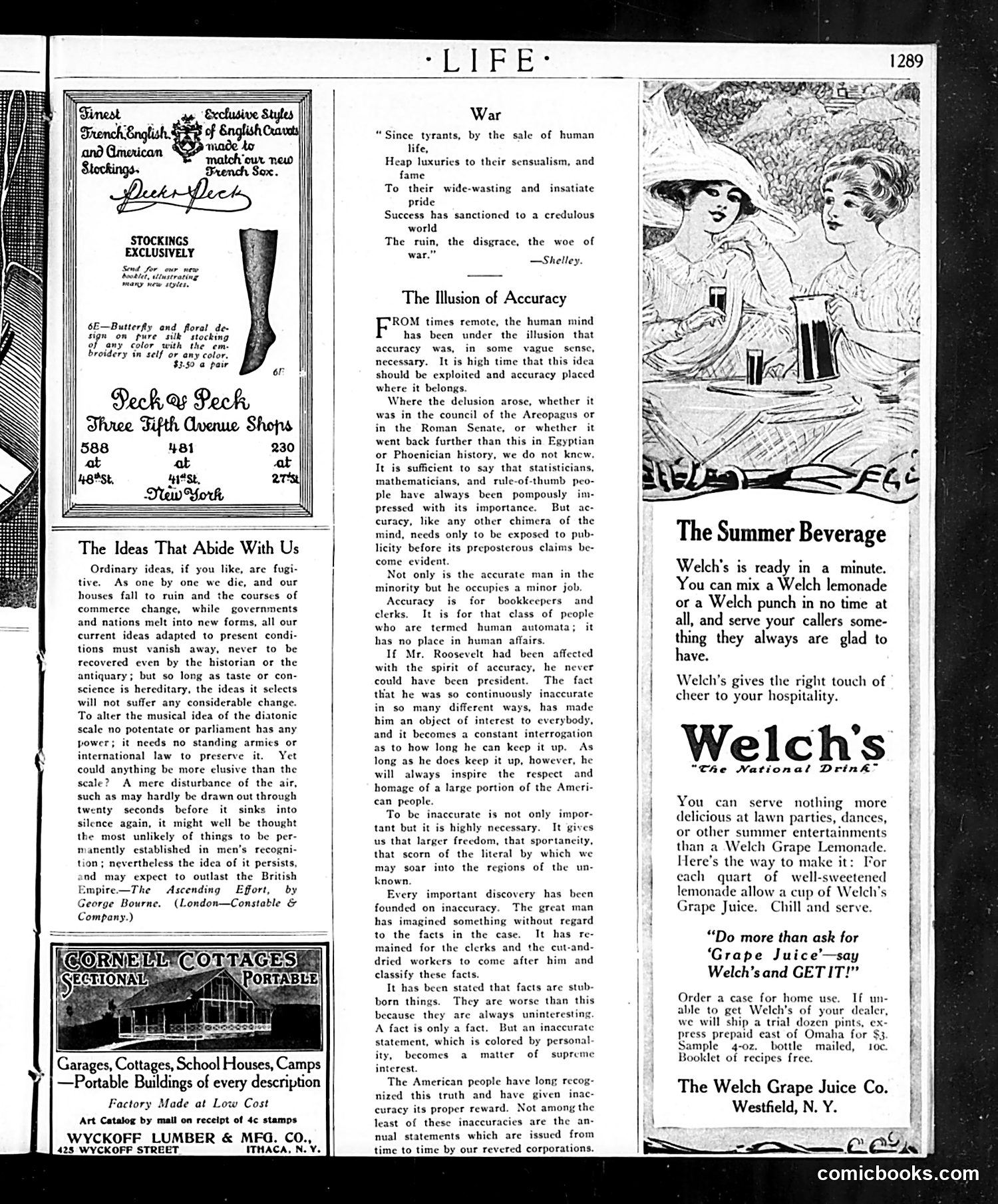
This essay argues that accuracy is overrated and unnecessary for greatness. The author dismisses accuracy as fit only for "bookkeepers and clerks"—routine work for "human automata." The piece uses **Theodore Roosevelt** as its central example, claiming his repeated inaccuracies made him an effective president. The author contends that important discoveries come from imaginative people who *ignore* facts, leaving mere clerical workers to organize details afterward. The essay advocates for "larger freedom" and dismisses accuracy's "preposterous claims." This likely reflects early-20th-century debates about pragmatism versus rigid factuality—positioning visionary leadership against pedantic precision. However, the argument reads as deliberately provocative satire, using Roosevelt's known exaggerations to mock those who valorize inaccuracy as a sign of genius or freedom.
📄 Transcribed text from this page (OCR, searchable)
Machine-transcribed from the original scan — historical spelling and the odd misread are preserved.
STOCKINGS EXCLUSIVELY for eur new Send hoobled, aiturerating many wew sles 6E—Butterfly and floral de- sign on pure silk’ stocking of any color with the em- broidery in self or any color. $3.59 @ pair Peck a Peck, Shree Fifth Guenue Shops Bes 481 230 at at ||484St. ANtst, The Ideas That Abide With Us Ordinary ideas, if you like, are fugi- tive. As one by one we die, and our houses fall to ruin and the courses of commerce change, while governments and nations melt into new forms, all our current ideas adapted to present condi- tions must vanish away, never to be recovered even by the historian or the antiquary; but so long as taste or con- science is hereditary, the ideas it selects will not suffer any considerable change. To alter the musical idea of the diatonic scale no potentate or parliament has any power; it needs no standing armics or international law to preserve it. Yet could anything be more elusive than the scale? A mere disturbance of the air, such as may hardly be drawn out through twenty seconds before it sinks into silence again, it might well be thought the most unlikely of things to be per- manently established in men’s recogni- tion; nevertheless the idea of it persists, and may expect to outlast the British Empire—The Ascending Effort, by George Bourne, (London—Constable & Company.) Garages, Cottages, School Houses, Camps —Portable Buildings of every description Factory Made at Low Cost Art Catalog by mail on receipt of 4c stamps “Since tyrants, by the sale of human life, Heap luxuries to their sensualism, and fame To their wide-wasting and insatiate pride Success has sanctioned to a credulous world The ruin, the disgrace, the woe of wees —Shelley. The Illusion of Accuracy ROM times remote, the human mind has been under the illusion that accuracy was, in some vague sense, necessary. It is high time that this idea should be exploited and accuracy placed where it belongs Where the delusion arose, whether it was in the council of the Areopagus or in the Roman Senate, or whether it went back further than this in Egyptian or Phoenician history, we do not knew. It is sufficient to say that statisticians, mathematicians, and rule-of-thumb peo- ple have always been pompously im- pressed with its importance. But ac- curacy, like any other chimera of the mind, needs only to be exposed to pub- licity before its preposterous claims be- come evident. Not only is the accurate man in the minority but he occupies a minor job. Accuracy is for bookkeepers and clerks. It is for that class of people who are termed human automata; it has no place in human affairs. If Mr. Roosevelt had been affected with the spirit of accuracy, he never could have been president. The fact that he was so continuously inaccurate in so many different ways, has made him an object of interest to everybody, and it becomes a constant interrogation as to how long he can keep it up. As long as he does keep it up, however, he will always inspire the respect and homage of a large portion of the Ameri- can people. To be inaccurate is not only impor- tant but it is highly necessary. It gives us that larger freedom, that sportan that scorn of the literal by which we may soar into the regions of the un- known. Every important discovery has been founded on inaccuracy. The great man has imagined something without regard to the facts in the case. It has re- mained for the clerks and the eut-and- dried workers to come after him and classify these facts. It has been stated that facts are stub- born things. They are worse than this because they are always uninteresting. A fact is only a fact. But an inaccurate statement, which is colored by personal ity, becomes a matter of supreme interest. The American people have long recog- nized this truth and have given inac- curacy its proper reward. Not among the least of these inaccuracies are the an- The Summer Beverage Welch's is ready in a minute. You can mix a Welch lemonade or a Welch punch in no time at all, and serve your callers some- thing they always are glad to have. Welch’s gives the right touch of cheer to your hospitality. You can serve nothing more delicious at lawn parties, dances, or other summer entertainments than a Welch Grape Lemonade. Here’s the way to make it: For cach quart of well-sweetened lemonade allow a cup of Welch's Grape Juice. Chill and serve. “Do more than ask for ‘Grape Juice’—say Welch’s and GET IT!” Order a case for home use. If un- able to get Welch's of your deale we will ship a trial dozen pints, ¢ press prepaid east of Omaha for $3 Sample 4-oz. bottle mailed, toc. Booklet of recipes free. The Welch Grape Juice Co. Westfield, N. Y. nual statements which are issued from time to time by our revered corporations. WYCKOFF LUMBER & MFG. CO., 425 WYCKOFF STREET ITHACA, N. comicbooks.com