
Life, 1913-06-26 · page 17 of 45
Life — June 26, 1913 — page 17: what you’re looking at
What you’re looking at
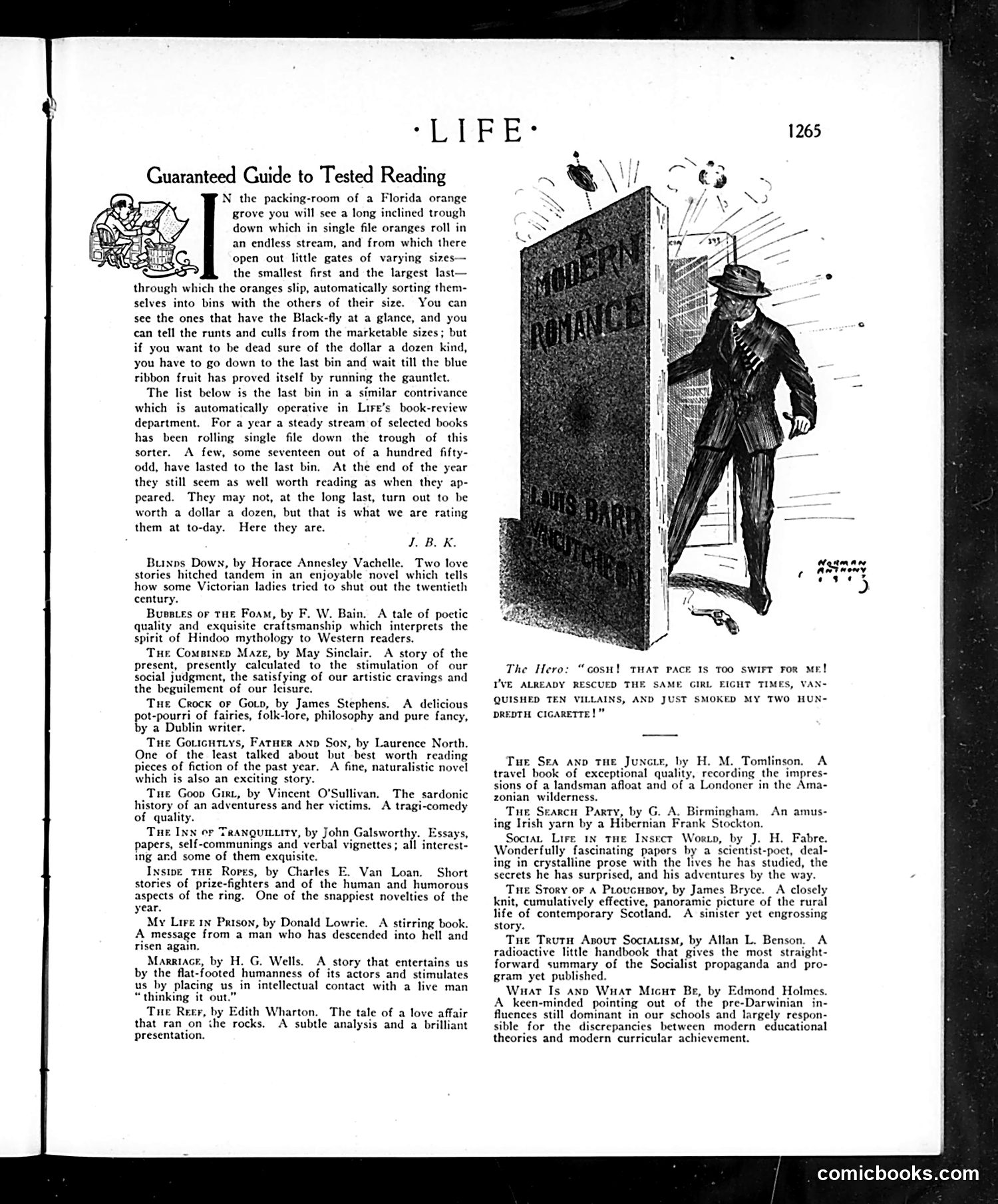
This page satirizes the publishing industry's book-review process by comparing it to an **orange-sorting machine**. The conceit: just as Florida packing houses automatically grade oranges by size through successive gates—with only the finest "blue ribbon fruit" reaching the final bin—Life's book-review department similarly filters hundreds of submissions annually, retaining only the worthiest. The cartoon's hero complains he's rescued the same girl **eight times, vanquished ten villains, and smoked two hundred cigarettes**—mocking the repetitive, formulaic adventure-story plots that get rejected. The satire targets both the flood of mediocre manuscript submissions and the magazine's rigorous editorial standards. By year's end, only 17 of 150+ books merit the "dollar a dozen" rating, making them worth reading. The humor lies in treating literary evaluation with the same mechanical precision and industrial language as produce grading—reducing subjective aesthetic judgment to objective sorting efficiency.
📄 Transcribed text from this page (OCR, searchable)
Machine-transcribed from the original scan — historical spelling and the odd misread are preserved.
‘EP E* Guaranteed Guide to Tested Reading N the packing-room of a Florida orange grove you will see a long inclined trough down which in single file oranges roll in an endless stream, and from which there open out little gates of varying sizes— the smallest first and the largest last— through which the oranges slip, automatically sorting them- selves into bins with the others of their size. You can see the ones that have the Black-fly at a glance, and you can tell the runts and culls from the marketable sizes; but if you want to be dead sure of the dollar a dozen kind, you have to go down to the last bin and wait till the blue ribbon fruit has proved itself by running the gauntlet. The list below is the last bin in a similar contrivance which is automatically operative in Lire’s book-review department. For a year a steady stream of selected books has been rolling single file down the trough of this sorter. A few, some seventeen out of a hundred fifty- odd, have lasted to the last bin, At the end of the year they still seem as well worth reading as when they ap- peared. They may not, at the long last, turn out to be worth a dollar a dozen, but that is what we are rating them at to-day. Here they are. J. BLK. Buixns Down, by Horace Annesley Vachelle. Two love stories hitched tandem in an enjoyable novel which tells how some Victorian ladies tried to shut out the twentieth century. Buontes or tue Foam, by F. W. Bain. A tale of poetic quality and exquisite craftsmanship which interprets the spirit of Hindoo mythology to Western readers. Tue Comainep Maze, by May Sinclair. A story of the present, presently calculated to the stimulation of our social judgment, the satisfying of our artistic cravings and the beguilement of our leisure, Tue Crock or Gorn, by James Stephens. A delicious ot-pourri of fairies, folk-lore, philosophy and pure fancy, by a Dublin writer. Tue Goticuttys, Fatuer anv Son, by Laurence North. One of the least talked about but best worth reading pieces of fiction of the past year. A fine, naturalistic novel which is also an exciting story. Tne Goon Girt, by Vincent O'Sullivan. The sardonic history of an adventuress and her victims. A tragi-comedy of quality. ne INN or Tranguituty, by John Galsworthy. Essays, papers, self-communings and verbal vignettes; afl interest- ing ard some of them exquisite. Insipe tHE Rores, by Charles E. Van Loan. Short stories of prize-fighters and of the human and humorous aspects of the ring. One of the snappiest novelties of the year. My Lire 1n Prison, by Donald Lowrie. A stirring book. A message from a man who has descended into hell and risen again. Marriace, by H. G. Wells. A story that entertains us by the flat-footed humanness of its actors and stimulates us by placing us in intellectual contact with a live man “thinking it out.” Tne Reer, by Edith Wharton. that ran on the rocks. presentation. The tale of a love affair A subtle analysis and a brilliant The Hero: “cosu! THAT PACE 1s TOO SWIFT FoR ME! V'VE ALREADY RESCUED THE SAME GIRL EIGHT TIMES, VAN QUISHED TEN VILLAINS, AND JUST SMOKED MY TWO HUN- DREDTH CIGARETTE!” Tue Ska AND THE JuNciE, by H. M. Tomlinson. A travel hook of exceptional quality, recording the impres- sions of a landsman afloat and of a Londoner in the Ama- zonian wilderness. Tue RCH Party, by G. Birmingham, ing Irish yarn by a Hibernian Frank Stockton. Soctat Lire 1x tHe Insect Wortp, by J. H. Fabre. Wonderfully fascinating papers by a scientist-poet, deal- ing in crystalline prose with the lives he has studied, the secrets he has surprised, and his adventures by the way. Tue Story or A Proucunoy, by James Bryce. A closely knit, cumulatively effective, panoramic picture of the rural life of contemporary Scotland. A sinister yet engrossing story. Tue Truta Anout Soctatism, by Allan L. Benson. A radioactive little handbook that gives the most straight- forward summary of the Socialist propaganda and pro- gram yet published. Wuart Is ano Wuat Micut Be, by Edmond Holmes. A keen-minded pointing out of the pre-Darwinian in- fluences still dominant in our schools and largely respon- sible for the discrepancies between modern educational theories and modern curricular achievement. An amus- comicbooks.com