
Life, 1913-06-26 · page 20 of 45
Life — June 26, 1913 — page 20: what you’re looking at
What you’re looking at
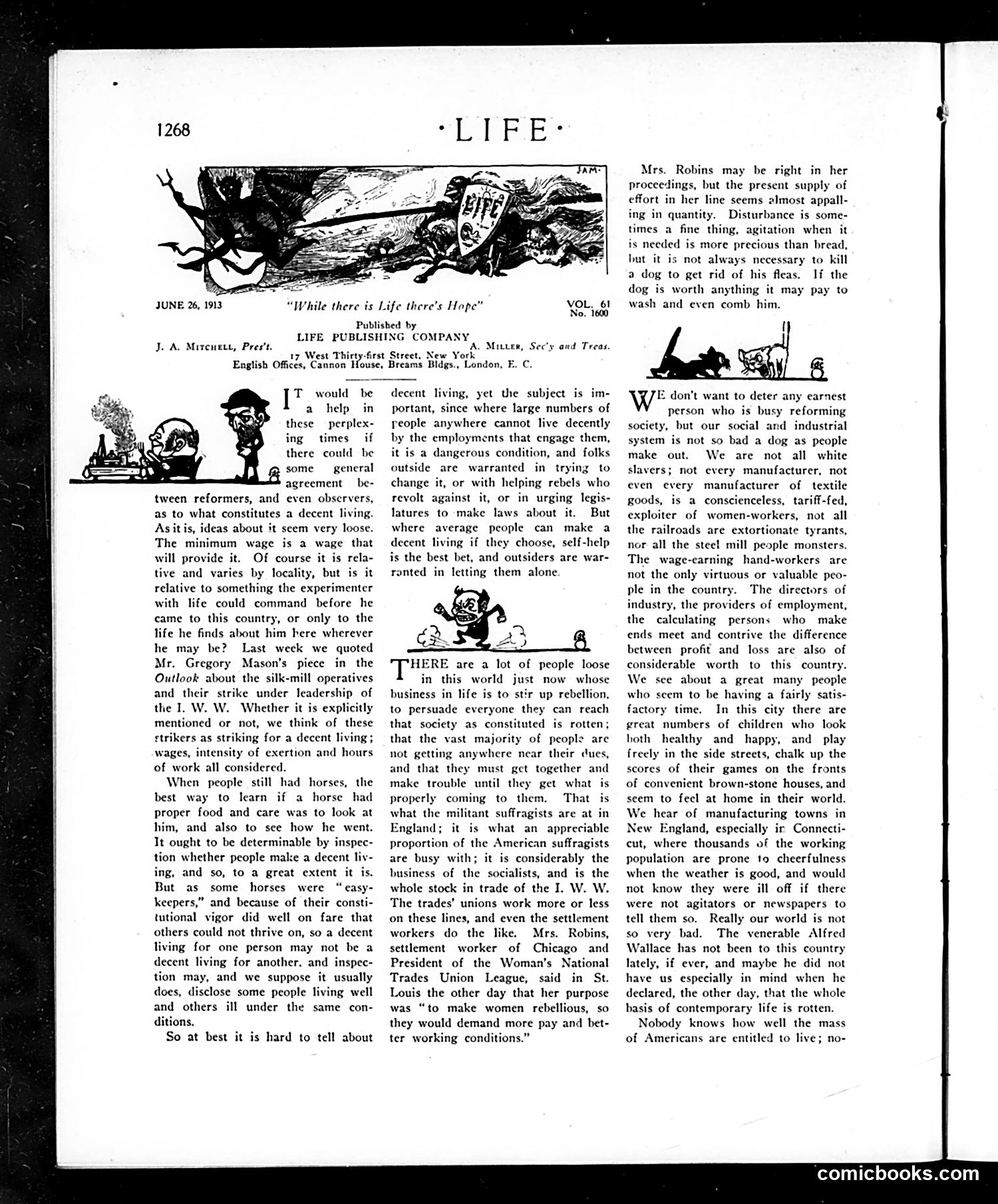
This editorial page debates labor activism and the concept of "decent living." The text critiques what it sees as excessive agitation by reform movements, particularly targeting Mrs. Florence Robins (identified as a Chicago settlement worker and president of the Woman's National Trades Union League) and her stated goal "to make women rebellious" for better wages and conditions. The author acknowledges legitimate grievances but argues that constant agitation isn't always necessary—using the metaphor of killing a dog to remove fleas when washing would suffice. The piece expresses skepticism toward the IWW (Industrial Workers of the World), socialists, militant suffragists, and trade unions, suggesting their activism is excessive given that "average people can make a decent living if they choose, self-help is the best bet." The cartoons (appearing to show labor/reform figures) reinforce this cautionary tone toward reform movements, though specific identities aren't entirely clear from the image.
📄 Transcribed text from this page (OCR, searchable)
Machine-transcribed from the original scan — historical spelling and the odd misread are preserved.
JUNE 26, 1913 “While there is Life there's Hope” Published by LIFE PUBLISHING J. A. Mircuett, Pres’t. COMPANY A. Mutter, Sec’y and Treas. 17 Weat Thirty-Gret Street, New York English Offices, Cannon I* would be a help in these perplex- ing times if there could be some general agreement be- tween reformers, and even observers, as to what constitutes a decent living. Asitis, ideas about it seem very loose. The minimum wage is a wage that will provide it. Of course it is rela- tive and varies by locality, but is it relative to something the experimenter with life could command before he came to this country, or only to the life he finds about him here wherever he may be? Last week we quoted Mr. Gregory Mason’s piece in the Outlook about the silk-mill operatives and their strike under leadership of the I. W. W. Whether it is explicitly mentioned or not, we think of these strikers as striking for a decent living; wages, intensity of exertion and hours of work all considered. When people still had horses, the best way to learn if a horse had proper food and care was to look at him, and also to see how he went. It ought to be determinable by inspec- tion whether people make a decent li ing, and so, to a great extent it i But as some horses were “easy- keepers,” and because of their const: tutional vigor did well on fare that others could not thrive on, so a decent living for one person may not be a decent living for another, and inspec- tion may, and we suppose it usually does, disclose some people living well and others ill under the same con- ditions, So at best it is hard to tell about fouse, Breams Bldgs., London, E. C. decent living, yet the subject is im- portant, since where large numbers of reople anywhere cannot live decently by the employments that engage them, it is a dangerous condition, and folks outside are warranted in trying to change it, or with helping rebels who revolt against it, or in urging legis- latures to make laws about it. But where average people can make a decent living if they choose, self-help is the best bet, and outsiders are war- ranted in letting them alone. are a lot of people loose this world just now whose business in life is to stir up rebellion, to persuade everyone they can reach that society as constituted is rotten; that the vast majority of people are not getting anywhere near their dues, and that they must get together and make trouble until they get what is properly coming to them, That is what the militant suffragists are at in England; it is what an appreciable proportion of the American suffragists are busy with; it is considerably the business of the socialists, and is the whole stock in trade of the I. W. W. The trades’ unions work more or less on these lines, and even the settlement workers do the like, Mrs. Robins, settlement worker of Chicago and President of the Woman's National Trades Union League, said in St. Louis the other day that her purpose was “to make women rebellious, so they would demand more pay and bet- ter working conditions.” Mrs. Robins may be right in her proceedings, but the present supply of effort in her line seems almost appall- ing in quantity. Disturbance is some- times a fine thing, agitation when it is needed is more precious than bread, but it is not always necessary to kill a dog to get rid of his fleas. If the dog is worth anything it may pay to wash and even comb him, { WE don't want to deter any earnest person who is busy reforming society, but our social and industrial system is not so bad a dog as people make out. We are not all white slavers; not every manufacturer, not even every manufacturer of textile goods, is a conscienceless, tariff-fed, exploiter of women-workers, not all the railroads are extortionate tyrants, nor all the steel mill people monsters. The wage-earning hand-workers are not the only virtuous or valuable peo- ple in the country. The directors of industry, the providers of employment, the calculating persons who make ends meet and contrive the difference between profit and loss are also of considerable worth to this country. We sce about a great many people who seem to be having a fairly satis- factory time. In this city there are great numbers of children who look hoth healthy and happy, and_ play freely in the side streets, chalk up the scores of their games on the fronts of convenient brown-stone houses, and seem to feel at home in their world. We hear of manufacturing towns in New England, especially ir Connecti- cut, where thousands of the working population are prone to cheerfulness when the weather is good, and would not know they were ill off if there were not agitators or newspapers to tell them so. Really our world is not so very bad. The venerable Alfred Wallace has not been to this country lately, if ever, and maybe he did not have us especially in mind when he declared, the other that the whole basis of contemporary life is rotten. Nobody knows how well the mass of Americans are entitled to liv comicbooks.com