
Life, 1913-06-26 · page 28 of 45
Life — June 26, 1913 — page 28: what you’re looking at
What you’re looking at
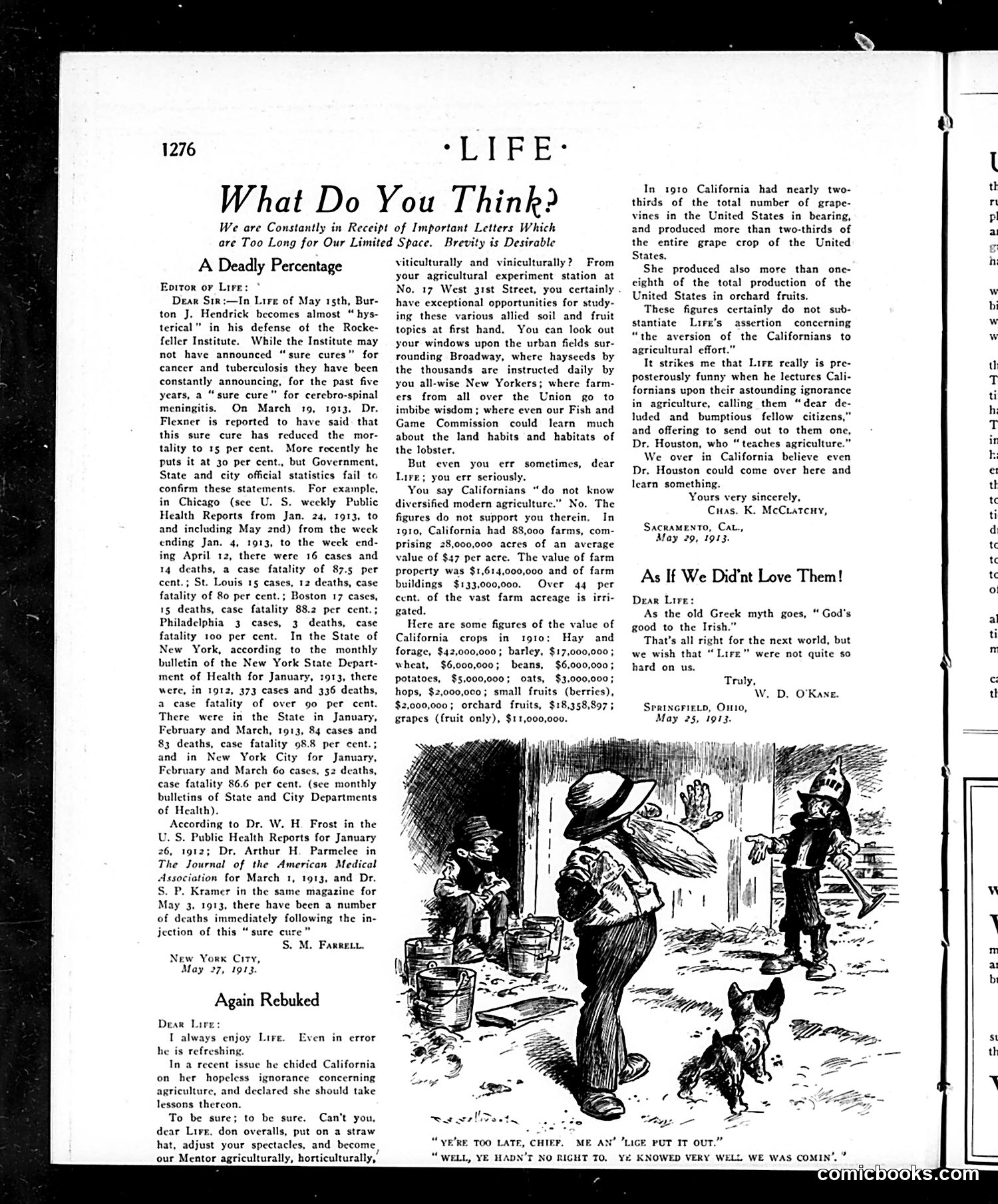
This page features a **readers' letters section** with a cartoon at the bottom depicting what appears to be **law enforcement or authority figures arriving too late to a scene**. The caption reads: "We're too late, chief. He as 'lice put out.' Well, ye hadn't no right to. Ye knowed very well we was comin'." The cartoon likely satirizes **police inefficiency or corruption**—officers arrive after a criminal has fled, with the implication they were either deliberately delayed or incompetent. The dialogue suggests foreknowledge of the arrest, hinting at collusion or negligence. The page itself consists of reader responses debating California agriculture and criticisms of the Rockefeller Institute's claimed "cure" for cerebrospinal meningitis, with one letter presenting mortality statistics suggesting the cure's effectiveness was overstated. These represent typical **Life magazine satire**: deflating institutional authority and exposing statistical deception through rigorous fact-checking.
📄 Transcribed text from this page (OCR, searchable)
Machine-transcribed from the original scan — historical spelling and the odd misread are preserved.
“lh PE™ What Do You Think? We are Constantly in Receipt of Important Letters Which are Too Long for Our Limited Space. Brevity is Desirable A Deadly Percentage Eoitor or Lire: Dear Sir:—In Lire of May sth, Bur- ton J. Hendrick becomes almost “ hys- terical” in his defense of the Rocke- feller Institute. While the Institute may not have announced “sure cures” for cancer and tuberculosis they have been constantly announcing, for the past five years, a “sure cure” for cerebro-spinal meningitis. On March 19, 1913, Dr. Flexner is reported to have said that this sure cure has reduced the mor- tality to 15 per cent. More recently he Puts it at 30 per cent., but Government, State and city official statistics fail to confirm these statements. For example, in Chicago (see U. S. weekly Public Health Reports from Jan. 24, 1913, to and including May 2nd) from the weck ending Jan. 4, 1913, to the weck end- ing April 12, there were 16 cases and 14 deaths, a case fatality of 87.5 per cent.; St. Louis 15 cases, 12 deaths, case fatality of 80 per cent.; Boston 17 cases, 15 deaths, case fatality 88.2 per cent.; Philadelphia 3 cases, 3 deaths, case fatality 100 per cent. In the State of New York, according to the monthly bulletin of the New York State Depart- ment of Health for January, 1913, there were, in 1912, 373 cases and 336 deaths, a case fatality of over 90 per cent. There were in the State in January, February and March, 1913, 84 cases and 83 deaths, case fatality 98.8 per cent.; and in New York City for January, February and March 60 cases, 52 deaths, case fatality 86.6 per cent. (see monthly bulletins of State and City Departments of Health). According to Dr. W. H. Frost in the U. S. Public Health Reports for January 26, 1912; Dr. Arthur H. Parmelee in The Journal of the American Medical Association for March 1, 1913, and Dr. S. P. Kramer in the same magazine for May 3, 1913, there have been a number of deaths immediately following the in- jection of this “sure cure” S. M. Farret.. New York City, May 27, 1913. Again Rebuked Dear Lire: I always enjoy Lire. Even in error he is refreshing. In a recent issue he chided California on her hopeless ignorance concerning agriculture, and declared she should take lessons thereon. To be sure; to be sure. Can't you, dear Live, don overalls, put on a straw hat, adjust your spectacles, and become, our Mentor agriculturally, horticulturally, viticulturally and viniculturally? From your agricultural experiment station at No. 17 West 31st Street, you certainly have exceptional opportunities for study- ing these various allied soil and fruit topics at first hand. You can look out your windows upon the urban fields sur- rounding Broadway, where hayseeds by the thousands are instructed daily by you all-wise New Yorkers; where farm- ers from all over the Union go to imbibe wisdom ; where even our Fish and Game Commission could learn much about the land habits and habitats of the lobster. But even you err sometimes, dear Lire; you err serious! You say Californians “do not know diversified modern agriculture.” No. The figures do not support you therein, In 1910, California had 88,000 farms, com- prising 28,000,000 acres of an average value of $47 per acre. The value of farm Property was $1,614,000,000 and of farm buildings $133,000,000. Over 44 per cent. of the vast farm acreage is irri- gated. Here are some figures of the value of California crops in 1910: Hay and forage, $42,000,000; barley, $17,000,000; wheat, $6,000,000; beans, $6,000,000; Potatoes, $5,000,000; oats, $3,000,000; hops, $2,000,000; small fruits (berries), 2,000,000; orchard fruits, $18,358,897; grapes (fruit only), $11,000,000. "Poet a enead In 1910 California had nearly two- thirds of the total number of grape- vines in the United States in bearing, and produced more than two-thirds of the entire grape crop of the United States. She produced also more than one- cighth of the total production of the United States in orchard fruits. These figures certainly do not sub- stantiate Lire’s assertion concerning “the aversion of the Californians to agricultural effort.” It strikes me that Lire really is pre- posterously funny when he lectures Cali- fornians upon their astounding ignorance in agriculture, calling them “dear de- luded and bumptious fellow citizens,” and offering to send out to them one, Dr. Houston, who “ teaches agriculture.” We over in California believe even Dr. Houston could come over here and learn something. Yours very sincerely, Cuas. K. McCratcny, Sacramento, Cat., May 29, 1913. As If We Did’nt Love Them! Dear Lire: As the old Greek myth goes, “ God's good to the Irish.” That’s all right for the next world, but we wish that “Lire” were not quite so hard on us. Truly, W. D. O'Kane. Sreixorietp, Onto, May 25, 1913. “VE’RE TOO LATE, CHIEF, ME AN’ ’LIGE PUT IT OUT.” “WELL, YE HADN’T NO RIGHT TO, Ye KNOWED VERY WELL WE WAS COMIN’, ” a bi st th