
Life, 1913-06-26 · page 12 of 45
Life — June 26, 1913 — page 12: what you’re looking at
What you’re looking at
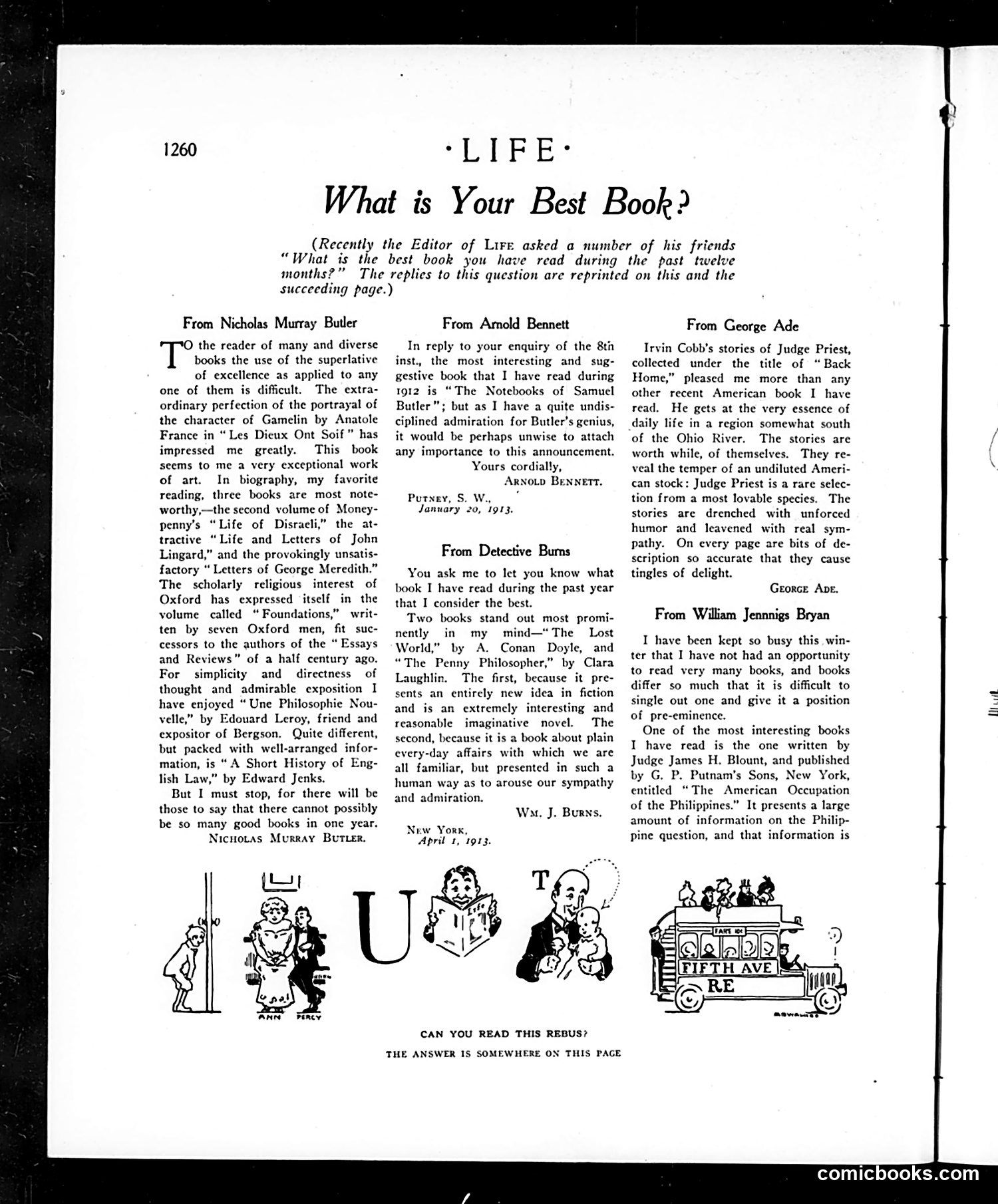
This page features book recommendations from prominent figures (Nicholas Murray Butler, Arnold Bennett, George Ade, William Jennings Bryan, and Detective Burns). The small cartoons at the bottom appear to illustrate the letter "U" through playful vignettes—characters reading, children with books, and what appears to be a mobile library or bookstore on wheels labeled "Fifth Ave." The decorative letterforms suggest this is a visual pun or rebus puzzle ("Can you read this rebus?" prompts readers). The overall page promotes reading and book culture to Life's educated audience during the 1910s. The contributors' recommendations range from classic literature to contemporary works, reflecting early 20th-century intellectual discourse about which books merit serious attention.
📄 Transcribed text from this page (OCR, searchable)
Machine-transcribed from the original scan — historical spelling and the odd misread are preserved.
Us Weal oe What is Your Best Book? a (Recently the Editor of Lire asked a number of his friends What is the best book you have read during the past twelve months?” The replies to this question are reprinted on this and the succeeding page.) From Nicholas Murray Butler the reader of many and diverse books the use of the superlative of excellence as applied to any one of them is difficult. The extra- ordinary perfection of the portrayal of the character of Gamelin by Anatole France in “Les Dieux Ont Soif” has impressed me greatly. This book seems to me a very exceptional work of art. In biography, my favorite reading, three books are most note- worthy,—the second volume of Money- penny’s “Life of Disrael the at- tractive “Life and Letters of John Lingard,” and the provokingly unsatis- factory “Letters of George Meredith.” The scholarly religious interest of Oxford has expressed itself in the volume called “ Foundations,” writ- ten by seven Oxford men, fit suc- cessors to the authors of the “ Essays and Reviews” of a half century ago. For simplicity and directness of thought and admirable exposition I have enjoyed “ Une Philosophie Nou- yelle,” by Edouard Leroy, friend and expositor of Bergson, Quite different, but packed with well-arranged infor- mation, is “A Short History of Eng- lish Law,” by Edward Jenks. But I must stop, for there will be those to say that there cannot possibly be so many good books in one year. Nicnotas Murray Butter. From Amold Bennett In reply to your enquiry of the 8th inst, the most interesting and sug- gestive book that I have read during 1912 is “The Notebooks of Samuel Butler”; but as I have a quite undis- ciplined admiration for Butler’s genius, it would be perhaps unwise to attach any importance to this announcement. Yours cordially, Arnotp Bennett. w, 1913. Purxey, January From Detective Bums You ask me to Iet you know what book I have read during the past year that I consider the best. Two books stand out most promi- nently in) my mind—“* The Lost World,” by A. Conan Doyle, and “The Penny Philosopher,” by Clara Laughlin. The first, because it pre- sents an entirely new idea in fiction and is an extremely interesting and reasonable imaginative novel. The second, because it is a book about plain every-day affairs with which we are all familiar, but presented in such a human way as to arouse our sympathy and admiration. Ws. J. Burns. New York, April 1, 1913. CAN YOU READ THIS REBUS? ANSWER IS SOMEWHERE ON THIS PAGE From George Ade Irvin Cobb's stories of Judge Priest, collected under the title of “Back Home,” pleased me more than any other recent American book I have read. He gets at the very essence of daily life in a region somewhat south of the Ohio River. The stories are worth while, of themselves. They re- veal the temper of an undiluted Ameri- can stock: Judge Priest is a rare selec- tion from a most lovable species. The stories are drenched with unforced humor and leavened with real sym- pathy. On every page are bits of de- scription so accurate that they cause tingles of delight. Georce Ape. From William Jennnigs Bryan I have been kept so busy this win- ter that I have not had an opportunity to read very many books, and books differ so much that it is difficult to single out one and give it a position of pre-eminence. One of the most interesting books I have read is the one written by Judge James H. Blount, and published by G. P. Putnam’s Sons, New York, entitled “The American Occupation of the Philippines.” It presents a large amount of information on the Philip- pine question, and that information is comicbooks.com