
A complete issue · 48 pages · 1913
Life — May 22, 1913
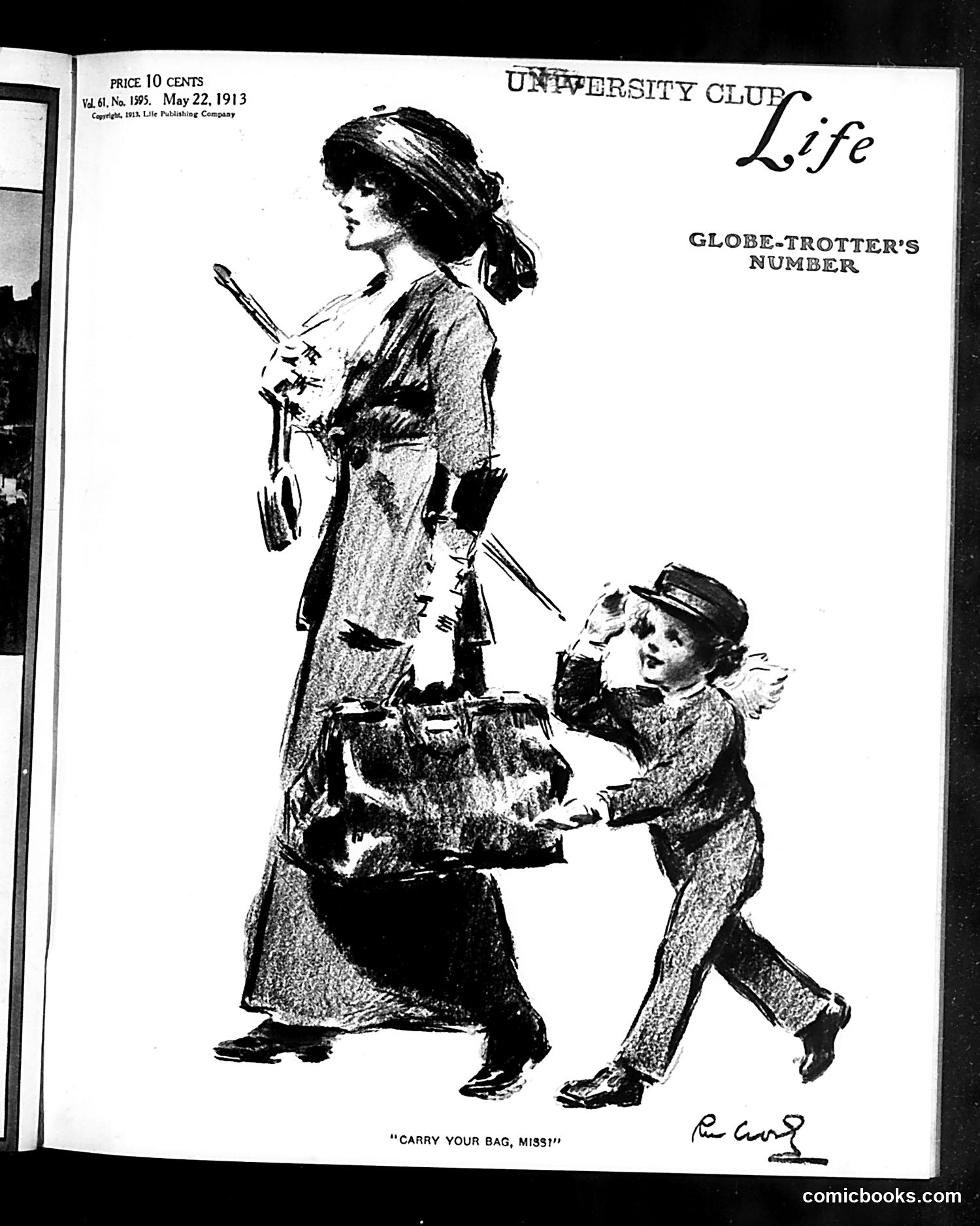
This May 1913 *Life* magazine cover depicts a woman in Edwardian dress holding a rifle, being approached by a winged cherub (Cupid) offering to carry her bag. The caption reads "Carry Your Bag, Miss!" The cartoon satirizes the emerging women's suffrage movement and changing gender roles of the Progressive Era. The woman's rifle suggests militant activism (British suffragettes were known for aggressive tactics during this period). The cherub offering to carry her belongings mocks the tension between traditional gallantry and women's increasing independence and assertiveness. The humor targets both the "New Woman" demanding rights and the confusion this caused among traditional gender expectations—the cherub's courteous gesture now seems absurd or inadequate when confronted with an armed, self-determined female figure.
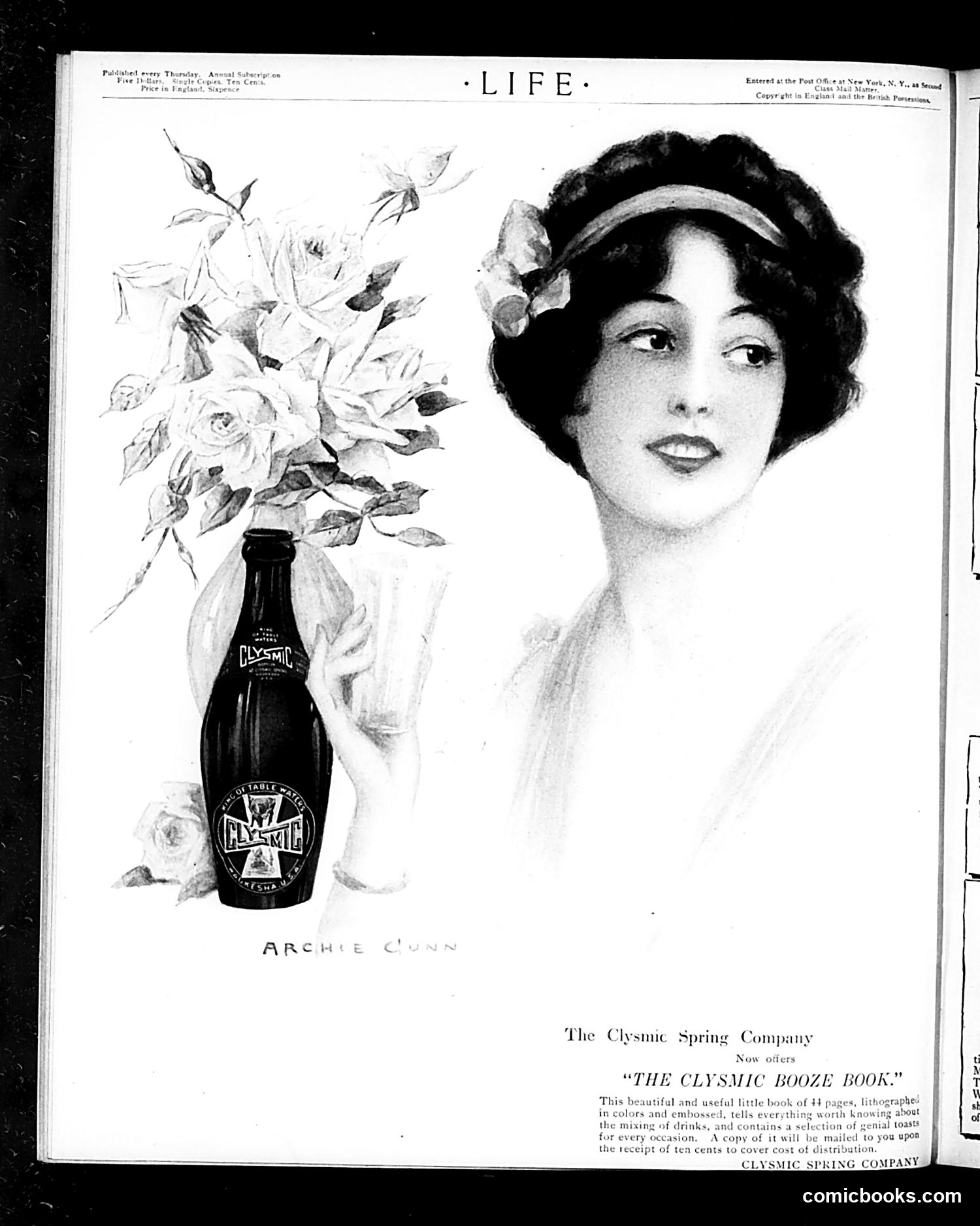
This page is primarily **advertising, not satire or political commentary**. The image features a portrait labeled "Archie Gunn" alongside a bottle of Clysmic brand beverage and flowers. Below is promotional text for "The Clysmic Spring Company," advertising "The Clysmic Booze Book"—described as a 48-page illustrated guide about mixing drinks, containing toasts for various occasions. This appears to be a **commercial advertisement masquerading as editorial content** within *Life* magazine. The elegant illustration style and magazine placement lent credibility to product promotion, a common early 20th-century marketing practice. The "Booze Book" promotion likely capitalized on cocktail culture's popularity during this era, though the specific date and Archie Gunn's identity remain unclear without additional context.
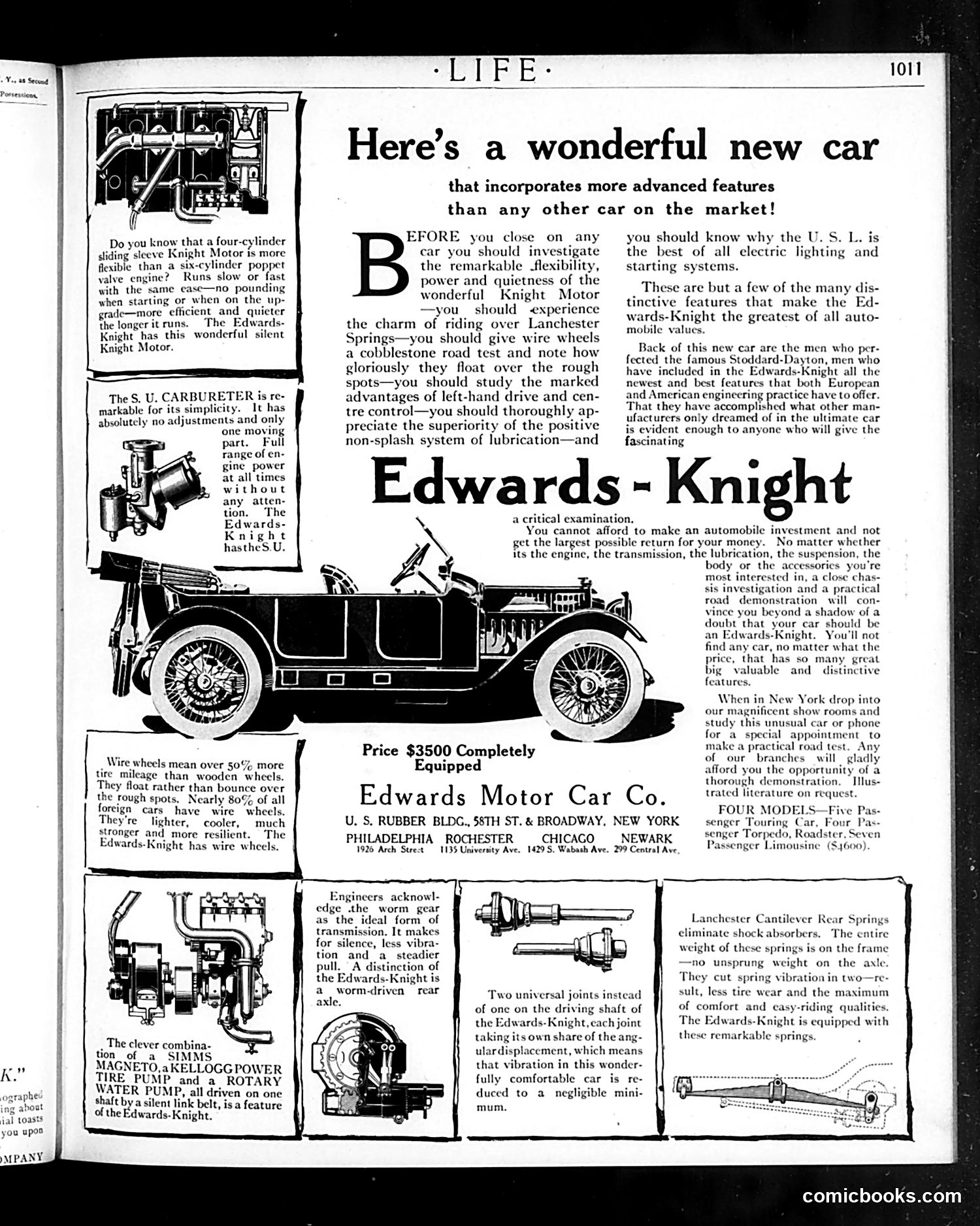
This page is **primarily an advertisement**, not satire or political commentary. It promotes the Edwards-Knight automobile, priced at $3,500 fully equipped. The ad highlights technical features: a four-cylinder Knight Motor with sliding sleeves, wire wheels (claimed superior to wooden ones), left-hand drive, center controls, and Lancashire Cantilever rear springs. The copy emphasizes engineering innovations and invites readers to test drive the vehicle or visit showrooms in New York, Philadelphia, Rochester, Chicago, and Newark. The left sidebar contains smaller technical diagrams and specifications. There is no identifiable political satire, caricature, or social commentary. This represents straightforward automotive marketing typical of early 20th-century magazine advertising.
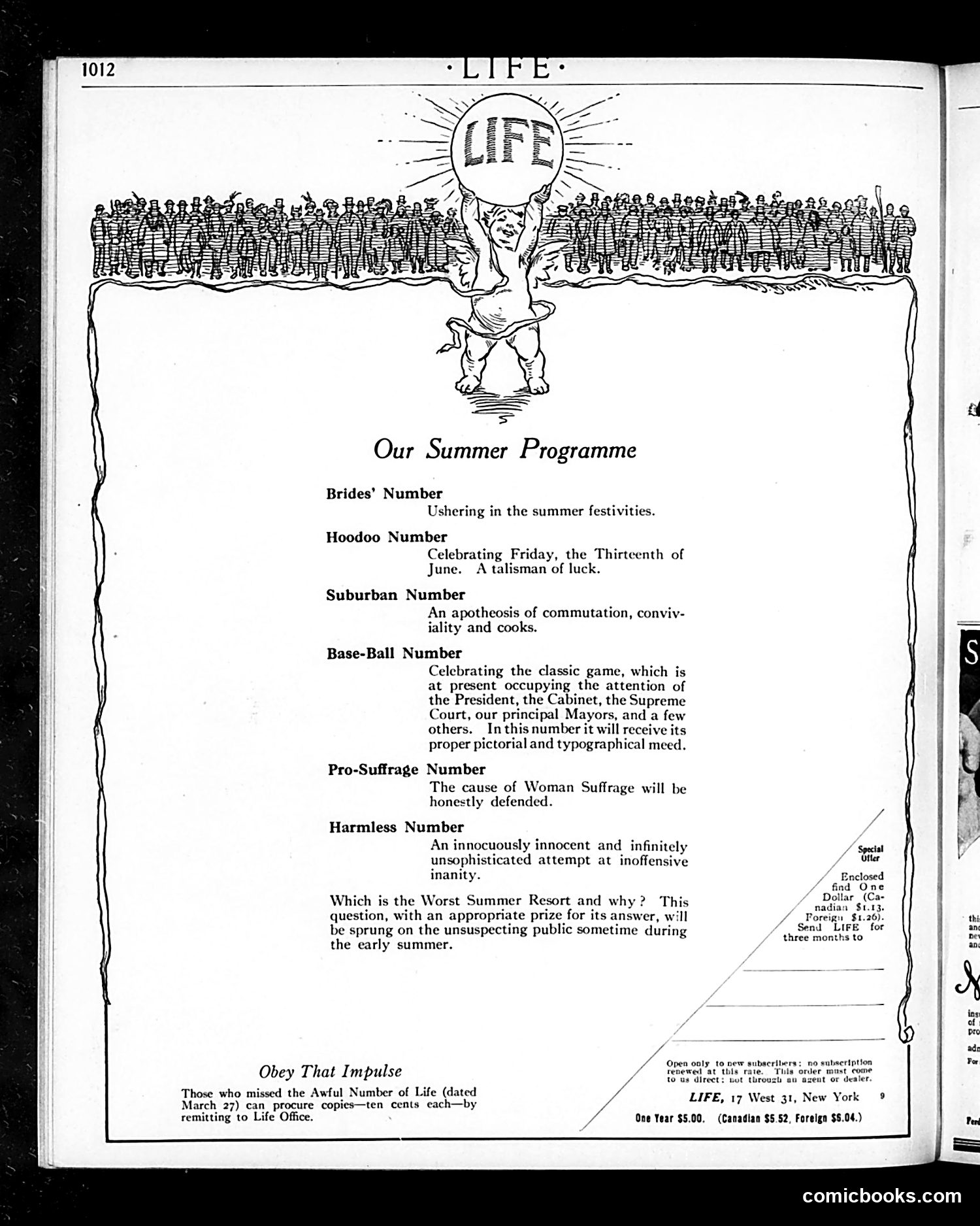
This page announces Life's "Summer Programme" of satirical issues, each targeting different social topics: - **Brides' Number**: Summer wedding season - **Hoodoo Number**: Friday the 13th superstitions - **Suburban Number**: Commuter culture and domestic life - **Base-Ball Number**: Baseball's popularity with political elites - **Pro-Suffrage Number**: Women's voting rights advocacy - **Harmless Number**: Described as "innocuously innocent" satire The illustration shows a figure holding an enormous "LIFE" globe above a crowd, emphasizing the magazine's satirical reach. The page solicits reader submissions for a contest asking "Which is the Worst Summer Resort and why?"—characteristic of Life's humorous, participatory approach to commentary on American society and leisure culture.
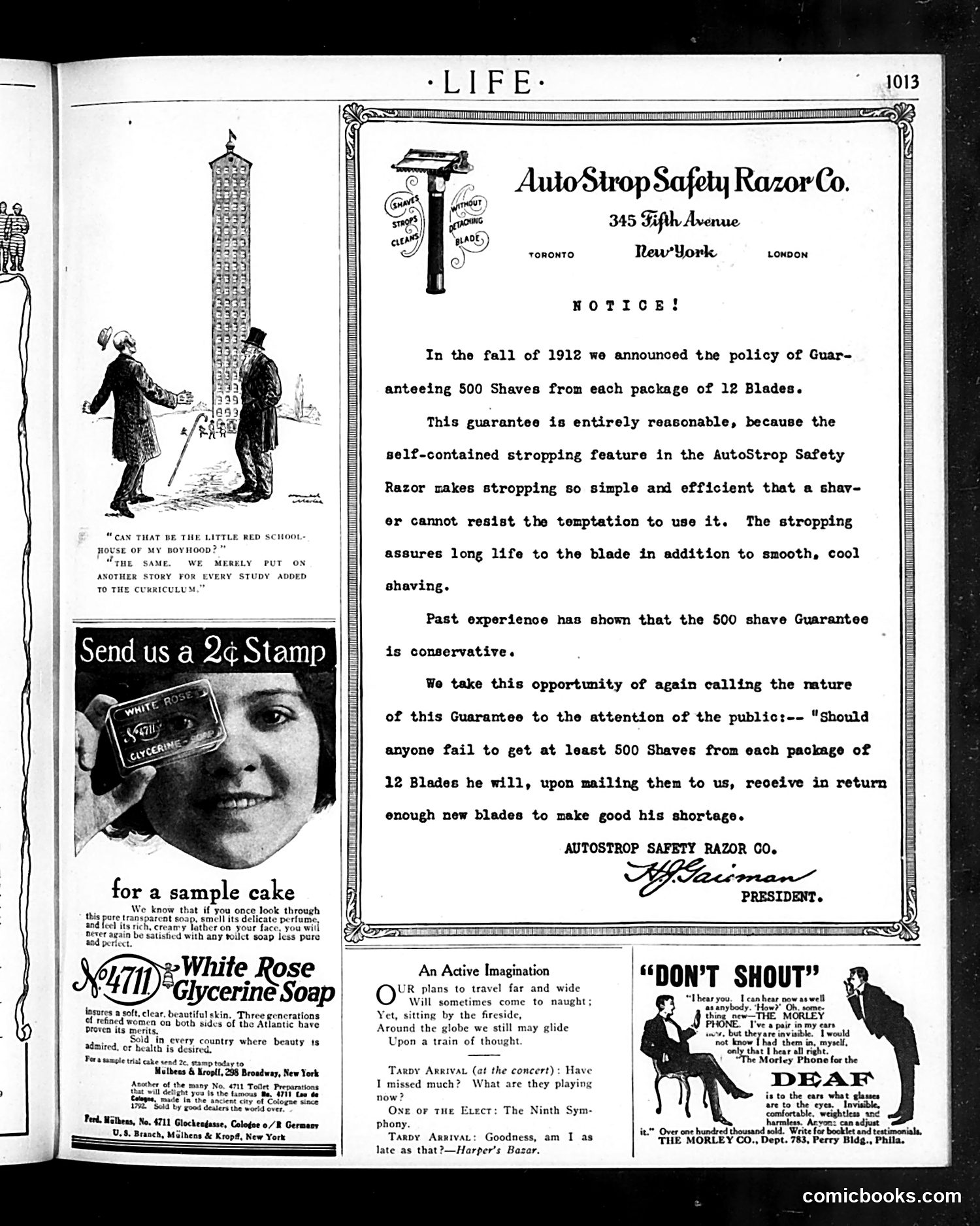
This page is primarily **advertising**, not political satire. The dominant content features: 1. **AutoStrop Safety Razor Co.** advertisement announcing a "500 Shaves Guarantee" policy from fall 1912, with the company president's signature. 2. **White Rose Glycerine Soap** advertisement featuring a woman's face, promoting the product's skin benefits. 3. **Minor content** includes a small cartoon about a schoolhouse, a poem titled "An Active Imagination," and an advertisement for a "Deaf" product from the Morley Co. The page reflects early 20th-century consumer advertising and contains no significant political commentary or satirical cartoons. It represents typical Life magazine commercial content from this era.
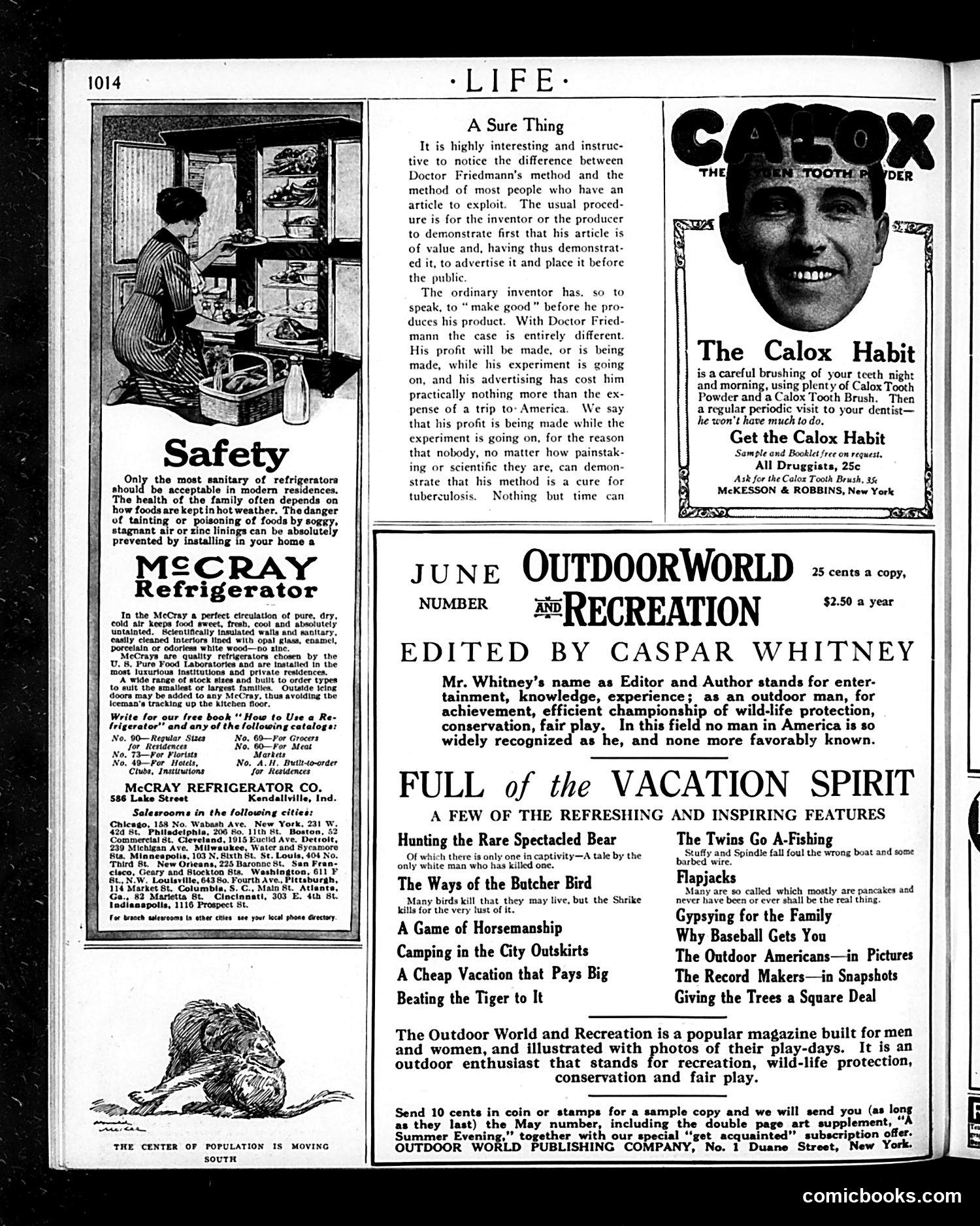
This page is primarily **advertising and magazine promotion** rather than political satire or editorial cartoon content. The left side features ads for **McCray Refrigerators** (emphasizing food safety in hot weather) and **Calox Tooth Powder** (with a smiling man's face as product endorsement). These are straightforward commercial advertisements typical of 1910s-era magazines. The bottom illustration—a sketch of what appears to be a beaver or similar animal—relates to an article about wildlife, accompanying text about "the center of population is moving south." The right page promotes **Outdoor World and Recreation**, a companion magazine edited by Caspar Whitney, listing recreational topics (hunting, fishing, camping, baseball). This is **magazine cross-promotion**, not satire. The page contains no evident political commentary or social satire—it's a commercial/promotional section from Life magazine's interior pages.
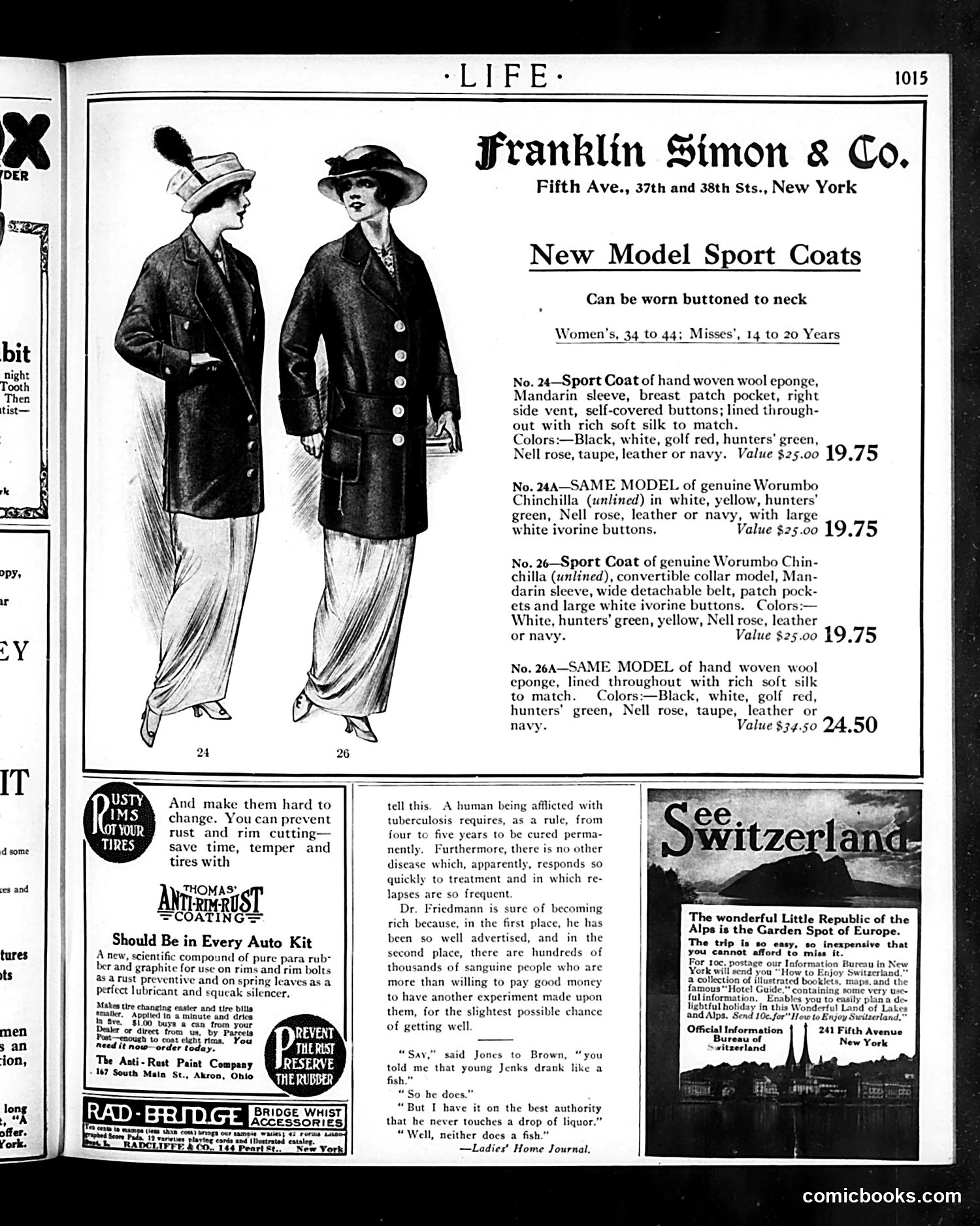
This page is primarily **commercial advertising** for Franklin Simon & Co., a New York department store featuring "New Model Sport Coats" for women. The two illustrated figures showcase 1920s fashion—long coats with Mandarin sleeves and convertible collars, priced at $19.75-$24.50. The page also contains **non-satirical content**: a public health message about tuberculosis prevention, a humorous dialogue ("Say," said Jones to Brown...) contrasting fish and liquor consumption, and advertisements for auto products and travel to Switzerland. There is **no political cartoon or satire** on this page. It reflects typical 1920s Life magazine content—mixing fashion advertisements, light humor, and sponsored health/travel promotion—rather than the satirical commentary the magazine was known for.
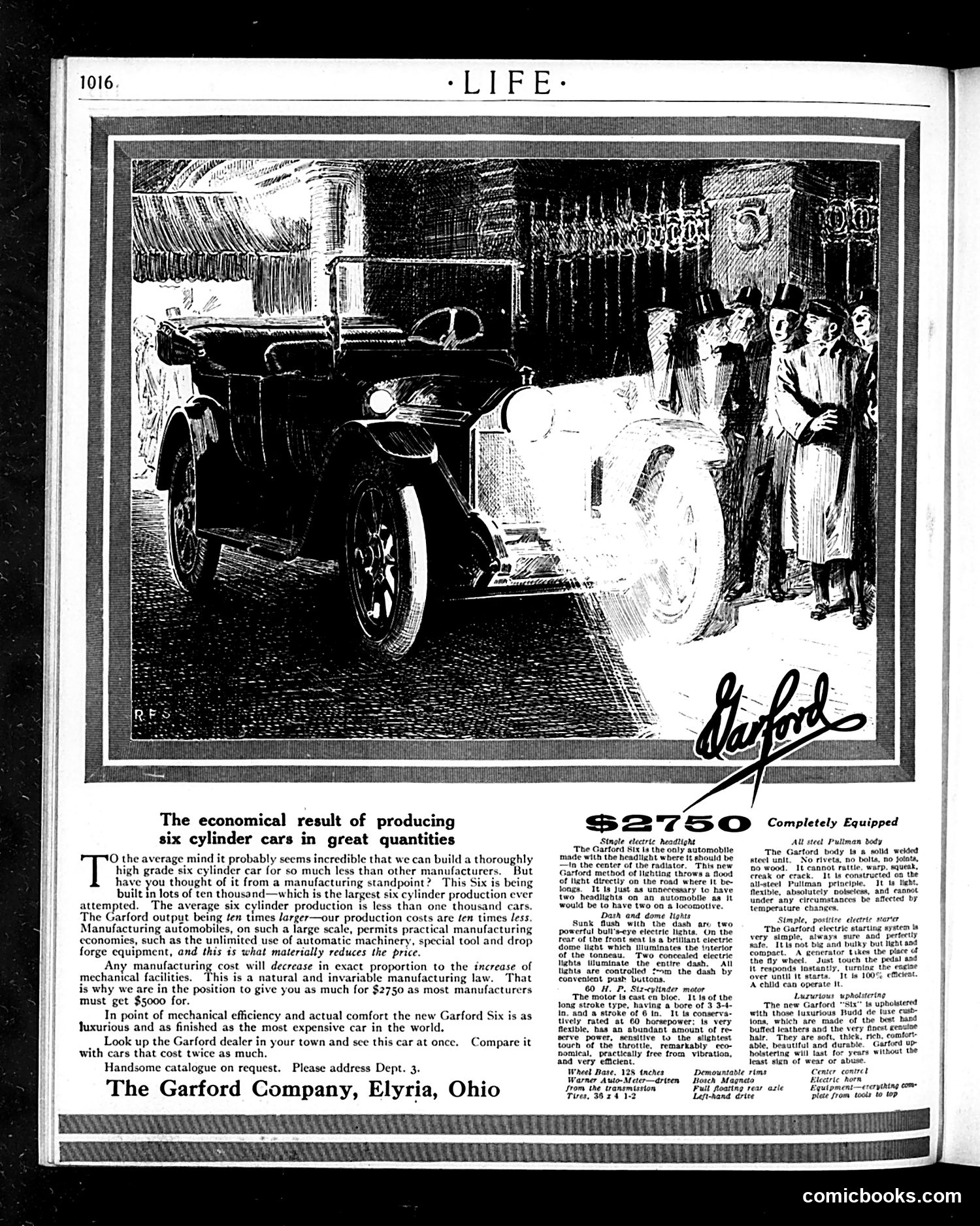
This is primarily an **advertisement for the Garford automobile**, not a political cartoon. The image shows two cars—a dark sedan and a white racing car—outside what appears to be an elegant venue with formally dressed spectators. The ad's argument is economic: Garford claims that mass-producing six-cylinder cars reduces manufacturing costs dramatically compared to competitors, allowing them to offer a well-equipped vehicle at $2,750. The text emphasizes "economical result of producing six cylinder cars in great quantities" as their competitive advantage. The visual juxtaposition of a luxury sedan and racing car suggests Garford vehicles appeal to both practical and performance-minded buyers. This is straightforward automotive marketing, not satire. The page includes technical specifications and dealer contact information for Garford Company of Elyria, Ohio.
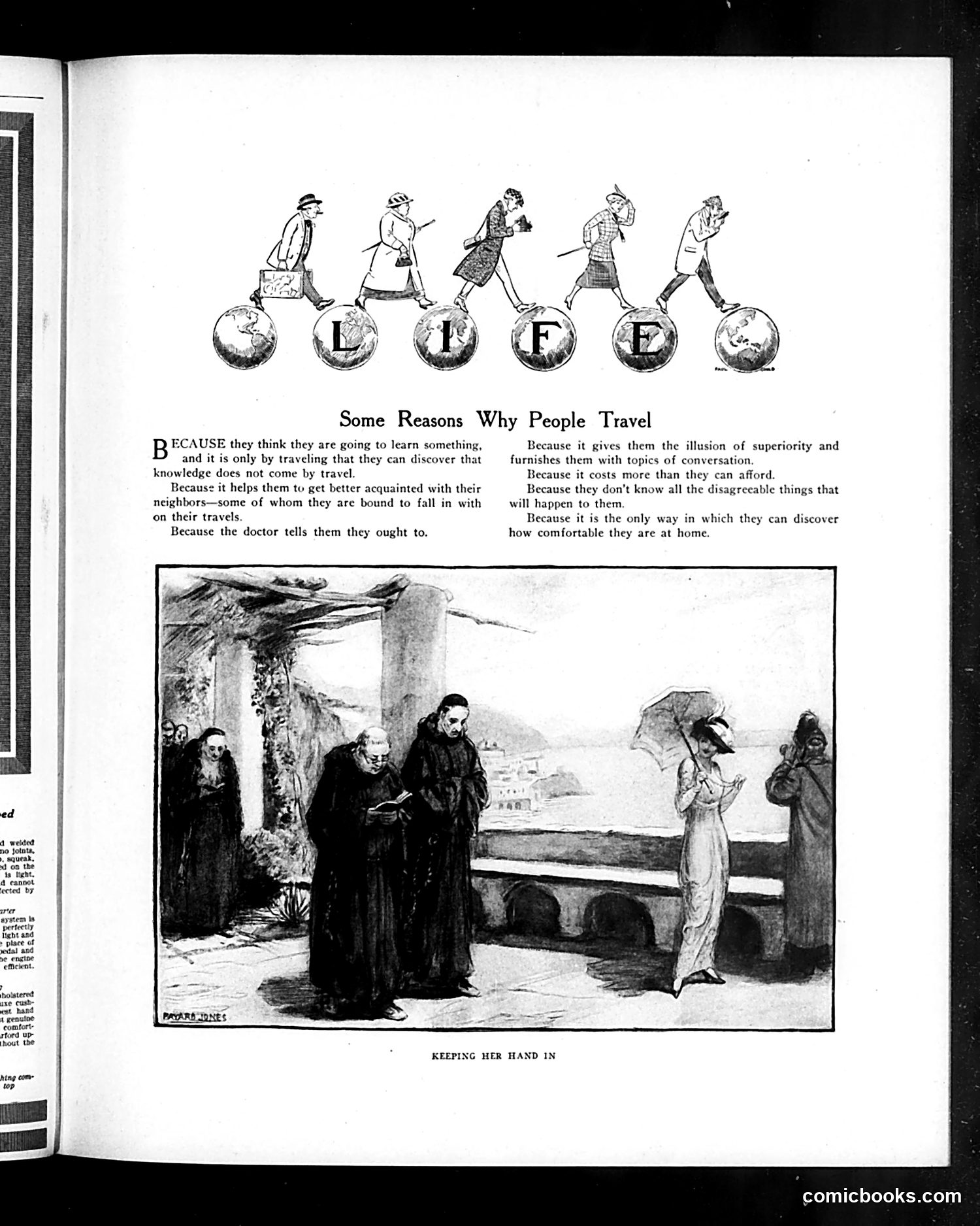
This page presents satirical commentary on travel motivations. The top cartoon shows six figures balanced on globes labeled with letters spelling "LIFE"—a visual pun on the magazine's own title, suggesting travel is essential to living fully. Below, the text lists humorous, somewhat cynical reasons people travel: to appear superior, gain conversation topics, afford luxuries, discover unknowns, and ironically, to appreciate home comforts. The illustration "Keeping Her Hand In" depicts what appears to be tourists or pilgrims at a Mediterranean overlook (suggested by classical ruins and coastal scenery). The satire likely mocks how travelers—particularly wealthy Americans—engaged in conventional sightseeing while maintaining social pretenses, with "keeping her hand in" suggesting she's maintaining appearances or social propriety during travel.
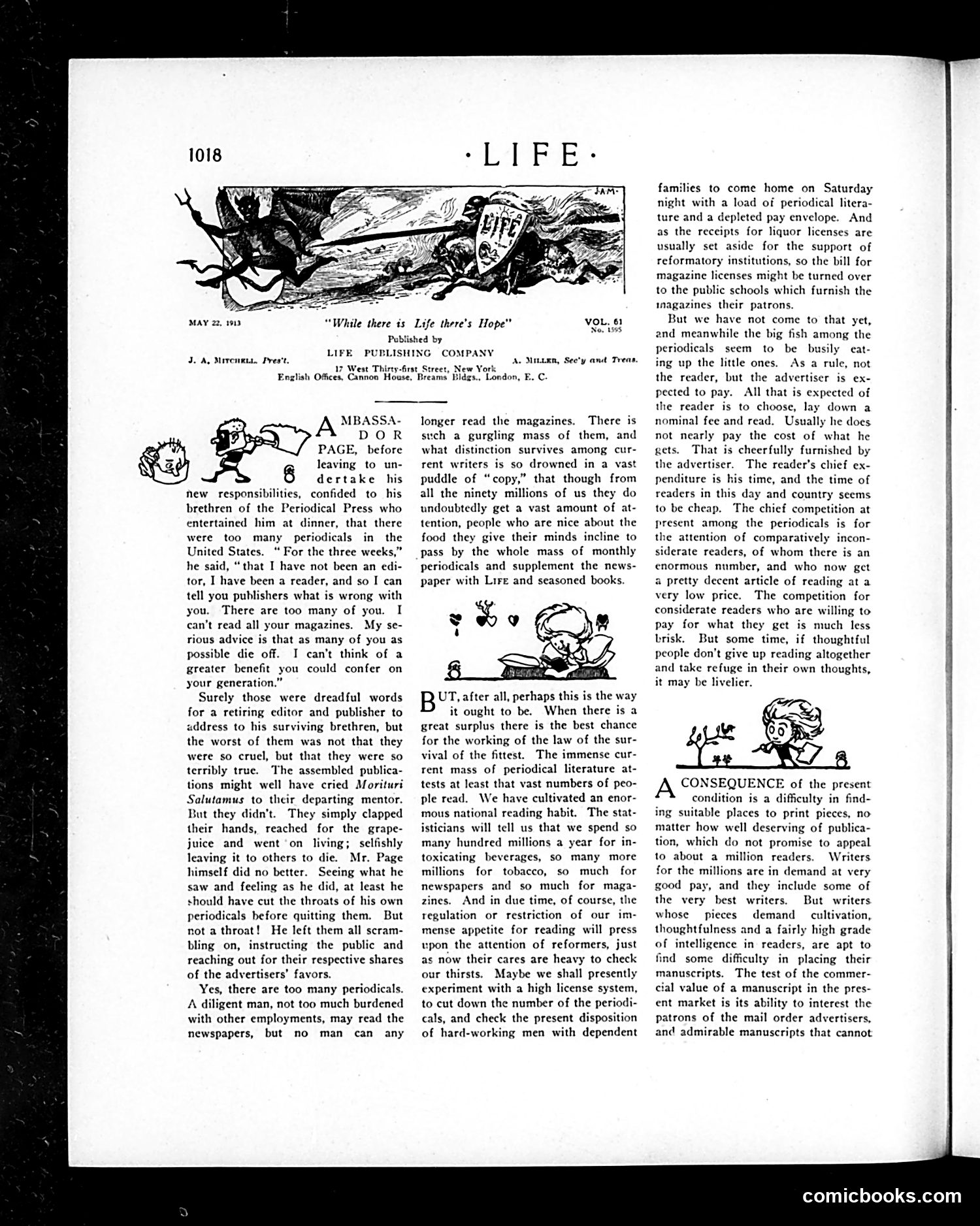
This page discusses the overcrowded market of American periodicals. The editorial argues there are too many magazines competing for readers' attention and advertising dollars. The cartoon at top appears to show a dying or struggling figure labeled "LIFE" — likely self-referential satire about the magazine's own survival amid competition. The text criticizes how periodicals saturate the market, making it difficult for quality publications to thrive. The editor proposes solutions like licensing systems to reduce the number of magazines, arguing this would benefit serious writers and readers while eliminating low-quality publications. The accompanying illustrations show cherubic figures, likely representing idealized readers or the magazine's mascot character, emphasizing the human cost of this industry competition.
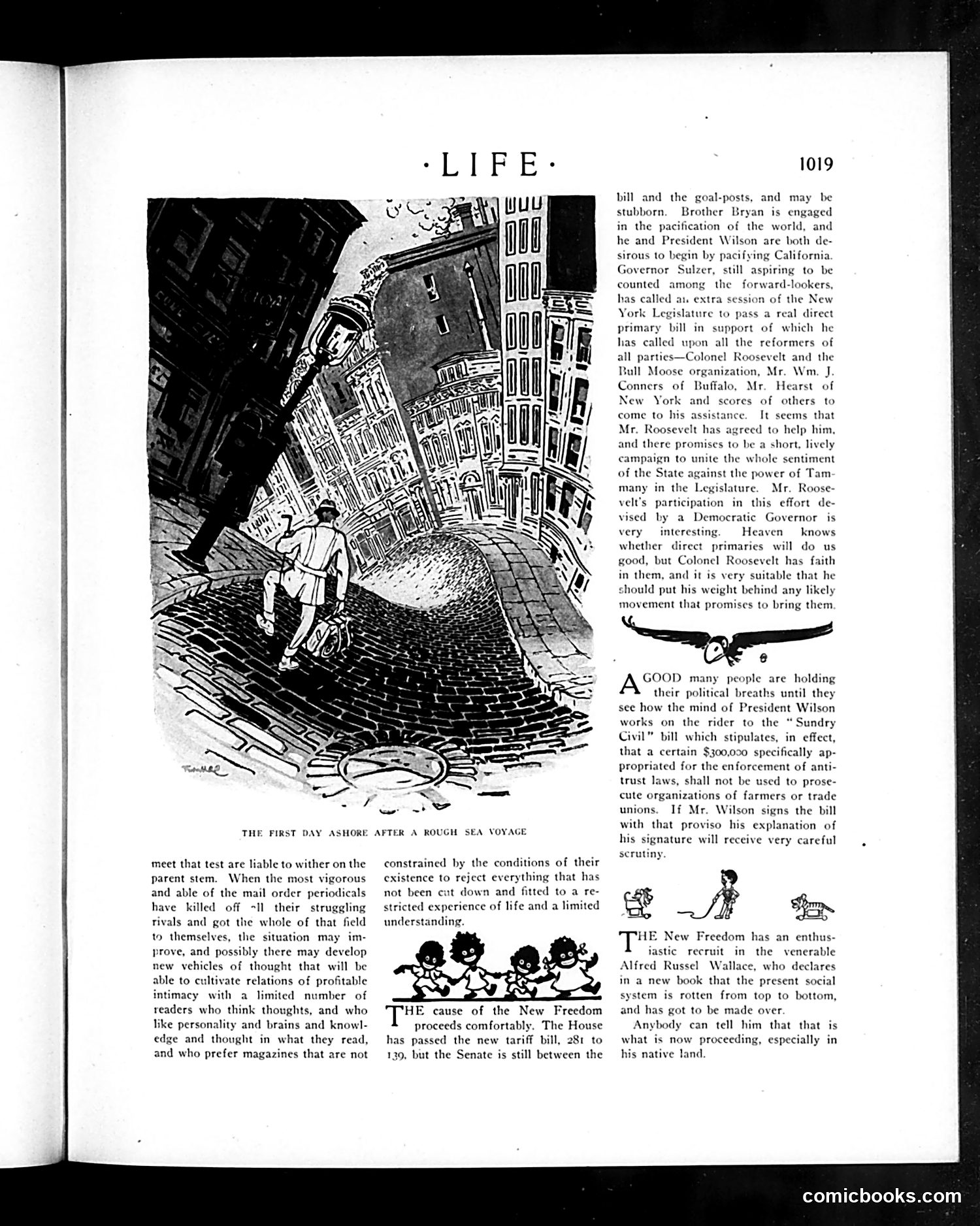
The main illustration depicts "The First Day Ashore After a Rough Sea Voyage"—showing a sailor emerging from a ship into an urban street scene. This is a visual gag about disorientation: the exaggerated perspective and tilting buildings suggest the sailor's equilibrium is still disrupted by seasickness, making solid ground appear as unstable as the ocean. The accompanying text discusses political reform movements, mentioning President Wilson, Colonel Roosevelt, and debates over tariff legislation and anti-trust laws. The article criticizes politicians constrained by limited thinking, advocating for broader-minded reformers who can cultivate new ideas. A secondary item praises Alfred Russell Wallace's new book criticizing the existing social system as "rotten from top to bottom."
This is the advice column section of the magazine, not a political cartoon. The page contains several columns addressing men's issues of the era: **"The Minimum Wage for Men"** argues for economic justice, suggesting American men deserve living wages to avoid poverty and moral decline. **"Should Men Vote?"** satirically questions male voting rights—flipping the women's suffrage debate by asking whether men, prone to poor judgment, should have political power. **"Passion of the Cities"** and **"How to Hold a Wife"** offer relationship and domestic advice typical of the period. The humor lies in inverting gender-politics arguments of 1913, when women's suffrage was actively debated. By applying suffrage arguments to men instead, the column mocks anti-suffrage logic.
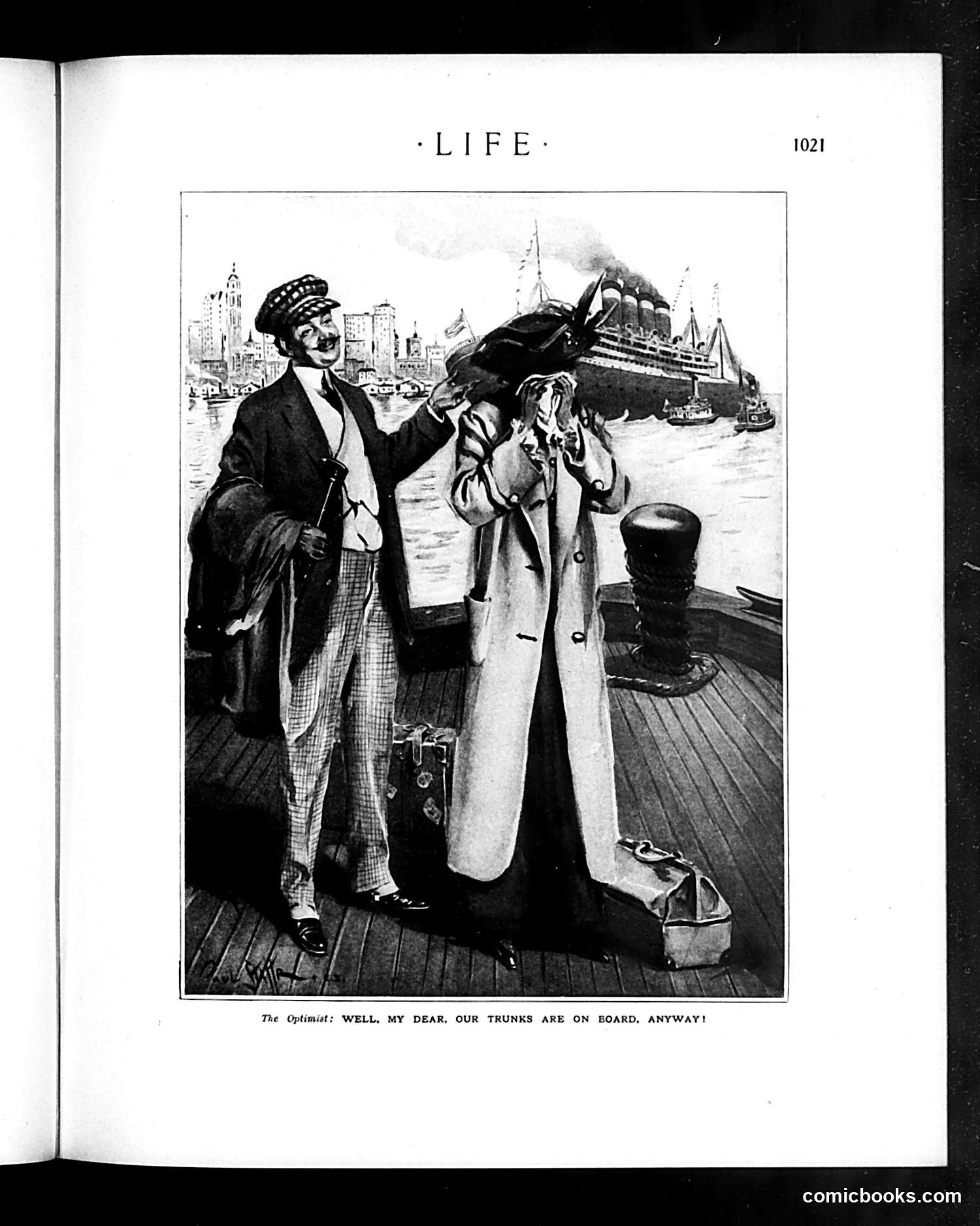
This cartoon satirizes optimistic travelers departing by ship, likely during the early 20th century when transatlantic travel was common. A well-dressed couple stands dockside with luggage, while a massive ocean liner looms in the background. The man's cheerful proclamation that "our trunks are on board" suggests he's finding a silver lining in an otherwise problematic situation—implying something has gone wrong with their travel plans (missed departure, delayed sailing, or similar travel mishap). The satire targets how people cope with travel misfortunes by focusing on minor positives rather than addressing actual problems. The cartoon's title, "The Optimist," makes this coping mechanism the explicit subject of ridicule.
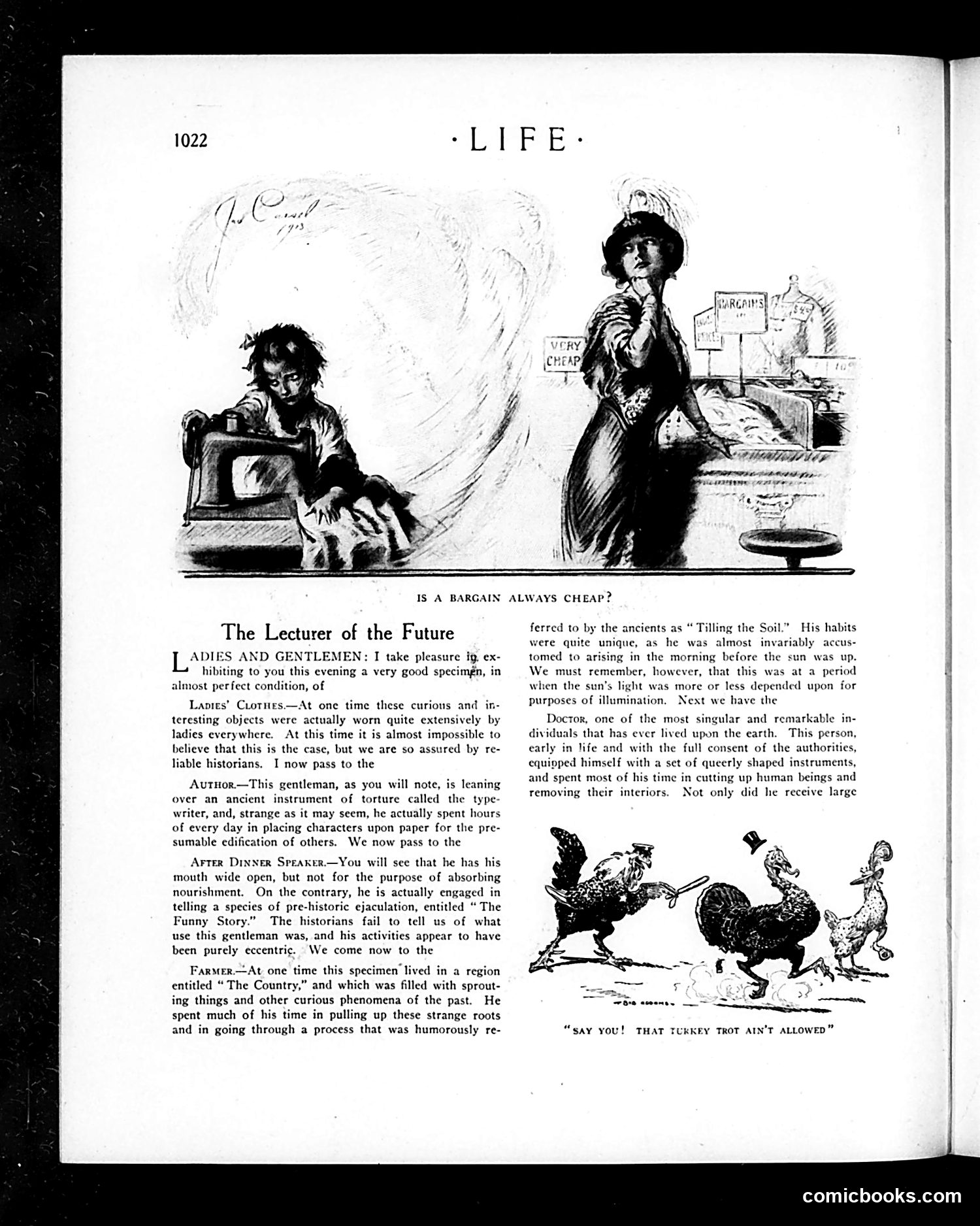
This satirical piece mocks the pretensions of pseudo-intellectual lecturers and oddball academics. The top cartoon asks "IS A BARGAIN ALWAYS CHEAP?" — setting up a joke about value versus cost. The text describes absurd historical "specimen" characters: a torture-implementing gentleman, an eccentric doctor who mutilates bodies, a dinner guest with an enormous mouth, and a "Farmer" who obsessively digs up roots and studies strange phenomena. The bottom cartoon shows turkeys being herded with the caption "SAY YOU! THAT TURKEY TAINT ALLOWED," likely satirizing either animal welfare debates or the pomposity of people imposing arbitrary rules. The overall message appears to be ridicule of self-important lecturers who present dubious "specimens" and historical curiosities as serious intellectual material to gullible audiences.
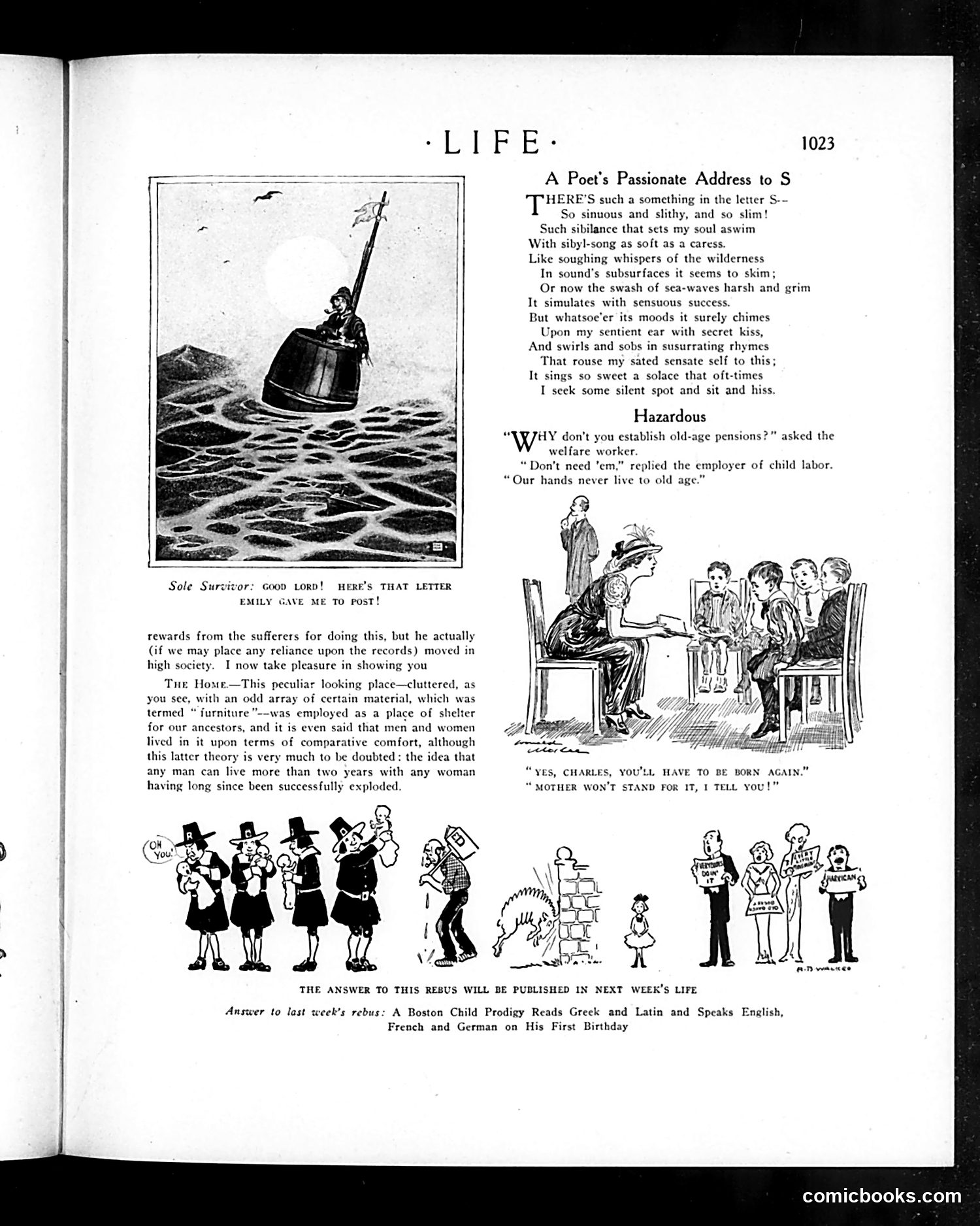
This page contains three satirical pieces: 1. **"A Poet's Passionate Address to S"**: A parody of overwrought Romantic poetry that obsessively celebrates the letter "S" through alliteration and flowery language ("sibilance," "sibyl-song," "susurrating"). The joke is the absurd pretension of treating a single letter as profoundly moving. 2. **"Hazardous"**: Dark social commentary on child labor. An employer of children dismisses the need for old-age pensions because child workers don't survive to old age—a grim indictment of exploitative labor practices in the early 20th century. 3. **"The Home"**: Humorous anthropological description of a house as if it were an ancient artifact, mocking both stuffy historical writing and contemporary domestic life. The final joke about men and women being unable to live together more than two years satirizes marriage. The page also contains a visual rebus puzzle and references Emily (likely from the "Sole Survivor" cartoon about posting letters).
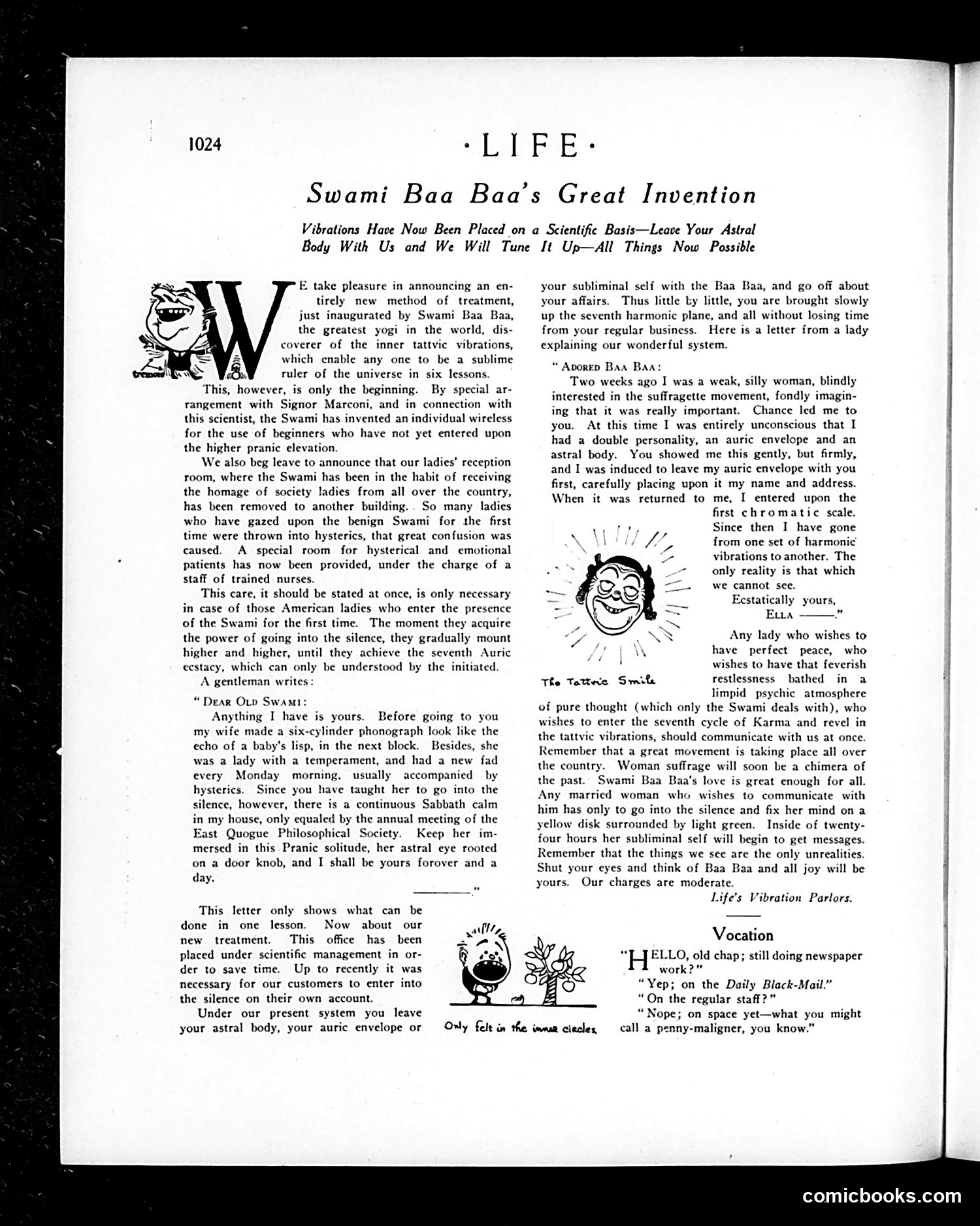
This page mocks fraudulent spiritualist movements gaining popularity in early 20th-century America. "Swami Baa Baa" is a fictional charlatan selling mystical "tattvic vibrations" and "astral body" treatments—pseudoscientific nonsense marketed as yogic wisdom. The satire targets multiple things: gullible wealthy women seeking spiritual enlightenment; the suffragette movement (dismissed as frivolous distraction); and men who benefit when women are pacified into mystical passivity rather than pursuing social reform. A testimonial describes a woman who abandoned suffragette interests after the Swami's "treatment," finding peace in submissive silence—implying the real goal is silencing women's activism. The humor lies in absurd claims (wireless devices for "pranic elevation," hysterical women fainting at the guru's presence) presented with deadpan seriousness. Life ridicules both the con artists exploiting women and the women themselves for their credulity, reflecting the period's dismissive attitudes toward female activism and spirituality.
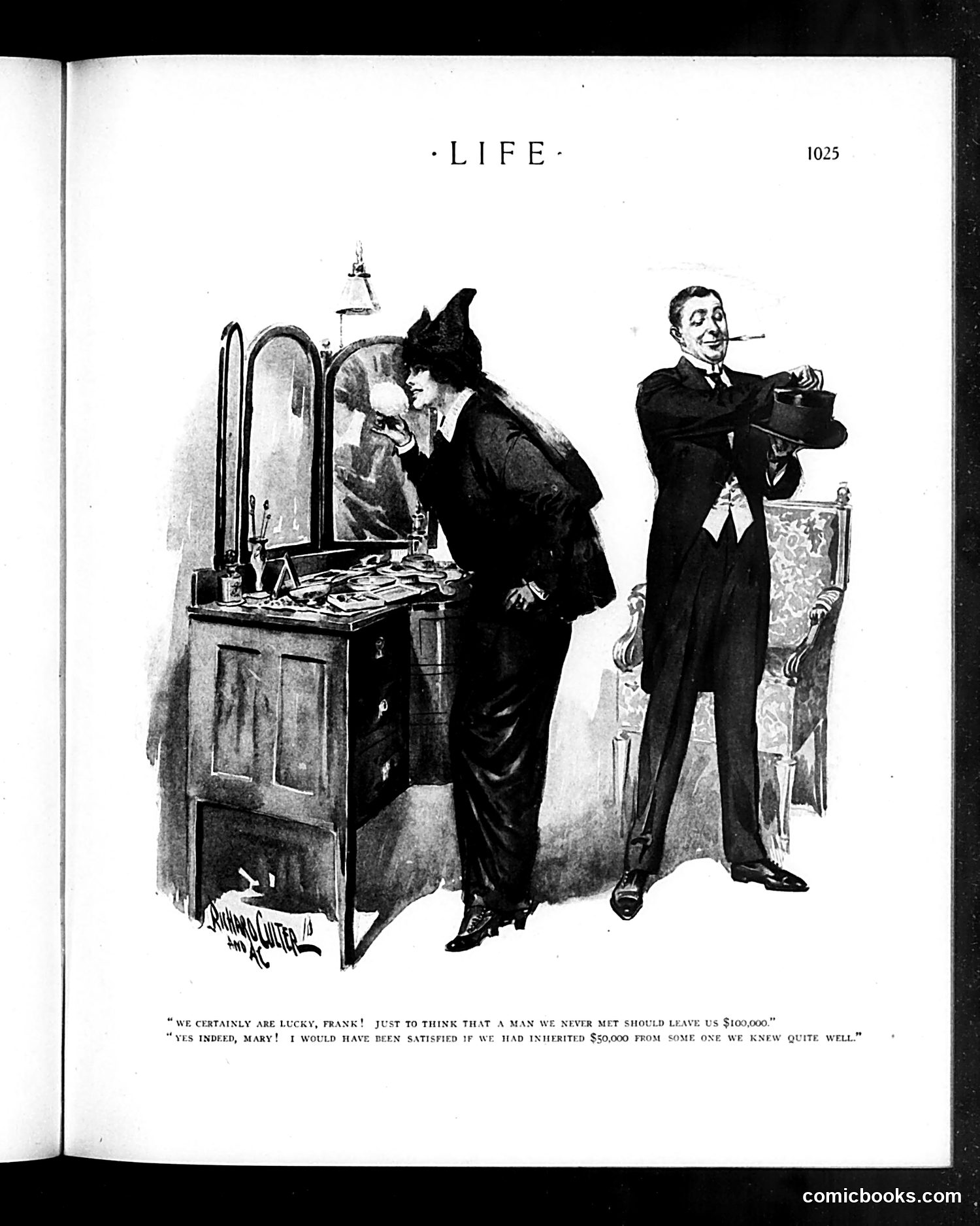
This cartoon satirizes the absurdity of inheritance expectations and human greed. A couple (Frank and Mary) celebrates receiving a $100,000 bequest from a complete stranger. Their dialogue reveals the joke's irony: Frank expresses gratitude for inheriting from someone unknown, while Mary responds that she would have been content with *half* that amount from someone they actually knew. The satire targets the illogical prioritization of wealth over personal relationships—the couple values the larger sum from a stranger over a smaller inheritance from an acquaintance. The cartoon mocks both unrealistic inheritance fantasies and the corrupting influence of money on human values during the early 20th century. The formal Victorian-era setting emphasizes the respectable veneer masking this mercenary sentiment.
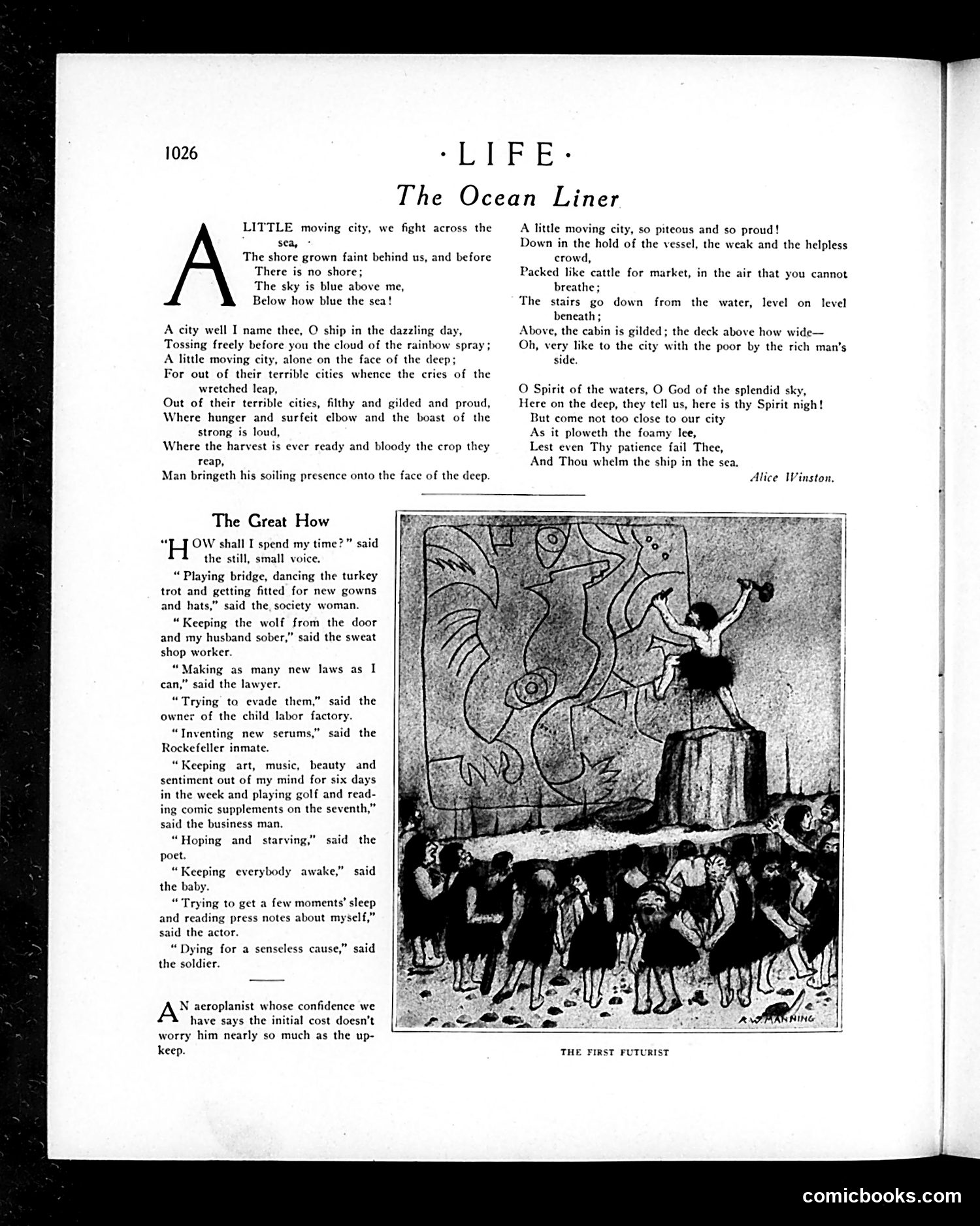
This page contains two satirical pieces critiquing early 20th-century American society. **"The Ocean Liner"** (poem by Alice Winston) uses a ship as metaphor for social inequality. While wealthy passengers enjoy gilded cabins above deck, steerage passengers below are "packed like cattle for market" in unbreathable conditions. The poem condemns how ocean liners replicate the brutal class divisions of industrial cities—the rich and poor traveling side-by-side yet worlds apart. It's a direct social critique of capitalism's visible contradictions. **"The Great How"** presents various professions/social types answering "How shall I spend my time?" The responses reveal hypocrisy and emptiness: lawyers make laws while factory owners evade them; businessmen ignore art for golf; soldiers die for "senseless" causes. The joke lies in exposing how different classes and professions prioritize survival, profit, or frivolity—a biting commentary on American society's moral bankruptcy. **"The First Futurist"** (cartoon caption) likely mocks new technological enthusiasts, though context is unclear from this page alone.
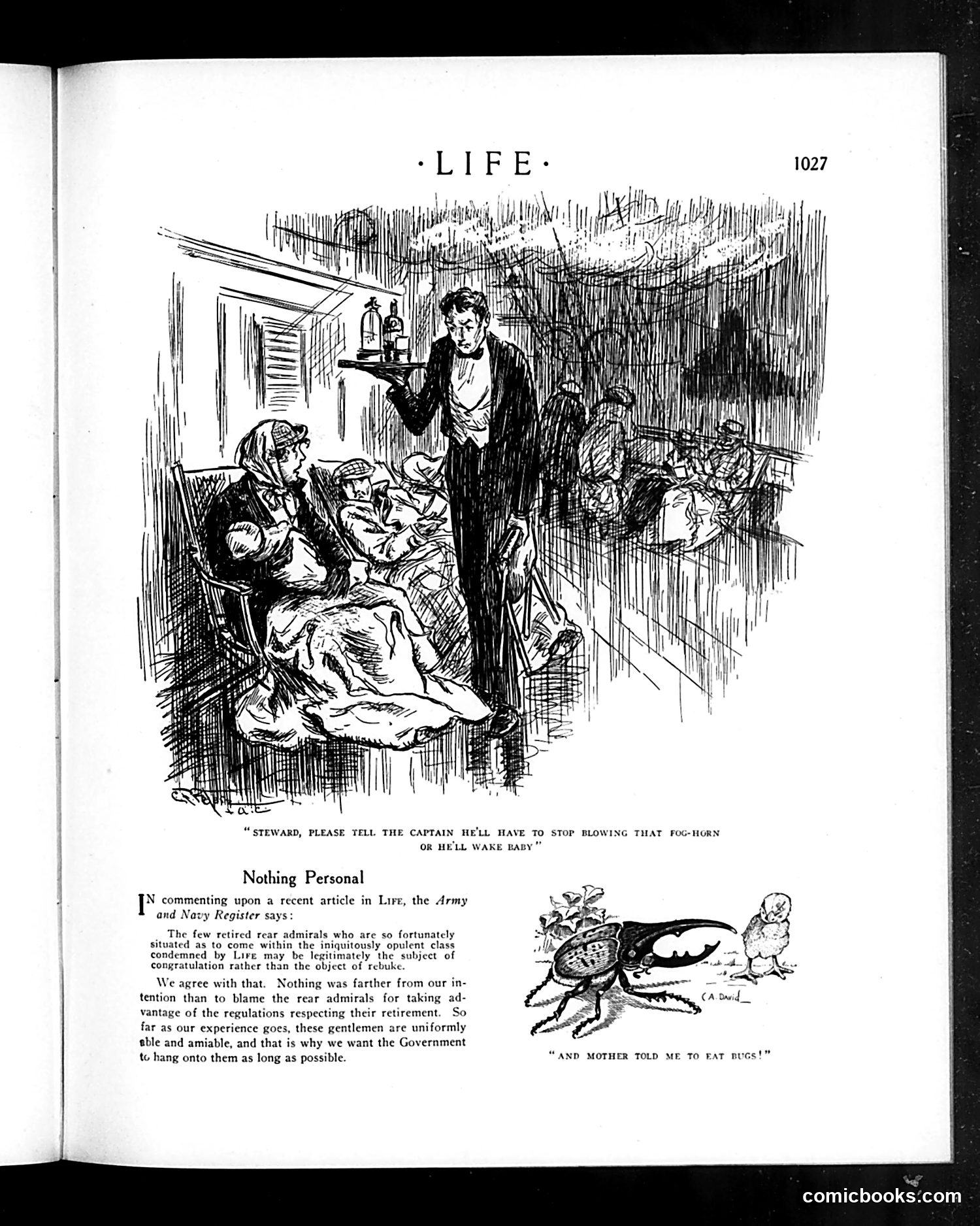
**Top Cartoon:** A ship's steward addresses the captain about a crying baby, asking him to stop the fog-horn. This is a domestic comedy joke playing on the absurdity of someone trying to enforce household rules (protecting a sleeping infant) in a completely inappropriate context (a ship at sea). The humor lies in the steward's polite but ridiculous request. **Article: "Nothing Personal"** — Life magazine had apparently criticized wealthy retired rear admirals in a previous article. The Army and Navy Register responds, and Life agrees they weren't attacking the admirals personally—just the regulations allowing wealthy officers generous retirement benefits. Life clarifies: they actually like these admirals as individuals and want the government to retain them longer. The satire is gentle: Life is defending its critique while praising the very people it criticized. **Bottom Cartoon:** A child says "Mother told me to eat bugs!"—a simple nonsense joke typical of the era's humorous illustrations.
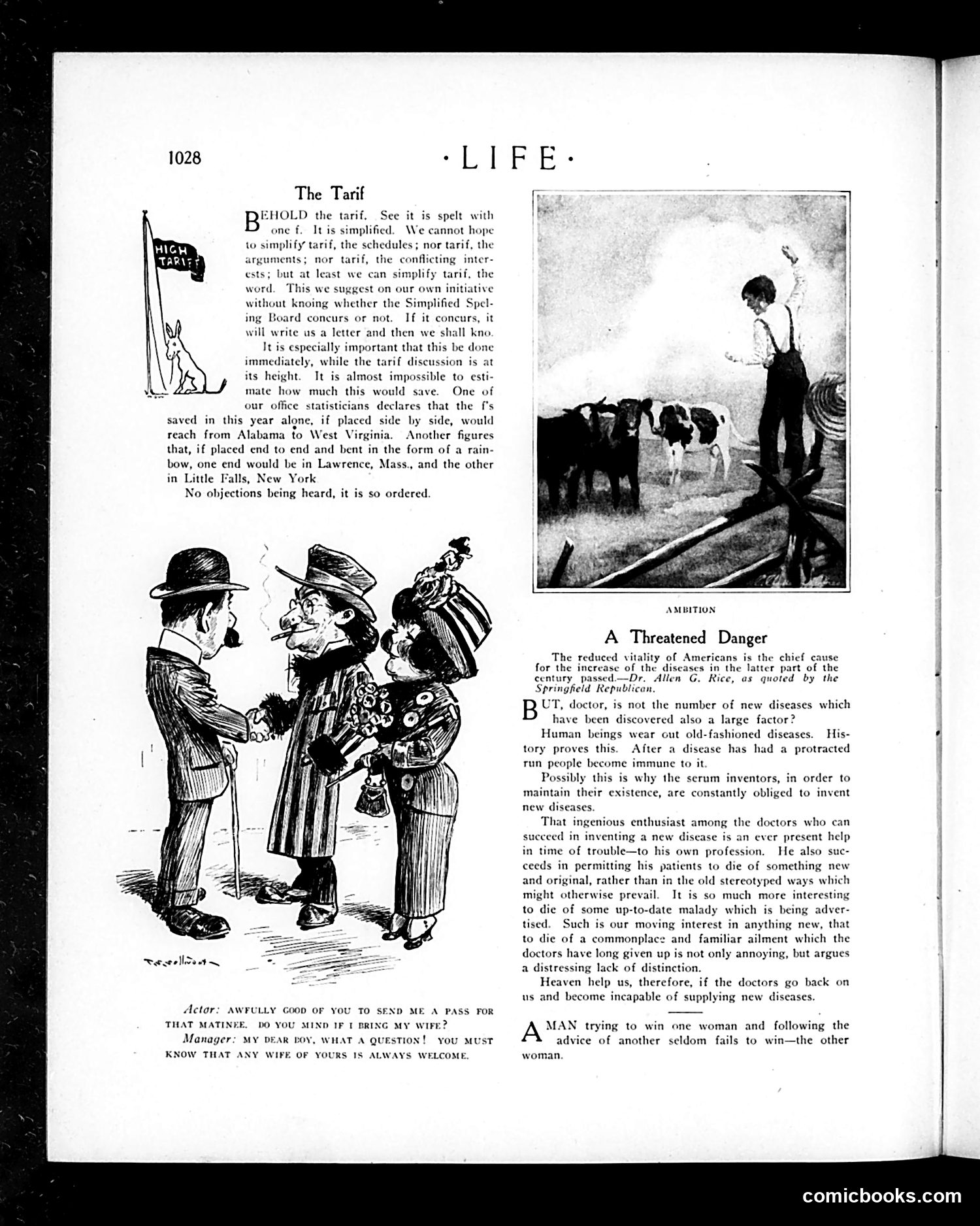
**"The Tarif" Cartoon (top left):** A visual joke mocking the Simplified Spelling movement, which advocated removing letters from English words. Life sarcastically proposes dropping the "f" from "tariff" during heated tariff debates. The humor lies in exaggerating the absurdity: they claim the saved letters, if laid end-to-end, would stretch from Alabama to West Virginia—an obvious hyperbolic nonsense. This satirizes both spelling reformers and the contentious, seemingly endless tariff discussion dominating politics. **"A Threatened Danger" (right side):** This article darkly jokes that doctors profit by inventing new diseases to replace old ones people have become immune to. It cynically suggests physicians maintain relevance by creating novel ailments rather than curing familiar ones. The piece mocks Americans' fascination with fashionable new diseases while lampooning the medical profession's apparent self-interest over patient welfare. **Bottom Dialogue (vaudeville sketch):** A simple romantic joke: an actor invites his wife to a show; the manager welcomes her warmly, saying "any wife of yours is always welcome"—a flirtatious double entendre.
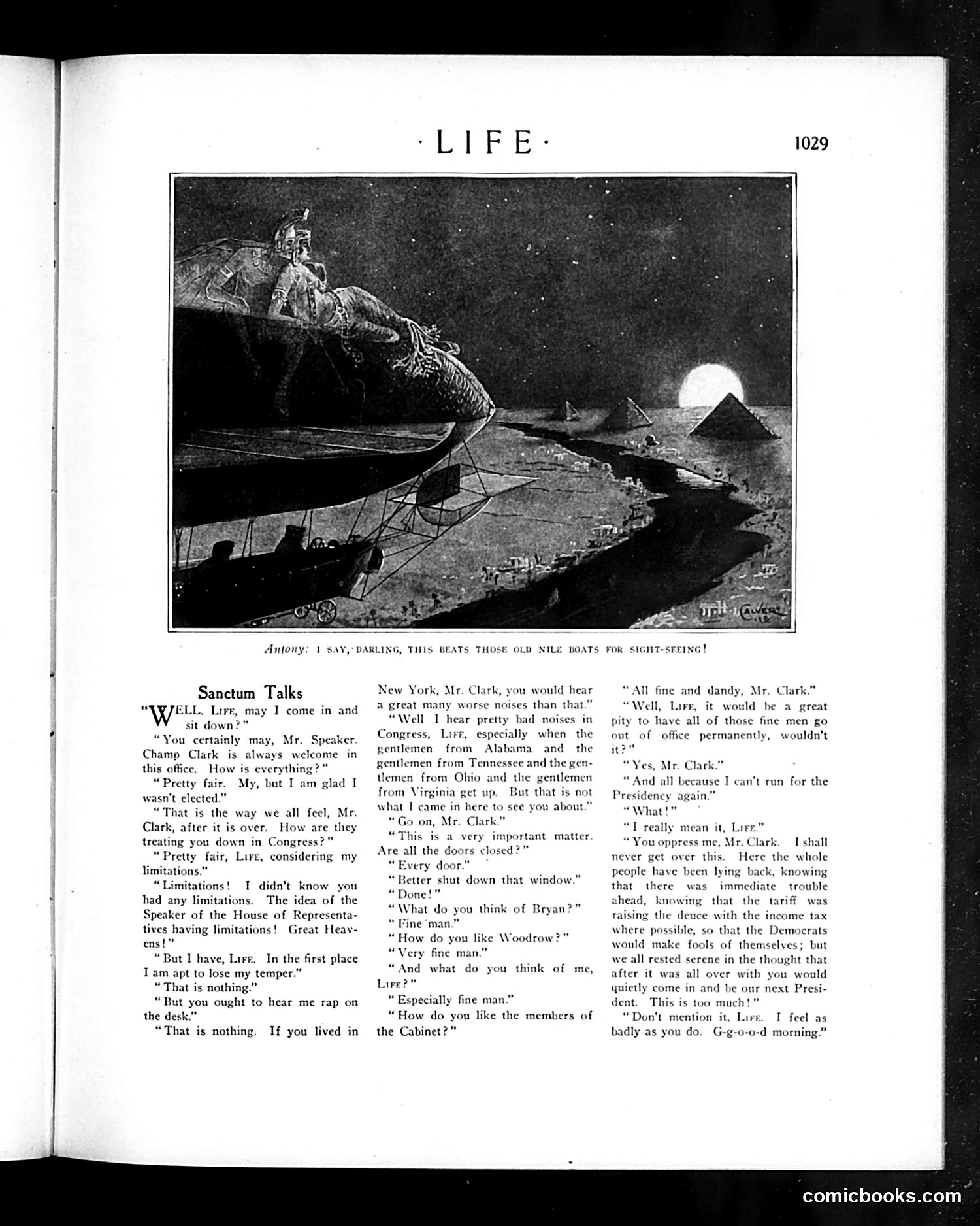
This is a "Sanctum Talks" satirical dialogue between Life magazine's editor and **Speaker of the House Champ Clark**. The joke centers on Clark's apparent delusion about his political importance. Clark confesses he cannot run for President again, lamenting that this means fine officials will leave office—implying *he alone* was the reason Democrats stayed in power and the public remained calm about Democratic governance. The editor mock-sympathetically responds that Americans have been "lying back" confident Clark would be their "next President," reassuring them through his mere presence. The satire mocks Clark's inflated ego: he believes the nation's stability depends entirely on him, when in reality he's a peripheral figure whose absence is irrelevant. The cartoon above (showing an Egyptian on a camel viewing pyramids) provides visual irony—ancient monuments dwarf the figure, suggesting Clark, like that traveler, overestimates his significance against larger historical forces. The piece lampoons vanity and self-importance in politics.
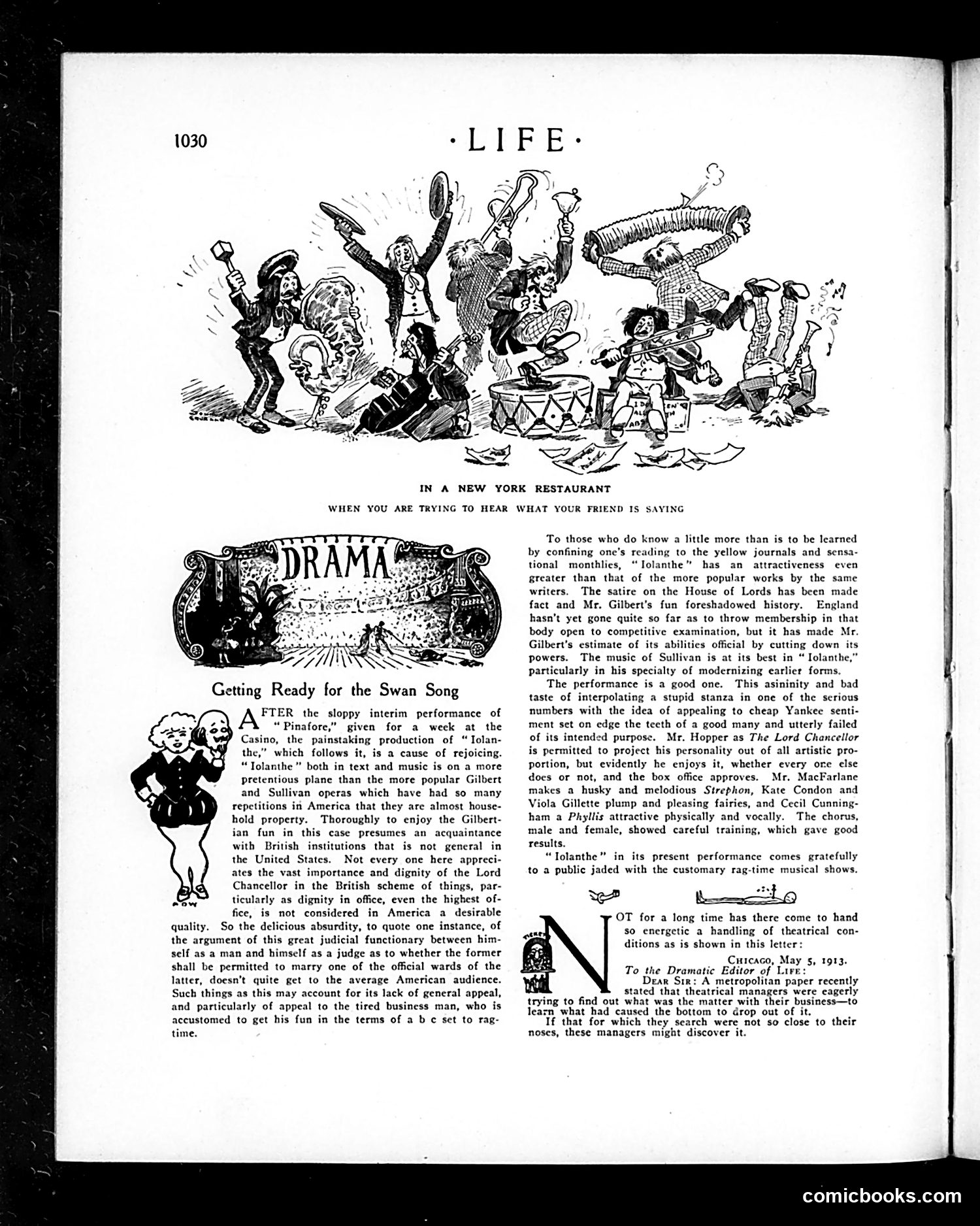
**Top Cartoon:** This satirical illustration shows a chaotic New York restaurant scene where diners are trying to converse amid noise and disruption. The joke—stated in the caption—is that the cacophony makes conversation impossible. It's social commentary on urban dining culture and noise pollution in early 1900s New York. **Drama Section:** This reviews a theatrical production of Gilbert and Sullivan's "Iolanthe." The critic praises the opera's satire of the British House of Lords, noting that Gilbert's fictional mockery has become reality—England has actually reduced the Lords' powers. The review complains that American audiences lack familiarity with British institutions needed to appreciate the humor, and criticizes the insertion of lowbrow "ragtime" elements to appeal to "tired business men." The final letter-to-editor critiques theater managers for not recognizing obvious problems with their business. **Context:** This reflects 1913 American attitudes: admiration for British sophistication, anxiety about vulgarization of culture, and dismissal of mass-market entertainment tastes.
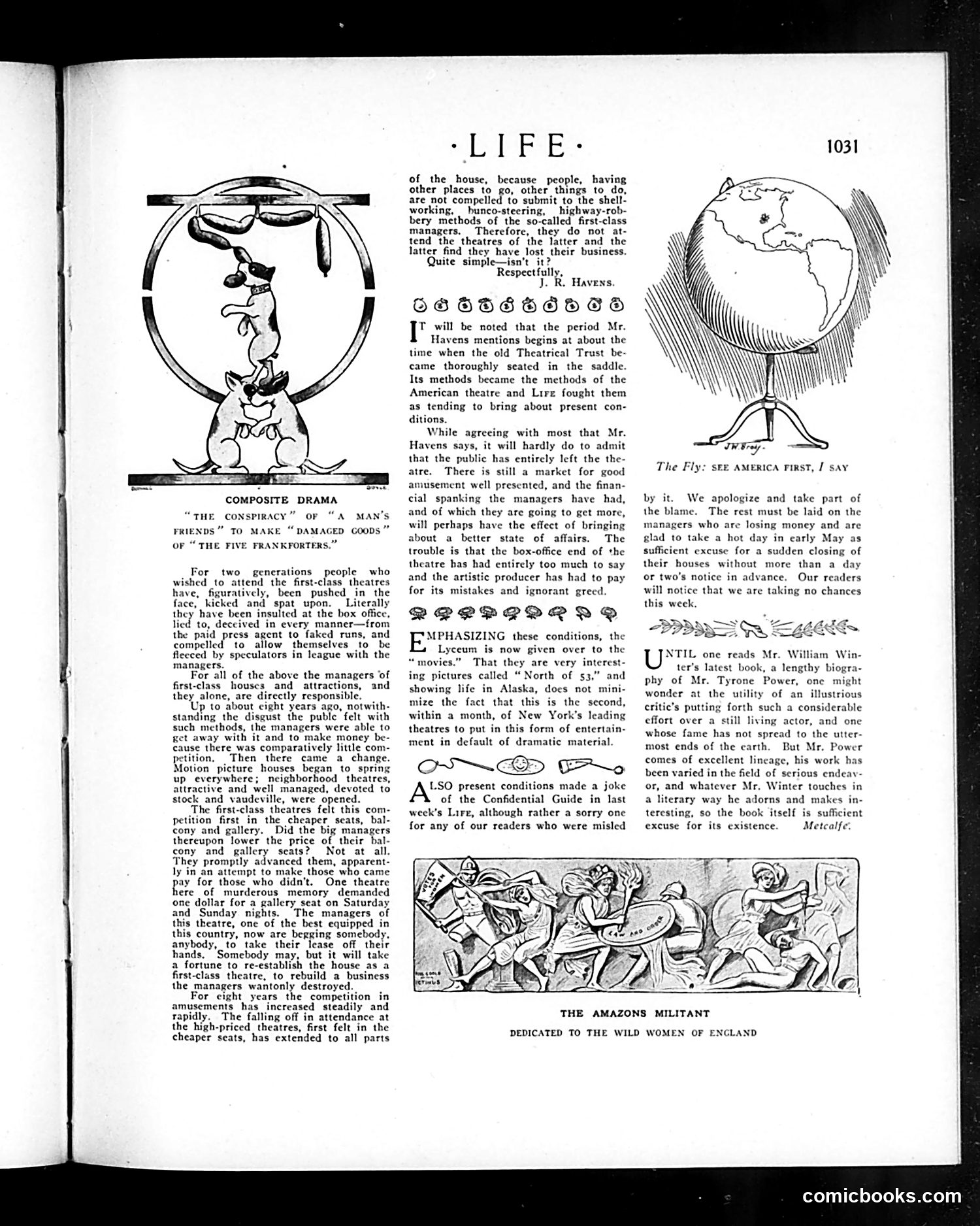
This page critiques the arrogance and poor business practices of early 20th-century theatrical managers. Letter-writer J.R. Havens argues that first-class theater owners mistreated audiences—overcharging, deceiving them through fake publicity, and colluding with ticket scalpers—while facing no competition. When motion pictures and neighborhood theaters emerged, audiences abandoned them rather than tolerate abuse. Life's editors agree, linking this decline to the "Theatrical Trust," a monopoly that prioritized profits over artistic quality. They note that even prestigious theaters like the Lyceum now show films ("North of 53") instead of dramatic productions, indicating theatrical management has run out of quality material. The cartoon's acrobatic figures likely satirize the theatrical world's contortions to survive. The satire targets managerial greed and the industry's self-inflicted decline through customer exploitation—a cautionary tale about underestimating competition and public tolerance.

This page from *Life* magazine features a silhouetted landscape scene with tall rock formations or cliffs in the background and several palm or pine trees in the foreground. The partial caption reads "The Beattn P[...]" (text cut off). The image appears to be a dramatic landscape illustration rather than a political cartoon. Without the complete caption or visible text identifying specific figures or references, I cannot determine what social or political satire it may contain. The artistic style suggests it could be commentary on nature, exploration, or geography, but the specific meaning and context remain unclear from what's visible here. The OCR text is too fragmentary to provide additional interpretation.
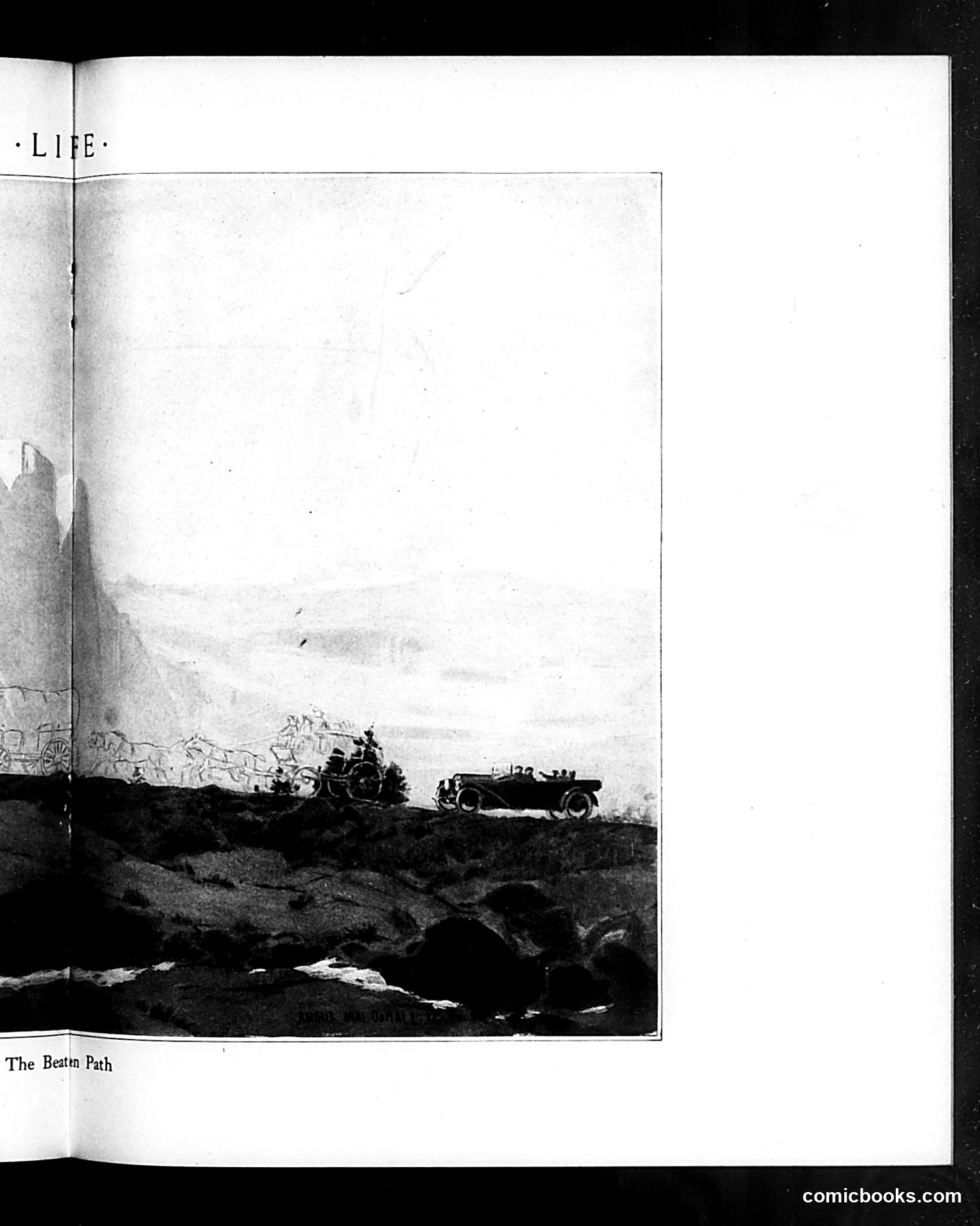
This page from *Life* magazine shows a photograph rather than a cartoon—a landscape image depicting an early automobile on a rural, worn dirt road. The road appears heavily traveled, with visible ruts and erosion suggesting frequent use. The caption "The Beaten Path" plays on the common expression meaning a well-worn, conventional route. The image likely satirizes early 20th-century automobile culture and the rapid development of American roads. It may comment on how cars were literally creating these paths across the landscape, or how motorists were following predictable, conventional routes rather than exploring new territory. Without additional context or visible date, the specific social or political commentary remains unclear, though it appears to critique aspects of automotive expansion or conformity in American travel culture.
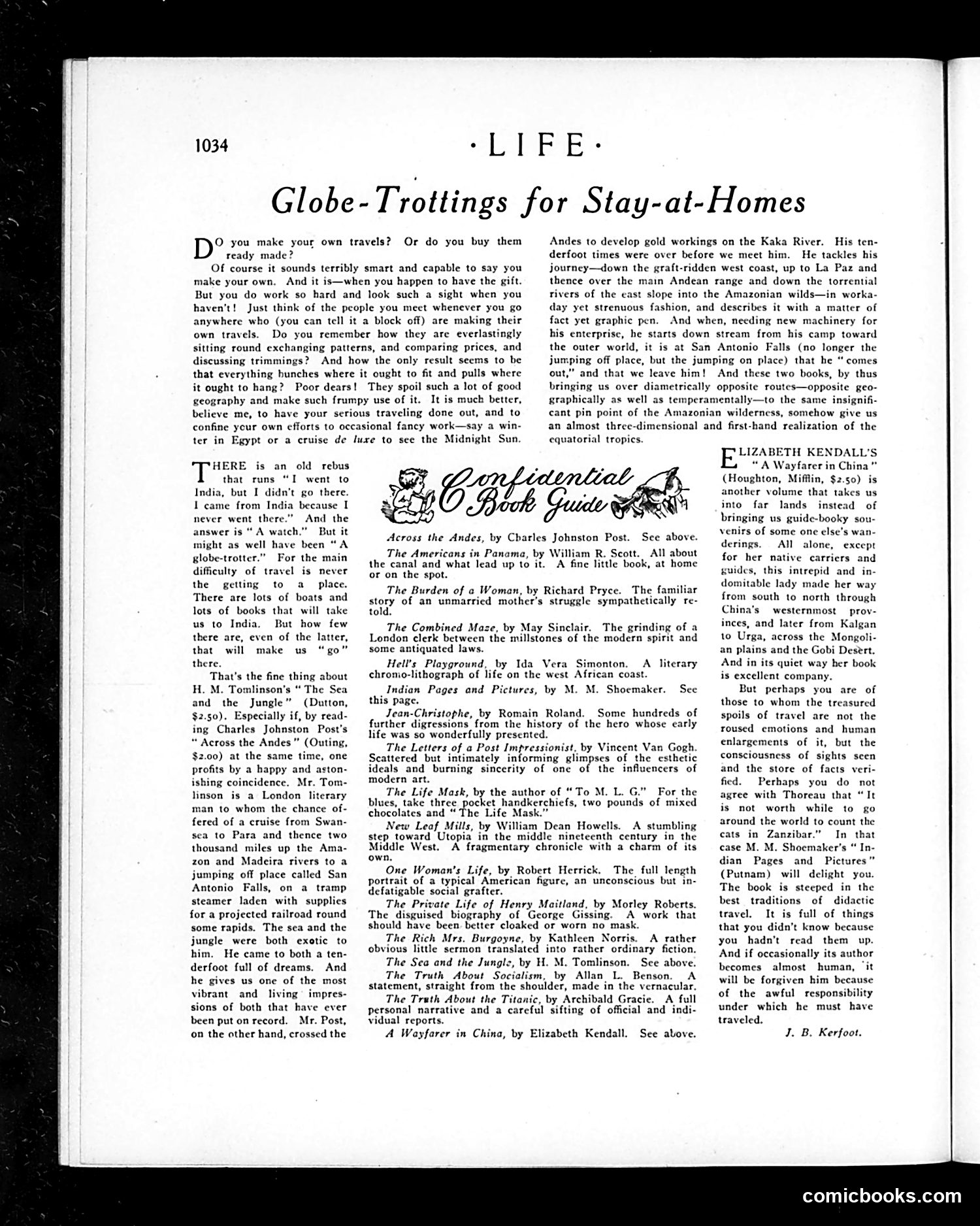
This page from *Life* magazine presents book reviews disguised as travel commentary. The central conceit is a clever metaphor: just as one can buy ready-made clothes rather than sewing them yourself, one can "buy" travel experiences through books rather than undertaking actual journeys. The satire targets armchair travelers—people who read travel narratives to vicariously experience distant places. The humor lies in the comparison: just as homemade garments often fit poorly and look "frumpy," amateur travelers who make their own expeditions produce awkward, self-conscious results. The implicit message is that reading well-written travel books by professional authors (like those reviewed here) offers superior armchair tourism compared to travelers' own bumbling attempts. The featured works describe exotic locales—the Andes, Panama, China, the Amazon—allowing readers to "travel" without leaving home, which aligns with the article's title "Globe-Trottings for Stay-at-Homes." This reflects early 20th-century middlebrow culture's embrace of literary escapism.
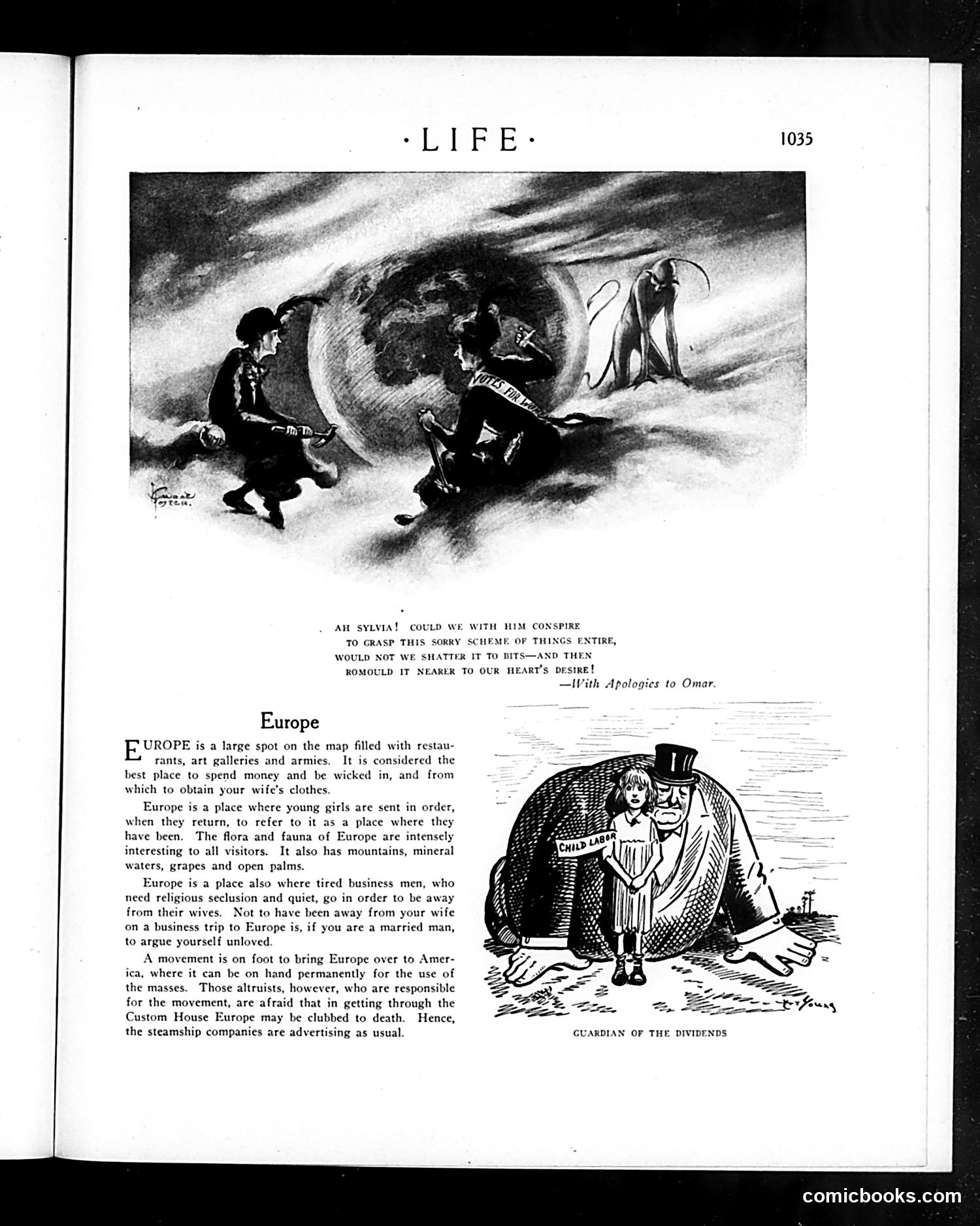
This page satirizes American attitudes toward Europe and wealth during the early 20th century. The top cartoon depicts a devil-like figure (representing Europe or Old World corruption) being dragged through customs by two businessmen, suggesting Europe embodies moral decadence that wealthy Americans pursue. The essay below mocks American tourism and materialism: Europe is portrayed as merely a place to spend money, acquire fashionable clothes, and for married men to escape their wives under the guise of "business trips." The satire targets both American materialism and European pretense. The lower cartoon, "Guardian of the Dividends," shows a wealthy man sheltering a child labeled "Child Labor" beneath his coat—criticizing how industrial capitalists profit from and protect exploitative labor practices. The reference suggests steamship companies profit from transatlantic travel while claiming moral high ground through advertising. The overall critique: American wealth-seekers romanticize Europe while ignoring genuine social problems at home.
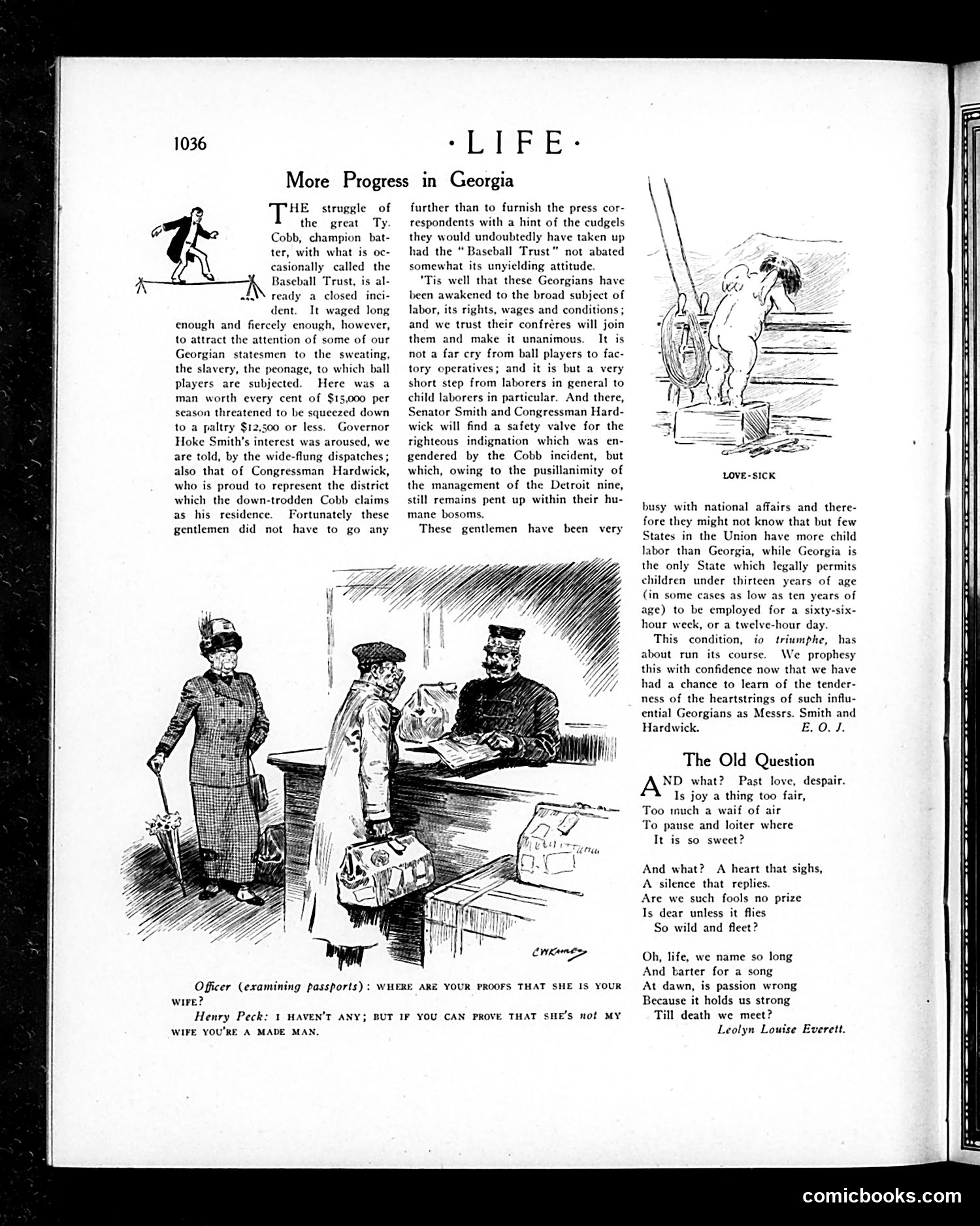
**"More Progress in Georgia"** satirizes Georgia politicians' hypocrisy. When baseball star Ty Cobb—a Georgian—faced wage cuts from the "Baseball Trust," Governor Hoke Smith and Congressman Hardwick publicly threatened intervention on his behalf. The article mocks their sudden concern for labor rights, noting these same politicians remain silent on Georgia's actual labor crisis: the state legally permits children as young as ten to work 66-hour weeks—making it uniquely permissive among U.S. states. The satire suggests their outrage over a wealthy athlete's contract dispute rings hollow given their indifference to child labor exploitation. **"Officer Examining Passports"** is an unrelated comic vignette about a man (Henry Peck) unable to prove his marriage, employing absurdist logic: he challenges the officer to disprove it instead. This is labeled "Love-Sick," suggesting romantic desperation. **"The Old Question"** is a poem about passion and mortality by Leolyn Louise Everett, thematically separate from the political content above.
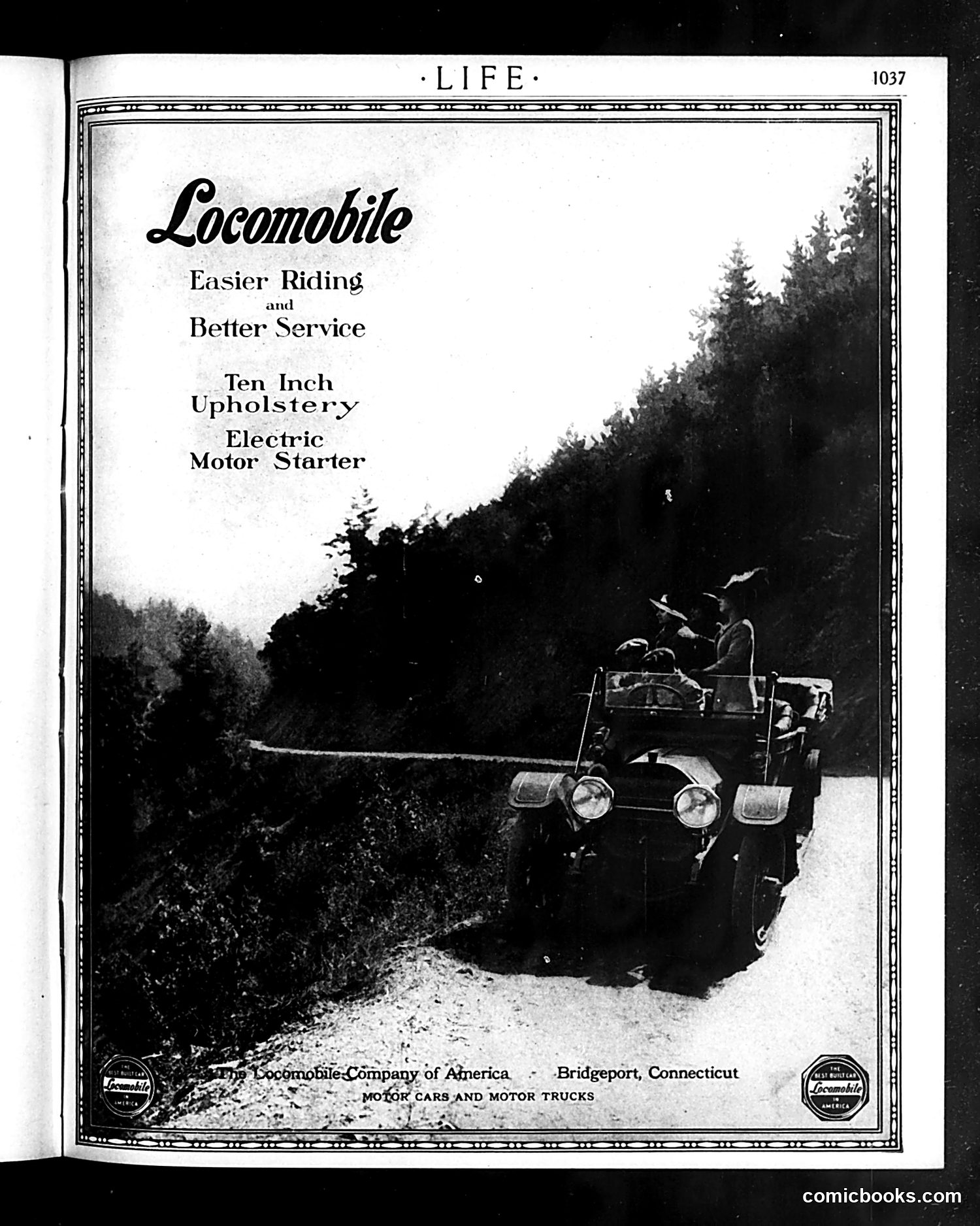
This is an advertisement, not satire or a cartoon. The page promotes the Locomobile, an early automobile manufactured by the Locomobile Company of America in Bridgeport, Connecticut. The image shows a car navigating a rural, tree-lined road, emphasizing the vehicle's capabilities for countryside travel. The advertisement highlights three selling points: easier riding comfort, better service reliability, ten-inch upholstery (luxury seating), and an electric motor starter (a technological convenience feature). This appears from a LIFE magazine, which regularly featured advertisements alongside editorial content. The Locomobile was a real, prestigious automobile brand of the early 20th century. The ad targets affluent readers seeking modern automotive technology and comfort.
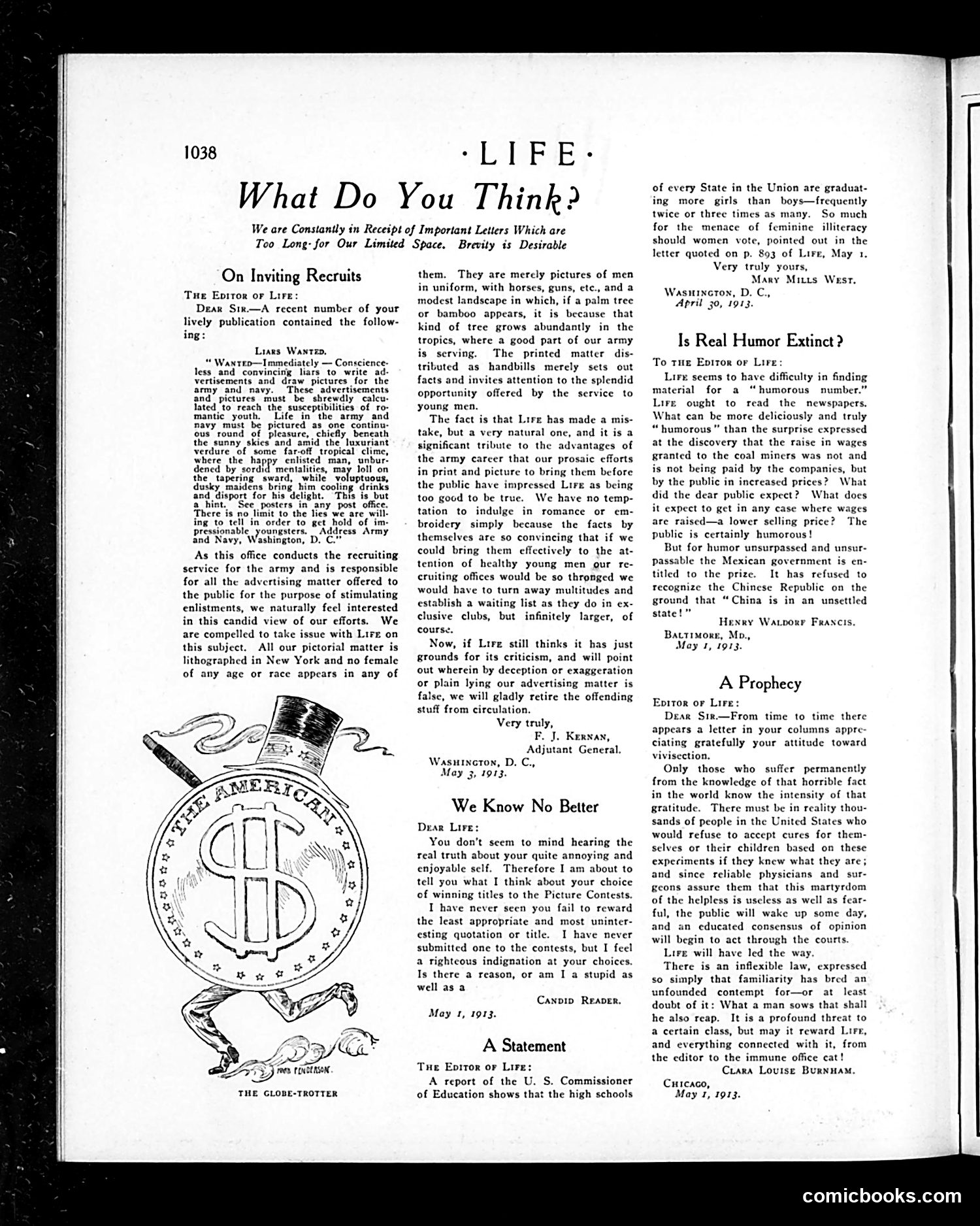
This page features the "What Do You Think?" letters column. The main content is a satirical exchange about **Army recruitment advertising**. **The Satire:** Life had previously published a fake "help wanted" ad mocking the military's deceptive recruitment tactics—claiming they needed "liars" to create romanticized advertisements showing army life as tropical pleasure under "voluptuous, dusky maidens" rather than honest depictions. **The Response:** An actual Army Adjutant General (F.J. Kernan) responds defensively, claiming all their materials show only "men in uniform, with horses, guns" and modest landscapes. He argues their factual descriptions are so appealing they hardly need embellishment—soldiers' waiting lists would rival "exclusive clubs." **The Joke:** The irony is heavy: his defensive response essentially proves Life's point. By insisting their ads are purely factual while simultaneously claiming they're irresistibly appealing, the General inadvertently admits to the very deception Life mocked. The small illustration of a dollar sign ("The Globe-Trotter") reinforces the commercial cynicism of military recruitment.
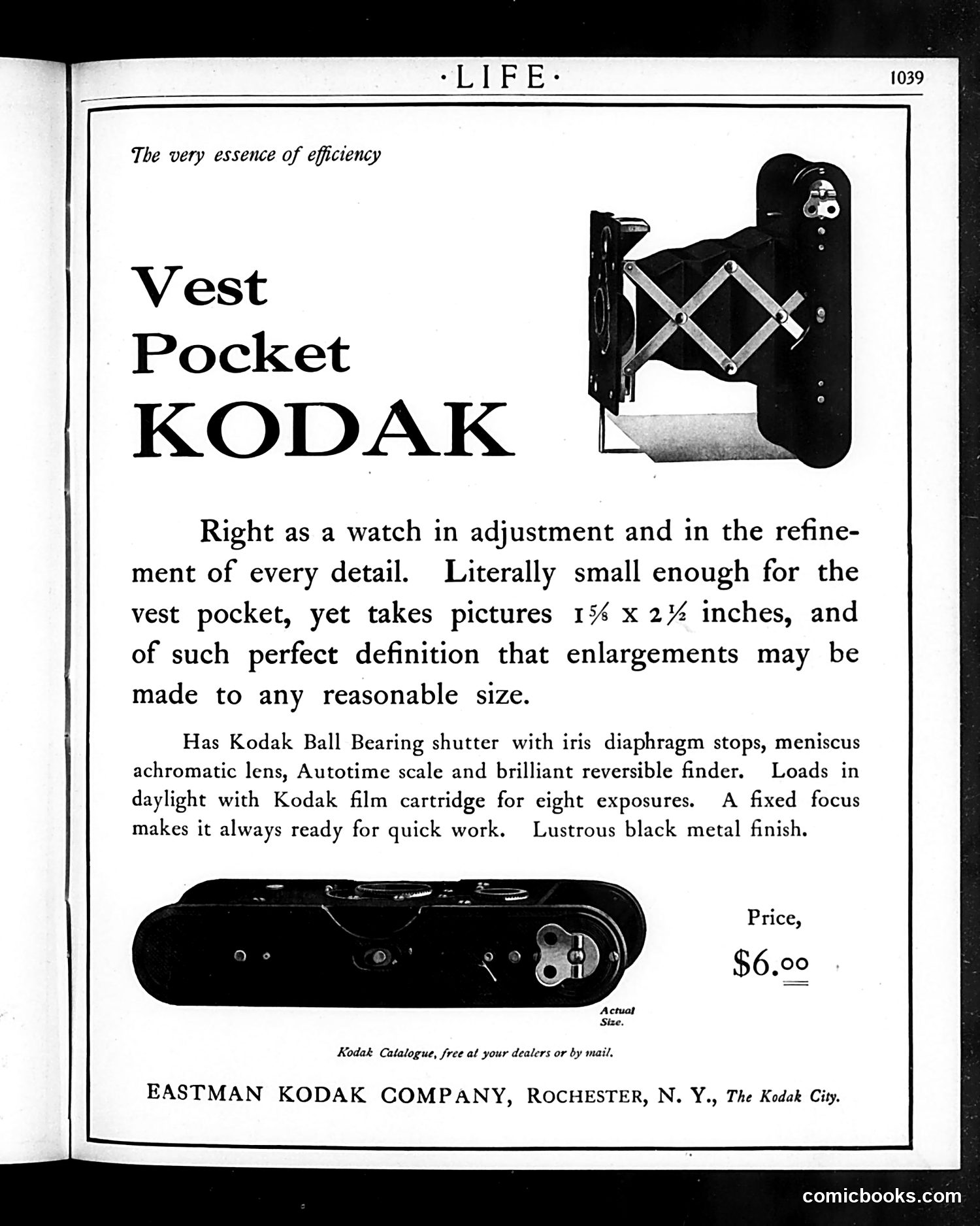
This is a **product advertisement**, not a cartoon. It promotes Kodak's "Vest Pocket" camera, a miniature portable camera marketed to early 20th-century consumers. The page emphasizes the camera's compact size (fits in a vest pocket) while claiming professional-quality output (pictures 1⅝ × 2⅛ inches that enlarge well). The accompanying photographs show the camera's actual small size and its accordion-style bellows design. The advertising copy appeals to efficiency and practicality—values emphasized by the headline "The very essence of efficiency"—reflecting the broader early-1900s American enthusiasm for portable, convenient technologies. The $6.00 price was relatively accessible for the era. There is no political satire or caricature here. This is straightforward commercial promotion from Eastman Kodak Company.
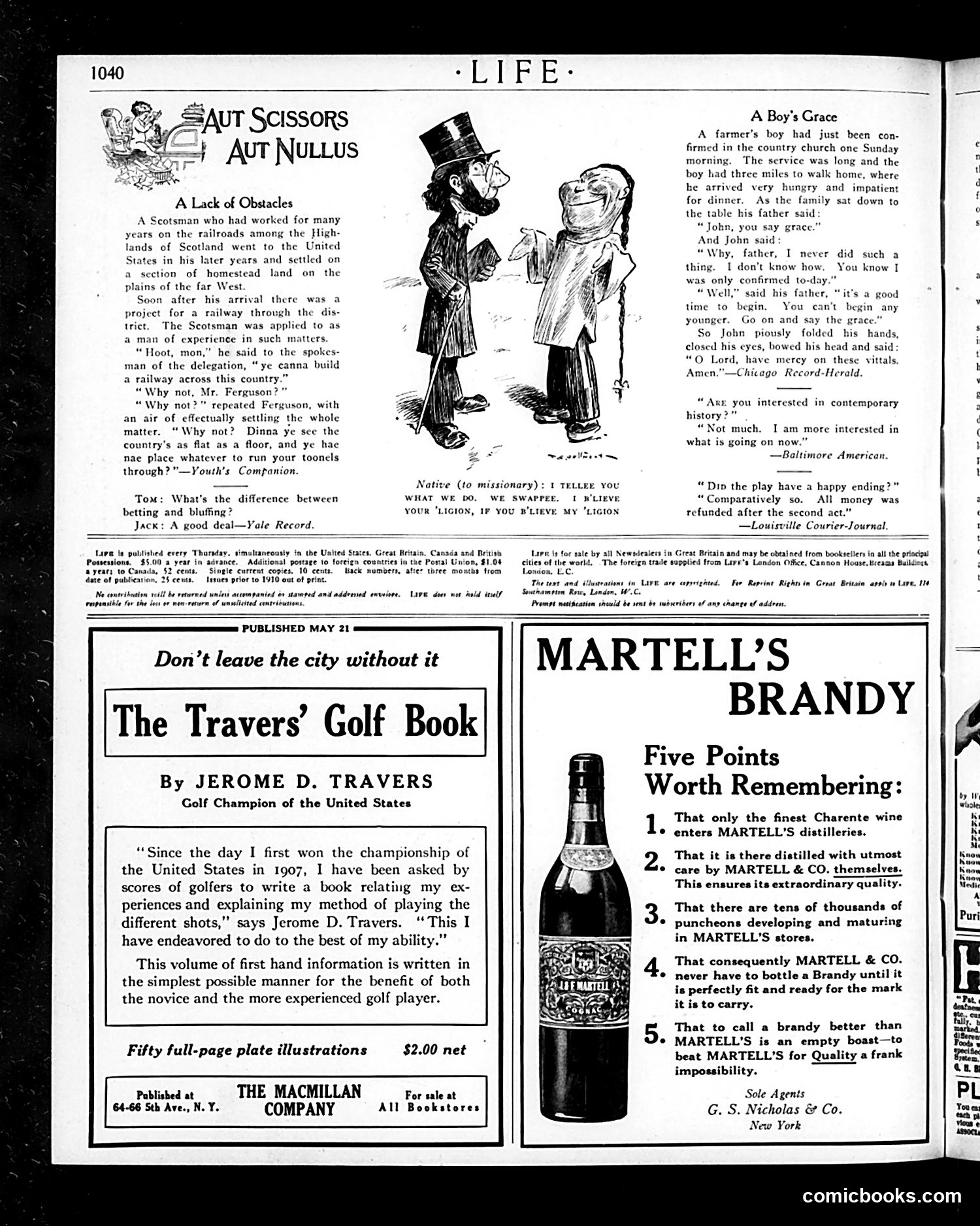
This page contains three unrelated humorous short pieces typical of Life's satirical format: **"A Lack of Obstacles"**: A Scottish railroad engineer refuses to build a railway across American plains, claiming the flat terrain offers nowhere to tunnel—a joke mocking Scottish stubbornness and misunderstanding American geography. **"A Boy's Grace"**: A newly confirmed boy, asked to say grace at dinner for the first time, offers a crude prayer ("O Lord, have mercy on these vitals, Amen"), humorously capturing youthful awkwardness with religious formality. **Native and Missionary exchange**: A brief joke about cultural misunderstanding, where a missionary attempts conversion but the Native expresses skepticism about adopting foreign religion. The page also includes period advertisements for Jerome D. Travers' golf instructional book and Martell's Brandy. These short satirical pieces represent Life's primary editorial content—gentle, class-conscious humor targeting Scottish accents, rural manners, and colonial attitudes prevalent in 1910 America.
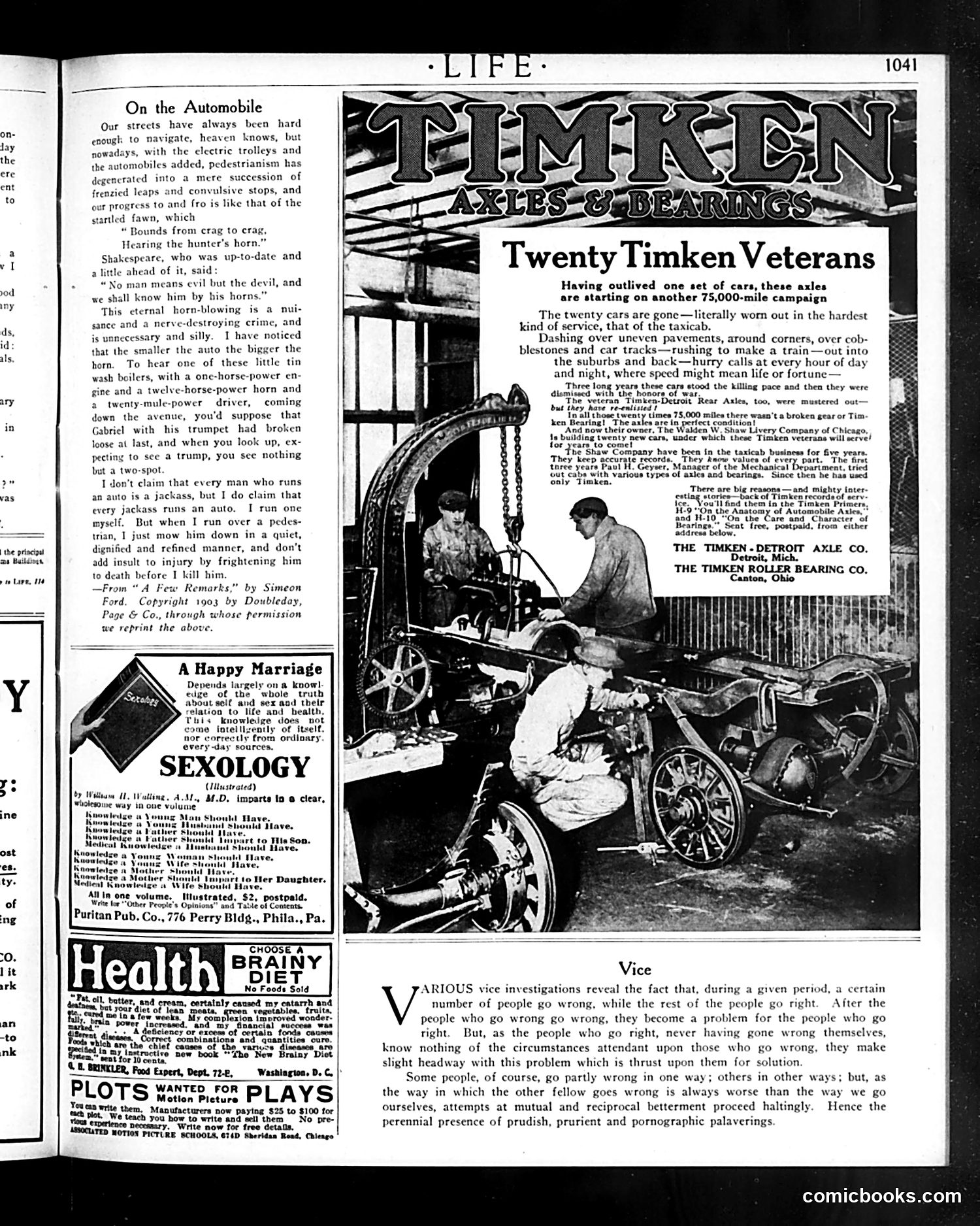
This page contains two distinct elements: **"On the Automobile" essay** (left column): A satirical complaint about early 1900s urban traffic hazards. The author, Simeon Ford, critiques automobile drivers—particularly their excessive horn-blowing—as a menace to pedestrians. His joke: "every jackass runs an auto," and smaller cars have disproportionately loud horns. He references Shakespeare to mock drivers' aggressive behavior. The humor relies on the novelty and chaos of automobiles competing with trolleys and pedestrians for street space—a pressing urban problem of that era. **"Twenty Timken Veterans" advertisement** (right): A product testimonial using military language. It advertises Timken axle bearings by describing twenty taxicabs that have each traveled 75,000 miles before being retired. The "veteran" metaphor suggests durability and reliability. The accompanying photograph shows mechanics inspecting or servicing vehicle axles, emphasizing the product's industrial toughness through real-world use cases. Both pieces reflect early 1900s concerns: automobiles as disruptive urban technology, and industrial manufacturing as a source of pride and commercial messaging.
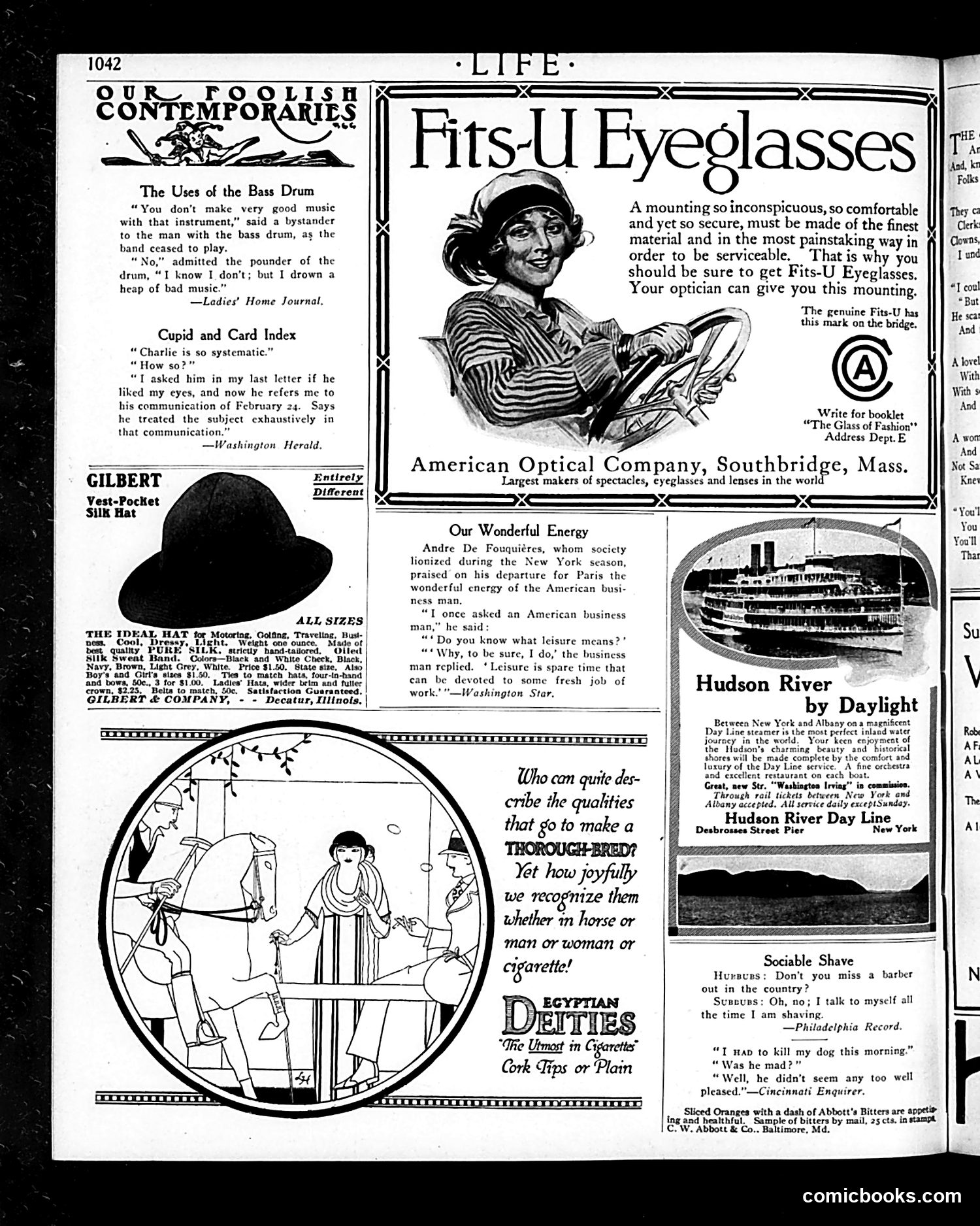
This is primarily an **advertising and humor page** rather than political satire. The content includes: **Humor Shorts**: Brief jokes satirizing modern life—a bass drummer drowning out bad music, a systematic suitor filing romantic correspondence like office records, and a French visitor marveling at Americans' workaholism (the punchline: Americans define "leisure" as spare time for more work). These gently mock contemporary American business culture and dating customs. **The Cartoon**: The circular illustration depicts Egyptian figures, accompanying an advertisement for Egyptian Deities cigarettes. It's a period piece reflecting 1920s Egyptomania—a cultural craze following King Tutankhamun's tomb discovery (1922). **Advertisements**: Prominent ads for Fits-U eyeglasses, Gilbert vests-pocket hats, Hudson River Day Line steamers, and various consumer products. The page reflects 1920s consumer culture and light social humor rather than serious political commentary.
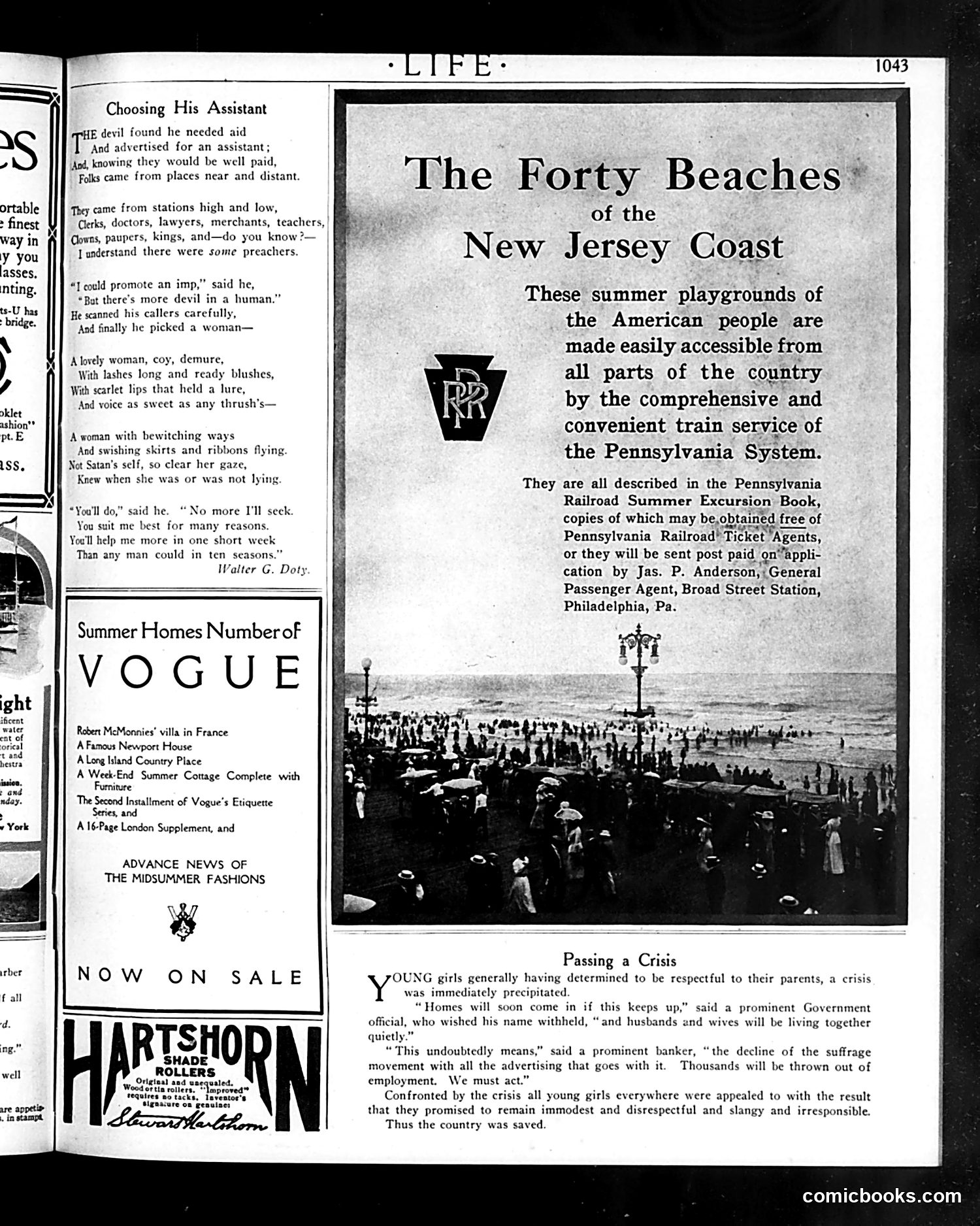
This page contains two satirical pieces: **"Choosing His Assistant"** (poem by Walter G. Doty): A misogynistic cartoon poem where the Devil seeks an assistant. The joke presents a woman—described through stereotypically seductive traits (long lashes, scarlet lips, "bewitching ways")—as more devilish than men because she's a skilled liar whose duplicity is undetectable. The satire targets women's perceived untrustworthiness and manipulative femininity, a common trope of the era. **"Passing a Crisis"**: This piece satirizes early 20th-century anxieties about changing female behavior. It mocks concerns that if young women became respectful daughters, families would stabilize and the suffrage movement would lose momentum (and jobs). The dark humor suggests elite fears about women's independence, implying that societal "salvation" requires women to remain "immodest and disrespectful"—essentially, uncontrolled and rebellious. Together, these pieces reflect anxieties about shifting gender roles and women's growing social power during this period.
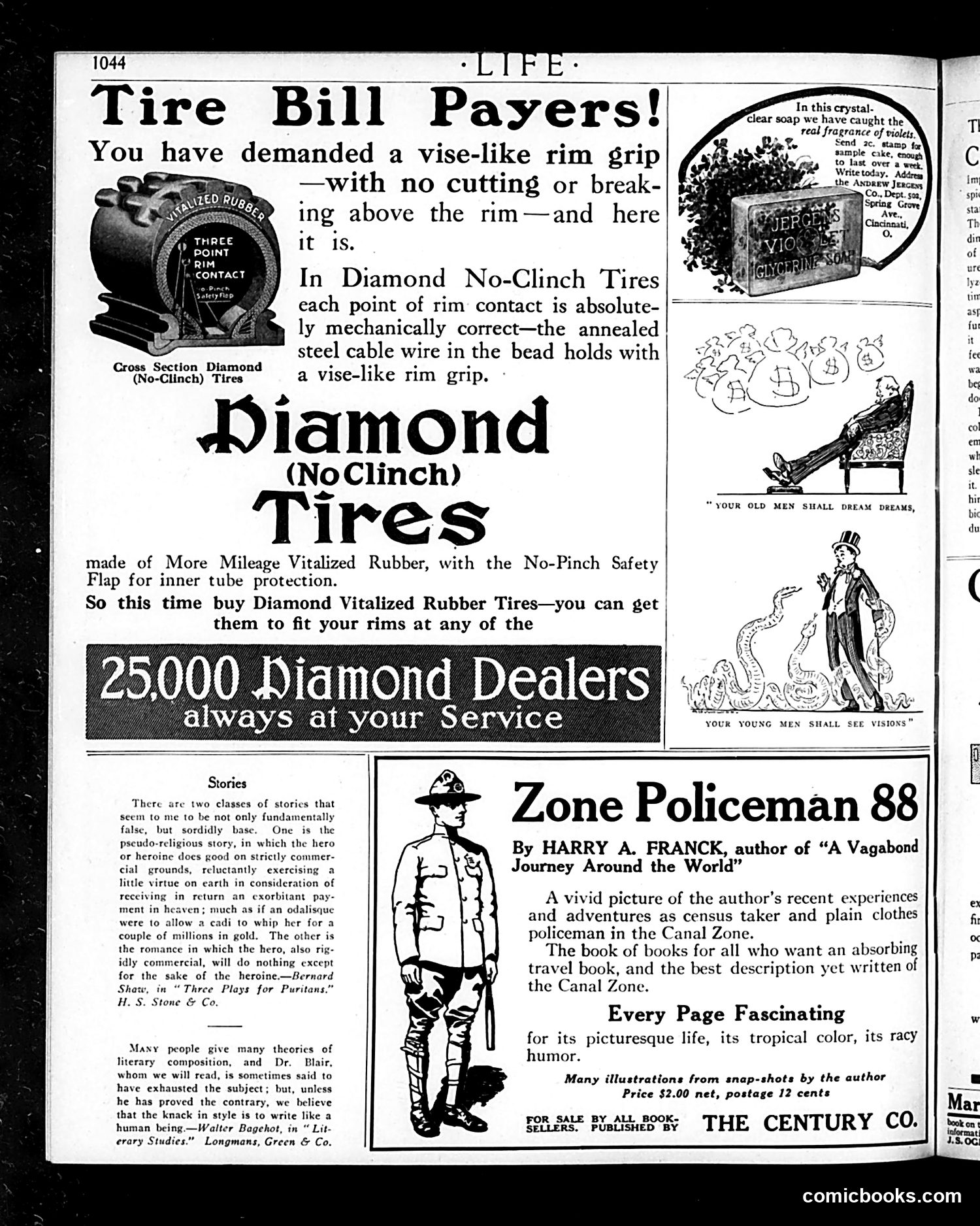
This page is primarily **advertising and book promotion**, not political satire. The top half advertises **Diamond No-Clinch Tires**, addressing consumers frustrated with tire rim problems—a common automotive complaint of the era. The ad emphasizes the tire's mechanical grip without damaging the rim. The right side contains a **soap advertisement** and two unrelated illustrations labeled "Your Old Men Shall Dream Dreams" and "Your Young Men Shall See Visions"—biblical references, likely promoting aspirational lifestyle messaging typical of early 20th-century advertising. The bottom half promotes **"Zone Policeman 88,"** a travel book by Harry A. Franck about his experiences as a census taker and plainclothes officer in the Panama Canal Zone. It's marketed as an adventure/travel narrative with authentic photography. The middle section contains literary quotations from Bernard Shaw and Walter Bagehot about writing style—filler content common in *Life* magazine. There is **no political cartoon or satire** on this page—it's essentially a classified advertising section.
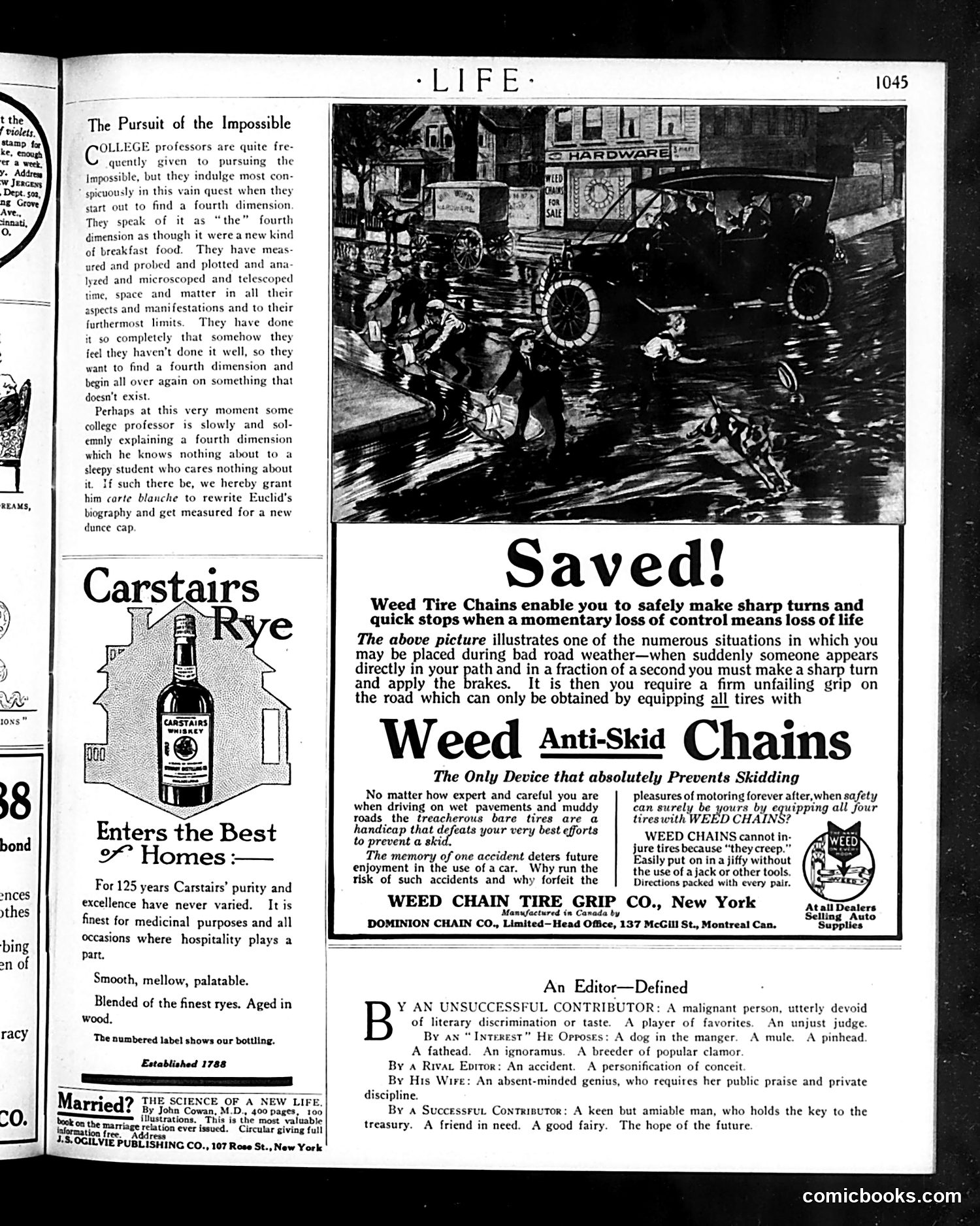
This satirical essay mocks college professors for obsessing over the "fourth dimension"—a concept from early 20th-century theoretical physics that captured public imagination. Life's writers ridicule academics for pursuing abstract, unprovable ideas with the same earnestness they'd apply to measurable phenomena. The joke: professors have exhausted practical knowledge ("measured and probed...time, space and matter") and now chase the unknowable simply because it doesn't exist—making their pursuits pointless. The satire suggests intellectual pretension and academic fashion: professors explain concepts they "know nothing about" to indifferent students, warranting dunce caps for their vanity. The page also contains period advertisements (Carstairs whiskey, Weed tire chains) and a humorous definitions section ("An Editor—Defined") offering tongue-in-cheek takes on editorial personas—standard Life magazine fare blending advertising, satire, and social commentary.
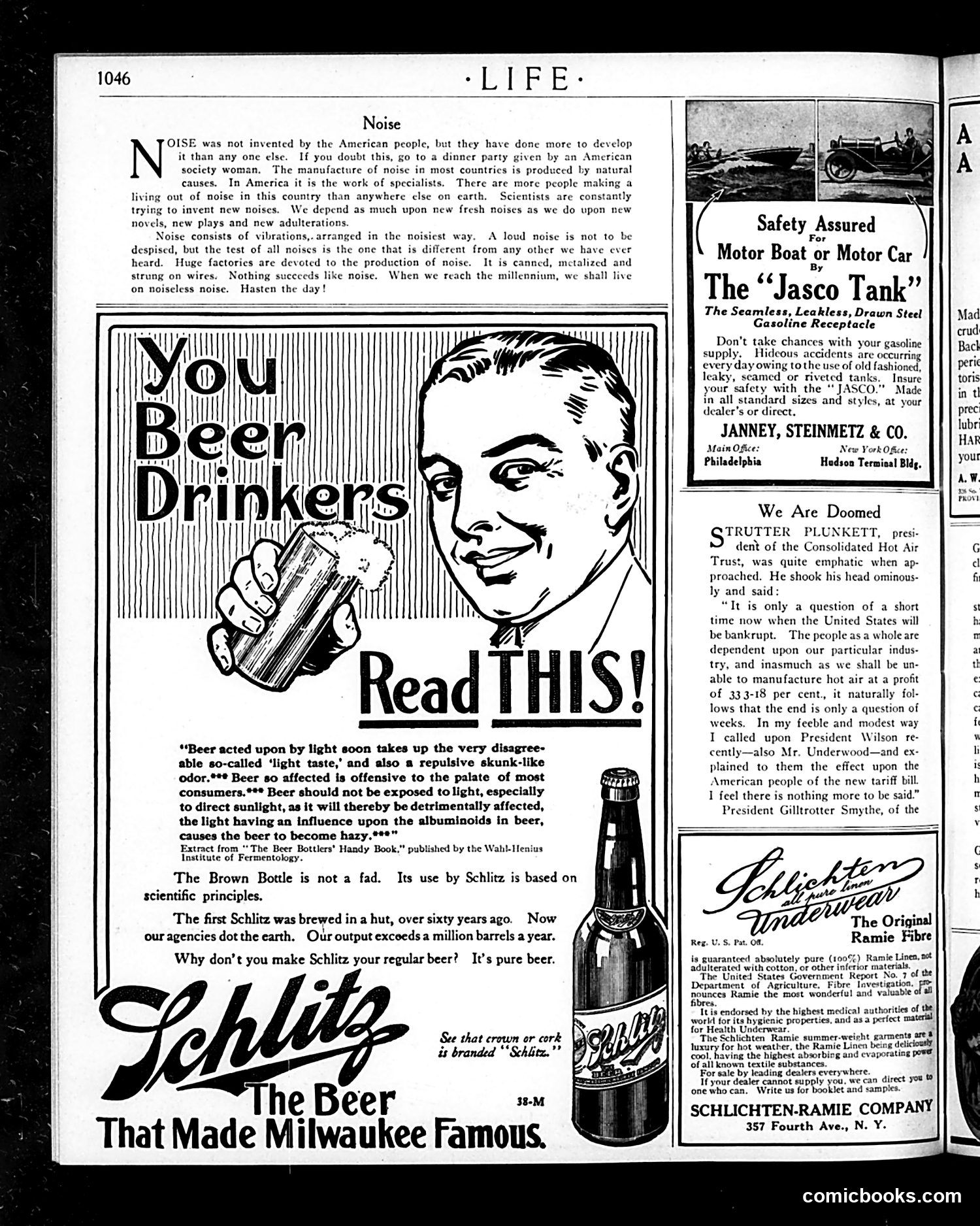
This page from *Life* magazine consists primarily of **advertisements and satirical commentary**, not political cartoons in the traditional sense. The main content is a humorous essay on "Noise" mocking American society's obsession with creating noise and novelty—suggesting Americans manufacture noise as a commodity and constantly seek new disturbances. It's gentle social satire about consumerism and restlessness. The largest advertisement features a **Schlitz beer ad** with a smiling man holding a beer mug, emphasizing the brown bottle's scientific basis and purity—ironic given that *Life* was a satirical magazine during Prohibition (the dates and language suggest early 1900s-1920s era when beer advertising faced scrutiny). A smaller satirical piece mocks a "Consolidated Hot Air Trust" president predicting American bankruptcy due to inability to profit from manufacturing "hot air"—a thinly veiled jab at corporate speculation and tariff politics under President Wilson. The page is primarily **advertising-driven** rather than editorial cartoon commentary.
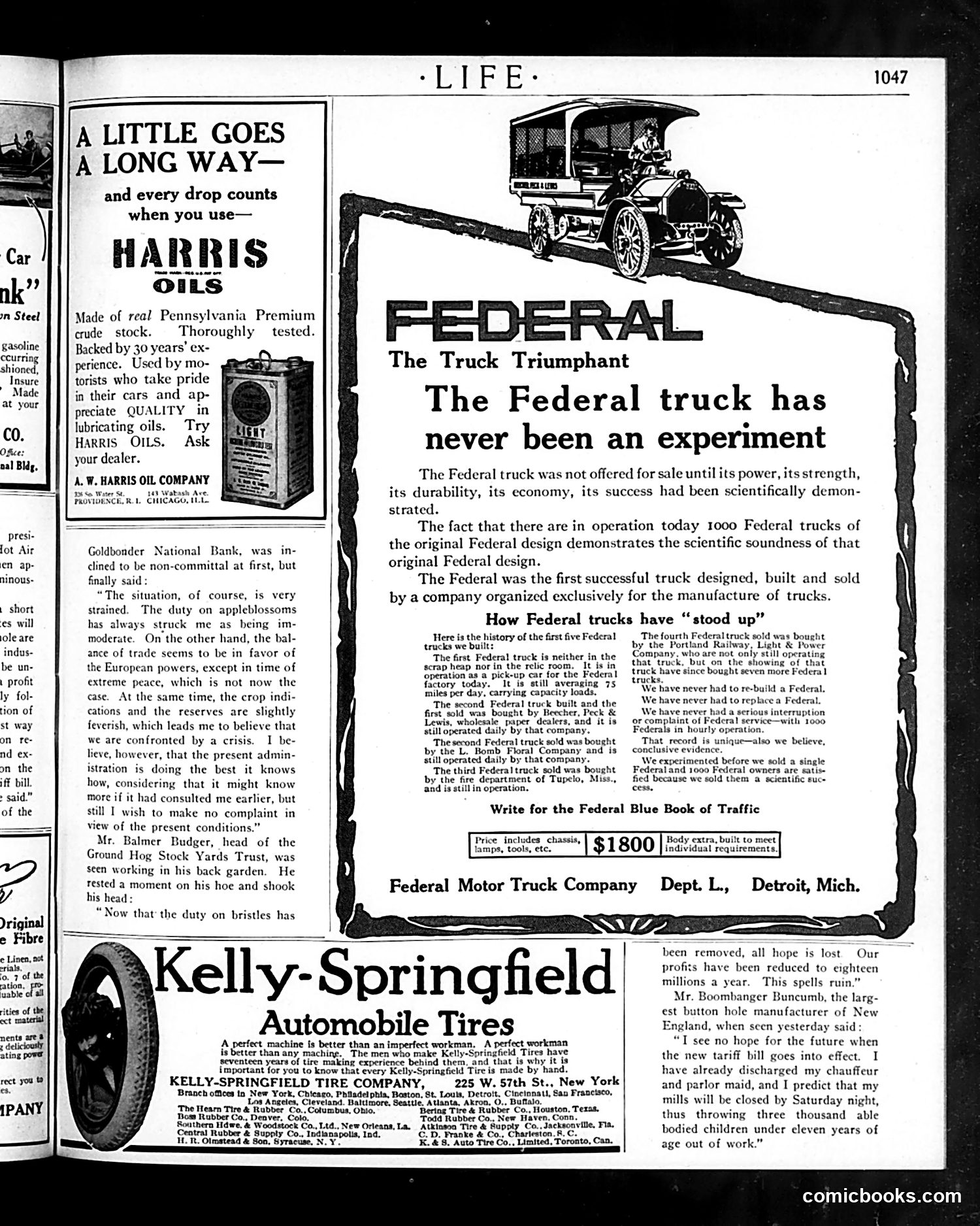
This page is primarily **advertising**, not political satire. It contains three major advertisements: 1. **Harris Oils** (top left): A standard product ad emphasizing Pennsylvania crude oil quality and 30 years' experience. 2. **Federal Motor Truck Company** (center/right): The dominant ad claims Federal trucks are scientifically proven, not experimental. It boasts 1,000 trucks in operation and cites specific examples (fire departments, paper dealers) still using original Federal trucks daily. The $1,800 price point is emphasized as including chassis and basic equipment. 3. **Kelly-Springfield Automobile Tires** (bottom): Standard tire manufacturer advertisement. The page also contains brief satirical **prose vignettes** about tariff complaints (appleblossoms, bristles, button holes), mocking businessmen's protectionist grievances during a trade dispute—likely referencing 1920s tariff debates. **No political figures or caricatures are present.** This is commercial content masquerading alongside light economic commentary.
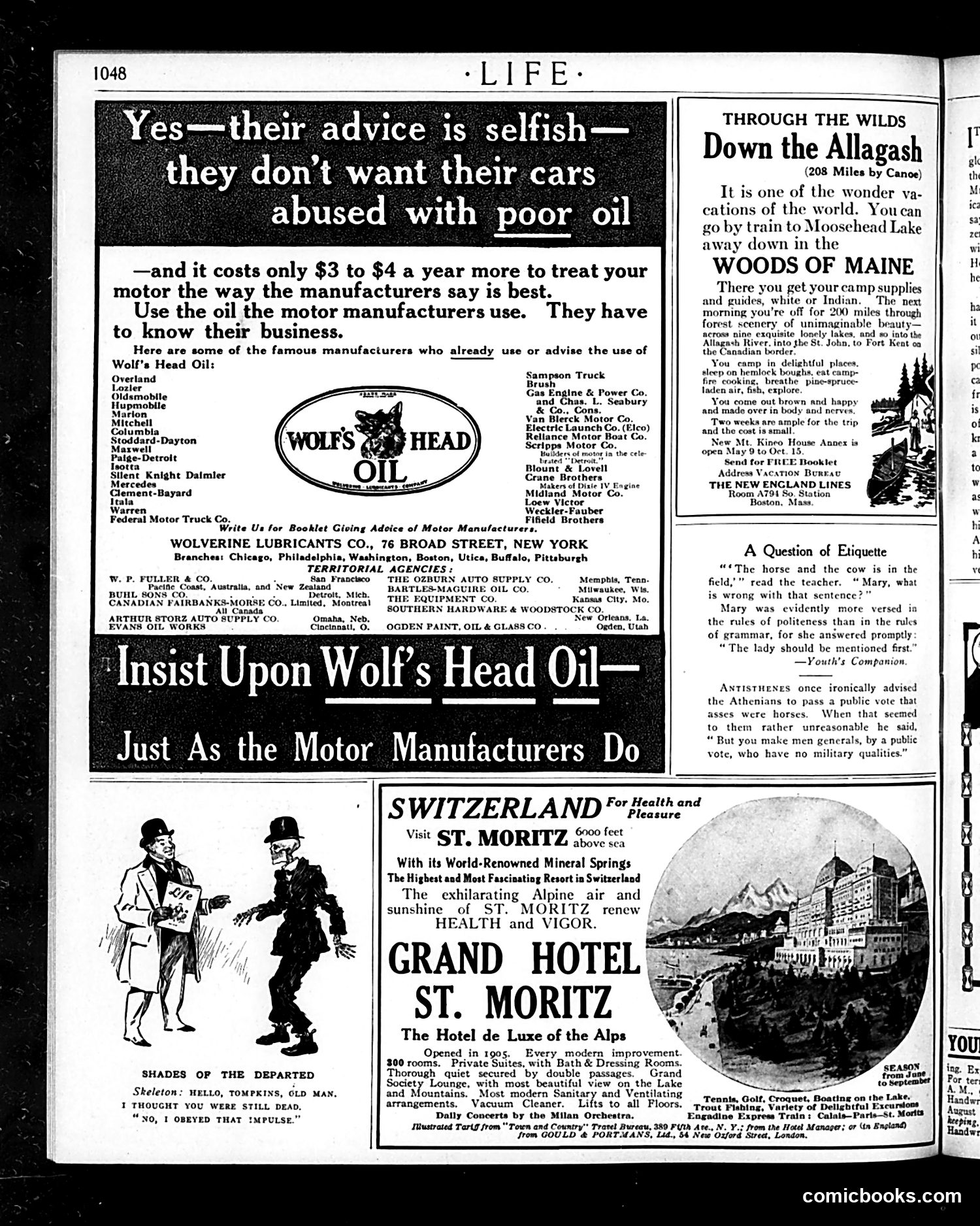
This page is primarily **advertising**, not editorial satire. The dominant content is a Wolf's Head Oil advertisement claiming motor manufacturers endorse their product, listing dozens of car companies (Oldsmobile, Hupmobile, Maxwell, etc.) to establish credibility. The small cartoon labeled "Shades of the Departed" shows a skeleton greeting a man named Tompkins, with the skeleton saying "I thought you were still dead" and the man replying "So I obeyed that impulse." This appears to be a darkly humorous non-sequitur about obeying impulses leading to near-death experiences—possibly suggesting reckless behavior. The page also contains travel advertisements for Maine canoeing and a Swiss hotel, plus a brief humor section titled "A Question of Etiquette" about grammar and an anecdote mocking Athenian democracy. The content reflects early 20th-century magazine format: advertising dominates; editorial humor is minimal and disconnected.
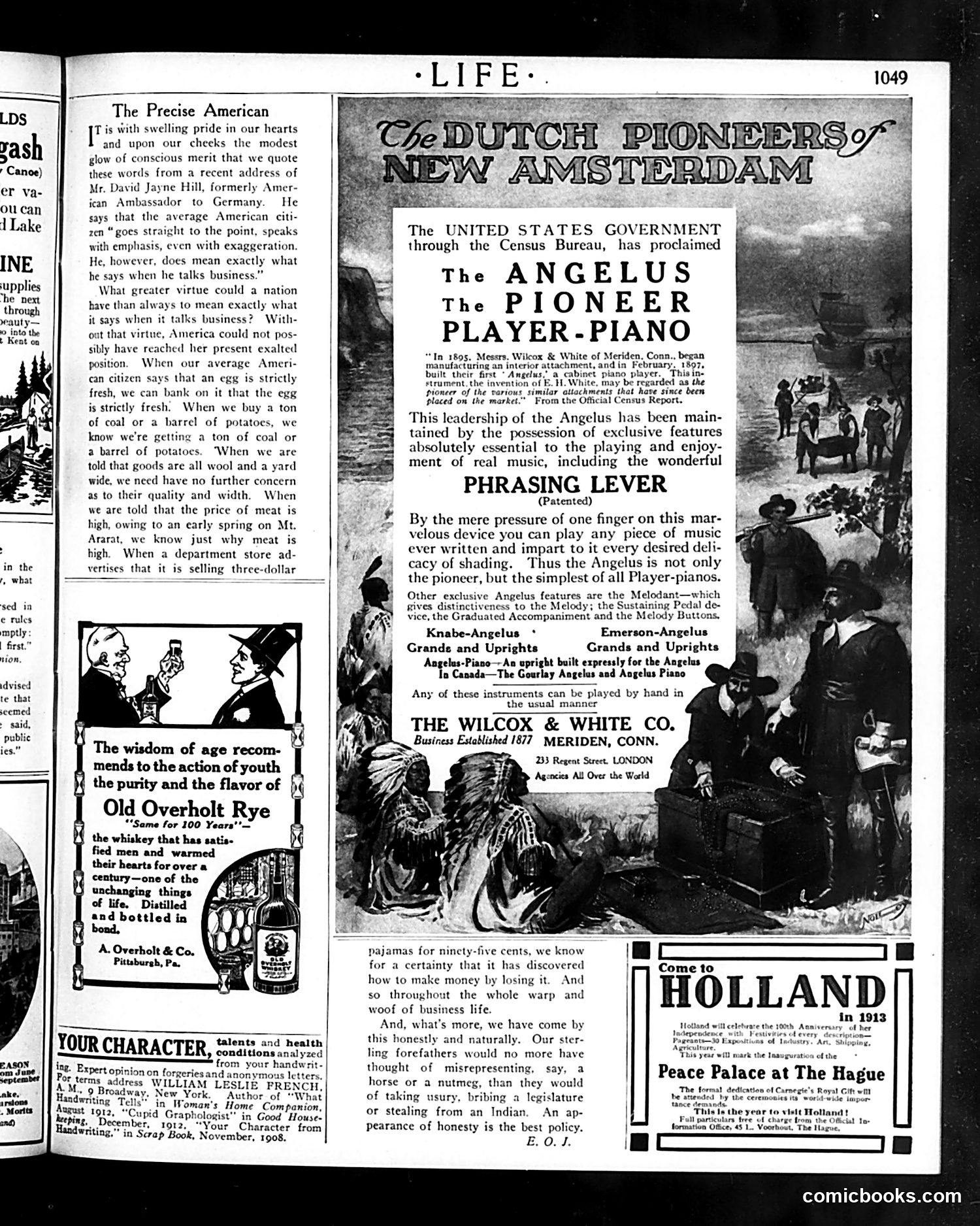
The page contains two main elements: **Left column ("The Precise American"):** A satirical essay mocking American boastfulness about commercial honesty. The author uses heavy irony—claiming Americans "always mean exactly what they say when it talks business"—while listing absurd examples (eggs being "strictly fresh," coal shipments precise). The satire suggests Americans actually exaggerate and deceive in commerce, contradicting ambassador David Jayne Hill's recent praise of American directness. The implication: American salesmanship relies on bluffing and misrepresentation. **Right column:** An advertisement claiming the U.S. Census Bureau certified the Angelus as the "pioneer player-piano" (1805). This appears to be satirized by the "Precise American" essay—it's the sort of bombastic, dubious commercial claim the essay mocks. The ad's use of official government language to tout superiority is exactly the type of American exaggeration the left column ridicules. Together, they expose the gap between American ideals of honesty and actual commercial practice.
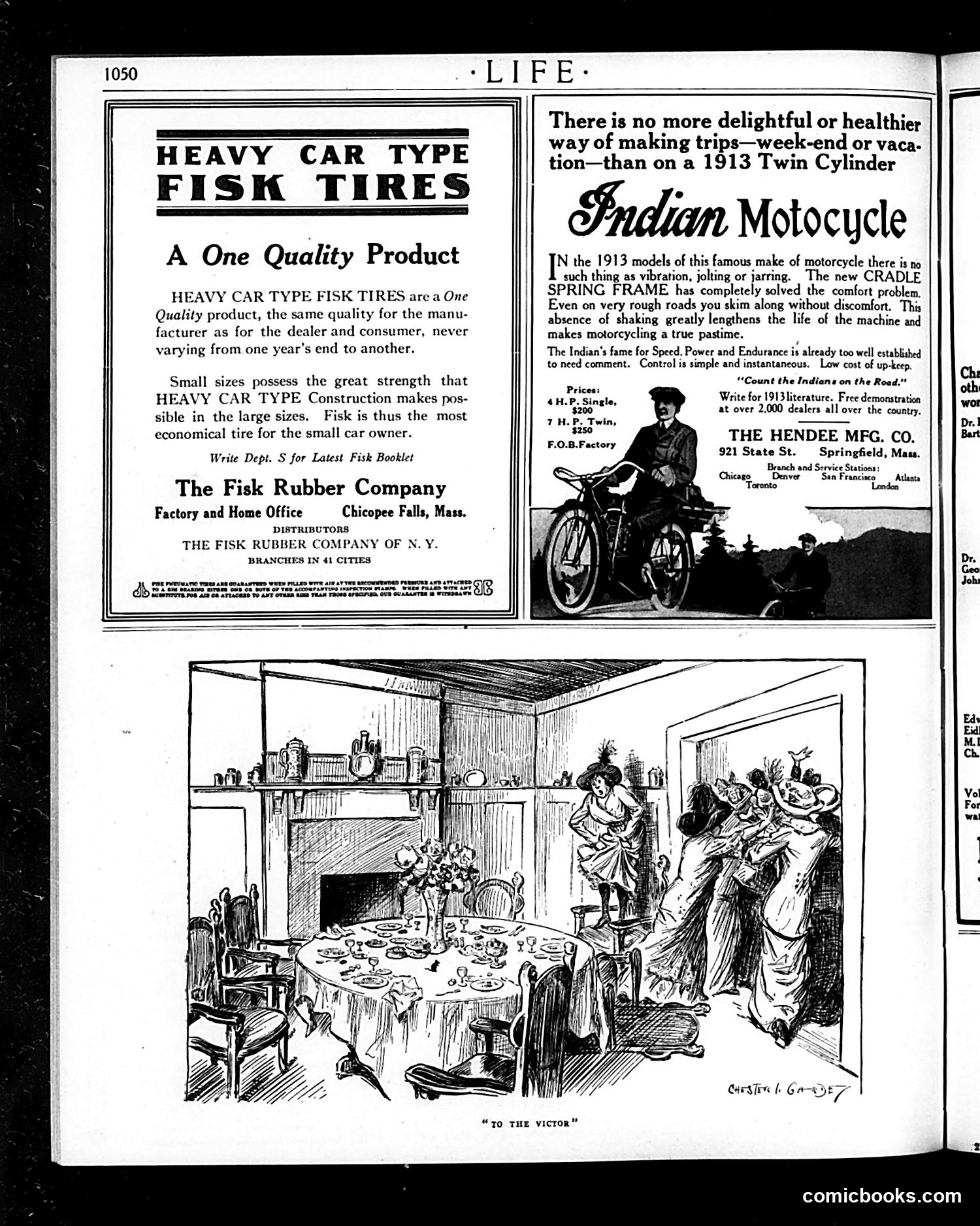
This page consists primarily of **advertisements** rather than political satire. The top half features two product ads: Fisk Tires and Indian Motorcycles, both emphasizing quality and comfort for early automotive travel. The bottom half contains a single cartoon labeled **"To the Victor,"** drawn by Cesare (Chester Gould). The sketch depicts an **indoor domestic scene**—a woman in classical Greek or Roman dress stands triumphantly in a living room while other figures (appearing to be family members) gather around. The classical imagery of "the victor" suggests this is a humorous commentary on **domestic victory or household authority**, likely depicting a wife or woman winning some household dispute or competition. Without additional context from the magazine's issue, the specific scenario being satirized is **unclear**—it may reference contemporary social debates about women's roles, suffrage, or domestic power dynamics popular in 1913 Life magazine humor.
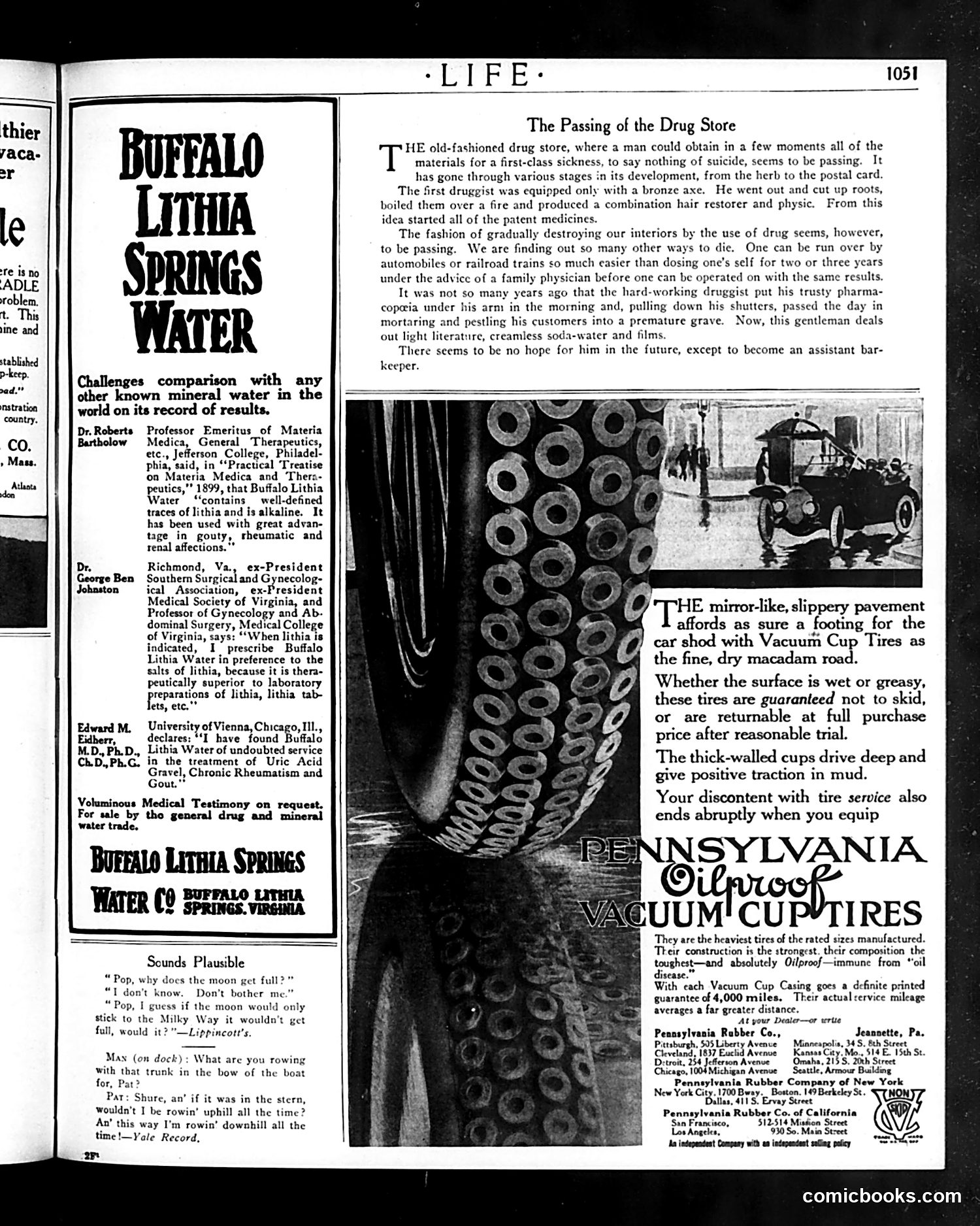
This satirical article mourns the decline of the old-fashioned American drug store as a cultural institution. The piece humorously traces the drugstore's evolution from its origins (equipped only with a "bronze axe" for cutting roots) through the patent medicine era, when proprietors aggressively sold remedies to customers. The satire's point: modern Americans have discovered easier ways to die (automobiles, trains) than through years of dubious patent medicines prescribed by family physicians. The hardworking druggist of yesteryear, who spent mornings "mortaring and pestling his customers into a premature grave," now merely sells "light literature, creamless soda-water and films"—a comedown suggesting his former role as a purveyor of quasi-lethal tonics gave him greater purpose. The conclusion—that drugstores' only future is becoming "assistant bar-keeper"—implies alcohol may become the next dubious remedy peddled to the public. The satire critiques both the quack medicine industry and American consumer gullibility.
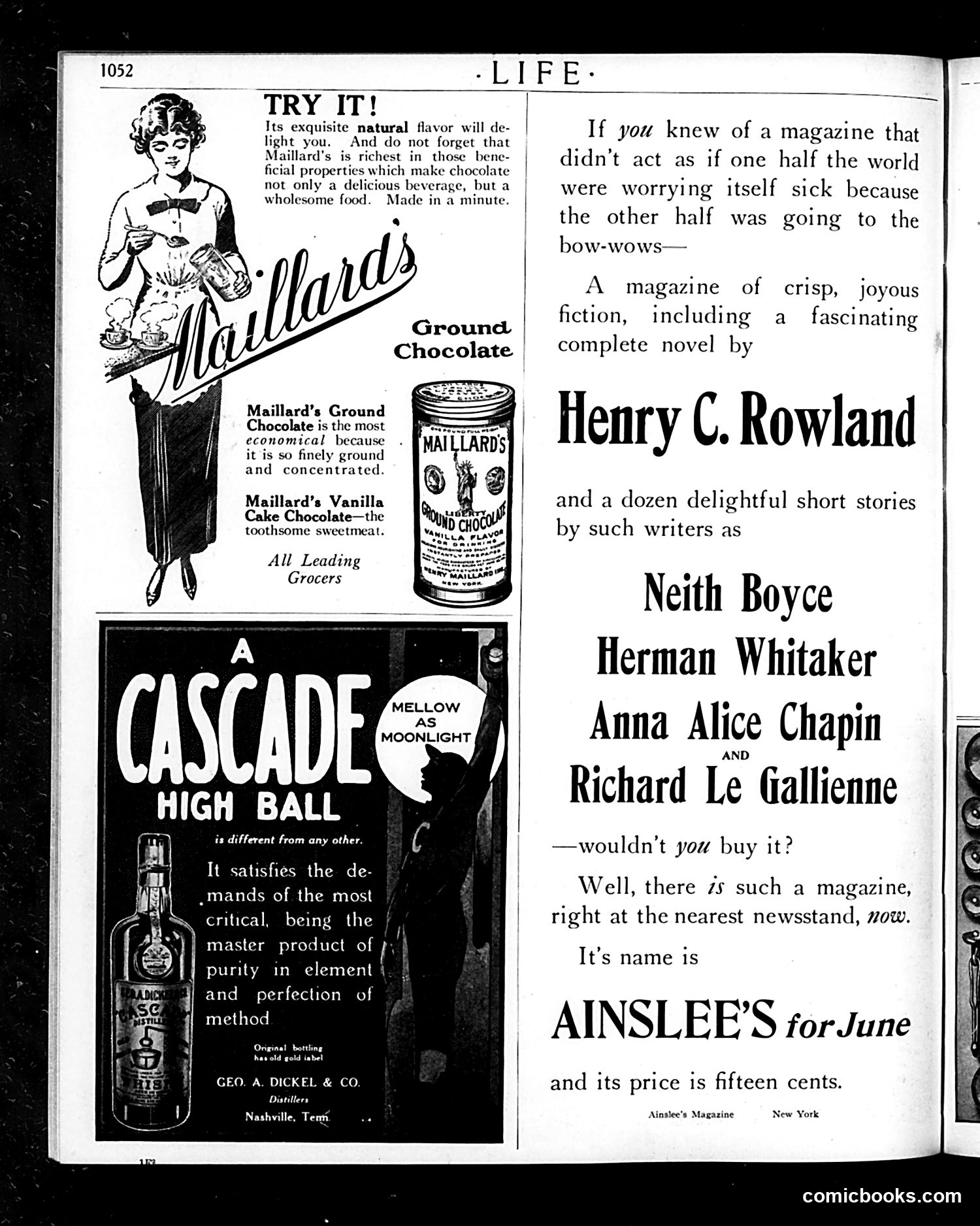
This page is primarily **advertising**, not political satire. It contains three advertisements with no cartoon humor: 1. **Maillard's Ground Chocolate**: A straightforward product ad featuring an illustrated woman promoting chocolate as a beverage and food, emphasizing its natural flavor and economy. 2. **Cascade High Ball whiskey**: An ad for liquor by Geo. A. Dickel & Co. (Nashville), highlighting purity and quality. 3. **Ainslee's Magazine for June**: A meta-advertisement promoting the magazine itself. The text uses mild social commentary—mocking publications that treat world problems as catastrophes ("bow-wows")—to contrast with Ainslee's promise of "crisp, joyous fiction" by writers like Henry C. Rowland and Neith Boyce. This is marketing copy rather than satire, designed to appeal to readers wanting escapist entertainment. The page reflects early 20th-century magazine advertising conventions and reflects period anxieties about world conditions, but contains no identifiable political figures or events.
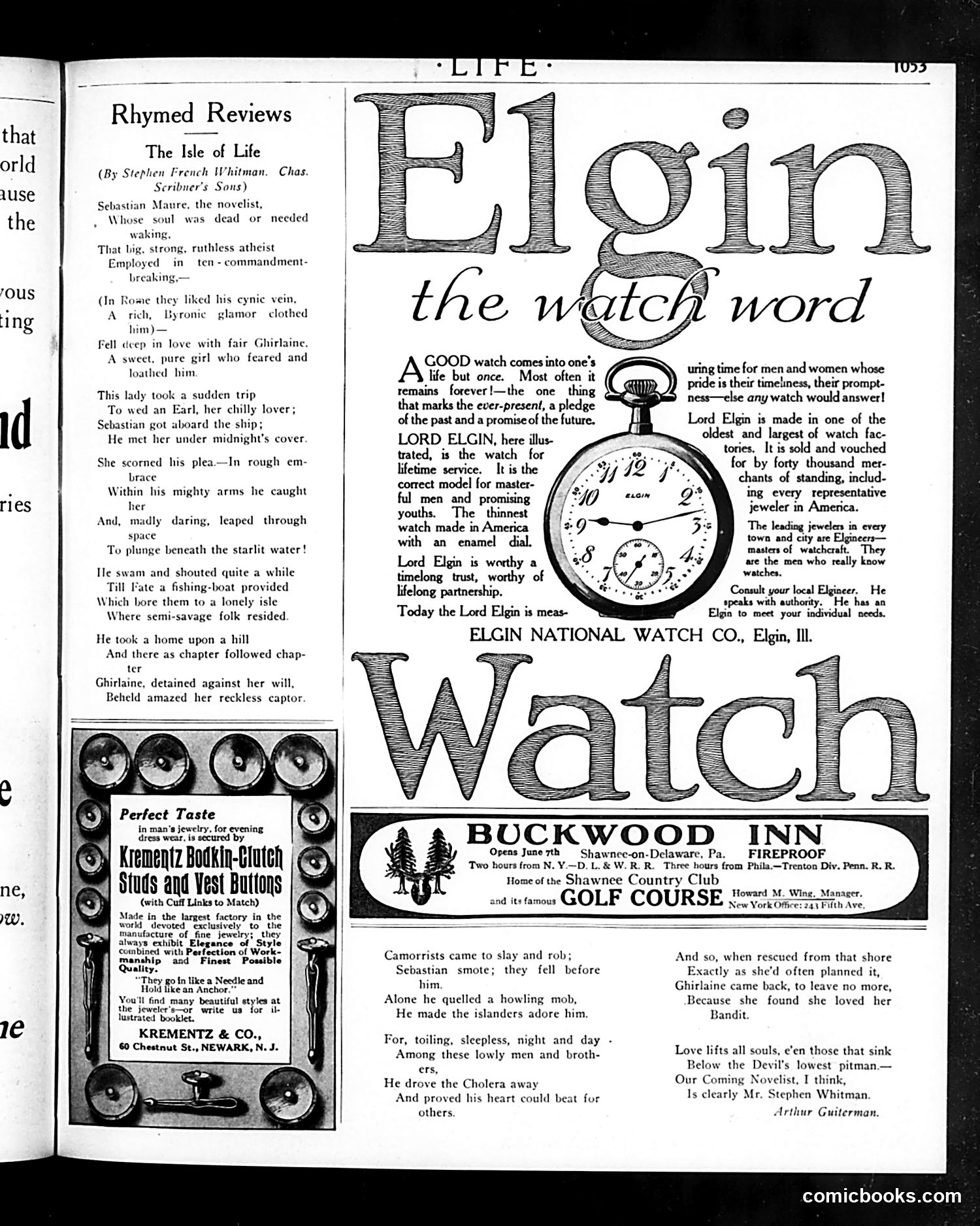
This page is primarily **advertising and a book review**, not political satire. The "Rhymed Reviews" section reviews Stephen French Whitman's novel *The Isle of Life*—a melodramatic romance about Sebastian Maure, an atheistic novelist who abducts the virtuous Ghirlaine, jumps with her into the sea, and lands on a remote island. There he heroically battles disease and criminals, ultimately winning her love. The poem's reviewer (Arthur Guiterman) presents this as contemporary literary fare—mocking the overwrought Romantic plot conventions: the cynical seducer redeemed through selfless love, the innocent woman's transformation, the exotic island setting. The page otherwise features advertisements for **Krementz jewelry studs, Lord Elgin watches, and Buckwood Inn**—typical early 20th-century luxury product marketing. There is no political cartoon or satire visible.
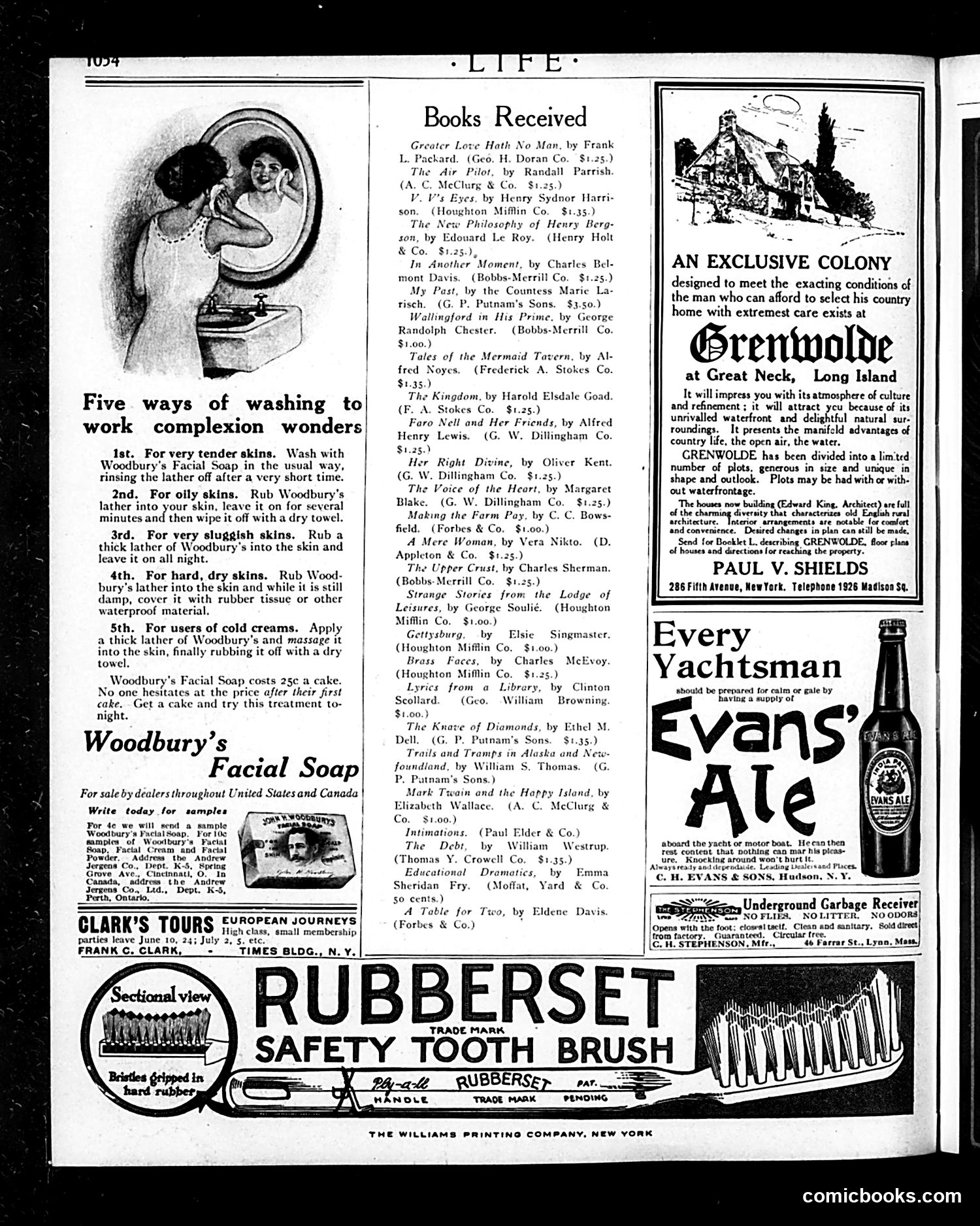
This page is primarily **advertising and book listings** rather than political satire or editorial cartooning. The main illustration shows a woman admiring her reflection in a mirror—a straightforward **beauty advertisement for Woodbury's Facial Soap**. There is no caricature or satirical intent; it's a conventional product endorsement typical of early 20th-century magazines. The page includes: - A five-step skincare regimen promoting Woodbury's soap (25¢) - A "Books Received" section listing contemporary novels and non-fiction - Real estate advertisement for Grentwolde, an exclusive residential community at Great Neck, Long Island - Tourism and tooth brush advertisements **No political or social satire is present.** This represents standard commercial content from an era when *Life* magazine, though originally satirical, increasingly relied on advertising revenue. The beauty standards implied (fair complexion, mirror-gazing) reflect contemporary aesthetics but aren't subjects of mockery here.
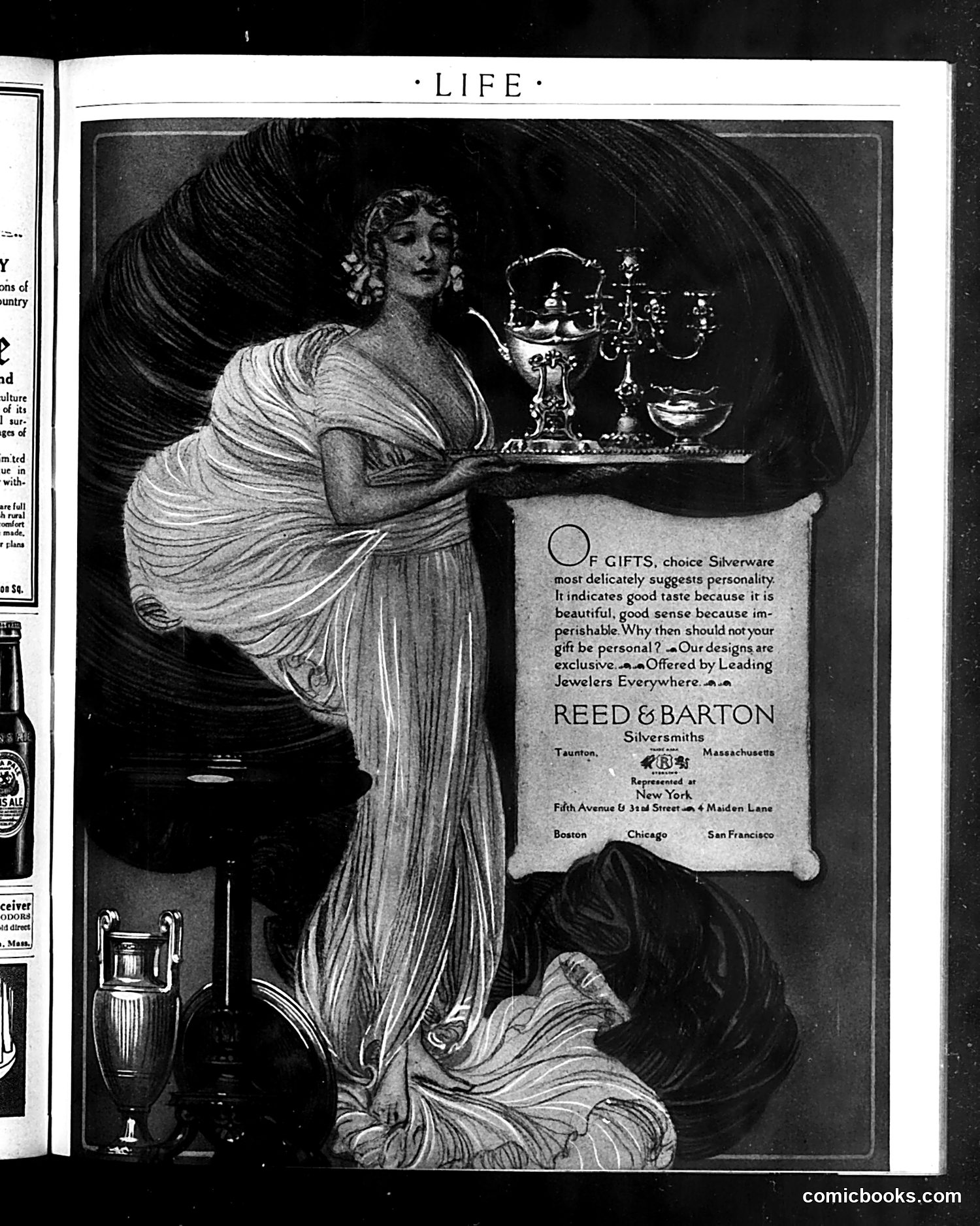
This is a **full-page advertisement**, not satire or a political cartoon. It advertises Reed & Barton silverware and silversmith services. The image features a classical allegorical female figure (appearing to represent Taste, Refinement, or similar virtue) in Greco-Roman draped clothing, displaying ornate silver serving pieces—a covered dish, pitcher, and other tableware. The composition suggests luxury and elegance through classical artistic convention. The advertisement's argument is straightforward: silver gifts "suggest personality" and indicate good taste because they are both beautiful and durable. The copy asks why gifts shouldn't be personal, then pitches Reed & Barton's "exclusive" designs available through jewelry retailers nationwide. This represents early 20th-century aspirational marketing using classical imagery to associate commercial products with timeless refinement and good breeding—a common advertising strategy of the period.
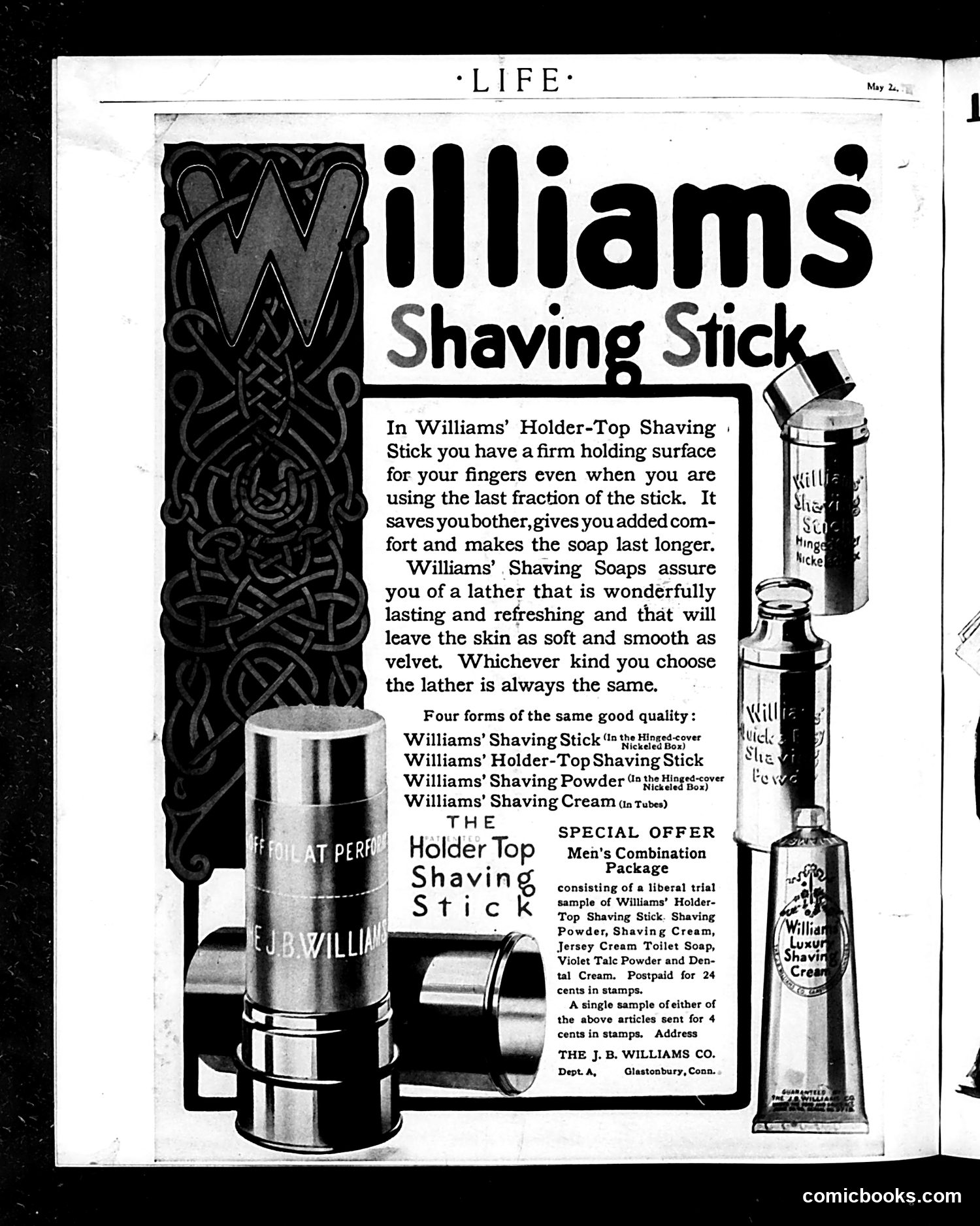
This is a full-page advertisement for Williams' Shaving Stick, not political satire. The page features ornamental product photography and marketing copy highlighting the "Holder-Top" design feature, which maintains a firm grip even as the soap stick diminishes with use. The ad emphasizes practical benefits: comfort, longer-lasting soap, and quality lather across multiple product forms (stick, powder, cream). A special men's combination package offer is promoted at 24 cents in stamps, with individual samples available for 4 cents. The decorative Celtic-style border on the left is purely ornamental branding. There are no political cartoons, caricatures, or satirical commentary on this page—it's straightforward period advertising from *Life* magazine's commercial content section.