
Life, 1913-05-22 · page 28 of 48
Life — May 22, 1913 — page 28: what you’re looking at
What you’re looking at
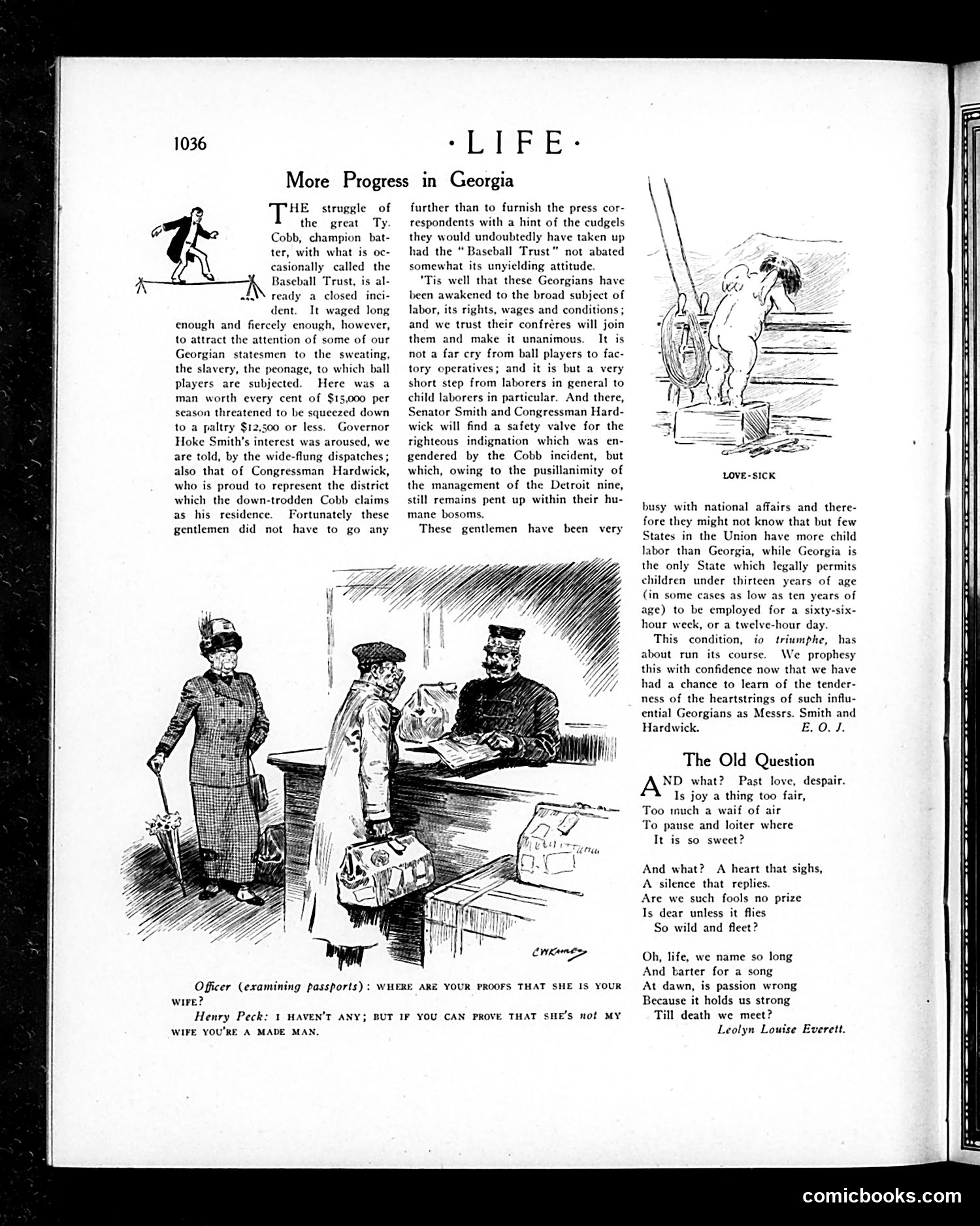
**"More Progress in Georgia"** satirizes Georgia politicians' hypocrisy. When baseball star Ty Cobb—a Georgian—faced wage cuts from the "Baseball Trust," Governor Hoke Smith and Congressman Hardwick publicly threatened intervention on his behalf. The article mocks their sudden concern for labor rights, noting these same politicians remain silent on Georgia's actual labor crisis: the state legally permits children as young as ten to work 66-hour weeks—making it uniquely permissive among U.S. states. The satire suggests their outrage over a wealthy athlete's contract dispute rings hollow given their indifference to child labor exploitation. **"Officer Examining Passports"** is an unrelated comic vignette about a man (Henry Peck) unable to prove his marriage, employing absurdist logic: he challenges the officer to disprove it instead. This is labeled "Love-Sick," suggesting romantic desperation. **"The Old Question"** is a poem about passion and mortality by Leolyn Louise Everett, thematically separate from the political content above.
📄 Transcribed text from this page (OCR, searchable)
Machine-transcribed from the original scan — historical spelling and the odd misread are preserved.
al OW Gal es More Progress in Georgia HE struggle of the great Ty. Cobb, champion bat- ter, with what is oc- casionally called the seball Trust, is al- AWN ready a closed inci- dent. It waged long enough and fiercely enough, however, to attract the attention of some of our Georgian statesmen to the sweating, the slavery, the peonage, to which ball players are subjected. Here was a man worth every cent of $15,000 per season threatened to be squeezed down to a paltry $12,500 or less. Governor Hoke Smith's interest was aroused, we are told, by the wide-flung dispatches ; also that of Congressman Hardwick, who is proud to represent the district which the down-trodden Cobb claims as his residence. Fortunately these gentlemen did not have to go any further than to furnish the press cor- respondents with a hint of the cudgels they would undoubtedly have taken up had the “ Baseball Trust” not abated somewhat its unyielding attitude. fis well that these Georgians have been awakened to the broad sub; of labor, its rights, wages and conditions ; and we trust their confréres will join them and make it unanimous. It is not a far cry from ball players to fac- tory operatives; and it is but a very short step from laborers in general to child laborers in particular. And there, Senator Smith and Congressman Hard- wick will find a safety valve for the righteous indignation which was en- gendered by the Cobb incident, but which, owing to the pusillanimity of the management of the Detroit nine, still remains pent up within their hu- mane bosoms. These gentlemen have been very Officer (examining passports): WHERE ARE YOUR PROOFS THAT SHE IS YOUR WIFE? Henry Peck: 1 HAVEN'T ANY; BUT IF YOU CAN PROVE THAT SHE'S not MY WIFE YOU'RE A MADE MAN. LOVE-SICK busy with national affairs and there- fore they might not know that but few States in the Union have more child labor than Georgia, while Georgia is the only State which legally permits children under thirteen years of age (in some cases as low as ten years of age) to be employed for a sixty-six- hour week, or a twelve-hour day. This condition, io triumphe, has about run its course. We prophesy this with confidence now that we have had a chance to learn of the tender- ness of the heartstrings of such influ- ential Georgians as Messrs. Smith and Hardwick. E. 0. J. The Old Question ND what? Past love, despair. Is joy a thing too fair, Too inuch a waif of air To pause and loiter where It is so sweet? And what? A heart that sighs, A silence that replies. Are we such fools no prize Is dear unless it flies So wild and fleet? Oh, life, we name so long And barter for a song At dawn, is passion wrong Because it holds us strong Till death we meet? Leolyn Louise Everett. comicbooks.com