
Life, 1913-05-22 · page 18 of 48
Life — May 22, 1913 — page 18: what you’re looking at
What you’re looking at
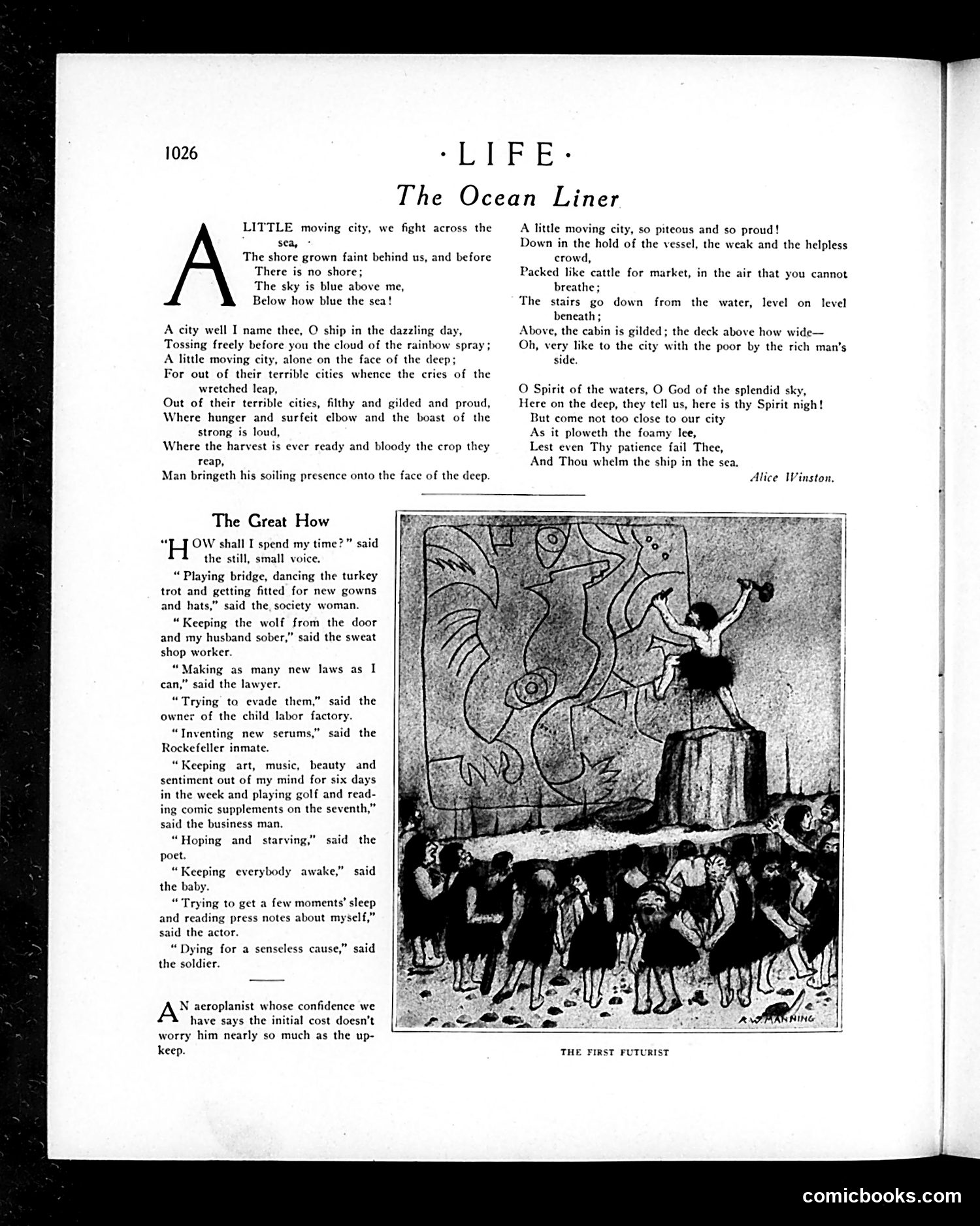
This page contains two satirical pieces critiquing early 20th-century American society. **"The Ocean Liner"** (poem by Alice Winston) uses a ship as metaphor for social inequality. While wealthy passengers enjoy gilded cabins above deck, steerage passengers below are "packed like cattle for market" in unbreathable conditions. The poem condemns how ocean liners replicate the brutal class divisions of industrial cities—the rich and poor traveling side-by-side yet worlds apart. It's a direct social critique of capitalism's visible contradictions. **"The Great How"** presents various professions/social types answering "How shall I spend my time?" The responses reveal hypocrisy and emptiness: lawyers make laws while factory owners evade them; businessmen ignore art for golf; soldiers die for "senseless" causes. The joke lies in exposing how different classes and professions prioritize survival, profit, or frivolity—a biting commentary on American society's moral bankruptcy. **"The First Futurist"** (cartoon caption) likely mocks new technological enthusiasts, though context is unclear from this page alone.
📄 Transcribed text from this page (OCR, searchable)
Machine-transcribed from the original scan — historical spelling and the odd misread are preserved.
LITTLE moving city, we fight across the sea, The shore grown faint behind us, and before There is no shore; The sky is blue above me, Below how blue the sea! A city well I name thee, O ship in the dazzling day, Tossing freely before you the cloud of the rainbow spray; A little moving city, alone on the face of the deep; For out of their terrible cities whence the cries of the wretched leap, Out of their terrible cities, filthy and gilded and proud, Where hunger and surfeit elbow and the boast of the strong is loud, Where the harvest is ever ready and bloody the crop they reap, Man bringeth his soiling presence onto the face of the deep. -LIFE- The Ocean Liner A little moving city, so piteous and so proud! Down in the hold of the vessel, the weak and the helpless crowd, Packed like cattle for market, in the air that you cannot breathe; The stairs go down from the water, level on level beneath; Above, the cabin is gilded; the deck above how wide— Oh, very like to the city with the poor by the rich man’s side. O Spirit of the waters, O God of the splendid sky, Here on the deep, they tell us, here is thy Spirit nigh! But come not too close to our city As it ploweth the foamy lee, Lest even Thy patience fail Thee, And Thou whelm the ship in the sea. Alice Winston. The Great How oe OW shall I spend my time?” said the still, small voice. “Playing bridge, dancing the turkey trot and getting fitted for new gowns and hats,” said the, society woman. “Keeping the wolf from the door and my husband sober,” said the sweat shop worker. “Making as many new laws as I can,” said the lawyer. “Trying to evade them,” said the owner of the child labor factory. “Inventing new serums,” said the Rockefeller inmate. “Keeping art, music, beauty and sentiment out of my mind for six days in the week and playing golf and read- ing comic supplements on the seventh,” said the business man. “Hoping and starving,” said the poet. “Keeping everybody awake,” said the baby. “Trying to get a few moments’ sleep and reading press notes about myself,” said the actor. “Dying for a senseless cause,” said the soldier. A® acroplanist whose confidence we have says the initial cost doesn’t worry him nearly so much as the up- keep. THE FIRST FUTURIST comicbooks.com