
Life, 1913-05-22 · page 26 of 48
Life — May 22, 1913 — page 26: what you’re looking at
What you’re looking at
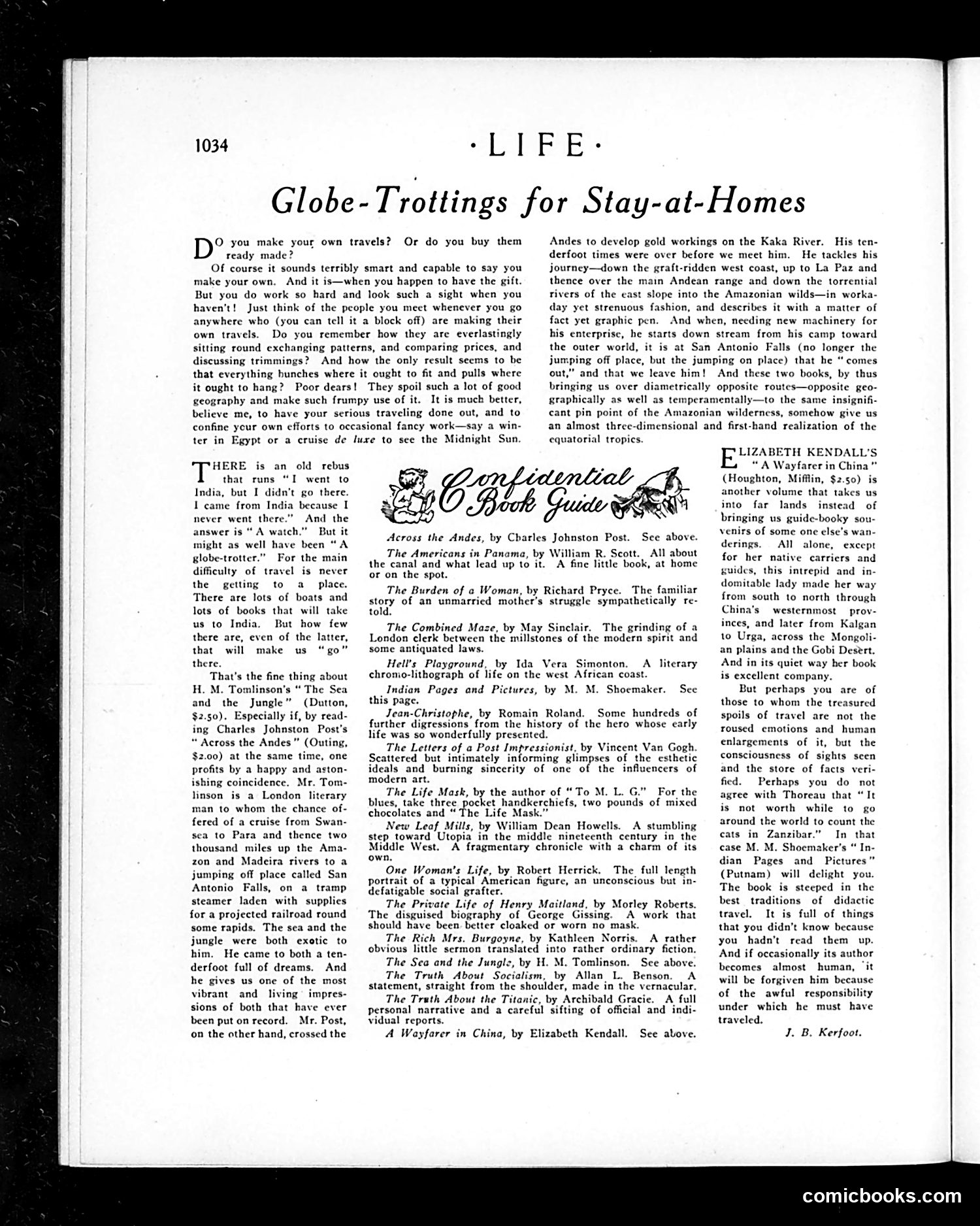
This page from *Life* magazine presents book reviews disguised as travel commentary. The central conceit is a clever metaphor: just as one can buy ready-made clothes rather than sewing them yourself, one can "buy" travel experiences through books rather than undertaking actual journeys. The satire targets armchair travelers—people who read travel narratives to vicariously experience distant places. The humor lies in the comparison: just as homemade garments often fit poorly and look "frumpy," amateur travelers who make their own expeditions produce awkward, self-conscious results. The implicit message is that reading well-written travel books by professional authors (like those reviewed here) offers superior armchair tourism compared to travelers' own bumbling attempts. The featured works describe exotic locales—the Andes, Panama, China, the Amazon—allowing readers to "travel" without leaving home, which aligns with the article's title "Globe-Trottings for Stay-at-Homes." This reflects early 20th-century middlebrow culture's embrace of literary escapism.
📄 Transcribed text from this page (OCR, searchable)
Machine-transcribed from the original scan — historical spelling and the odd misread are preserved.
Gal Le) oe Globe-Trottings for Stay-at-Homes © you make your own travels? Or do you buy them ready made? Of course it sounds terribly smart and capable to say you make your own. And it is—when you happen to have the gift. But you do work so hard and look such a sight when you haven't! Just think of the people you meet whenever you go anywhere who (you can tell it a block off) are making their own travels. Do you remember how they are everlastingly sitting round exchanging patterns, and comparing prices, and discussing trimmings? And how the only result seems to be that everything bunches where it ought to fit and pulls where it ought to hang? Poor dears! They spoil such a lot of good geography and make such frumpy use of it. It is much better, believe me, to have your serious traveling done out, and to confine your own efforts to occasional fancy work—say a win- ter in Egypt or a cruise de luxe to sce the Midnight Sun. HERE is an old rebus that runs “I went to India, but I didn’t go there. 1 came from India because I never went there.” And the answer is “ A watch.” But it might as well have been “A globe-trotter.” For the main difficulty of travel is never the getting to a _ place. There are lots of boats and lots of books that will take told. or on the spot. OBL Cire 2: Across the Andes, by Charles Johnston Post. The Americans in Panama, by William R. Scott. the canal and what lead up to it. The Burden of a Woman, by Richard Pryce. The familiar story of an unmarried mother’s struggle sympathetically re- Andes to develop gold workings on the Kaka River. His ten- derfoot times were over before we meet him. He tackles his journcy—down the graft-ridden west coast, up to La Paz and thence over the main Andean range and down the torrential rivers of the east slope into the Amazonian wilds—in worka- day yet strenuous fashion, and describes it with a matter of fact yet graphic pen. And when, needing new machinery for his enterprise, he starts down stream from his camp toward the outer world, it is at San Antonio Falls (no longer the jumping off place, but the jumping on place) that he “ comes out,” and that we leave him! And these two books, by thus bringing us over diametrically opposite routes—opposite geo- graphically as well as temperamentally—to the same insignifi- cant pin point of the Amazonian wilderness, somehow give us an almost three-dimensional and first-hand realization of the equatorial tropics. LIZABETH KENDALL'S “A Wayfarer in China (Houghton, Mifflin, $2.50) is another volume that takes us lands instead of bringing us guide-booky sou- venirs of some one else's wan- derings. All alone, except for her native carriers and guides, this intrepid and in- domitable lady made her way from south to north through China's westernmost prov- See above. All about A fine little book, at home us to India. But how few there are, even of the latter, that will make us “go there. That's the fine thing about H. M. Tomlinson’s “ The Sea and the Jungle” (Dutton, $2.50). Especially if, by read- ing Charles Johnston Post's “ Across the Andes” (Outing, $2.00) at the same time, one profits by a happy and aston- ishing coincidence. Mr. Tom- linson is a London literary man to whom the chance of- fered of a cruise from Swan- sea to Para and thence two thousand miles up the Ama- zon and Madeira rivers to a jumping off place called San Antonio Falls, on a tramp steamer laden with supplies for a projected railroad round some rapids. The sea and the jungle were both exotic to him. He came to both a ten- derfoot full of dreams. And he gives us one of the most vibrant and living impres- sions of both that have ever been put on record. Mr. Post, on the other hand, crossed the The Combined Maze, by May Sinclair. The grinding of a London clerk between the millstones of the modern spirit and some antiquated laws. Hell’s Playground, by Ida Vera Simonton. A literary chromio-lithograph of life on the west African coast. Indian Pages and Pictures, by M. M. Shoemaker. See this page. Jean-Christophe, by Romain Roland. Some hundreds of further digressions from the history of the hero whose early life was so wonderfully presented. The Letters of a Post Impressionist. by Vincent Van Gogh. Scattered but intimately informing glimpses of the esthetic ideals and burning sincerity of one of the influencers of modern art. ¢ Life Mask, by the author of “To M. L. G.” For the blues, take three pocket handkerchiefs, two pounds of mixed chocolates and “The Life Mask.” New Leaf Mills, by William Dean Howells. A stumbling step toward Utopia in the middle nineteenth century in the Middle West. A fragmentary chronicle with a charm of its own, One Woman's Life, by Robert Herrick. The full length portrait of a typical American figure, an unconscious but in- defatigable social grafter. The Private Life of Henry Maitland, by Morley Roberts. The disguised biography of George Gissing. A work that should have been better cloaked or worn no mask. The Rich Mrs. Burgoyne, by Kathleen Norris. A rather obvious little sermon translated into rather ordinary fiction. The Sca and the Jungle, by H. M. Tomlinson. Sce above. The Truth About Socialism, by Allan L. Benson. A statement, straight from the shoulder, made in the vernacular. The Trath About the Titanic, by Archibald Gracie. A full personal narrative and a careful sifting of official and indi- vidual reports. A Wayfarer in China, by Elizabeth Kendall. See above. inces, and later from Kalgan to Urga, across the Mongoli- an plains and the Gobi Desert. And in its quiet way her book is excellent company. But perhaps you are of those to whom the treasured spoils of travel are not the roused emotions and human enlargements of it, but the consciousness of sights seen and the store of facts veri- fied. Perhaps you do not agree with Thoreau that “It is not worth while to go around the world to count the cats in Zanzibar.” In that case M. M. Shocmaker's “ In- dian Pages and Pictures” (Putnam) will delight you. The book is steeped in the best traditions of didactic travel. It is full of things that you didn’t know because you hadn't read them up. And if occasionally its author becomes almost human, ‘it will be forgiven him because of the awful responsibility under which he must have traveled. J. B. Kerfoot. comicbooks.com