
Life, 1913-05-22 · page 23 of 48
Life — May 22, 1913 — page 23: what you’re looking at
What you’re looking at
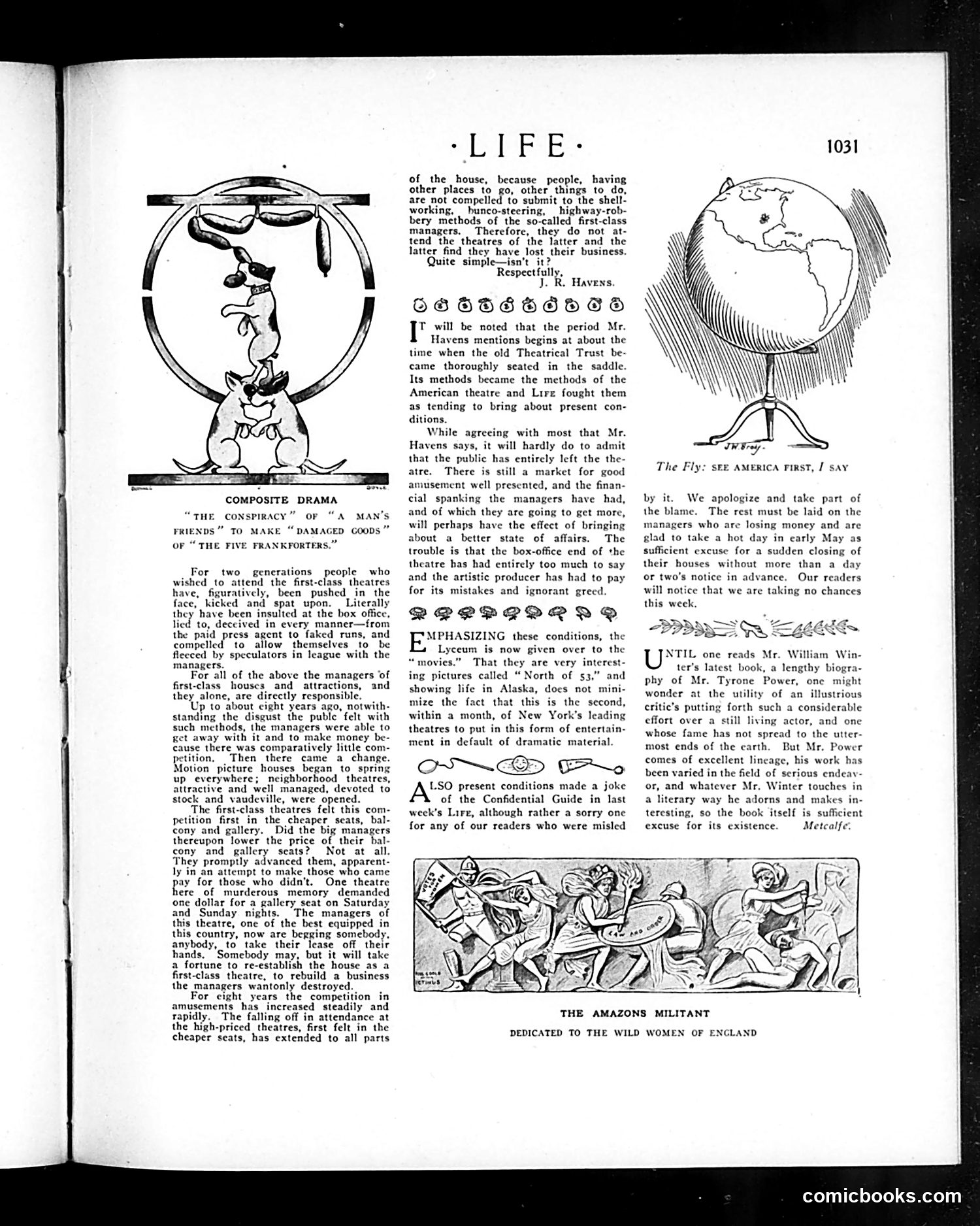
This page critiques the arrogance and poor business practices of early 20th-century theatrical managers. Letter-writer J.R. Havens argues that first-class theater owners mistreated audiences—overcharging, deceiving them through fake publicity, and colluding with ticket scalpers—while facing no competition. When motion pictures and neighborhood theaters emerged, audiences abandoned them rather than tolerate abuse. Life's editors agree, linking this decline to the "Theatrical Trust," a monopoly that prioritized profits over artistic quality. They note that even prestigious theaters like the Lyceum now show films ("North of 53") instead of dramatic productions, indicating theatrical management has run out of quality material. The cartoon's acrobatic figures likely satirize the theatrical world's contortions to survive. The satire targets managerial greed and the industry's self-inflicted decline through customer exploitation—a cautionary tale about underestimating competition and public tolerance.
📄 Transcribed text from this page (OCR, searchable)
Machine-transcribed from the original scan — historical spelling and the odd misread are preserved.
COMPOSITE DRAMA THE CONSPIRACY” OF “A FRIENDS” TO MAKE “ DAMAGED Coops” OF “THE FIVE FRANKFORTERS.” For two generations people who wished to attend the first-class. theatres have, figuratively, been pushed in the face, kicked and’ spat upon. _ Literally they’ have been insulted at the box office, lied to, deceived in every manner—from the paid press agent to faked runs, and compelled to allow themselves to be flecced by speculators in league with the managers. For all of the above the managers ‘of first-class houses and attractions, and they alone, are directly responsible. Up to about cight years ago, notwith- standing the disgust the puble felt with such methods, the managers were able to get away with it and to make money be- cause there was comparatively little com- petition, Then there came a change. Motion ‘picture houses began to. spring up everywhere; neighborhood theatres, attractive and well managed, devoted to stock and vaudeville, were opened. The first-class theatres felt this com- petition first in the cheaper seats, bal- cony and gallery. Did the big managers thereupon lower the price of their bal- cony and gallery seats? Not at all. They promptly advanced them, apparent: ly in an attempt to make those who came ‘ay for those who didn’t. One theatre ere of murderous memory demanded one dollar for a gallery seat on Saturday and Sunday nights. The managers of this theatre, one of the best equipped in this country, now are begging somebody, anybody, to take their lease off their hands. ‘Somebody may, but it will take a fortune to re-establish the house as a first-class theatre, to rebuild a business the managers wantonly destroyed. For cight years the compet amusements has increased steadily and rapidly. The falling off in attendance at the high-priced theatres, first felt in the cheaper seats, has extended to all parts Ey PBAES of the house, because people, having other places to go, other things to do, are not compelled to submit to the shell- working, hunco-steering, highway-rob- bery methods of the so-called first-class managers, Therefore, they do not at- tend the theatres of the latter and the latter find they have lost their business. Quite simple—isn't it? Respectfully, J. R. Havens. ORG MORGLORCROROROMO) T will be noted that the period Mr. Havens mentions begins at about the time when the old Theatrical Trust be- came thoroughly seated in the saddle. Its methods became the methods of the American theatre and Lire fought them as tending to bring about present con- ditions. While agreeing with most that Mr. Havens says, it will hardly do to admit that the public has entirely left the the- atre. There is still a market for good amusement well presented, and the finan- cial spanking the managers have had, and of which they are going to get more, will perhaps have the effect of bringing about a better state of affairs, The trouble is that the box-office end of the theatre has had entirely too much to say and the artistic producer has had to pay for its mistakes and ignorant greed QRBRSSDPZQR AED MPHASIZING these conditions, the Lyceum is now given over to the “movies.” That they are very interest- ing pictures called “North of 53,” and showing life in Alaska, docs not mini- mize the fact that this is the second, within a month, of New York's leading theatres to put in this form of entertain- ment in default of dramatic material. OSN™GED (P~o. LSO present conditions made a joke of the Confidential Guide in last week’s Lire, although rather a sorry one for any of our readers who were misled The Fly: see AMERICA First, J SAY by it. We apologize and take part of the blame. The rest must be laid on the managers who are losing money and are glad to take a hot day in early May as sufficient excuse for a sudden closing of their houses without more than a day or two's notice in advance. Our readers will notice that we are taking no chances this week. L one reads Mr. William Win- ter’s latest book, a lengthy biogra- phy of Mr. Tyrone Power, one might wonder at the utility of an illustrious critic's putting forth such a considerable effort over a still living actor, and one whose fame has not spread to the utter- most ends of the earth. But Mr. Power comes of excellent lineage, his work has been varied in the field of serious endeav- or, and whatever Mr, Winter touches in a literary way he adorns and makes in- teresting, so the book ‘itself is sufficient excuse for its existence. Metcalfe. THE AMAZONS MILITANT DEDICATED TO THE WILD WOMEN OF £2 comicbooks.com