
Life, 1913-05-22 · page 10 of 48
Life — May 22, 1913 — page 10: what you’re looking at
What you’re looking at
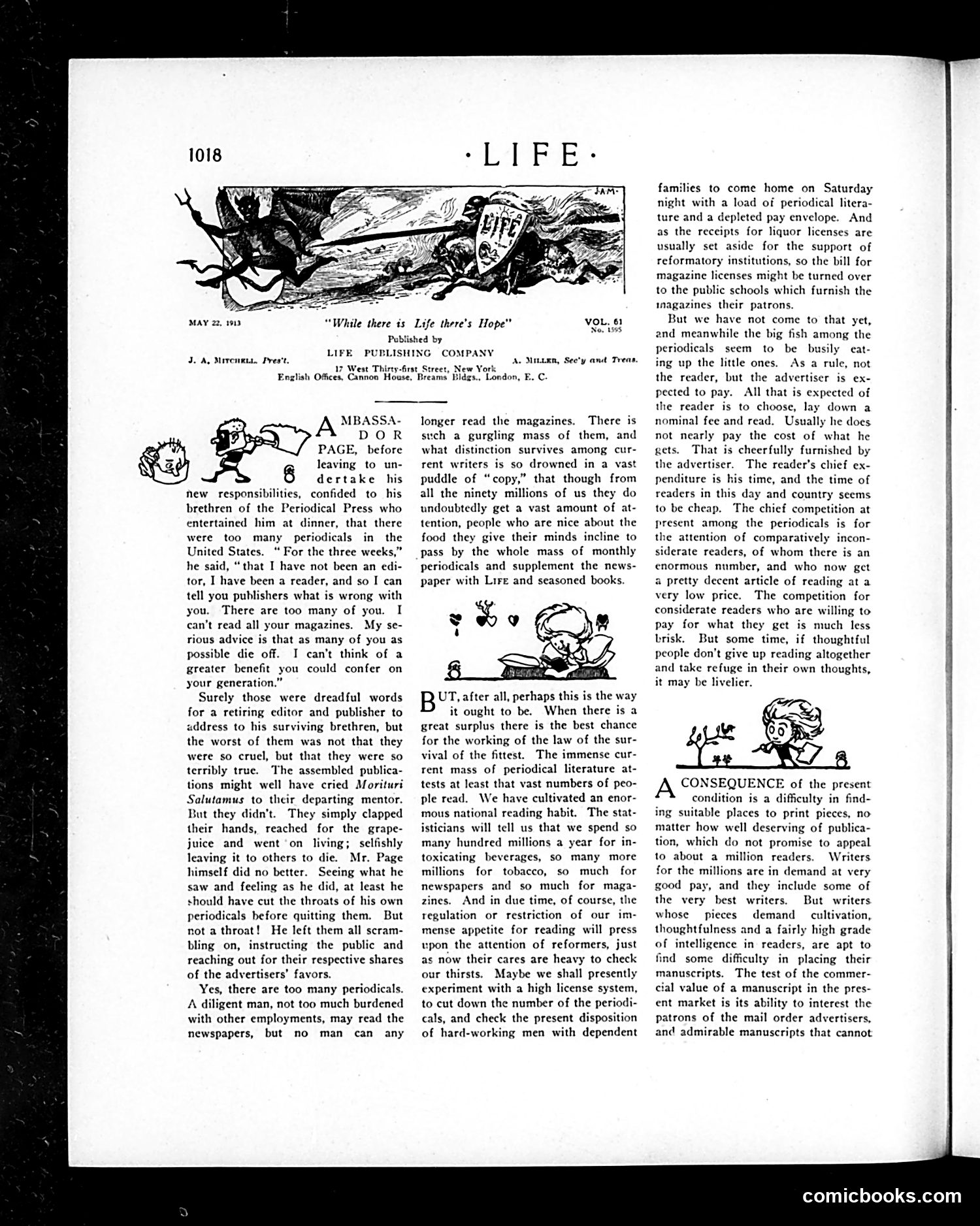
This page discusses the overcrowded market of American periodicals. The editorial argues there are too many magazines competing for readers' attention and advertising dollars. The cartoon at top appears to show a dying or struggling figure labeled "LIFE" — likely self-referential satire about the magazine's own survival amid competition. The text criticizes how periodicals saturate the market, making it difficult for quality publications to thrive. The editor proposes solutions like licensing systems to reduce the number of magazines, arguing this would benefit serious writers and readers while eliminating low-quality publications. The accompanying illustrations show cherubic figures, likely representing idealized readers or the magazine's mascot character, emphasizing the human cost of this industry competition.
📄 Transcribed text from this page (OCR, searchable)
Machine-transcribed from the original scan — historical spelling and the odd misread are preserved.
MAY 22, 1913, “While there is Life there's Hope" Poblished by LIFE J. A, Miron. Pres't, PUBLISHING COMPANY 17 West Thirty-frst Stre A. MILLER, See'y anit Treas. New York English Offices, Cannon House, Breams’ Didgs., London, E.. C- MBASSA- DOR before leaving to un- 8 dertake his new responsibilities, confided to his brethren of the Periodical Press who entertained him at dinner, that there were too many periodicals in the United States. “ For the three weeks,” he said, “that I have not been an edi- tor, I have been a reader, and so I can tell you publishers what is wrong with you. There are too many of you. I can’t read all your magazines. My se- rious advice is that as many of you as possible die off. I can’t think of a greater benefit you could confer on your generation.” Surely those were dreadful words for a retiring editor and publisher to address to his surviving brethren, but the worst of them was not that they were so cruel, but that they were so terribly true. The assembled publica- tions might well have cried Morituri Salutamus to their departing mentor. But they didn't. They simply clapped their hands, reached for the grape- juice and went ‘on living; selfishly leaving it to others to die. Mr. Page himself did no better. Seeing what he saw and feeling as he did, at least he should have cut the throats of his own periodicals before quitting them. But not a throat! He left them all scram- bling on, instructing the public and reaching out for their respective shares of the advertisers’ favors. Yes, there are too many periodicals. A diligent man, not too much burdened with other employments, may read the newspapers, but no man can any longer read the magazines. There is such a gurgling mass of them, and what distinction survives among cur- rent writers is so drowned in a vast puddle of “copy,” that though from all the ninety millions of us they do undoubtedly get a vast amount of at- tention, people who are nice about the food they give their minds incline to pass by the whole mass of monthly periodicals and supplement the news- paper with Lire and seasoned books. shoes B UT, after all, perhaps this is the way it ought to be. When there is a great surplus there is the best chance for the working of the law of the sur- vival of the fittest. The immense cur- rent mass of periodical literature at- tests at least that vast numbers of peo- ple read. We have cultivated an enor- mous national reading habit. The stat- isticians will tell us that we spend so many hundred millions a year for in- toxicating beverages, so many more millions for tobacco, so much for newspapers and so much for maga- zines. And in due time, of course, the regulation or restriction of our im- mense appetite for reading will press upon the attention of reformers, just as now their cares are heavy to check our thirsts. Maybe we shall presently experiment with a high license system, to cut down the number of the periodi. cals, and check the present disposition of hard-working men with dependent families to come home on Saturday night with a load of periodical litera- ture and a depleted pay envelope. And as the receipts for liquor licenses are usually set aside for the support of reformatory institutions, so the bill for magazine licenses might be turned over to the public schools which furnish the imagazines their patrons. But we have not come to that yet, and meanwhile the big fish among the periodicals seem to be busily eat- ing up the little ones. As a rule, not the reader, but the advertiser is ex- pected to pay. All that is expected of the reader is to choose, lay down a nominal fee and read. Usually he does not nearly pay the cost of what he gets. That is cheerfully furnished by the advertiser. The reader’s chief ex- penditure is his time, and the time of readers in this day and country seems to be cheap. The chief competition at present among the periodicals is for the attention of comparatively incon- siderate readers, of whom there is an enormous number, and who now get a pretty decent article of reading at a very low price. The competition for considerate readers who are willing to pay for what they get is much less Lrisk. But some time, if thoughtful people don't give up reading altogether and take refuge in their own thoughts, it may be livelier. as aR I) ss) A CONSEQUENCE of the present condition is a difficulty in find- ing suitable places to print pieces, no matter how well deserving of publica- tion, which do not promise to appeal to about a million readers. Writers for the millions are in demand at very good pay, and they include some of the very best writers. But writers whose pieces demand cultivation, thoughtfulness and a fairly high grade of intelligence in readers, are apt to find some difficulty in placing their manuscripts. The test of the commer- cial value of a manuscript in the pres- ent market is its ability to interest the patrons of the mail order advertisers, and admirable manuscripts that cannot comicbooks.com