
Life, 1913-05-22 · page 22 of 48
Life — May 22, 1913 — page 22: what you’re looking at
What you’re looking at
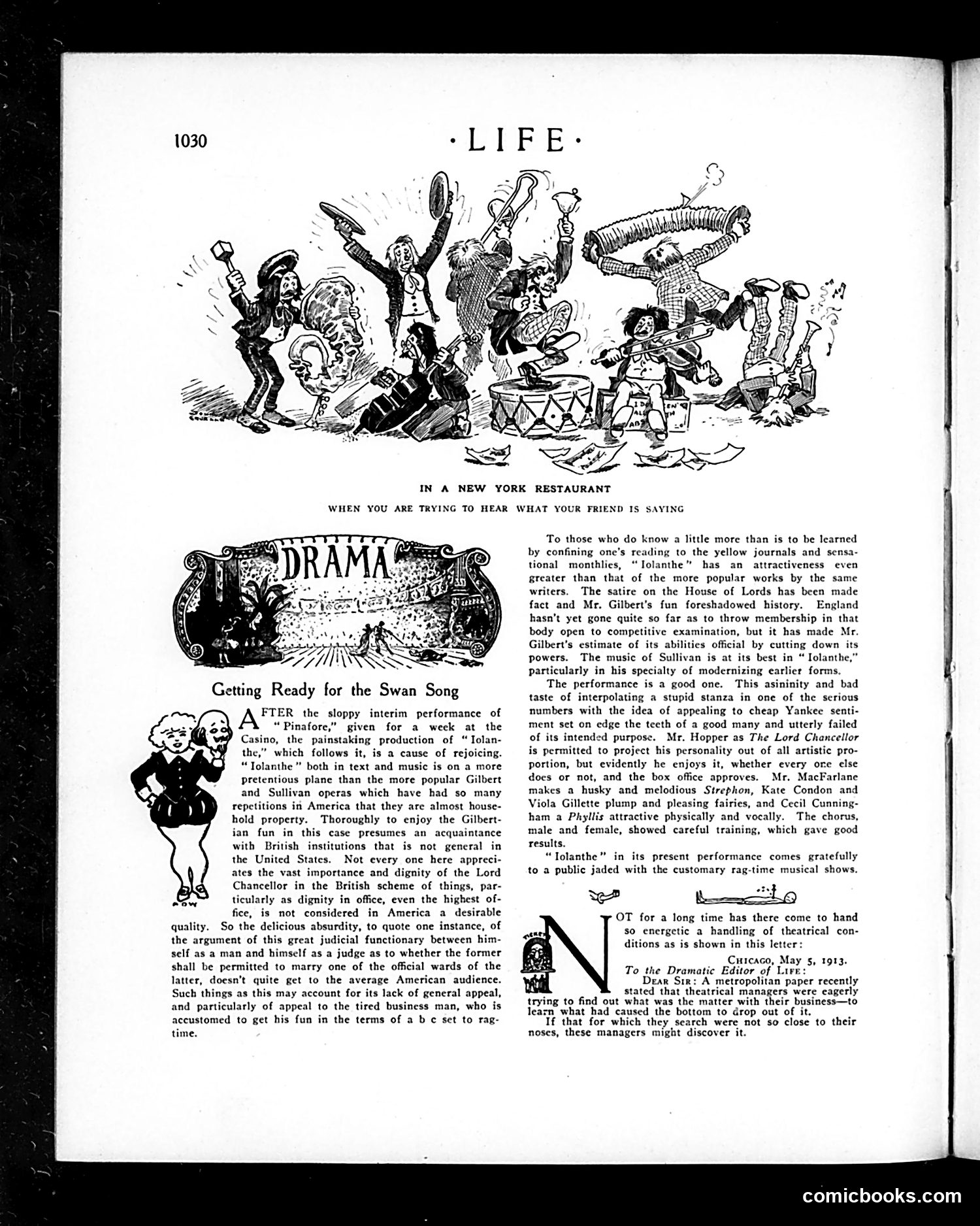
**Top Cartoon:** This satirical illustration shows a chaotic New York restaurant scene where diners are trying to converse amid noise and disruption. The joke—stated in the caption—is that the cacophony makes conversation impossible. It's social commentary on urban dining culture and noise pollution in early 1900s New York. **Drama Section:** This reviews a theatrical production of Gilbert and Sullivan's "Iolanthe." The critic praises the opera's satire of the British House of Lords, noting that Gilbert's fictional mockery has become reality—England has actually reduced the Lords' powers. The review complains that American audiences lack familiarity with British institutions needed to appreciate the humor, and criticizes the insertion of lowbrow "ragtime" elements to appeal to "tired business men." The final letter-to-editor critiques theater managers for not recognizing obvious problems with their business. **Context:** This reflects 1913 American attitudes: admiration for British sophistication, anxiety about vulgarization of culture, and dismissal of mass-market entertainment tastes.
📄 Transcribed text from this page (OCR, searchable)
Machine-transcribed from the original scan — historical spelling and the odd misread are preserved.
IN A NEW YORK RESTAURANT WHEN YOU ARE TRYING TO HEAR WHAT YOUR FRIEND IS SAYING Getting Ready for the Swan Song FTER the sloppy interim performance of “Pinafore,” given for a week at the Casino, the painstaking production of “ Iolan- the,” which follows it, is a cause of rejoicing. “Tolanthe” both in text and music is on a more pretentious plane than the more popular Gilbert and Sullivan operas which have had so many repetitions in America that they are almost house- hold property. Thoroughly to enjoy the Gilbert- ian fun in this case presumes an acquaintance with British institutions that is not general in the United States. Not every one here appreci- ates the vast importance and dignity of the Lord Chancellor in the British scheme of things, par- ticularly as dignity in office, even the highest of- fice, is not considered in America a desirable quality. So the delicious absurdity, to quote one instance, of the argument of this great judicial functionary between him- self as a man and himself as a judge as to whether the former shall be permitted to marry one of the official wards of the latter, doesn’t quite get to the average American audience. Such things as this may account for its lack of general appeal, and particularly of appeal to the tired business man, who is accustomed to get his fun in the terms of a bc set to rag- time. wow To those who do know a little more than is to be learned by confining one’s reading to the yellow journals and sensa- tional monthlics, “Iolanthe” has an attractiveness even greater than that of the more popular works by the same writers. The satire on the House of Lords has been made fact and Mr. Gilbert's fun foreshadowed history. England hasn't yet gone quite so far as to throw membership in that body open to competitive examination, but it has made Mr. Gilbert's estimate of its abilities official by cutting down its powers. The music of Sullivan is at its best in “ Iolanthe,” particularly in his specialty of modernizing earlier forms. The performance is a good one. This asininity and bad taste of interpolating a stupid stanza in one of the serious numbers with the idea of appealing to cheap Yankee senti- ment set on edge the teeth of a good many and utterly failed of its intended purpose. Mr. Hopper as The Lord Chancellor is permitted to project his personality out of all artistic pro- portion, but evidently he enjoys it, whether every ore else does or not, and the box office approves. Mr. MacFarlane makes a husky and melodious Strephon, Kate Condon and Viola Gillette plump and pleasing fairies, and Cecil Cunning- ham a Phyllis attractive physically and vocally. The chorus, male and female, showed careful training, which gave good results. “Tolanthe” in its present performance comes gratefully to a public jaded with the customary rag-time musical shows. OT for a long time has there come to hand so energetic a handling of theatrical con- ditions as is shown in this letter: Cucaco, May s, 1913. To the Dramatic Editor of Lire: Dear Sir: A metropolitan paper recently stated that theatrical managers were eagerly trying to find out what was the matter with their business—to learn what had caused the bottom to drop out of it. If that for which they search were not so close to their noses, these managers might discover it. comicbooks.com