
A complete issue · 48 pages · 1913
Life — May 8, 1913
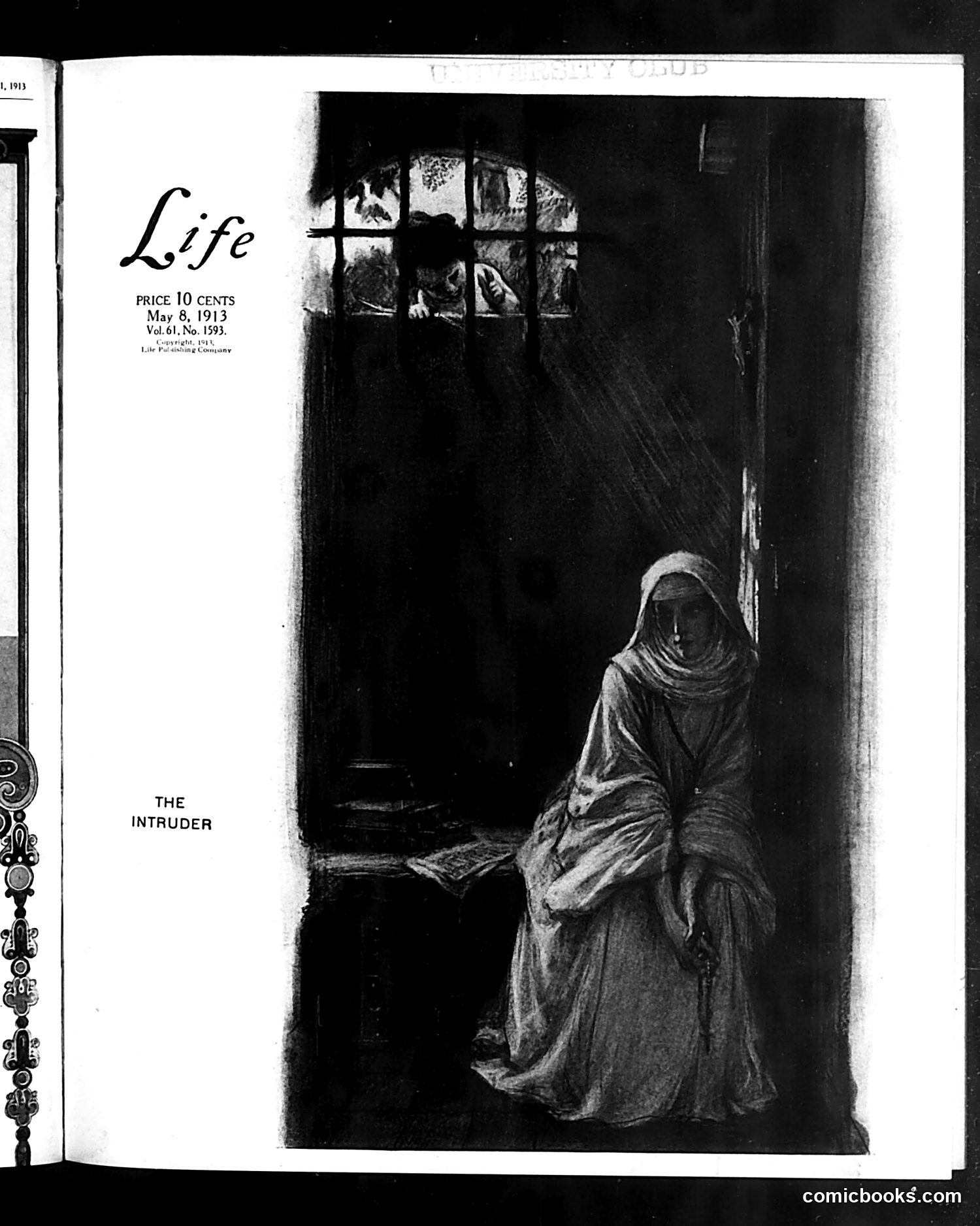
This illustration depicts a cloaked, hooded figure peering through a window at night—a classic "intruder" or burglar. The figure appears menacing, silhouetted against darkness, holding what may be tools or stolen goods. Without additional context from the magazine's contents, the specific political or social reference remains unclear. However, given Life's satirical nature and 1913 date, "The Intruder" likely comments on contemporary anxieties—possibly immigration concerns, crime fears, or labor unrest prevalent in that era. The hooded figure's anonymity and ominous presentation suggest the image invokes social anxiety about threatening outsiders infiltrating American society. The artwork's dramatic chiaroscuro style emphasizes menace and intrigue rather than humor.
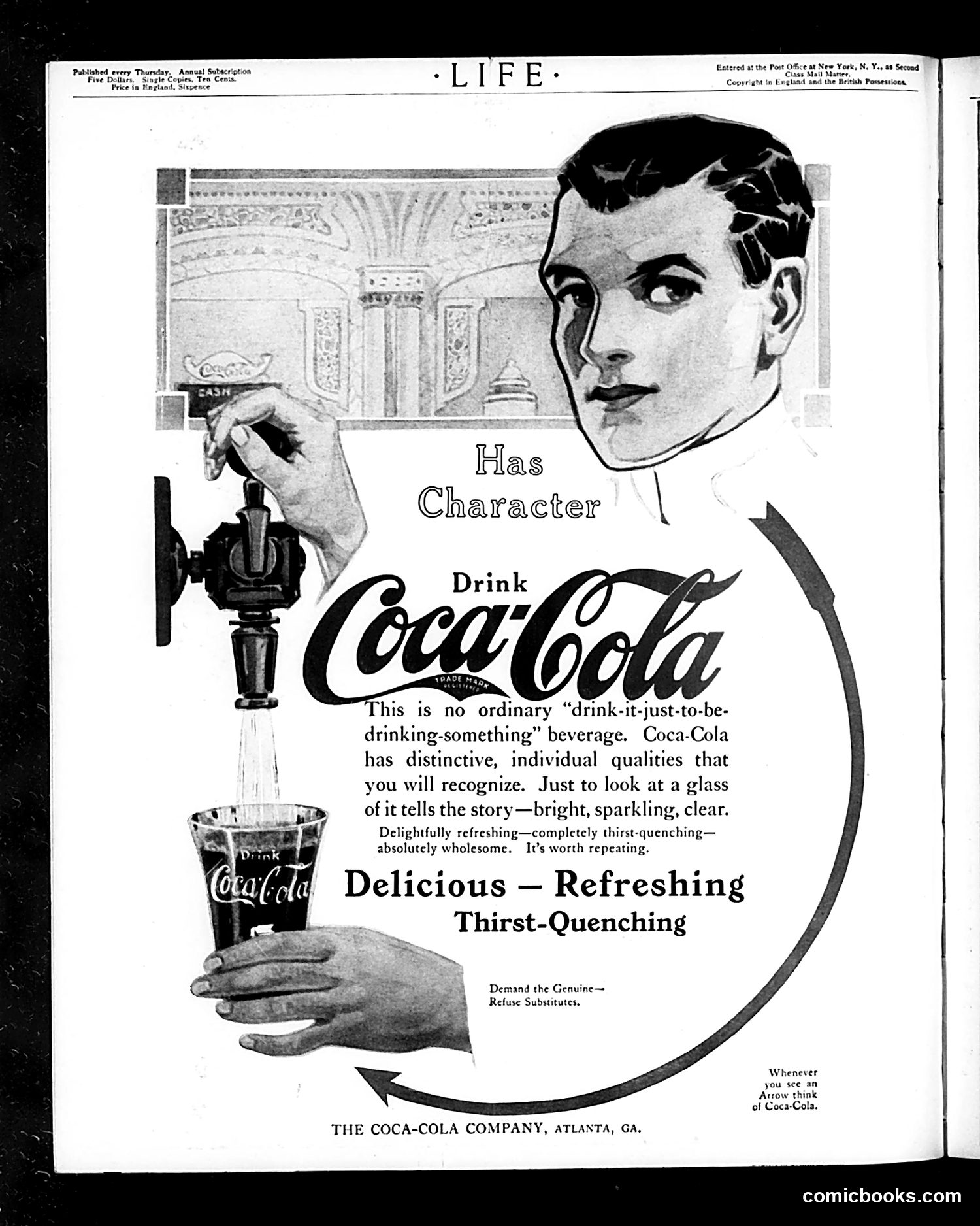
This is **a Coca-Cola advertisement**, not political satire. The page appeared in Life magazine and promotes Coca-Cola as a beverage of character and distinction. The advertisement features: - A stylized male face with a mustache, representing an idealized gentleman - Text claiming Coca-Cola "Has Character" - Imagery of hands serving the drink from a fountain dispenser into a branded glass - Marketing language emphasizing the drink's distinctive qualities: "bright, sparkling, clear," "refreshing," "thirst-quenching," and "wholesome" The advertisement uses the gentleman's visage to suggest that consuming Coca-Cola reflects good taste and refined character. The "Arrow" symbol referenced indicates Coca-Cola's branding strategy of the era. This is primarily **commercial messaging** rather than editorial content or satire.
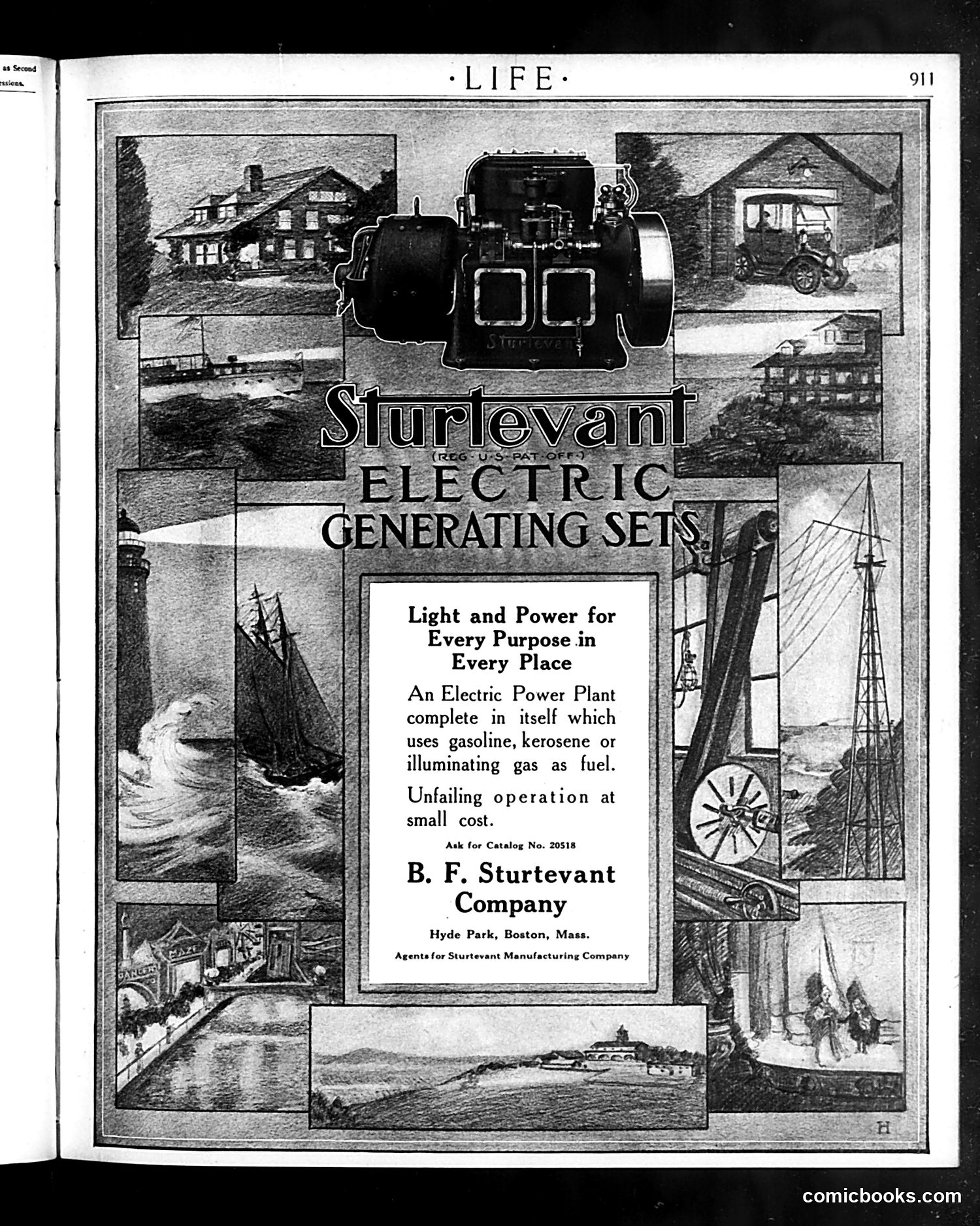
This page is **primarily an advertisement**, not satirical content. It's a full-page ad for the B. F. Sturtevant Company of Hyde Park, Massachusetts, promoting their "Sturtevant Electric Generating Sets." The ad emphasizes portable electric power generation for rural and remote locations. The surrounding images show diverse applications: farms, ships, lighthouses, construction sites, and country estates. The central generator engine is displayed prominently at the top. The pitch targets customers without access to municipal power grids, advertising "light and power for every purpose in every place" using gasoline, kerosene, or gas as fuel. The ad promises "unfailing operation at small cost" and directs readers to catalog No. 20518. This reflects early-20th-century American electrification, when independent power generation was still commercially significant before widespread grid infrastructure.
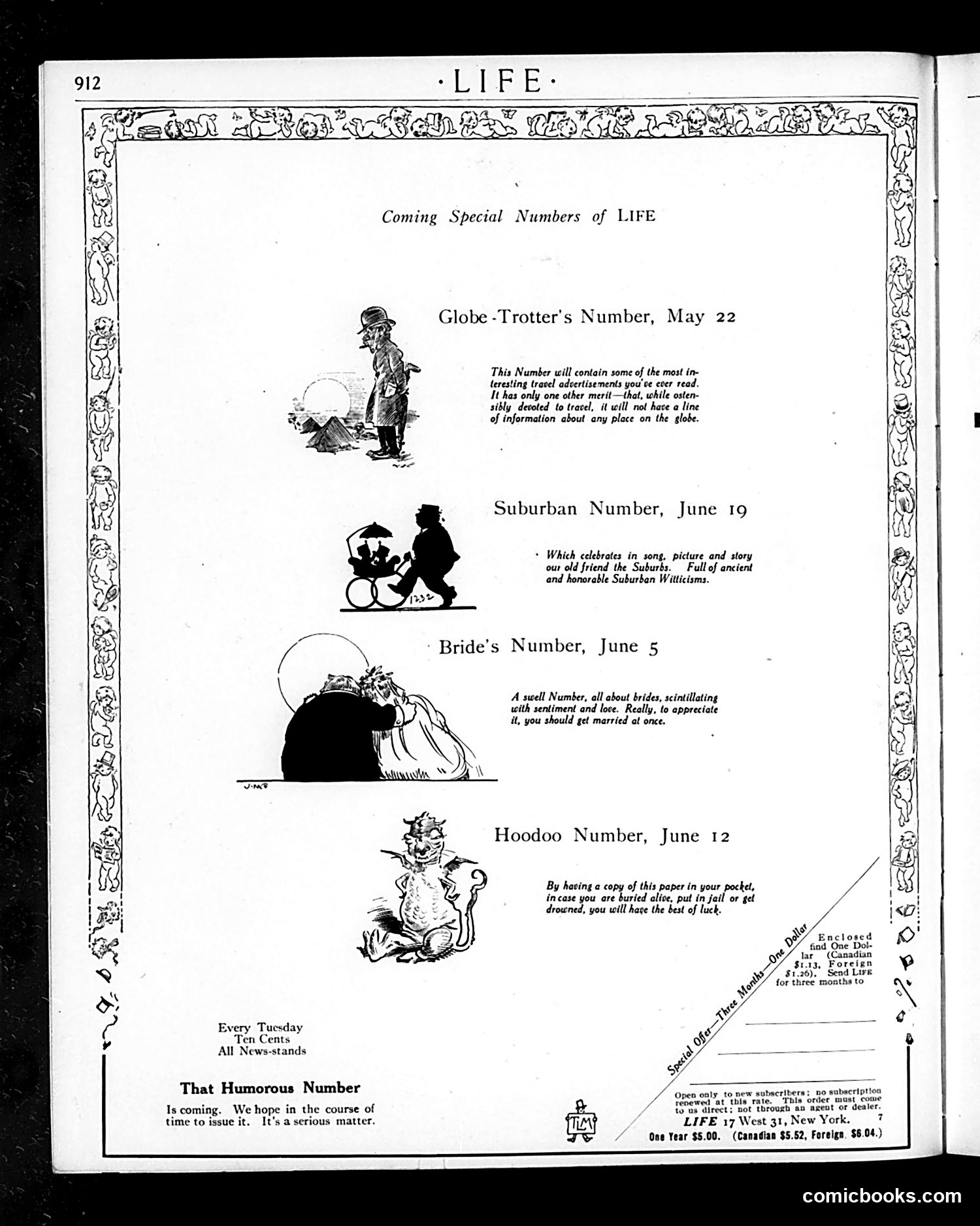
This page advertises upcoming special issues of Life magazine with illustrated themes: 1. **Globe-Trotter's Number (May 22)**: Features travel advertisements about "any place on the globe." 2. **Suburban Number (June 19)**: Celebrates "the Suburbs" and "ancient and honorable Suburban Williamites"—satirizing suburban life and its residents. 3. **Bride's Number (June 5)**: A humorous issue about weddings, described as "all about brides, scintillating with sentiment and lace," with the tongue-in-cheek advice "you should get married at once." 4. **Hoodoo Number (June 12)**: A superstition-themed issue joking that carrying the paper brings luck (or misfortune). 5. **That Humorous Number**: Promised as "coming" but details withheld. The page uses cartoonish illustrations and playful descriptions typical of Life's satirical approach to American social life.
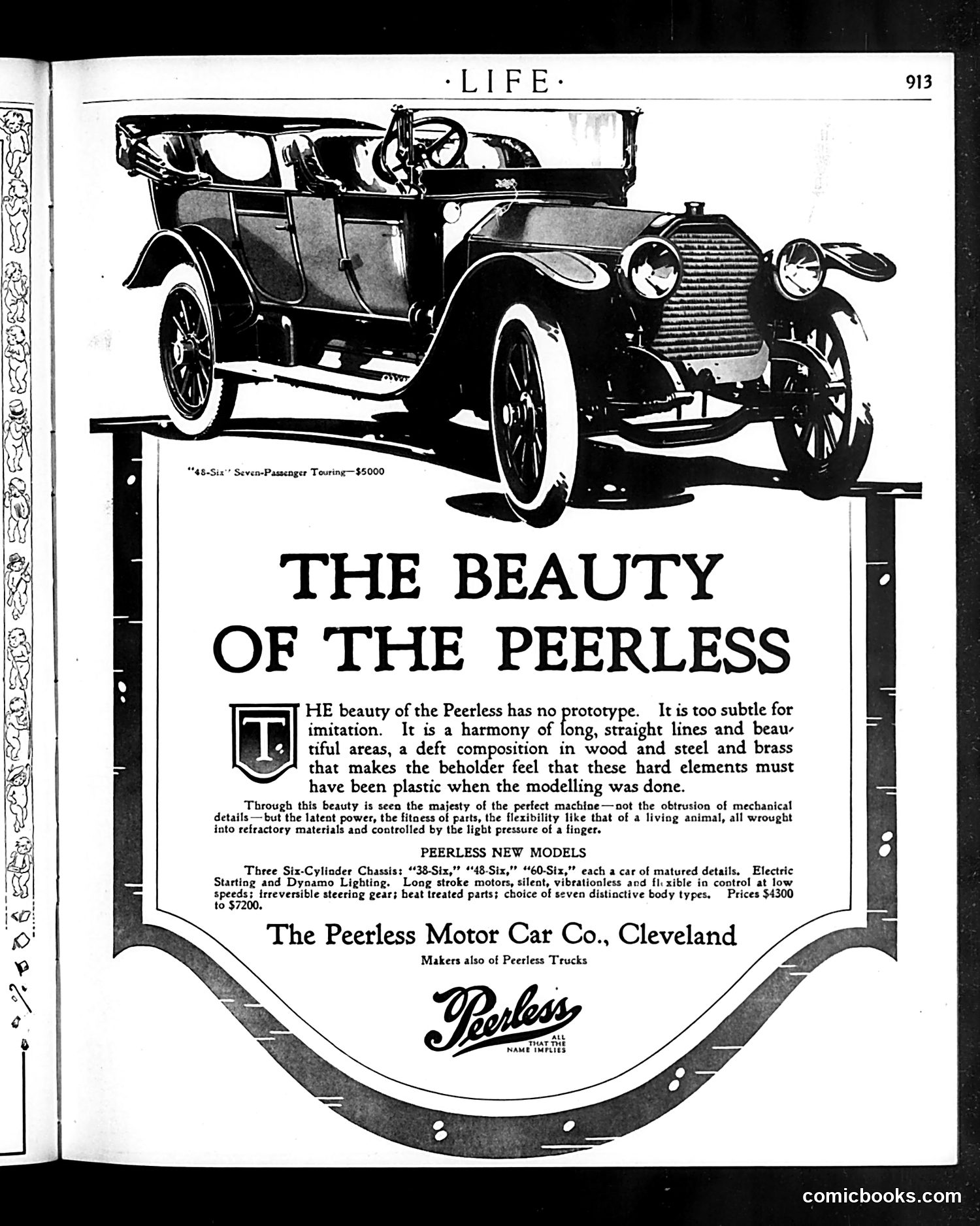
This is **not a political cartoon or satire** — it's a straightforward automobile advertisement from *Life* magazine (page 913). The page advertises the Peerless automobile, specifically their "48-Six" seven-passenger touring car priced at $5000. The ad emphasizes the vehicle's elegant design, highlighting "long, straight lines and beautiful areas" and praising the craftsmanship of wood and steel components. The copy describes Peerless's mechanical superiority: six-cylinder engines, electric starting and lighting, smooth operation, and steering flexibility. Multiple chassis options ("38-Six," "48-Six," "60-Six") are offered at varying prices ($3500-$7200). The Peerless Motor Car Company was based in Cleveland and also manufactured trucks. This represents early-twentieth-century automotive marketing targeting affluent buyers.
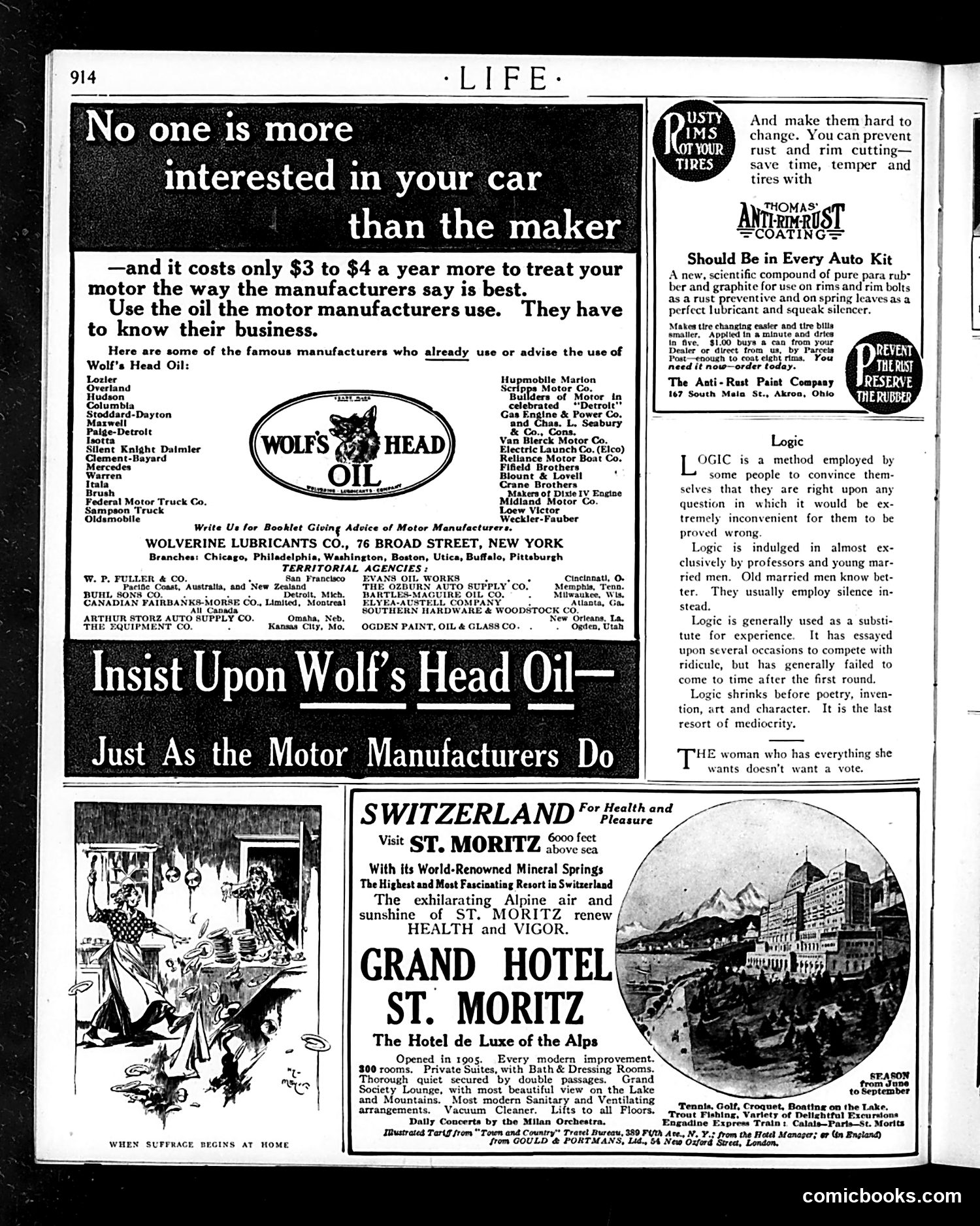
This page is primarily **advertising**, not satire or editorial content. The dominant advertisement promotes **Wolf's Head Oil** motor lubricant. The copy argues that using the manufacturer-recommended oil costs only "$3 to $4 a year more" but is worth it. The ad lists numerous automobile manufacturers who "already use or advise" Wolf's Head Oil, including Hudson, Packard, and others—a common advertising strategy of establishing credibility through endorsements. Below is a separate travel advertisement for the **Grand Hotel St. Moritz** in Switzerland, promoting its mineral springs, Alpine air, and luxury amenities. On the right is a brief essay titled "Logic" discussing how logic is misused as a substitute for experience, particularly by professors and young married men. The page contains no political cartoons or satirical commentary—it represents typical early 20th-century magazine advertising and filler content.
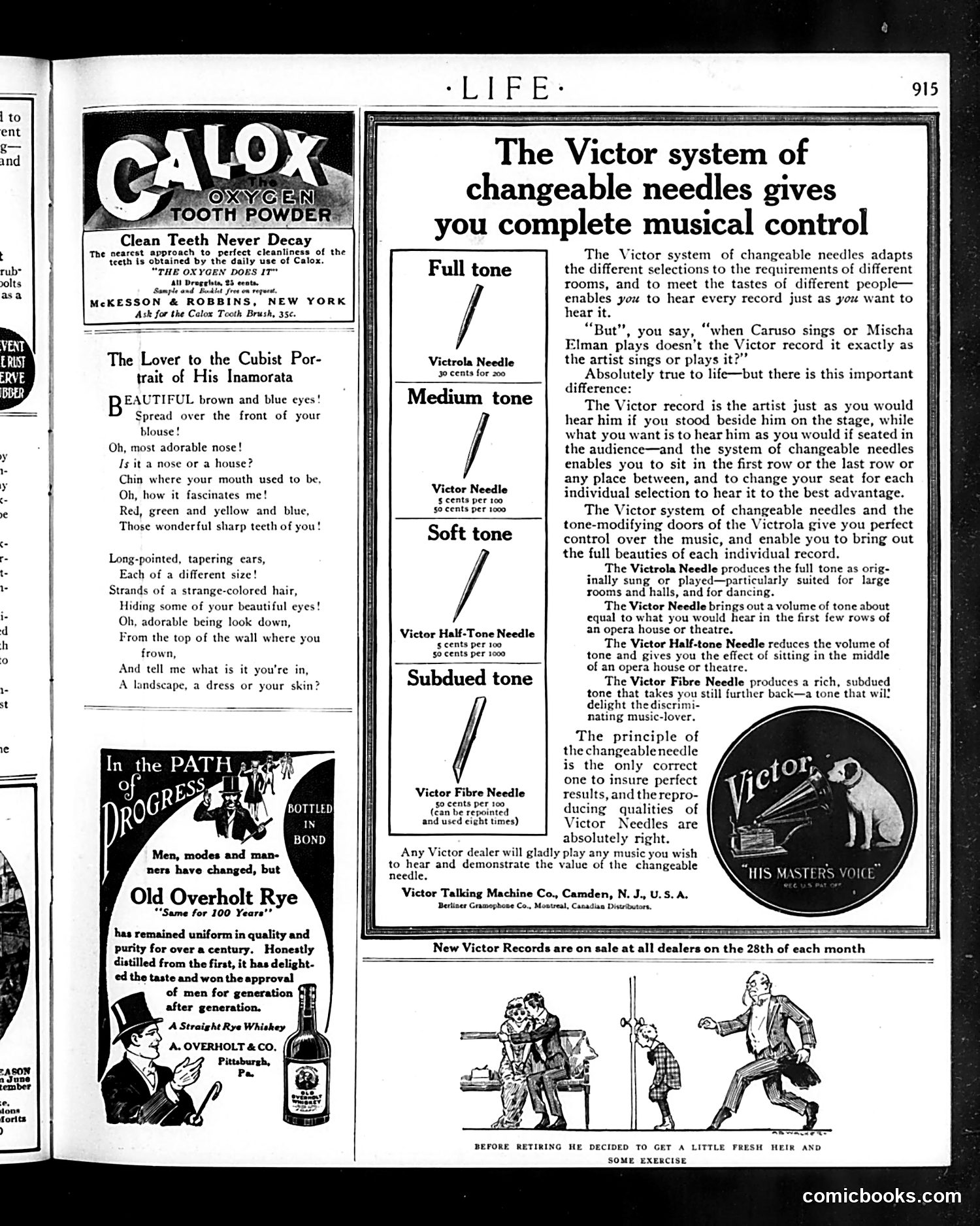
This page is primarily **advertising content** rather than political satire or comics. The dominant feature is a large Victor Victrola advertisement promoting their system of "changeable needles" that allegedly allows listeners to adjust the tone quality of phonograph recordings—from "full tone" to "soft tone" to "subsided tone." The smaller advertisements include: - **Calox Tooth Powder** (dental hygiene product) - **Old Overholt Rye Whiskey** (spirits brand) - A poem titled "The Lover to the Cubist Portrait of His Inamorata" (sentimental/romantic verse) - A cartoon at page bottom showing domestic comedy about exercise The page reflects early 20th-century consumer culture and product marketing rather than political commentary.
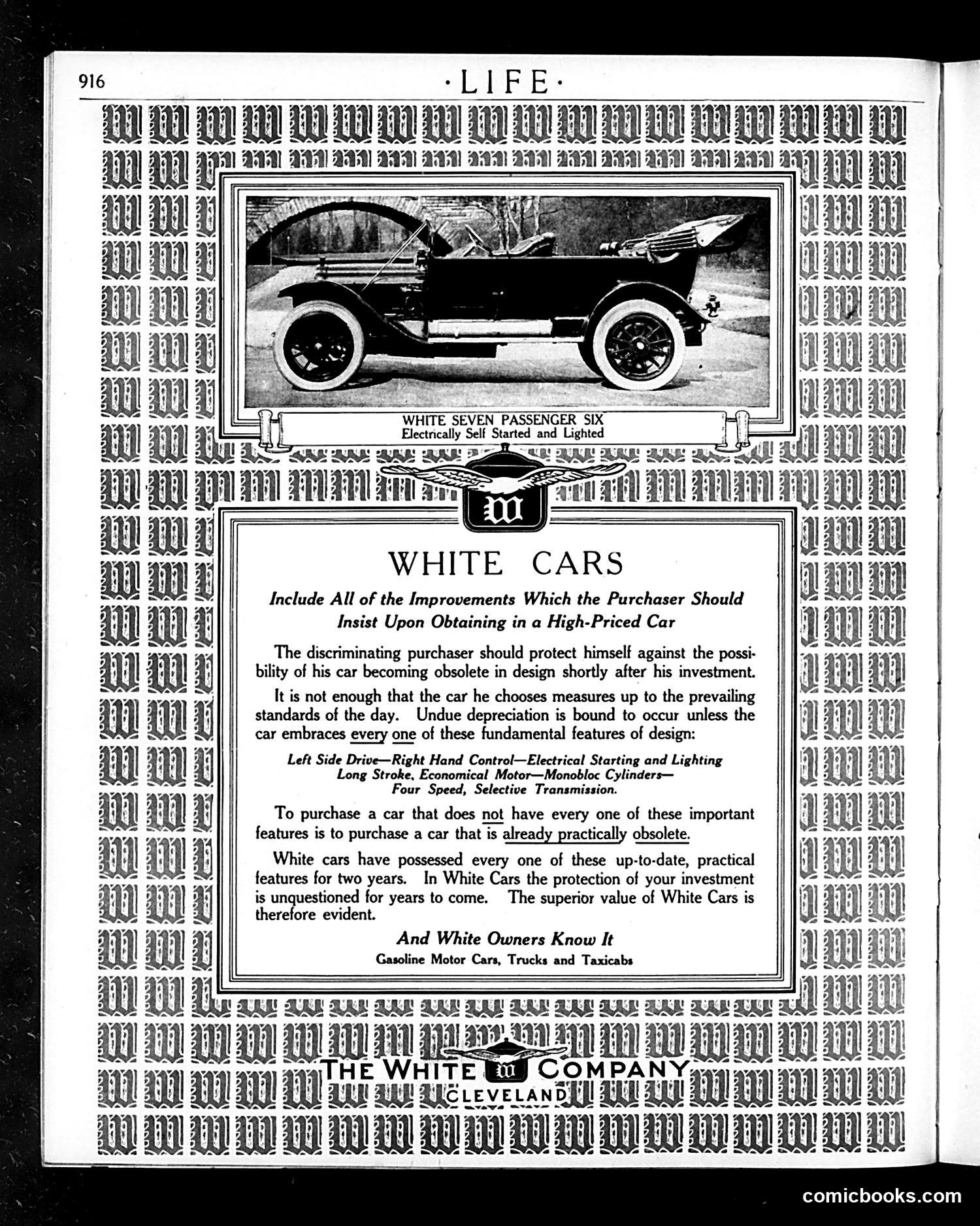
This page is primarily a **commercial advertisement**, not political satire. It promotes the White Motor Company's "Seven Passenger Six" automobile, manufactured in Cleveland, Ohio. The ad emphasizes that White Cars included modern features that were considered essential in high-end vehicles of the era: left-side drive, right-hand control, electrical starting and lighting, economical engines, and four-speed transmissions. The copy warns discriminating buyers against purchasing cars that might become "obsolete in design" shortly after purchase. The advertisement claims White Cars had possessed these "up-to-date, practical features for two years," positioning them as quality vehicles that would retain value—a significant selling point when automobile technology was rapidly evolving. The slogan "And White Owners Know It" emphasizes customer satisfaction and brand loyalty.
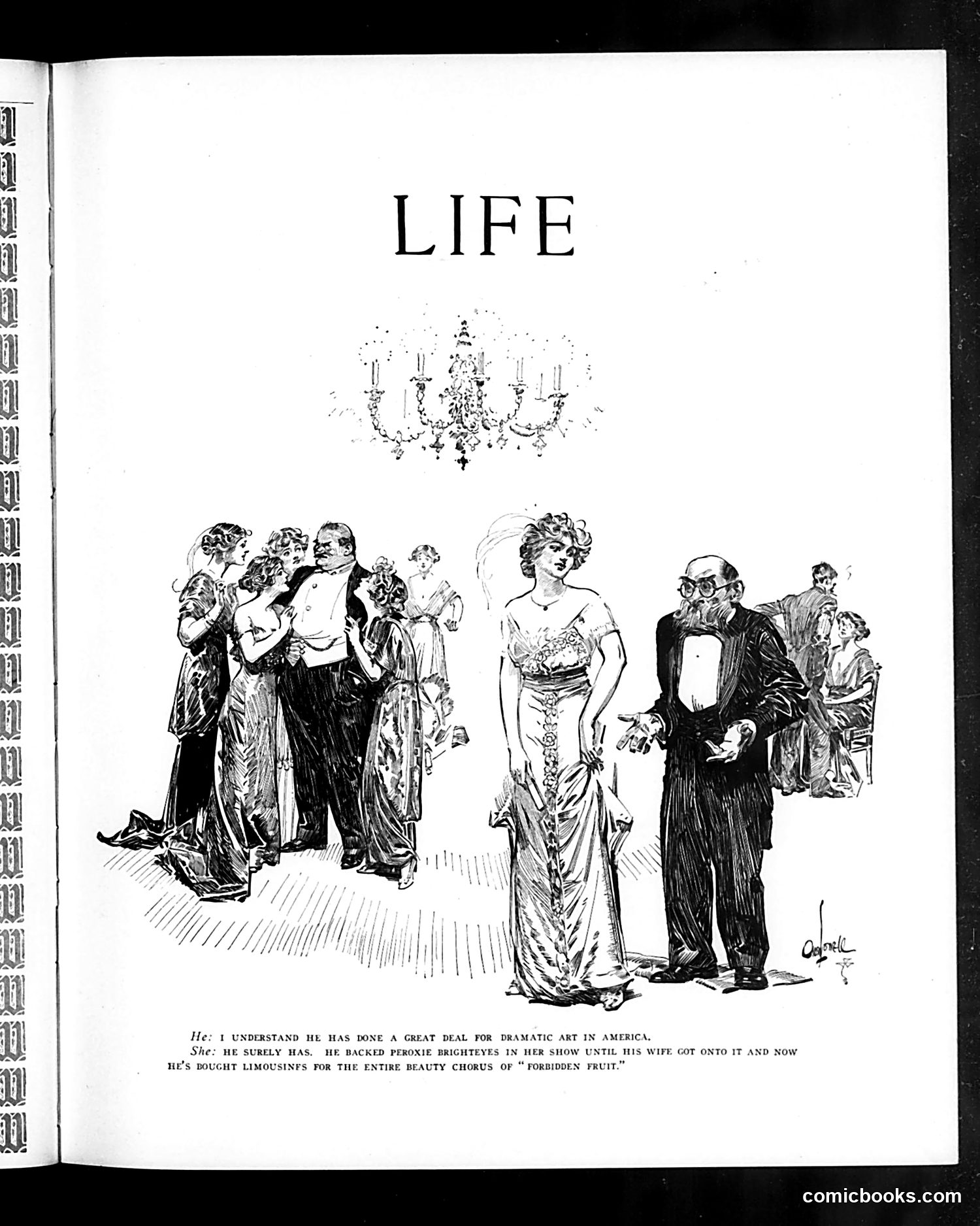
This is a satirical commentary on theatrical success and marital dynamics in early 20th-century America. The cartoon depicts a wealthy man who financed his wife's theatrical career in a play called "Forbidden Fruit." The satire mocks the husband's financial investment and the wife's apparent success—she's become so celebrated that he's now buying "limousines for the entire beauty chorus." The joke targets both the husband's willingness to bankroll his wife's show business ambitions and the superficial nature of theatrical fame and spending. The elegant figures and chandelier suggest high society, while the caption's sarcastic tone suggests the husband has become a financial victim of his wife's theatrical success, reducing him to merely funding her chorus line's transportation.
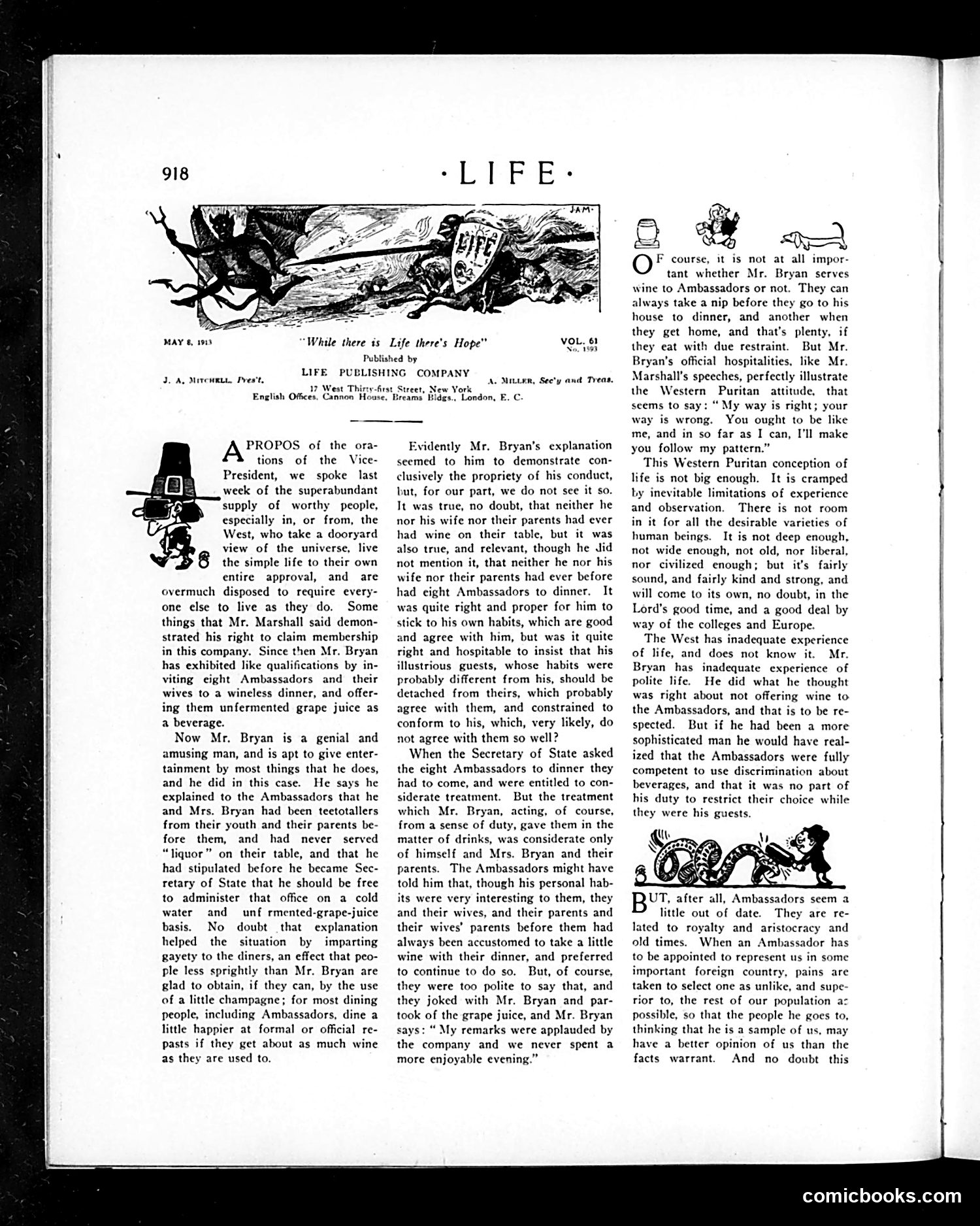
This 1915 *Life* cartoon satirizes Secretary of State William Jennings Bryan's entertaining eight foreign Ambassadors and their wives at dinner without serving wine—a notable choice given Bryan's well-known temperance advocacy. The satire targets the tension between Bryan's personal abstinence principles and diplomatic protocol. The text argues that while Bryan's gesture was "genial and amusing," it created an awkward situation for guests accustomed to wine at formal dinners. The joke centers on whether strict personal morality should dictate diplomatic hospitality. The cartoon mocks both Bryan's rigid adherence to his beliefs and the discomfort this caused his distinguished guests, treating a minor social controversy as emblematic of broader debates about Prohibition-era America imposing moral standards on others.
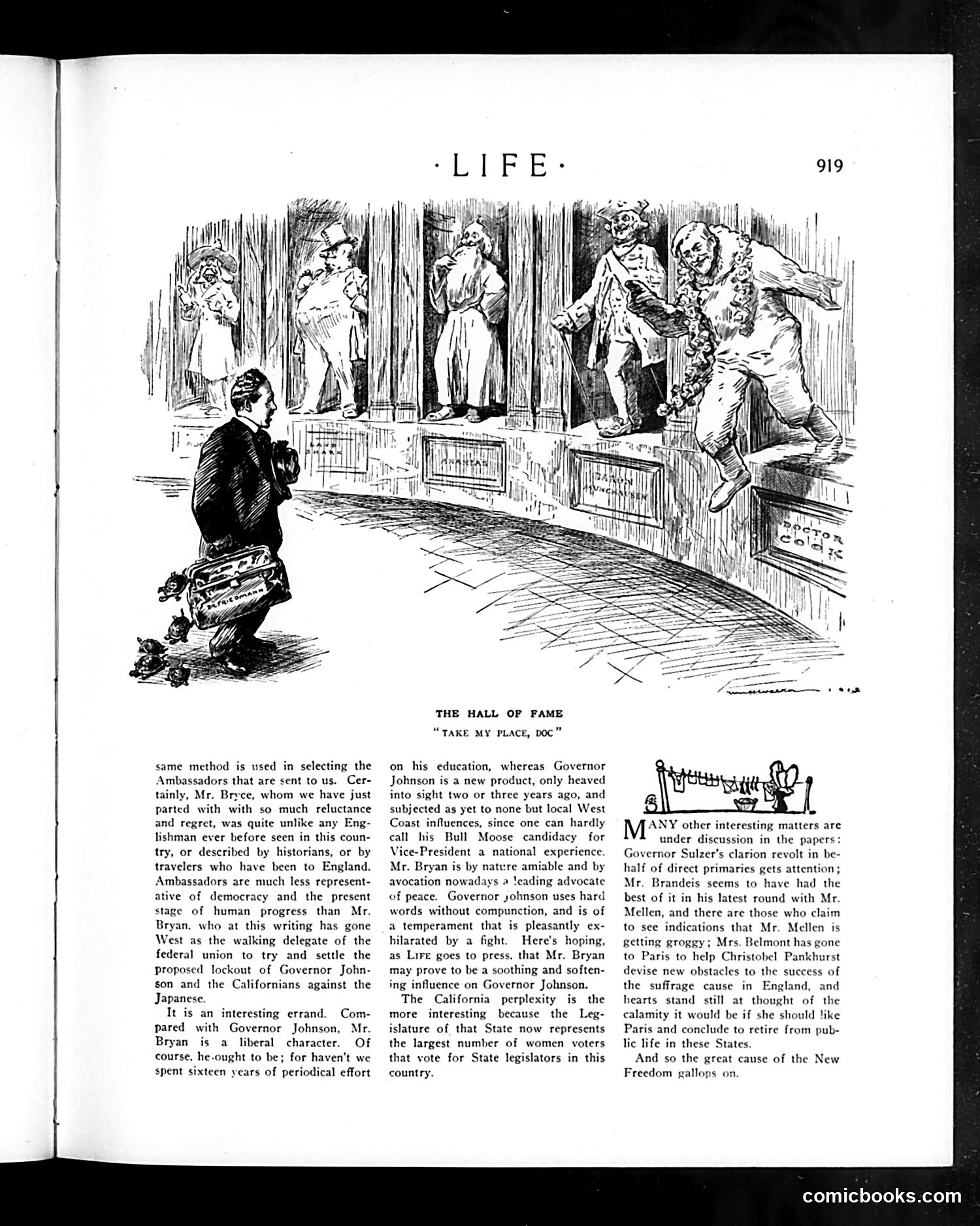
This cartoon satirizes the political ambitions of California Governor William Stephens Johnson and a rival named Bryan. The sketch shows a small man in a suit (likely Bryan) approaching a display of busts in what appears to be a hall of fame. The figures on the pedestals represent established political figures, with one apparently offering to step aside ("take my place, doc"). The accompanying text discusses Bryan as a "liberal character" and notes the competition between these political figures. The satire mocks the jostling for political prominence and the desire to secure a place in history among California's political elite. The cartoon suggests Bryan seeks to displace an established politician, treating political status as something literally exchangeable.
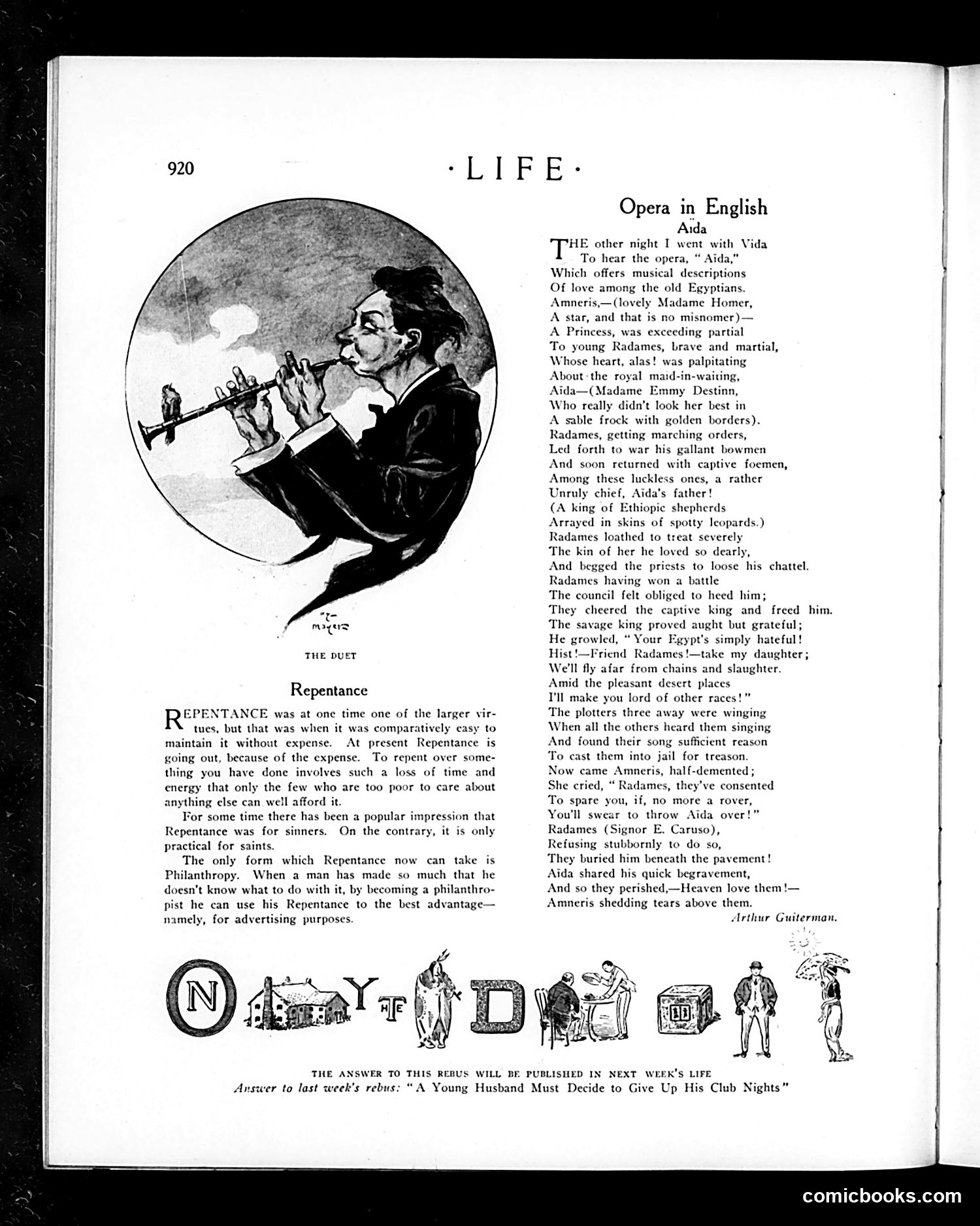
**"The Duet" Cartoon:** The illustration shows a caricatured man playing a flute while conducting an orchestra. The exaggerated facial features and style suggest this is satirizing a specific operatic or musical figure of the era, though the identity is unclear from the image alone. **"Opera in English" Section:** This is a humorous poem by Arthur Guterman about a production of Verdi's *Aida* performed in English. The satire mocks the experience of watching grand opera with English translations, following a melodramatic plot involving an Ethiopian king, Egyptian princess Aida, and romantic/political complications. The humor derives from treating the elaborate operatic narrative as absurdly overwrought entertainment. **"Repentance" Essay:** A brief philosophical piece questioning whether "Repentance" remains a practical virtue, suggesting it now serves primarily as advertising.
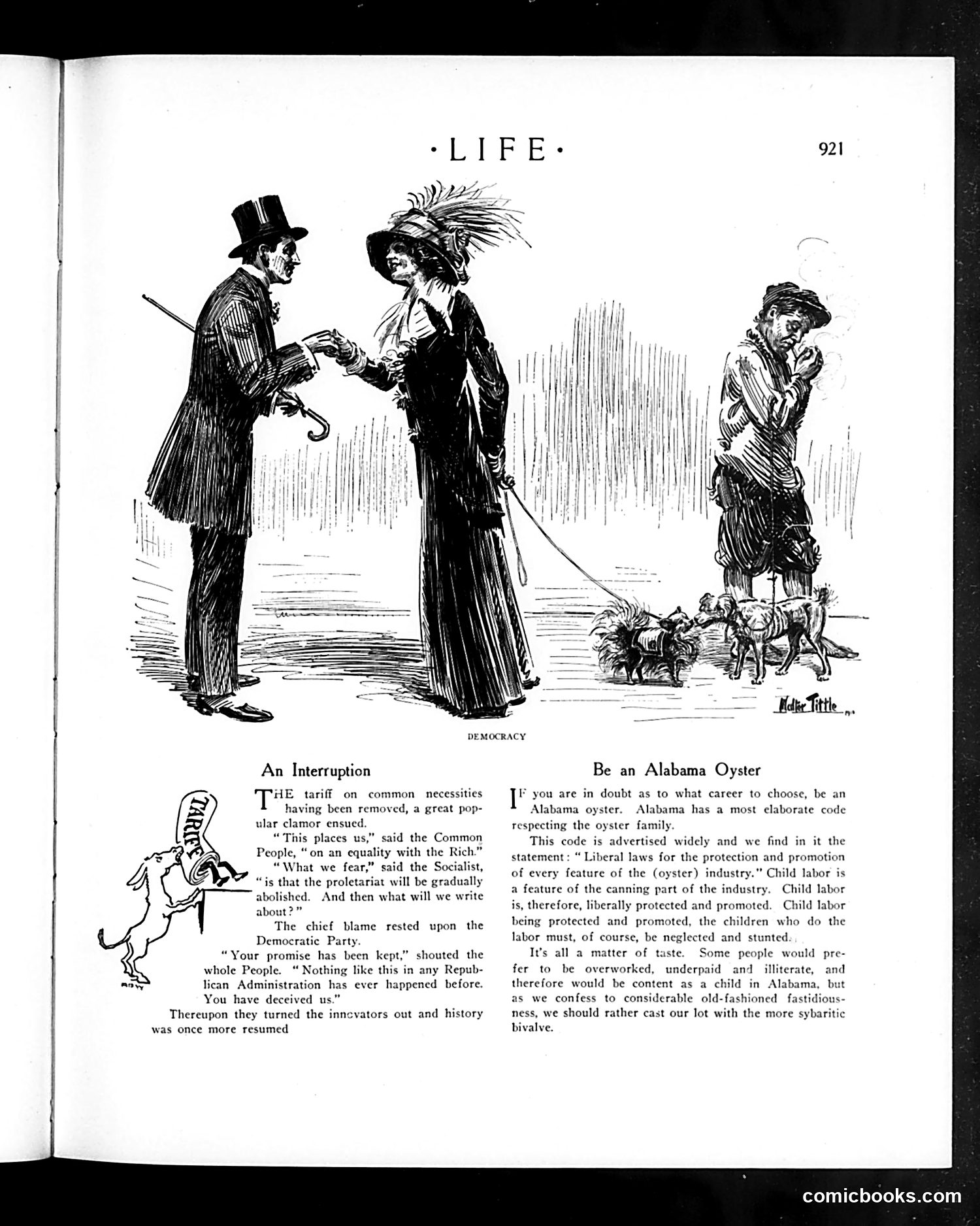
The top cartoon depicts a street scene labeled "DEMOCRACY" showing three figures: a well-dressed man in a top hat (likely representing wealth or Republican interests), a woman in fashionable dress, and a boy with small dogs on a leash. The illustration satirizes social inequality and class divisions within democracy. Below are two separate pieces: "An Interruption" mocks political debate about tariffs and protectionism, with the Common People, Rich People, and Socialists all making claims. "Be an Alabama Oyster" sarcastically critiques Alabama's child labor laws by praising their protection of oyster industry workers—likely exposing how these "protections" are inadequate or cynically applied. Both pieces attack hypocrisy in Progressive Era politics.
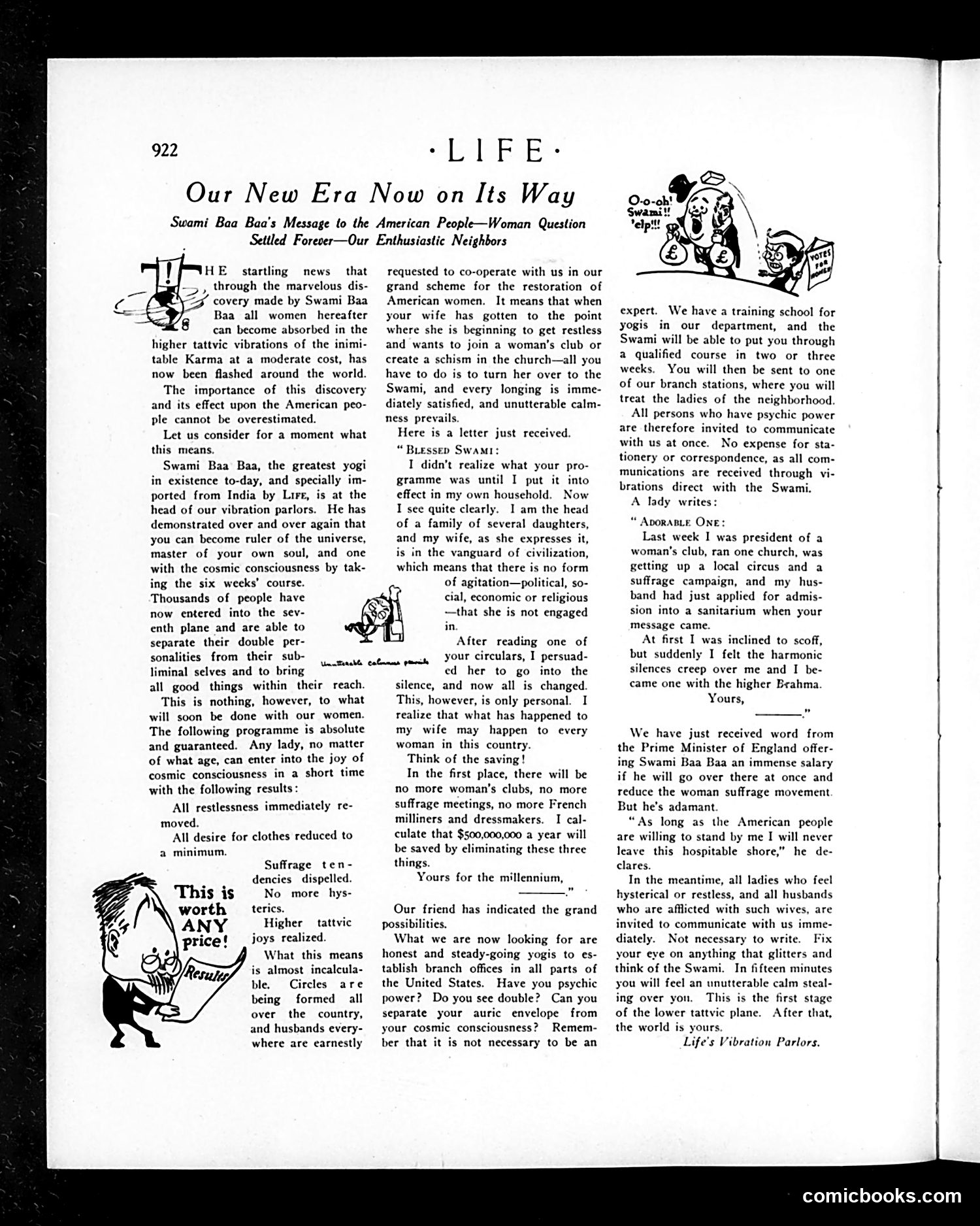
This page satirizes Swami Baa Baa, an Indian spiritual figure who had apparently gained popularity in America, particularly among women seeking self-improvement. The cartoon ridicules the "cosmic consciousness" movement he promoted. The left cartoon shows a smug figure labeled "This is worth ANY price!" — mocking how people eagerly paid for dubious spiritual instruction. The text describes Swami Baa Baa's promises to cure societal ills through yogic practices and female empowerment, while the response letters reveal the absurdity: one woman confused his teachings, another experienced only vague mystical feelings. The satire targets both the charlatan guru exploiting Americans' spiritual hunger and wealthy women chasing trendy occultism while neglecting practical concerns. The "$500,000,000 a year" saved claim exemplifies the exaggerated promises Life mocks throughout.
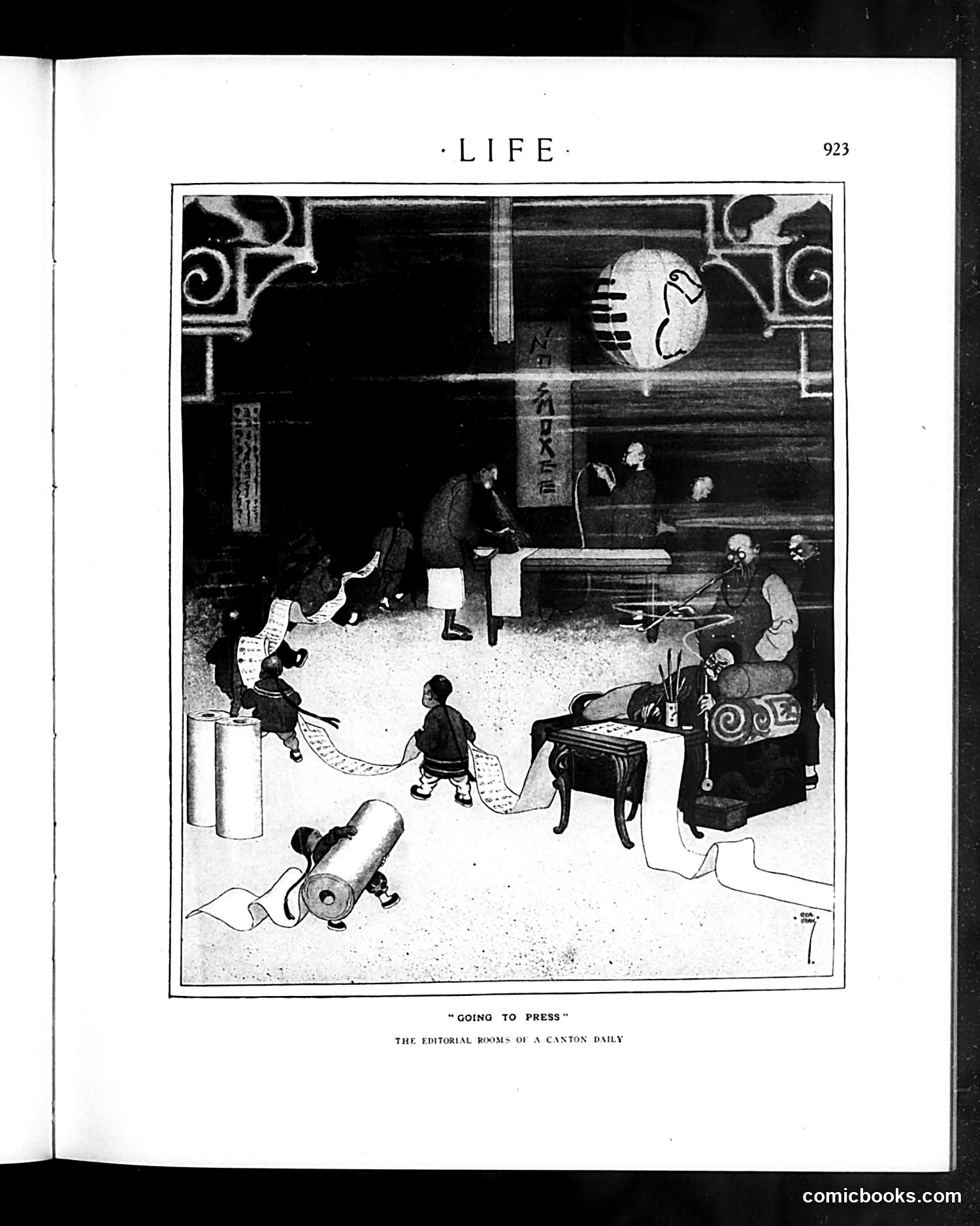
This satirical cartoon depicts the editorial offices of a Canton (Ohio) newspaper preparing content for publication. The scene shows various figures engaged in newspaper work—some at desks, others handling what appear to be printing materials and mechanical equipment (notably a large printing press in the lower left). The humor likely satirizes the chaos and absurdity of newspaper production, with exaggerated characters in frenetic activity. The Asian architectural elements visible in the building's decoration suggest this may reference a specific Canton publication or time period with notable Chinese-American community presence. Without additional historical context about Canton's specific newspapers or notable editorial controversies of this era, the exact satirical target remains somewhat unclear, though it appears to mock journalistic practices generally.
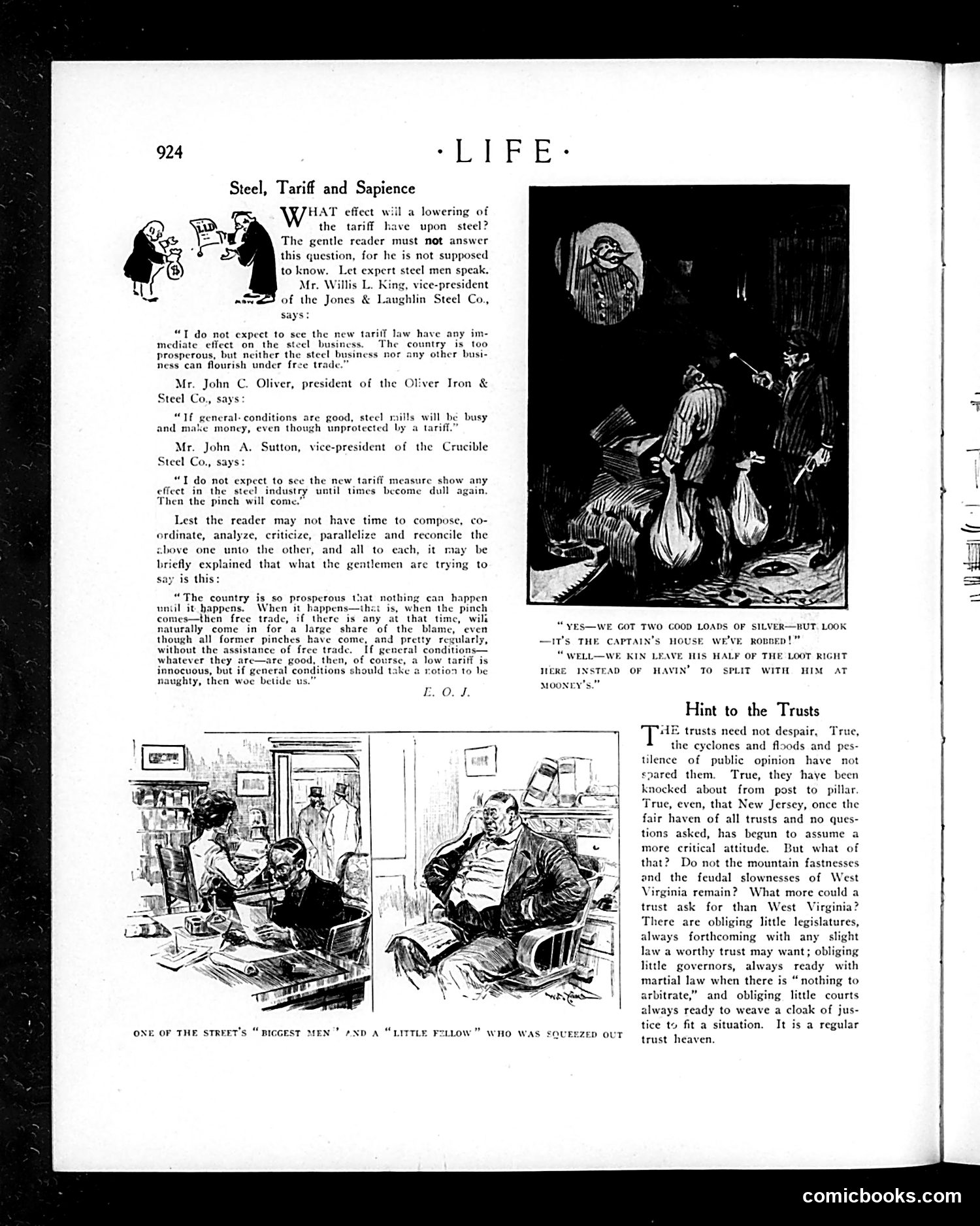
This page satirizes steel industry executives' contradictory statements on tariff policy. Three steel company vice-presidents and presidents offer conflicting views on how lowering tariffs will affect business—some claim prosperity shields them regardless, others suggest problems only appear during downturns. Life's editors mock this circular logic: the executives essentially argue tariffs don't matter when times are good, but blame free trade when conditions worsen, creating convenient excuses either way. The accompanying pirate cartoon reinforces the satire, depicting criminals dividing stolen silver while discussing keeping a captain's share rather than splitting it—a parallel to how business leaders manipulate economic policy arguments for self-interest. The "Hint to the Trusts" section similarly criticizes monopolies for exploiting weak West Virginia governance (obliging legislatures, governors, and courts) as a regulatory safe haven.
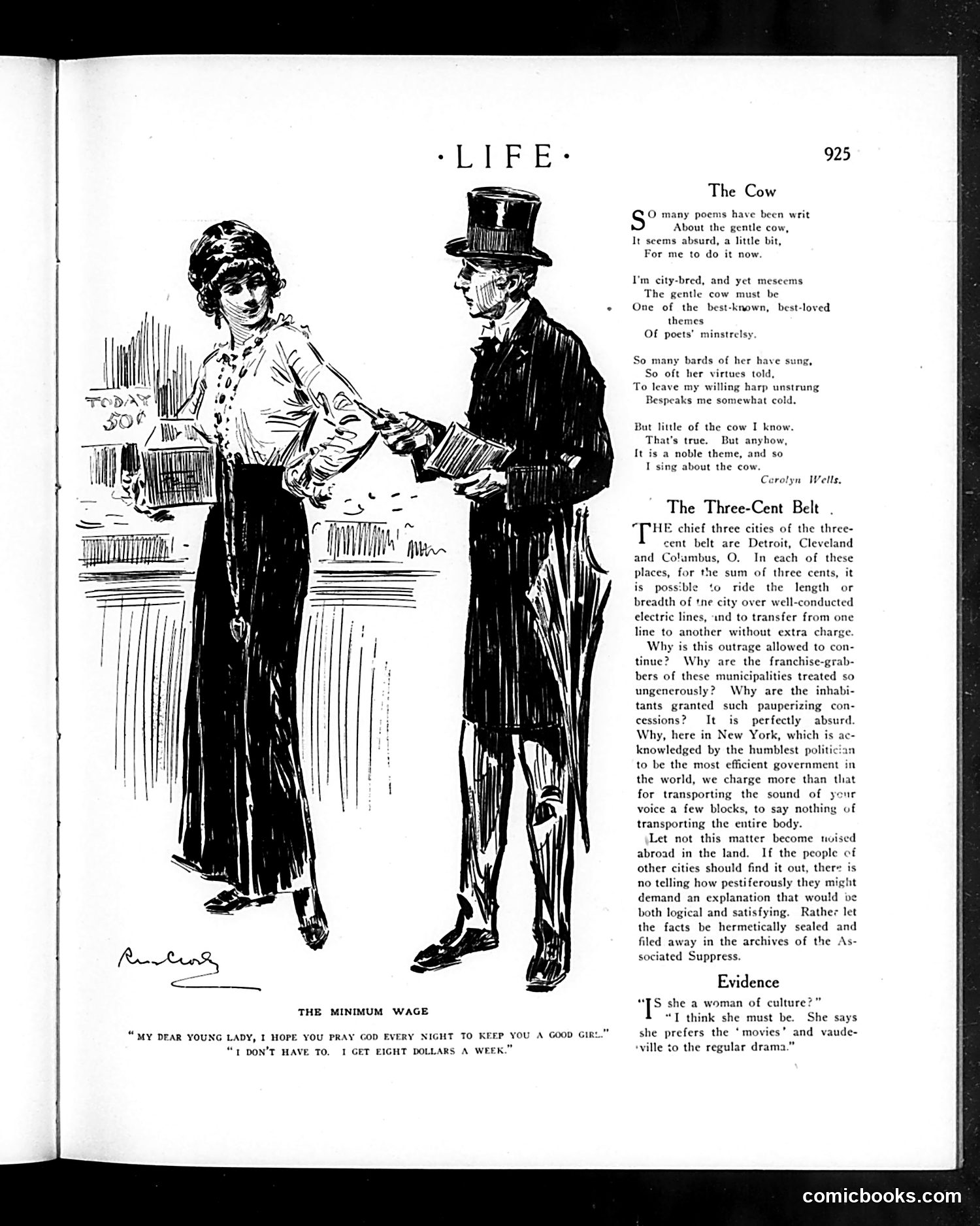
**"The Minimum Wage" cartoon** depicts a well-dressed gentleman (likely a wealthy employer or moralist) lecturing a young working woman about virtue and prayer. Her response—that she doesn't need to pray because she earns eight dollars weekly—is satirical commentary on labor economics. The joke suggests that adequate wages (eight dollars weekly was the minimum wage debate of the era) provide material security that makes moral exhortation from the privileged unnecessary. It mocks paternalistic attitudes toward working-class women. **"The Three-Cent Belt"** article sarcastically criticizes New York's public transportation pricing. Three Midwestern cities (Detroit, Cleveland, Columbus) offer cheap three-cent fares with transfers, while New York charges more. The author ironically praises New York's "efficiency" while suggesting the city exploits riders—and warns that if other cities discover this disparity, they might demand logical explanations New York cannot provide. Both pieces satirize economic inequality and institutional hypocrisy common to early 20th-century America.
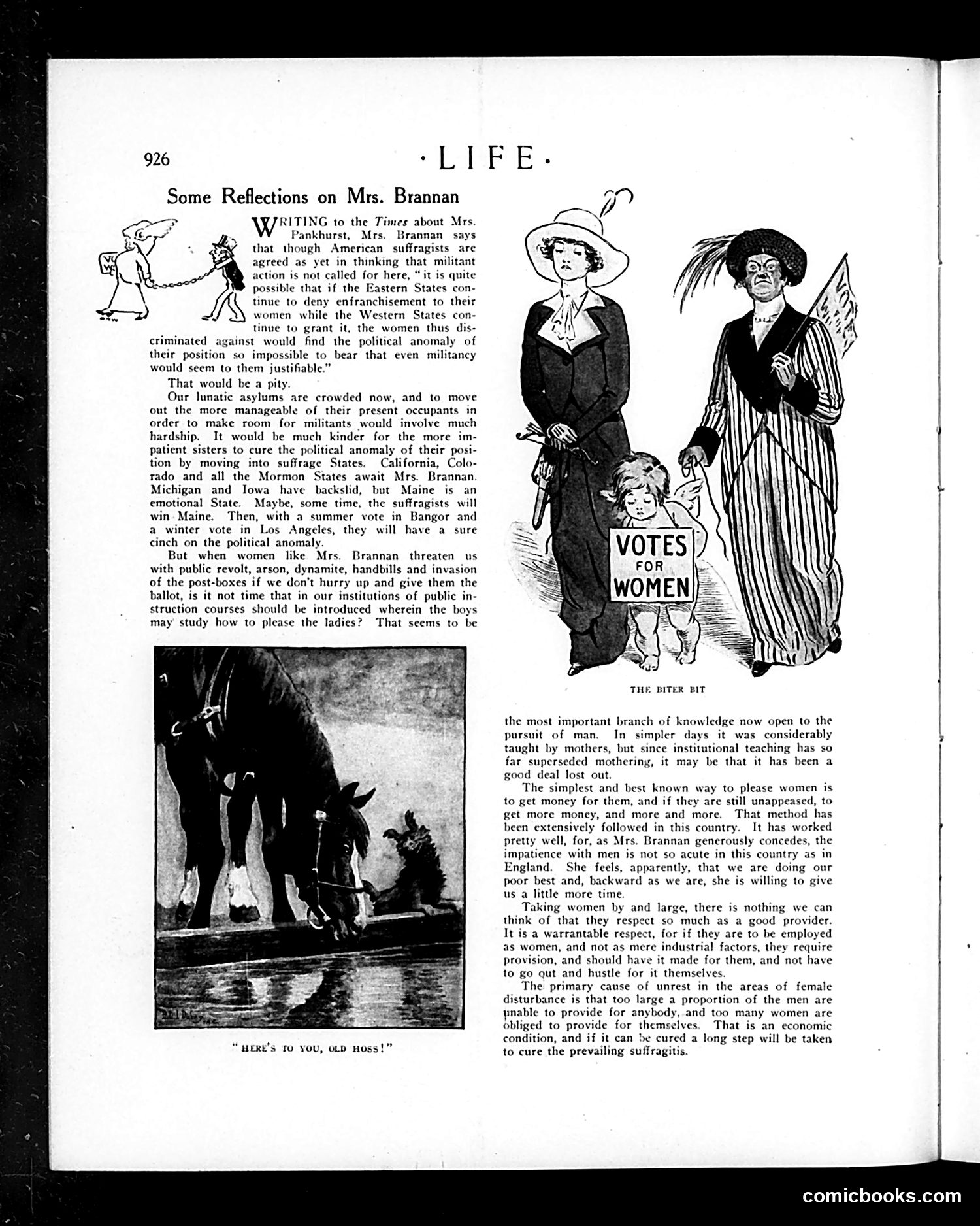
This satirical piece mocks suffragist Constance Brannan's warning that American women might resort to militant tactics (like those of British suffragists led by Emmeline Pankhurst) if denied voting rights across all states. The cartoon "THE BITER BIT" depicts three figures—likely representing suffragists of different generations—carrying a sign reading "VOTES FOR WOMEN," with the imagery suggesting they are the "bitter" ones being satirized. The author's argument is sarcastically dismissive: he suggests militant suffragists belong in asylums, recommends women simply relocate to pro-suffrage states, and proposes teaching boys "how to please the ladies" instead. His core argument reduces women's political demands to economic dependency—women want votes only because men don't provide adequately for them. He frames female unrest as an "economic condition" rather than a justice issue, ultimately trivializing women's political aspirations as complaints about money and male providers. The satire targets both the suffragists and, through exaggeration, the paternalistic attitudes dismissing their cause.
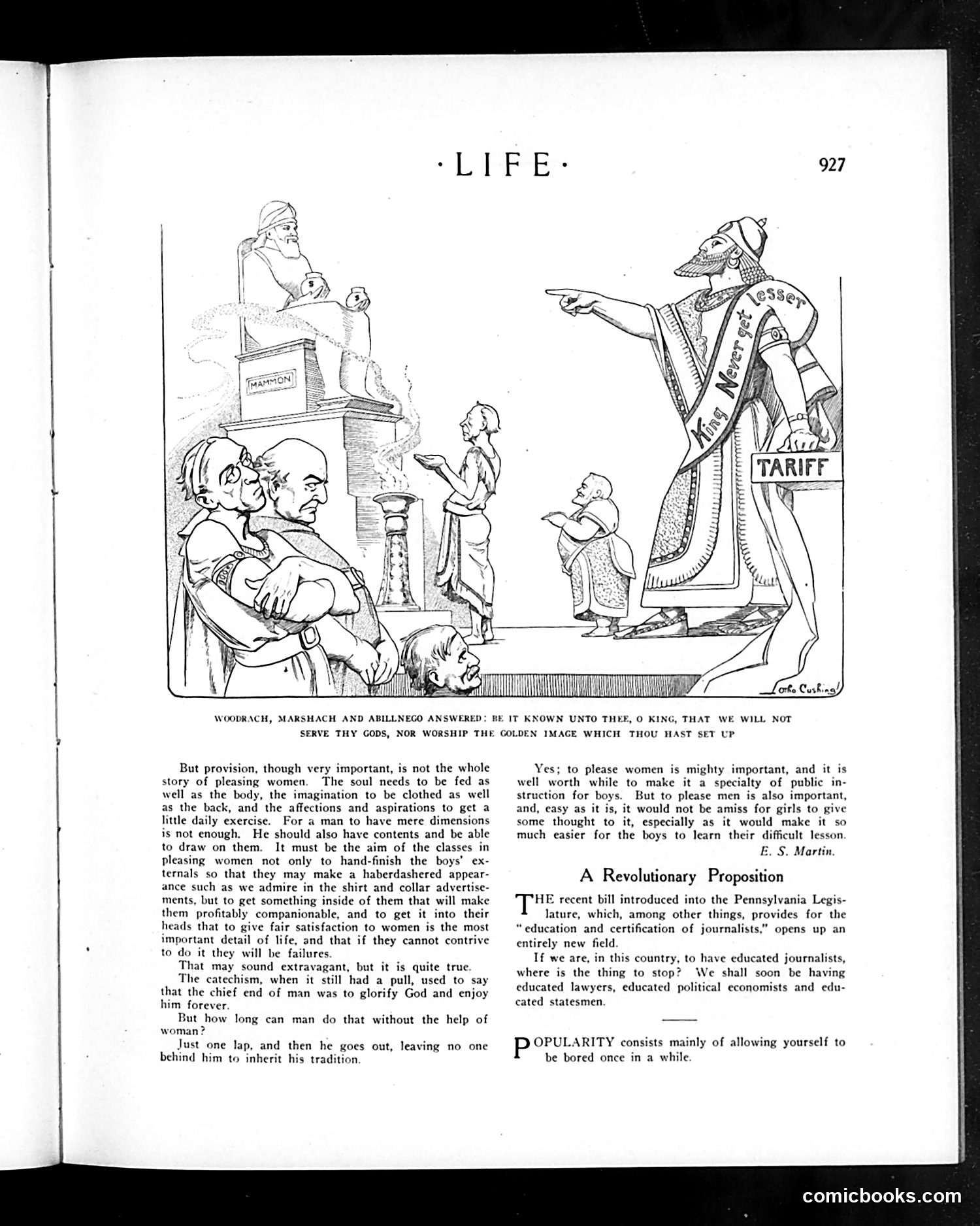
The cartoon depicts a biblical scene (Shadrach, Meshach, and Abednego refusing to worship King Nebuchadnezzar's golden idol) as satire about resisting authority and false worship. A tall figure labeled "Tariff" points commandingly while common people below refuse to bow, suggesting the tariff is an idol citizens should reject. The accompanying text by E.S. Martin discusses educating boys to please women, then satirizes a Pennsylvania bill proposing "education and certification of journalists." The satire suggests that if we start certifying journalists as professionals, we'll logically need educated lawyers, economists, and statesmen—implying this represents dangerous or absurd governmental overreach into professions previously unregulated. The piece mocks the progressive impulse to professionalize and standardize occupations through formal education.
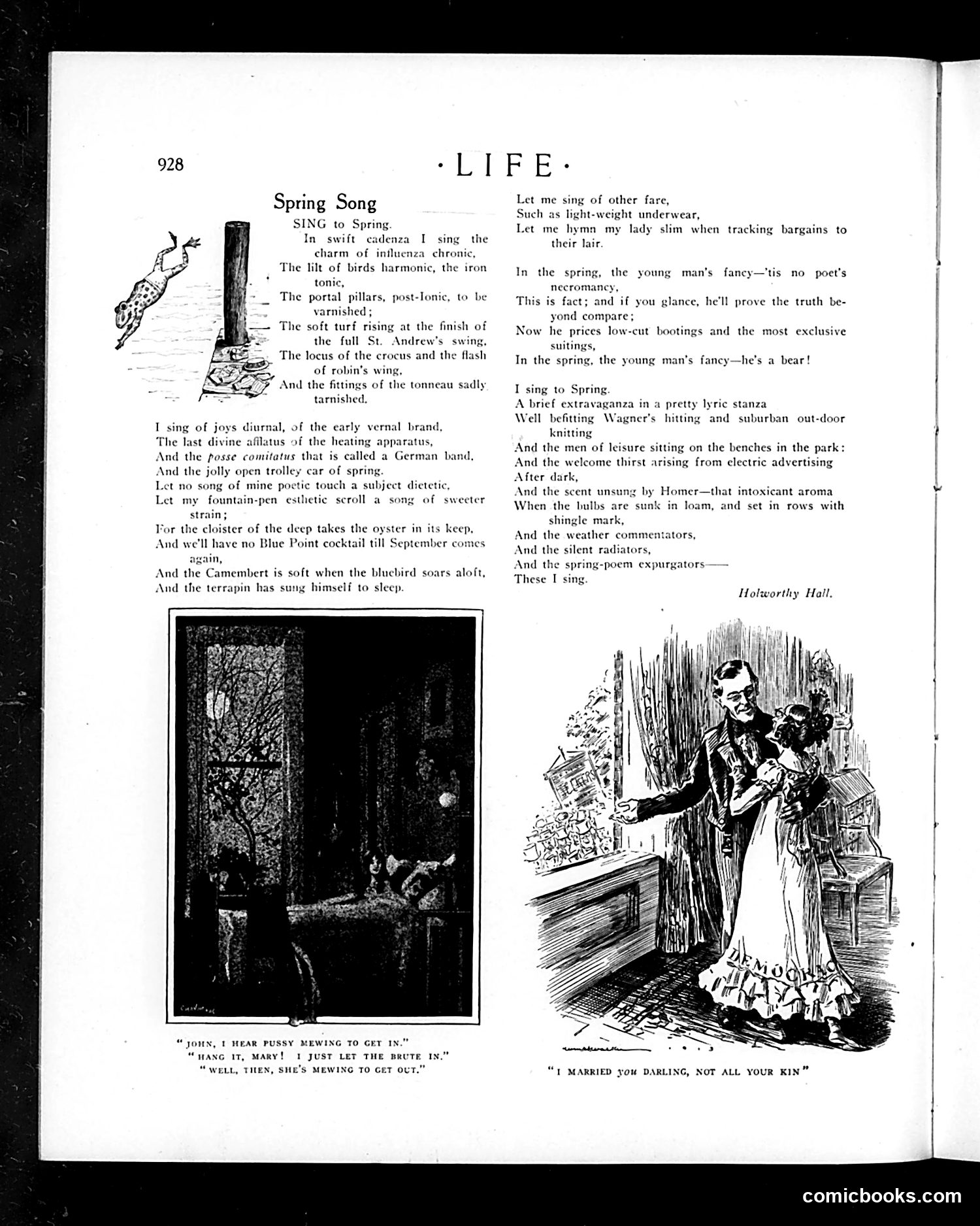
This page contains humorous spring-themed poetry mocking contemporary consumer culture and domestic life. The main poem "Spring Song" parodies romantic spring poetry by cataloging mundane modern concerns: influenza, heating systems, German bands, trolleys, oysters, and underwear shopping. It satirizes how commercial interests have displaced traditional poetic sentiments about spring. The two cartoons below offer domestic humor. The left cartoon depicts a marital disagreement over a cat entering/exiting the house—a relatable domestic absurdity. The right cartoon, titled "Holworthy Hall," shows a man addressing a woman about her relatives, with the caption "I married you darling, not all your kin"—mocking in-law complications. Together, the content humorously critiques how modern spring has become less about nature and romance, and more about shopping, gadgets, and domestic irritations.
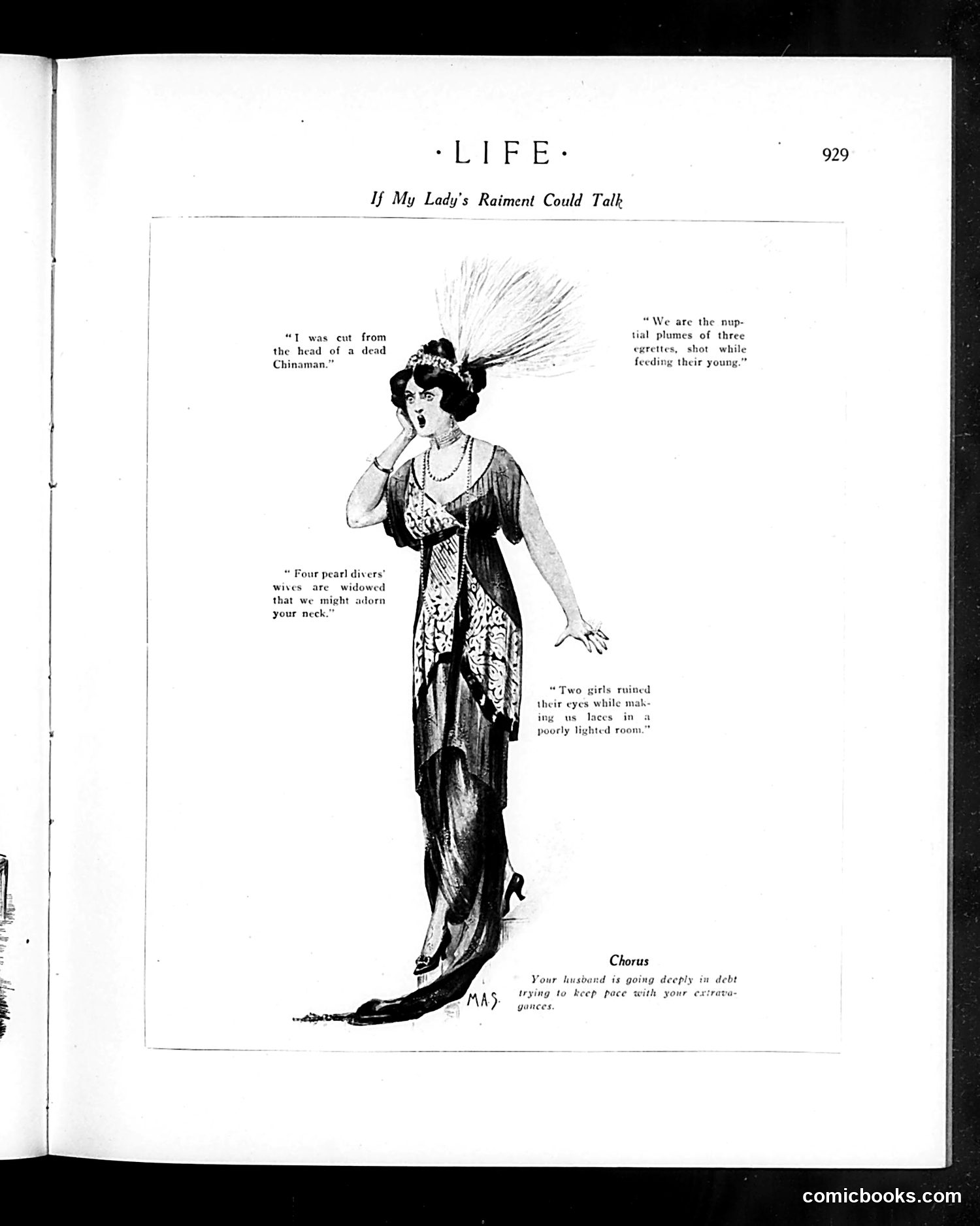
This satirical piece criticizes wealthy women's fashion consumption by imagining luxury garments confessing their dark origins. The illustration shows an elegantly dressed woman whose accessories each have a "voice": - **Feathered hat**: Made from egrets shot while nesting - **Hair ornament**: Cut from a dead Chinese man's head - **Pearl necklace**: Obtained through pearl divers' wives' deaths - **Lace trim**: Made by young women who damaged their eyesight in poor working conditions The **Chorus** delivers the moral: the husband goes into debt funding his wife's extravagance. The satire targets both the cruelty embedded in luxury fashion and the conspicuous consumption of wealthy women. It reflects early 20th-century Progressive-era concerns about labor exploitation, animal welfare, and the environmental/human costs of fashion—while also critiquing women's spending habits as financially irresponsible.
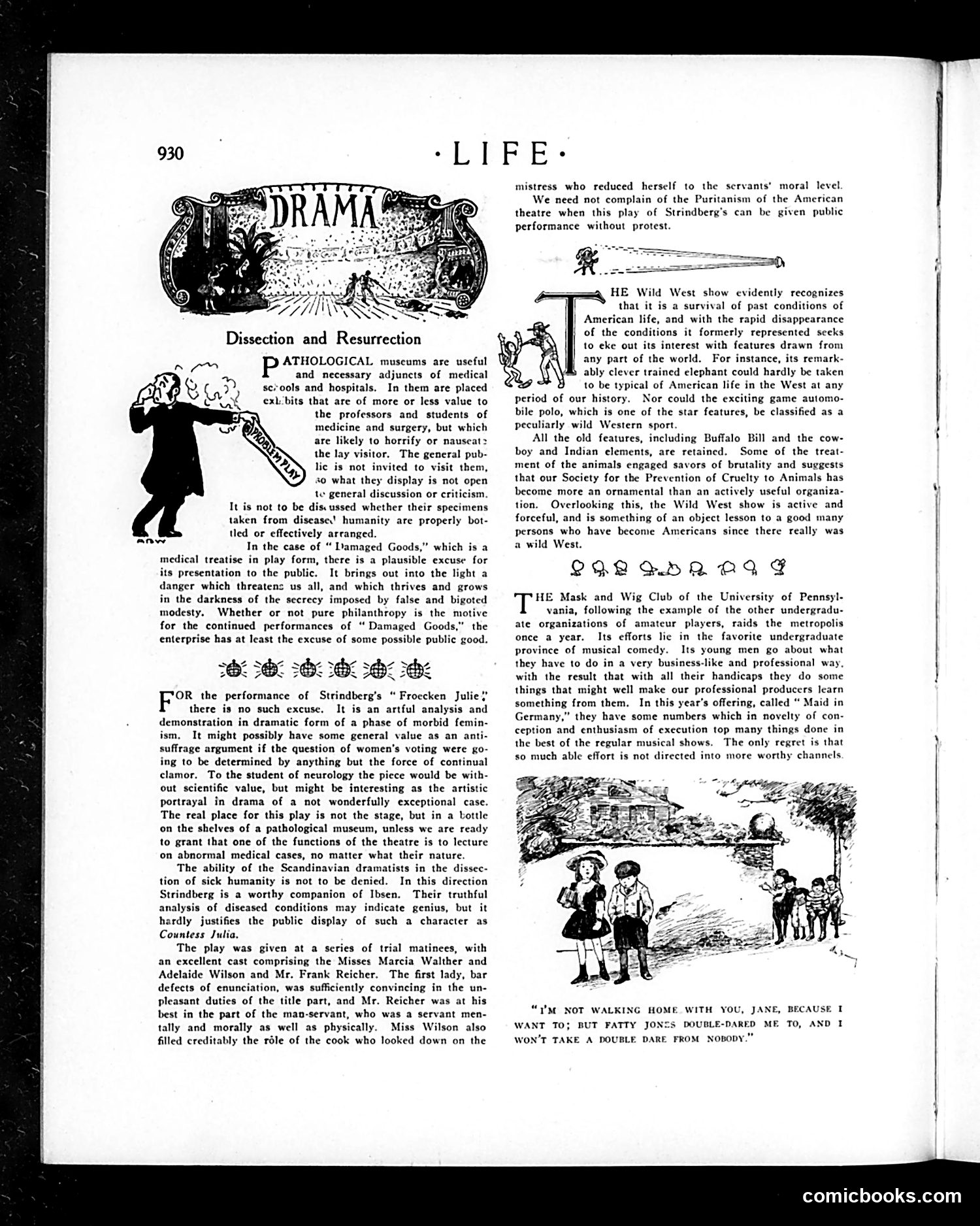
This page critiques theatrical productions through two reviews: **"Dissection and Resurrection"** attacks Strindberg's *Fräulein Julie*, arguing the play—depicting a noblewoman's sexual/moral degradation with her servant—belongs in a "pathological museum," not on stage. The critic distinguishes between *Damaged Goods* (which educates about venereal disease for public good) and Strindberg's work, which merely dissects "morbid feminism" and abnormal psychology without justification. The review sarcastically notes America's supposed "Puritanism" while allowing such morally transgressive content. **The Wild West section** observes Buffalo Bill's show adapting to changing times—adding trained elephants and automobile polo since actual Western conditions have disappeared. The critic notes this contradicts the show's authenticity claims, though it retains Buffalo Bill, cowboys, and Native American elements. Both reviews showcase *Life*'s satirical voice: using exaggeration and irony to critique what the editors view as artistic or commercial excess.
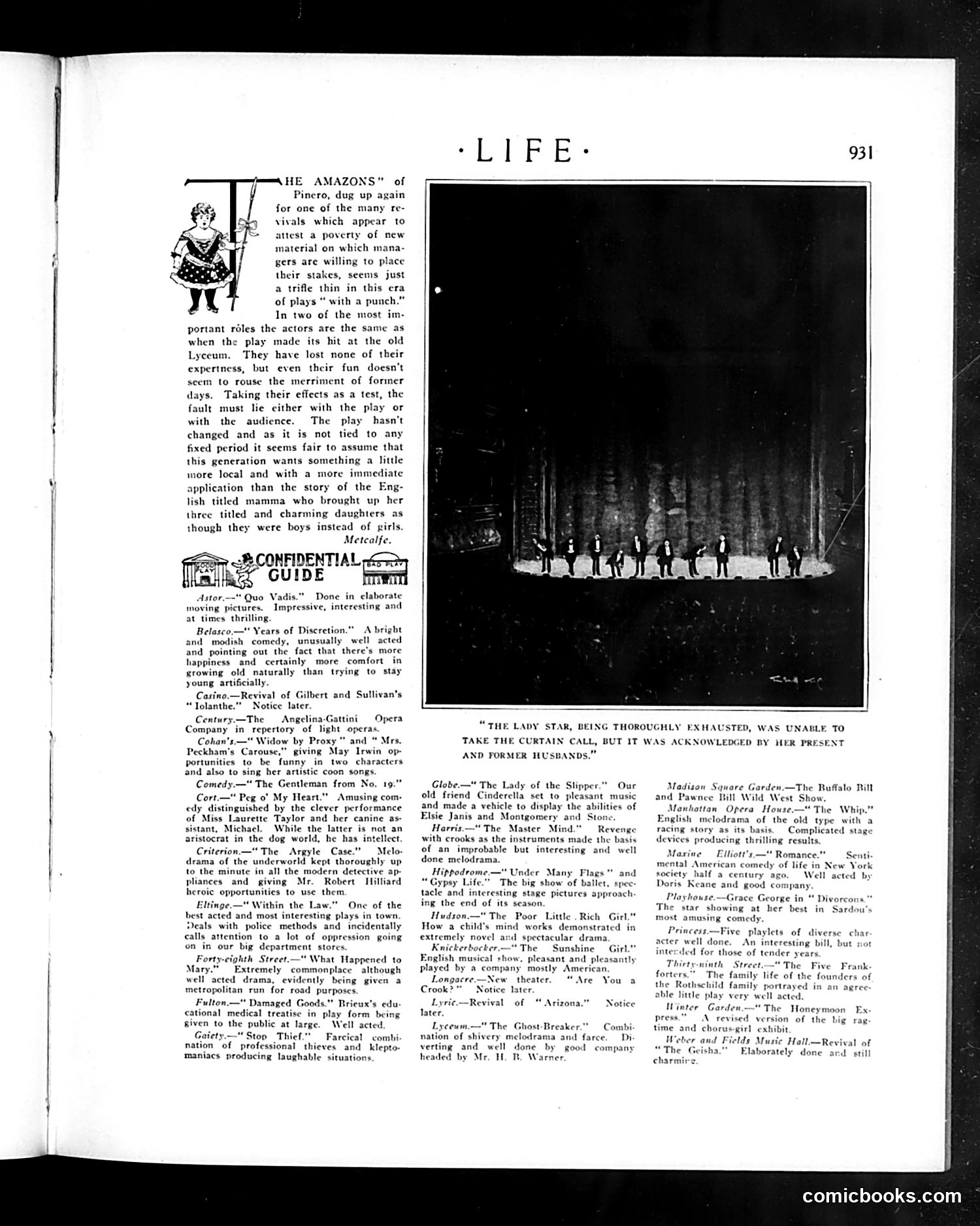
This page contains theater reviews rather than political cartoons. The small illustration at top left depicts a woman in classical dress—likely representing "The Amazons," a revival of Arthur Wing Pinero's play being reviewed. The critic (signed Metcalf) argues the play feels dated. Originally a hit at London's Lyceum Theatre with the same actors, the revival fails to entertain modern audiences. Metcalf suggests the problem isn't the unchanged script but rather contemporary tastes: audiences now want plays with more immediate, local relevance rather than stories about English aristocratic mothers raising titled daughters as boys. The "Confidential Guide" section provides brief reviews of New York theaters and current productions, ranging from Shakespeare revival to melodrama to vaudeville—offering readers a entertainment guide for the era. The photograph shows a stage scene, likely from one of the reviewed productions.
This satirical cartoon depicts a massive crowd protest at what appears to be the U.S. Capitol building. The demonstrators carry signs referencing various labor and working-class grievances, including visible placards mentioning "Dish-Dryers Lubrication League," "Unmagnified Sardine Workers," and "Men's Underwear Society." The cartoon satirizes the proliferation of absurdist or frivolous labor organizations and protest movements. By depicting ridiculous, made-up unions and leagues alongside legitimate worker concerns, the artist mocks either the proliferation of minor worker grievances being elevated to political importance, or satirizes the legitimacy of labor movements themselves. The chaotic scene suggests satire about democratic participation and organized protest becoming overwhelming or trivial.
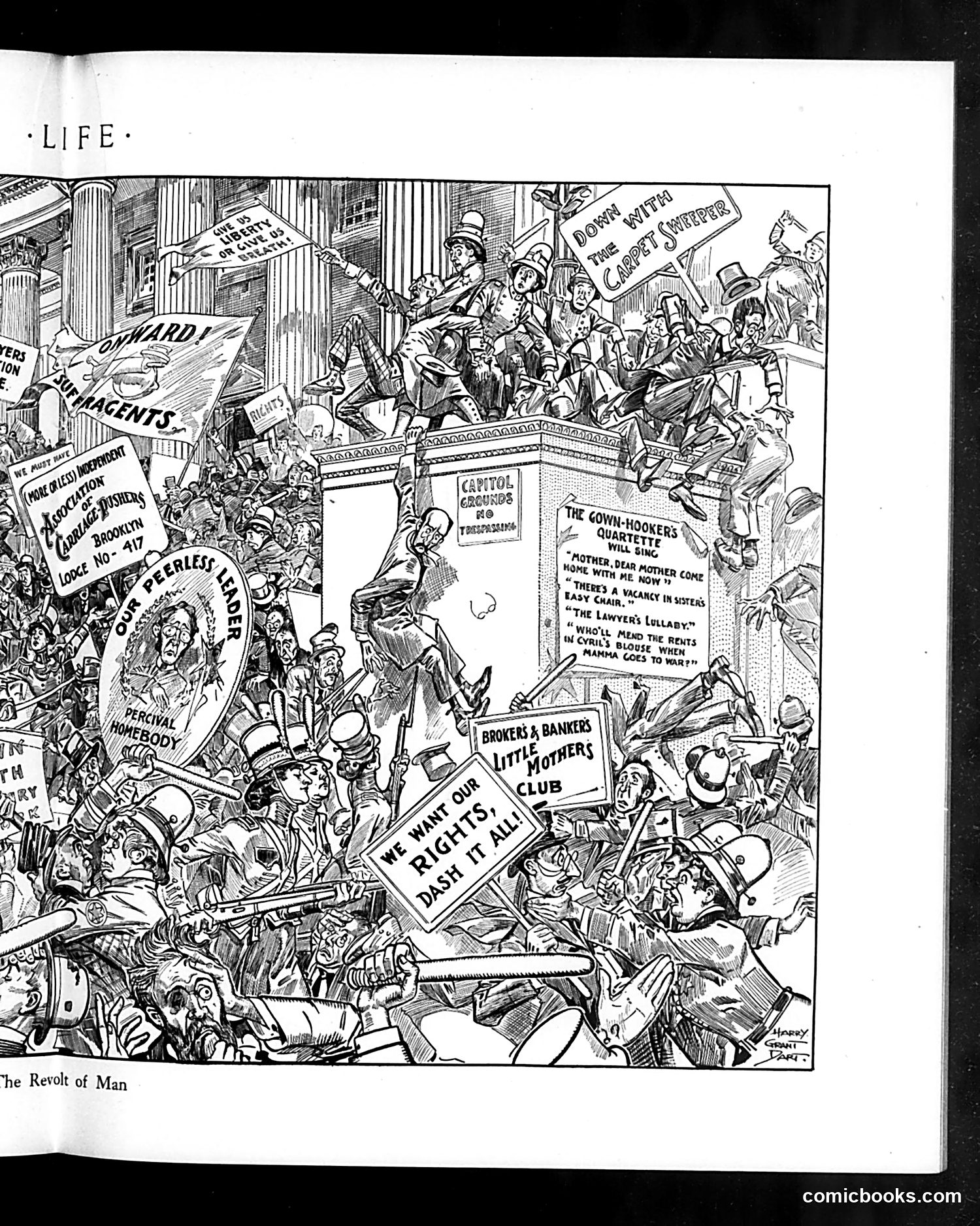
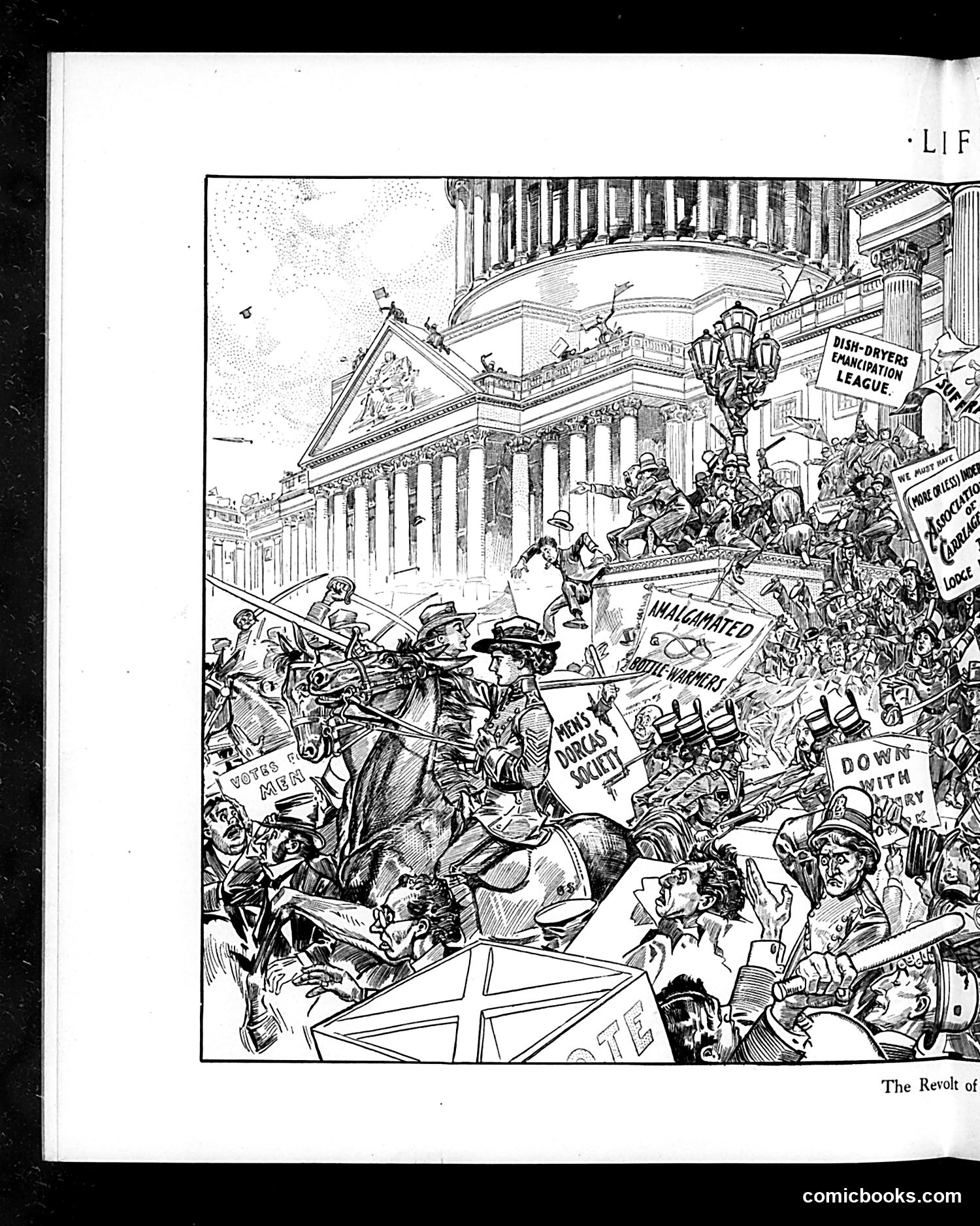
This satirical cartoon depicts a massive, chaotic crowd uprising at the Capitol building. The crowds carry protest signs demanding various rights and reforms: "We Want Our Rights! Dash It All!!!" and signs referencing "Brokers & Bankers," "Little Mothers Club," and theatrical performances (the Gown-Hookers Quartette). The satire appears to mock post-WWI social upheaval—competing interest groups, labor movements, and various constituencies all simultaneously demanding attention and concessions from government. The dense, frenzied composition emphasizes cacophony and competing demands rather than unified purpose. The title "The Revolt of Man" likely suggests common people rising against establishment power, though the cartoon's tone suggests satirical skepticism about whether such fragmented demands can produce meaningful change. This reflects early 20th-century anxieties about mass movements and democratic chaos.
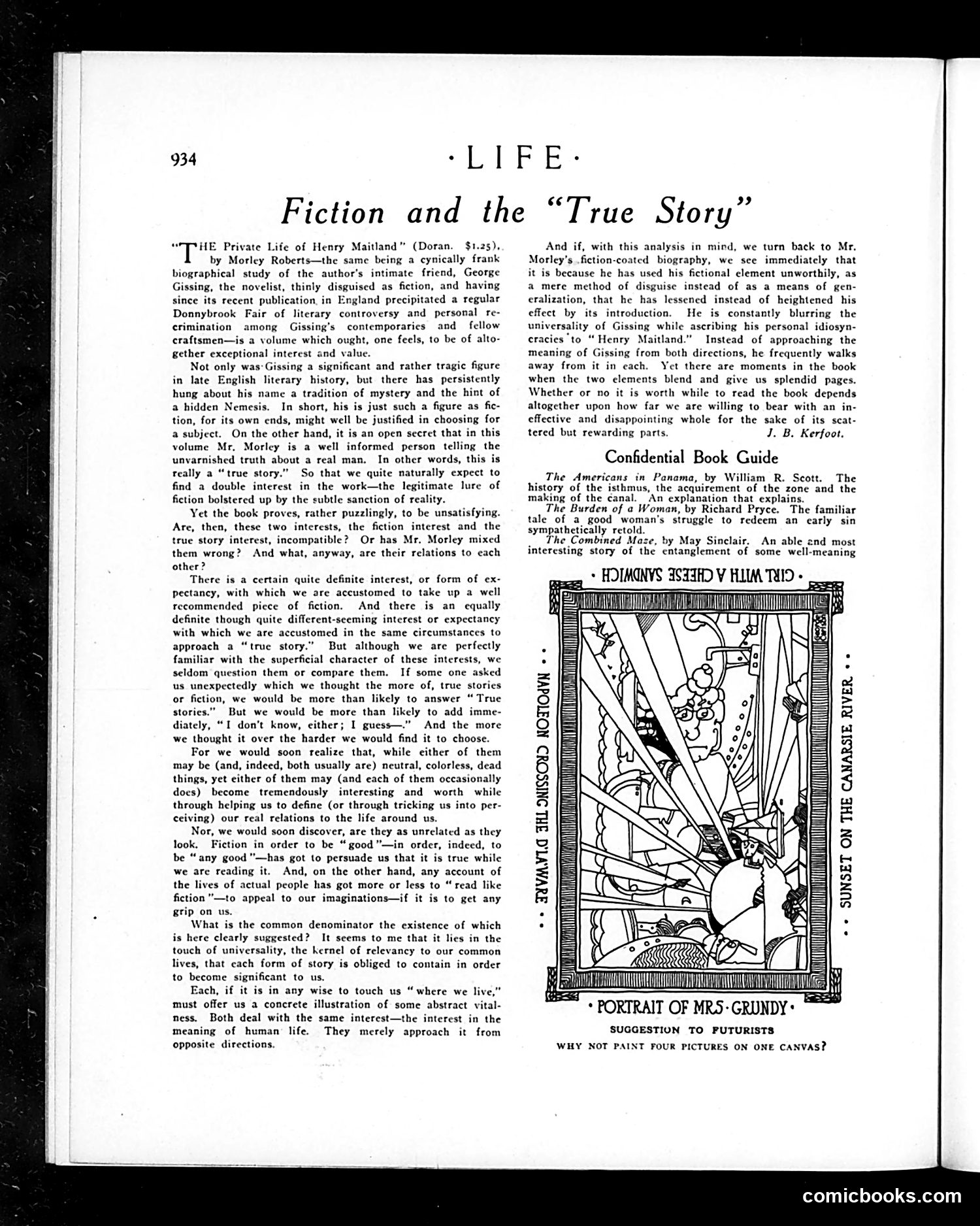
This page discusses Morley Roberts's biography of novelist George Gissing, disguised as fiction under the title "The Private Life of Henry Maitland." The article examines why this hybrid work—factual biography presented as a novel—fails to satisfy readers despite promising double appeal. The author argues that fiction and "true stories" operate on different but equally valid principles. Good fiction must *feel* true while being read; conversely, real biographical accounts must possess narrative appeal to engage readers. Both derive power from touching universal human concerns and "where we live"—our genuine life experiences. The paradox: The Gissing book disappoints precisely because it confuses these modes. Rather than enriching each other, fact and fiction here undermine one another, suggesting they work best when kept distinct or fully integrated, not awkwardly blended. The accompanying illustration ("Portrait of Mrs. Grundy") appears unrelated to the main text—likely a separate satirical commentary on social conventions.
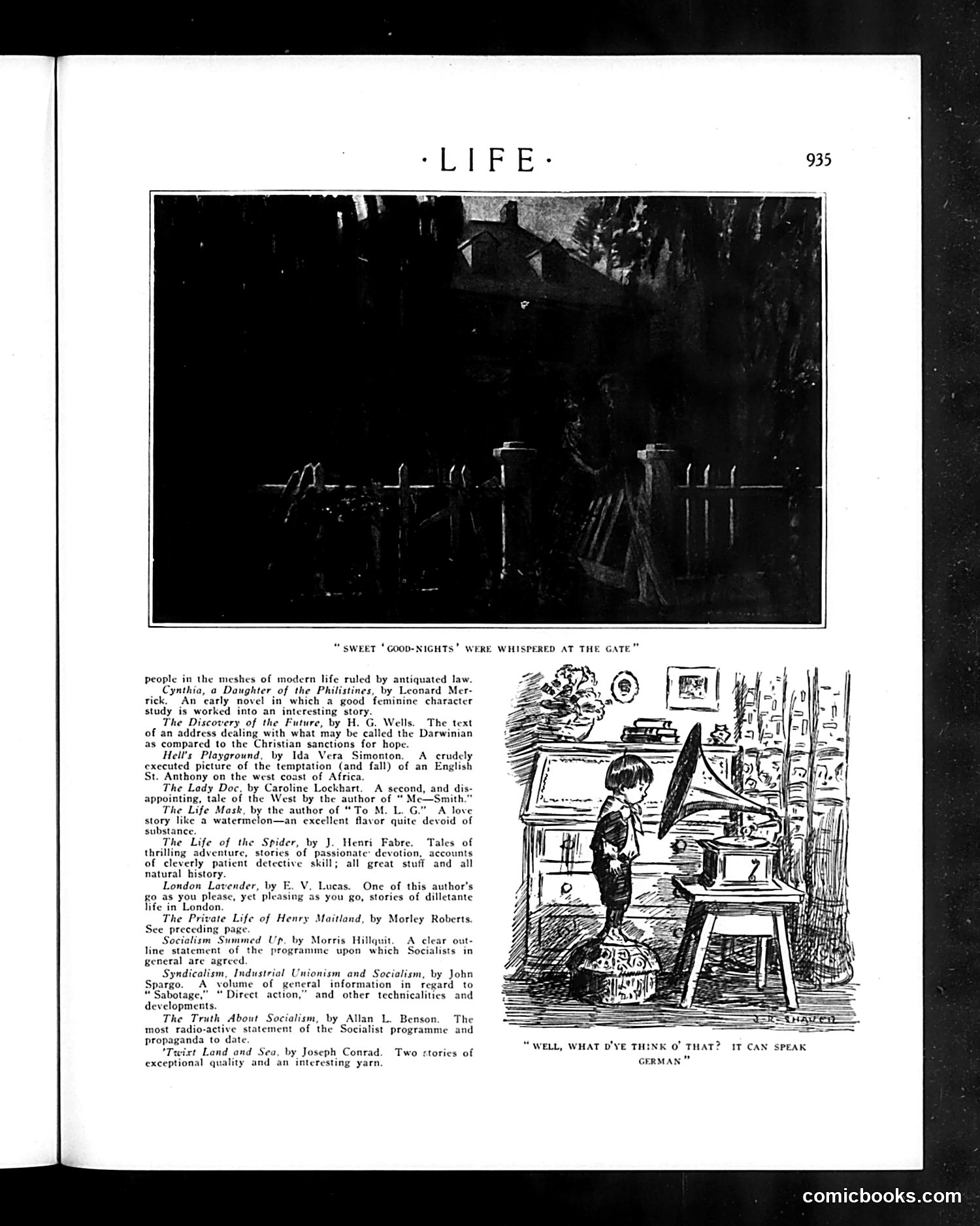
This page from *Life* magazine contains book reviews alongside two satirical illustrations. The top image shows a nighttime cemetery or graveyard scene with figures at a gate, captioned "Sweet 'Good-Nights' Were Whispered at the Gate"—likely illustrating a romantic or sentimental novel excerpt. The lower cartoon depicts a man examining what appears to be a mechanical or artificial creature, with the caption "Well, What D'ye Think O' That? It Can Speak—German." This is political satire mocking German culture or immigrants, playing on contemporary American anxieties about "foreign" peoples and automata/artificiality—a common turn-of-the-century comic trope suggesting Germans were mechanical or inhuman. Notably, the book reviews include several Socialist titles (*Summed Up* by Morris Hillquit, works on Socialism and Syndicalism), indicating *Life*'s engagement with contemporary radical political movements as subject matter for literary coverage and satire.
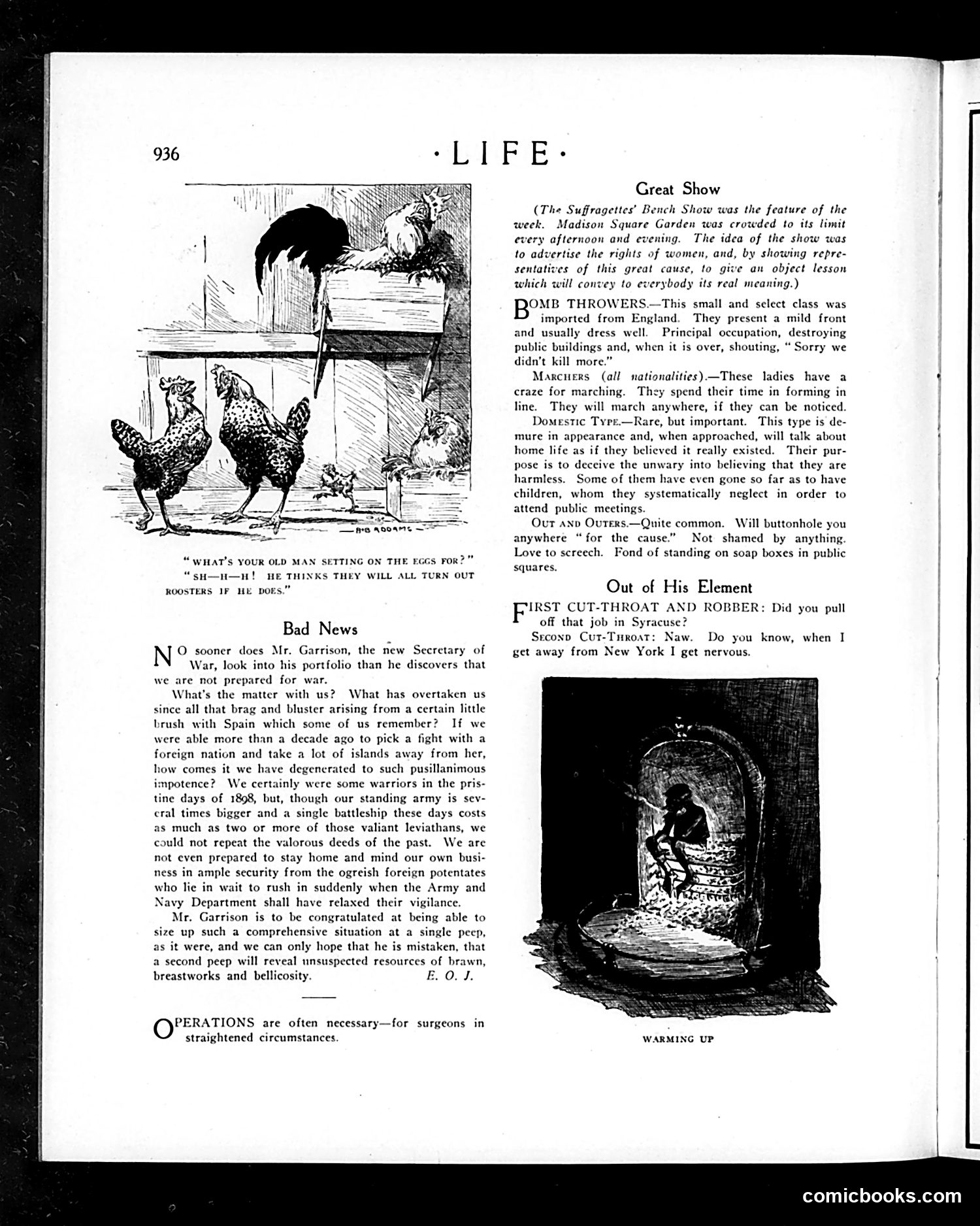
This page contains multiple satirical pieces: **"Bad News"** criticizes Secretary of War Garrison for discovering America's military unpreparedness. The author sarcastically contrasts current weakness with American confidence after the Spanish-American War (1898), mocking the nation's decline from past imperial swagger to present vulnerability. **The chicken cartoon** uses barnyard humor—a man sitting on eggs expecting roosters, suggesting foolish expectations. **"Great Show"** mocks the women's suffrage movement's public demonstration at Madison Square Garden. Life satirizes different activist "types": bomb-throwing English suffragettes, marching women, "Domestic Type" housewives pretending contentment, and street-corner agitators—all portrayed as absurd or deceptive. **"Out of His Element"** is a joke about a New York criminal nervous away from home, playing on stereotypes about urban toughness. The page reflects early 1900s attitudes: skepticism about American military readiness and mockery of women's rights activism as theatrical and extreme.
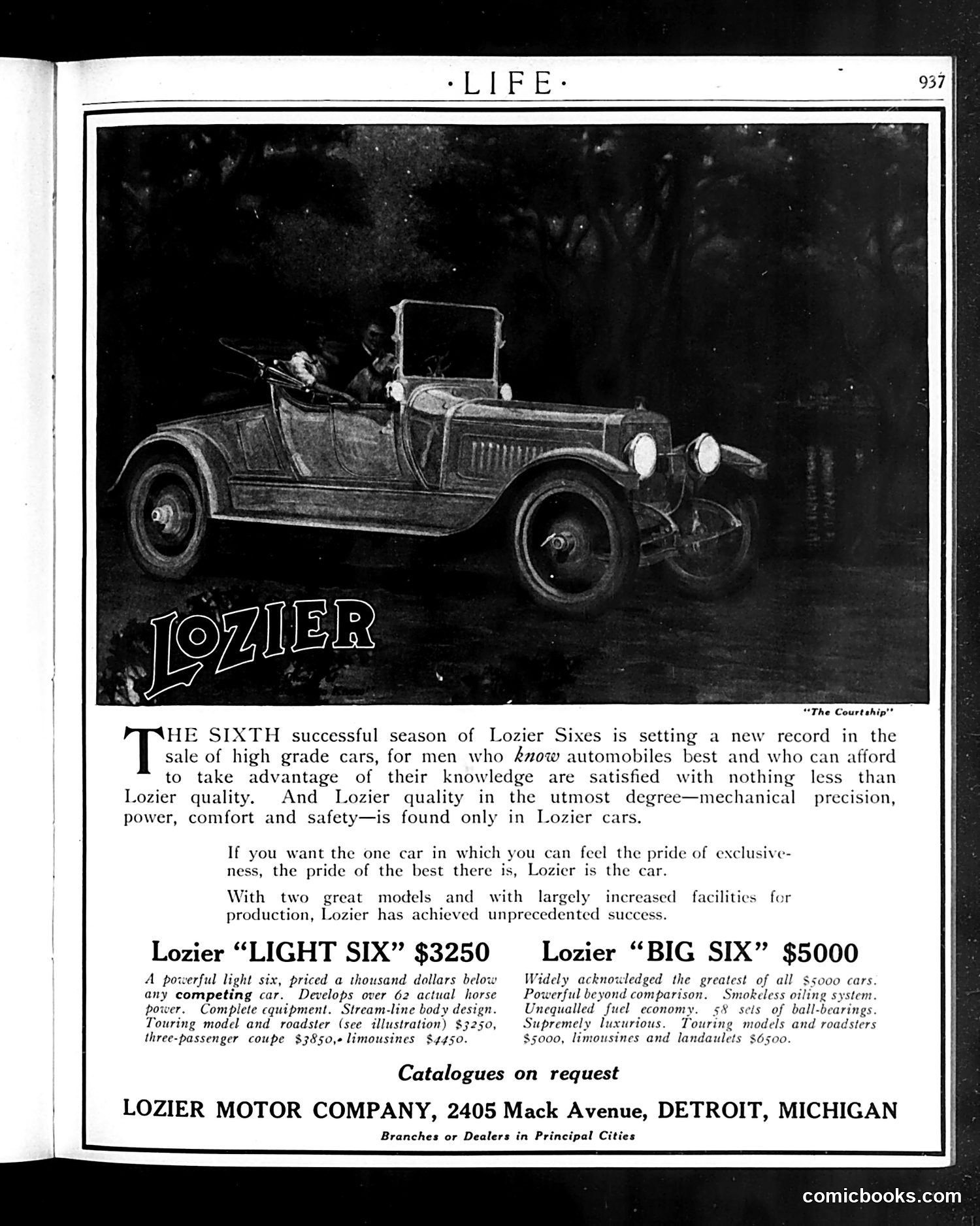
This page is primarily a **product advertisement**, not political satire. It promotes Lozier automobiles—specifically their "Light Six" ($3,250) and "Big Six" ($5,000) models—during what appears to be the early 1900s automobile boom. The image titled "The Courtship" shows a vintage open-air touring car, likely meant to evoke romance and leisurely driving. The advertisement targets affluent buyers, emphasizing exclusivity, mechanical precision, and superior quality as markers of status and refined taste. There is **no political cartoon or satire** present. The page simply reflects the era's consumerism and the automobile's newfound role as a luxury good for the wealthy. The copy's emphasis on "pride of exclusiveness" reveals period attitudes about consumption as status display.
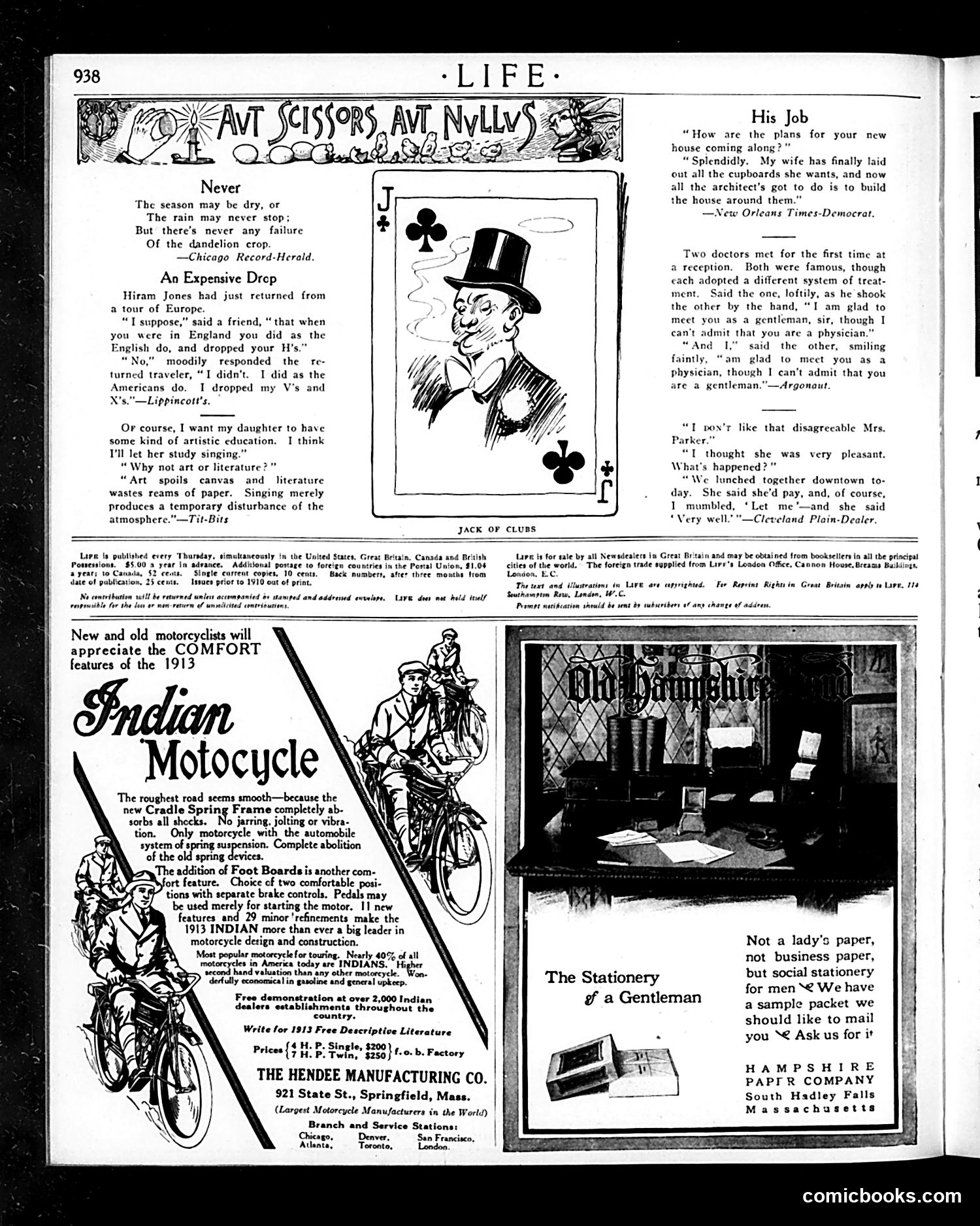
This *Life* magazine page contains several brief humorous anecdotes satirizing early 20th-century social absurdities: **Main Content:** The page features short joke items mocking domestic life, travel pretensions, and professional pomposity. Notable examples include a wife dictating house plans to her architect, and two famous doctors meeting and backhanding each other's competence while complimenting their gentlemanly behavior—satirizing professional rivalry masked by civility. **Visual:** A playing card illustration (Jack of Clubs) anchors the center, though its connection to the text is unclear. **Advertising:** The lower half features ads for Indian motorcycles (emphasizing comfort and shock absorption) and Hampshire Paper Company's gentlemen's stationery, typical of the era's marketing. The humor targets familiar domestic frustrations, social pretension among travelers, and professional jealousy—themes meant to resonate with *Life's* educated, middle-class readership.

This is a vintage tire advertisement, not political satire. It promotes Diamond brand tires to consumers concerned about tire wear and rim damage—common problems in the early automotive era when poor rim contact caused tire failure. The ad addresses a practical frustration: tire buyers wanted tires that wouldn't damage rims through cutting or breaking. Diamond's solution was the "Perfect 3-Point Rim Contact"—a mechanical design ensuring even pressure distribution where the tire meets the rim, plus a "No-Pinch Safety Flap" for inner tube protection and "Vitalized Rubber" for durability. The format mimics Life magazine's humorous tone by staging a fictional dialogue between engineers and chemists solving customer demands. The ad emphasizes engineering sophistication to justify the product's value, concluding with the availability of 25,000 dealers nationwide.
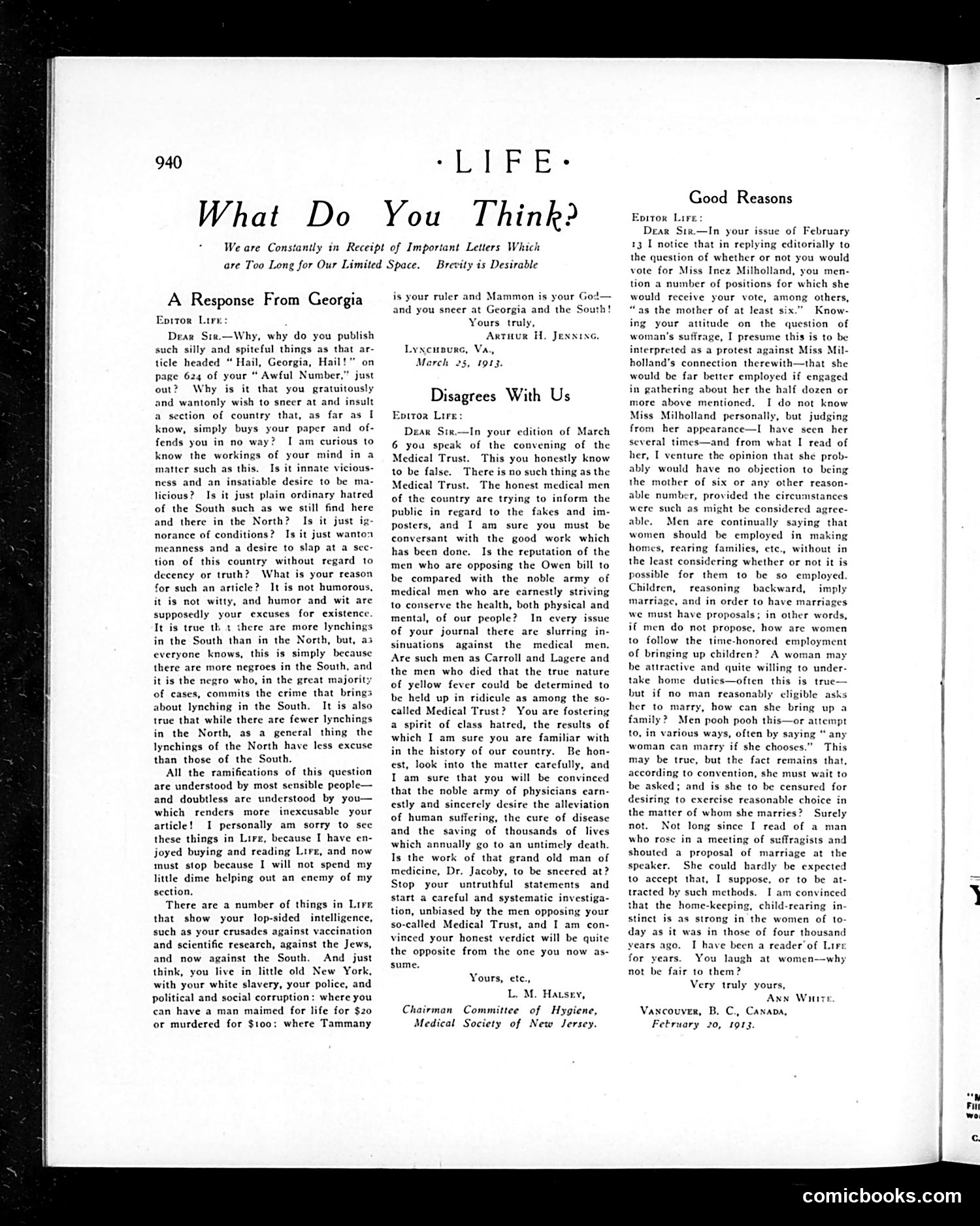
This is a "letters to the editor" section from Life magazine (March 1913). Two readers respond to recent Life articles with strong disagreements. **First letter** (Georgia): A Southern reader protests Life's article "Hail, Georgia, Hail!" as unfair mockery of the South. He defends Southern lynching by claiming it results from higher Black population density, and accuses Life of hypocrisy—criticizing the South while ignoring corruption in New York City (referencing Tammany Hall political corruption and police brutality). He threatens to stop reading Life. **Second letter** (Medical Trust): A doctor attacks Life's references to a "Medical Trust," calling it false. He defends the medical profession against what he sees as Life's slurring insinuations, citing respected physicians like Carroll and Lagere who advanced medicine (yellow fever research). Both letters show Life's reputation as a satirical publication willing to criticize powerful institutions and regions—generating defensive reader backlash. No cartoons appear on this page.
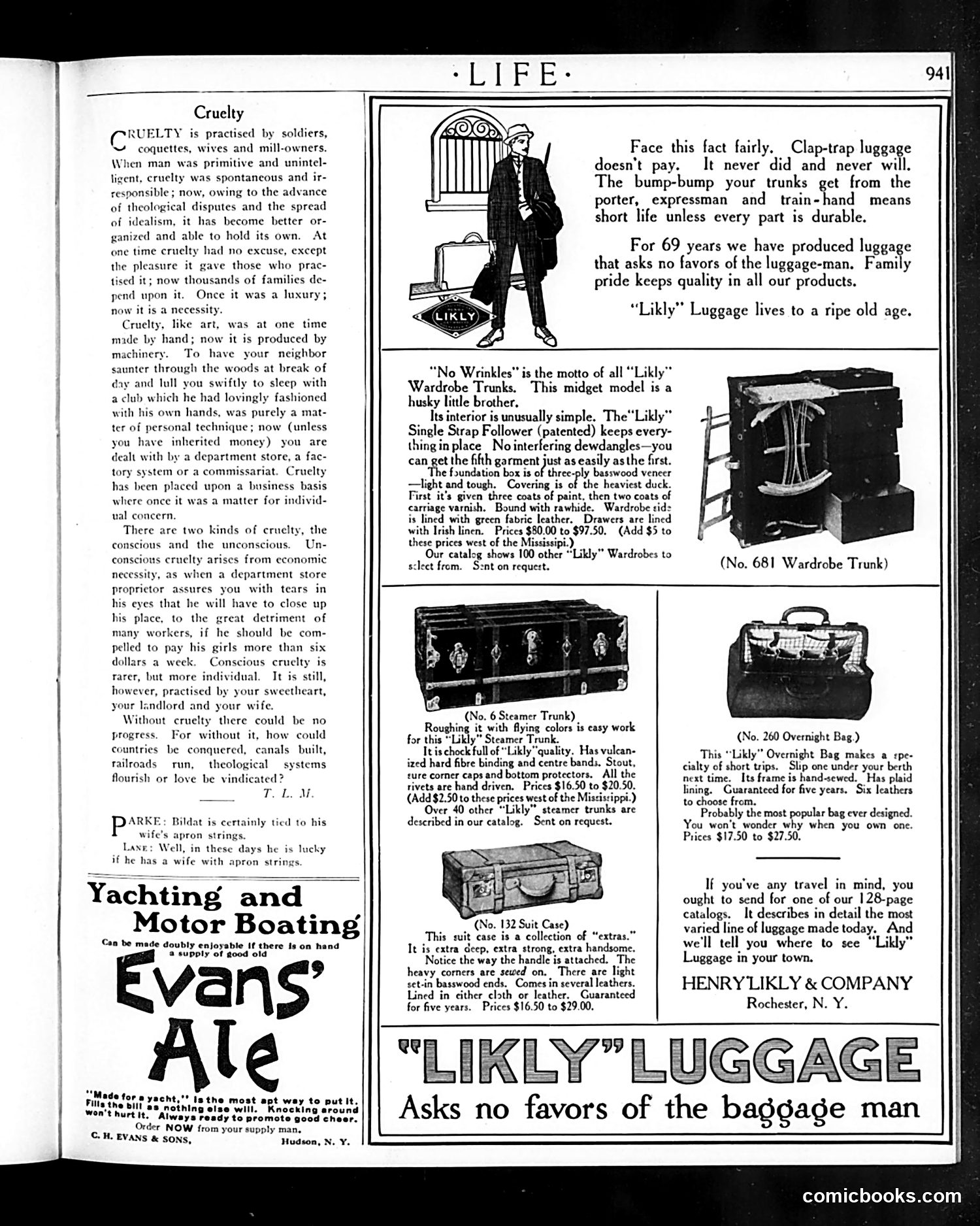
This page mixes editorial content with advertisements. The main essay, "Cruelty," is satirical social commentary typical of Life's style. The author argues that cruelty has evolved from personal, artisanal brutality into *systematized, industrial cruelty*—now practiced impersonally by corporations, department stores, and commissariats rather than individuals. The satire targets modern capitalism: store owners claiming poverty while underpaying workers exemplifies "unconscious cruelty" masked by economic necessity. The brief dialogue jokes about wives controlling husbands ("apron strings"), a common satirical trope of the era. The rest of the page comprises advertisements for Likly Luggage and Evans Ale—standard magazine fare. No political figures or caricatures appear. The satire's point: industrialization has made exploitation systematic and therefore more acceptable, which Life presents as darkly ironic social progress.
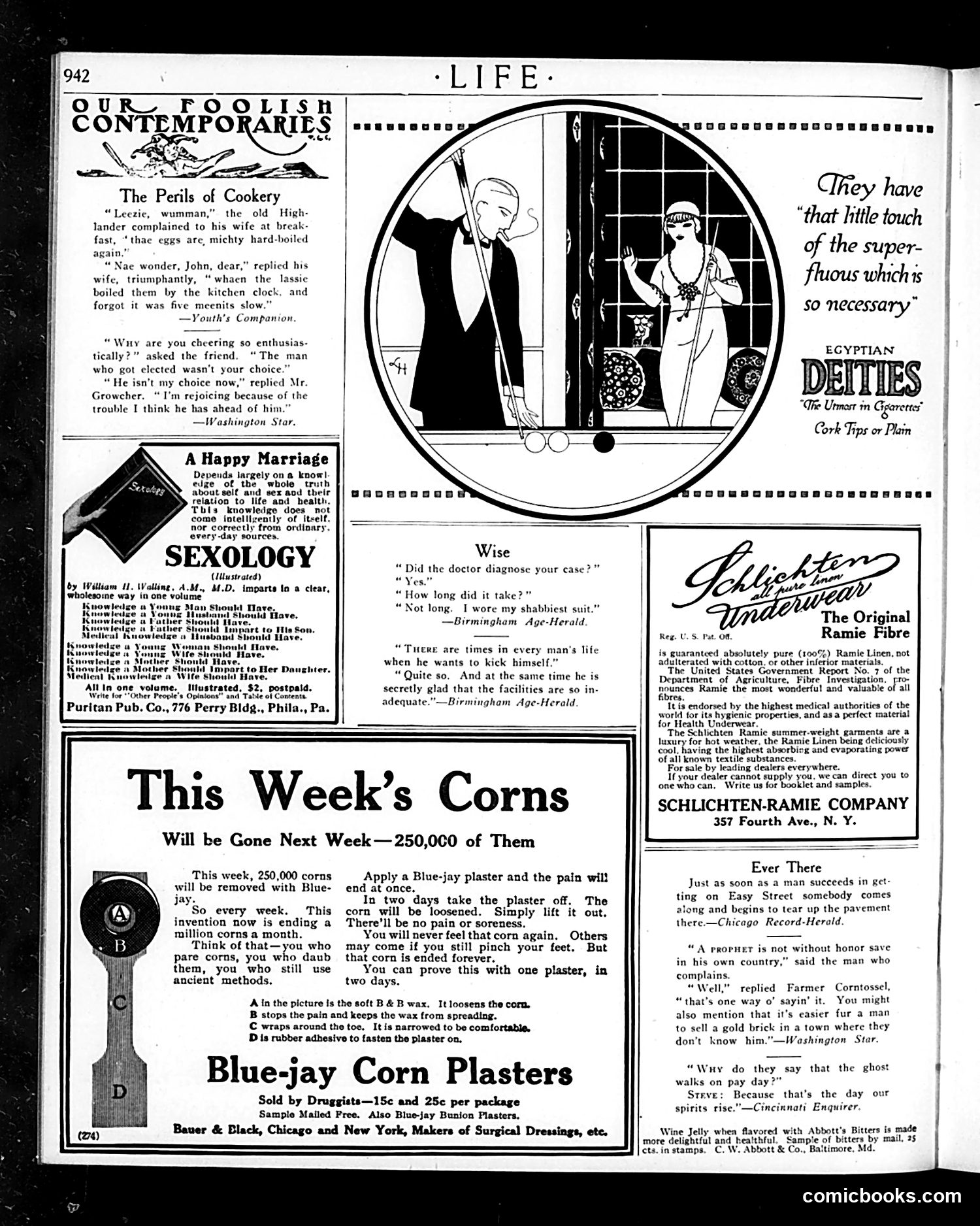
This page features humorous social commentary typical of early-20th-century Life magazine. The main cartoon depicts a domestic scene where a Scottish husband complains his wife boiled eggs too hard. Her reply reveals she timed them by the kitchen clock—which was five minutes slow—a joke about absent-minded housewifery. Below, "A Happy Marriage" satirizes the gap between romantic ideals and practical reality, suggesting spouses need encyclopedic knowledge from "ordinary, every-day sources" rather than sentiment. The "Wise" section mocks a doctor who diagnoses a patient's illness as poverty (evidenced by shabby clothes worn to the appointment), commenting on class-based assumptions in medicine. Other brief jokes mock political opportunism and male vanity. The page is primarily advertising for period products: Blue-jay corn plasters, Schlichton Ramie underwear, and a Sexology book—reflecting contemporary consumer culture and modest health concerns.
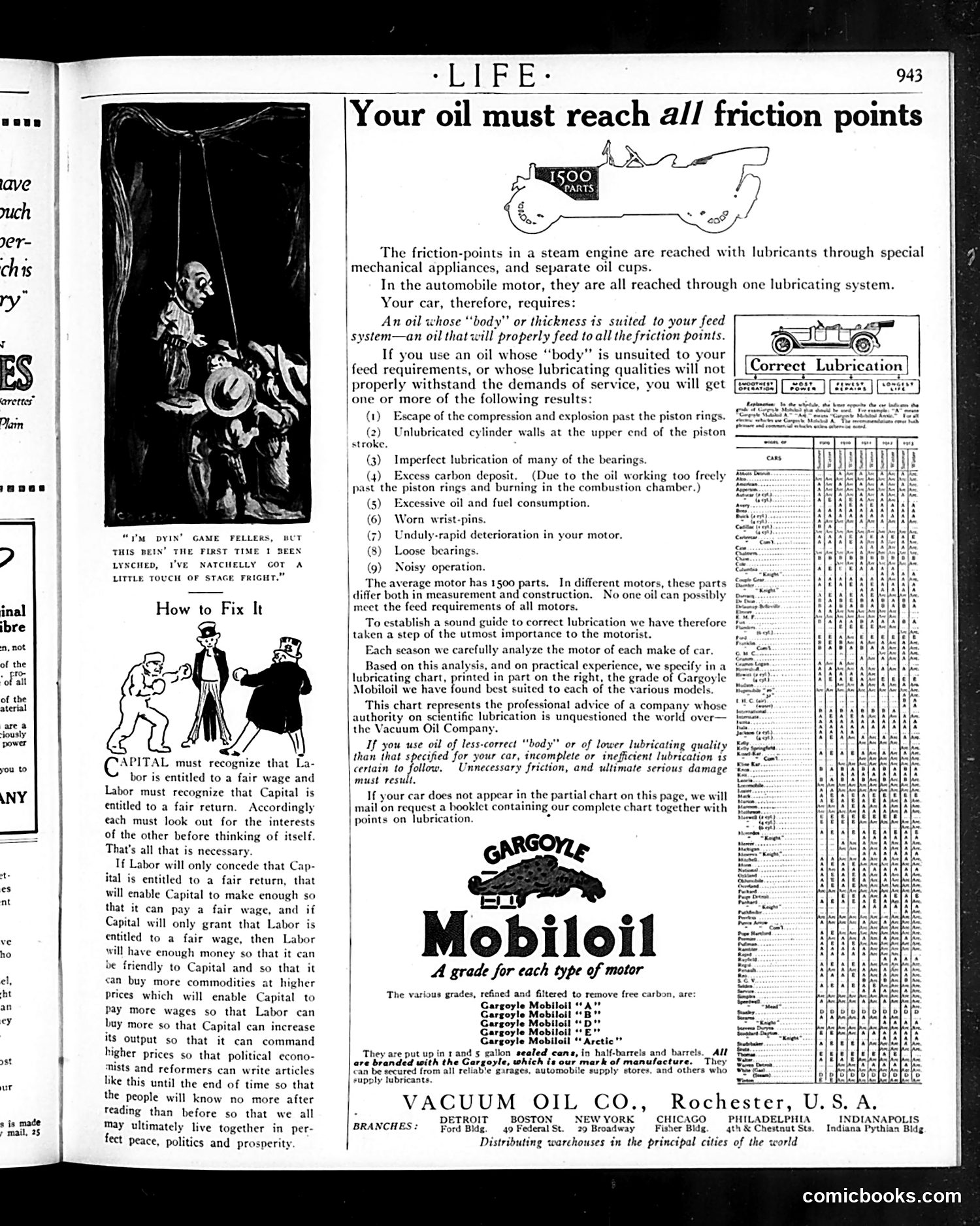
This page contains **two distinct sections**: a political cartoon and a motor oil advertisement. ## The Cartoon ("How to Fix It") The left side depicts a figure appearing nervous about performing—the caption reads: "I'm dyin' game fellers, but this bein' the first time I been lynched, I've natchelly got a little touch of stage fright." This is a **deeply racist cartoon** using lynching as dark comedy. The accompanying text offers circular, meaningless advice about Capital and Labor recognizing each other's "fair" claims—essentially arguing that if both sides just remain cooperative, prosperity follows. The satire mocks this naive economic philosophy as circular reasoning. ## The Advertisement (Right Side) A **Gargoyle Mobiloil advertisement** occupies most of the page, arguing that different car motors require specifically formulated oils matched to their precise specifications. It includes a lubrication chart for various car models. **Context**: This Life magazine page (page 943) likely dates to the early 20th century, when such racist imagery was considered acceptable satirical content, even as the magazine positioned itself as socially conscious.
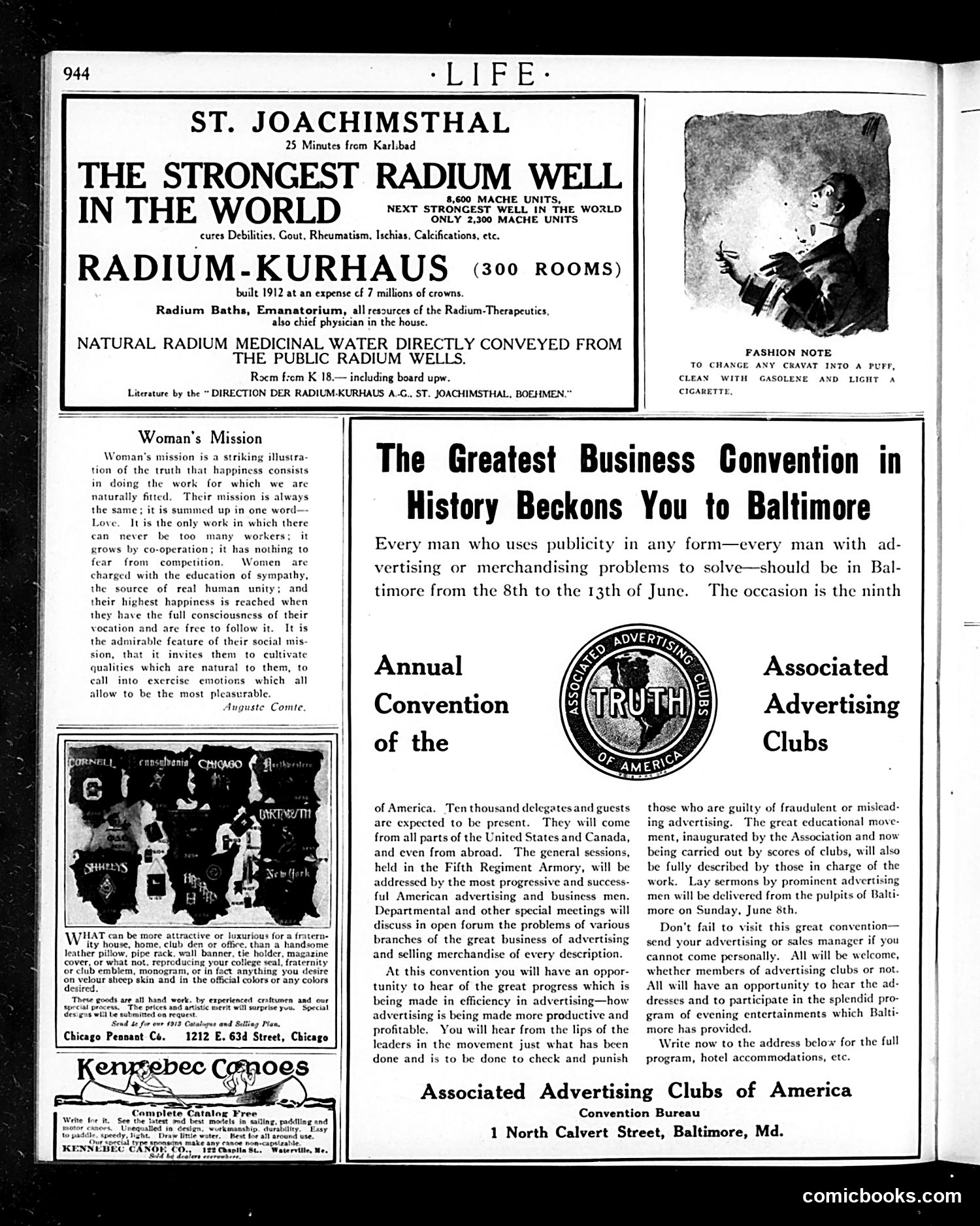
This is primarily an **advertising page** rather than satirical content. It contains three distinct sections: 1. **St. Joachimsthal Radium Spa** (top): A European health resort advertisement claiming the "strongest radium well in the world" curing various ailments. This reflects early-20th-century faith in radium's therapeutic properties—now understood as dangerously misguided. 2. **"Woman's Mission"** (left): A philosophical essay by Auguste Comte arguing women's natural calling is cultivating sympathy and love, not competing in other fields. This represents period attitudes about gender roles. 3. **Baltimore Advertising Convention** (right): An announcement for the Associated Advertising Clubs of America's ninth annual convention, emphasizing industry professionalism and efforts to combat fraudulent advertising. The small "Fashion Note" humorously suggests using gasoline and a cigarette to convert cravats—a dangerous suggestion offered as practical advice. The page reflects 1910s-era advertising, scientific misconceptions, and social assumptions.
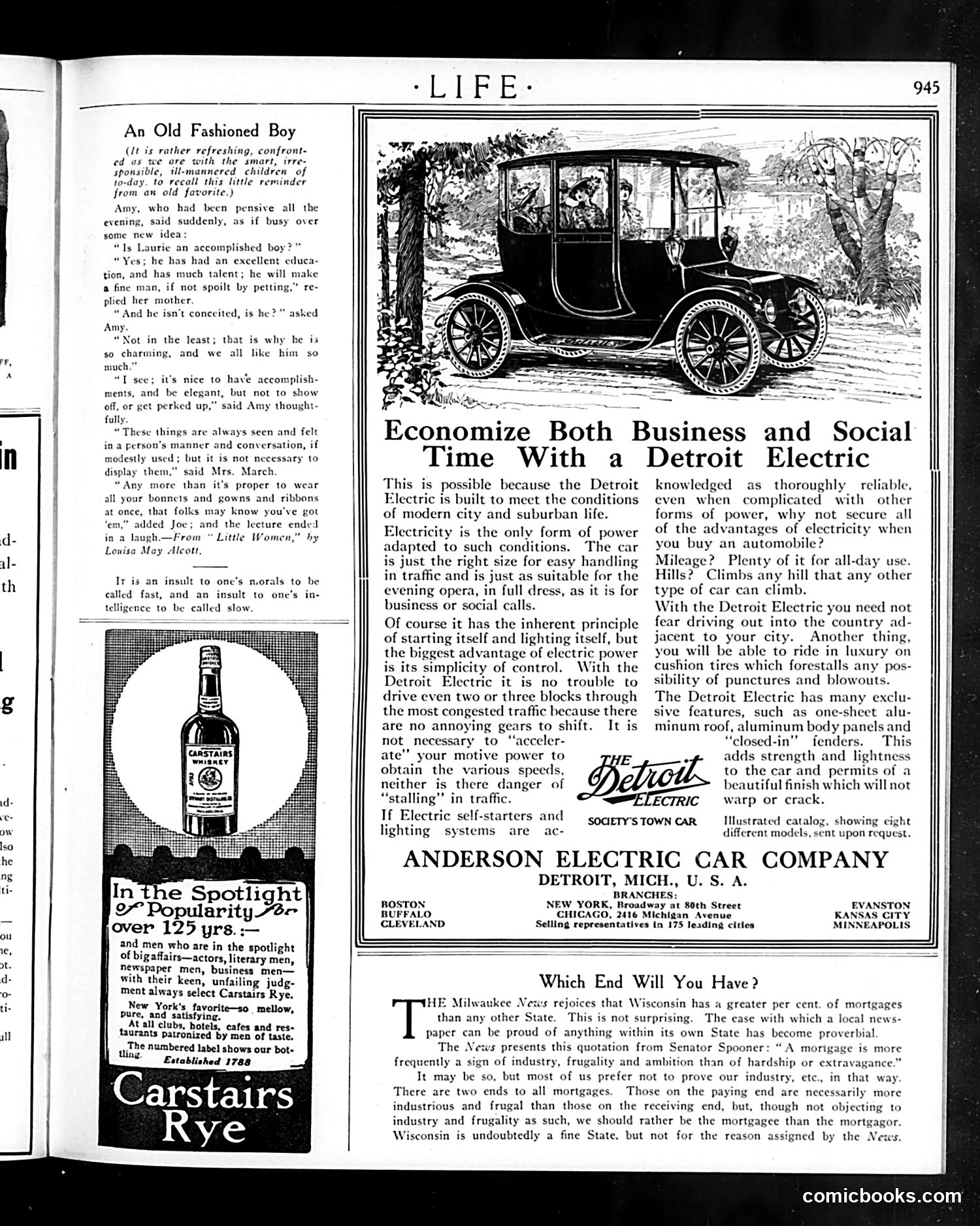
This page mixes editorial content with advertising—typical of early-20th-century Life magazine. **The Editorial Section** reprints a passage from Louisa May Alcott's *Little Women*, contrasting an "old fashioned boy" (Laurie) with modern children. The text criticizes contemporary youth as "smart, irresponsible, ill-mannered," praising instead Laurie's accomplishments, elegance, and modesty. This reflects period anxieties about declining manners and parental discipline. **The Advertisements** include Carstairs Rye whiskey (emphasizing 125+ years of popularity among "men of taste") and the Detroit Electric automobile. The car ad targets affluent buyers with promises of ease, luxury, and reliability—positioning electric cars as vehicles suitable for both business and formal evening wear, a significant selling point for the era. The juxtaposition suggests Life's dual role: cultural commentary on traditional values alongside consumption appeals to the urban elite.
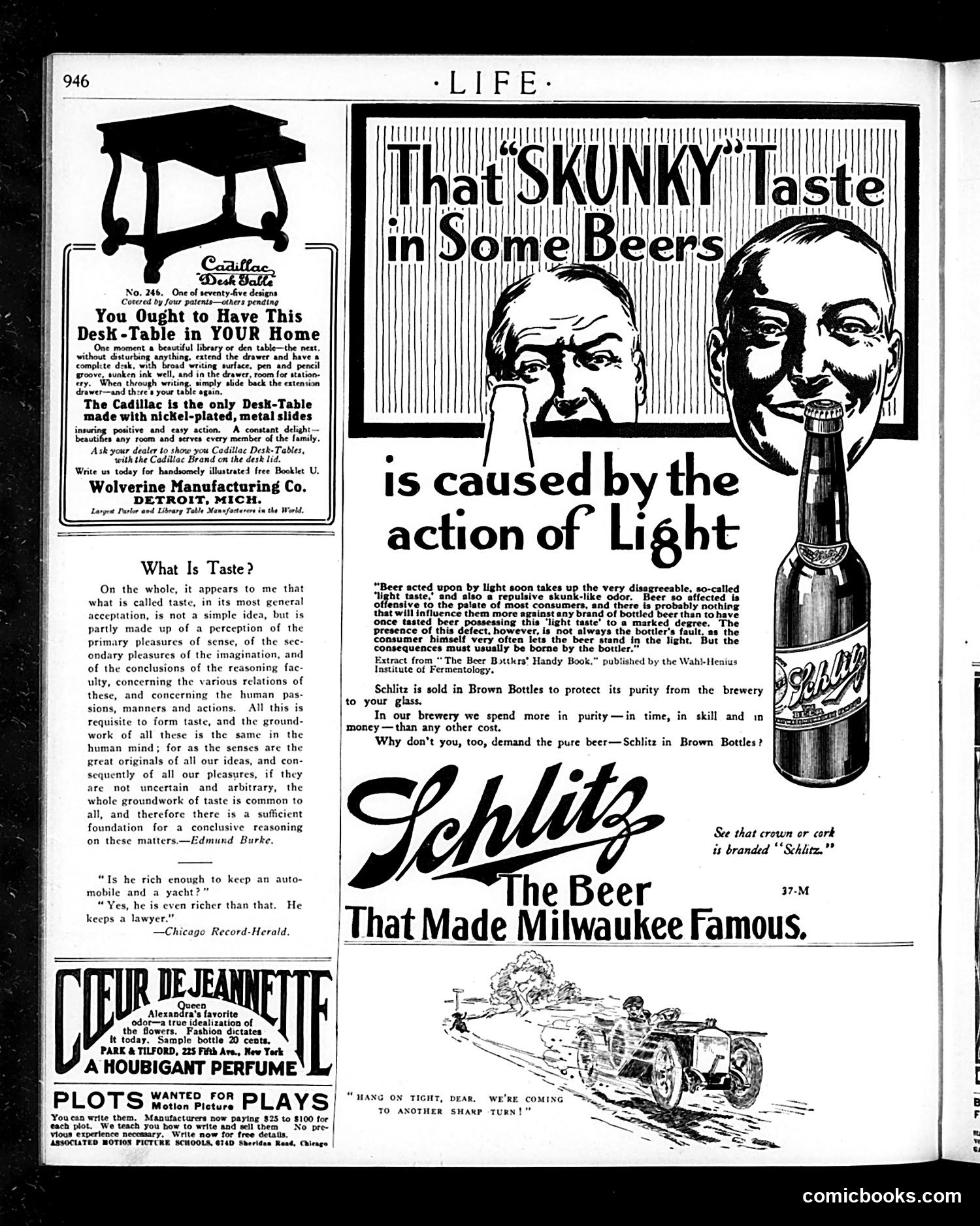
This page is dominated by a **Schlitz beer advertisement** rather than satire or political commentary. The main illustration shows two men's faces (caricatured in exaggerated style typical of the era) reacting with disgust, alongside a Schlitz bottle. The ad's core message addresses a genuine technical problem: **beer exposed to light develops a "skunky" taste and odor**—an undesirable chemical reaction. Schlitz marketed their solution: **brown bottles that protected beer from light exposure** during storage and transport. The advertisement argues that breweries invest heavily in purity, so consumers should demand their beer in protective brown bottles rather than clear glass. This was positioned as a quality/purity issue—a legitimate selling point in early 20th-century beer marketing. The page also contains unrelated ads for furniture, perfume, and motion picture writing courses. There is no discernible political satire here.
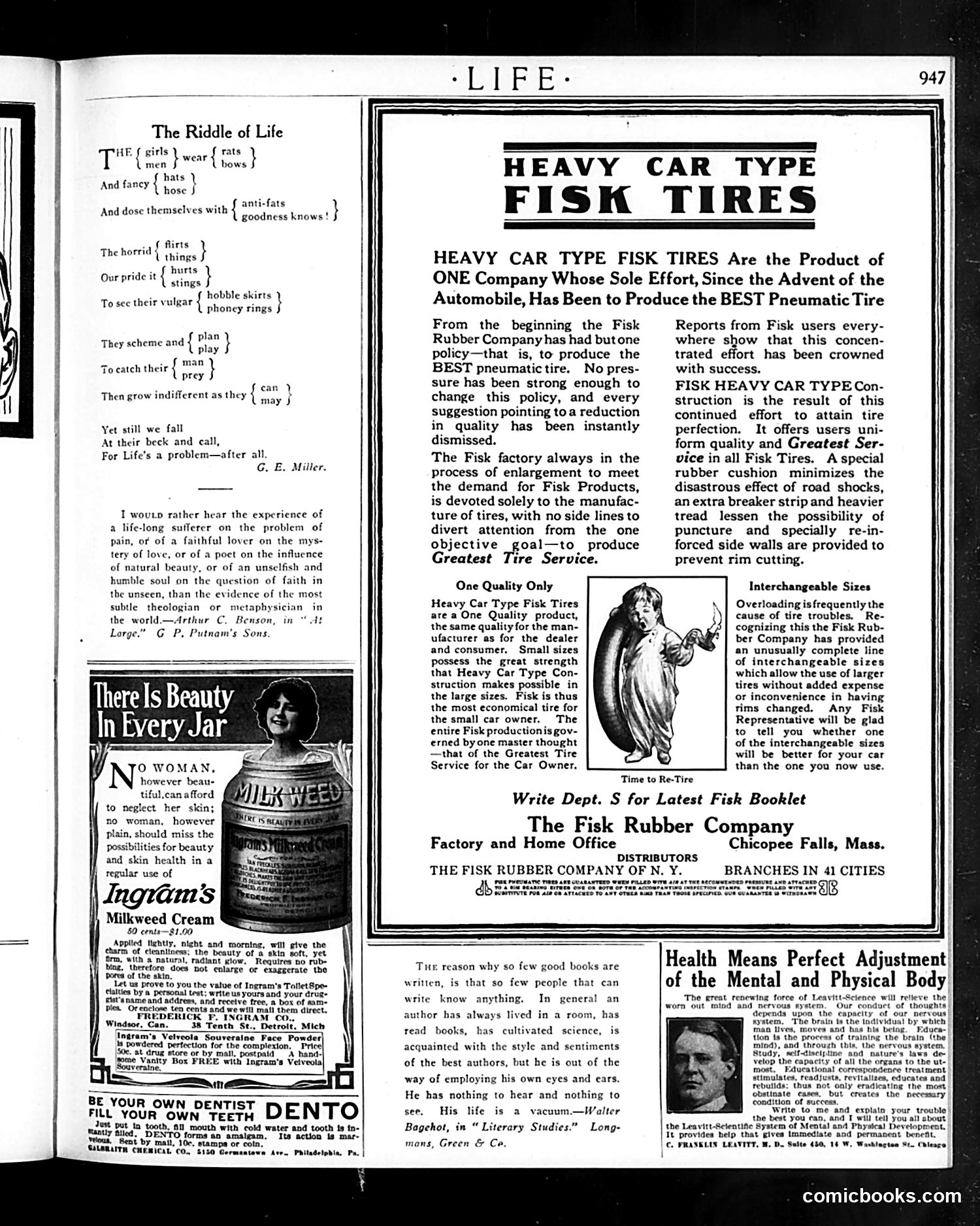
This page contains **primarily advertisements** rather than political satire. The main content includes: **"The Riddle of Life"** (top left) — a humorous poem by G.E. Miller satirizing courtship and romance. It mocks the scheming tactics women use to "catch" men, their vanity (hobble skirts, phoneys rings), and the paradox that despite seeing through such games, men still fall for them. The satire targets both genders' romantic dishonesty. **Advertisements dominate the page:** - Ingram's Milkweed Cream (beauty product) - Dento (DIY tooth filler) - Fisk Tires (automotive) These ads reflect early 1900s consumer culture targeting both women's beauty insecurities and practical automotive concerns. The page exemplifies how Life magazine blended satirical commentary with commercial messaging typical of the era.
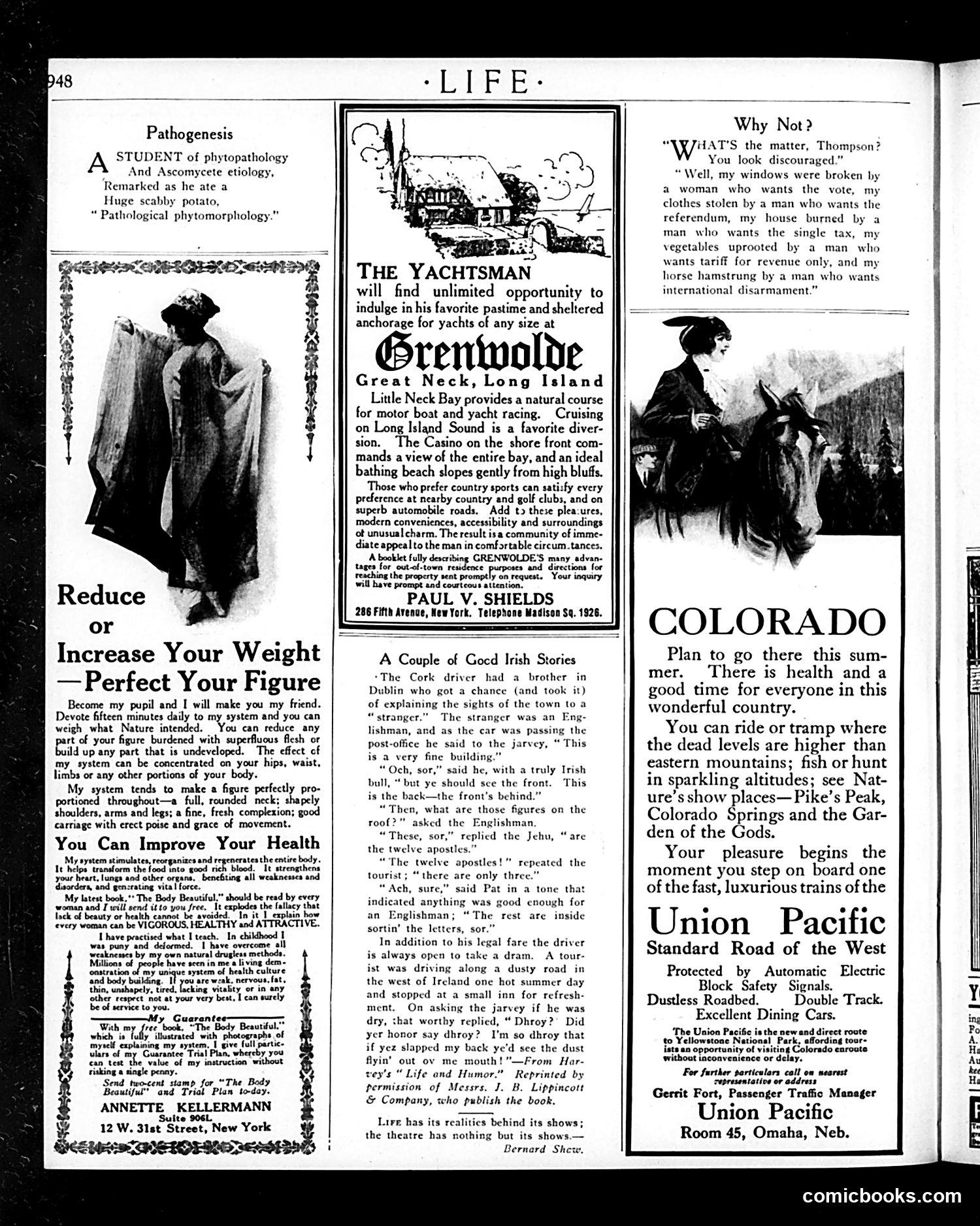
This page from *Life* magazine (circa 1925, based on advertising style) contains satirical commentary on Progressive Era political activism. **The "Why Not?" cartoon** mocks advocates of various reform movements through a character named Thompson, whose complaints catalog the era's major political disputes: women's suffrage ("a woman who wants the vote"), direct democracy ("referendum"), single-tax reform, tariff policy, and disarmament. The joke satirizes reformers by suggesting their political activism—presented as destructive acts—have ruined Thompson's property. This reflects conservative opposition to Progressive reforms; the cartoon implies such activists are radical extremists rather than legitimate reformers. **The page also includes** period advertising (Grentwolde estate, weight-loss services, Colorado tourism) and two Irish dialect stories that were standard humor fare of the era, relying on ethnic stereotypes. The political content ridicules both the *causes* (reform movements) and implicitly their *supporters* (those advocating social change), presenting activism as destructive rather than constructive.
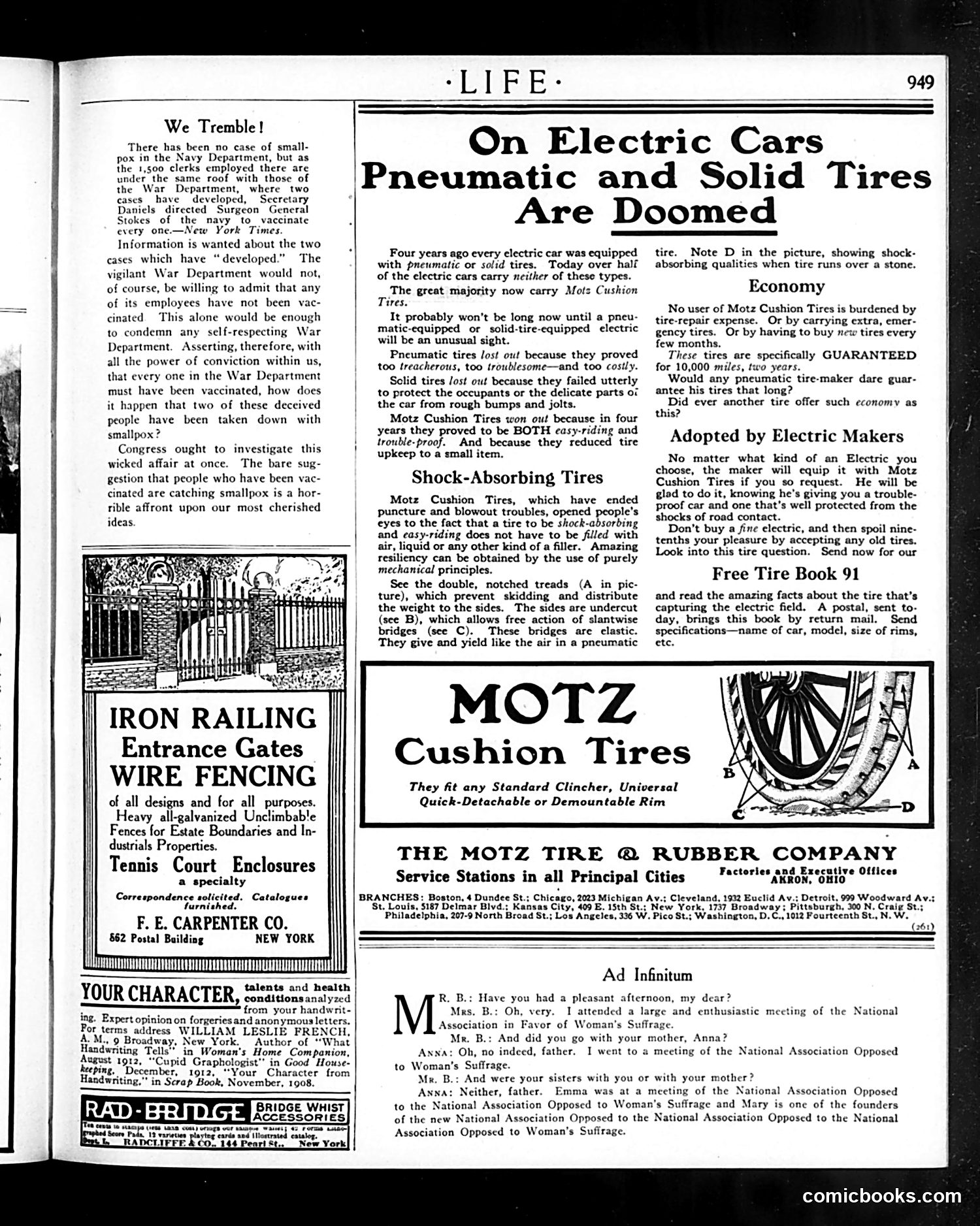
This page contains two distinct elements: **"We Tremble!" Editorial**: A satirical piece mocking the War Department's credibility on vaccination. Life suggests the War Department claims all 1,500 employees were vaccinated, yet two developed smallpox anyway. The satire targets government incompetence and dishonesty—the department won't admit vaccination failures because it would damage their reputation, so they deny the problem exists. It's commentary on institutional self-protection over public health transparency. **Motz Cushion Tires Advertisement**: The commercial section promotes a tire technology for electric cars. It claims pneumatic (air-filled) and solid tires have been replaced by Motz's cushioned design, which absorbs shocks without liquid or air filling. The ad emphasizes durability (10,000-mile guarantee) and cost savings—relevant when early automobiles required frequent tire replacement. The page is primarily advertising with one satirical editorial piece.
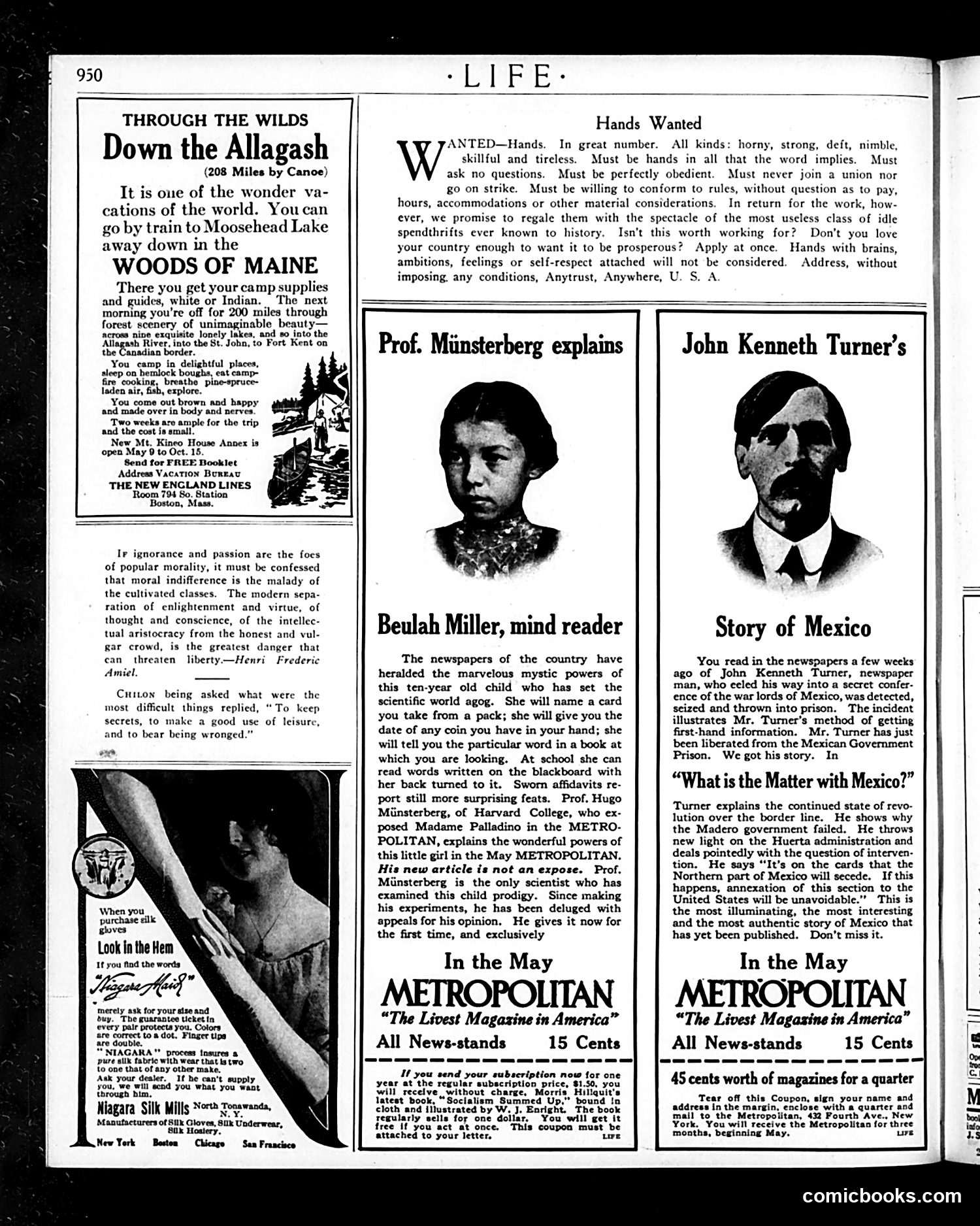
This page contains satirical advertisements and articles typical of *Life* magazine's social commentary. The **"Hands Wanted" advertisement** is sharp political satire mocking industrial employers. It advertises for workers described as obedient, unquestioning, and explicitly excludes those with "brains, ambitions, feelings or self-respect." The cruel irony—promising workers the "spectacle" of watching idle wealthy people as compensation—critiques both labor exploitation and class inequality. The final line, "Don't you love your country enough to want it to be prosperous?" uses patriotic language to mock the wealthy's self-serving justifications. The page also promotes articles about **Beulah Miller**, a child "mind reader" whose supposed psychic powers were attracting public attention. **Prof. Hugo Münsterberg** of Harvard promises a non-exposé explanation in *Metropolitan* magazine, suggesting skeptical examination of her claimed abilities—typical early-20th-century fascination with spiritualism and pseudoscience. A tourism ad for Maine canoeing rounds out the commercial content.
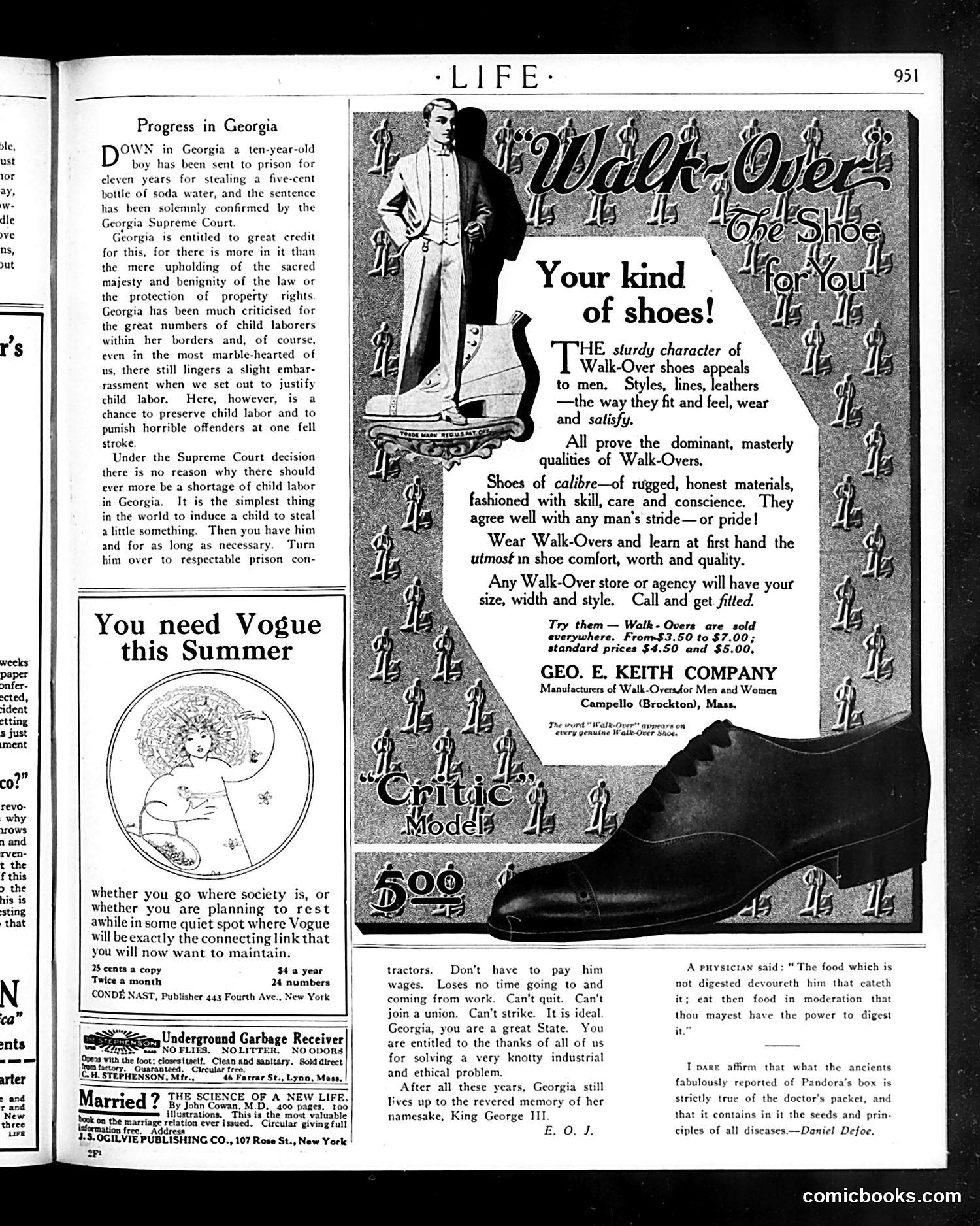
This is a scathing satirical piece criticizing Georgia's criminal justice system, not a cartoon. The author uses bitter irony to expose the state's hypocrisy. The context: Georgia had faced criticism for widespread child labor. A ten-year-old boy received an eleven-year prison sentence for stealing a five-cent bottle of soda water—a sentence the Georgia Supreme Court upheld. The satire's point: The author mockingly congratulates Georgia for "solving" its child labor problem through criminalization rather than reform. He sarcastically argues that imprisoning children for minor theft is "ideal"—they require no wages, can't unionize or strike, and provide free labor to the state as prisoners. This exposes the cruel logic whereby Georgia could simultaneously maintain child labor *and* punish children by simply criminalizing them. The piece satirizes both the severity of the sentence and the state's implicit endorsement of exploitative child labor practices disguised as justice. The author is E.O.J. (initials only, suggesting *Life* magazine's editorial voice).
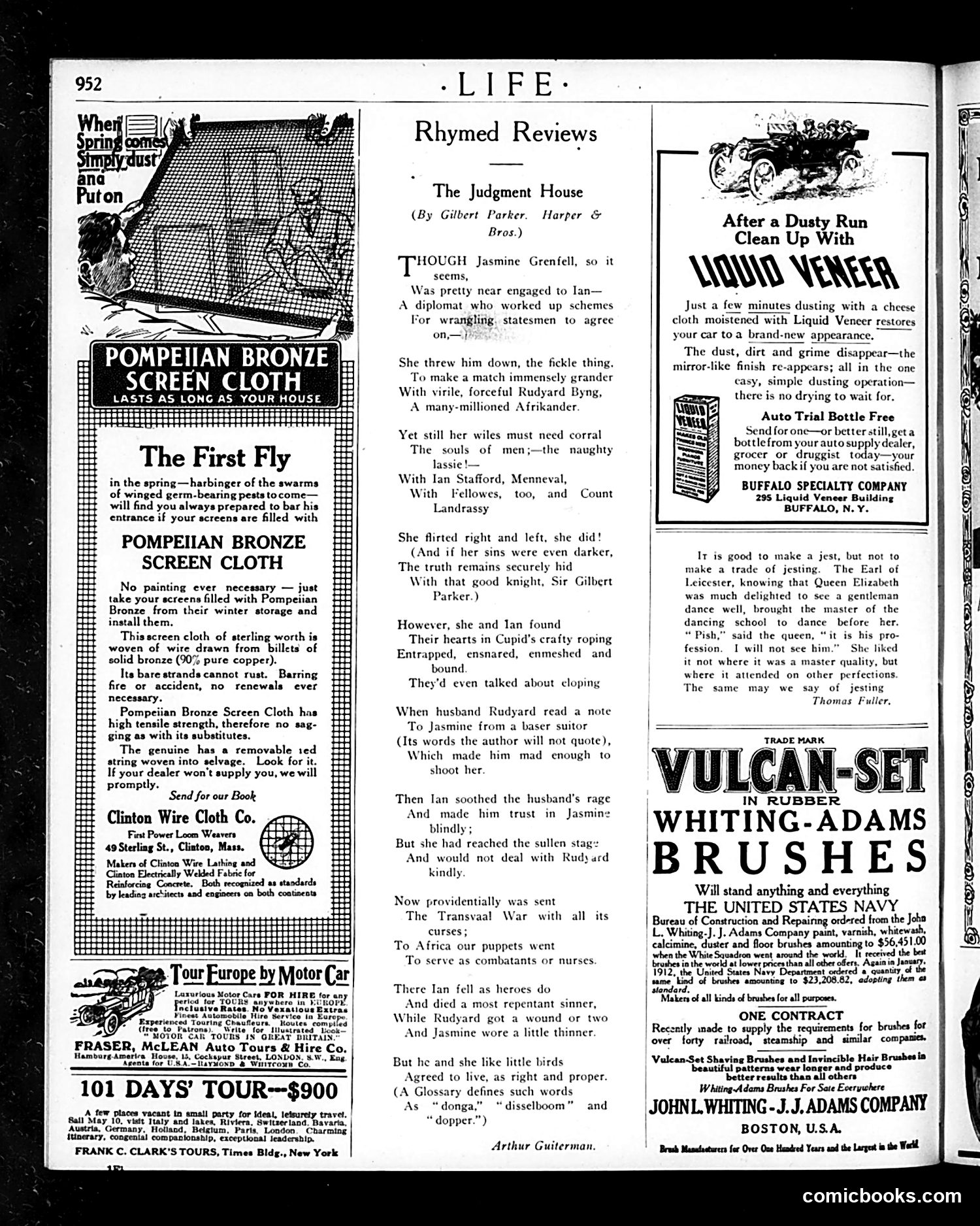
This page is primarily **advertisements with one substantial book review**. The review, by Arthur Guiterman, satirizes Gilbert Parker's novel *The Judgment House* through comic verse. The satire mocks the melodramatic plot: Jasmine Grenfell flirts promiscuously with multiple men (Ian, Stafford, Menneval, Fellowes, Landrassy) before marrying the wealthy "Afrikander" Rudyard Byng. When Rudyard discovers her infidelity via a love letter, he nearly shoots her—but Ian intervenes, earning her trust instead. The Transvaal War conveniently removes both Ian (who dies) and Rudyard (wounded), allowing the surviving pair to reunite as "right and proper." Guiterman's tone is gently mocking of the contrived plotting and overwrought emotions. His casual rhyming ("lassie/Landrassy," "darker/Parker") undercuts the novel's apparent seriousness. The review assumes readers find such Victorian-era romantic complications amusing rather than compelling.
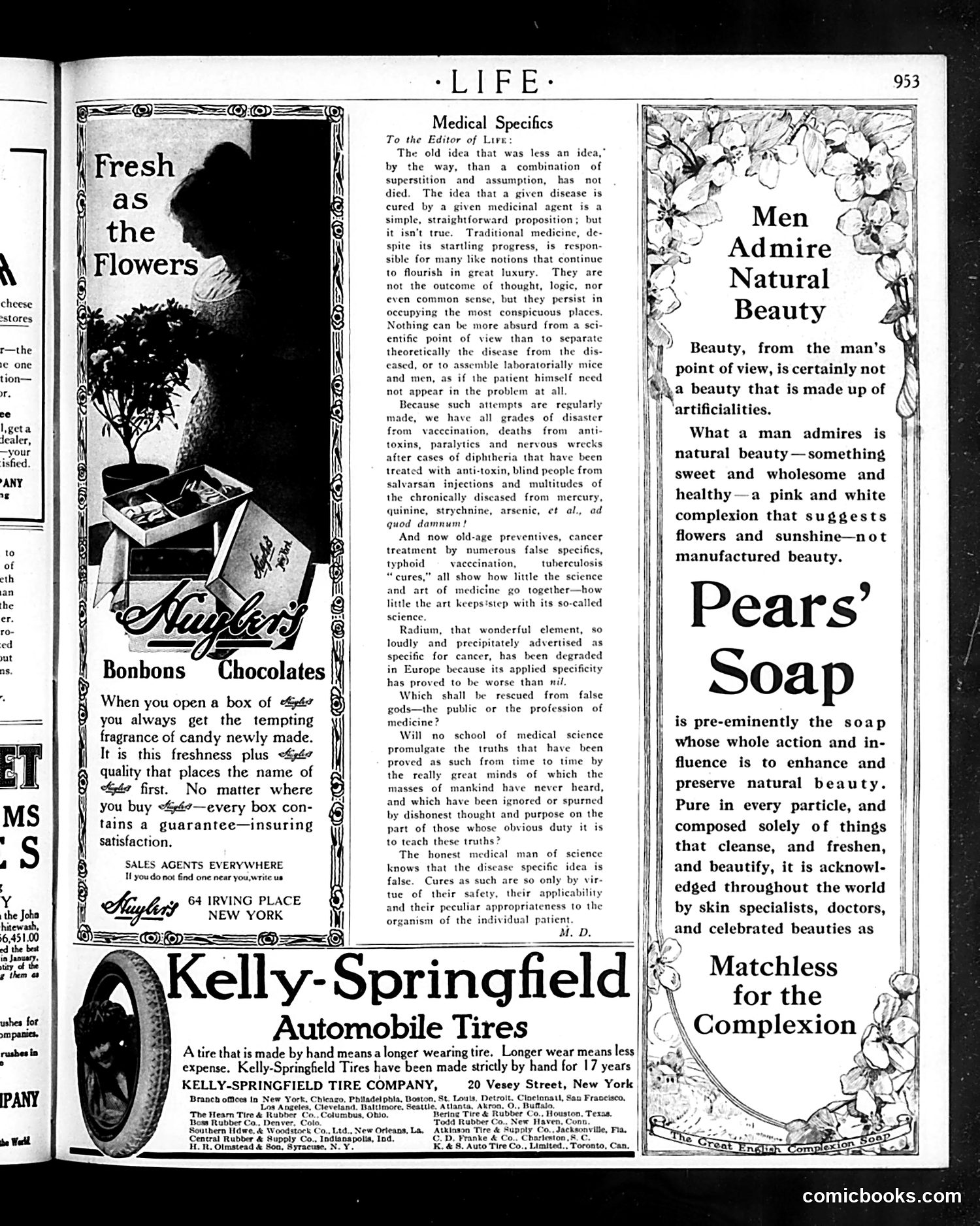
This page is primarily **advertising** with one substantial editorial letter. The main content is a letter to Life's editor criticizing medical practice. The writer argues that the notion of "disease-specific cures"—that a particular disease requires a particular medicine—is scientifically baseless superstition. He catalogs medical disasters: blindness from salvarsan injections, paralysis from diphtheria antitoxin, and degraded radium treatments for cancer. He attacks the medical profession for ignoring proven truths and promoting false specifics like cancer and typhoid treatments. The satire is implicit: modern medicine's confident claims about cures rest on abandoned logic. The surrounding **advertisements** reinforce this critique through irony. Ayling's chocolates, Kelly-Springfield tires, and especially Pears' Soap ("Matchless for the Complexion") all make absolute product-efficacy claims—the same "disease-specific idea" the letter condemns. The soap ad's language about "natural beauty" versus "manufactured" parallels the editorial's argument about authentic versus false medical remedies.
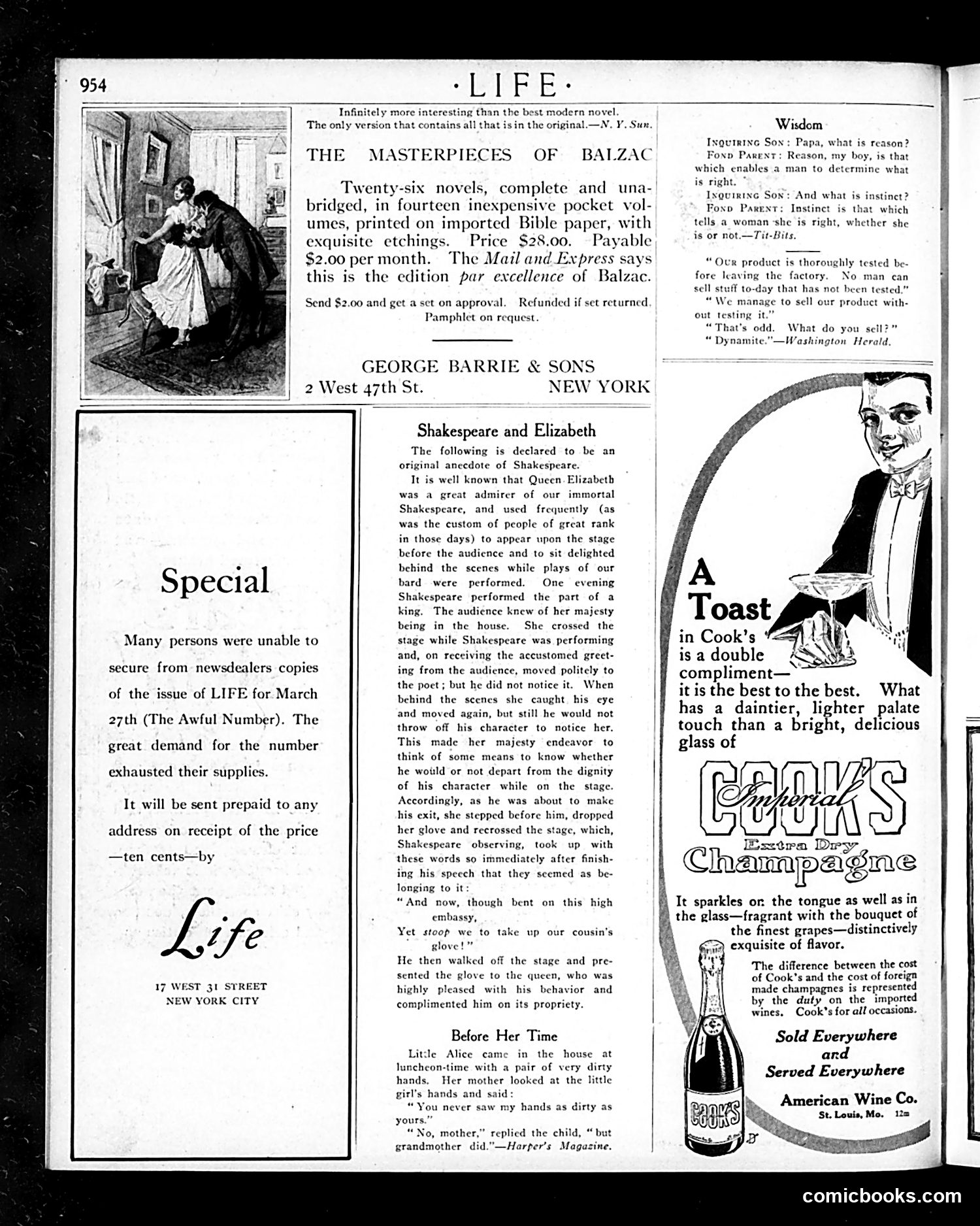
This page contains primarily **advertisements and humor pieces** rather than political cartoons. The main content includes: 1. **Balzac book advertisement** - promoting a 26-novel collection as the definitive edition 2. **"Wisdom" joke** - a gender-based humor piece contrasting "reason" (male domain) with "instinct" (female domain), suggesting women rely on intuition rather than logic to justify their positions. This reflects early-20th-century sexist stereotypes common in period humor. 3. **Shakespeare anecdote** - a purported historical story about Queen Elizabeth dropping her glove on stage to test whether Shakespeare would break character to assist her (he did, poetically). 4. **"Before Her Time" joke** - contrasting a child's dirty hands with the grandmother's, implying lower hygiene standards in previous generations. 5. **Cook's Champagne advertisement** - emphasizing quality and distinctive flavor. The page is largely **commercial** rather than satirical, typical of Life's mix of advertising revenue and light humor pieces.
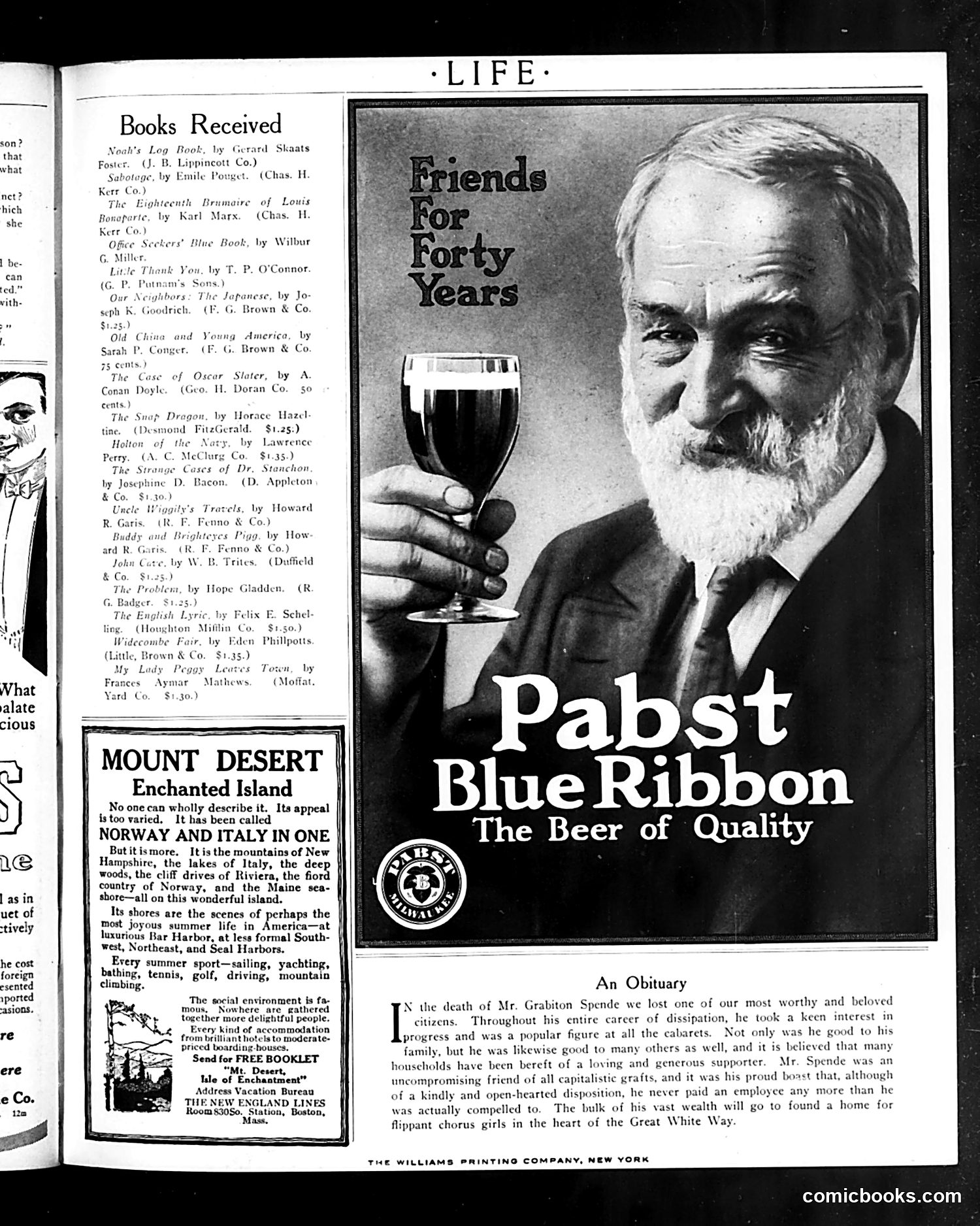
This page is primarily a **Pabst Blue Ribbon beer advertisement** featuring a bearded gentleman holding a glass, captioned "Friends for Forty Years" and "The Beer of Quality." However, the satire lies in the accompanying **mock obituary** for "Mr. Grabiton Spende." The text ironically praises a man whose life was devoted to "dissipation" (excess and debauchery) and cabaretgoing, while simultaneously revealing his stinginess toward employees and his exploitation of working people. The joke is the contradiction: he's eulogized as "worthy and beloved" while the obituary plainly documents his moral failings—he never paid workers more than legally required, and his vast wealth will fund a home for "flippant chorus girls." This appears to be **Life magazine's satirical critique** of wealthy industrialists who accumulated fortunes through exploitation while maintaining respectable public images. The pairing with a beer advertisement creates additional irony about working-class vices versus elite hypocrisy.
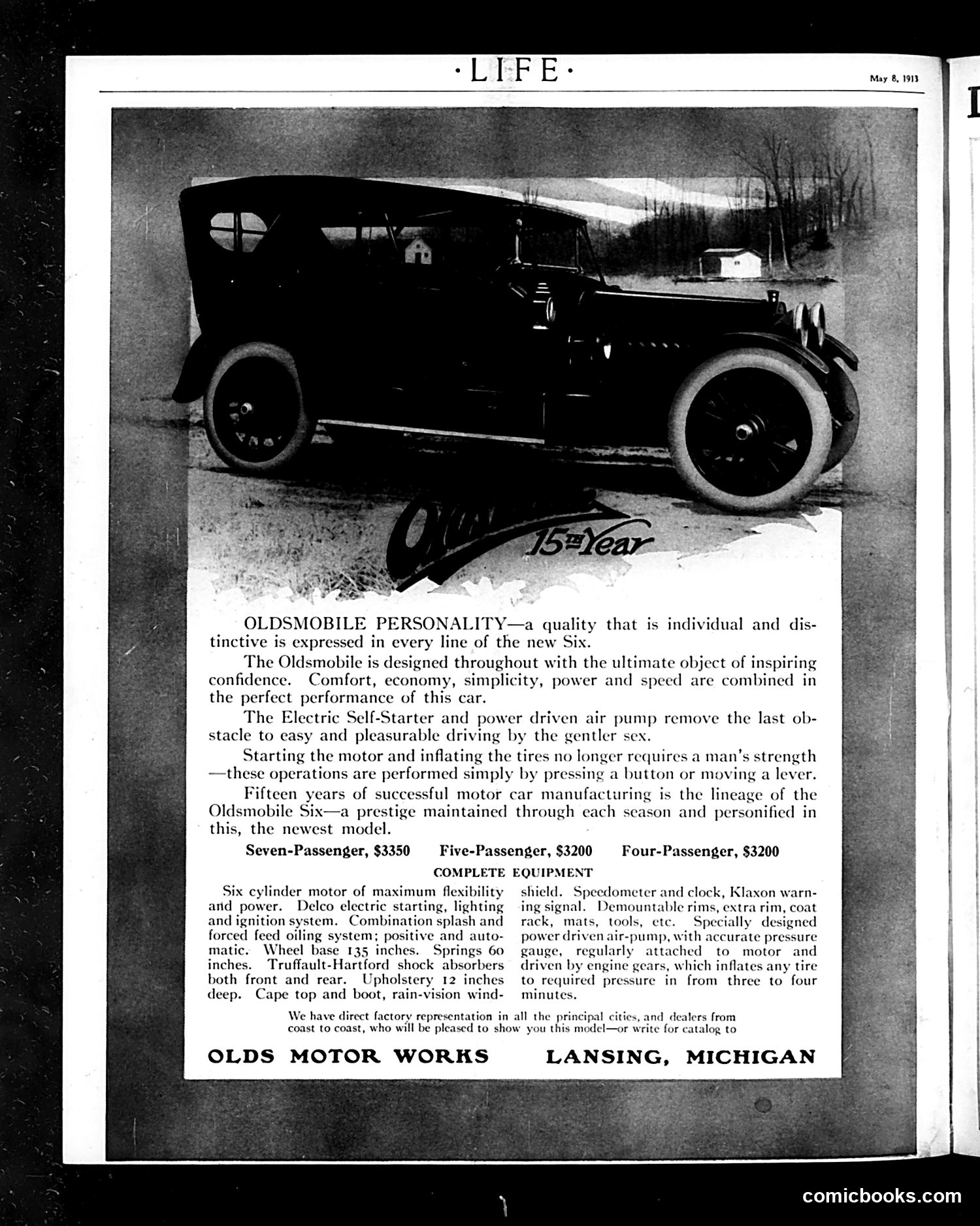
This is an **automobile advertisement, not a cartoon or satirical piece**. It promotes the 1913 Oldsmobile Six to readers of *Life* magazine (May 8, 1913). The notable aspect for modern readers is the **marketing pitch targeting women**. The ad explicitly highlights that the electric self-starter and power-driven air pump eliminate the need for "a man's strength" to operate the car, making it accessible to "the gentler sex." This reflects early automotive history when hand-cranking engines were genuinely difficult and dangerous—a genuine technological advancement that broadened potential car buyers. The pricing ($3,200–$3,350) and detailed specifications emphasize this was a luxury vehicle. The "15-year" claim establishes Oldsmobile's reputation as an established, reliable manufacturer. The ad is straightforward product promotion with period-appropriate gender marketing—not satirical commentary.