
Life, 1913-05-08 · page 22 of 48
Life — May 8, 1913 — page 22: what you’re looking at
What you’re looking at
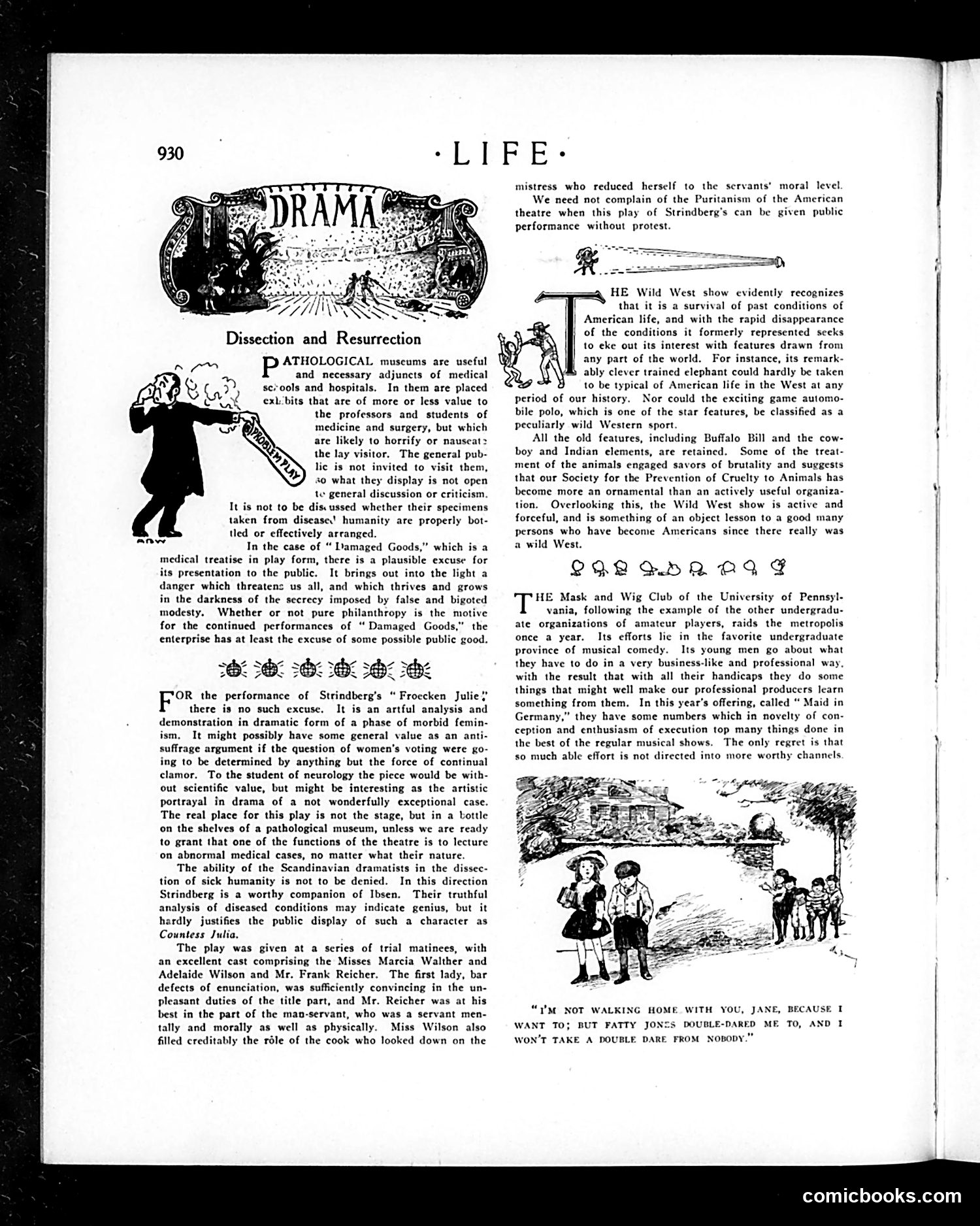
This page critiques theatrical productions through two reviews: **"Dissection and Resurrection"** attacks Strindberg's *Fräulein Julie*, arguing the play—depicting a noblewoman's sexual/moral degradation with her servant—belongs in a "pathological museum," not on stage. The critic distinguishes between *Damaged Goods* (which educates about venereal disease for public good) and Strindberg's work, which merely dissects "morbid feminism" and abnormal psychology without justification. The review sarcastically notes America's supposed "Puritanism" while allowing such morally transgressive content. **The Wild West section** observes Buffalo Bill's show adapting to changing times—adding trained elephants and automobile polo since actual Western conditions have disappeared. The critic notes this contradicts the show's authenticity claims, though it retains Buffalo Bill, cowboys, and Native American elements. Both reviews showcase *Life*'s satirical voice: using exaggeration and irony to critique what the editors view as artistic or commercial excess.
📄 Transcribed text from this page (OCR, searchable)
Machine-transcribed from the original scan — historical spelling and the odd misread are preserved.
anw Dissection and Resurrection ATHOLOGICAL museums are useful and necessary adjuncts of medical & Cae scrools and hospitals. In them are placed Y its that are of more or less value to the professors and students of medicine and surgery, but which are likely to horrify or nausea’ the lay visitor. The general pub- lic is not invited to visit them, 30 what they display is not open te general discussion or criticism. It is not to be dis ussed whether their specimens taken from disease’ humanity are properly bot- tled or effectively arranged. In the case of “ Liamaged Goods,” which is a medical treatise in play form, there is a plausible excuse for its presentation to the public. It brings out into the light a danger which threatens us all, and which thrives and grows in the darkness of the secrecy imposed by false and bigoted modesty. Whether or not pure philanthropy is the motive for the continued performances of “Damaged Goods,” the enterprise has at least the excuse of some possible public good. ~@s* Seb =e: tebe see See 'OR the performance of Strindberg’s “ Froccken Julie,’ there is no such excuse. It is an artful analysis and demonstration in dramatic form of a phase of morbid femin- ism, It might possibly have some general value as an anti- suffrage argument if the question of women's voting were go- ing to be determined by anything but the force of continual clamor, To the student of neurology the piece would be with- out scientific value, but might be interesting as the artistic portrayal in drama of a not wonderfully exceptional case. The real place for this play is not the stage, but in a bottle on the shelves of a pathological museum, unless we are ready to grant that one of the functions of the theatre is to lecture on abnormal medical cases, no matter what their nature. The ability of the Scandinavian dramatists in the dissec- tion of sick humanity is not to be denied. In this direction Strindberg is a worthy companion of Ibsen. Their truthful analysis of diseased conditions may indicate genius, but it hardly justifies the public display of such a character as Countess Julia, The play was given at a series of trial matinees, with an excellent cast comprising the Misses Marcia Walther and Adelaide Wilson and Mr. Frank Reicher. The first lady, bar defects of enunciation, was sufficiently convincing in the un- pleasant duties of the title part, and Mr. Reicher was at his best in the part of the man-servant, who was a servant men- tally and morally as well as physically. Miss Wilson also filled creditably the réle of the cook who looked down on the ~L PPB mistress who reduced herself to the servants’ moral level. We need not complain of the Puritanism of the American theatre when this play of Strindberg’s can be given public performance without protest. HE Wild West show evidently recognizes fj that it is a survival of past conditions of | American life, and with the rapid disappearance | of the conditions it formerly represented seeks to eke out its interest with features drawn from any part of the world. For instance, its remark- ably clever trained elephant could hardly be taken to be typical of American life in the West at any period of our history. Nor could the exciting game automo- bile polo, which is one of the star features, be classified as a peculiarly wild Western sport. All the old features, including Buffalo Bill and the cow- boy and Indian elements, are retained. Some of the treat- ment of the animals engaged savors of brutality and suggests that our Society for the Prevention of Cruelty to Animals has become more an ornamental than an actively useful organiza- tion. Overlooking this, the Wild West show is active and forceful, and is something of an object lesson to a good many persons who have become Americans since there really was a wild West. O9ge2oa52 09 ¢ HE Mask and Wig Club of the University of Pennsyl- vania, following the example of the other undergradu- ate organizations of amateur players, raids the metropolis once a year. Its efforts lic in the favorite undergraduate province of musical comedy. Its young men go about what they have to do in a very business-like and professional way. with the result that with all their handicaps they do some things that might well make our professional producers learn something from them. In this year’s offering, called “ Maid in Germany,” they have some numbers which in novelty of con- ception and enthusiasm of execution top many things done in the best of the regular musical shows. The only regret is that so much able effort is not directed into more worthy channels “YM NOT WALKING HOME WITH YOU, JANE, BECA WANT 10; BUT FATTY JONSS DOUBLE-DARED ME TO, AND T WON’T TAKE A DOUBLE DARE FROM NOBODY comicbooks.com