
Life, 1913-05-08 · page 26 of 48
Life — May 8, 1913 — page 26: what you’re looking at
What you’re looking at
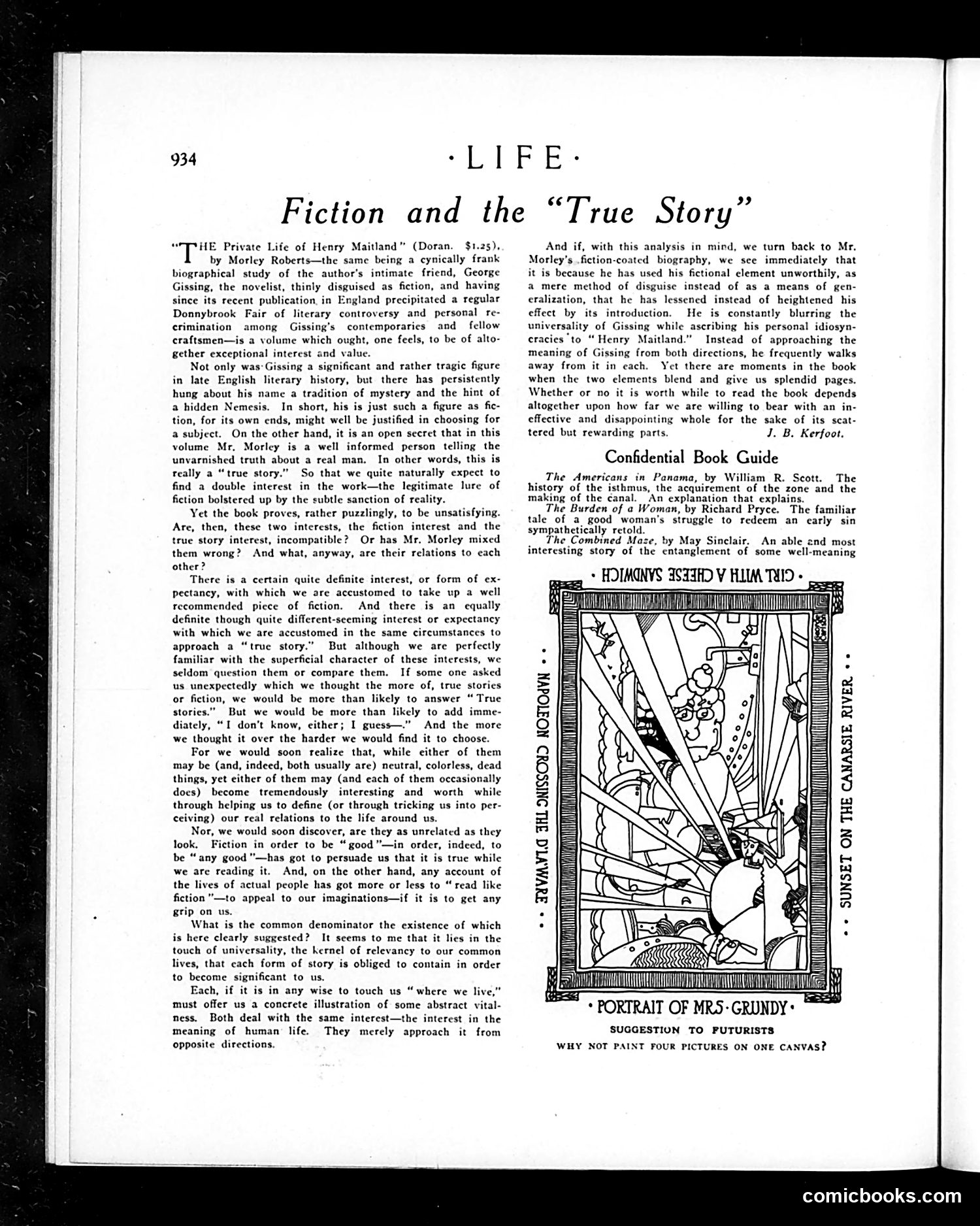
This page discusses Morley Roberts's biography of novelist George Gissing, disguised as fiction under the title "The Private Life of Henry Maitland." The article examines why this hybrid work—factual biography presented as a novel—fails to satisfy readers despite promising double appeal. The author argues that fiction and "true stories" operate on different but equally valid principles. Good fiction must *feel* true while being read; conversely, real biographical accounts must possess narrative appeal to engage readers. Both derive power from touching universal human concerns and "where we live"—our genuine life experiences. The paradox: The Gissing book disappoints precisely because it confuses these modes. Rather than enriching each other, fact and fiction here undermine one another, suggesting they work best when kept distinct or fully integrated, not awkwardly blended. The accompanying illustration ("Portrait of Mrs. Grundy") appears unrelated to the main text—likely a separate satirical commentary on social conventions.
📄 Transcribed text from this page (OCR, searchable)
Machine-transcribed from the original scan — historical spelling and the odd misread are preserved.
‘LIF E* Fiction and the “True Story” HE Private Life of Henry Maitland” (Doran. $1.25), by Morley Roberts—the same being a cynically frank biographical study of the author's intimate friend, George Gissing, the novelist, thinly disguised as fiction, and having since its recent publication, in gland precipitated a regular Donnybrook Fair of literary controversy and personal re- crimination among Gissing’s contemporaries and fellow craftsmen—is a volume which ought, one feels, to be of alto- gether exceptional interest and value. Not only was:Gissing a significant and rather tragic figure in late English literary history, but there has persistently hung about his name a tradition of mystery and the hint of a hidden Nem In short, his is just such a figure as fic- tion, for its own ends, might well be justified in choosing for a subject. On the other hand, it is an open secret that in this volume Mr. Morley is a well informed person telling the unvarnished truth about a real man. In other words, this is really a “true story.” So that we quite naturally expect to find a double interest in the work—the legitimate lure of fiction bolstered up by the subtle sanction of reality. Yet the book proves, rather puzzlingly, to be unsatisfying. Are, then, these two interests, the fiction interest and the true story interest, incompatible? Or has Mr. Morley mixed them wrong? And what, anyway, are their relations to each other? There is a certain quite definite interest, or form of ex- pectancy, with which we are accustomed to take up a well recommended picce of fiction. And there is an equally definite though quite different-seeming interest or expectancy with which we are accustomed in the same circumstances to approach a “true story.” But although we are perfectly familiar with the superficial character of these interests, we seldom question them or compare them. If some one asked us unexpectedly which we thought the more of, true stories or fiction, we would be more than likely to answer “ True stories.” But we would be more than likely to add imme- diately, “I don’t know, either; I guess—.” And the more we thought it over the harder we would find it to choose. For we would soon realize that, while either of them may be (and, indeed, both usually are) neutral, colorless, dead things, yet either of them may (and each of them occasionally does) become tremendously interesting and worth while through helping us to define (or through tricking us into per- ceiving) our real relations to the life around us. Nor, we would soon discover, are they as unrelated as they look, Fiction in order to be “good”—in order, indeed, to be “any good has got to persuade us that it is true while we are reading it. And, on the other hand, any account of the lives of actual people has got more or less to “ read like fiction ""—to appeal to our imaginations—if it is to get any grip on us. What is the common denominator the existence of which is here clearly suggested? It seems to me that it lies in the touch of universality, the kernel of relevancy to our common lives, that cach form of story is obliged to contain in order to become significant to us. Each, if it is in any wise to touch us “where we live, must offer us a concrete illustration of some abstract vital- ness. Both deal with the same interest—the interest in the meaning of human life. They merely approach it from opposite directions. And if, with this analysis in mind, we turn back to Mr. Morley’s .fiction-coated biography, we sce immediately that it is because he has used his fictional clement unworthily, as a mere method of disguise instead of as a means of gen- eralization, that he has lessened instead of heightened his effect by its introduction. He is constantly blurring the universality of Gissing while ascribing his personal idiosyn- cracies ‘to “Henry Maitland.” Instead of approaching the meaning of Gissing from both directions, he frequently walks away from it in cach, Yet there are moments in the book when the two elements blend and give us splendid pages. Whether or no it is worth while to read the book depends altogether upon how far we are willing to bear with an in- effective and disappointing whole for the sake of its scat- tered but rewarding parts. J. B. Kerfoot. Confidential Book Guide The Americans in Panama, by William R. Scott. The history of the isthmus, the acquirement of the zone and the ing of the canal. ‘An explanation that explains. The Burden of a Woman, by Richard Pryce. The familiar tale of a good woman's struggle to redeem an early sin sympathetically retold The Combined Mi by May Sinclair, An able end most interesting story of the entanglement of some well-meaning + HOTMONYS 3SaqHD V HLM THD - TTT + + TAVMVTC FHL ONISSOYD NOTION - + * + SUNSET ON THE CANARSIE RIVER «+ * PORTRAIT OF MR5- GRUNDY: SUGGESTION TO PUTURISTS WHY NOT PAINT FOUR PICTURES ON ONE CANVAS? comicbooks.com