
Life, 1913-05-08 · page 10 of 48
Life — May 8, 1913 — page 10: what you’re looking at
What you’re looking at
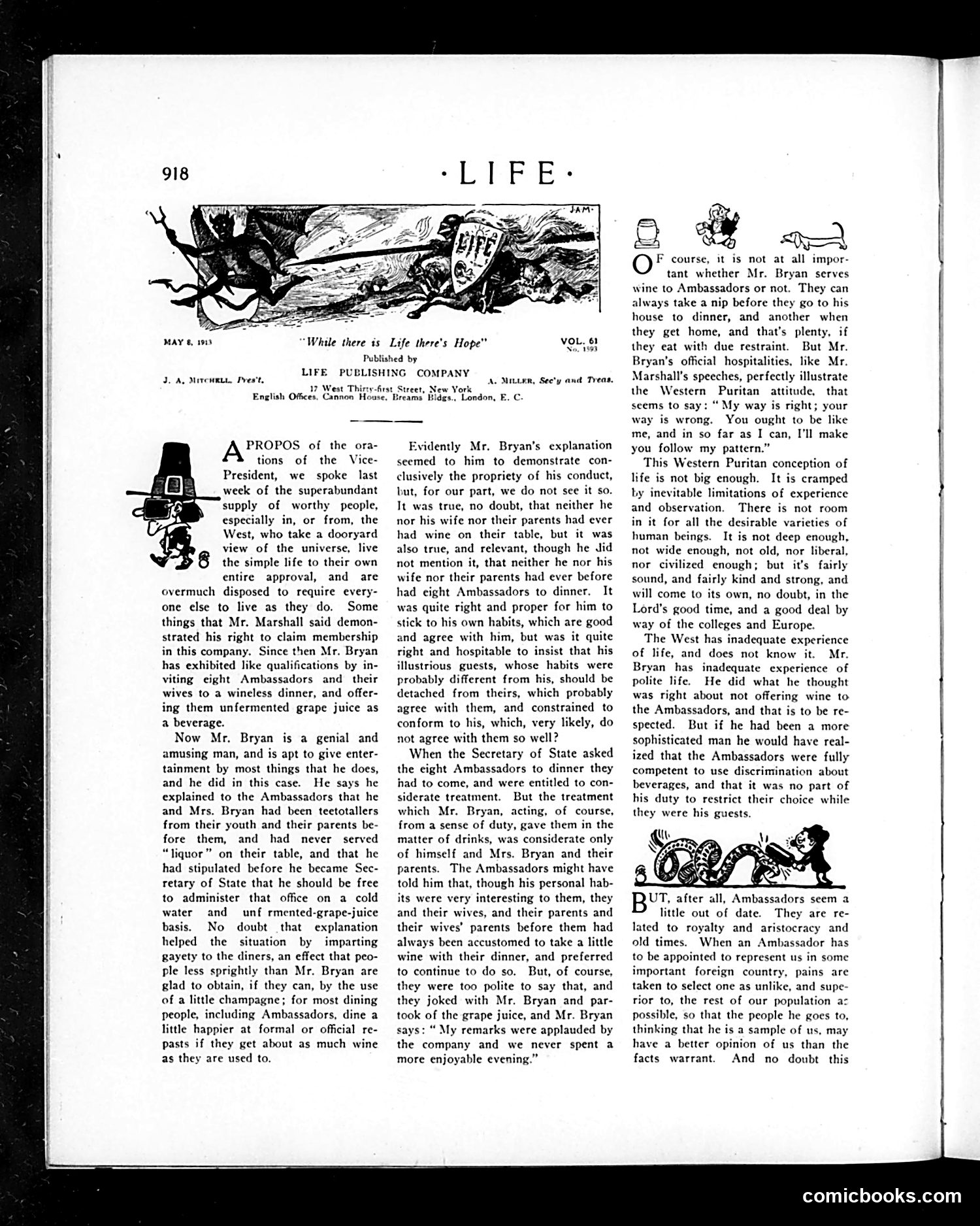
This 1915 *Life* cartoon satirizes Secretary of State William Jennings Bryan's entertaining eight foreign Ambassadors and their wives at dinner without serving wine—a notable choice given Bryan's well-known temperance advocacy. The satire targets the tension between Bryan's personal abstinence principles and diplomatic protocol. The text argues that while Bryan's gesture was "genial and amusing," it created an awkward situation for guests accustomed to wine at formal dinners. The joke centers on whether strict personal morality should dictate diplomatic hospitality. The cartoon mocks both Bryan's rigid adherence to his beliefs and the discomfort this caused his distinguished guests, treating a minor social controversy as emblematic of broader debates about Prohibition-era America imposing moral standards on others.
📄 Transcribed text from this page (OCR, searchable)
Machine-transcribed from the original scan — historical spelling and the odd misread are preserved.
MAY 8, 1913 “While there is Life there's Hope” VOL. 64 Published by LIFE PUBLISHING COMPANY J. A, MirewRLL, Pret, 17 West Thirey-fi English Offices, Cannon House, Breams’ Nos 193 A. Miuien, See'y and Treas. treet, PROPOS of the ora- tions of the Vice- President, we spoke last week of the superabundant supply of worthy people, especially in, or from, the West, who take a dooryard view of the universe, live the simple life to their own entire approval, and are overmuch disposed to require every- one else to live as they do. Some things that Mr. Marshall said demon- strated his right to claim membership in this company. Since then Mr. Bryan has exhibited like qualifications by in- viting eight Ambassadors and_ their wives to a wineless dinner, and offer- ing them unfermented grape juice as a beverage. Now Mr. Bryan is a genial and amusing man, and is apt to give enter- tainment by most things that he does, and he did in this case. He says he explained to the Ambassadors that he and Mrs. Bryan had been teetotallers from their youth and their parents be- fore them, and had never served “liquor” on their table, and that he had stipulated before he became Sec- retary of State that he should be free to administer that office on a cold water and unf rmented-grape-juice basis. No doubt that explanation helped the situation by imparting gayety to the diners, an effect that peo- ple less sprightly than Mr. Bryan are glad to obtain, if they can, by the use of a little champagne; for most dining people, including Ambassadors, dine a little happier at formal or official re- pasts if they get about as much wine as they are used to. Evidently Mr. Bryan's explanation seemed to him to demonstrate con- clusively the propriety of his conduct, but, for our part, we do not see it so. It was true, no doubt, that neither he nor his wife nor their parents had ever had wine on their table, but it was also true, and relevant, though he did not mention it, that neither he nor his wife nor their parents had ever before had eight Ambassadors to dinner. It was quite right and proper for him to stick to his own habits, which are good and agree with him, but was it quite right and hospitable to insist that his illustrious guests, whose habits were probably different from his, should be detached from theirs, which probably agree with them, and constrained to conform to his, which, very likely, do not agree with them so well? When the Secretary of State asked the eight Ambassadors to dinner they had to come, and were entitled to con- siderate treatment. But the treatment which Mr. Bryan, acting, of course, from a sense of duty, gave them in the matter of drinks, was considerate only of himself and Mrs. Bryan and their parents. The Ambassadors might have told him that, though his personal hab- its were very interesting to them, they and their wives, and their parents and their wives’ parents before them had always been accustomed to take a little wine with their dinner, and preferred to continue to do so. But, of course, they were too polite to say that, and they joked with Mr. Bryan and par- took of the grape juice, and Mr. Bryan says: “ My remarks were applauded by the company and we never spent a more enjoyable evening.” is F course, it is not at all impor- tant whether Mr. Bryan serves wine to Ambassadors or not. They can always take a nip before they go to his house to dinner, and another when they get home, and that’s plenty, if they eat with due restraint. But Mr. Bryan's official hospitalities, like Mr. Marshall's speeches, perfectly illustrate the Western Puritan attitude, that seems to say: “ My way is right; your way is wrong. You ought to be like me, and in so far as I can, I'll make you follow my pattern.” This Western Puritan conception of life is not big enough. It is cramped by inevitable limitations of experience and observation. There is not room in it for all the desirable varieties of human beings. It is not deep enough, not wide enough, not old, nor liberal, nor zed enough; but it’s fairly sound, and fairly kind and strong, and will come to its own, no doubt, in the Lord’s good time, and a good deal by way of the colleges and Europe. The West has inadequate experience of life, and does not know it. Mr. Bryan has inadequate experience of polite life. He did what he thought was right about not offering wine to the Ambassadors, and that is to be re- spected. But if he had been a more sophisticated man he would have real- ized that the Ambassadors were fully competent to use discrimination about beverages, and that it was no part of his duty to restrict their choice while they were his guests. UT, after all, Ambassadors seem 2 ittle out of date. They are re- lated to royalty and aristocracy and old times. When an Ambassador has to be appointed to represent us in some important foreign country, pains are taken to select one as unlike, and supe- rior to, the rest of our population az possible, so that the people he goes to, thinking that he is a sample of us, may have a better opinion of us than the facts warrant. And no doubt this comicbooks.com