
Life, 1913-05-08 · page 17 of 48
Life — May 8, 1913 — page 17: what you’re looking at
What you’re looking at
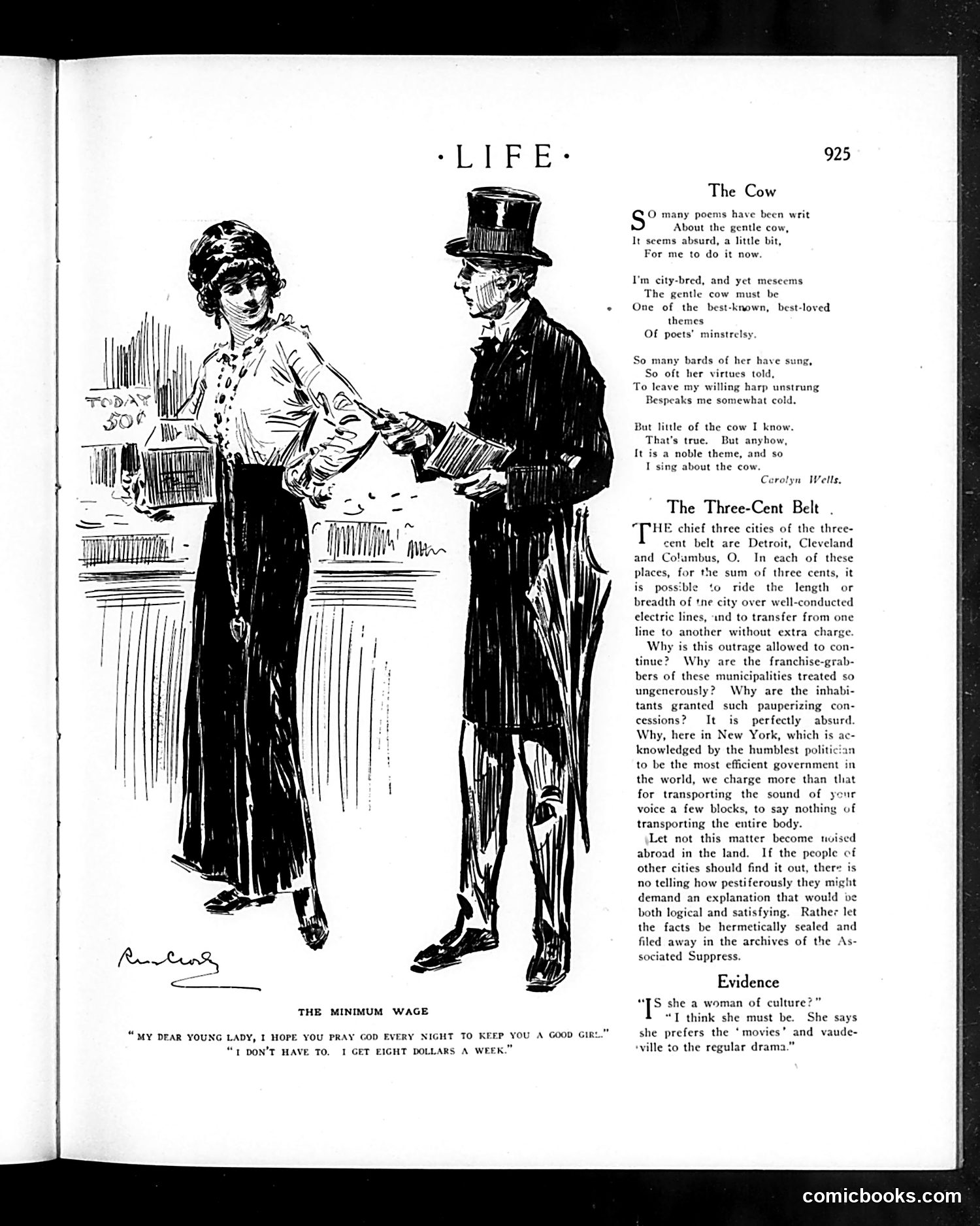
**"The Minimum Wage" cartoon** depicts a well-dressed gentleman (likely a wealthy employer or moralist) lecturing a young working woman about virtue and prayer. Her response—that she doesn't need to pray because she earns eight dollars weekly—is satirical commentary on labor economics. The joke suggests that adequate wages (eight dollars weekly was the minimum wage debate of the era) provide material security that makes moral exhortation from the privileged unnecessary. It mocks paternalistic attitudes toward working-class women. **"The Three-Cent Belt"** article sarcastically criticizes New York's public transportation pricing. Three Midwestern cities (Detroit, Cleveland, Columbus) offer cheap three-cent fares with transfers, while New York charges more. The author ironically praises New York's "efficiency" while suggesting the city exploits riders—and warns that if other cities discover this disparity, they might demand logical explanations New York cannot provide. Both pieces satirize economic inequality and institutional hypocrisy common to early 20th-century America.
📄 Transcribed text from this page (OCR, searchable)
Machine-transcribed from the original scan — historical spelling and the odd misread are preserved.
The Cow O many poems have been writ About the gentle cow, It seems absurd, a little bit, For me to do it now. I'm city-bred, and yet meseems The gentle cow must be One of the best-known, best-loved themes OF poets’ minstrelsy So many bards of her have sung, So oft her virtues told, To leave my willing harp unstrung Bespeaks me somewhat cold. But little of the cow I know. That's true. But anyhow, It is a noble theme, and so I sing about the cow. Cerolyn Wells, The Three-Cent Belt “THE chief three cities of the three- cent belt are Detroit, Cleveland and Columbus, O. In each of these places, for the sum of three cents, it is possible to ride the length or breadth of tne city over well-conducted electric lines, ind to transfer from one line to another without extra charge. Jhy is this outrage allowed to con- Why are the franchise-grab- bers of these municipalities treated so ungenerously? Why are the inhabi- tants granted such pauperizing con- cessions? It is perfectly absurd. Why, here in New York, which is ac- knowledged by the humblest politician to be the most efficient government in the world, we charge more than that for transporting the sound of your voice a few blocks, to say nothing of transporting the entire body. Let not this matter become twvised abroad in the land. If the people of other cities should find it out, there is no telling how pestiferously they might demand an explanation that would be both logical and satisfying. Rather let the facts be hermetically sealed and filed away in the archives of the As- sociated Suppress, Evidence “TS she a. woman of culture?” “I think she must be. She says she prefers the ‘movies’ and vaude- THE MINIMUM WAGE “MY DEAR YOUNG LADY, I HOPE YOU PRAY GOD EVERY NIGHT TO KEEP YOU A GooD GiR:.” h “~T DON’T HAVE TO, 1 GET EIGHT DOLLARS A WEEK.” ‘ville to the regular drama. comicbooks.com