
Life, 1913-05-08 · page 16 of 48
Life — May 8, 1913 — page 16: what you’re looking at
What you’re looking at
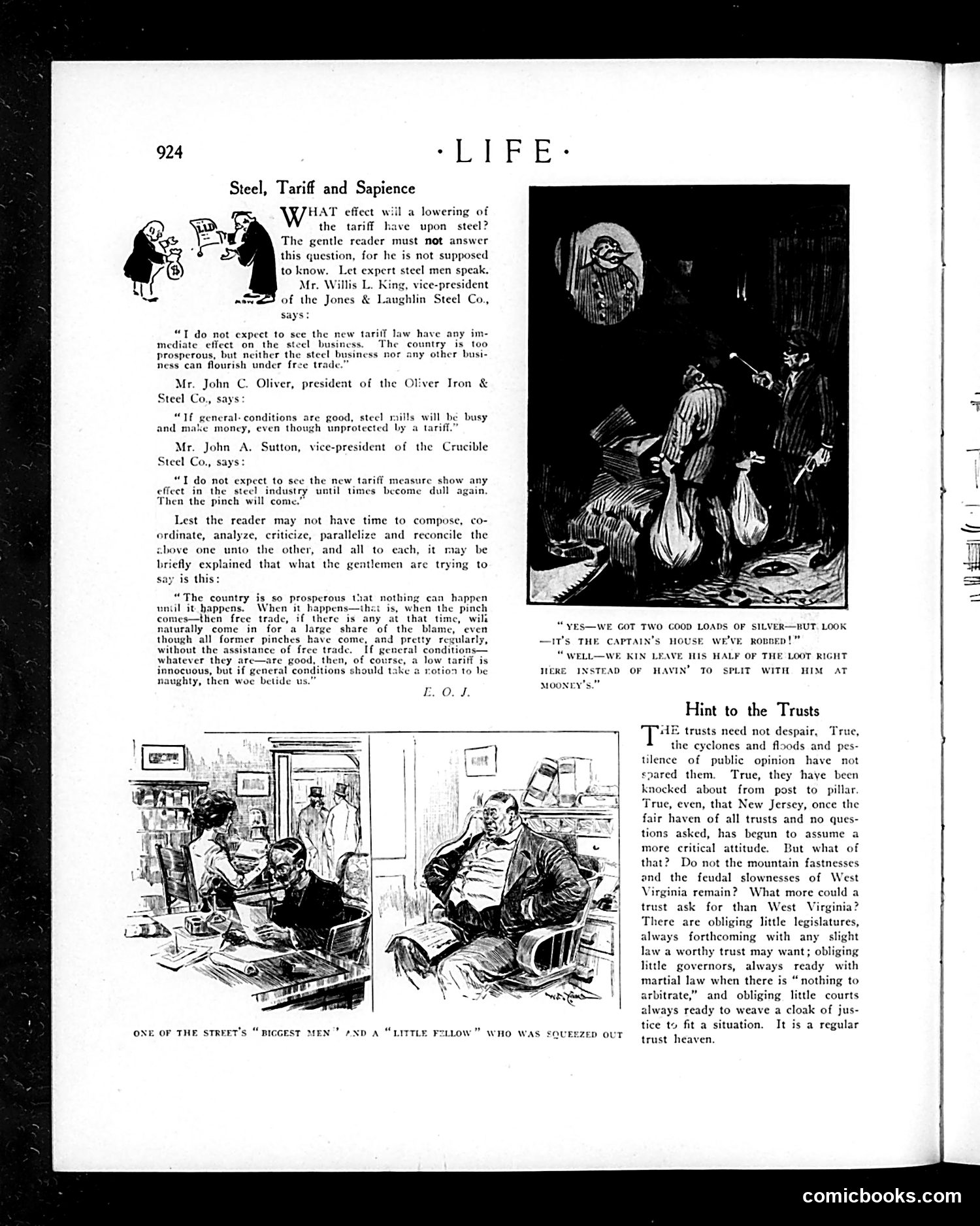
This page satirizes steel industry executives' contradictory statements on tariff policy. Three steel company vice-presidents and presidents offer conflicting views on how lowering tariffs will affect business—some claim prosperity shields them regardless, others suggest problems only appear during downturns. Life's editors mock this circular logic: the executives essentially argue tariffs don't matter when times are good, but blame free trade when conditions worsen, creating convenient excuses either way. The accompanying pirate cartoon reinforces the satire, depicting criminals dividing stolen silver while discussing keeping a captain's share rather than splitting it—a parallel to how business leaders manipulate economic policy arguments for self-interest. The "Hint to the Trusts" section similarly criticizes monopolies for exploiting weak West Virginia governance (obliging legislatures, governors, and courts) as a regulatory safe haven.
📄 Transcribed text from this page (OCR, searchable)
Machine-transcribed from the original scan — historical spelling and the odd misread are preserved.
ONE OF THE STREET'S “ BIGGEST MEN Steel, Tariff and Sapience HAT effect will a lowering of the tariff © upon steel? The gentle reader must not answer this question, for he is not supposed to know. Let expert steel men speak. Mr. Willis L. King, vice-president of the Jones & Laughlin Steel Co., says: “T do not expect to sce the new tariff law have any im- mediate effect on the steel business. The country is too prosperous, but neither the steel business nor any other busi- ness can flourish under free trade.” Mr. John C. Oliver, president of the Oliver Iron & Steel Co., “af and ma neral- conditions are good, steel mills will h money, even though unprotected by iff.” Mr. John A. Sutton, vice-president of the Crucible Steel Co., says: “T do not expect to sce the new tariff measure show any effect in the steel industry until times become dull again, Then the pinch will come.” Lest the reader may not have time to comfy ordinate, analyze, criticize, parallelize and reconcile the hove one unto the other, and all to each, it may be efly explained that what the gentlemen are trying to is this: + CO “The country isso prosperous that nothing can happen until it happens. When it happens—ihet is, when the pinch comes—then free trade, if there is any at that time, wilk naturally come in fora large share of the blame, even though all former pinches have come, and pretty regularly, without the assistance of free trade. If g al conditions— whatever they are—are good, then, of cov low tariff is innocuous, but if general conditions should take a rotion to be naughty, then woe betide u £0. J. YES—WE GOT TWO GOOD LOADS OF SILVER—RUT. LOOK 11's THE CAPTAIN'S HOUSE WE'VE ROBBED!” “WELL—WE KIN LEAVE HIS HALF OF THE LOOT RIGHT WERE INSTEAD OF HAVIN’ 10 SPLIT WITH HIM AT MOONEY's.” Hint to the Trusts AND A “LITTLE FELLOW” WHO WAS SQUEEZED OUT T = trusts need not despair, True, the cyclones and floods and pes- tilence of public opinion have not spared them. True, they haye been knocked about from post to pillar. True, even, that New Jersey, once the fair haven of all trusts and no ques- tions asked, has begun to assume a more critical attitude. But what of that? Do not the mountain fastnesses and the feudal slownesses of West Virginia remain? What more could a trust ask for than West Virginia? There are obliging little legislatures, alw forthcoming with any slight law a worthy trust may want; obliging little governors, always ready with martial law when there is “nothing to arbitrate,” and obliging little courts always ready to weave a cloak of jus- tice to fit a situation. It is a regular trust heaven. n Waves fey. comicbooks.com