
A complete issue · 40 pages · 1913
Life — February 27, 1913
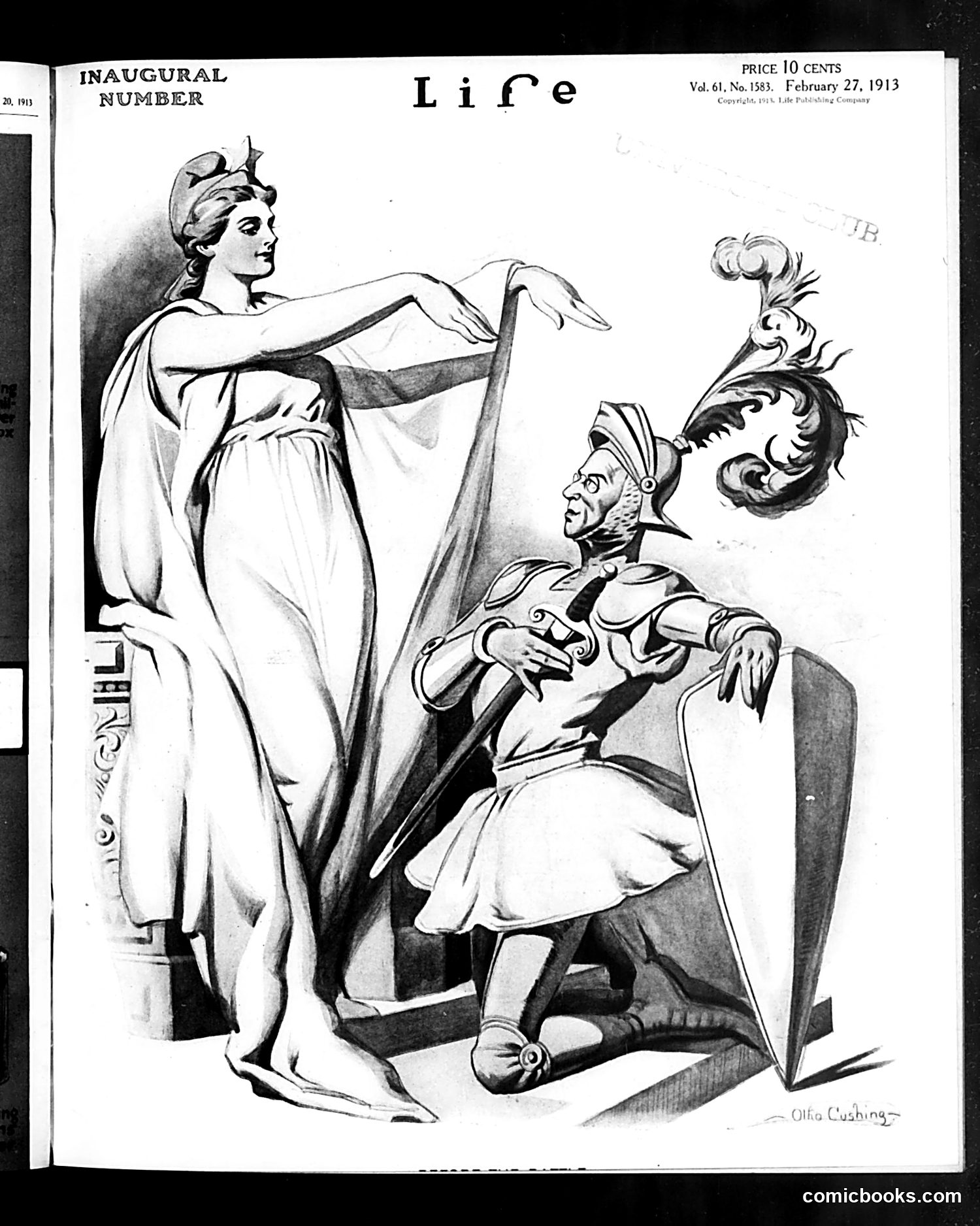
This is the **inaugural cover of Life magazine** (February 27, 1913), featuring a political allegory drawn by Otho Cushing. The standing female figure represents **Lady Liberty or Columbia** (classical symbol of America), wielding a sword or staff. She gazes downward at a kneeling military or political figure in ornate regalia—likely a caricatured foreign leader or authoritarian ruler. The satire appears to celebrate American democratic ideals triumphing over autocratic power. The gesture suggests Liberty asserting dominance or judgment over despotism. This likely reflects early 20th-century American political sentiment favoring democratic governance over European monarchy and militarism, particularly given the 1913 date and tensions preceding World War I. The exact historical figure caricatured remains unclear without additional context.
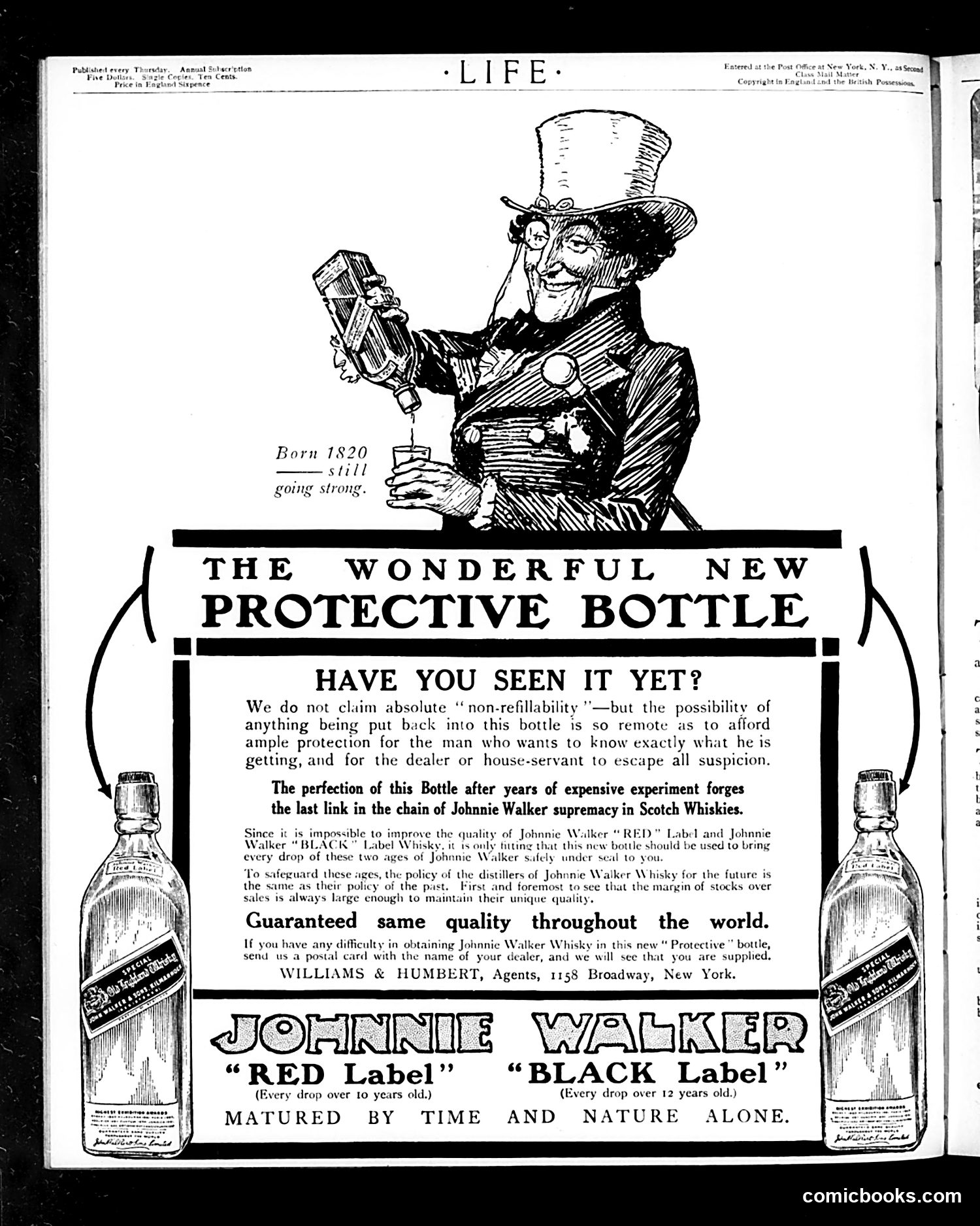
This page is primarily a **Johnnie Walker whisky advertisement**, not political satire. The large illustration shows a caricatured figure (likely representing the brand's mascot "Striding Man") in top hat and formal dress, pouring whisky and smiling broadly. The caption reads "Born 1820 still going strong." The ad promotes a "Wonderful New Protective Bottle" designed to prevent refilling—addressing concerns about counterfeit whisky. It emphasizes that Johnnie Walker maintains consistent quality worldwide through this anti-tampering bottle design. The two bottle illustrations show the "RED Label" and "BLACK Label" varieties. This appears to be vintage advertising rather than editorial satire, reflecting early 20th-century concerns about product authenticity and counterfeiting in the spirits trade.
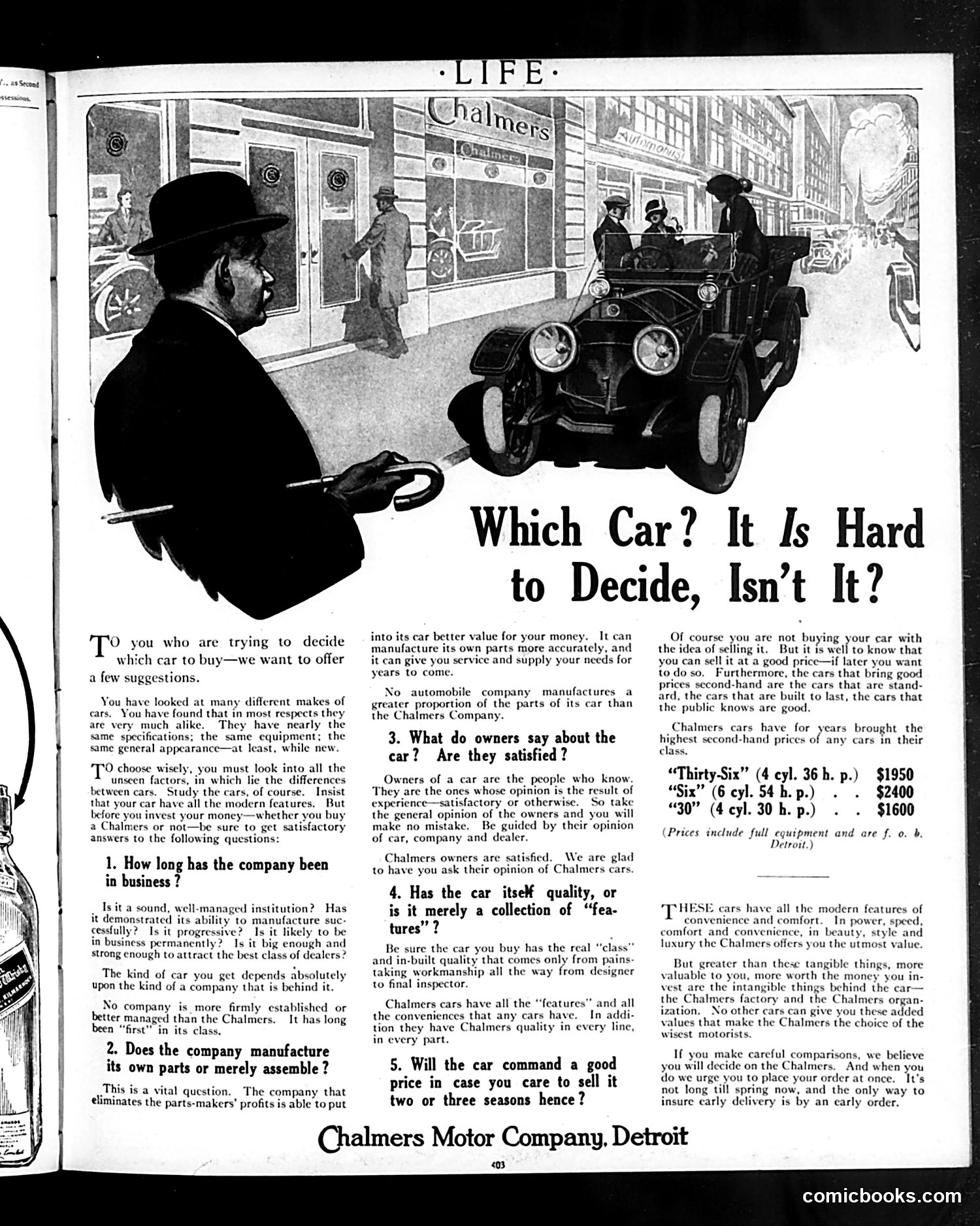
This page is primarily **advertising**, not satire. It's a Chalmers Motor Company advertisement from *Life* magazine. The image shows a man in a bowler hat contemplating which car to buy, with the headline "Which Car? It Is Hard to Decide, Isn't It?" The ad then argues for choosing Chalmers by posing five rhetorical questions about the company's management, manufacturing practices, parts quality, owner satisfaction, and resale value. The "cartoon" is essentially a sales pitch framed as helpful consumer advice. For modern readers, the period detail worth noting is how the ad appeals to practical concerns—manufacturing reliability, owner testimonials, and resale value—suggesting these were genuine consumer anxieties in early automotive purchasing.
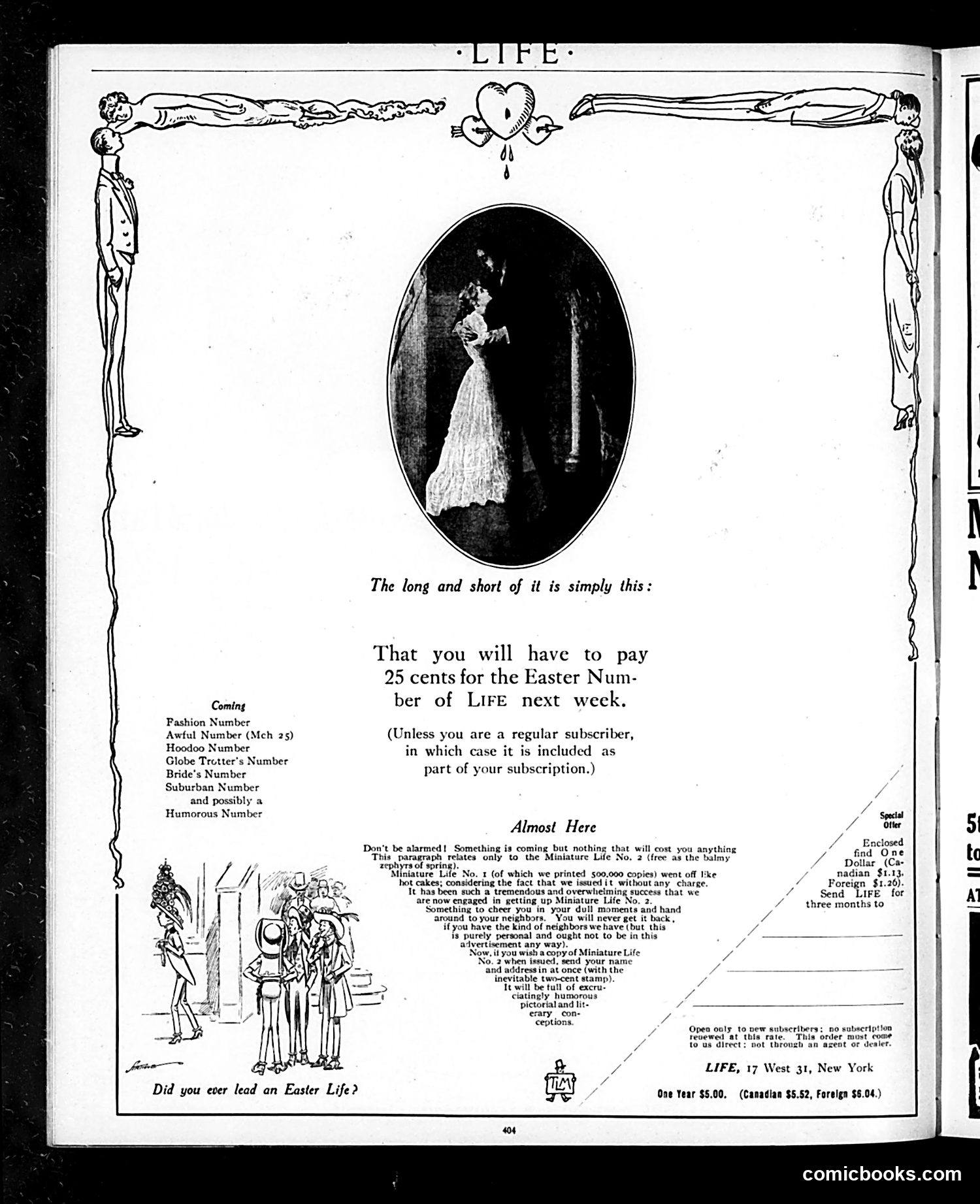
This page is primarily **promotional advertising** for Life magazine's upcoming Easter issue, rather than political satire. The central oval photograph shows a woman in an elegant white evening gown, likely representing the magazine's fashion content. The text announces that readers must pay 25 cents for the special Easter Number (regular subscribers receive it included). The copy emphasizes the issue will feature multiple themed sections: "Coming Fashion Number," "Awful Number," "Hoodoo Number," "Globe Trotter's Number," and others. The small cartoon at bottom left, captioned "Did you ever lead an Easter Life?" appears to show children in Easter dress, making a mild pun on "Easter life" versus typical life. This is essentially a subscription appeal using humor and the promise of varied entertainment content to drive sales of a special holiday edition.
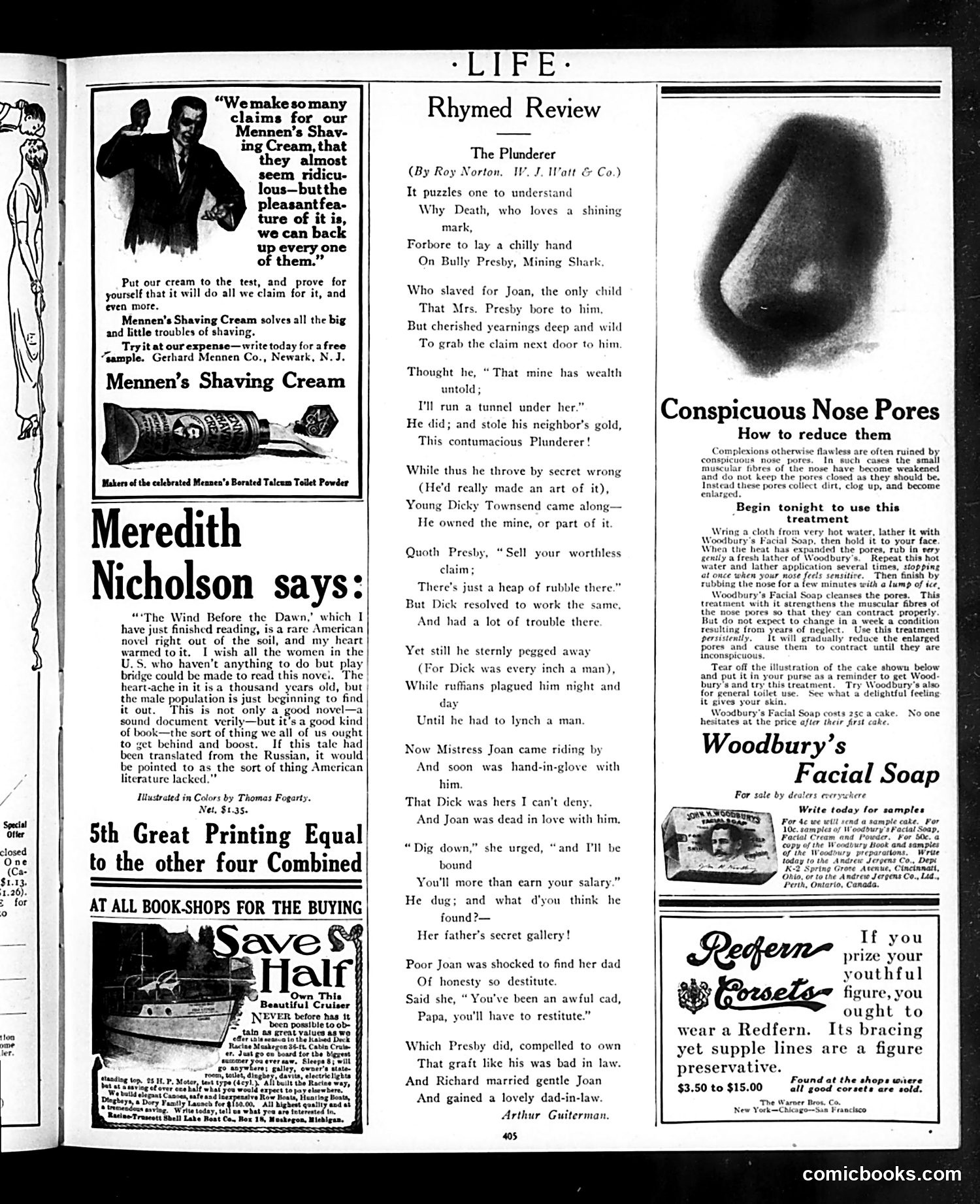
This page is primarily **advertising and literary content** rather than political satire. The main elements include: **Advertisements:** - Mennen's Shaving Cream (left): Standard product ad with typical grooming claims - Woodbury's Facial Soap (right): Addresses "Conspicuous Nose Pores," a beauty concern marketed to women - Redfern corsets (bottom right): Emphasizes figure control as desirable **Literary Content:** The center features "The Plunderer," a poem by Roy Norton about theft and moral wrongdoing, culminating in honest redemption through marriage. **Social Context:** These ads reveal early 20th-century consumer culture and beauty standards—particularly the marketing of insecurity about appearance to both men and women. The poem's morality tale reflects period attitudes toward virtue and social rehabilitation through matrimony.
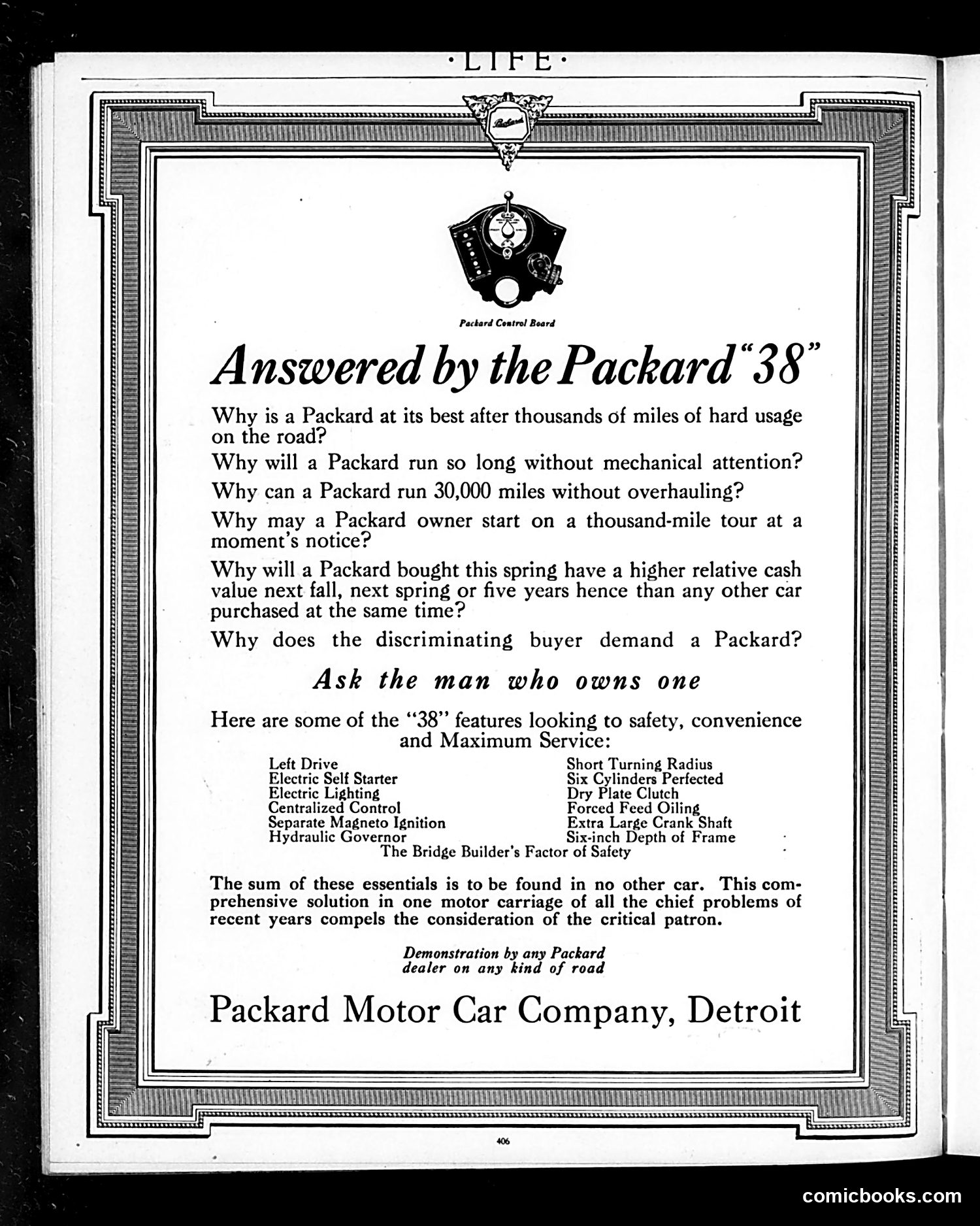
This is **not a cartoon or satire**, but rather a **straightforward advertisement** for the Packard Motor Car Company of Detroit. The page promotes the Packard "38" automobile model through a series of rhetorical questions emphasizing reliability and durability—claiming it runs thousands of miles without overhauls and retains strong resale value. The ad lists technical features (left-drive, electric starter, hydraulic governor, etc.) as evidence of the vehicle's superiority, concluding that this "comprehensive solution" addresses "all the chief problems of recent years." The Packard Control Board illustration at top shows the vehicle's dashboard instruments. This appears to be a luxury car advertisement from the early 20th century, appealing to "discriminating buyers" through appeals to engineering excellence rather than satire or humor.
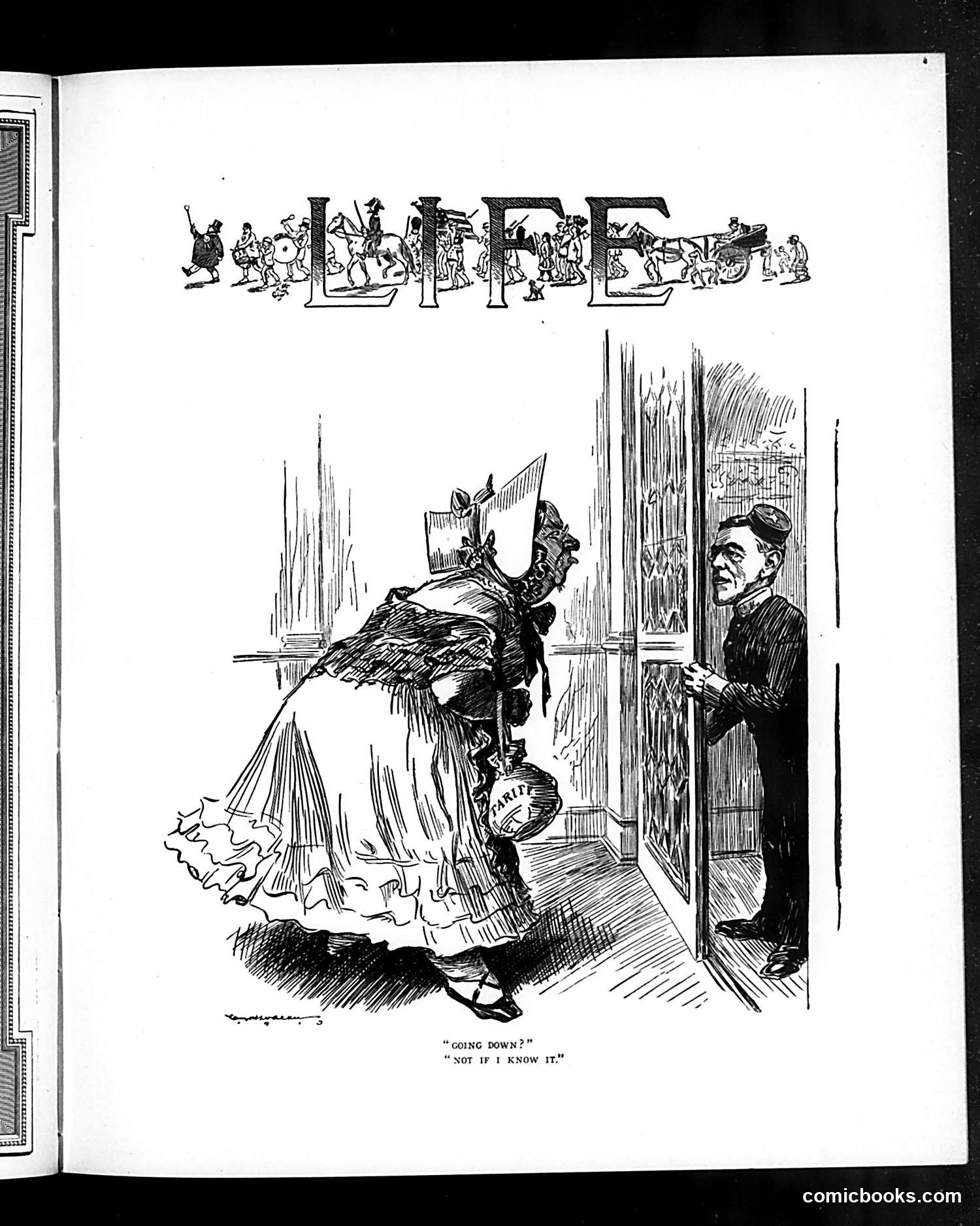
This political cartoon from *Life* magazine depicts a figure in elaborate, ornate dress (appearing to be royalty or high nobility based on the crown and formal attire) standing at a doorway, speaking to a man in plain dark clothing. The ornate figure asks "GOING DOWN?" and receives the response "NOT IF I KNOW IT." The cartoon satirizes social hierarchy and class anxiety. The elaborately dressed figure—likely representing wealth, privilege, or aristocratic power—is positioned above (literally on an elevated threshold), while the plainly dressed man represents the working or middle class. The exchange suggests resistance to descending into subordination or lower social status. The cartoon appears to comment on class tensions and reluctance among ordinary people to accept their "place" in a rigid social order, a common theme in early 20th-century American satirical commentary on inequality.
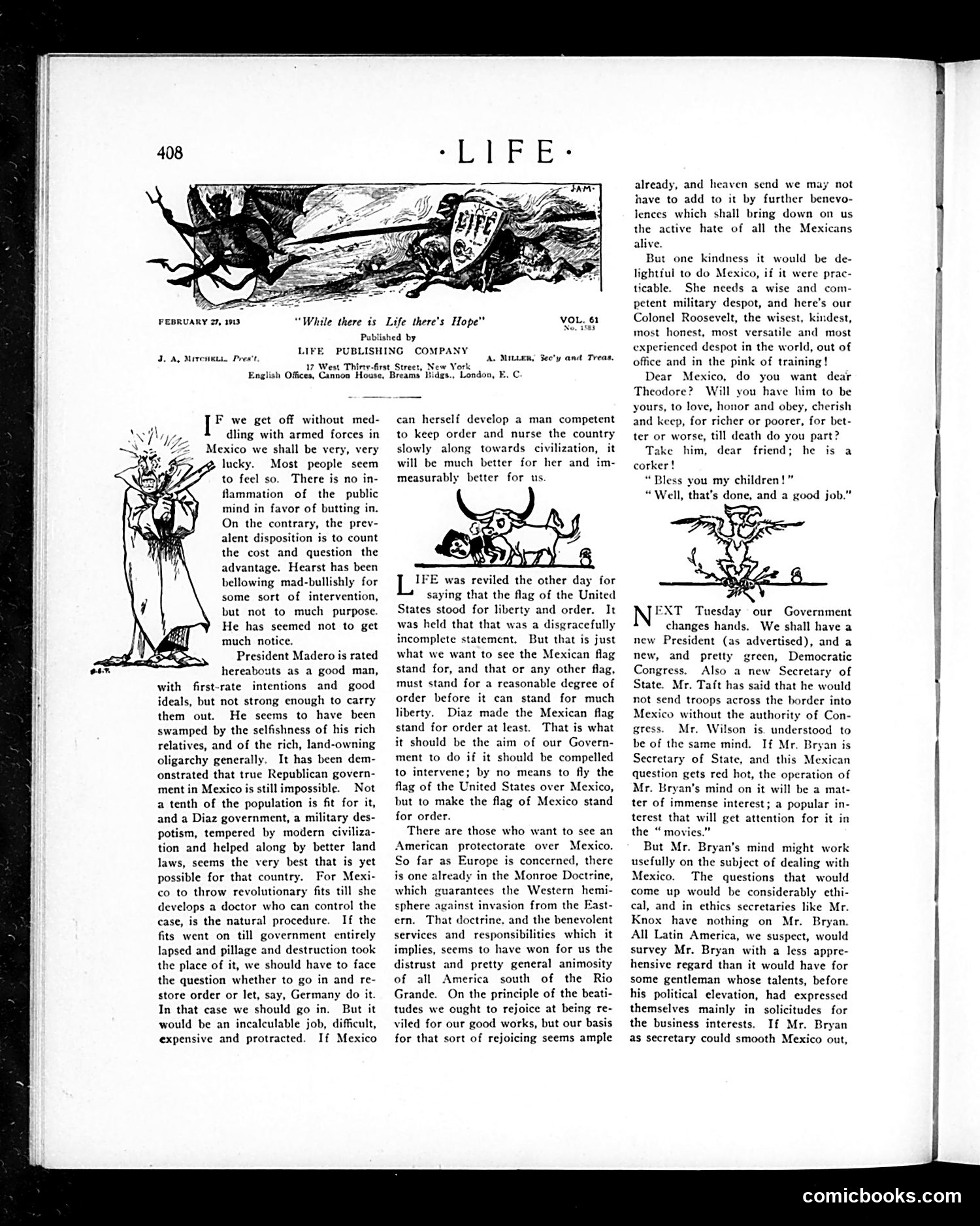
This editorial page addresses U.S. intervention in Mexico during the Mexican Revolution. The text criticizes President Madero as well-intentioned but ineffectual, arguing that Mexico needs strong military leadership—specifically praising Colonel Theodore Roosevelt as the ideal "wise, kindest, most honest" solution. The cartoon (upper left) depicts Mexico as a chaotic, violent figure—likely representing the country in turmoil. The editorial advocates for American intervention to establish order, invoking the Monroe Doctrine to justify U.S. authority over Latin America. The page also discusses upcoming government changes under President Wilson, with concerns about whether the new administration will maintain or alter American policy toward Mexico. The satire mocks both Mexican instability and American imperial ambitions.
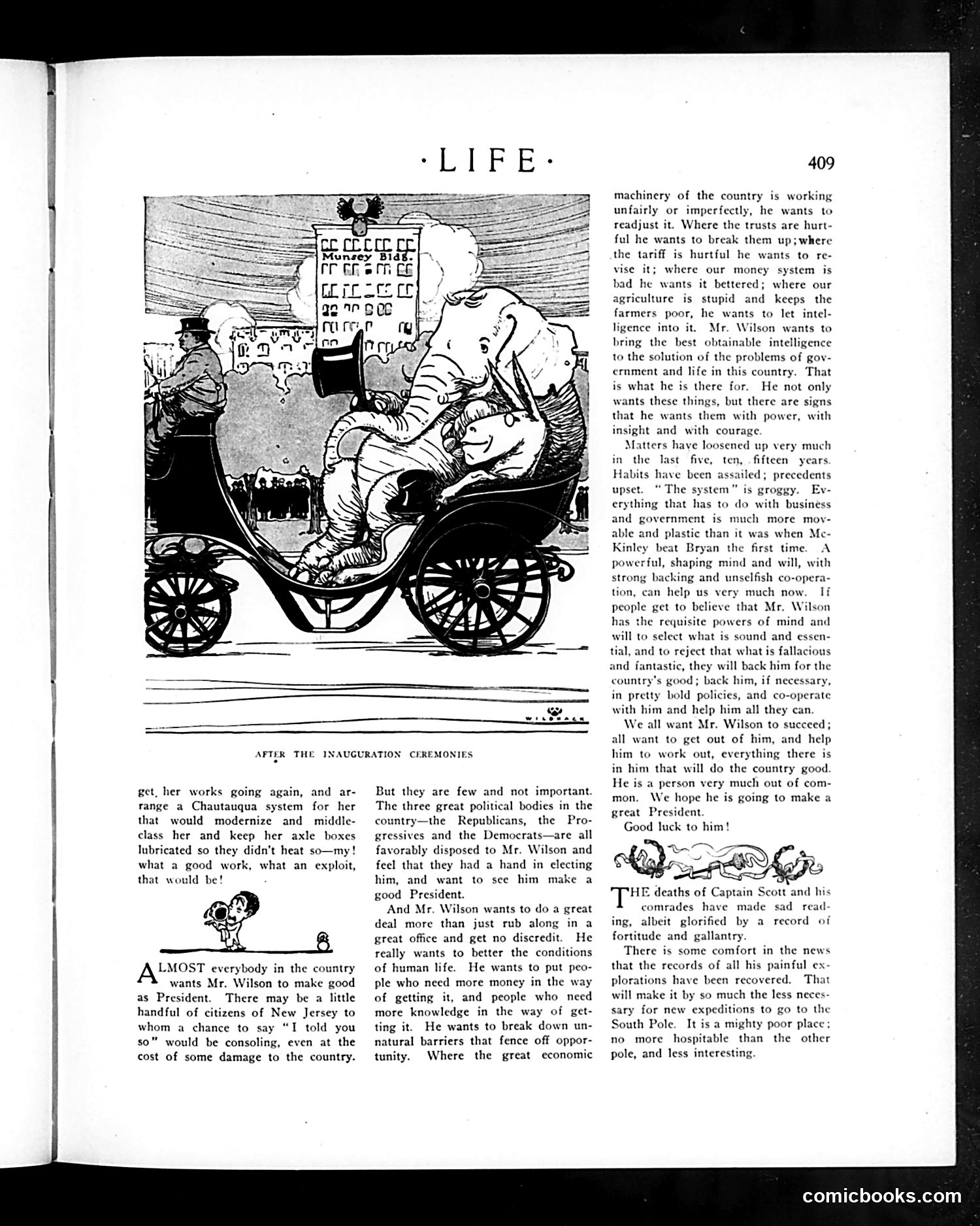
The cartoon titled "AFTER THE INAUGURATION CEREMONIES" depicts a rotund figure in formal dress (likely President Wilson) riding in an ornate carriage labeled "Munsey Bids" past a building. The satire appears to reference post-inauguration expectations. The accompanying text discusses widespread public desire for Wilson to succeed as President. It emphasizes that citizens want him to address major problems: fixing government inefficiency, breaking down economic barriers, improving conditions for the poor, and modernizing business and agriculture. The text expresses cautious optimism, noting that while Wilson's success depends on his personal character and judgment, public support is available "if people get to believe that Mr. Wilson has the requisite powers of mind." The overall tone suggests both hope and uncertainty about the new administration's ability to deliver reform.
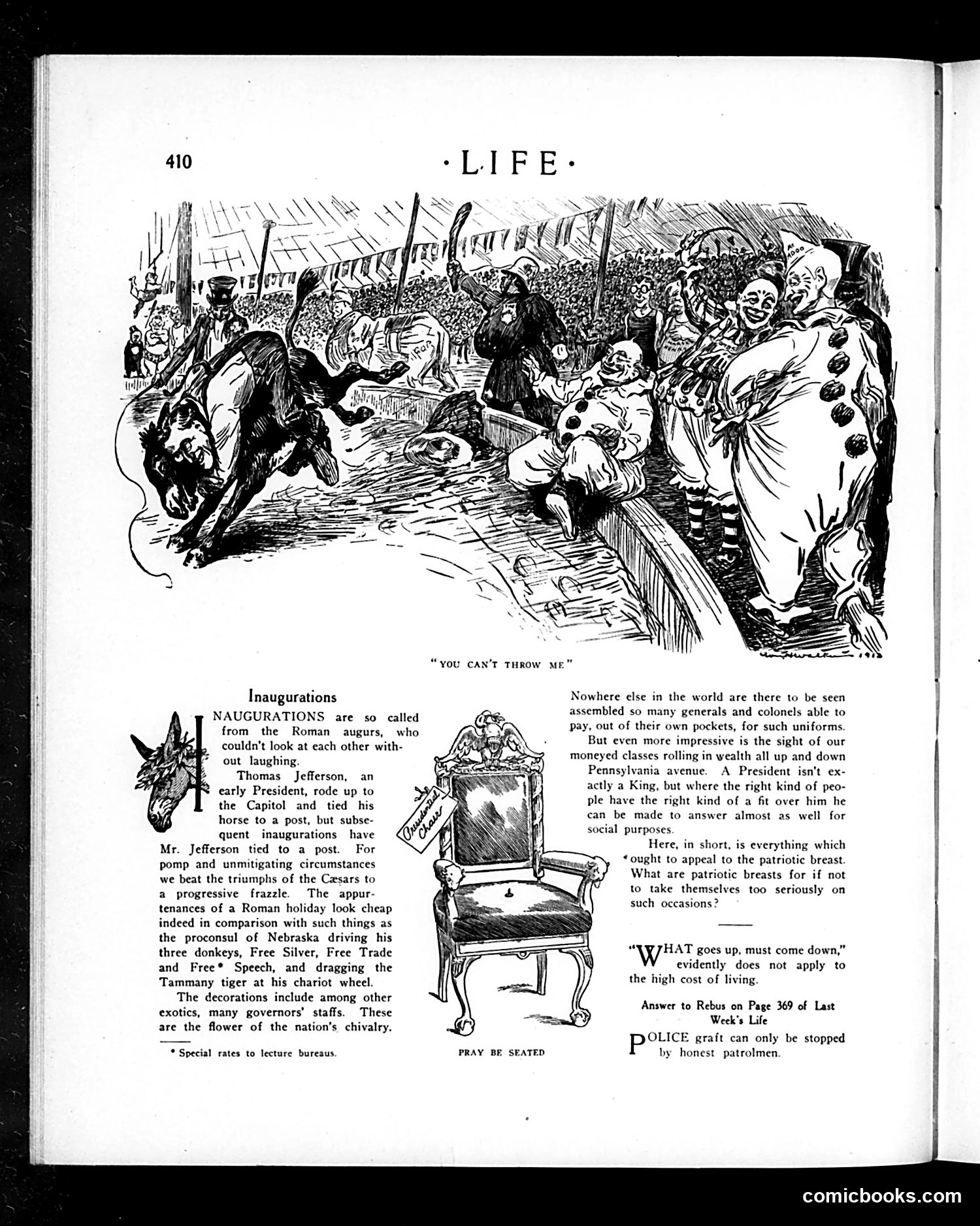
This page satirizes **presidential inaugurations** as excessively extravagant spectacles. The top cartoon shows crowds and what appears to be circus performers or clowns ("you can't throw me"), mocking the theatrical nature of inaugural celebrations. The text criticizes how inaugurations rival Roman gladiatorial games in excess, mentioning **Thomas Jefferson** tying his horse to a post rather than using elaborate ceremony. The piece argues that modern inaugurations feature wasteful displays—generals in expensive uniforms, decorated chairs, exotic animals—that contradict democratic principles. The satire targets the gap between democratic ideals and aristocratic pageantry: presidents present themselves as kings despite a nation claiming egalitarian values. The final quote questions whether patriotic citizens should take such ostentatious occasions seriously.
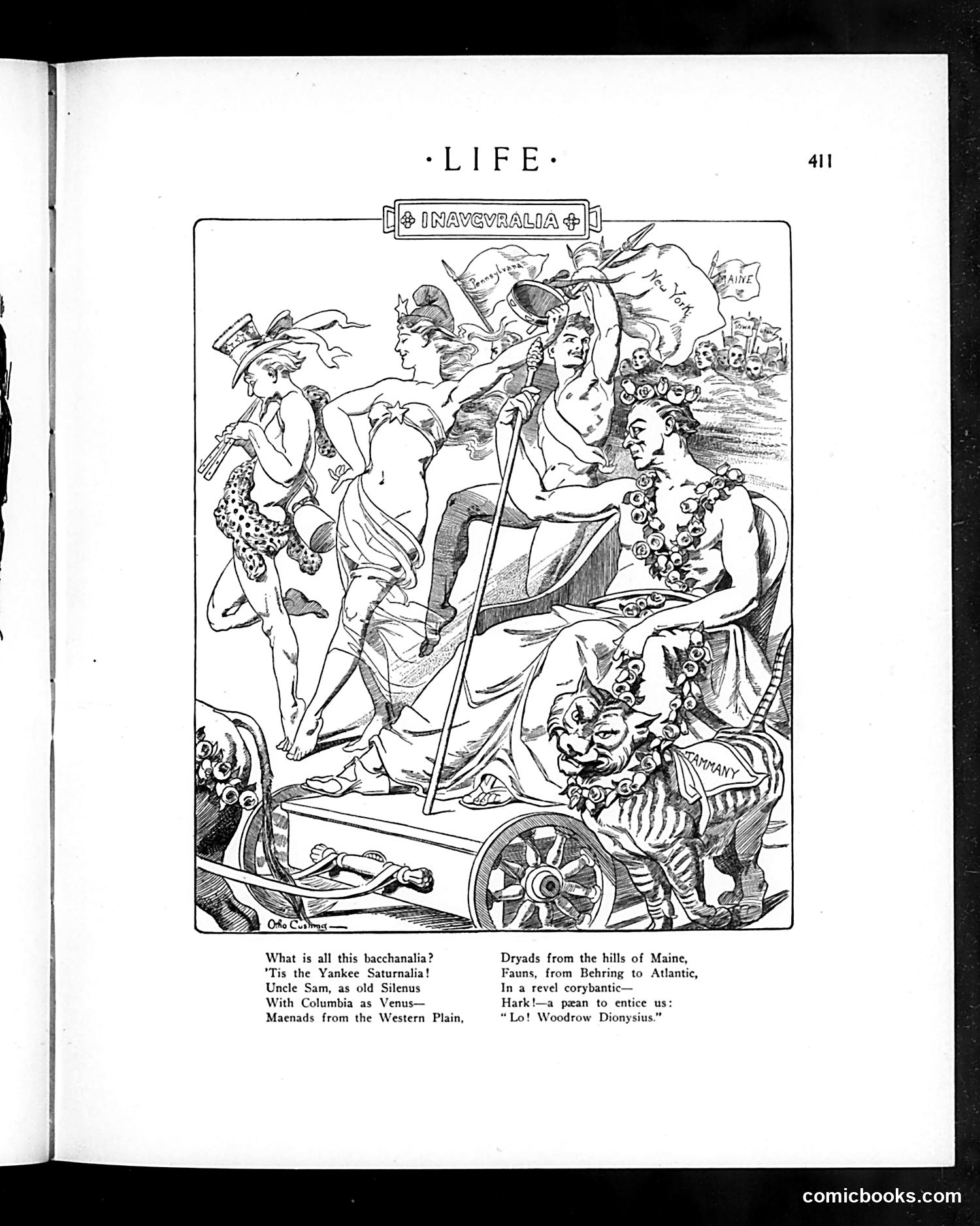
This satirical cartoon titled "Naveyralia" depicts a bacchanalian (drunken, celebratory) scene with allegorical female figures representing American states and regions. The text identifies references to "Uncle Sam" as Silenus, "Columbia as Venus," and "Maenads from the Western Plain"—classical mythological imagery repurposed for American commentary. The figures wear elaborate costumes and carry attributes suggesting wealth and excess. Labels visible include "Maine," "Behring," "Atlantic," and "Company." The poem below criticizes excessive celebration or revelry among American regions, comparing the scene to mythological debauchery. The satire likely critiques either political excess, jingoism, or wasteful spending during a period of American expansion or celebration—though the exact historical moment remains unclear without publication date confirmation.
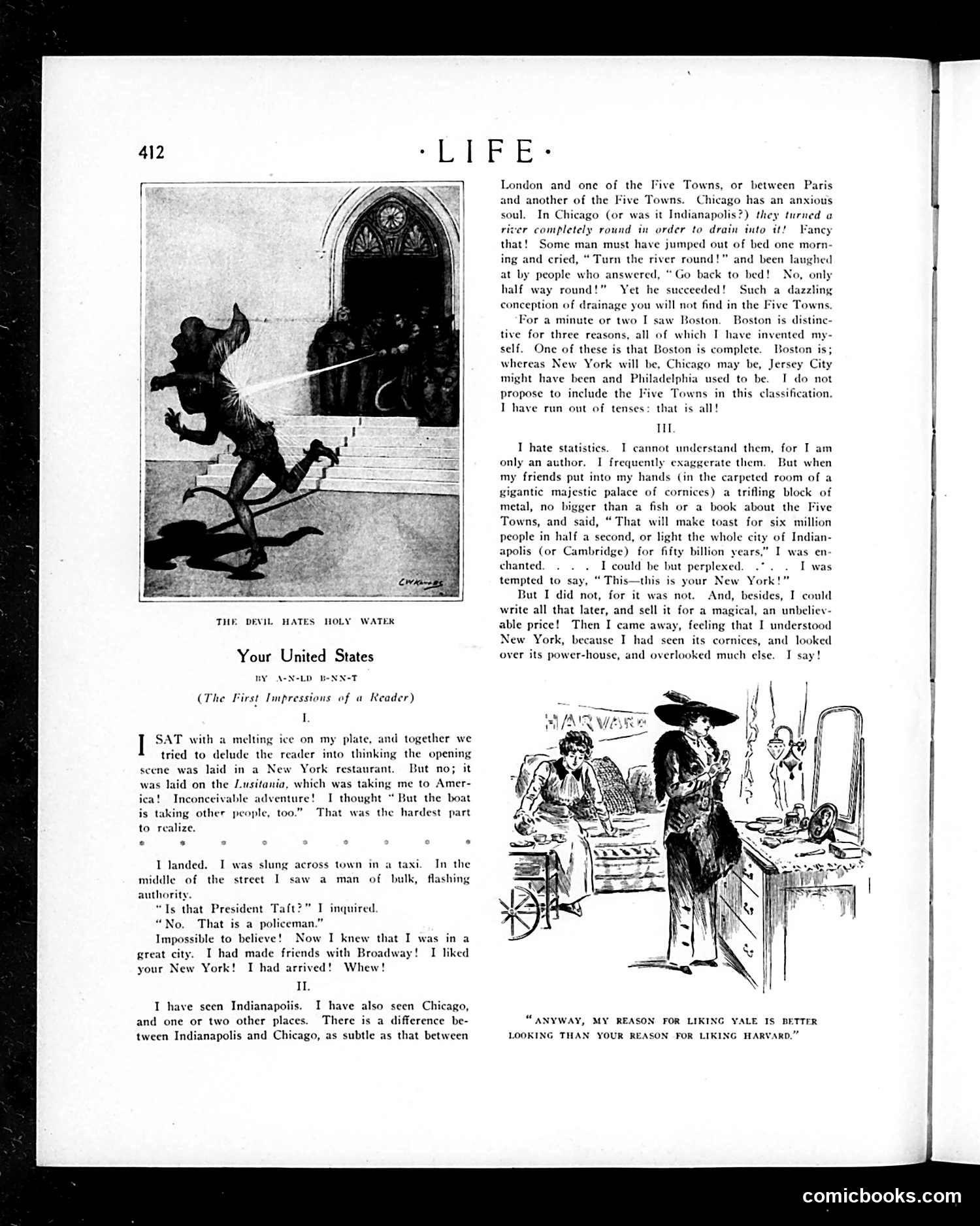
This page contains two satirical pieces about American cities. The top illustration, "The Devil Hates Holy Water," depicts a demonic figure recoiling from a church, likely commenting on urban moral decay or religious hypocrisy in American cities. The main article, "Your United States" by an unsigned author, humorously compares American cities—particularly New York, Boston, Chicago, and Indianapolis. The author describes arriving in New York by ship (the *Lusitania*) and encountering culture shock, including mistaking a policeman for President Taft. The bottom cartoon shows two men at what appears to be a ship or dock, with one saying Yale looks better than Harvard—a lighthearted jab at Ivy League rivalry and American snobbery about prestigious institutions. The overall tone mocks American parochialism and urban pretension.
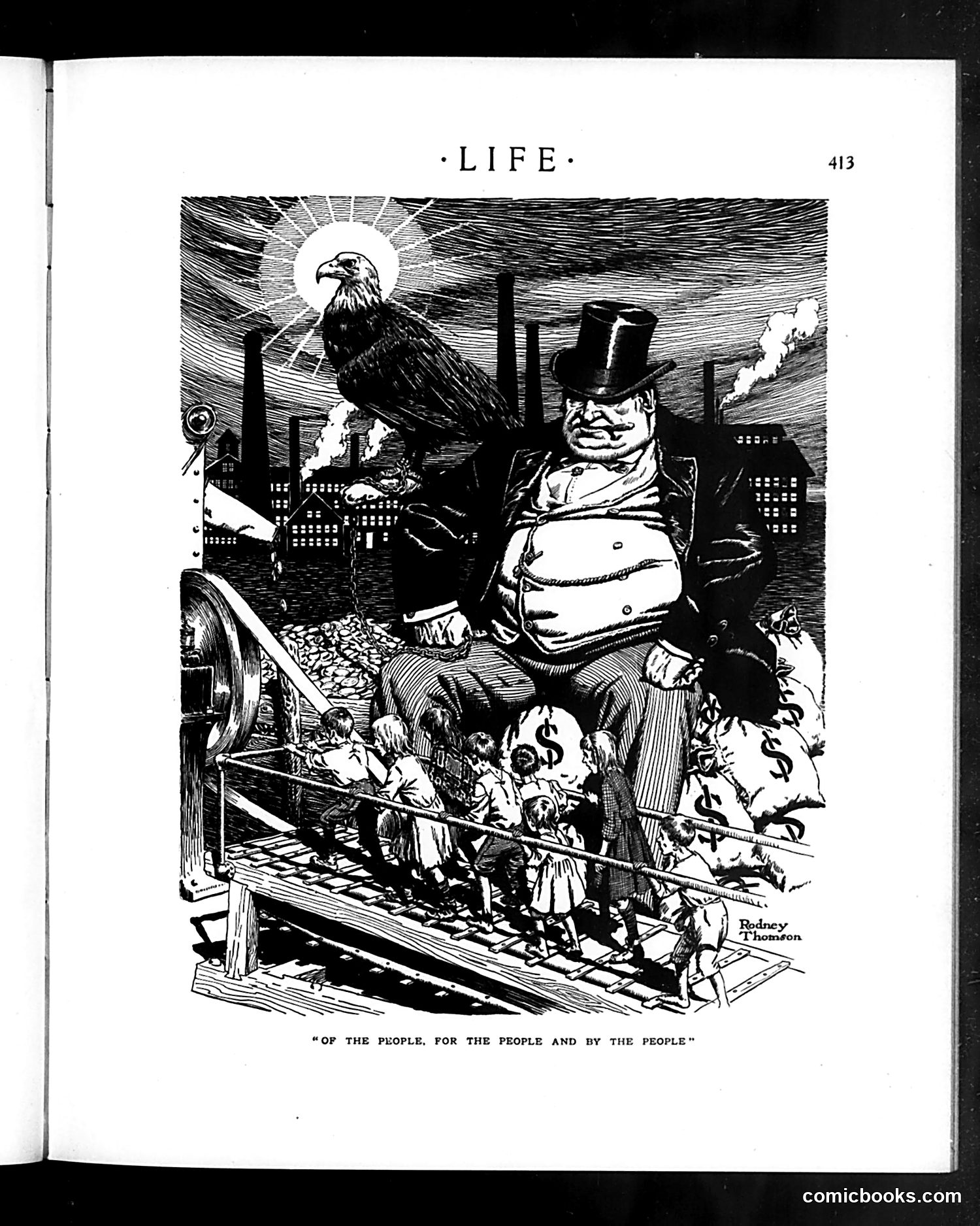
This is a political cartoon by Rodney Thomson satirizing American capitalism and inequality. The central figure is a portly capitalist in a top hat, surrounded by money bags marked with dollar signs, seated atop what appears to be exploited workers or the poor (depicted as smaller figures below). Behind him looms an eagle with a halo—symbolizing American ideals—while factory smokestacks pollute the sky. The caption reads "Of the people, for the people and by the people," ironically invoking Lincoln's Gettysburg Address. The cartoon critiques how American democracy has been corrupted by wealthy elites who control the system "for the people" in name only, while actually serving their own financial interests at workers' expense. This reflects early-to-mid 20th century progressive criticism of industrial capitalism.
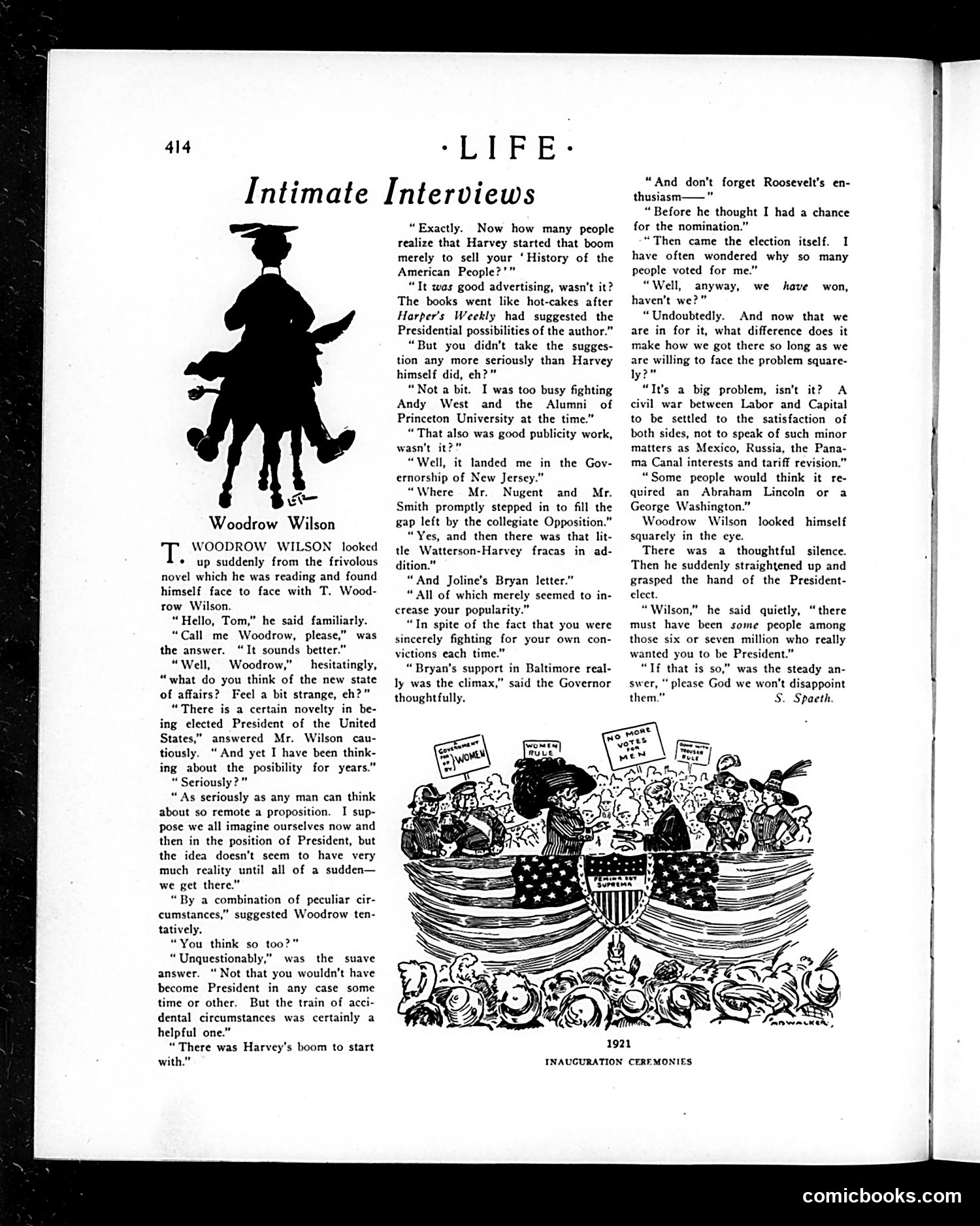
This page features an interview with **Woodrow Wilson** discussing his 1920 presidential election victory. The accompanying cartoon satirizes **American political divisions** during Wilson's presidency. The illustration depicts a ship labeled "1921 Inauguration Ceremonies" being pulled in multiple directions by competing factions—each representing different political interests and constituencies fighting over control. The chaos visualizes the deep splits Wilson faced: the text references ongoing disputes over tariffs, the Panama Canal, Mexico, and Russia, plus labor versus capital tensions. The cartoon's point: despite Wilson's election victory, governing would prove difficult because powerful, opposing groups demanded conflicting policies. The ship metaphor suggests the administration risked being torn apart by these pressures rather than moving forward unified.
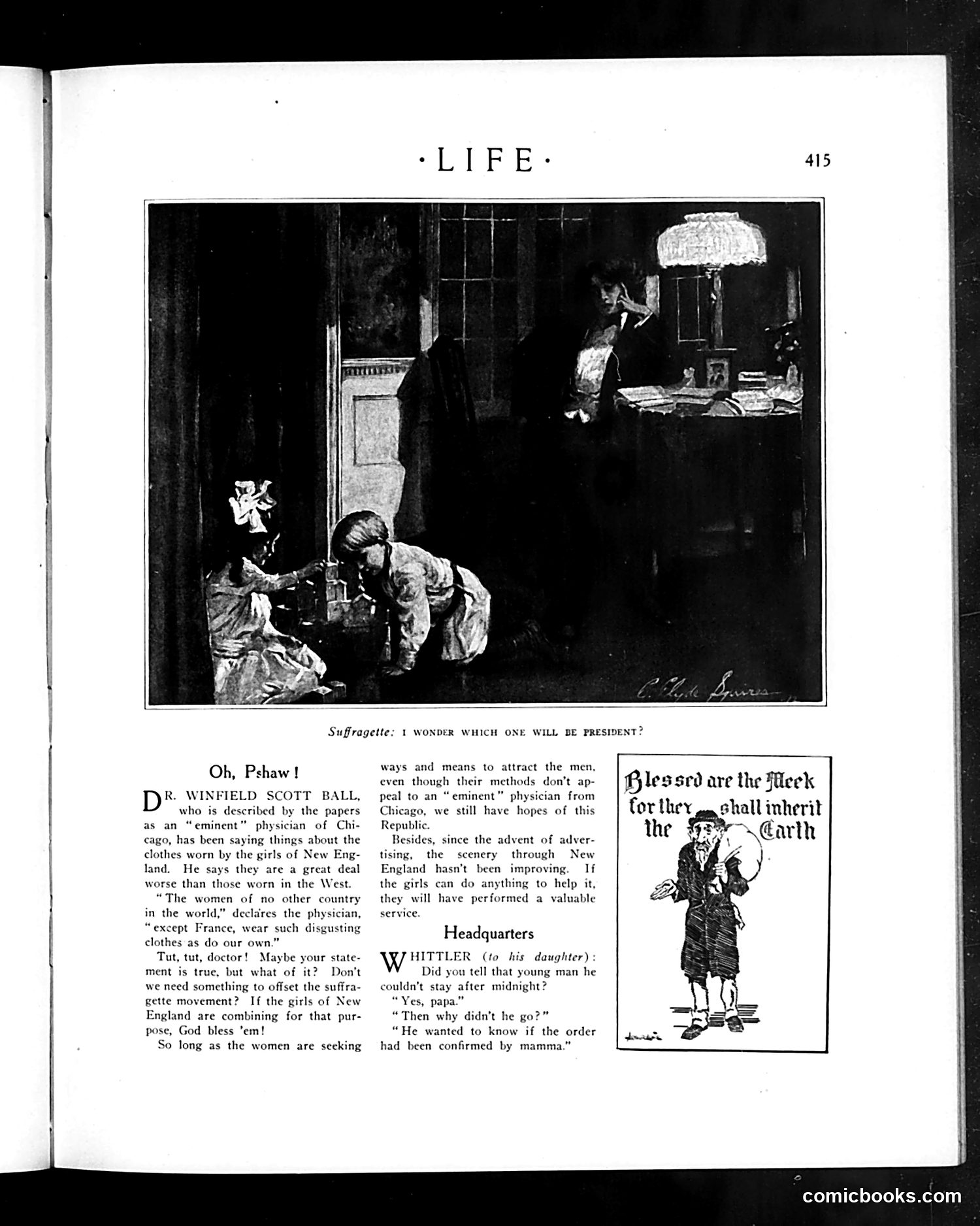
This page contains two distinct satirical pieces: **"Suffragette: Oh, Pshaw!"** mocks a Chicago physician (Dr. Winfield Scott Ball) who criticized New England women's fashion as disgusting. The satire defends women's clothing choices as a counterbalance to the suffragette movement—suggesting unfashionable dress threatens the Republic, so attractive appearance is patriotic. The piece employs ironic praise to critique both the doctor's prudishness and anti-suffrage anxiety. **"Headquarters"** is a brief domestic joke about a father's authority being undermined when his daughter defers decisions to her mother, inverting traditional parental hierarchy. The top illustration labeled "I Wonder Which One Will Be President?" appears to depict a suffragette interaction in an office, likely commenting on women's political ambitions. The small illustration with the quote about meekness inheriting the earth is unclear in context. The overall page reflects early 20th-century American magazine humor addressing women's rights, fashion, and social change.
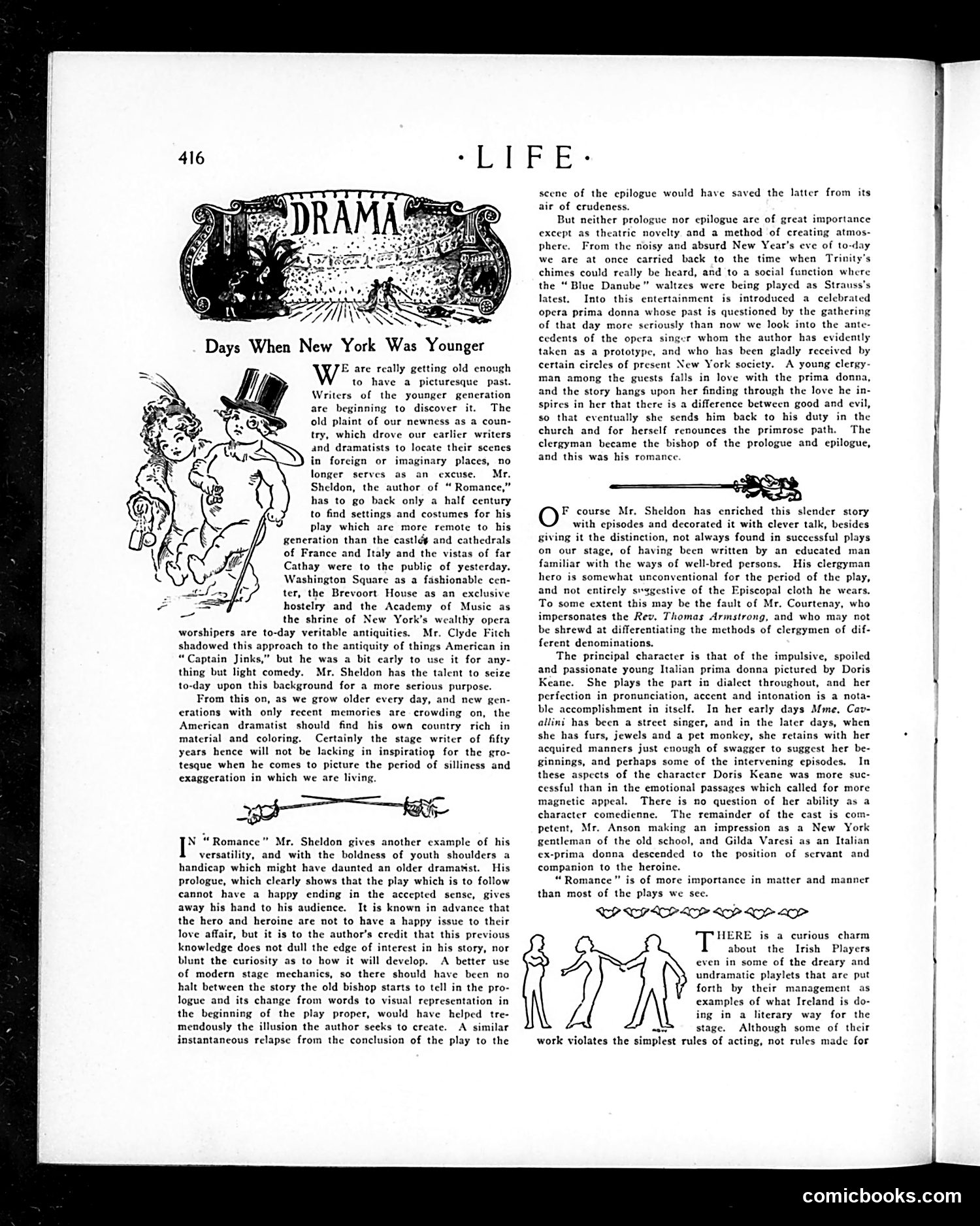
This page reviews Edward Sheldon's play "Romance," celebrating American dramatists discovering their own country's recent past as material. The author notes that writers once felt compelled to set plays in foreign locales due to America's "newness," but now fifty-year-old New York—featuring Washington Square, the Brevoort House, and the Academy of Music—feels sufficiently antiquated. The **cartoon illustration** (top left) shows a dandy in period dress, likely representing the theatrical world or the nostalgic aesthetic being discussed. The critique praises Sheldon's ambition in tackling a serious romance with an unhappy ending, though it faults the prologue/epilogue mechanics as clunky. The plot involves a clergyman falling for an opera prima donna of questionable moral standing—a contemporary figure whose acceptance in "certain circles of present New York society" the author treats with mild irony. The piece reflects Progressive-era concerns: nostalgia for a supposedly more morally rigorous past, anxiety about modern society's "silliness and exaggeration," and changing social standards regarding women's respectability.
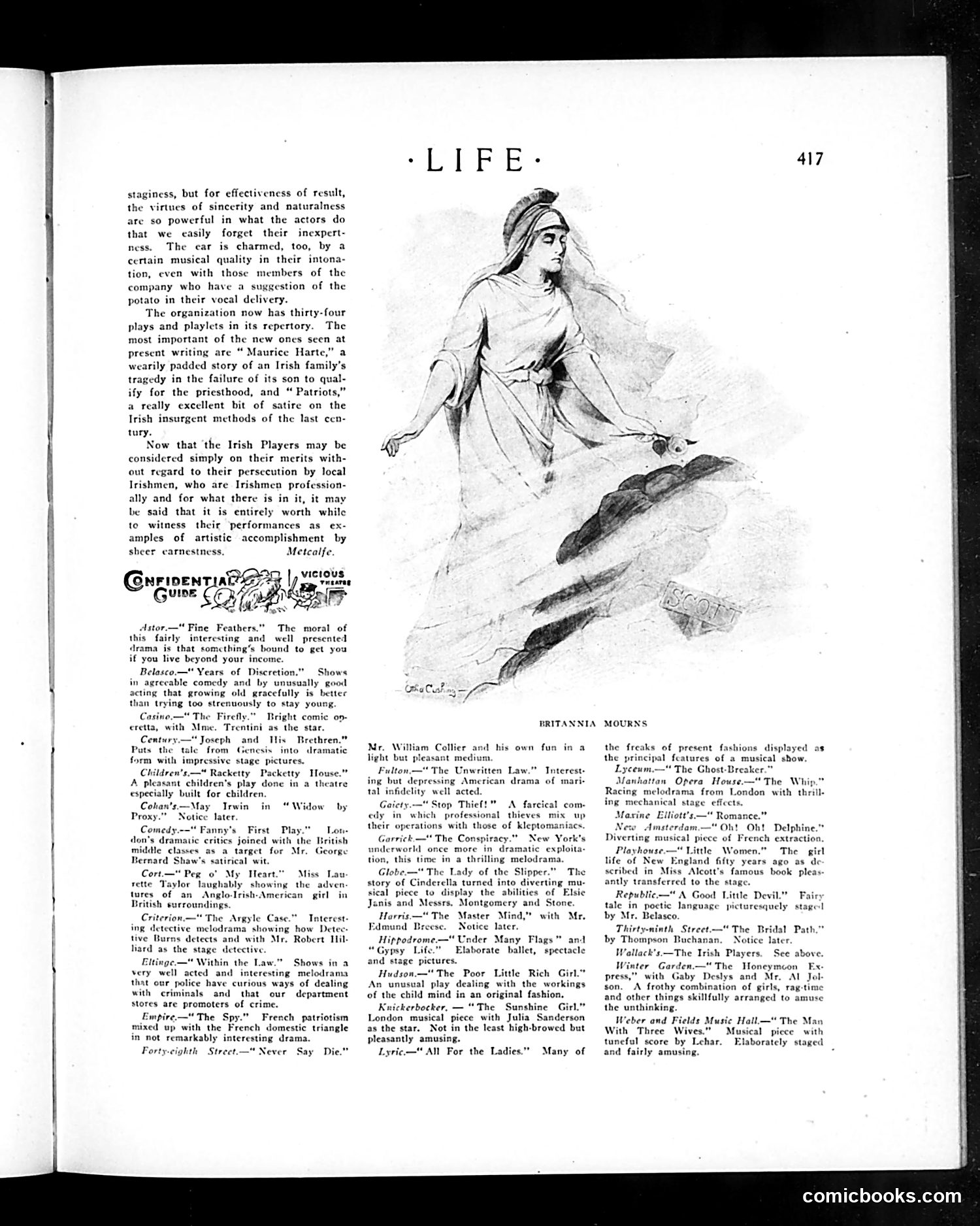
This page reviews contemporary Broadway productions (circa 1912). The illustrated figure appears to be "Britannia Mourns"—a classical allegorical representation of Britain, depicted in a melancholic pose overlooking what's likely a battlefield or troubled landscape. The context suggests this illustration accompanies commentary on Irish theatrical performers ("The Irish Players"), whose productions included politically charged plays like "Patriots" about Irish insurgency. The "Britannia Mourns" image likely satirizes British imperial concerns about Irish nationalist sentiment gaining artistic and cultural expression through theater. The text discusses how the Irish Players' performances merit serious artistic consideration despite local Irish-American opposition to them. The surrounding theater reviews showcase typical Broadway fare of the era—melodramas, comedies, and musicals—establishing the magazine's role as cultural arbiter for educated American audiences interested in both entertainment and social commentary.
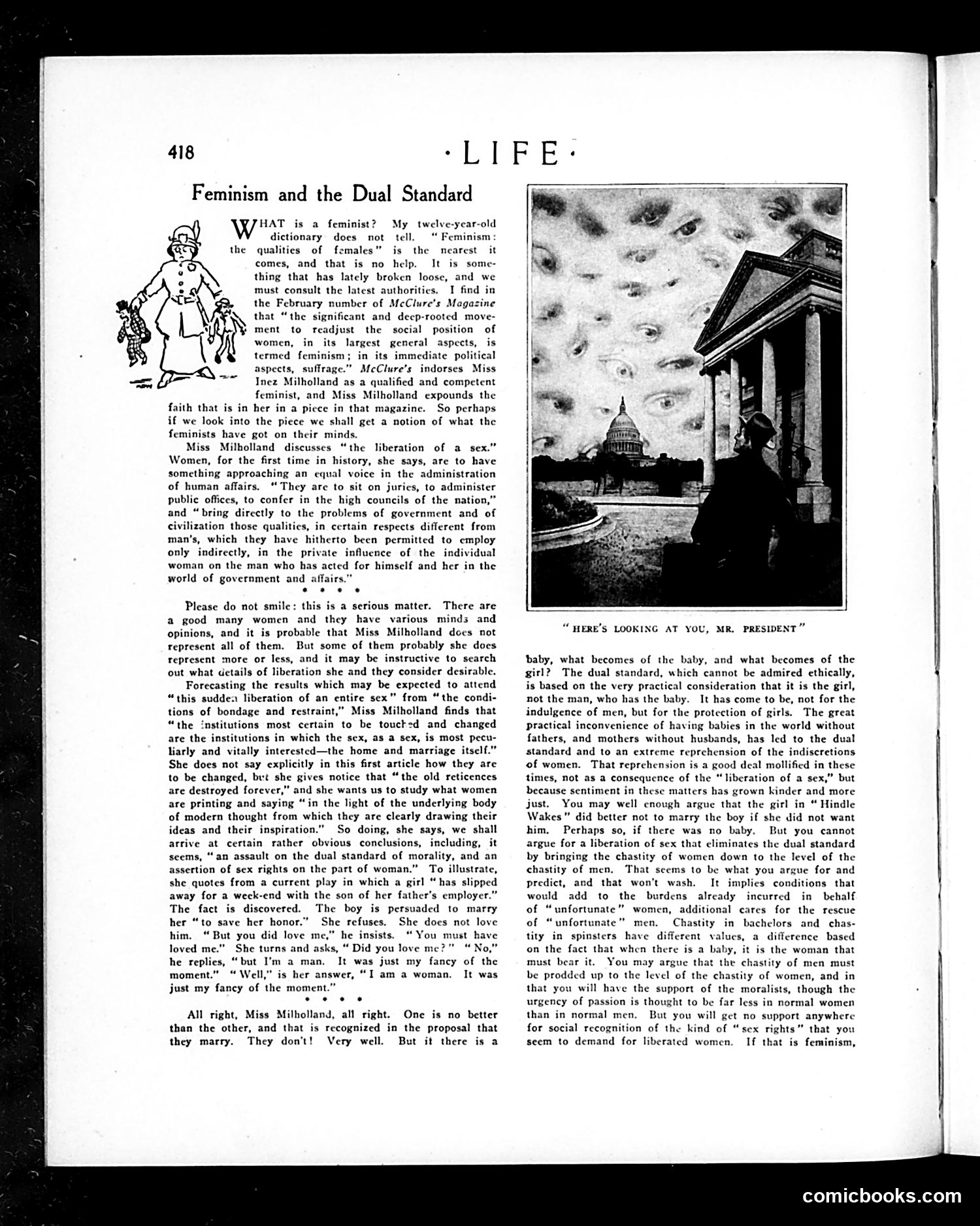
This page critiques early feminism through a debate on sexual morality. The cartoon shows a woman in Victorian dress—likely representing traditional femininity or conventional womanhood—facing the Capitol building, captioned "HERE'S LOOKING AT YOU, MR. PRESIDENT," suggesting women demanding political voice. The text discusses Inez Milholland, a real feminist activist cited in McClure's Magazine, who advocates women's liberation and equality in government, juries, and public affairs. The author sarcastically engages with her arguments, then pivots to attack the feminist critique of the "dual standard"—the sexual hypocrisy where men face no consequences for premarital relations while women do. The article uses a theatrical anecdote: a girl refuses to marry a man she doesn't love after a "week-end" affair, mirroring his casual attitude. The author then poses the practical objection: *what about the baby?* This exposes the tension between moral equality and biological reality—a common anti-feminist argument of the era suggesting women's liberation was impractical and dangerous.
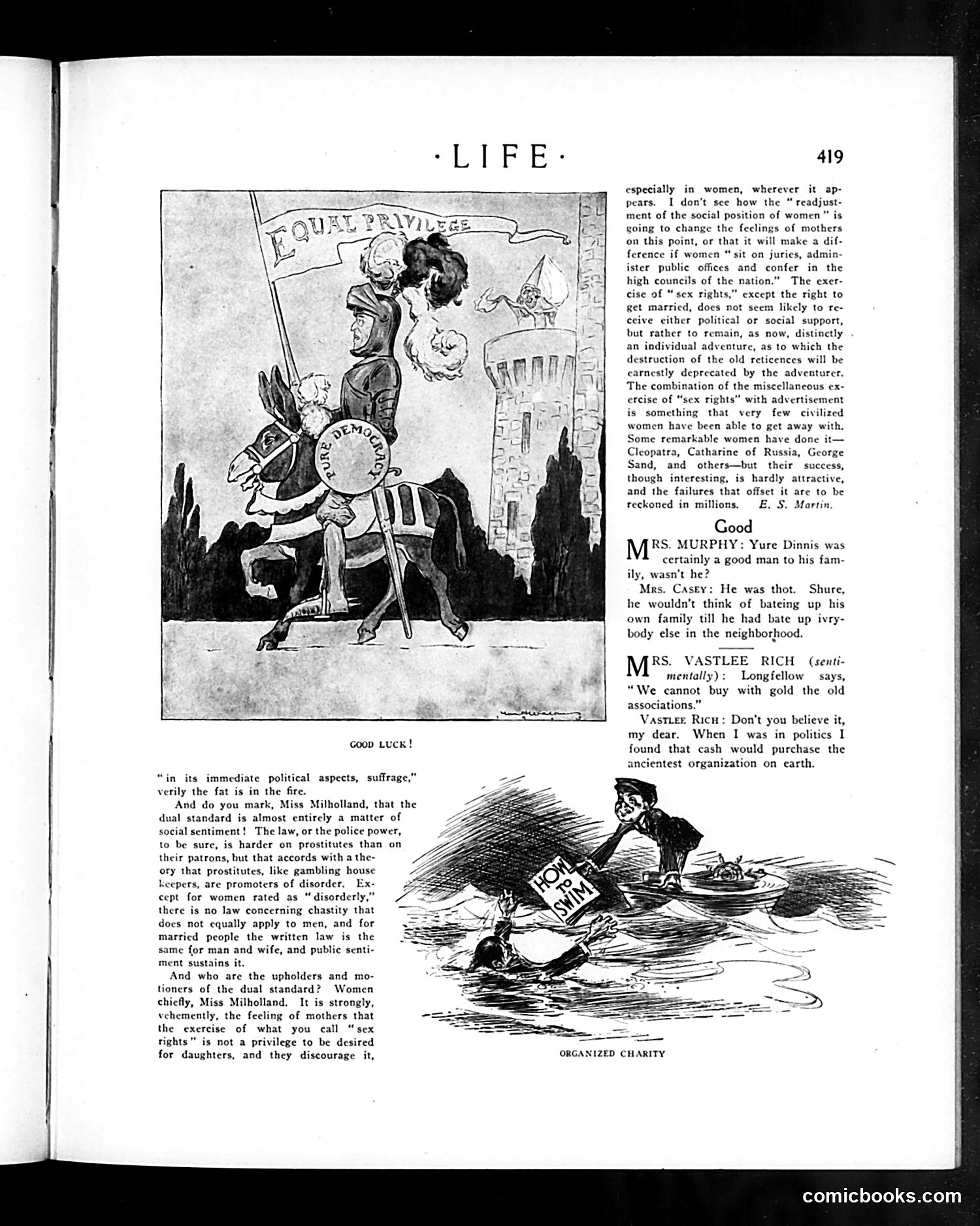
**"Good Luck!" (top cartoon):** This satirizes women's suffrage activism. The figure labeled "Equal Privilege" stands atop "Pure Democracy," juggling various social demands. The satire suggests that the suffrage movement's expansion of women's rights into political participation (voting, serving on juries, holding office) is chaotic and destabilizing to traditional society—hence the precarious balancing act. **"Organized Charity" (bottom cartoon):** This depicts apparent hypocrisy in charitable giving. A figure labeled "Poor Law" appears to be drowning while "Organized Charity" (shown as a well-dressed woman) sails past, suggesting that formal charitable organizations fail the truly destitute while prioritizing respectable causes. **Text commentary:** E.S. Martin argues that women's political equality won't change traditional moral standards, particularly regarding sexual conduct—mothers will continue discouraging daughters from exercising "sex rights" regardless of legal equality. The closing anecdote mocks how political organizations can be purchased with money, undercutting claims of principled charity or democracy.
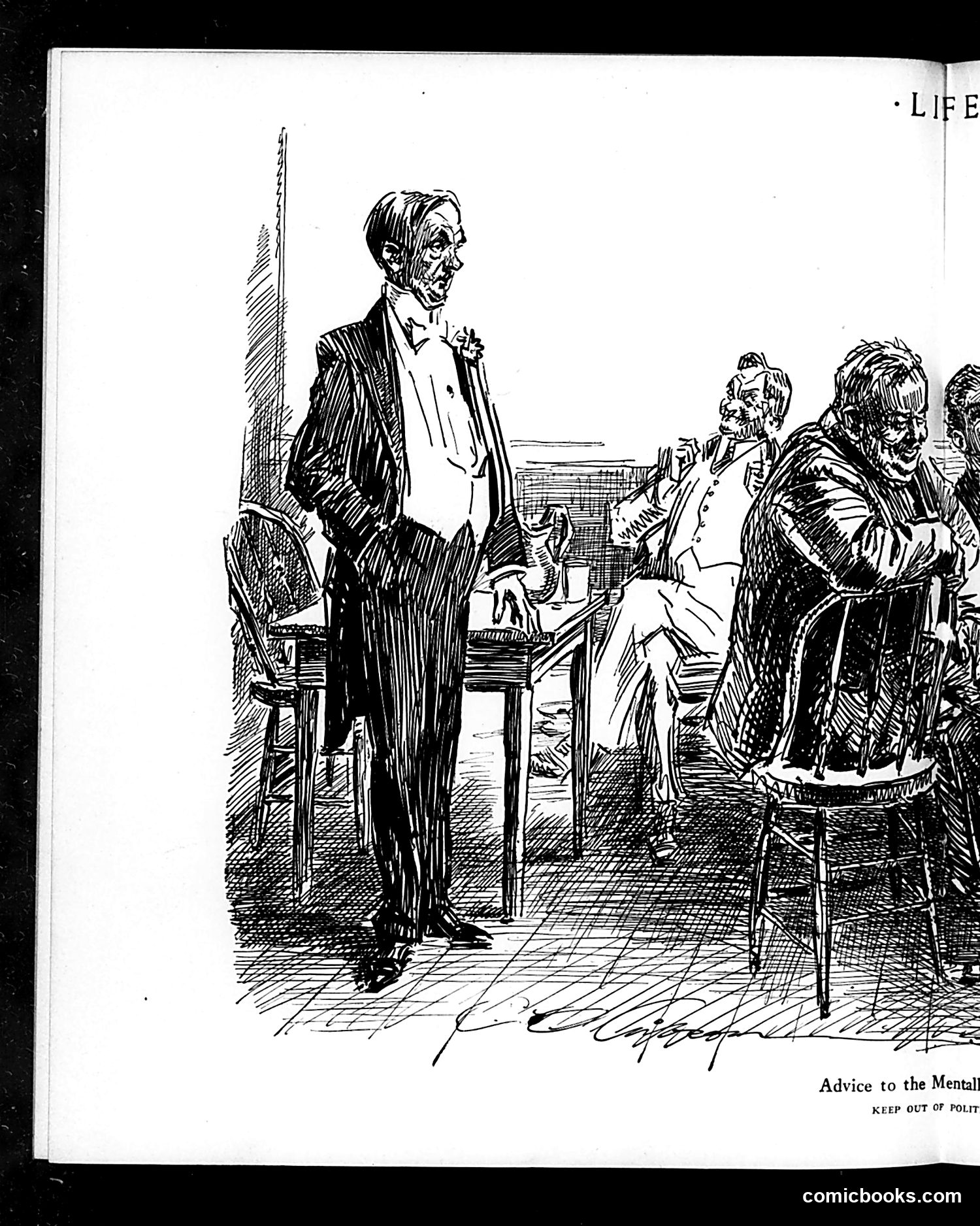
This is a satirical cartoon from *Life* magazine with the caption "Advice to the Mentall[y]" and "KEEP OUT OF POLIT[ICS]" (text cut off). The image shows a tall, thin man in formal attire standing and gesturing while addressing three seated gentlemen in an interior setting. The cartoon appears to satirize political involvement or debate. The advice being offered—to keep mentally [sound people] out of politics—suggests that engaging in politics is inherently damaging to one's mental health or judgment. The specific identities of the figures are unclear from the image alone. The satire likely critiques either the corrupting nature of politics generally, or possibly lampoons a particular political figure or movement of the era, though without a date or additional context, the exact target remains uncertain.
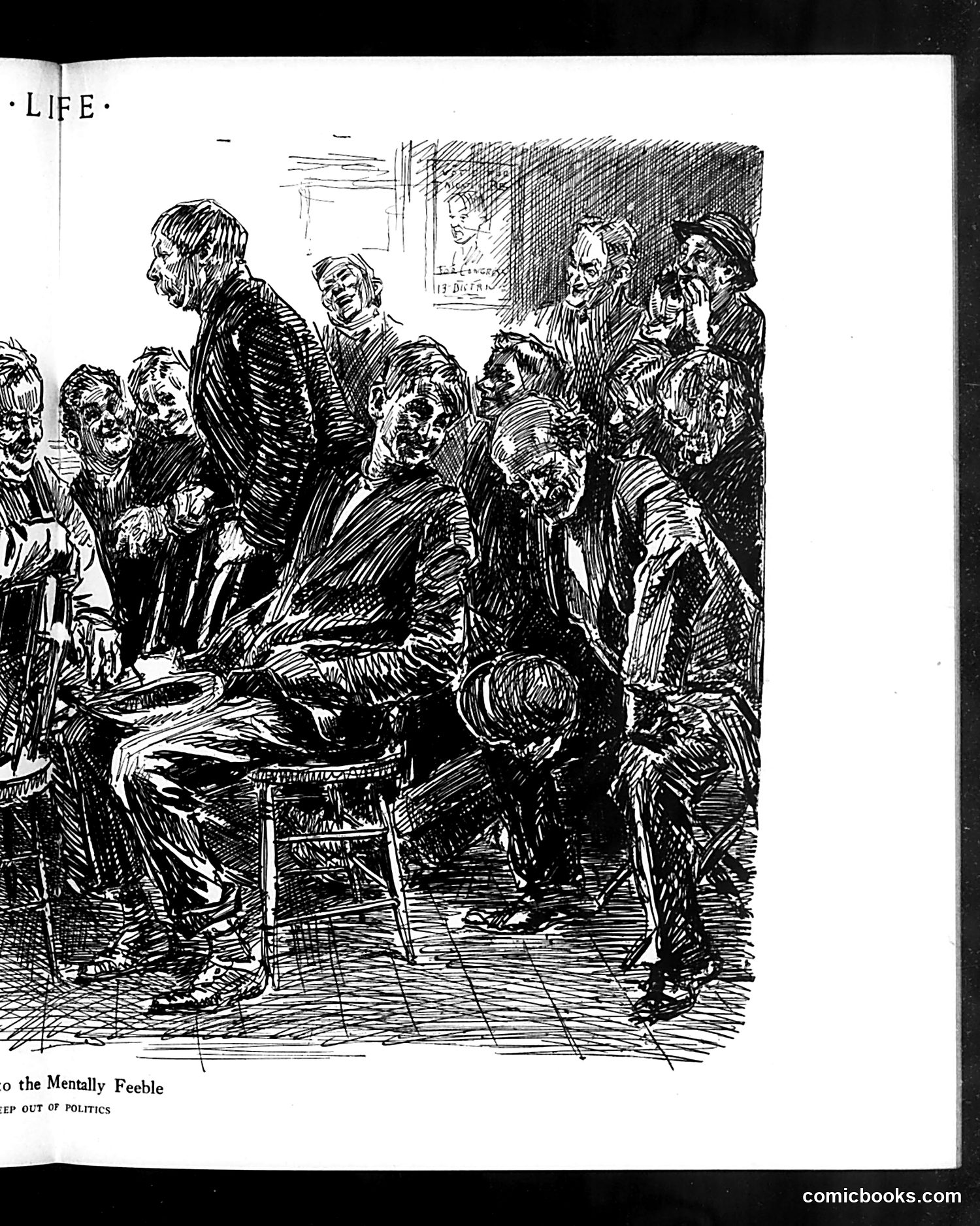
This appears to be a political cartoon from Life magazine satirizing a speaker addressing a crowd of people depicted with exaggerated, unflattering facial features. The partially visible caption reads "to the Mentally Feeble" with text below suggesting "KEEP OUT OF POLITICS." The cartoon critiques a political figure (identity unclear from visible text) who is apparently appealing to or manipulating voters portrayed as intellectually inferior. The artist uses crude caricature—a common technique in early 20th-century American political satire—to mock both the speaker's demagoguery and the audience susceptible to it. The satire suggests that this politician's rhetoric targets and exploits the gullible rather than appealing to reason or substantive policy. Without the complete caption and date, the specific political context remains unclear.
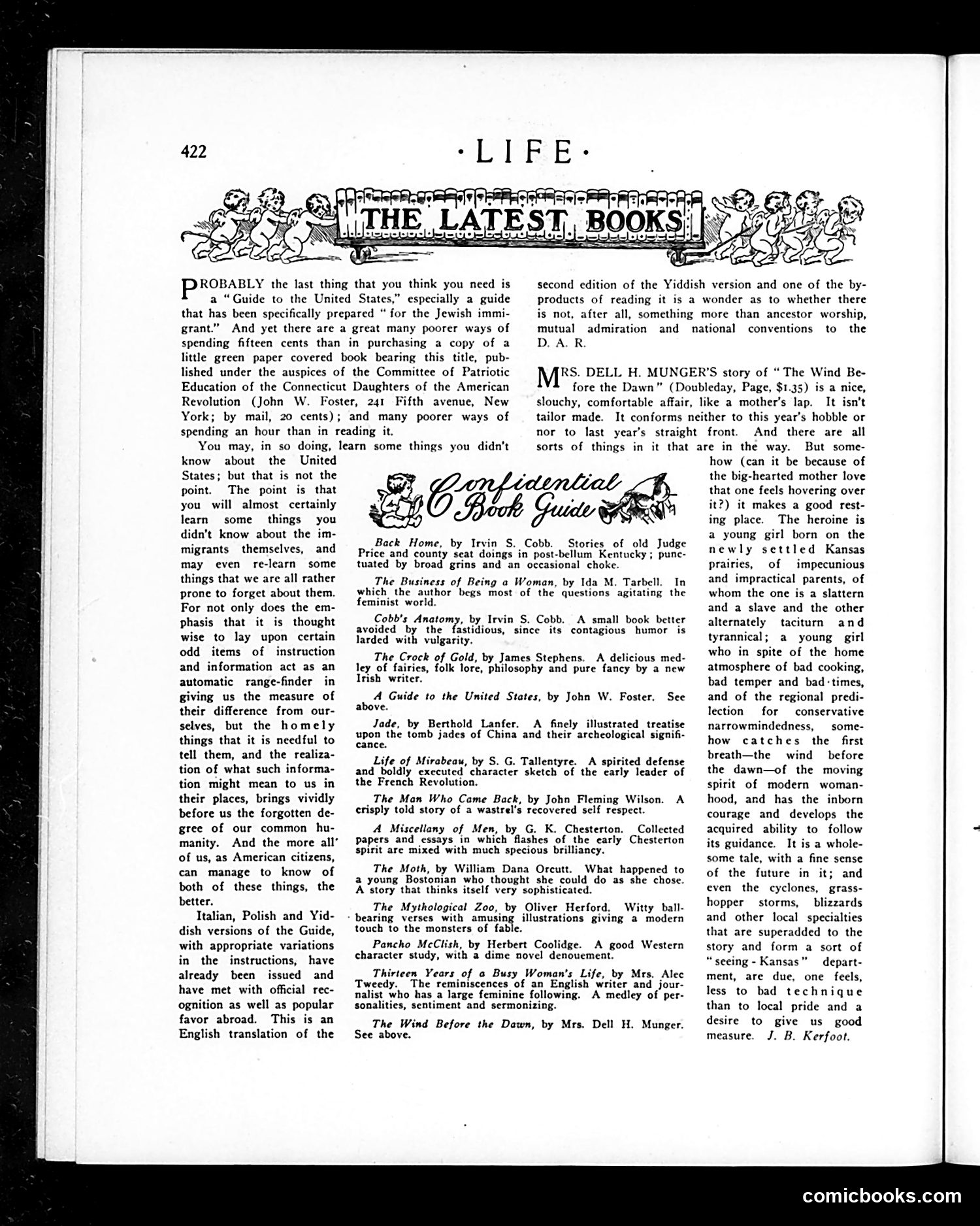
This is a book review page from *Life* magazine, not primarily a political cartoon. The satirical content is subtle but pointed. The main satire targets the Daughters of the American Revolution (DAR), specifically their "Committee of Patriotic Education," which published a "Guide to the United States" explicitly prepared "for the Jewish immigrant." The reviewer's tone is gently mocking: by noting what instructions the DAR deemed necessary to teach immigrants, the guide inadvertently reveals the DAR's own assumptions about immigrants' deficiencies and cultural distance from "real" Americans. The reviewer suggests this reveals something unflattering about the DAR itself—their condescension masked as patriotic education. The mention that Italian, Polish, and Yiddish versions exist with "appropriate variations" further underscores this patronizing approach. The surrounding book reviews are standard literary fare, providing context for the magazine's educated readership.
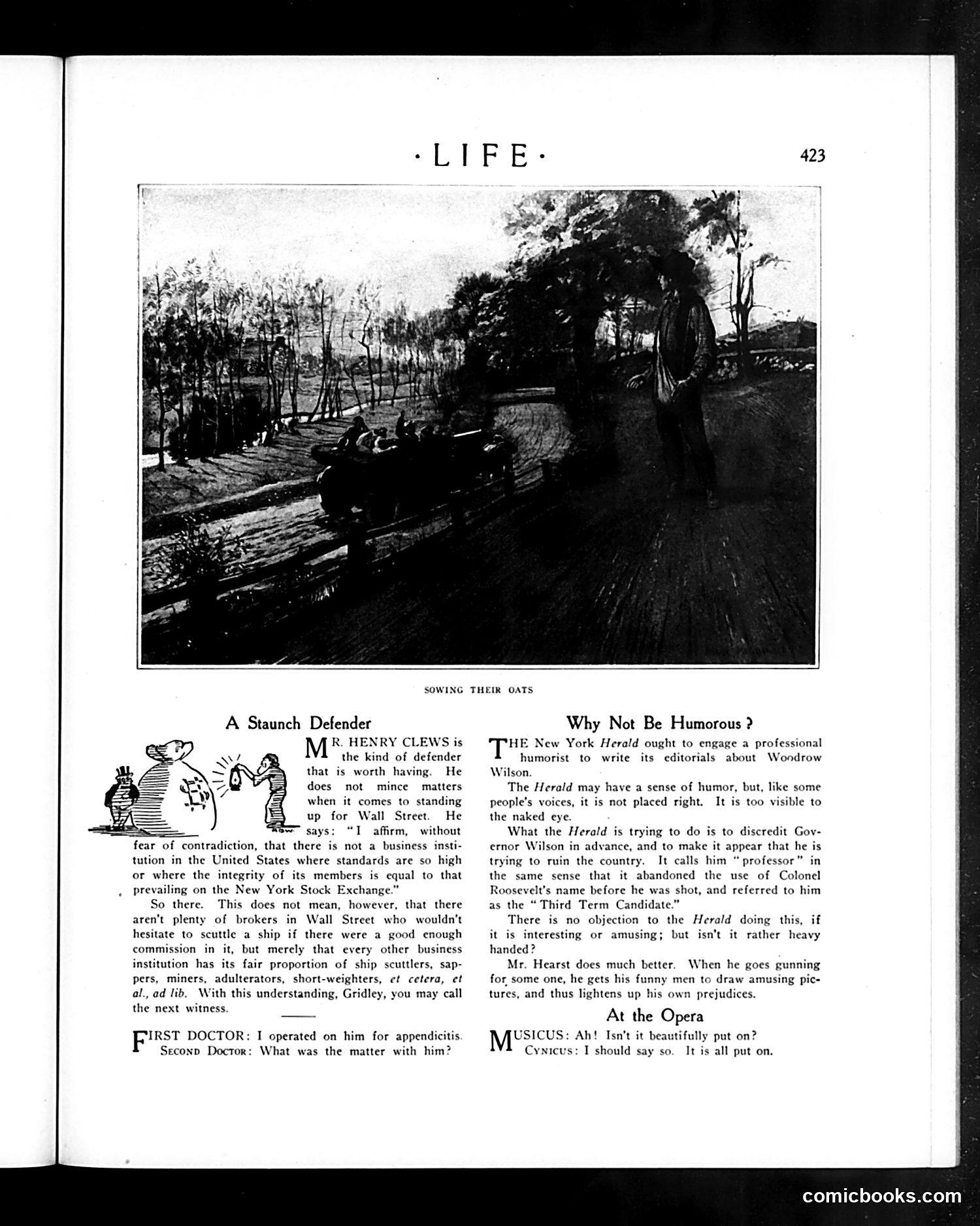
This page contains three separate satirical pieces targeting prominent figures and institutions circa early 20th century. **"A Staunch Defender"** mocks Henry Clews, a Wall Street financier, for his defensive praise of stock exchange integrity. The satire suggests his claims are absurdly self-serving—while Clews insists the Exchange has higher standards than any other business, the piece sarcastically implies Wall Street brokers are actually corrupt "ship scuttlers" no different from fraud artists elsewhere. **"Why Not Be Humorous?"** criticizes the *New York Herald* newspaper for its heavy-handed attacks on Governor Woodrow Wilson (likely during his presidential campaign). The piece suggests the *Herald* lacks wit compared to William Randolph Hearst's publications, which employ humor while attacking their targets. **"At the Opera"** is a brief joke about artificiality in high society—the exchange between Musicus and Cynicus suggests everything at the opera is performative or fake. The overarching theme: attacking hypocrisy among wealthy elites and media dishonesty.
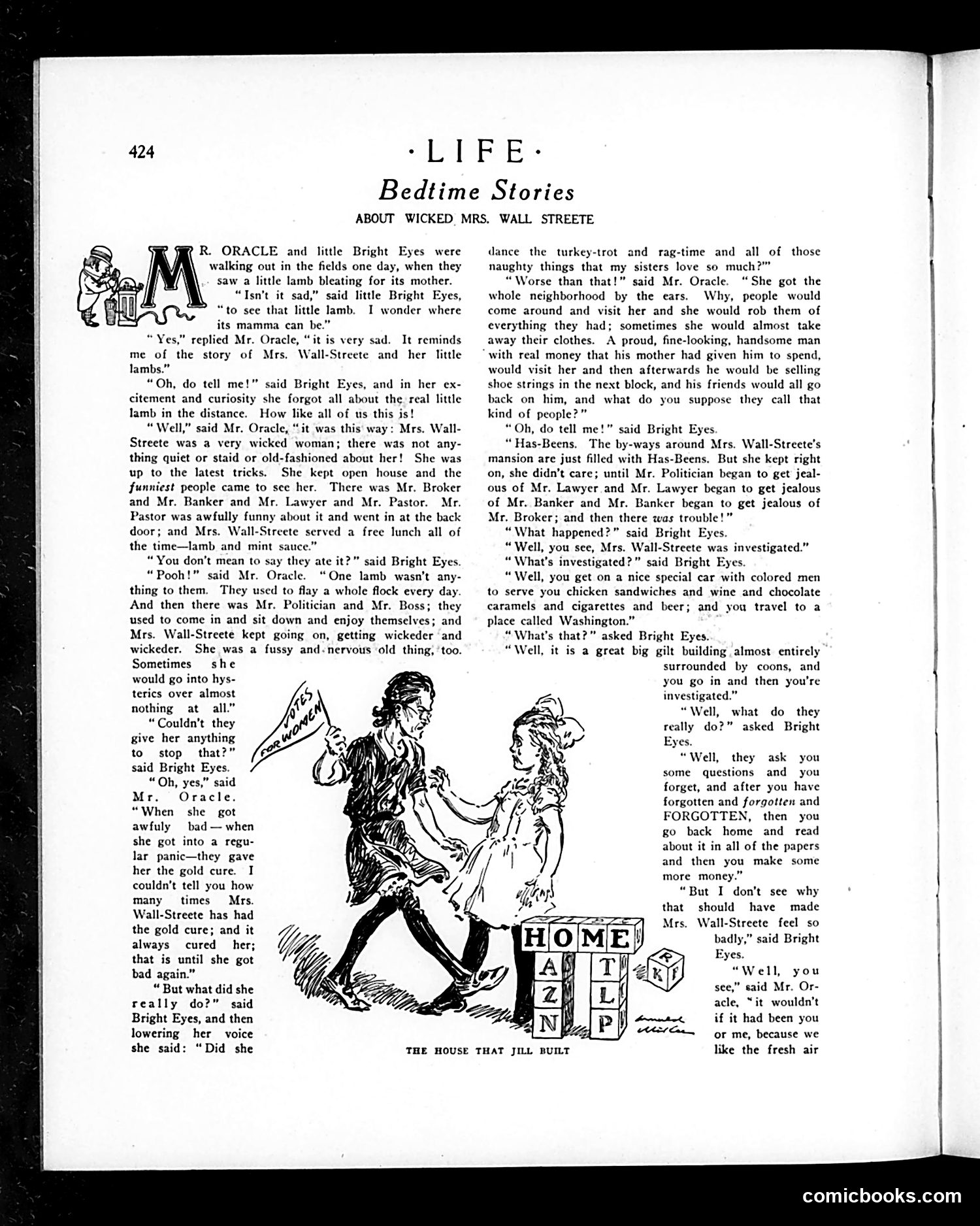
This satirical bedtime story uses allegory to critique Wall Street excess and financial corruption. "Mrs. Wall-Streete" represents the financial sector itself—a "wicked woman" who entertains corrupt figures: Mr. Broker, Banker, Lawyer, Politician, and Pastor (representing industry, finance, law, government, and religion). The "lambs" she slaughters metaphorically represent ordinary people stripped of their wealth. Wealthy men visit her and are financially ruined, becoming "Has-Beens" selling shoelaces—a vivid image of class collapse. The story culminates in congressional investigation ("Washington"), portrayed as ineffectual theater: investigators ask questions, witnesses forget their answers, and nothing changes. The "gold cure" likely references gold standard monetary policy debates of the era. The crude racial slur in the final OCR'd fragment appears authentic to the publication's era, reflecting period prejudices. The overall message: Wall Street corruption is enabled by complicit institutions, investigations accomplish nothing, and ordinary people bear the cost.
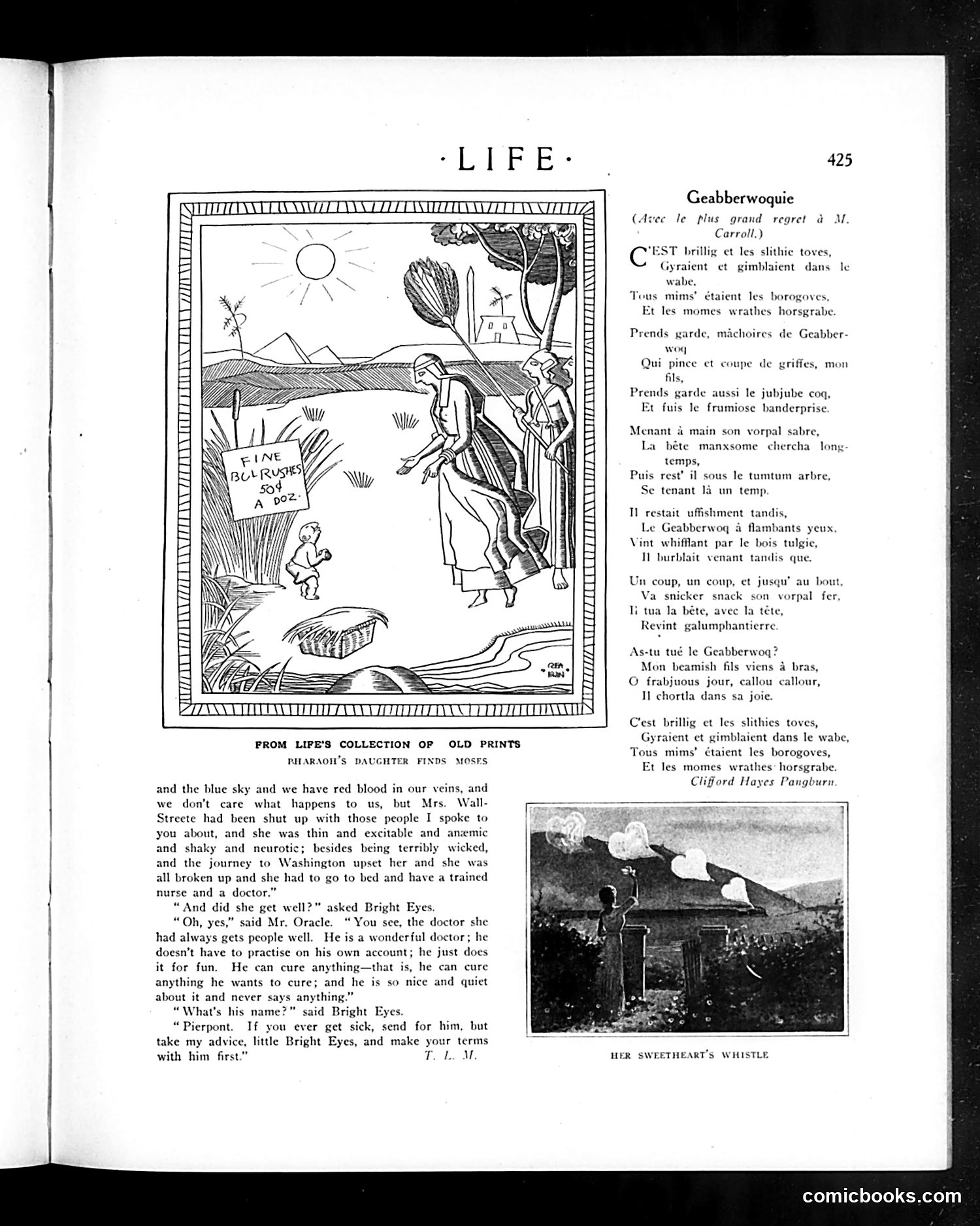
This page contains a French-language parody of Lewis Carroll's "Jabberwocky" poem (noted with "Avec le plus grand regret à M. Carroll"—"With greatest regret to Mr. Carroll"). The illustration depicts a scene from the parody, showing a figure battling a creature in a landscape, directly mimicking Carroll's nonsense narrative about slaying the fearsome Jabberwock. Below the illustration is unrelated prose fiction dialogue between characters named "Bright Eyes" and "Mr. Oracle" discussing a doctor named Pierpont who cures wealthy patients for entertainment rather than payment—satirizing wealthy doctors who practice medicine as a hobby rather than profession. The page also includes a photograph titled "Her Sweetheart's Whistle" showing a couple in a mountainous landscape. The cartoon itself satirizes nothing specific to its era beyond extending Carroll's absurdist humor through translation and visual adaptation.
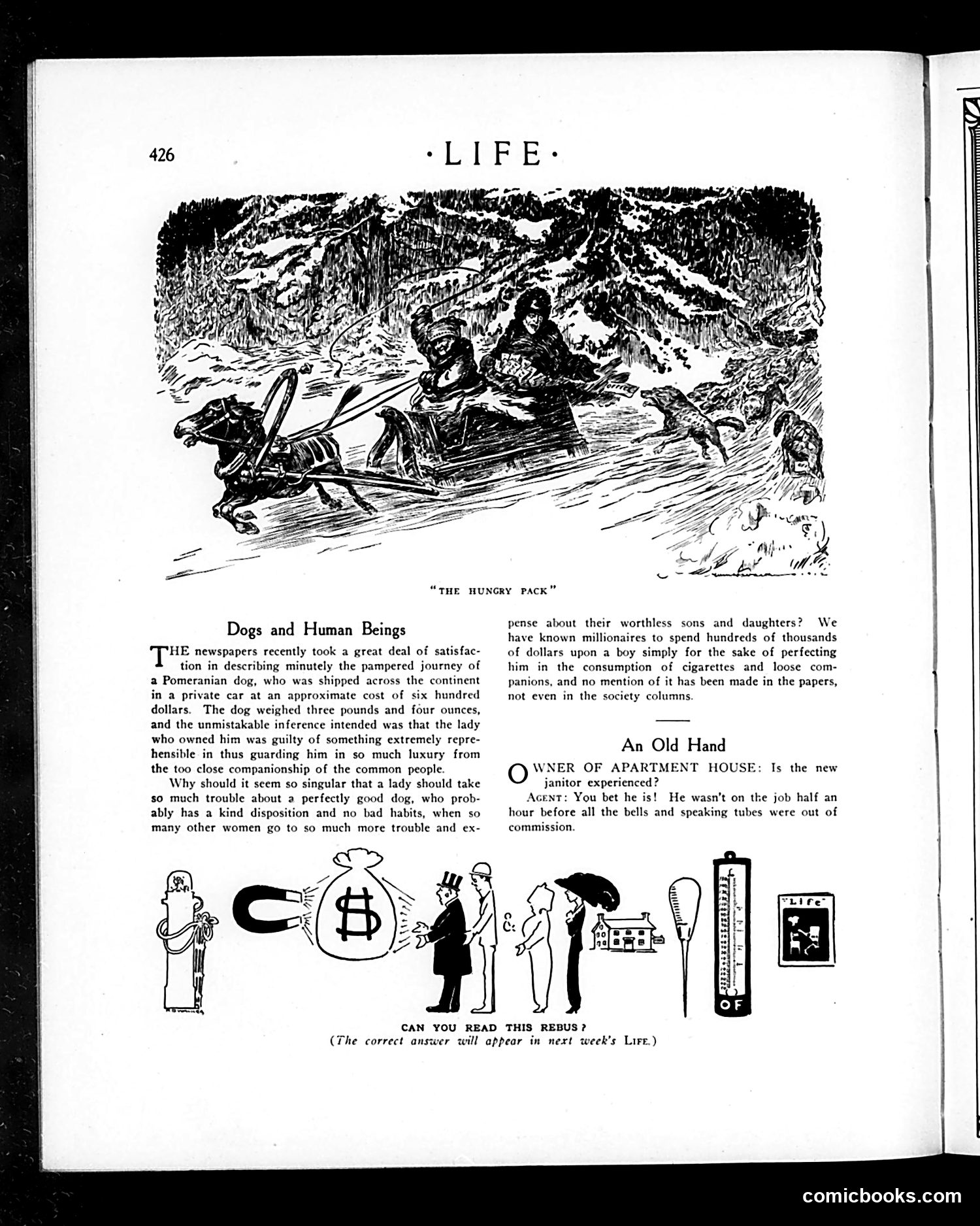
**"The Hungry Pack"** cartoon depicts a wealthy woman traveling by sleigh with her small Pomeranian dog through snowy wilderness, accompanied by what appear to be wolves or hungry dogs pursuing them—hence the title. The accompanying article satirizes newspaper outrage over a lady spending $600 to transport her three-pound dog across the continent in luxury. The author argues this criticism is hypocritical: wealthy parents lavishly indulge their "worthless sons and daughters," spending far greater sums on their idle consumption of cigarettes and loose companions, yet society papers celebrate rather than condemn this. The satire suggests selective moral judgment—the public accepts human excess while condemning similar extravagance toward animals. **"An Old Hand"** is a brief joke about an apartment building janitor so inexperienced (or deliberately destructive) that within an hour he's disabled all the communication systems—the bells and speaking tubes connecting residents to staff. The page also includes a visual rebus puzzle for readers to solve.
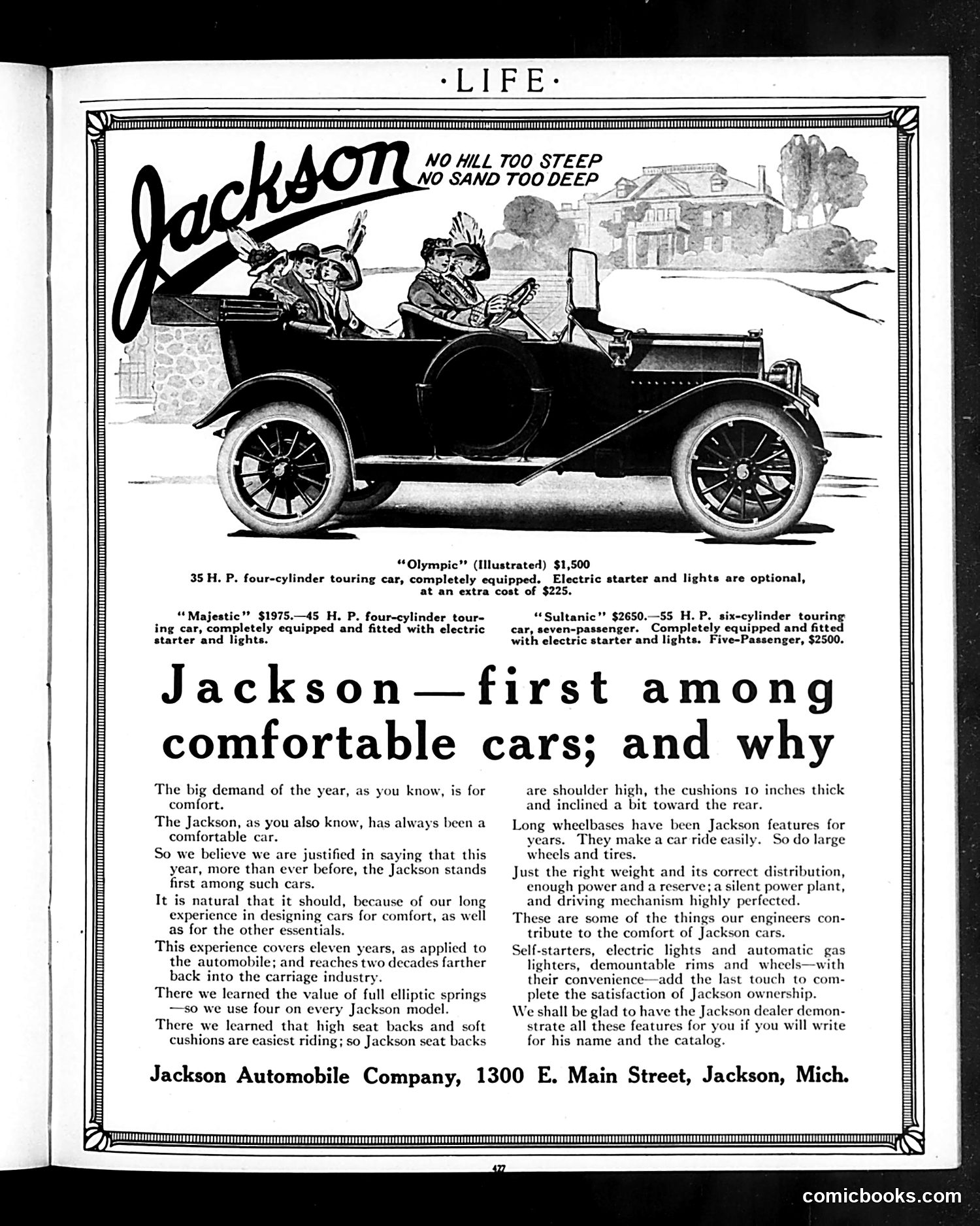
This is primarily a **car advertisement**, not political satire. The illustration shows two men in an early touring car navigating difficult terrain (hills and sand), with the slogan "No Hill Too Steep / No Sand Too Deep"—claiming the Jackson automobile's superior capability. The three models advertised—"Olympic," "Majestic," and "Sultanic"—use grandiose names reflecting early automotive marketing's tendency toward exotic, luxurious nomenclature. The lengthy text emphasizes comfort features: elliptic springs, high seat backs, soft cushions, long wheelbases, and optional electric starters and lights. This appeared in *Life* magazine, which despite its satirical reputation, regularly featured advertisements. The content reflects early-1900s automotive technology and consumer concerns: reliability, comfort, and the novelty of electrical features. No specific political figures or contemporary events are referenced.
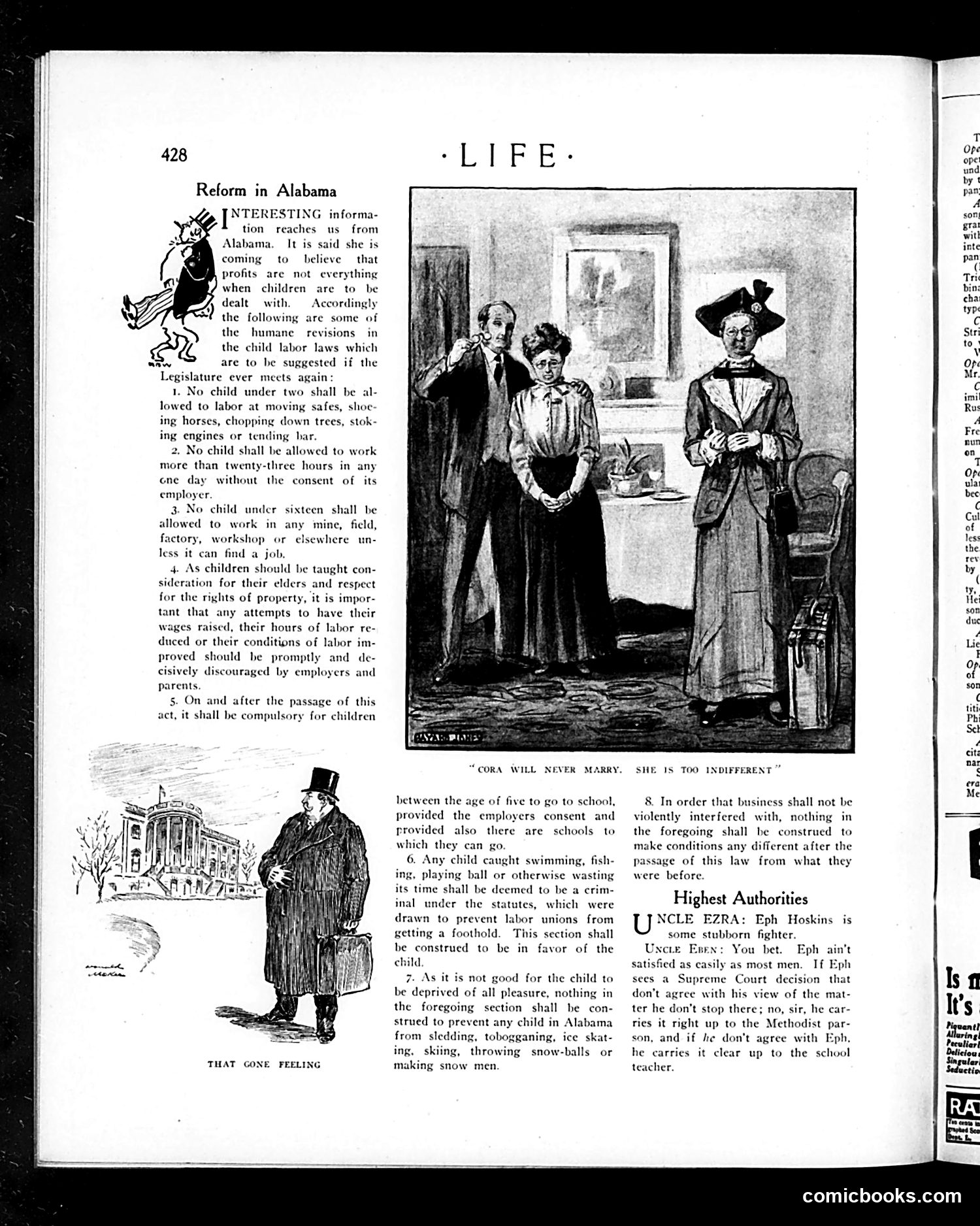
This satirical piece mocks Alabama's proposed child labor reforms as toothless and hypocritical. The text presents eight "suggested" laws in increasingly absurd language—beginning with reasonable-sounding restrictions (children under two shouldn't move safes), then revealing their true intent through ironic loopholes. The core joke: each "protection" is immediately undermined. Children can work 23 hours daily "without consent." Those under sixteen can work anywhere "if it can find a job." Crucially, point 8 states the laws won't actually change working conditions—they're purely performative. The cartoon illustrates "Cora Will Never Marry. She Is Too Indifferent"—depicting a young woman indifferent to suitors, likely commentary on women's exploitation through labor rather than marriage. The "That Gone Feeling" illustration suggests loss or resignation about reform's failure. This attacks Alabama's legislature for appearing to address child labor abuse while ensuring nothing substantively changes—satire on corporate power blocking genuine worker protections.
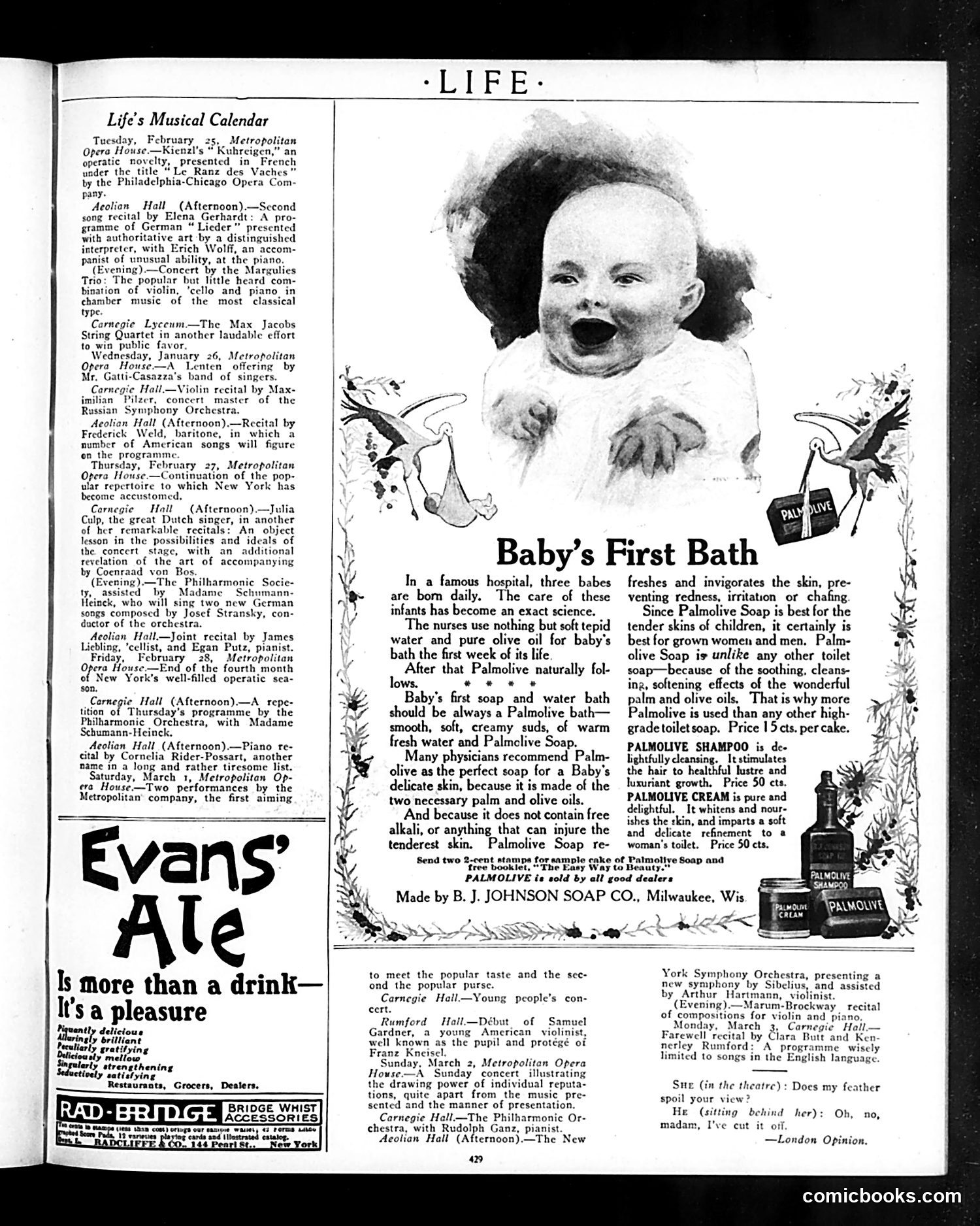
This page is primarily **advertising and entertainment listings**, not political satire. The dominant content is a **Palmolive Soap advertisement** featuring a smiling baby, emphasizing the product's gentleness for infant care. The ad claims hospital endorsement and positions Palmolive as superior because it contains only palm and olive oils without harmful alkali. The left column contains "Life's Musical Calendar"—listings of classical music performances in New York (opera, recitals, symphonies) from February-March, appealing to the magazine's educated readership. A smaller ad for **Evans' Ale** appears at bottom left, marketing it as more than merely a beverage but "a pleasure." There is **no political cartoon or satire** visible. This represents Life magazine's commercial function: entertaining affluent readers with cultural programming while selling consumer products—typical of early 20th-century American magazines blending editorial content with advertising.
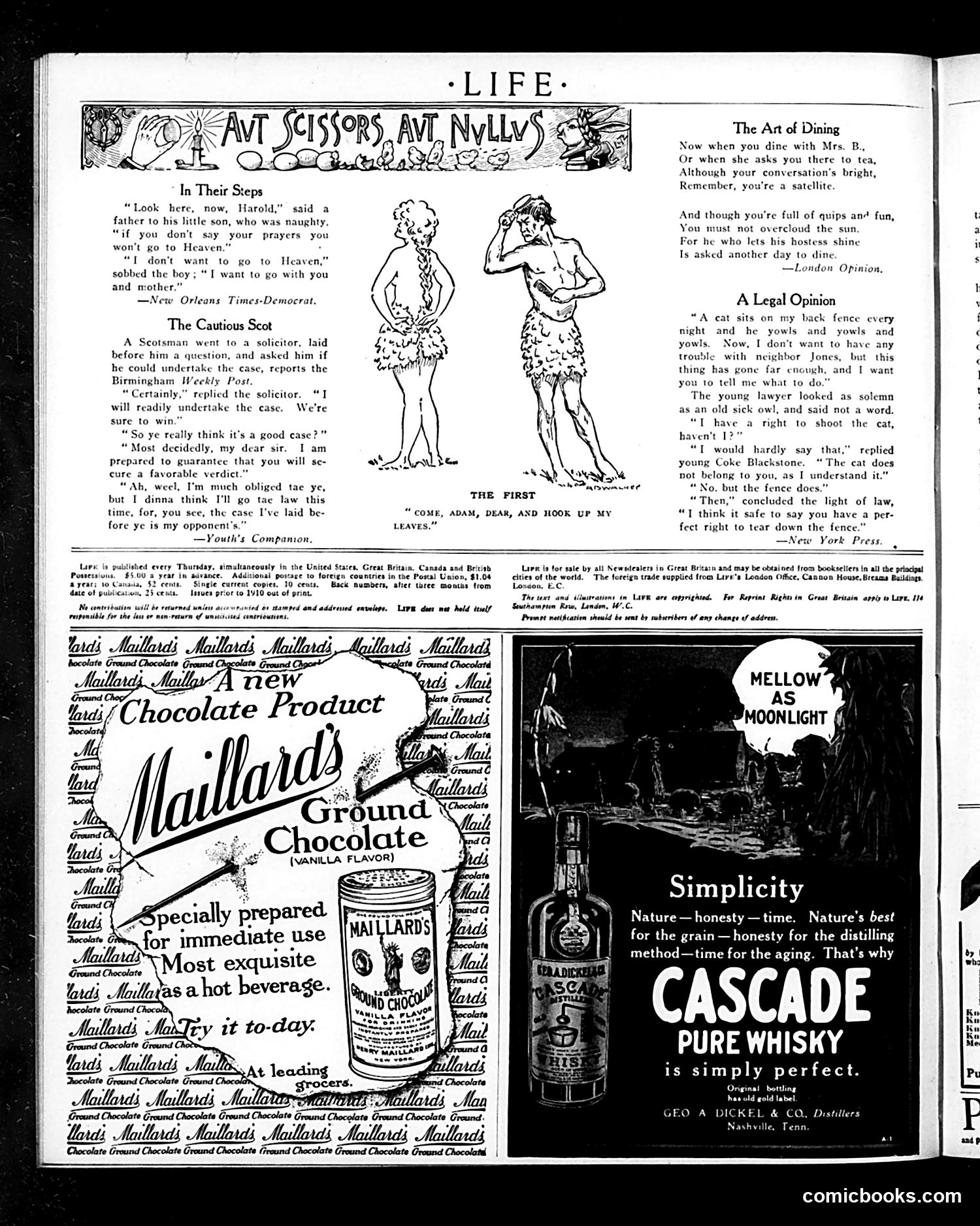
This page contains three separate humor pieces typical of Life's satirical content: **"In Their Steps"** presents a moral lesson joke: a naughty boy refuses to pray because he wants to go to Heaven with his parents rather than alone—inverting the expected piety lesson. **"The Cautious Scot"** plays on Scottish stereotypes about frugality and caution. A Scotsman consults a lawyer about winning a case, but admits he's actually describing his *opponent's* case—suggesting he's too penny-wise to afford pursuing his own litigation. **"A Legal Opinion"** satirizes pedantic lawyers. A man complains about a neighbor's cat on his fence and asks if he can shoot it. The young lawyer, focused on property rights rather than practical solutions, concludes the man can tear down his own fence instead—absurdly legalistic advice that solves nothing. The page also contains period advertisements for Maillards Ground Chocolate and Cascade Pure Whisky. The humor relies on common early-20th-century stereotypes and the gap between formal logic and common sense.
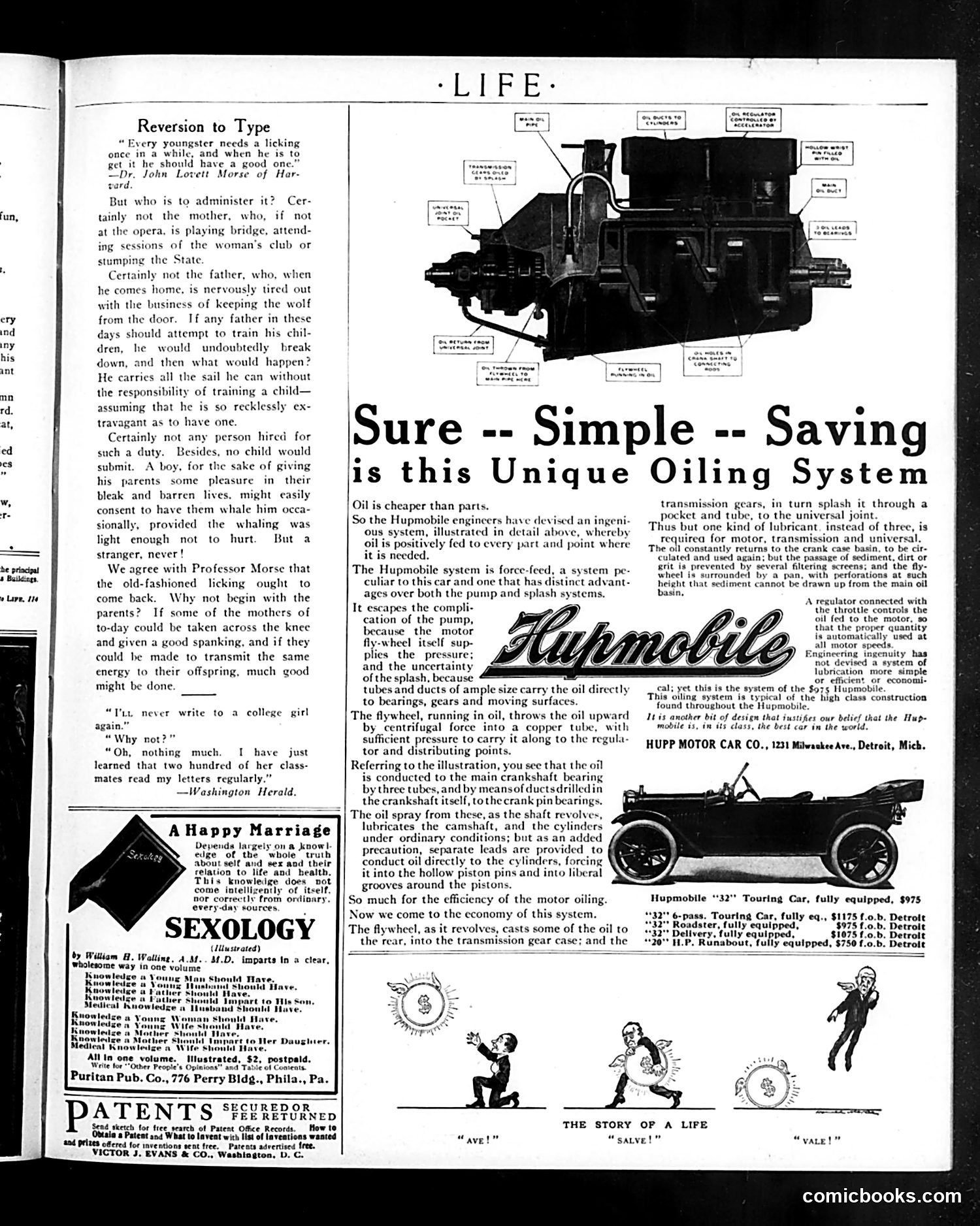
This page satirizes early 20th-century anxieties about parenting and discipline. Dr. John Lovett Morse (likely a real authority figure) argues children need corporal punishment. The article then comically asks *who* should administer it—certainly not mothers, who are occupied with opera, bridge, and women's clubs; not fathers, exhausted from work; and certainly not hired help, as no child would accept discipline from a stranger. The satire's point: modern society has made traditional parenting impossible. Parents are too distracted or tired, yet lack alternatives. The piece mocks both parental negligence and the impracticality of the old "licking" system in contemporary life. The cartoon at bottom right, titled "The Story of a Life," depicts a figure's arc from infancy ("Salve!") through adulthood to old age ("Vale!")—reinforcing themes of life stages and responsibility.
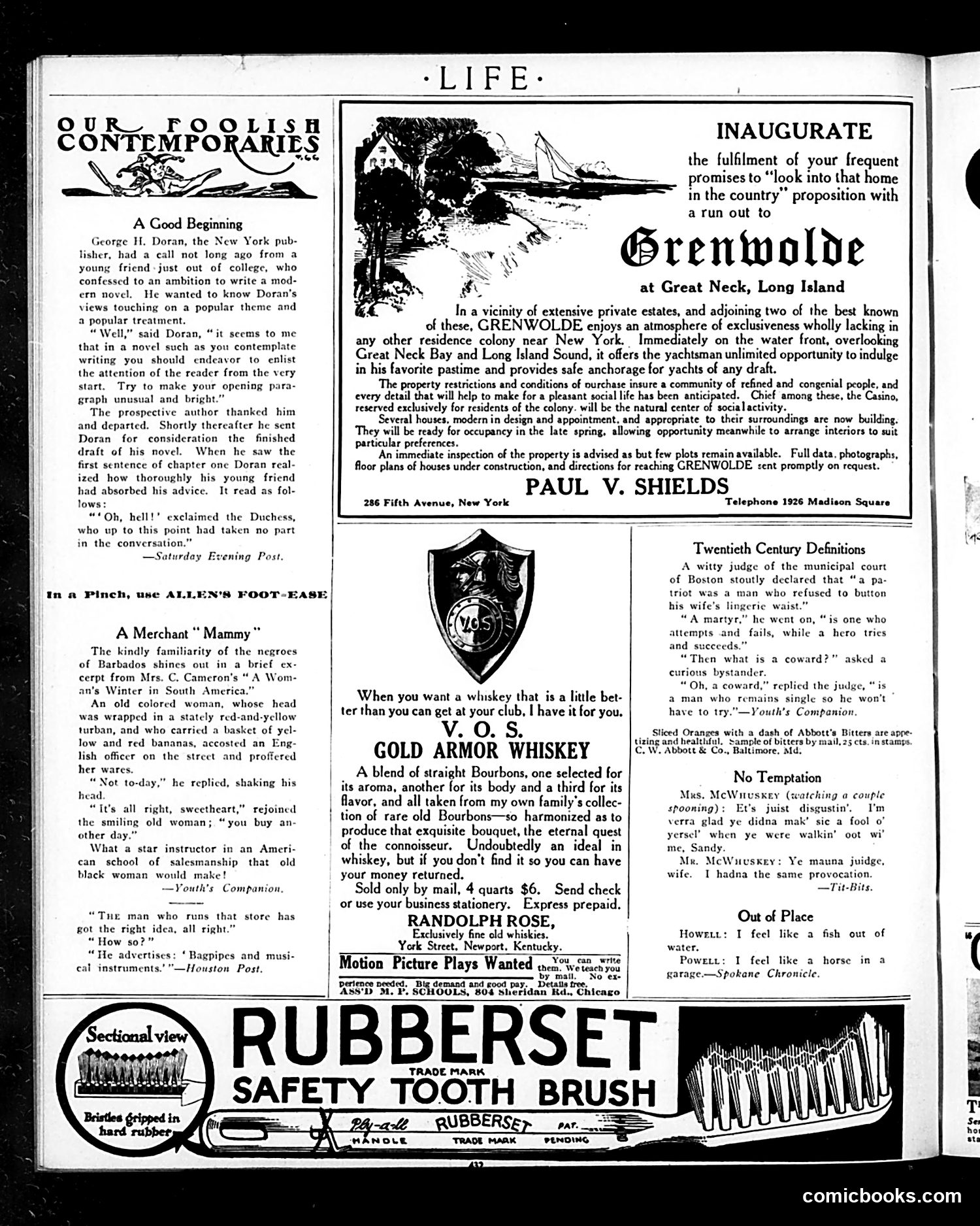
This page is primarily **advertising and humorous anecdotes**, not political cartoons. The main content includes: 1. **"Our Foolish Contemporaries"** — brief satirical stories mocking popular attitudes: - A publisher's advice about writing attention-grabbing novels (illustrated by a duchess saying "Oh, hell!") - A charming anecdote about a Black vendor in Barbados - Commentary on American salesmanship 2. **Large advertisements** for Grenwolde (a Long Island residential community), V.O.S. Gold Armor Whiskey, and Rubberset toothbrushes dominate the page. 3. **"Twentieth Century Definitions"** — a humorous piece defining patriot, martyr, hero, and coward through a Boston judge's witticisms. The humor is gentle, aimed at educated readers. There's **no significant political satire** here—the page reflects early 20th-century advertising aesthetics and light social commentary typical of *Life* magazine's mix of humor and commercial content.
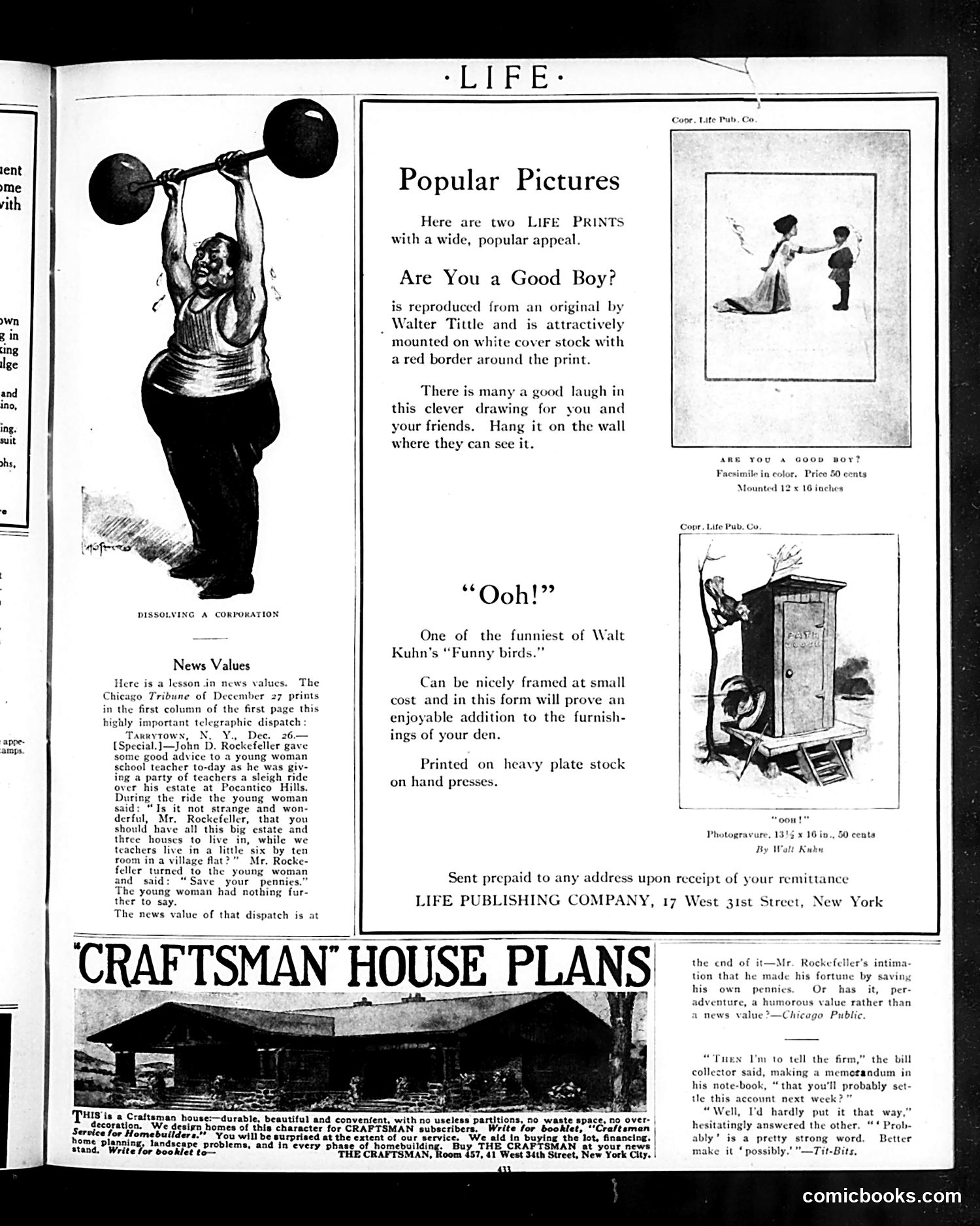
This page primarily advertises art prints and house plans rather than featuring political cartoons. The "Popular Pictures" section offers two framed prints for home decoration: Walter Tittle's "Are You a Good Boy?" (a humorous domestic scene) and Walt Kuhn's "Ooh!" (from his "Funny birds" series), both priced at 50 cents. The "News Values" section contains satire about John D. Rockefeller. A young schoolteacher questions why Rockefeller owns vast estates while teachers live in cramped quarters. He responds with the platitude that he built his fortune by "saving his own pennies"—a self-serving myth that obscures his actual monopolistic business practices. The Chicago Public source questions whether this anecdote has genuine news value or merely reinforces Rockefeller's preferred narrative. The lower section advertises Craftsman house plans, typical of the magazine's commercial content.
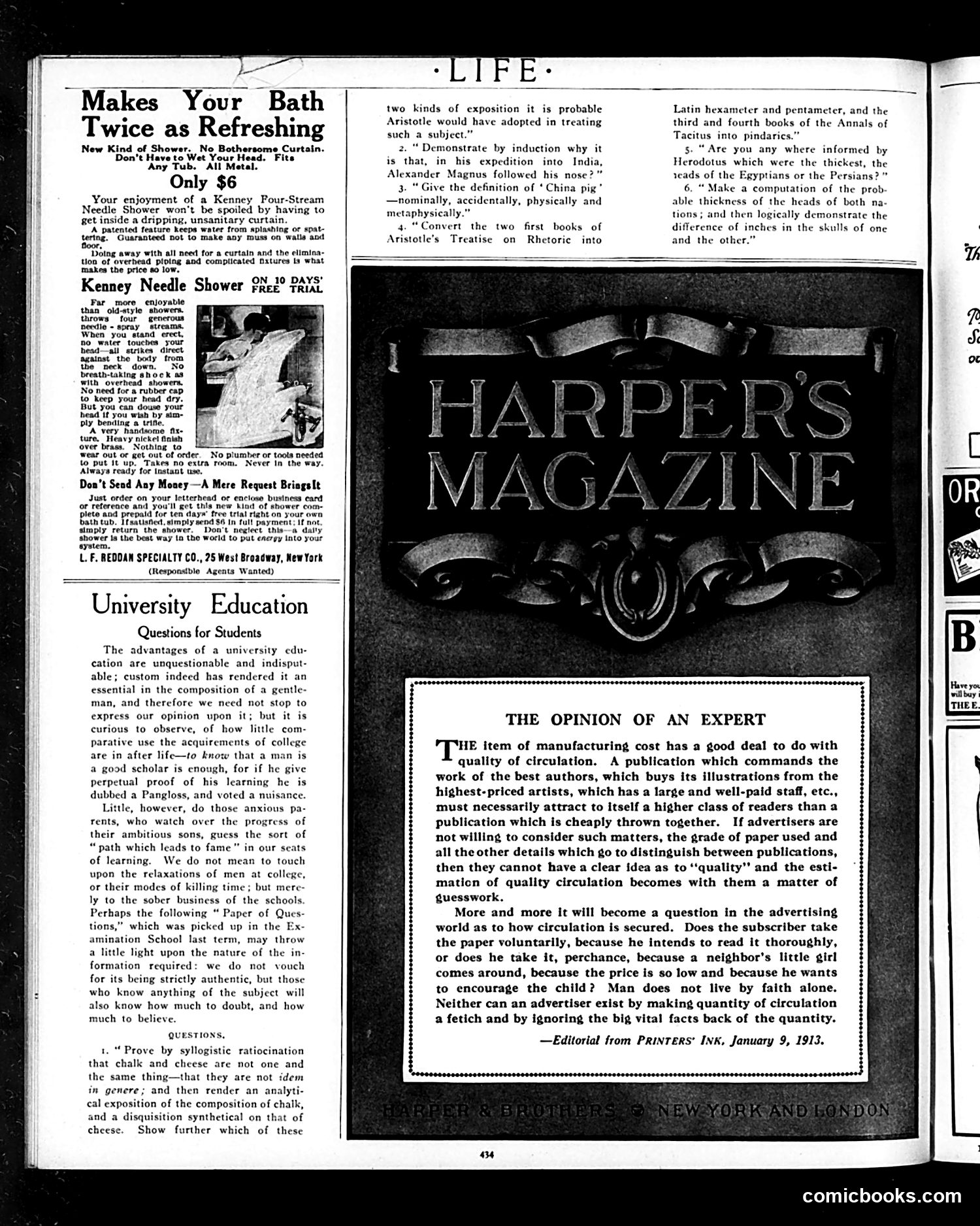
This page contains advertisements and satirical editorial content typical of Life's format. The main content is: **Left side**: Product advertisements for a Kenney Needle Shower ($6) and university education discussion. **Center/Right**: A *Harper's Magazine* advertisement and an editorial boxed section titled "The Opinion of an Expert" from *Printers' Ink* (January 9, 1913). The editorial discusses magazine circulation and quality—arguing that publications commanding high circulation must invest in quality paper, talented writers, and skilled staff. It critiques cheap publications and suggests advertisers shouldn't rely on circulation numbers alone without considering actual readership quality. The "University Education" section satirizes Oxford/Cambridge exam questions, presenting absurdly pedantic, impractical queries (translating Aristotle into Latin hexameter, computing Egyptian skull thickness) to mock how disconnected classical education was from real life. This reflects early-20th-century debates about educational relevance and publishing standards—concerns that remain surprisingly contemporary.
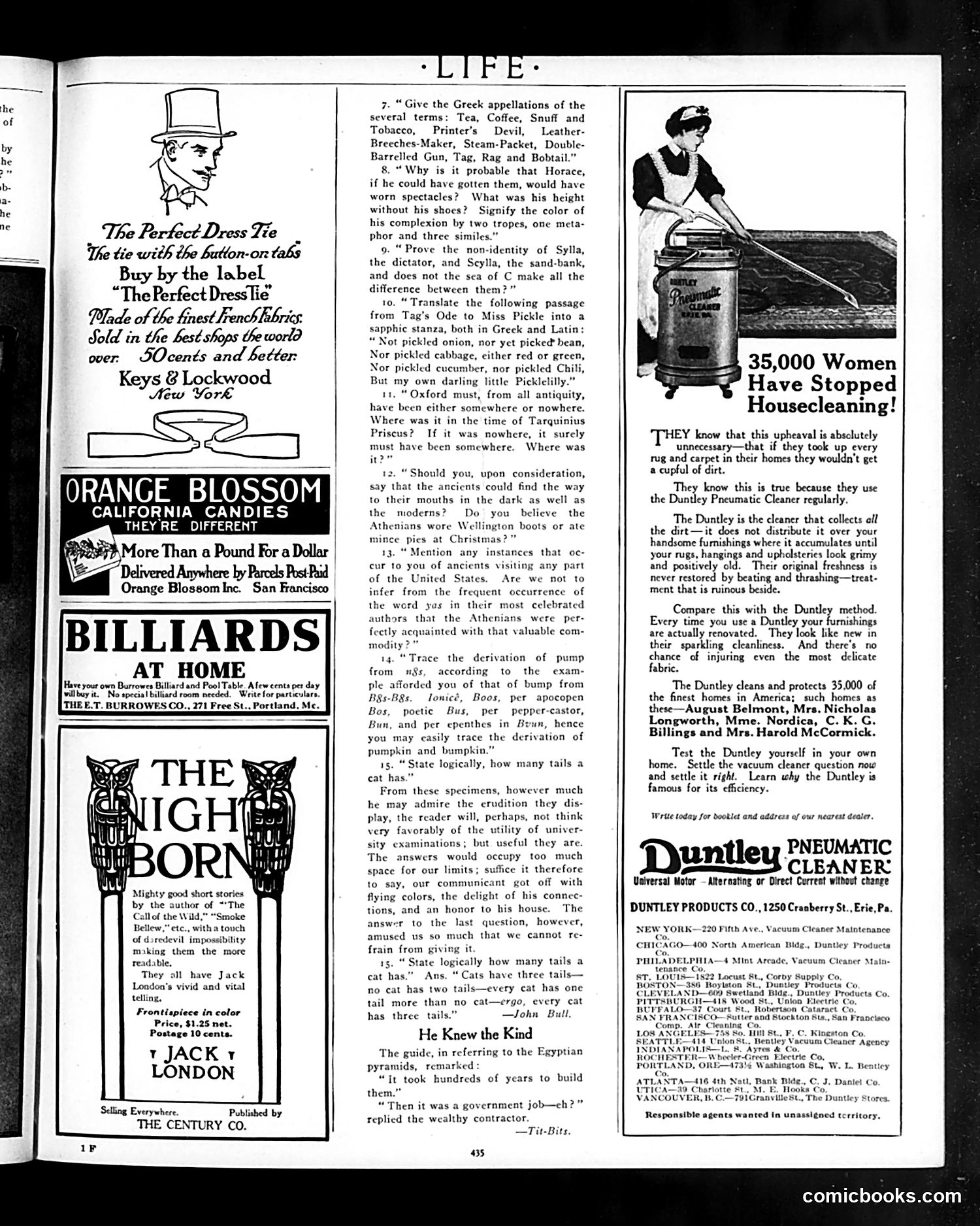
This page is primarily **advertisements and literary content** rather than political satire. The visible cartoon elements are minimal. The main text content consists of **humorous university examination questions** mocking the absurdity of classical education. Questions like "Why would Horace have worn spectacles?" and "Did Athenians wear Wellington boots or eat mince pies at Christmas?" satirize overly pedantic, irrelevant academic testing. The final joke about a government construction job (referencing the Egyptian pyramids taking centuries to build) is a mild jab at government inefficiency—a common early-20th-century American theme. The advertisements showcase period consumer goods (dress ties, billiard tables, vacuum cleaners) and Jack London's literary works. There's no identifiable political figures or specific dated references visible in the image itself beyond the general satirizing of academic pretension.
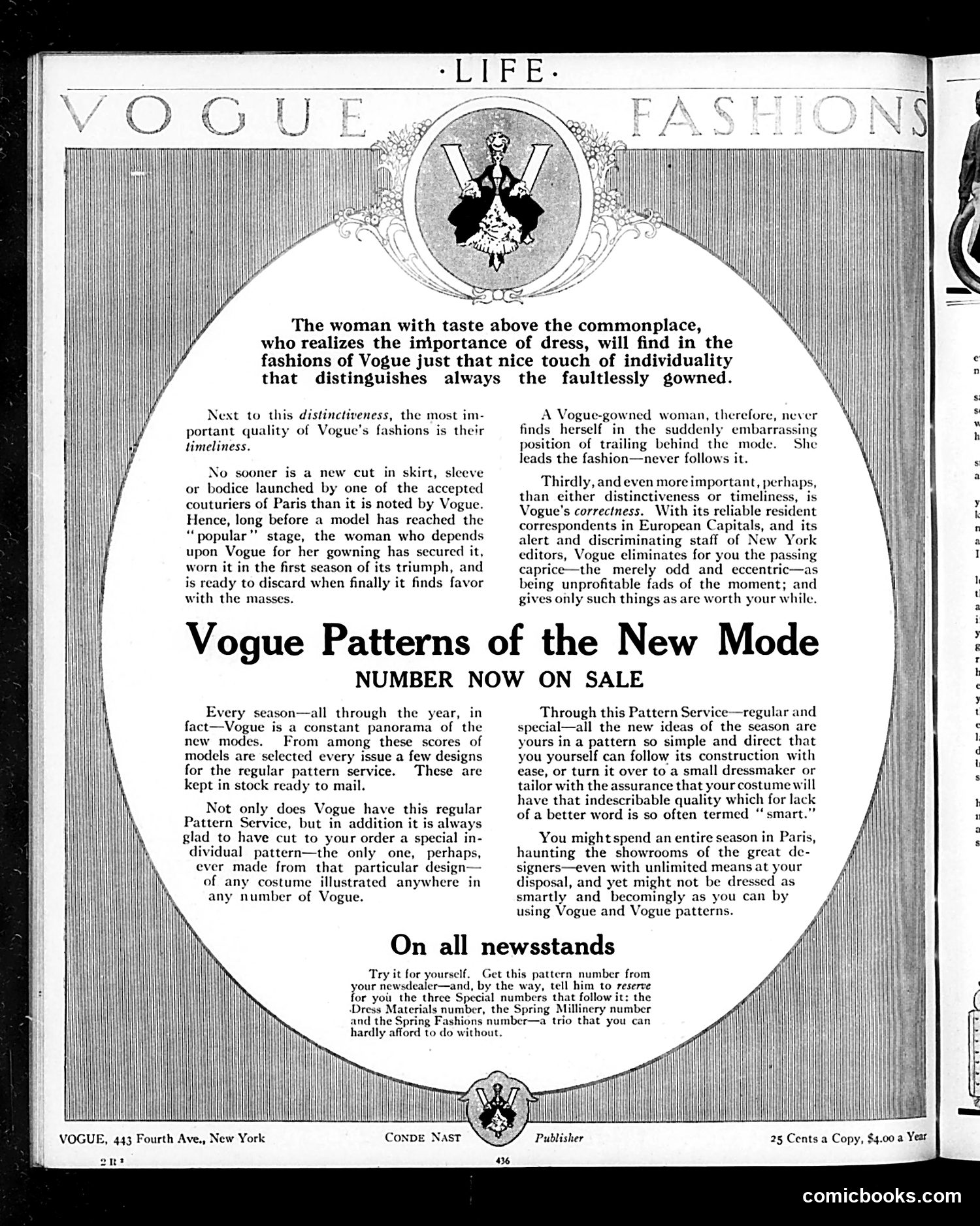
This is a **full-page advertisement**, not satire—it promotes Vogue magazine's fashion patterns and services to aspirational women readers. The page emphasizes that Vogue-dressed women occupy social superiority: they possess "taste above the commonplace," wear fashions *before* they become popular ("leads the fashion—never follows it"), and avoid embarrassing outdatedness. The pitch is explicitly class-based—Vogue's Paris correspondents and New York editors filter out "passing caprice" and "eccentric" fads, ensuring only worthy fashions reach readers. The ad promotes Vogue's pattern service, positioning it as affordable access to haute couture: women can now replicate expensive Parisian designs at home, or hire dressmakers using Vogue's patterns. The closing line claims users will be "dressed as smartly" as wealthy Parisians without their expense. This reflects early 20th-century consumer culture, where magazines monetized middle-class aspirations for upper-class appearance and status through mail-order patterns and advice.
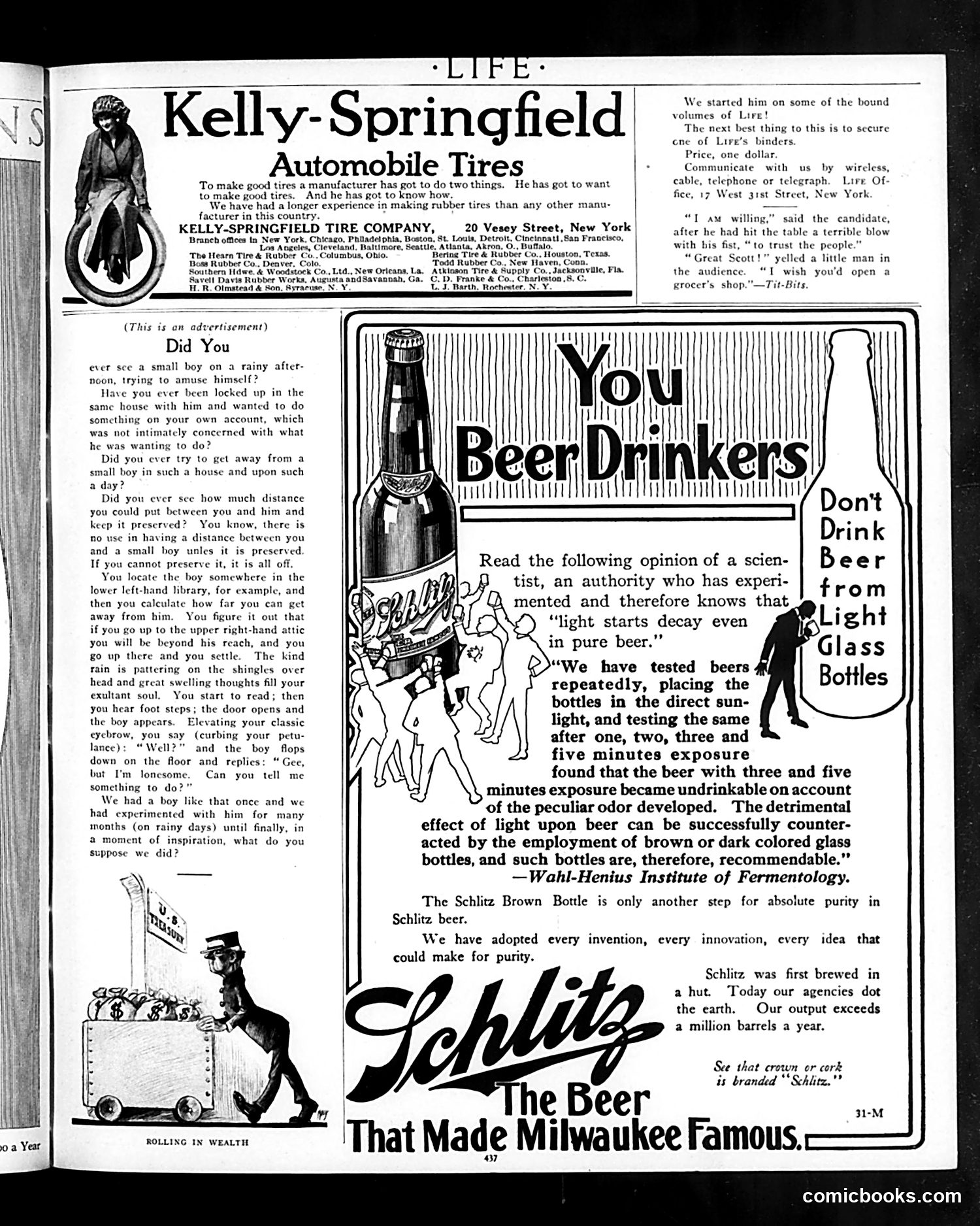
This page contains **three distinct advertisements** rather than political satire: 1. **Kelly-Springfield Automobile Tires** (top): A straightforward ad emphasizing manufacturing experience and quality standards for rubber tires. 2. **"Did You" humor piece** (left): A relatable anecdote about a bored boy on a rainy day, used to promote Life magazine subscriptions and binders. The accompanying cartoon shows a man "rolling in wealth" (pushing money in a cart), likely satirizing prosperity or materialism. 3. **Schlitz Beer advertisement** (right): The main content. It cites scientific testing from the Wahl-Henius Institute proving that light causes beer to spoil. Schlitz promotes their brown bottles as a solution, claiming this protects beer purity. The "Don't Drink Beer from Light Glass Bottles" message emphasizes their competitive advantage. The page is primarily **commercial in nature**—typical early 20th-century magazine advertising with minimal social commentary beyond consumer messaging.
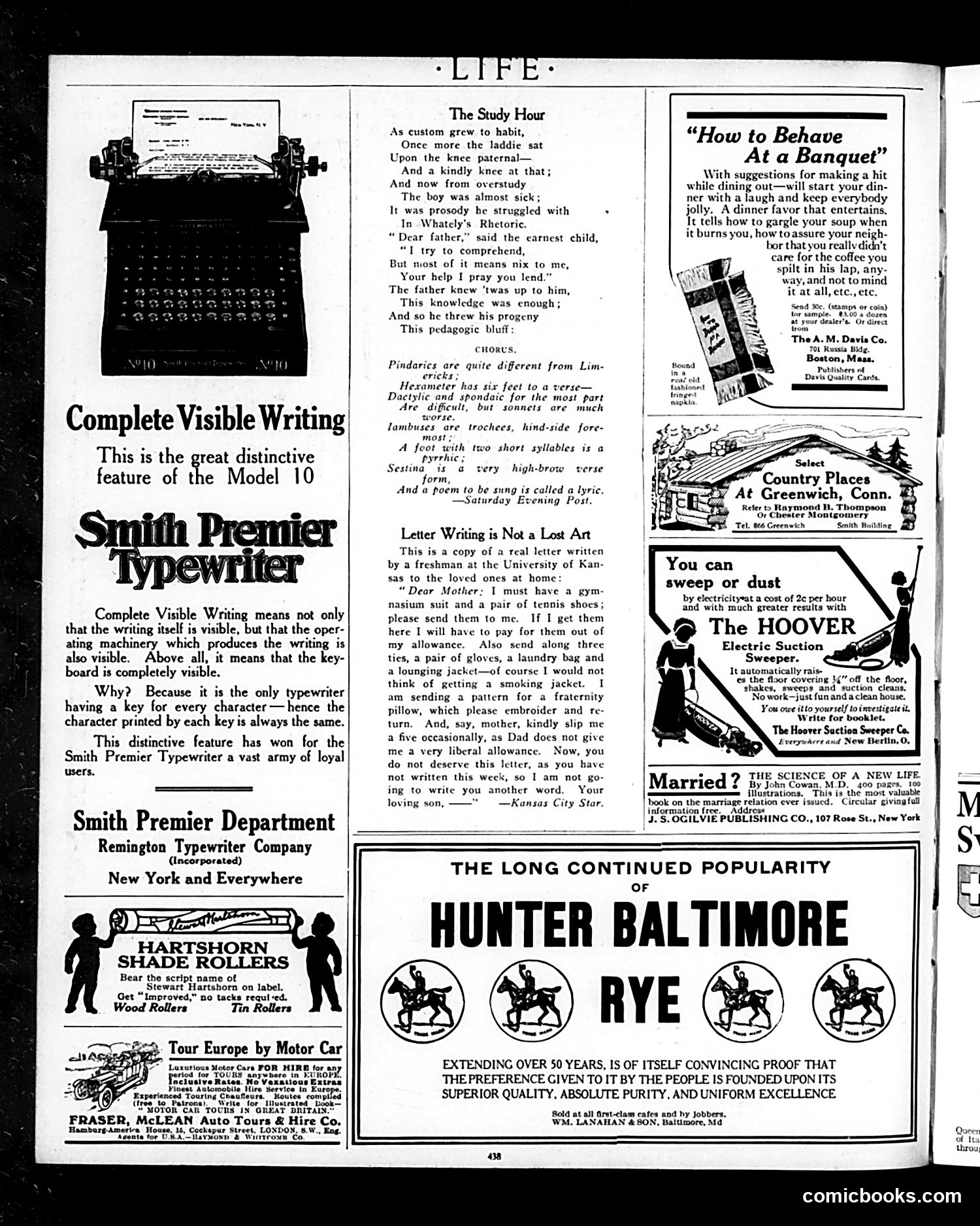
This page is primarily **advertisements and light satirical verse**, not political cartoons. The main satirical content is "The Study Hour," a poem mocking pedantic education. It depicts a father attempting to help his struggling son with prosody and rhetoric, then bluffing his way through with jargon-filled but meaningless advice about meters, forms, and verse types. The satire targets pretentious academic instruction and parental posturing rather than politics. A secondary piece, "Letter Writing is Not a Lost Art," humorously presents a college freshman's shameless begging letter to his mother—requesting gymnasium suits, ties, gloves, laundry service, and money while complaining she hasn't written him. This satirizes the entitlement and dependency of young students. The remaining content consists of period advertisements for typewriters (Smith Premier), window shades, European motor tours, vacuum cleaners, etiquette guides, and marriage advice books—all typical early 20th-century commercial messaging designed to fill magazine space.
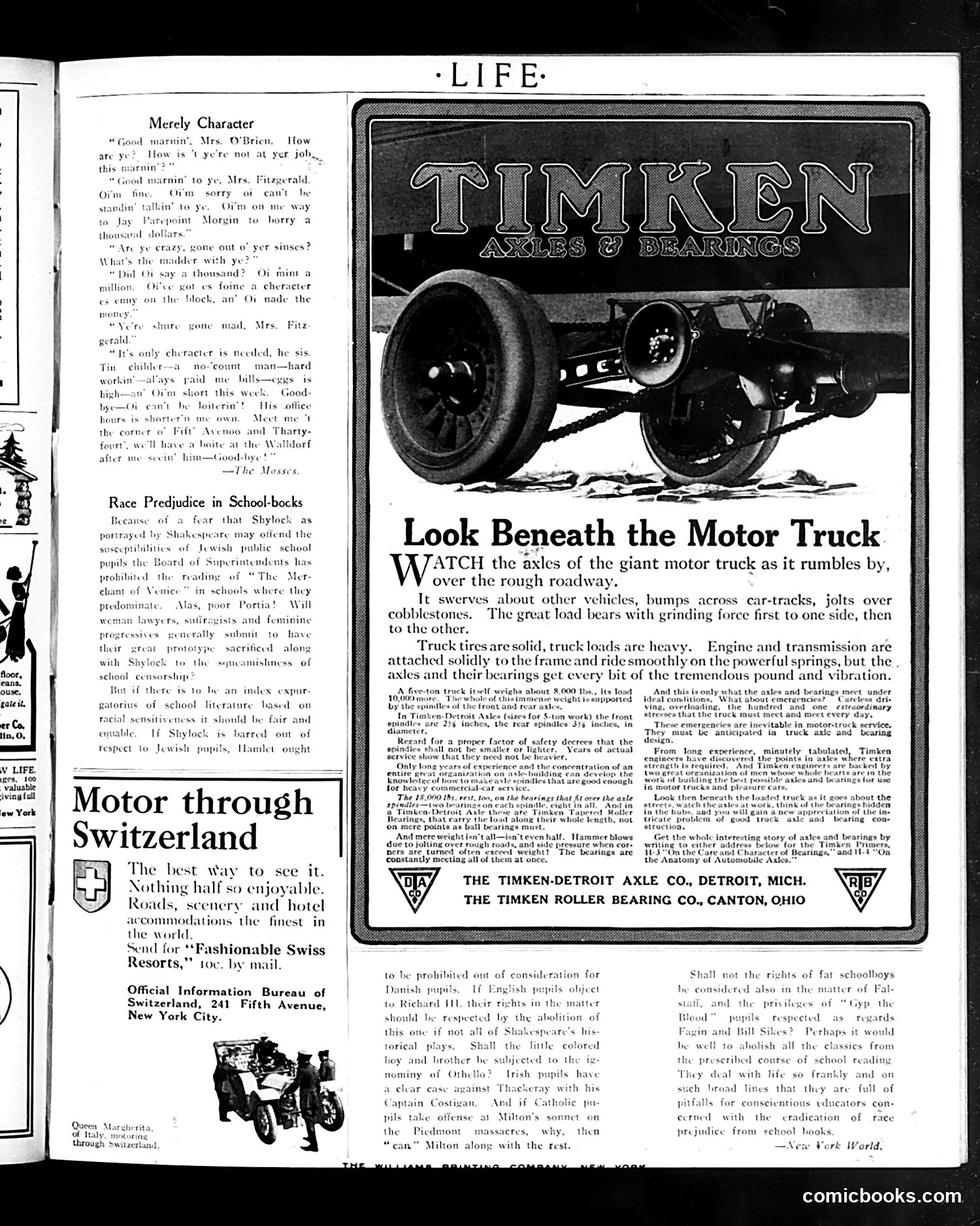
This page contains two distinct sections: **Left side:** A satirical dialogue titled "Merely Character" depicting Irish immigrant characters (Mrs. O'Brien and Mrs. Fitzgerald) speaking in exaggerated brogue. The joke appears to be about someone borrowing money based solely on "character"—the humor relies on ethnic stereotyping of Irish Americans as working-class and financially precarious. **Below that:** An article titled "Race Prejudice in School-books" criticizing educational censorship. It argues that schools wrongly ban Shakespeare's *The Merchant of Venice* to avoid offending Jewish students, yet allow other works with problematic stereotypes. The piece advocates for fair, non-discriminatory treatment of literature. **Right side:** A Timken Roller Bearing Company advertisement featuring a motor truck, emphasizing engineering durability. The page juxtaposes ethnic humor with serious social commentary about prejudice—ironically, the "Merely Character" sketch itself employs the very ethnic stereotyping the article criticizes in textbooks.
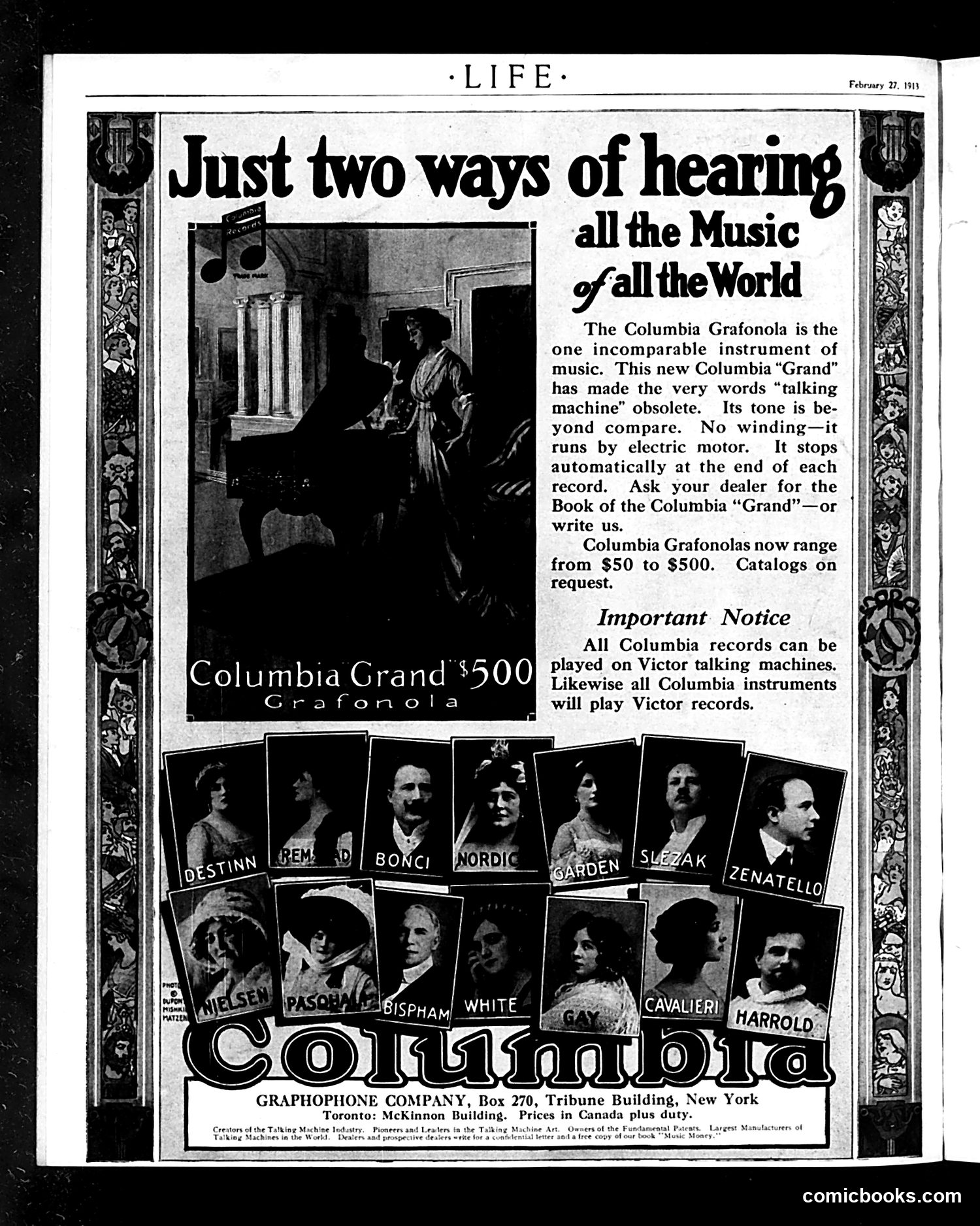
This is **primarily a full-page advertisement**, not satirical content. It promotes the Columbia Grafonola (an early phonograph/record player) from the Graphophone Company, dated February 27, 1913. The ad's main selling points: electric motor (no hand-winding), automatic stop, superior sound quality. Price range: $50-$500. The bottom section displays headshots of famous opera singers and performers of the era—including names like Destinn, Bonci, Nordica, Gården, Slezak, Zenatello, Nielsen, Pasquale, Bispham, White, Gay, Cavallieri, and Harrold—suggesting Columbia records feature world-class musical talent. An "Important Notice" states Columbia records play on Victor machines and vice versa, indicating competitive compatibility between the two leading phonograph manufacturers. This is essentially a luxury consumer product advertisement targeting middle-to-upper-class households, not political satire.