
Life, 1913-02-27 · page 19 of 40
Life — February 27, 1913 — page 19: what you’re looking at
What you’re looking at
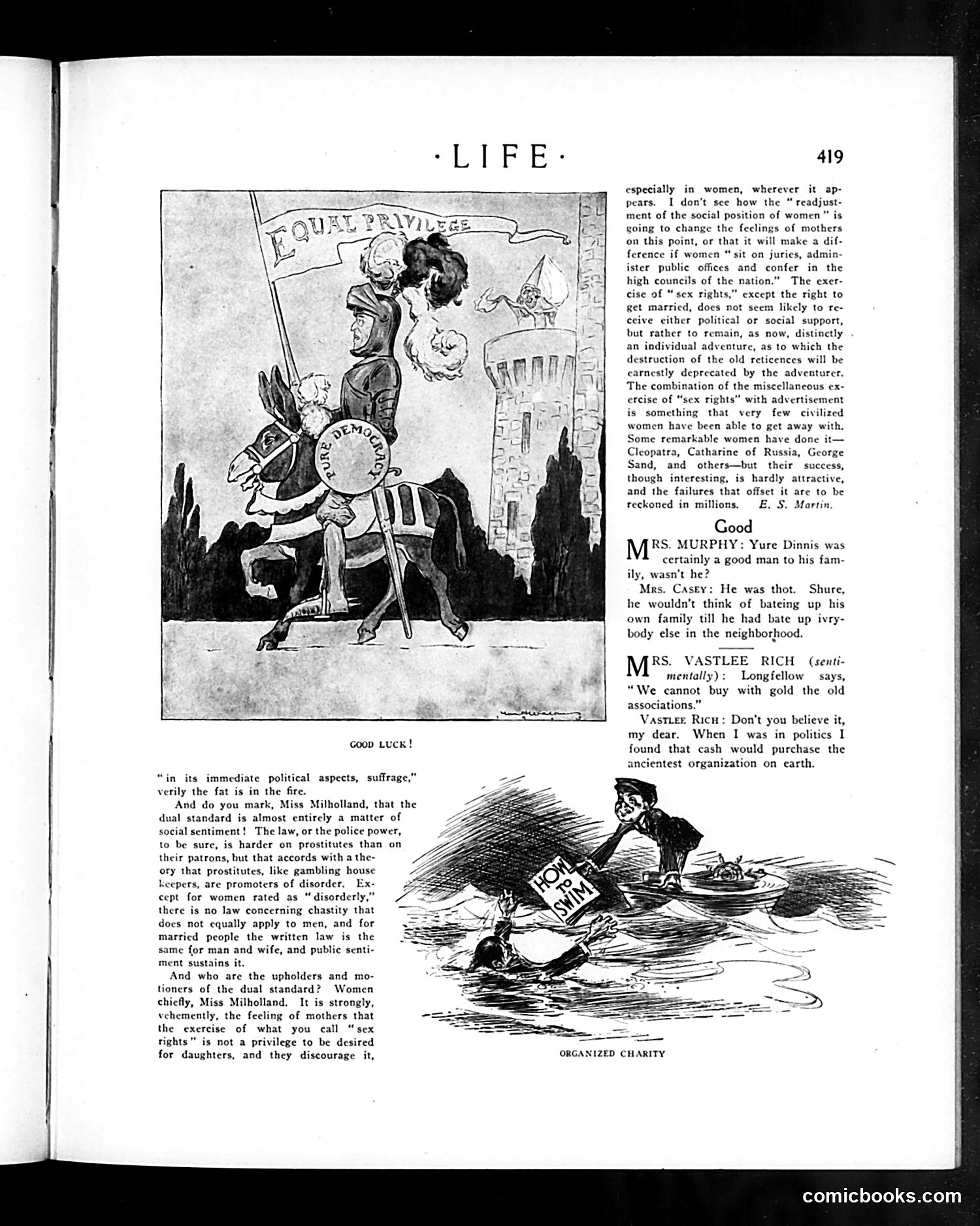
**"Good Luck!" (top cartoon):** This satirizes women's suffrage activism. The figure labeled "Equal Privilege" stands atop "Pure Democracy," juggling various social demands. The satire suggests that the suffrage movement's expansion of women's rights into political participation (voting, serving on juries, holding office) is chaotic and destabilizing to traditional society—hence the precarious balancing act. **"Organized Charity" (bottom cartoon):** This depicts apparent hypocrisy in charitable giving. A figure labeled "Poor Law" appears to be drowning while "Organized Charity" (shown as a well-dressed woman) sails past, suggesting that formal charitable organizations fail the truly destitute while prioritizing respectable causes. **Text commentary:** E.S. Martin argues that women's political equality won't change traditional moral standards, particularly regarding sexual conduct—mothers will continue discouraging daughters from exercising "sex rights" regardless of legal equality. The closing anecdote mocks how political organizations can be purchased with money, undercutting claims of principled charity or democracy.
📄 Transcribed text from this page (OCR, searchable)
Machine-transcribed from the original scan — historical spelling and the odd misread are preserved.
en [SSS 419 especially in women, wherever it ap- coop LucK! “in its immediate political aspects, suffrage,” verily the fat is in the fire. And do you mark, Miss Milholland, that the dual standard is almost entirely a matter of social sentiment! The law, or the police power, to be sure, is harder on prostitutes than on their patrons, but that accords with a the- ory that prostitutes, like gambling house keepers, are promoters of disorder, Ex- cept for women rated as “ disorderly,” there is no law concerning chastity that does not equally apply to men, and for married people the written law is the same for man and wife, and public senti- ment sustains it. And who are the upholders and mo- tioners of the dual standard? Women chiefly, Miss Milholland. It is strongly, vehemently, the feeling of mothers that the exercise of what you call “sex rights” is not a privilege to be desired for daughters, and they discourage it, pears. I don't sce how the “ readjust- ment of the social position of women” is going to change the feclings of mothers on this point, or that it will make a dif- ference if women “ sit on juries, admin- ister public offices and confer in the high councils of the nation.” The exer- cise of “sex rights,” except the right to get married, does not seem likely to re- ceive either political or social support, but rather to remain, as now, distinctly an individual adventure, as to which the destruction of the old reticences will be earnestly deprecated by the adventurer. The combination of the miscellancous ex- ercise of “sex rights” with advertisement is something that very few civilized women have been able to get away with. Some remarkable women have done it— Cleopatra, Catharine of Russia, George Sand, and others—but their success, though interesting, is hardly attractive, and the failures that offset it are to be reckoned in millions. E. S. Martin. Good RS. MURPHY: Yure Dinnis was certainly a good man to his fam- ily, wasn’t he? Mrs. Casey: He was thot. Shure, he wouldn't think of bateing up his own family till he had bate up ivry- body else in the neighborhood. RS. VASTLEE RICH (senti- mentally): Longfellow says, “We cannot buy with gold the old associations.” Vastiee Ricu: Don't you believe it, my dear. When I was in politics I found that cash would purchase the ancientest organization on earth. ORGANIZED CHARITY comicbooks.com