
Life, 1913-02-27 · page 23 of 40
Life — February 27, 1913 — page 23: what you’re looking at
What you’re looking at
This page contains three separate satirical pieces targeting prominent figures and institutions circa early 20th century. **"A Staunch Defender"** mocks Henry Clews, a Wall Street financier, for his defensive praise of stock exchange integrity. The satire suggests his claims are absurdly self-serving—while Clews insists the Exchange has higher standards than any other business, the piece sarcastically implies Wall Street brokers are actually corrupt "ship scuttlers" no different from fraud artists elsewhere. **"Why Not Be Humorous?"** criticizes the *New York Herald* newspaper for its heavy-handed attacks on Governor Woodrow Wilson (likely during his presidential campaign). The piece suggests the *Herald* lacks wit compared to William Randolph Hearst's publications, which employ humor while attacking their targets. **"At the Opera"** is a brief joke about artificiality in high society—the exchange between Musicus and Cynicus suggests everything at the opera is performative or fake. The overarching theme: attacking hypocrisy among wealthy elites and media dishonesty.
📄 Transcribed text from this page (OCR, searchable)
Machine-transcribed from the original scan — historical spelling and the odd misread are preserved.
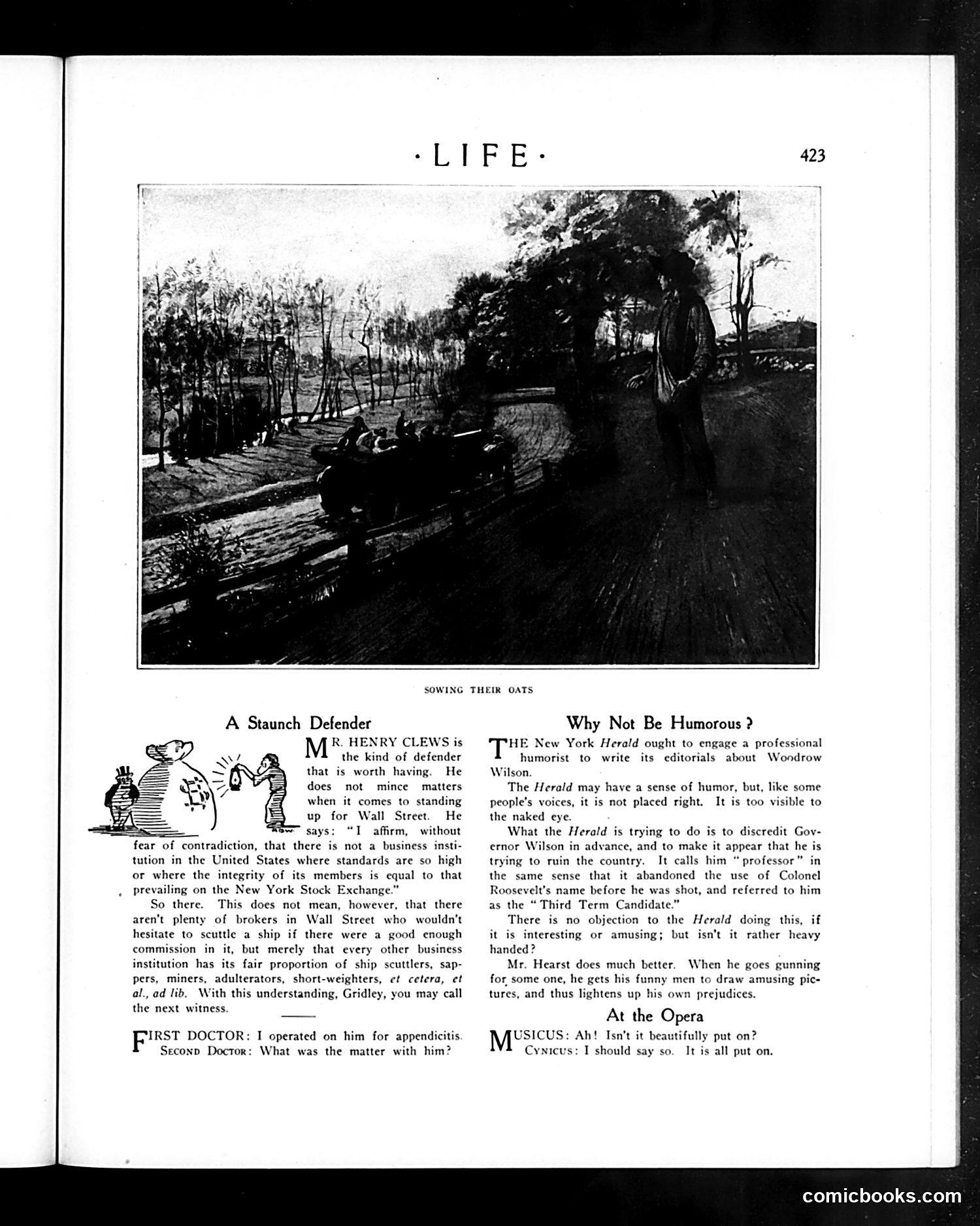
G THEIR OATS A Staunch Defender R. HENRY CLEWS is the kind of defender that is worth having. He does not mince matters when it comes to standing up for Wall Street. He say: “T affirm, without fear of contradiction, that there is not a business insti- tution in the United States where standards are so high or where the integrity of its members is equal to that prevailing on the New York Stock Exchange.” So there. This does not mean, however, that there aren't plenty of brokers in Wall Street who wouldn't hesitate to scuttle a ship if there were a good enough commission in it, but merely that every other business institution has its fair proportion of ship scuttlers, sap- pers, miners, adulterators, short-weighters, ef cetera, et al., ad lib, With this understanding, Gridley, you may call the next witness. IRST DOCTOR: I operated on him for appendicitis. Seconp Doctor: What was the matter with him Why Not Be Humorous ? HE New York Herald ought to engage a professional humorist to write its editorials about Woodrow Wilson. The Herald may have a sense of humor, but, like some people's voices, it is not placed right. It is too visible to the naked eye. What the Herald is trying to do is to discredit Gov- ernor Wilson in advance, and to make it appear that he is trying to ruin the country. It calls him “ professor” in the same sense that it abandoned the use of Colonel Roosevelt’s name before he was shot, and referred to him as the “ Third Term Candidate. There is no objection to the Herald doing this, if it is interesting or amusing; but isn't it rather heavy handed? Mr. Hearst does much better. When he goes gunning for, some one, he gets his funny men to draw amusing pic- tures, and thus lightens up his own prejudices. At the Opera Ah! Isn't it beautifully put on? I should say so. It is all put on. comicbooks.com