
Life, 1913-02-27 · page 22 of 40
Life — February 27, 1913 — page 22: what you’re looking at
What you’re looking at
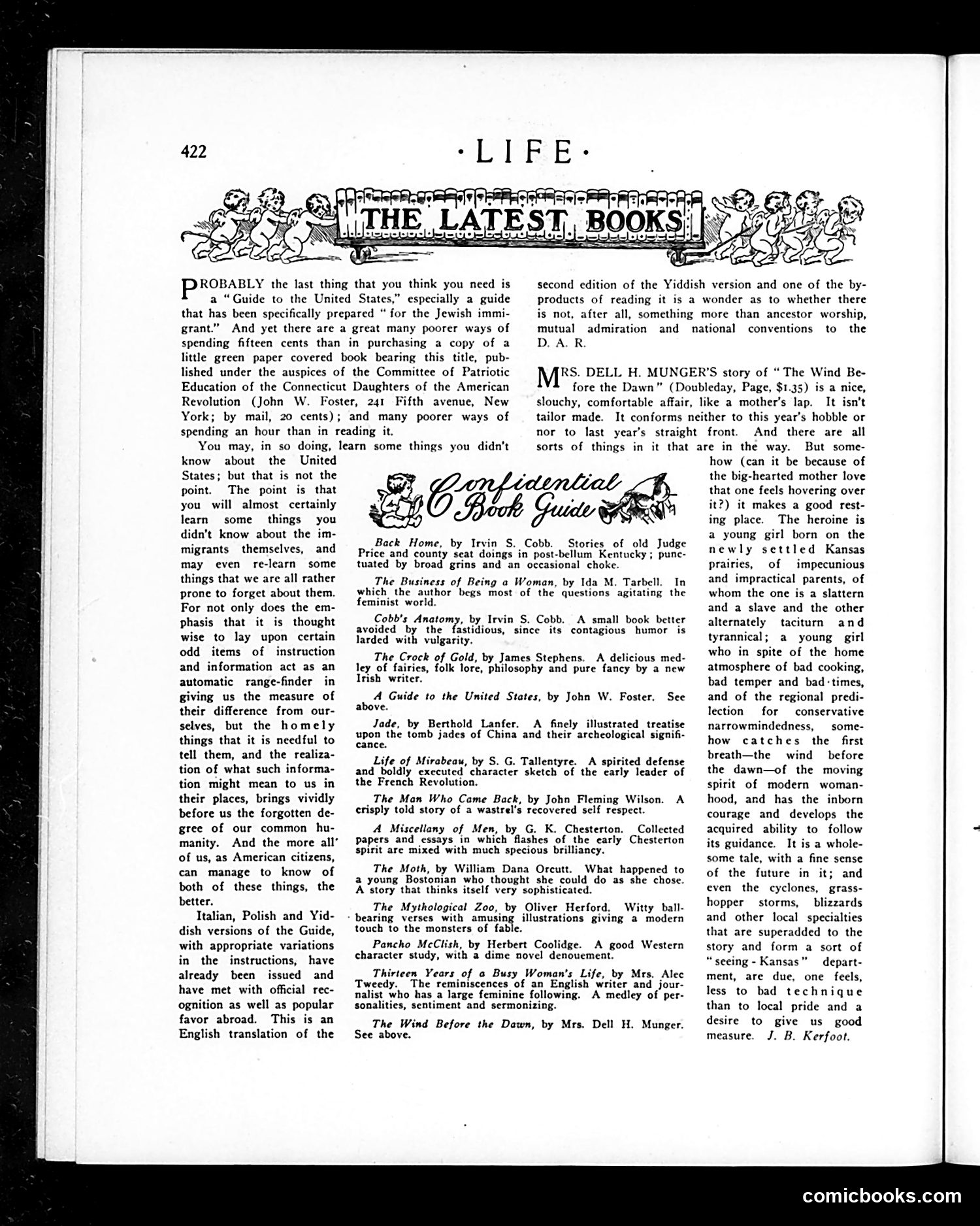
This is a book review page from *Life* magazine, not primarily a political cartoon. The satirical content is subtle but pointed. The main satire targets the Daughters of the American Revolution (DAR), specifically their "Committee of Patriotic Education," which published a "Guide to the United States" explicitly prepared "for the Jewish immigrant." The reviewer's tone is gently mocking: by noting what instructions the DAR deemed necessary to teach immigrants, the guide inadvertently reveals the DAR's own assumptions about immigrants' deficiencies and cultural distance from "real" Americans. The reviewer suggests this reveals something unflattering about the DAR itself—their condescension masked as patriotic education. The mention that Italian, Polish, and Yiddish versions exist with "appropriate variations" further underscores this patronizing approach. The surrounding book reviews are standard literary fare, providing context for the magazine's educated readership.
📄 Transcribed text from this page (OCR, searchable)
Machine-transcribed from the original scan — historical spelling and the odd misread are preserved.
ROBABLY the last thing that you think you need is a “Guide to the United States,” especially a guide that has been specifically prepared “ for the Jewish immi- grant.” And yet there are a great many poorer ways of spending fifteen cents than in purchasing a copy of a little green paper covered book bearing this title, pub- lished under the auspices of the Committee of Patriotic Education of the Connecticut Daughters of the American Revolution (John W. Foster, 241 Fifth avenue, New York; by mail, 20 cents); and many poorer ways of spending an hour than in reading it. You may, in so doing, learn some things you didn’t know about the United States; but that is not the point. The point is that you will almost certainly learn some things you didn’t know about the im- migrants themselves, and may even re-learn some things that we are all rather prone to forget about them. For not only does the em- phasis that it is thought wise to lay upon certain odd items of instruction and information act as an automatic range-finder in giving us the measure of their difference from our- selves, but the homely things that it is needful to tell them, and the realiza- tion of what such informa- tion might mean to us in their places, brings vividly before us the forgotten de- gree of our common hu- manity. And the more all’ Pape of us, as American citizens, can manage to know of both of these things, the better. Italian, Polish and Yid- dish versions of the Guide, with appropriate variations in the instructions, have already been issued and feminist world. avoided by the larded with vulgarity. Irish writer. above. cance. the French Revolution. bearing verses with amusin; Tweedy. Back Home, by Irvin S. Cobb. Price and county seat doings in post-bellum Kentucky ; pune- tuated by broad grins and an occasional choke. The Business of Being a Woman, by Ida M. Tarbell. In which the author begs most of the questions agitating the Cobb's Anatomy, by Irvin S. Cobb. fastidious, since its contagious humor is The Crock of Gold, by James Stephens. ley of fairies, folk lore, philosophy and pure fancy by a new A Guide to the United States, by John W. Foster, See Jade, by Berthold Lanfer. A finely illustrated treatise upon the tomb jades of China and their archeological signifi- Life of Mirabeau, by S. G. Tallentyre. and boldly executed character sketch of the early leader of _The Man Who Came Back, by John Fleming Wilson. A crisply told story of a wastrel’s recovered self respect. A Miscellany of Men, by G. K. Chesterton. rs and essays in which flashes of the early Chesterton spirit are mixed with much specious brilliancy. The Moth, by William Dana Orcutt. a young Bostonian who thought she could do as she chose. A story that thinks itself very sophisticated. The Mythological Zoo, by Oliver Herford. illustrations giving a modern touch to the monsters of fable. Pancho McClish, by Herbert Coolidge. character study, with a dime novel denouement. Thirteen Years of a Busy Woman's Life, by Mrs. Alec The reminiscences of an English writer and jour- second edition of the Yiddish version and one of the by- products of reading it is a wonder as to whether there is not, after all, something more than ancestor worship, mutual admiration and national conventions to the D. A. R. RS. DELL H. MUNGER'S story of “ The Wind Be- fore the Dawn” (Doubleday, Page, $1.35) is a nice, slouchy, comfortable affair, like a mother’s lap. It isn’t tailor made. It conforms neither to this year’s hobble or nor to last year’s straight front. And there are all sorts of things in it that are in the way. But some- how (can it be because of the big-hearted mother love that one feels hovering over it?) it makes a good rest- ing place. The heroine is a young girl born on the newly settled Kansas prairies, of impecunious and impractical parents, of whom the one is a slattern and a slave and the other alternately taciturn and tyrannical; a young girl who in spite of the home atmosphere of bad cooking, bad temper and bad-times, and of the regional predi- lection for conservative narrowmindedness, some- how catches the first breath—the wind before the dawn—of the moving spirit of modern woman- hood, and has the inborn courage and develops the acquired ability to follow its guidance. It is a whole- some tale, with a fine sense What happened to of the future in it; and even the cyclones, grass- hopper storms, _ blizzards and other local specialties that are superadded to the story and form a sort of “seeing - Kansas” depart- ment, are due, one feels, Stories of old Judge A small book better A delicious med- A spirited defense Collected Witty ball- A good Western have met with official rec- ognition as well as popular favor abroad. This is an English translation of the nalist who has a large feminine following. A medley of per- sonalities, sentiment and sermonizing. The Wind Before the Dawn, by Mrs. Dell H. Munger. See above. less to bad technique than to local pride and a desire to give us good measure. J. B. Kerfoot. comicbooks.com