
Life, 1913-02-27 · page 8 of 40
Life — February 27, 1913 — page 8: what you’re looking at
What you’re looking at
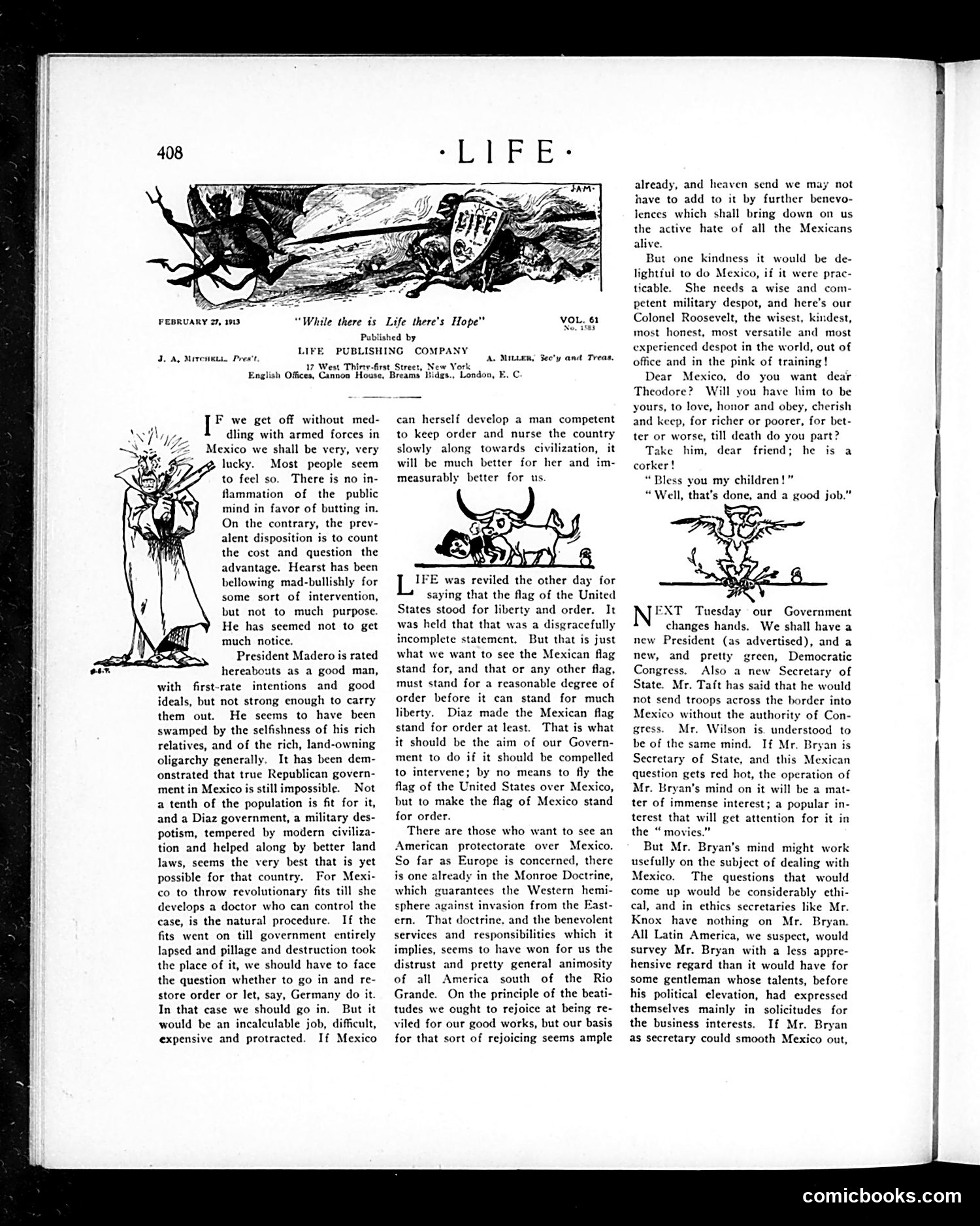
This editorial page addresses U.S. intervention in Mexico during the Mexican Revolution. The text criticizes President Madero as well-intentioned but ineffectual, arguing that Mexico needs strong military leadership—specifically praising Colonel Theodore Roosevelt as the ideal "wise, kindest, most honest" solution. The cartoon (upper left) depicts Mexico as a chaotic, violent figure—likely representing the country in turmoil. The editorial advocates for American intervention to establish order, invoking the Monroe Doctrine to justify U.S. authority over Latin America. The page also discusses upcoming government changes under President Wilson, with concerns about whether the new administration will maintain or alter American policy toward Mexico. The satire mocks both Mexican instability and American imperial ambitions.
📄 Transcribed text from this page (OCR, searchable)
Machine-transcribed from the original scan — historical spelling and the odd misread are preserved.
FEBRUARY 2, 1913 “While there is Life there's Hope” Published by LIFE J. AL Mirennts. Pres't, 17 West Thiry-frst_ Street PUBLISHING COMPANY A. Minin, 3ec'y anit Treas. New York English Offices, Cannon House, Breams’ Bidgs., London, E. C. F we get off without med- dling with armed forces in Mexico we shall be very, very lucky. Most people seem to feel so. There is no in- flammation of the public mind in favor of butting in. On the contrary, the prev- alent disposition is to count the cost and question the advantage. Hearst has been bellowing mad-bullishly for some sort of intervention, but not to much purpose. He has seemed not to get much notice. President Madero is rated hereabouts as a good man, with first-rate intentions and good ideals, but not strong enough to carry them out. He seems to have been swamped by the selfishness of his rich relatives, and of the rich, land-owning oligarchy generally. It has been dem- onstrated that true Republican govern- ment in Mexico is still impossible. Not a tenth of the population is fit for it, and a Diaz government, a military des- potism, tempered by modern civiliza- tion and helped along by better land laws, seems the very best that is yet possible for that country. For Mexi- co to throw revolutionary fits till she develops a doctor who can control the case, is the natural procedure. If the fits went on till government entirely lapsed and pillage and destruction took the place of it, we should have to face the question whether to go in and re- store order or let, say, Germany do it. In that case we should go in. But it would be an incalculable job, difficult, expensive and protracted. If Mexico can herself develop a man competent to keep order and nurse the country slowly along towards civilization, it will be much better for her and im- measurably better for us. IFE was reviled the other day for saying that the flag of the United States stood for liberty and order. It was held that that was a disgracefully incomplete statement, But that is just what we want to see the Mexican flag stand for, and that or any other flag, must stand for a reasonable degree of order before it can stand for much liberty. Diaz made the Mexican flag stand for order at least. That is what it should be the aim of our Govern- ment to do if it should be compelled to intervene; by no means to fly the flag of the United States over Mexico, but to make the flag of Mexico stand for order. There are those who want to see an American protectorate over Mexico. So far as Europe is concerned, there is one already in the Monroe Doctrine, which guarantees the Western hemi- sphere against invasion from the East- ern, That doctrine, and the benevolent services and responsibilities which it implies, seems to have won for us the distrust and pretty general animosity of all America south of the Rio Grande. On the principle of the beati- tudes we ought to rejoice at being re- viled for our good works, but our basis for that sort of rejoicing seems ample already, and heaven send we may not have to add to it by further benevo- lences which shall bring down on us the active hate of all the Mexicans alive. But one kindness it would be de- lightiul to do Mexico, if it were prac- ticable. She needs a wise and com- petent military despot, and here’s our Colonel Roosevelt, the wisest, kindes most honest, most versatile and most experienced despot in the world, out of office and in the pink of training! Dear Mexico, do you want dear Theodore? Will you have him to be yours, to love, honor and obey, cherish and keep, for richer or poorer, for bet- ter or worse, till death do you part? Take him, dear friend; he is a corker! “Bless you my children!” “Well, that’s done, and a good job.” N! XT Tuesday our Government changes hands. We shall have a new President (as advertised), and a new, and pretty green, Democratic Congr Also a new Secretary of State. Mr. Taft has said that he would not send troops across the border into Mexico without the authority of Con- gress. Mr. Wilson is. understood to be of the same mind. If Mr. Bryan is Secretary of State, and this Mexican question gets red hot, the operation of Mr. Bryan’s mind on it will be a mat- ter of immense interes! popular in- terest that will get attention for it in the “ movies.” But Mr. Bryan’s mind might work usefully on the subject of dealing with Mexico. The questions that would come up would be considerably ethi- cal, and in ethics secretaries like Mr. Knox have nothing on Mr. Bryan. All Latin America, we suspect, would survey Mr. Bryan with a less appre- hensive regard than it would have for some gentleman whose talents, before his political elevation, had expressed themselves mainly in solicitudes for the business interests. If Mr. Bryan as secretary could smooth Mexico out, comicbooks.com