
Life, 1913-02-27 · page 37 of 40
Life — February 27, 1913 — page 37: what you’re looking at
What you’re looking at
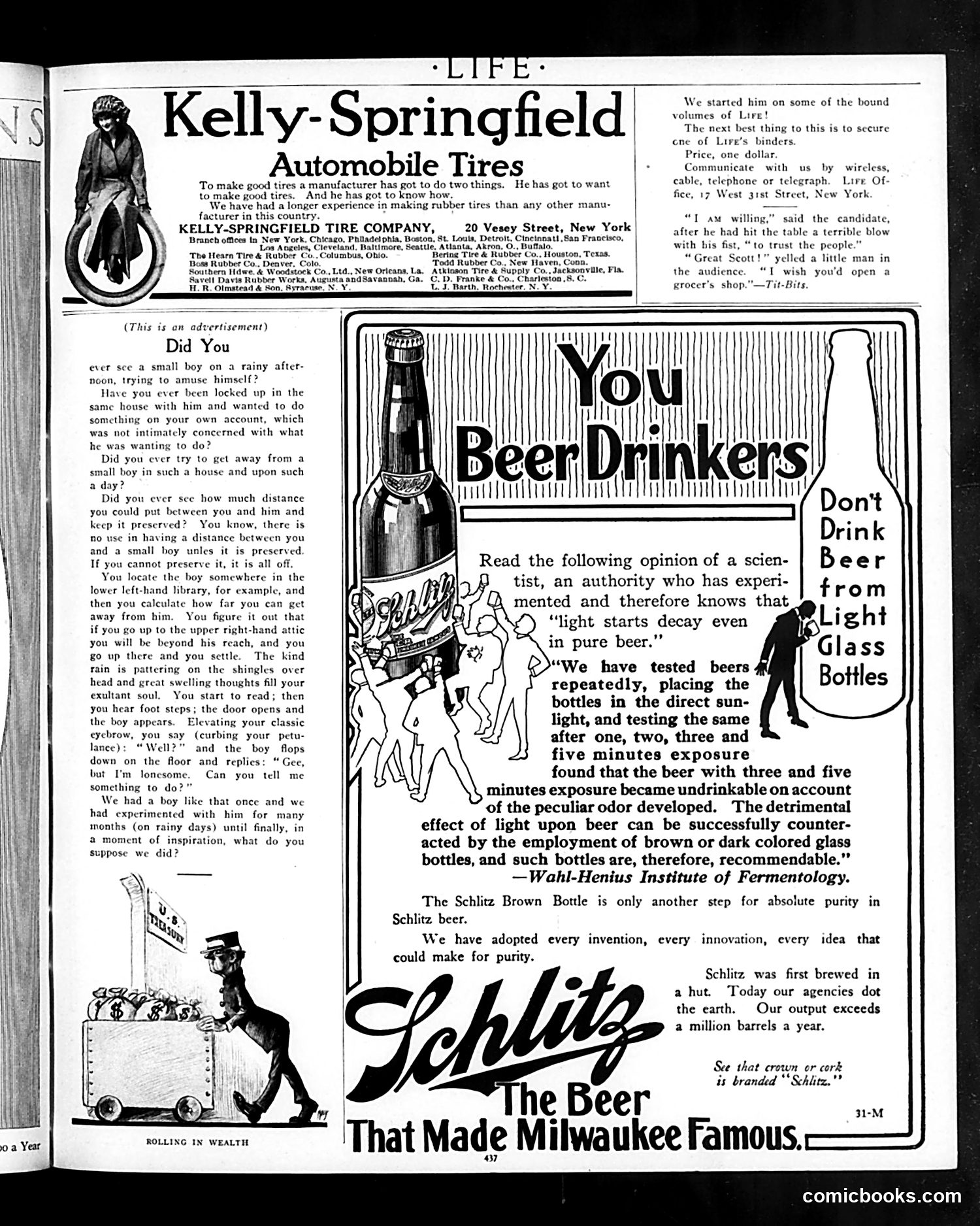
This page contains **three distinct advertisements** rather than political satire: 1. **Kelly-Springfield Automobile Tires** (top): A straightforward ad emphasizing manufacturing experience and quality standards for rubber tires. 2. **"Did You" humor piece** (left): A relatable anecdote about a bored boy on a rainy day, used to promote Life magazine subscriptions and binders. The accompanying cartoon shows a man "rolling in wealth" (pushing money in a cart), likely satirizing prosperity or materialism. 3. **Schlitz Beer advertisement** (right): The main content. It cites scientific testing from the Wahl-Henius Institute proving that light causes beer to spoil. Schlitz promotes their brown bottles as a solution, claiming this protects beer purity. The "Don't Drink Beer from Light Glass Bottles" message emphasizes their competitive advantage. The page is primarily **commercial in nature**—typical early 20th-century magazine advertising with minimal social commentary beyond consumer messaging.
📄 Transcribed text from this page (OCR, searchable)
Machine-transcribed from the original scan — historical spelling and the odd misread are preserved.
We started him on some of the bound volumes of Lire! The next best thing to this is to secure ene of Lire’s binders. Price, one dollar. Kelly-Springfield Automobile Tires Communicate with us by wireless, To make good tires a manufacturer has got to do two things. He has got to want cable, telephone or telegraph. Lire Of- to,make good tires. | And he has got to know how. fice, 17 West 31st Street, New York Weh had a longer experience in making rubber tires than any other manu- facturer in this country. “1 as willing,” said the candidate, \, KELLY-SPRINGFIELD TIRE COMPANY, _20 Vesey Street, New York ahce be Nad Mik ihe able a tezsible blows \ . 4 ineinnatt San Francisco, é rm f Hy Las Apgeles, Ci . , Seattle, % with bis fist, “to trust the people. “Great Scott!” yelled a little man in the audience. “I wish you'd open a grocer’s shop."—Tit-Bits. (This is an advertisement) Did You Ki | 1 ever sce a small boy on a rainy after- noon, trying to amuse himself? Have you ever been locked up in the } same house with him and wanted to do M something on your own account, which was not intimately concerned with what e | ink lt NKErS he was wanting to do? Did you ever try to get away from a small boy in such a house and upon such . 1 a day? Did you ever see how much distance you could put between you and him and keep it preserved? You know, there is no use in having a distance between you and a small boy unles it is preserved If you cannot preserve it, it is all off. You locate the boy somewhere in the lower left-hand library, for example, and then you calculate how far you can get away from him. You figure it out that if you go up to the upper right-hand attic you will be beyond his reach, and you go up there and you settle. The kind Read the following opinion of a scien- tist, an authority who has experi- mented and therefore knows that “light starts decay even in pure beer.” rain is pattering on the shingles over head and great swelling thoughts fill your exultant soul. You start to read; then you hear foot steps; the door opens and “We have tested beers repeatedly, placing the bottles in the direct sun- Bottles the boy appears. Elevating your classic eyebrow, you say (curbing your petu- lance): “Well?” and the boy flops down on the floor and replies: “Gee, but I'm lonesome. Can you tell me something to do?” We had a boy like that once and we had experimented with him for many months (on rainy days) until finally, in a moment of inspiration, what do you light, and testing the same after one, two, three and five minutes exposure found that the beer with three and five minutes exposure became undrinkable on account of the peculiar odor developed. The detrimental effect of light upon beer can be successfully counter- i acted by the employment of brown or dark colored glass anppesebwendid bottles, and such bottles are, therefore, recommendable.” 2. —_— —Wahl-Henius Institute of Fermentology. The Schlitz Brown Bottle is only another step for absolute purity in | hess Schlitz. beer. | pe We have adopted every invention, every innovation, every idea that | | # could make for purity. Schlitz was first brewed in a hut. Today our agencies dot the earth. Our output exceeds a million barrels a year. See that crown or cork is branded **Schlitz."* | he Beer That Made Milwaukee Famous. ROLLING IN WEALTIL comicbooks.com