
Life, 1913-02-27 · page 14 of 40
Life — February 27, 1913 — page 14: what you’re looking at
What you’re looking at
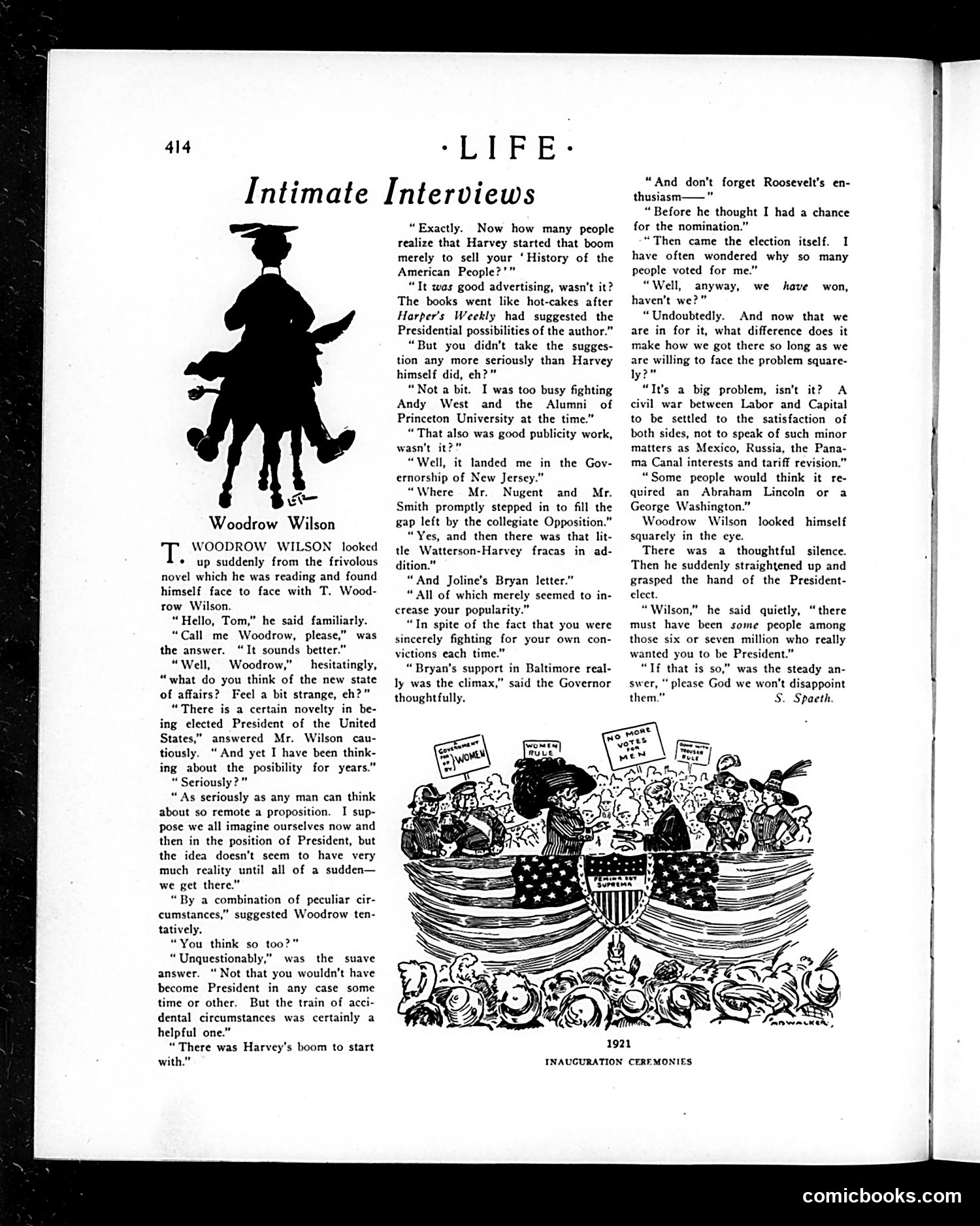
This page features an interview with **Woodrow Wilson** discussing his 1920 presidential election victory. The accompanying cartoon satirizes **American political divisions** during Wilson's presidency. The illustration depicts a ship labeled "1921 Inauguration Ceremonies" being pulled in multiple directions by competing factions—each representing different political interests and constituencies fighting over control. The chaos visualizes the deep splits Wilson faced: the text references ongoing disputes over tariffs, the Panama Canal, Mexico, and Russia, plus labor versus capital tensions. The cartoon's point: despite Wilson's election victory, governing would prove difficult because powerful, opposing groups demanded conflicting policies. The ship metaphor suggests the administration risked being torn apart by these pressures rather than moving forward unified.
📄 Transcribed text from this page (OCR, searchable)
Machine-transcribed from the original scan — historical spelling and the odd misread are preserved.
‘PE - Intimate Interviews we Woodrow Wilson WOODROW WILSON looked * up suddenly from the frivolous novel which he was reading and found himself face to face with T. Wood- row Wilson. “Hello, Tom,” he said familiarly. “Call me Woodrow, pleas the answer. “It sounds better.’ “Well, Woodrow,” _ hesitatingly, “what do you think of the new state of affairs? Feel a bit strange, ch?” “There is a certain novelty in be- ing elected President of the United States,” answered Mr. Wilson cau- tiously. “And yet I have been think- ing about the posibility for years.” “ Seriously?” “As seriously as any man can think about so remote a proposition. I sup- pose we all imagine ourselves now and then in the position of President, but the idea doesn’t seem to have very much reality until all of a sudden— we get there.” “By a combination of peculiar cir- cumstances,” suggested Woodrow ten- tatively. “You think so too?” “Unquestionably,” was the suave answer. “ Not that you wouldn't have become President in any case some time or other. But the train of acci- dental circumstances was certainly a helpful one.” “There was Harvey’s boom to start with.” “Exactly. Now how many people realize that Harvey started that boom merely to sell your ‘History of the American People?’” “It was good advertising, wasn’t it? The books went like hot-cakes after Harper's Weekly had suggested the Presidential possibilities of the author.” “But you didn’t take the sugges- tion any more seriously than Harvey himself did, eh?” “Not a bit. I was too busy fighting Andy West and the Alumni of Princeton University at the time.” “That also was good publicity work, wasn't it?” “Well, it landed me in the Gov- ernorship of New Jersey.” “Where Mr. Nugent and Mr. Smith promptly stepped in to fill the gap left by the collegiate Opposition.” “Yes, and then there was that lit- tle Watterson-Harvey fracas in ad- dition.” “And Joline’s Bryan letter.” “ All of which merely seemed to in- crease your popularity.” “In spite of the fact that you were sincerely fighting for your own con- victions each time.” “Bryan’s support in Baltimore real- ly was the climax,” said the Governor thoughtfully, “And don’t forget Roosevelt's en- thusiasm——” “Before he thought I had a chance for the nomination.” “Then came the election itself. I have often wondered why so many people voted for me.” “Well, anyway, we have won, haven’t we?” “Undoubtedly. And now that we are in for it, what difference does it make how we got there so long as we are willing to face the problem square- ly?" “It's a big problem, isn’t it? A civil war between Labor and Capital to be settled to the satisfaction of both sides, not to speak of such minor matters as Mexico, Russia, the Pana- ma Canal interests and tariff revision.” “Some people would think it re- quired an Abraham Lincoln or a George Washington.” Woodrow Wilson looked himself squarely in the eye. There was a thoughtful silence. Then he suddenly straightened up and grasped the hand of the President- elect. “Wilson,” he said quietly, “there must have been some people among those six or seven million who really wanted you to be President.” “Tf that is so,” was the steady an- swer, “ please God we won't disappoint them.” S. Spaeth. 1921 INAUGURATION CEREMONIES comicbooks.com ee