
Life, 1913-02-27 · page 18 of 40
Life — February 27, 1913 — page 18: what you’re looking at
What you’re looking at
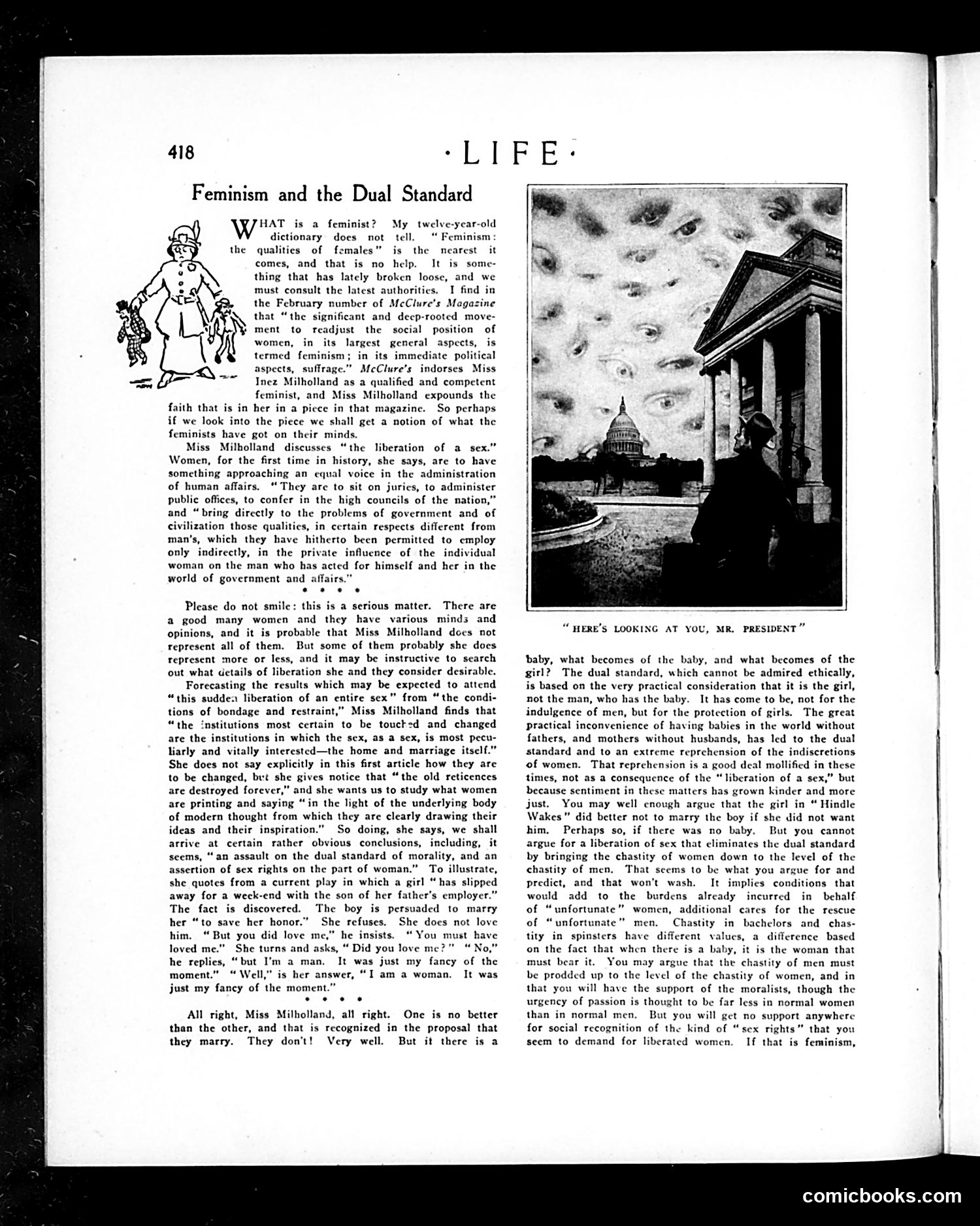
This page critiques early feminism through a debate on sexual morality. The cartoon shows a woman in Victorian dress—likely representing traditional femininity or conventional womanhood—facing the Capitol building, captioned "HERE'S LOOKING AT YOU, MR. PRESIDENT," suggesting women demanding political voice. The text discusses Inez Milholland, a real feminist activist cited in McClure's Magazine, who advocates women's liberation and equality in government, juries, and public affairs. The author sarcastically engages with her arguments, then pivots to attack the feminist critique of the "dual standard"—the sexual hypocrisy where men face no consequences for premarital relations while women do. The article uses a theatrical anecdote: a girl refuses to marry a man she doesn't love after a "week-end" affair, mirroring his casual attitude. The author then poses the practical objection: *what about the baby?* This exposes the tension between moral equality and biological reality—a common anti-feminist argument of the era suggesting women's liberation was impractical and dangerous.
📄 Transcribed text from this page (OCR, searchable)
Machine-transcribed from the original scan — historical spelling and the odd misread are preserved.
Feminism and the Dual Standard HAT is a feminist? My twelve dictionary docs not tell.“ Feminism: the qualities of females” is the nearest it comes, and that is no help. It is some- thing that has lately broken loose, and we ah must consult the latest authorities. I find in the February number of McClure’s Magazine Vi that “the significant and deep-rooted mov year-old | ment to readjust the social position of women, in its largest general aspects, is termed feminism; in its immediate political aspects, suffrage.” McClure’s indorses Miss Inez Milholland as a qualified and competent feminist, and Miss Milholland expounds the faith that is in her in a picce in that magazine. So perhaps if we look into the piece we shall get a notion of what the feminists have got on their minds. Miss Milhbolland discusses “the liberation of a sex.” Women, for the first time in history, she says, are to have something approaching an equal voice in the administration of human affairs. “ They are to sit on juries, to administer public offices, to confer in the high councils of the nation,” and “bring directly to the problems of government and of civilization those qualities, in certain respects different from man’s, which they have hitherto been permitted to employ only indirectly, in the private influence of the individual woman on the man who has acted for himself and her in the world of government and affairs.” oe ee Hy Please do not smile: this is a serious matter. There are a good many women and they have various minds and opinions, and it is probable that Miss Milholland docs not represent all of them. But some of them probably she docs represent more or less, and it may be instructive to search out what details of liberation she and they consider desirable. Forecasting the results which may be expected to attend “this suddea liberation of an entire sex" from “the condi- tions of bondage and restraint,” Miss Milholland finds that “the institutions most certain to be toucted and changed are the institutions in which the sex, as a sex, is most pecu- liarly and vitally interested—the home and marriage itself.” She does not say explicitly in this first article how they are to be changed, brt she gives notice that “the old reticences are destroyed forever,” and she wants us to study what women are printing and saying “in the light of the underlying body of modern thought from which they are clearly drawing their ideas and their inspiration.” So doing, she says, we shall arrive at certain rather obvious conclusions, including, it seems, “an assault on the dual standard of morality, and an assertion of sex rights on the part of woman.” To illustrate, she quotes from a current play in which a girl “has slipped away for a weck-end with the son of her father's employer.” The fact is discovered. The boy is persuaded to marry her “to save her honor.” She refuses. She does not love him. “But you did love me,” he insists. You must have loved me.” She turns and asks, “ Did you love mc?" “ he replies, “but I'm a man. It was just my fancy of the moment.” “ Well,” is her answer, “I am a woman. It was just my fancy of the moment All right, Miss Milholland, all right. One is no better than the other, and that is recognized in the proposal that they marry. They don't! Very well. But it there is a 418 -LIFE: “HERE'S LOOKING AT YOU, MR. PRESIDENT” baby, what becomes of the baby, and what becomes of the girl? The dual standard, which cannot be admired ethically, is based on the very practical consideration that it is the girl, not the man, who has the baby. It has come to be, not for the indulgence of men, but for the protection of girls. The great Practical inconvenience of having babies in the world without fathers, and mothers without husbands, has led to the dual standard and to an extreme reprehension of the indiscretions of women. That reprehension is a good deal mollified in these times, not as a consequence of the “liberation of a sex,” but because sentiment in these matters has grown kinder and more just. You may well enough argue that the girl in “ Hindle Wakes" did better not to marry the boy if she did not want him. Perhaps so, if there was no baby. But you cannot argue for a liberation of sex that eliminates the dual standard by bringing the chastity of women down to the level of the chastity of men, That scems to be what you argue for and predict, and that won't wash. It implies conditions that would add to the burdens already incurred in behalf of “unfortunate” women, additional cares for the rescue of “unfortunate” men. Chastity in bachelors and chas- tity in spinsters have different values, a difference based on the fact that when there is a baby, it is the woman that must bear it. You may argue that the chastity of men must be prodded up to the level of the chastity of women, and in that you will have the support of the moralists, though the urgency of passion is thought to be far less in normal women than in normal men, But you will no support anywhere for social recognition of the kind of ex rights” that you seem to demand for liberated women. If that is feminism, comicbooks.com