
Life, 1913-02-27 · page 16 of 40
Life — February 27, 1913 — page 16: what you’re looking at
What you’re looking at
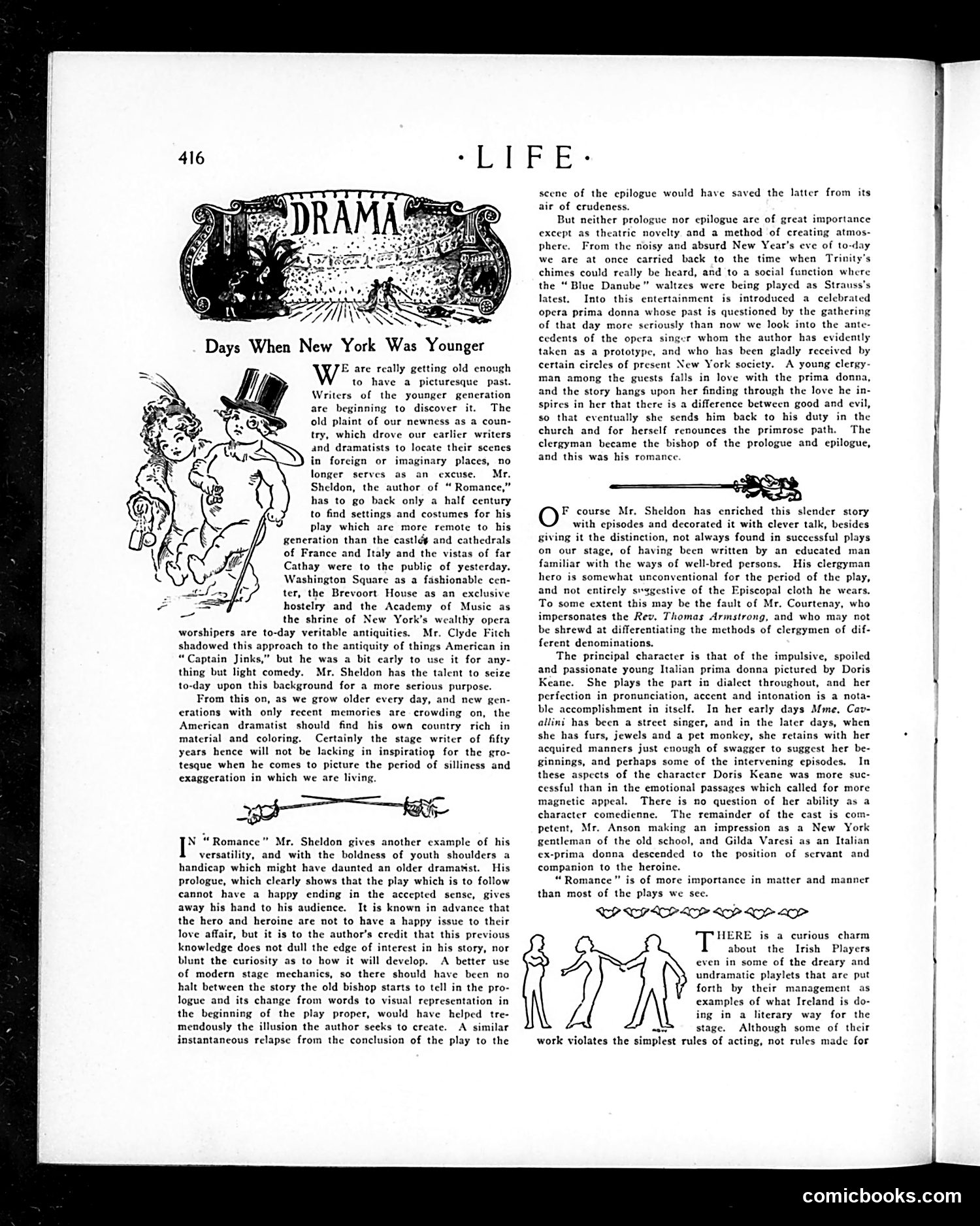
This page reviews Edward Sheldon's play "Romance," celebrating American dramatists discovering their own country's recent past as material. The author notes that writers once felt compelled to set plays in foreign locales due to America's "newness," but now fifty-year-old New York—featuring Washington Square, the Brevoort House, and the Academy of Music—feels sufficiently antiquated. The **cartoon illustration** (top left) shows a dandy in period dress, likely representing the theatrical world or the nostalgic aesthetic being discussed. The critique praises Sheldon's ambition in tackling a serious romance with an unhappy ending, though it faults the prologue/epilogue mechanics as clunky. The plot involves a clergyman falling for an opera prima donna of questionable moral standing—a contemporary figure whose acceptance in "certain circles of present New York society" the author treats with mild irony. The piece reflects Progressive-era concerns: nostalgia for a supposedly more morally rigorous past, anxiety about modern society's "silliness and exaggeration," and changing social standards regarding women's respectability.
📄 Transcribed text from this page (OCR, searchable)
Machine-transcribed from the original scan — historical spelling and the odd misread are preserved.
Days When New York Was Younger W are really getting old enough to have a picturesque past. Writers of the younger generation are beginning to discover it. The old plaint of our newness as a coun- try, which drove our earlier writers and dramatists to locate their scenes in foreign or imaginary places, no longer serves an excuse. Mr. Sheldon, the author of “ Romance,” has to go back only a half century to find settings and costumes for his play which are more remote to his generation than the castld¢ and cathedrals of France and Italy and the vistas of far Cathay were to the publi¢ of yesterday. Washington Square as a fashionable cen- ter, the Brevoort House as an exclusive hostelry and the Academy of Music as the shrine of New York’s wealthy opera worshipers are to-day veritable antiquities. Mr. Clyde Fitch shadowed this approach to the antiquity of things American in “Captain Jinks,” but he was a bit carly to use it for any- thing but light comedy. Mr. Sheldon has the talent to seize to-day upon this background for a more serious purpose. From this on, as we grow older every day, and new gen- erations with only recent memories are crowding on, the American dramatist should find his own country rich in material and coloring. Certainly the stage writer of fifty years hence will not be lacking in inspiratiop for the gro- tesque when he comes to picture the period of silliness and exaggeration in which we are living. > eee 35 [ {{Romance” Me. Sheldon gives another example of his versatility, and with the boldness of youth shoulders a handicap which might have daunted an older dramatist. His prologue, which clearly shows that the play which is to follow cannot have a happy ending in the accepted sense, gives away his hand to his audience. It is known in advance that the hero and heroine are not to have a happy issue to their love affair, but it is to the author’s credit that this previous knowledge does not dull the edge of interest in his story, nor blunt the curiosity as to how it will develop. A better use of modern stage mechanics, so there should have been no halt between the story the old bishop starts to tell in the pro- logue and its change from words to visual representation in the beginning of the play proper, would have helped tre- mendously the illusion the author seeks to create. A similar instantaneous relapse from the conclusion of the play to the “ERE scene of the epilogue would have saved the latter from its air of crudeness. But neither prologue nor epilogue are of great importance except as theatric novelty and a method of creating atmos- phere. From the noisy and absurd New Year's eve of to-day we are at once carried back to the time when Trinity's chimes could really be heard, and to a social function where the “Blue Danube” waltzes were being played as Strauss's latest. Into this entertainment is introduced a celebrated opera prima donna whose past is questioned by the gathering of that day more seriously than now we look into the ante- cedents of the opera singer whom the author has evidently taken as a prototype, and who has been gladly received by certain circles of present New York society. A young clergy- man among the guests falls in love with the prima donna, and the story hangs upon her finding through the love he in- spires in her that there is a difference between good and evil, so that eventually she sends him back to his duty in the church and for herself renounces the primrose path. The clergyman became the bishop of the prologue and epilogue, and this was his romance ——— ee, F course Mr. Sheldon has enriched this slender story with episodes and decorated it with clever talk, besides giving it the distinction, not always found in successful plays on our stage, of having been written by an educated man familiar with the ways of well-bred persons. His clergyman hero is somewhat unconventional for the period of the play, and not entirely suggestive of the Episcopal cloth he wears. To some extent this may be the fault of Mr. Courtenay, who impersonates the Rev. Thomas Armstrong, and who may not be shrewd at differentiating the methods of clergymen of dif- ferent denominations. The principal character is that of the impulsive, spoiled and passionate young Italian prima donna pictured by Doris Keane. She plays the part in dialect throughout, and her perfection in pronunciation, accent and intonation is a nota- ble accomplishment in itself. In her early days Mme, Cav- allini has been a street singer, and in the later days, when she has furs, jewels and a pet monkey, she retains with her acquired manners just cnough of swagger to suggest her be- ginnings, and perhaps some of the intervening episodes, In these aspects of the character Doris Keane was more suc- cessful than in the emotional passages which called for more magnetic appeal. There is no question of her ability as a character comedienne, The remainder of the cast is com- petent, Mr. Anson making an impression as a New York gentleman of the old school, and Gilda Varesi as an Italian ex-prima donna descended to the position of servant and companion to the heroine. “Romance” is of more importance in matter and manner than most of the plays we see. LPI LOP LEE SOP OP EOP HERE is a curious charm about the Irish Players even in some of the dreary and undramatic playlets that are put forth by their management as examples of what Ireland is do- ing in a literary way for the aA stage. Although some of their work violates the simplest rules of acting, not rules made for comicbooks.com