
Life, 1913-02-27 · page 17 of 40
Life — February 27, 1913 — page 17: what you’re looking at
What you’re looking at
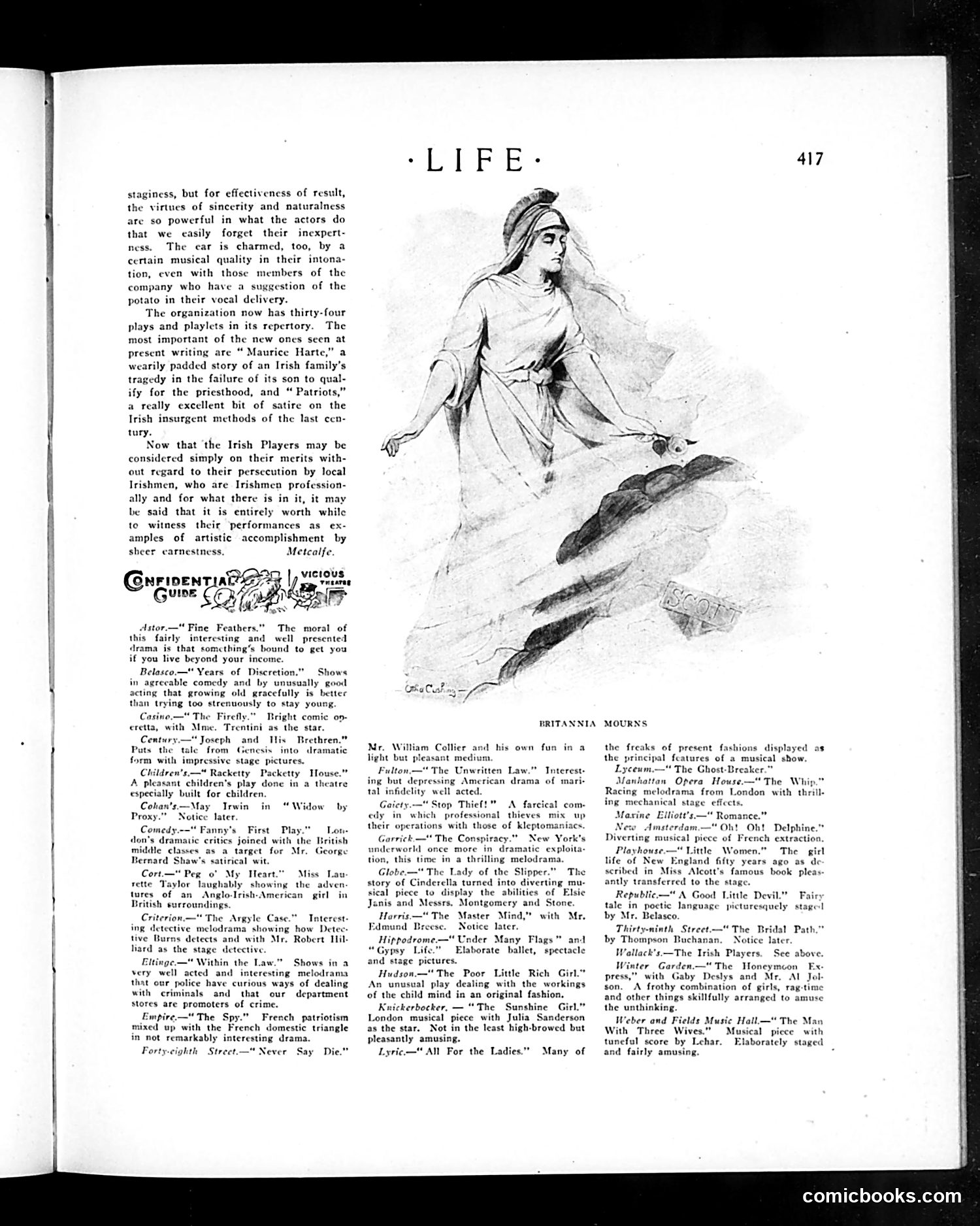
This page reviews contemporary Broadway productions (circa 1912). The illustrated figure appears to be "Britannia Mourns"—a classical allegorical representation of Britain, depicted in a melancholic pose overlooking what's likely a battlefield or troubled landscape. The context suggests this illustration accompanies commentary on Irish theatrical performers ("The Irish Players"), whose productions included politically charged plays like "Patriots" about Irish insurgency. The "Britannia Mourns" image likely satirizes British imperial concerns about Irish nationalist sentiment gaining artistic and cultural expression through theater. The text discusses how the Irish Players' performances merit serious artistic consideration despite local Irish-American opposition to them. The surrounding theater reviews showcase typical Broadway fare of the era—melodramas, comedies, and musicals—establishing the magazine's role as cultural arbiter for educated American audiences interested in both entertainment and social commentary.
📄 Transcribed text from this page (OCR, searchable)
Machine-transcribed from the original scan — historical spelling and the odd misread are preserved.
— — — SS staginess, but for effectiveness of result, the virtues of sincerity and naturalness are so powerful in what the actors do that we easily forget their inexpert- ness. The car is charmed, too, by a certain musical quality in their intona- tion, even with those members of the company who have a suggestion of the potato in their vocal delivery. The organization now has thirty-four plays and playlets in its repertory. The most important of the new ones seen at present writing are “ Maurice Harte,” a wearily padded story of an Irish family’s tragedy in the failure of its son to qual- ify for the priesthood, and “ Patriots,” a really excellent bit of satire on the Irish insurgent methods of the last ccn- tury. Now that ‘the Irish Players may be considered simply on their merits with- out regard to their persecution by local Irishmen, who are Irishmen profession- ally and for what there is in it, it may be said that it is entirely worth while to witness their performances as ex- amples of artistic accomplishment by sheer earnestness, Metealj AEOENE Bi; Guiwe Hore Astor.—" Fine Feathers.” The moral of this fairly interesting and well presented drama is that somcthing’s bound to get you if you live beyond your income. Belasco.—" Years of Discretion.” Shows in agreeable comedy and by unusually good acting that growing old gracefully is better than trying too strenuously to stay young. Casine.— The Firefly.” Bright comic on- eretta, with Mme. Trentini as the star. Century.—" Joseph and His Brethren. fats the tale from Genesis ints’ dramatie form with impressive stage pictures. Children's.—*“ Racketty Packetty House.” A pleasant children’s play done in a theatre especially built for children. Cohan’s.—May Irwin in “Widow by Proxy.” Notice later. nny’s First Pla Lon. tic critics joined with the British middle classes as a target for Mr. George Rernard Shaw's satirical wit Cort.—" Peg o” My Heart.” Miss Law rette Taylor laughably showing the adven tures of an Anglo-Irish-American girl in British surroundings, Criterion. —"" The Argyle Case.” Interest: detective melodrama showing how Detec- tive Burns detects and with Mr, Robert Hil- liard as the stage detective Eltinge.—" Within the Law.” Shows in a very well acted and interesting melodrama that our police have curious ways of dealing with criminals and that our department stores are promoters of crime. Empire.—" The Spy.” French patriotism mixed up with the French domestic triangle in not remarkably interesting drama. Forty-eighth Street. Never Say Die." BRITANNIA MOURNS Nr. William Collier and his own fun in a light but pleasant medium. Fulton. —" The Unwritten Law.” Interest: can drama of mari ing but depressing Amer: tal infidelity well acted. Gaicty.—" Stop Thief!” A farcical com- edy in which professional thieves mix up their operations with those of kleptomar Garrick —" The Conspiracy.” New Y underworld once more in dramatic exploita- tion, this time in a thrilling melodrama. Globe.—" The Lady of the Slipper.” The story of Cinderella turned into diverting mu- sical piece to display the abilities of E! Janis and Messrs. Montgomery and Stone. Horris—"The Master Mind,” with Mr. Fdmund Breese. Notice later. Hippodrome.—" Under Many Flags” and “Gypsy Life.” Elaborate ballet, spectacle and stage pictures. Hudson.—"The Poor Little Rich Girl.” An unusual play dealing with the workings of the child mind in an original fashion. Knickerbocker, — “The Sunshine Girl.” London musical piece with Julia Sanderson as the star. Not in the least high-browed but pleasantly amusing. Lyric.—" AN For the Ladies.” Many of the freaks of present fashions displayed the principal features of a musical show Lyceum.—" The Ghost-Breaker Manhattan Opera House.—" The Whiy Racing melodrama from London with th ing mechanical stage e Maxine Elliott’s.—" Rom: New Amsterdam —" Oh! Ob! Delphine.” Diverting musical piece of French extraction. Playhouse.—" Little Women.” The gir life of New England fifty years ago as de scribed in Miss Alcott’s famous book pleas antly transferred to the stage. Republic-—" A Good Little Devil.” tale in poetic language picturesquely stage! by Mr, Belasco. Thirty-ninth Street-—" The Bridal Path.” by Thompson Buchanan. Notice later IIe Wallack’s.—The Irish Players. See above. Winter Garden.—" The Honeymoon Ex: press,” with Gaby Deslys and Mr. Al Jol- son. A frothy combination of girls, rag-t and other things skillfully arranged to the unthinking. Weber and Fields Music Hall.— The Man With Three Wives.” Musical piece with tuneful score by Lehar. Elaborately staged and fairly amusing. comicbooks.com