
A complete issue · 40 pages · 1913
Life — January 23, 1913
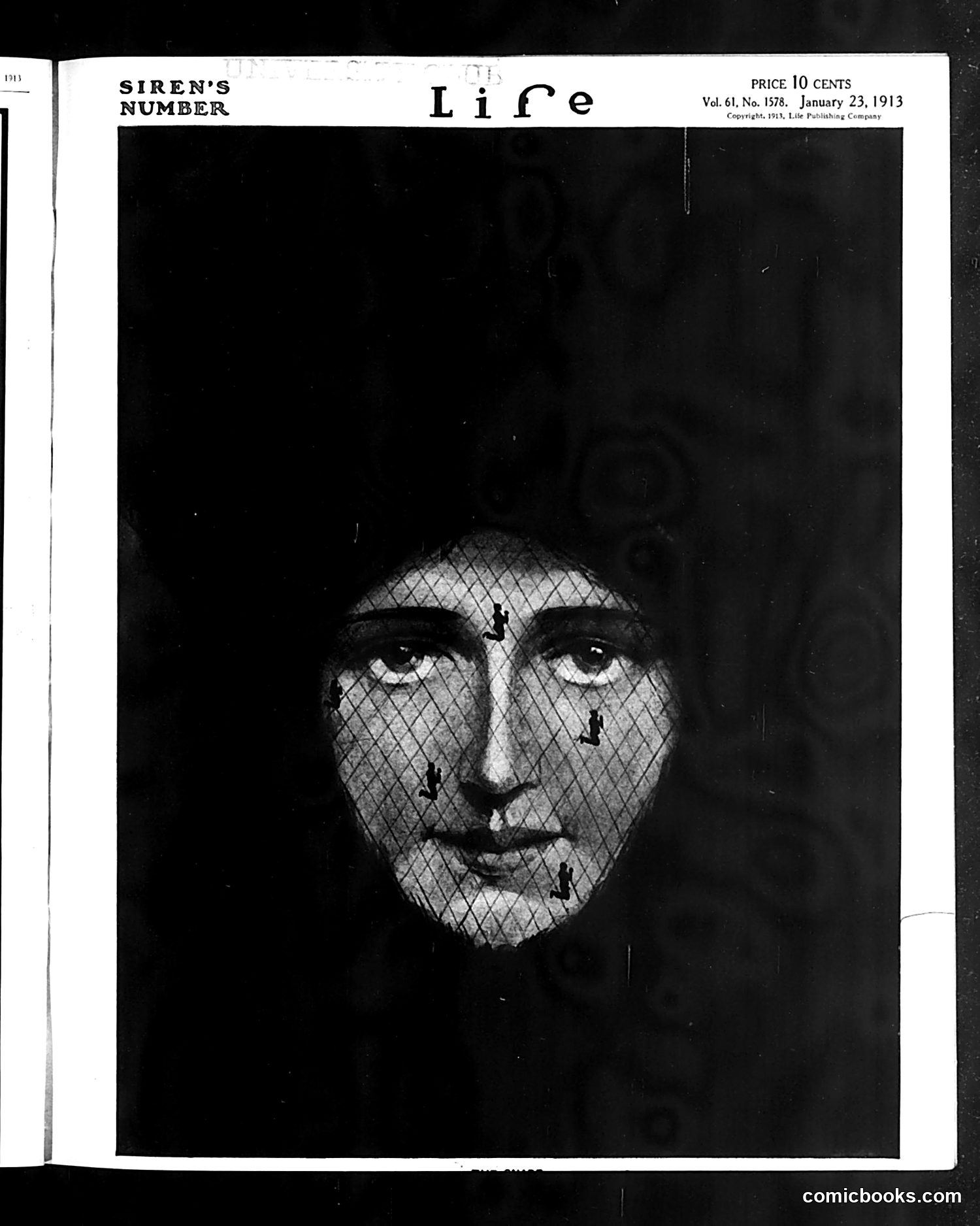
This is the cover of *Life* magazine from January 23, 1913, labeled "Siren's Number." The image shows a woman's face partially obscured by decorative netting or mesh, with dramatic lighting against a dark background. Her expression appears alluring or mysterious. The "siren" reference suggests this issue focused on the seductive or dangerous appeal of women—a common satirical theme in early 20th-century American humor magazines. The netting may symbolize concealment or the "veiled" nature of feminine mystique. Without additional visible text identifying specific figures or events, the cover appears to be a generic commentary on feminine allure rather than commentary on a particular public figure or political event. The issue likely contained articles and cartoons exploring social attitudes toward women and romance.
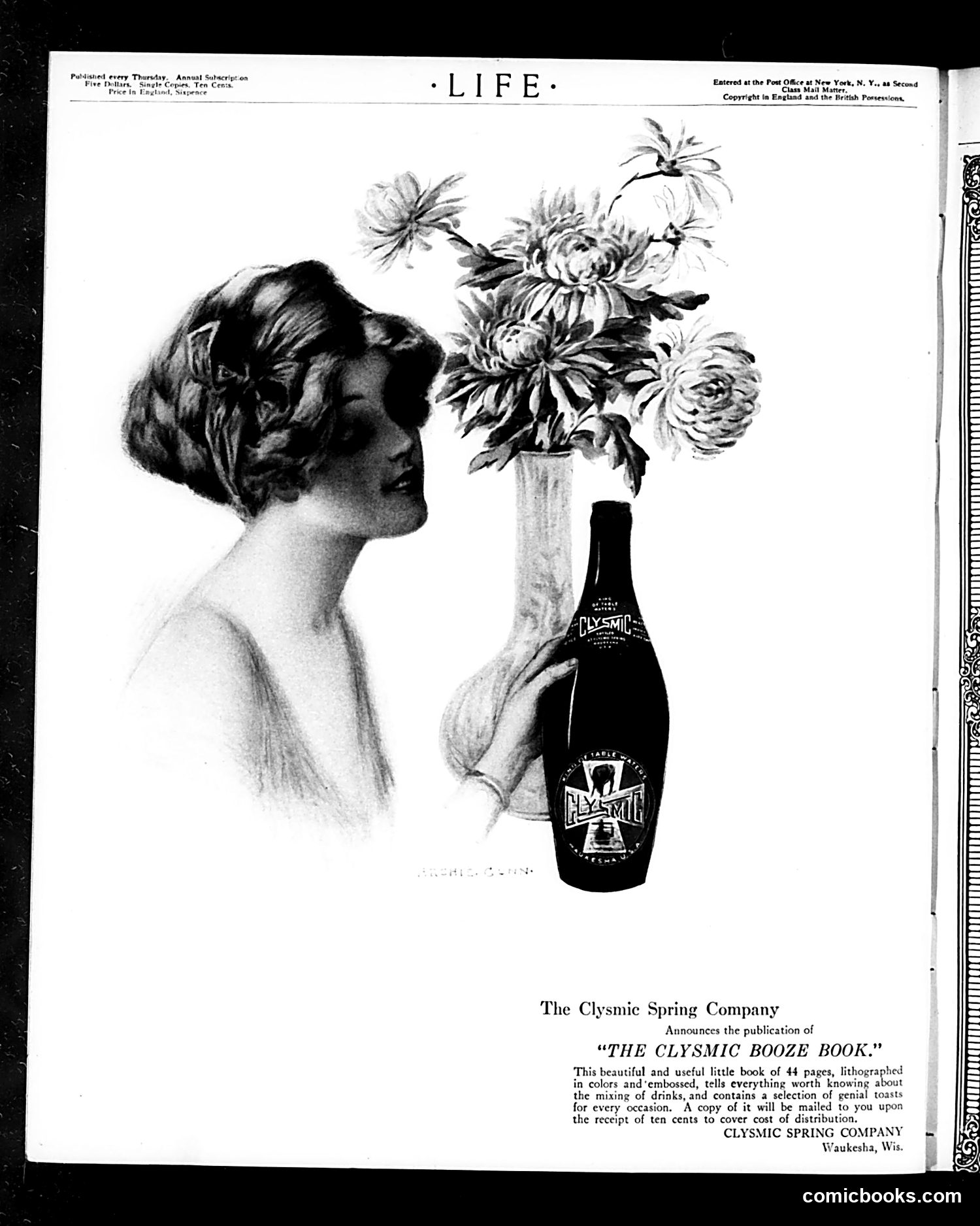
This page is primarily an advertisement for Clysmic Spring Company's "Clysmic Booze Book," a 44-page guide to mixing alcoholic drinks. The advertisement features an elegant illustration of a woman in profile admiring flowers in a bottle of Clysmic liquor. The imagery juxtaposes refined, aesthetic beauty—the woman's classical profile and delicate flowers—with alcohol consumption, suggesting that drinking Clysmic products is sophisticated and tasteful rather than crude or vulgar. The "Booze Book" promises "genial toasts for every occasion," marketing drinking as cultured entertainment. This reflects early 20th-century advertising strategies that associated commercial products with elegance and social respectability. The page appears to be primarily commercial content rather than satire or political commentary.
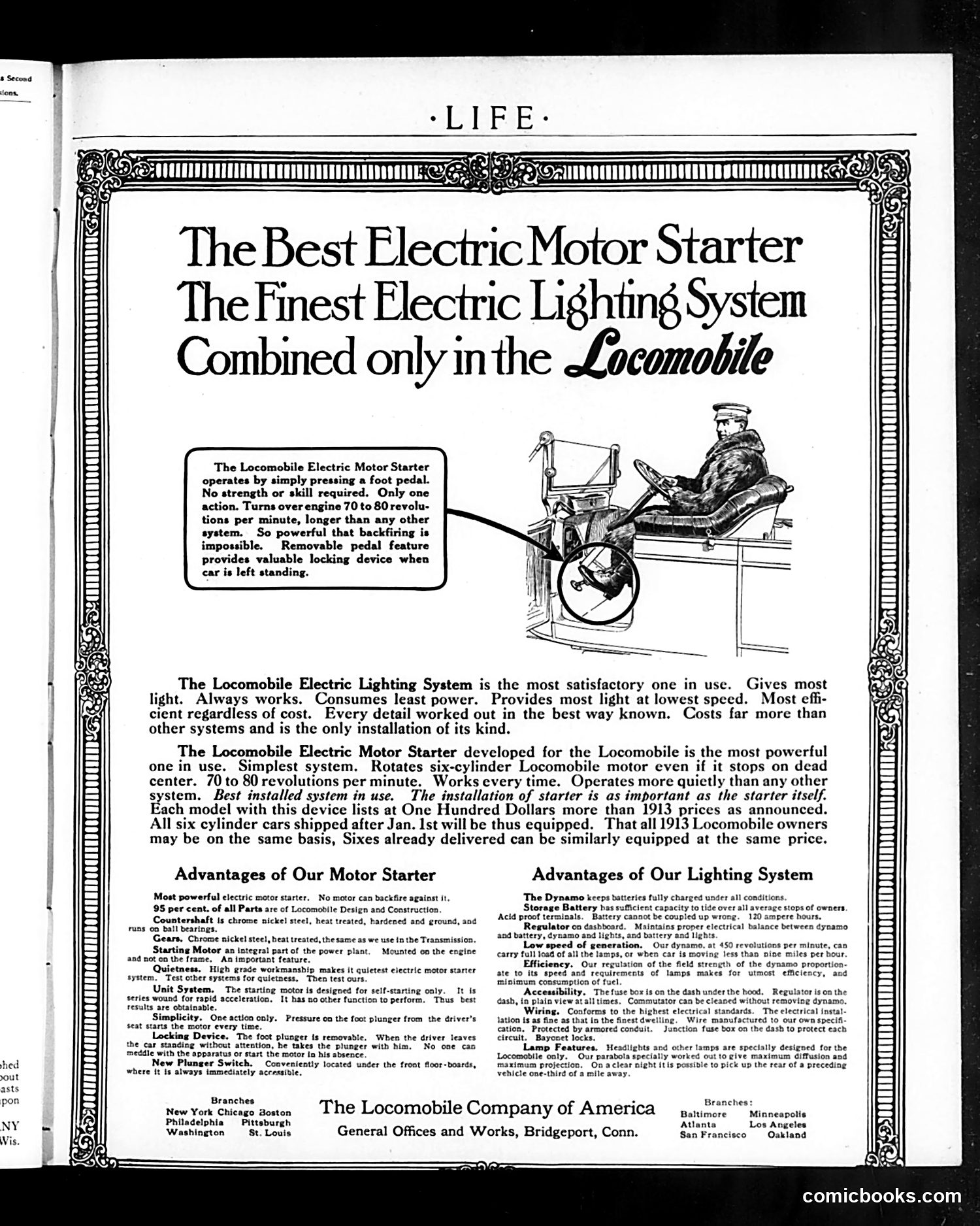
This is **not a cartoon or satirical content** — it's a full-page advertisement for the Locomotile Company of America, promoting their electric motor starter and lighting system for automobiles. The image shows a technical illustration of an early automobile with a driver operating the electric starter via foot pedal. The ad emphasizes the innovation's practical advantages: easy operation (no hand-cranking required), reliability, and efficiency. This reflects the historical moment when electric starters were revolutionary technology, eliminating the dangerous manual hand-crank starting method. The ad appeared in *Life* magazine as paid promotional content, not editorial satire. It's valuable primarily as evidence of early automotive innovation marketing and the transition from mechanical to electric automobile systems.
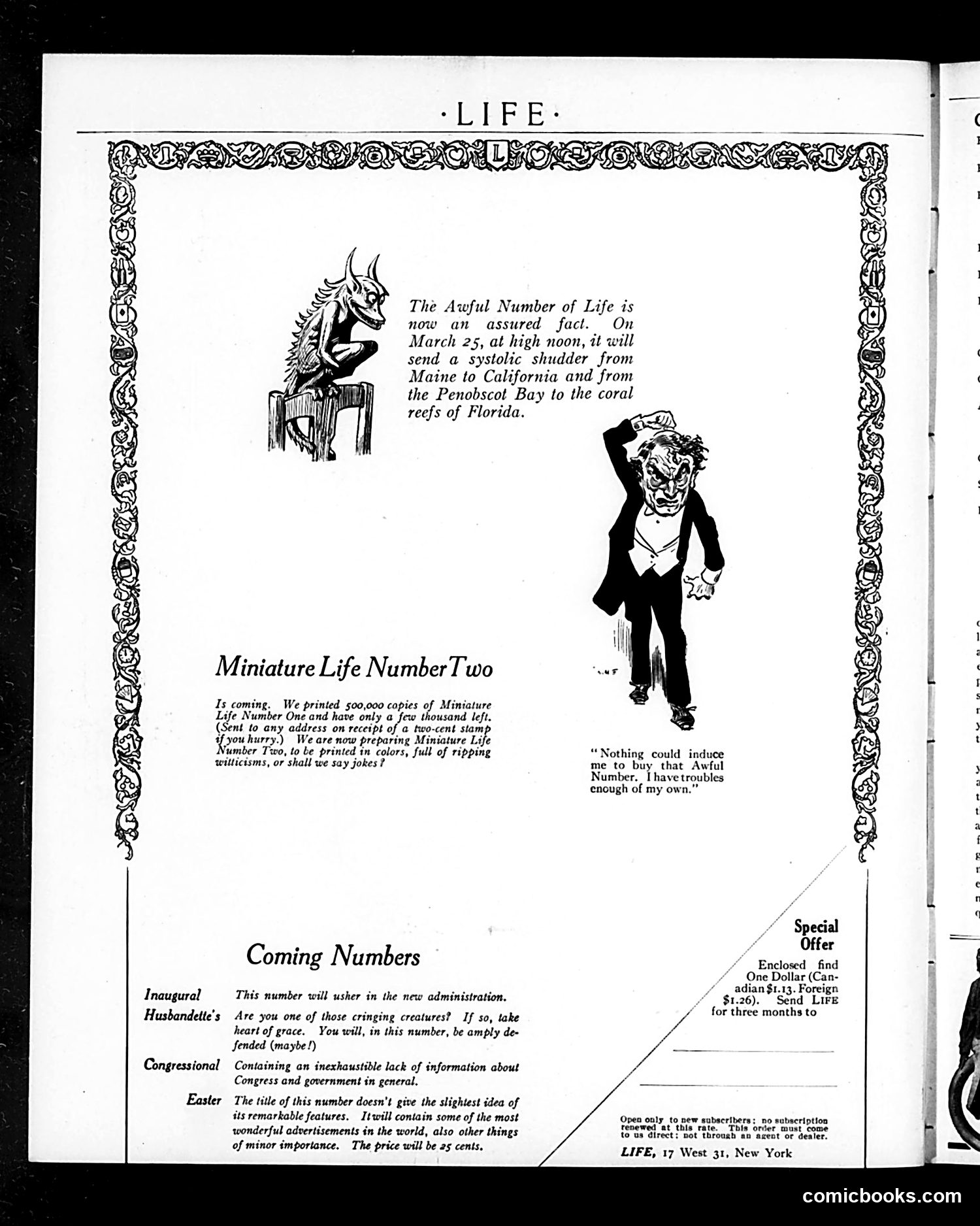
This page announces "Miniature Life Number Two," a special issue of *Life* magazine. The satirical content features two caricatured figures: 1. **The horned demon** (upper left) represents "The Awful Number of Life"—a joking reference to numerology or superstition about unlucky numbers. The demon will travel "from Maine to California" on March 25 at noon. 2. **The distressed man** (right) appears panicked about buying this "Awful Number," saying he has "troubles enough of my own"—humor derived from the fear of bad luck. The page promotes upcoming "Coming Numbers": an "Inaugural Husbandlet's" issue (likely about newlyweds), a "Congressional" number about government, and an "Easter" issue. The satire mocks readers' superstitions while promoting the magazine's special editions at 25 cents each.
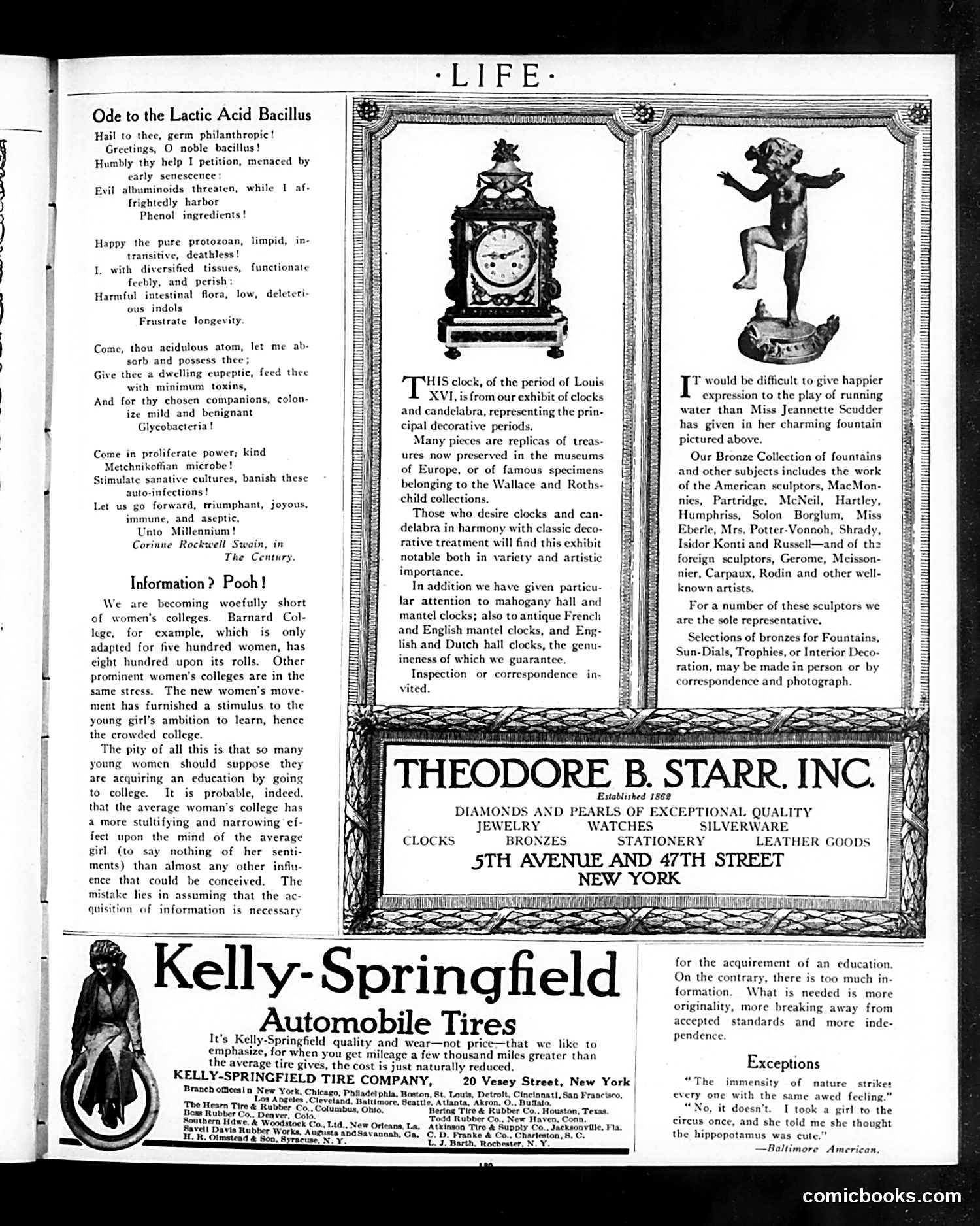
This page is primarily **advertising and editorial content** rather than political satire. The left side contains an "Ode to the Lactic Acid Bacillus"—a humorous poem praising beneficial bacteria, reflecting early-20th-century enthusiasm for microbiology and health science. Below that, an article titled "Information? Pooch!" discusses women's colleges, arguing that education shouldn't assume women are inherently ignorant, and that acquiring information is necessary. The right page features **Theodore B. Starr Inc.** advertisements showcasing luxury goods (clocks, bronzes, jewelry) and Kelly-Springfield automobile tires. The decorative images show an ornate Louis XVI clock and a classical bronze fountain sculpture. The page reflects period attitudes about education, consumerism, and scientific progress rather than political commentary.

This page is **not a political cartoon or satire—it's a straightforward advertisement** for the newly completed Grand Central Terminal in New York City, which opened in February 1913. The architectural rendering shows the terminal building and surrounding cityscape. The text promotes the terminal as a major civic achievement, highlighting its scale (722 feet long, 801 feet wide), capacity (30,000 people simultaneously), and integrated features (hotels, shops, restaurants, exhibition halls). The advertisement emphasizes practical benefits: separate levels for through and suburban service to avoid congestion, 33 miles of track accommodating 1,000 cars, and efficient traffic flow design. This represents early 20th-century boosterism celebrating modern infrastructure as civic progress.
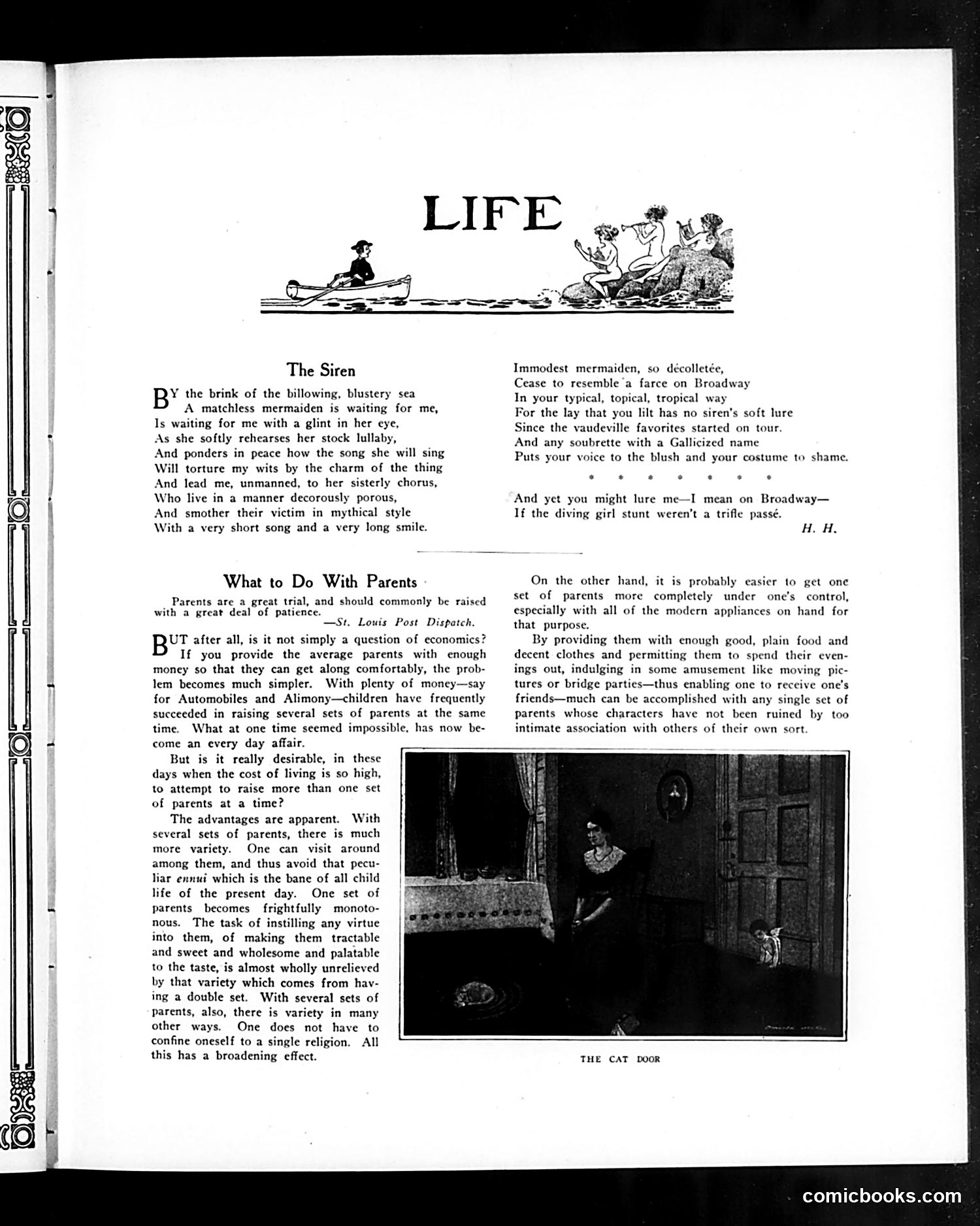
This page contains two satirical pieces: **"The Siren"** (top): A poem mocking theatrical "mermaid" performers—likely vaudeville acts popular in early 20th-century entertainment. The satire targets the absurdity of these shows, describing a mediocre performer whose "tropical, topical" appeal masks lack of genuine talent. The author (H.H.) jokes that even a diving stunt wouldn't make her performance worthwhile. This reflects Life's consistent mockery of lowbrow entertainment. **"What to Do With Parents"** (bottom): Humorous advice suggesting parents should be "raised" collectively rather than individually—a reversal of typical parent-child relationships. The piece satirizes the challenge and expense of supporting parents, ironically proposing that multiple sets provide "variety" and prevent monotony. The accompanying photograph, "The Cat Door," appears to illustrate domestic life.
This page discusses the disposition of vast fortunes accumulated by wealthy industrialists like Andrew Carnegie and John D. Rockefeller. The article argues that despite their philanthropic gifts to libraries, research foundations, and peace initiatives, these contributions represent only a fraction of their wealth—"quite a drop" from eighteen million dollars down to $600,000. The cartoon illustrations (though small) appear to accompany commentary on how the ultra-wealthy distribute their fortunes. The satirical point is that even massive charitable donations are relatively insignificant given the scale of these men's accumulated wealth, questioning whether such giving truly represents meaningful social responsibility or merely token gestures from fortunes largely retained.
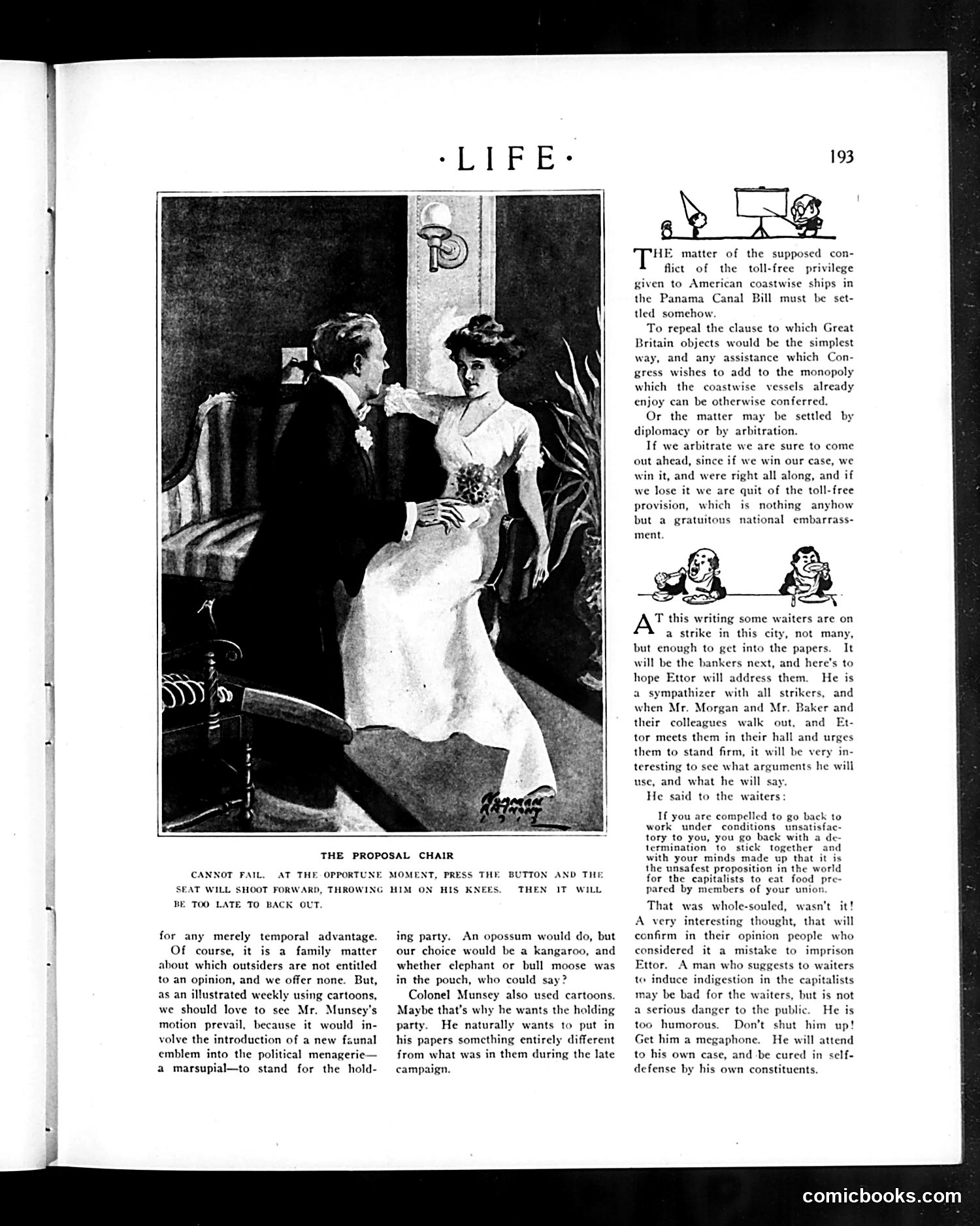
This cartoon depicts a man proposing to a woman in an elegant interior. The caption beneath reads: "CANNOT FAIL. AT THE OPPORTUNE MOMENT, PRESS THE BUTTON AND THE SEAT WILL SHOOT FORWARD, THROWING HIM ON HIS KNEES. THEN IT WILL BE TOO LATE TO BACK OUT." The satire mocks the anxiety surrounding marriage proposals—suggesting a mechanical device could force a man into marriage against his hesitation. It plays on contemporary gender dynamics and male reluctance about commitment. The article text discusses labor disputes and workers' rights, suggesting this humorous piece about marriage proposals appears alongside serious political commentary, typical of Life's satirical approach to American social and political issues of the era.
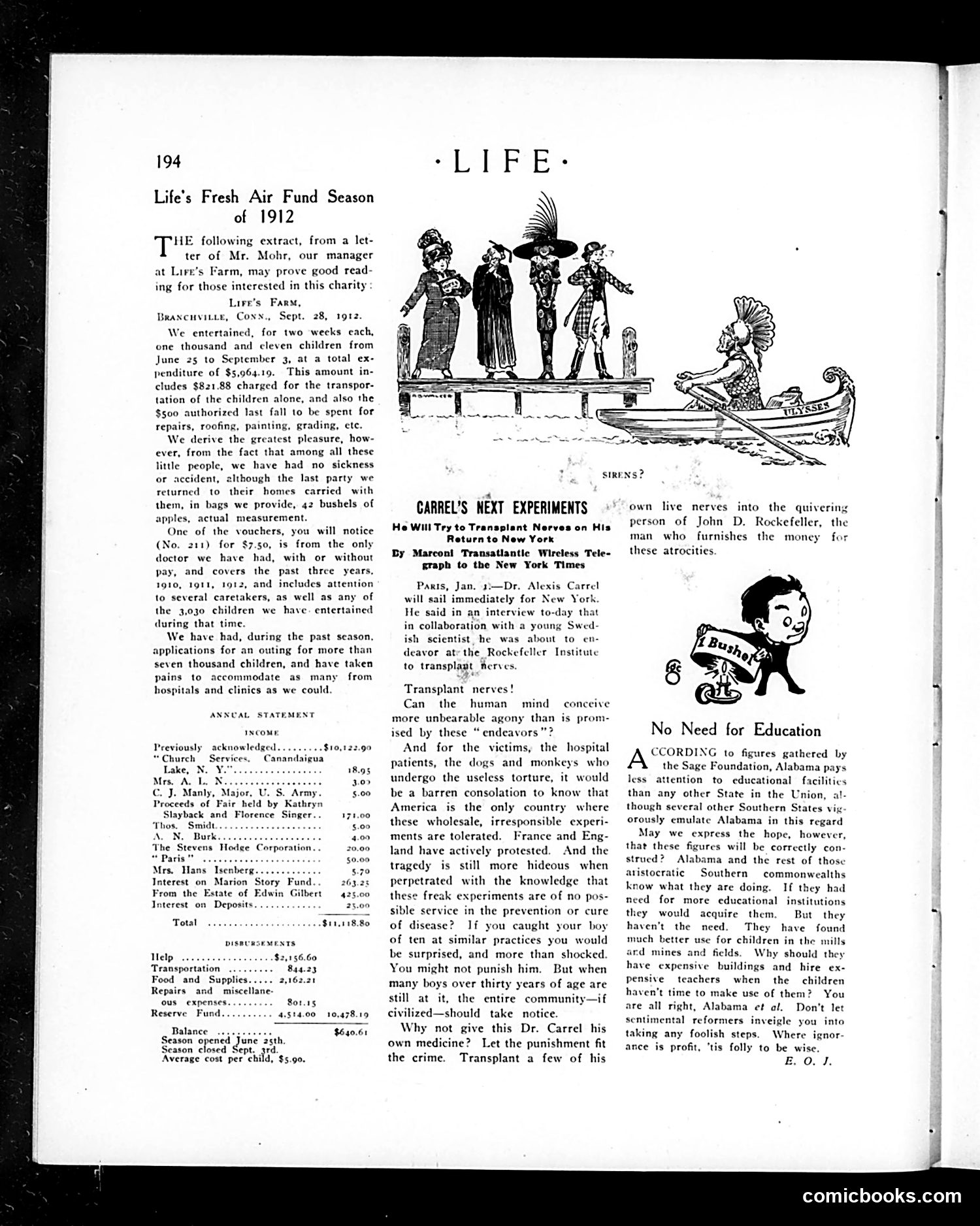
The page contains two distinct elements: **Left side:** An article about Life's Fresh Air Fund charity for 1912, detailing how they funded outings for poor children from New York City. **Right side:** Two separate pieces— 1. "Garrel's Next Experiments," a satirical article criticizing Dr. Alexis Carrel's nerve transplant experiments on animals. The text argues these procedures are cruel and serve no medical purpose, calling them "wholesale, irresponsible experiments" that other civilized countries have protested. The accompanying illustration shows a caricatured figure labeled "Bother!" expressing frustration. 2. "No Need for Education," an article criticizing Alabama's low education spending compared to other states, arguing they shouldn't neglect educational institutions. The page reflects Progressive Era concerns about animal welfare and public education standards.
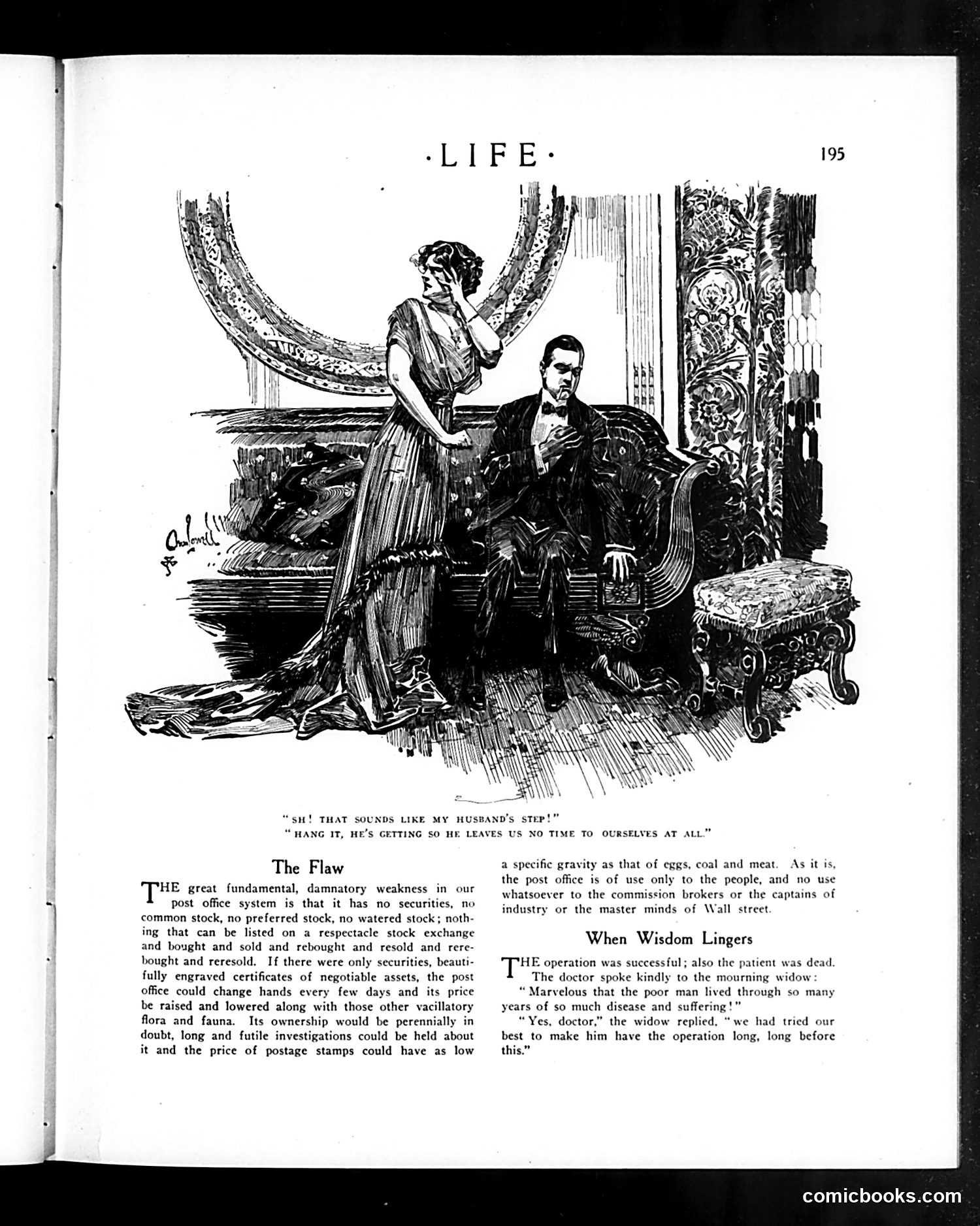
This page contains a satirical illustration and two opinion pieces critiquing the U.S. postal system. **The Cartoon:** Shows a woman and man in an elegant interior. The woman exclaims "She! That sounds like my husband's step!" while the man responds "Hang it, he's getting so he leaves us at all." The humor targets marital infidelity—the man appears to be a lover whose visits are becoming less frequent because the husband is increasingly absent from home. **"The Flaw":** Criticizes the post office's lack of securities or stock listings, arguing this prevents it from being traded on exchanges like other institutions. The author contends the post office's value and pricing power remain perpetually uncertain. **"When Wisdom Lingers":** A brief anecdote about a successful but lengthy surgical operation on a poor patient, commenting on medical outcomes and class differences. The page reflects early-20th-century American concerns about institutional reform and social commentary.
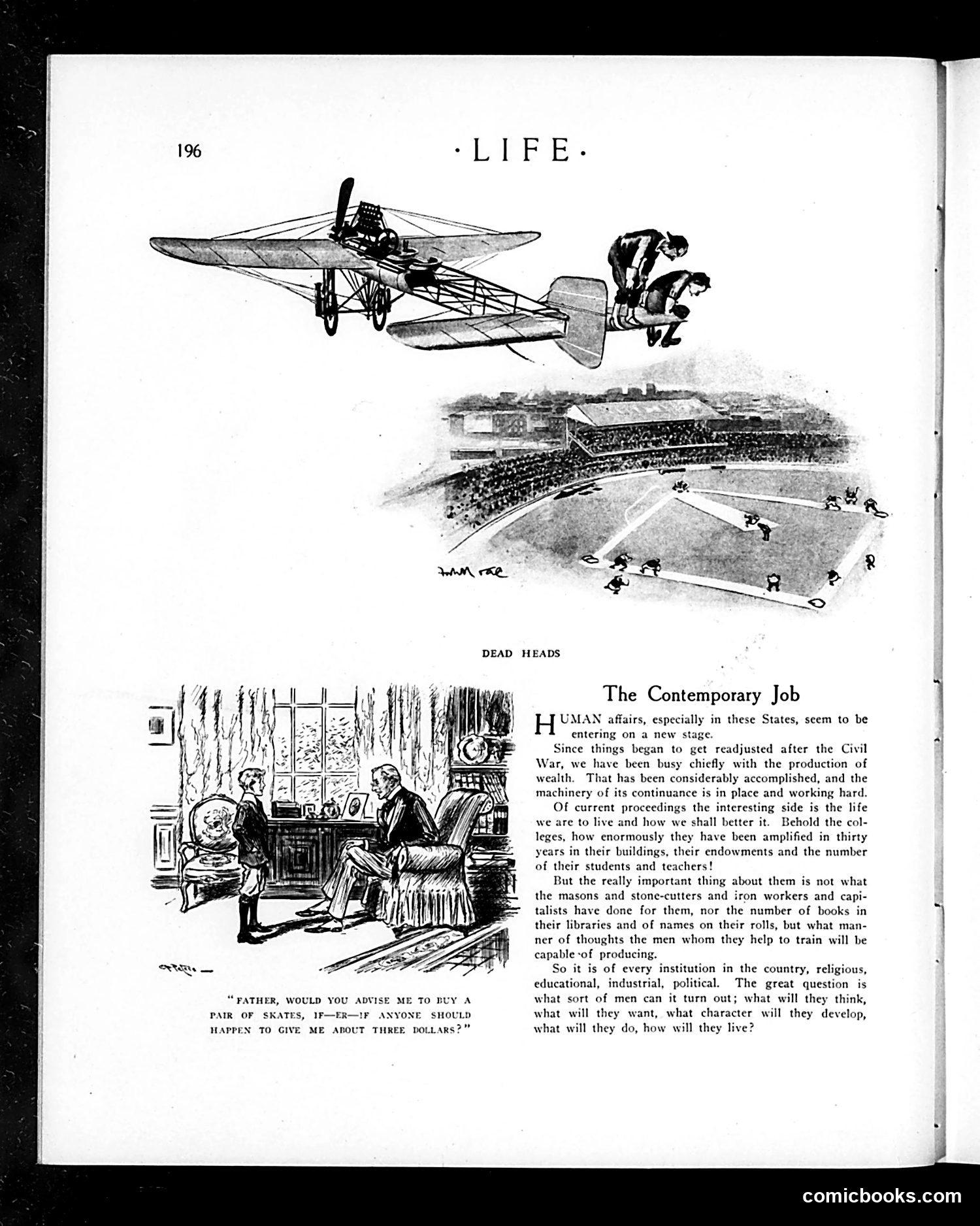
This page contains two satirical pieces about American institutions and social expectations. The top cartoon shows an airplane flying over a baseball stadium—likely satirizing the era's fascination with aviation as a novelty spectacle, contrasting modern technology with traditional entertainment. The lower cartoon and caption depict a father-son conversation about buying ice skates for three dollars. The accompanying article, "The Contemporary Job," discusses how American institutions (religious, educational, industrial, political) shape young men's character and ambitions. The satire appears to question what values these institutions instill—implying fathers worry about teaching sons practical skills and responsible spending rather than deeper character formation. The caption suggests gentle mockery of parental concerns about small expenses in a rapidly modernizing economy.
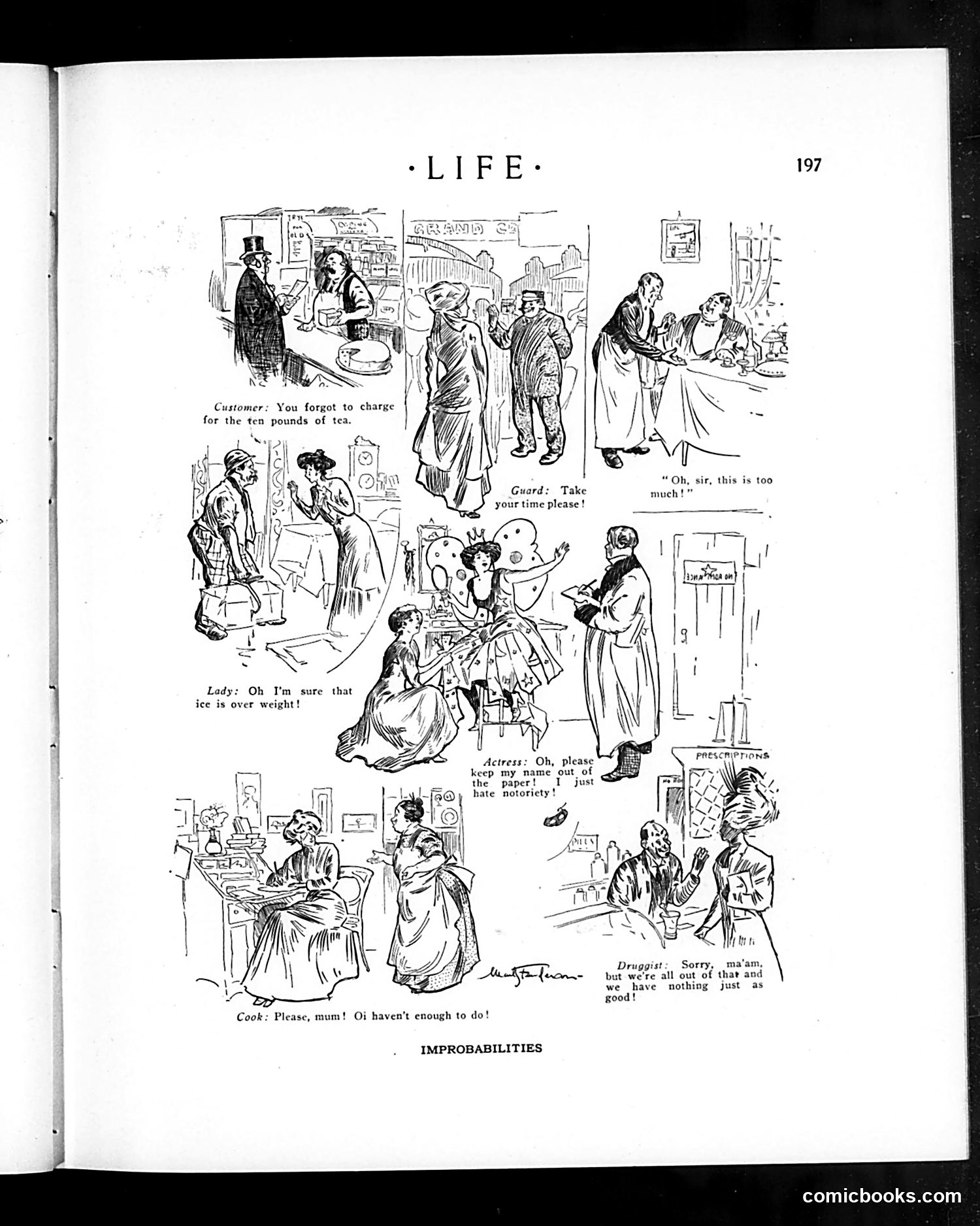
This satirical comic strip depicts everyday domestic and commercial scenarios with absurd complaints or requests that highlight social frustrations of the era. The scenes mock various service workers and their interactions with demanding customers: - A shopkeeper accused of forgetting to charge for tea - A guard instructed to "take your time" - A lady worried ice is "overweight" - An actress complaining about her name on papers - A cook claiming insufficient work - A druggist apologizing for empty stock The title "Improbabilities" suggests these scenarios represent unlikely or ridiculous situations—either customers making unreasonable demands or service providers making improbable excuses. The humor relies on class tensions and the absurdity of everyday commercial interactions, typical of early-to-mid 20th century satirical commentary on consumer culture and social hierarchies.
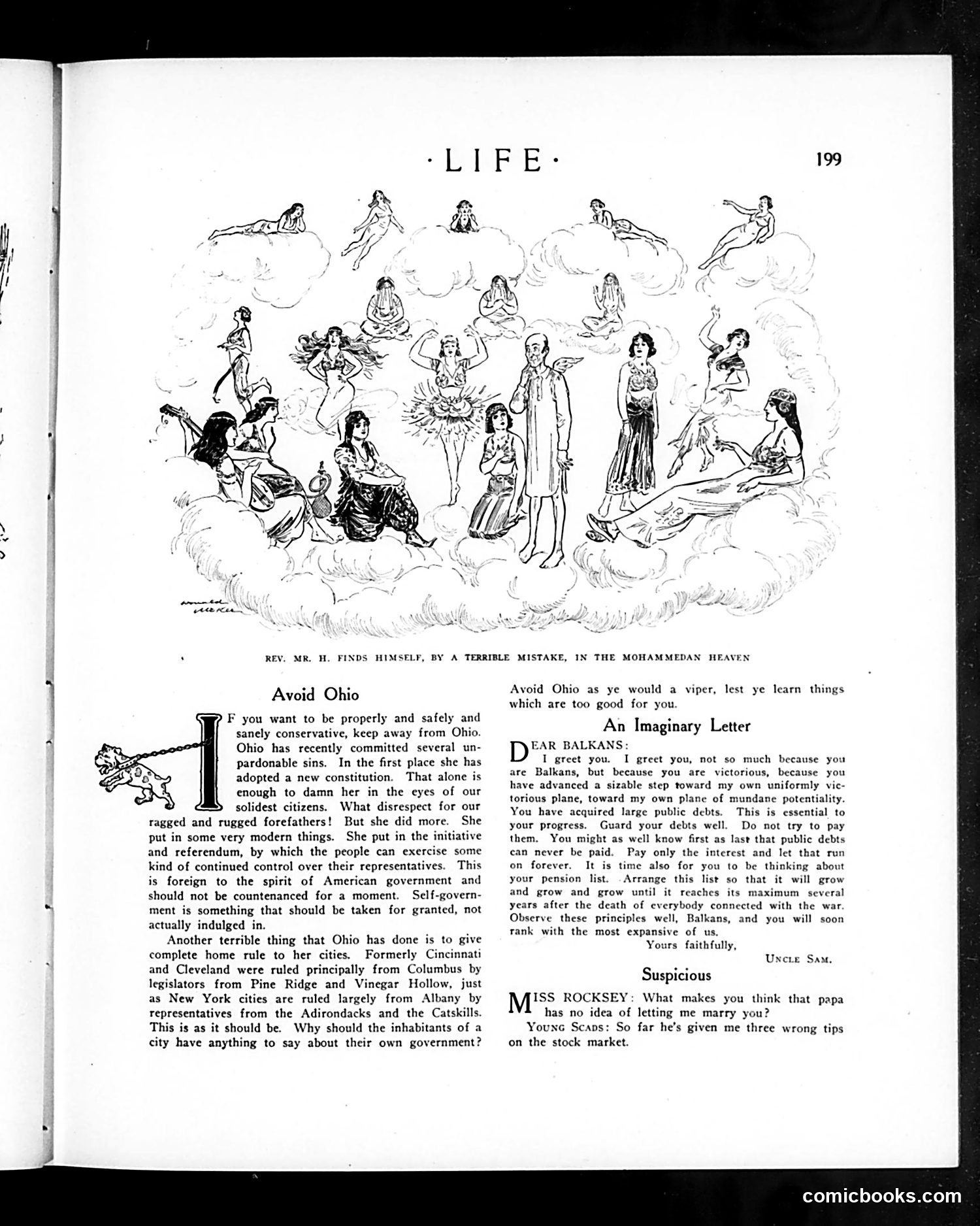
This Life magazine page satirizes progressive political reform and American imperialism circa 1912. **"Avoid Ohio"** mocks conservative resistance to Ohio's new constitution, which introduced the **initiative and referendum**—direct democratic tools allowing citizens to bypass legislators. The satire's absurdity (criticizing self-government as "foreign to American spirit") exposes how entrenched powers resisted populist reforms that threatened their control. **"Rev. Mr. H. Finds Himself"** (top cartoon) appears to depict a clergyman in heaven—likely mockery of a public figure's hypocrisy. **"An Imaginary Letter"** sarcastically addresses the Balkans as "Uncle Sam," with the U.S. government cynically "advising" them to accumulate public debt and pension obligations—critiquing American imperial meddling in foreign affairs while promoting corrupt financial practices. **"Suspicious"** is a brief romantic joke: a young man suspects his girlfriend's father disapproves because the father gave him bad stock tips—implying deliberate sabotage rather than honest advice. The page collectively satirizes political corruption, resistance to democracy, and American overseas influence.
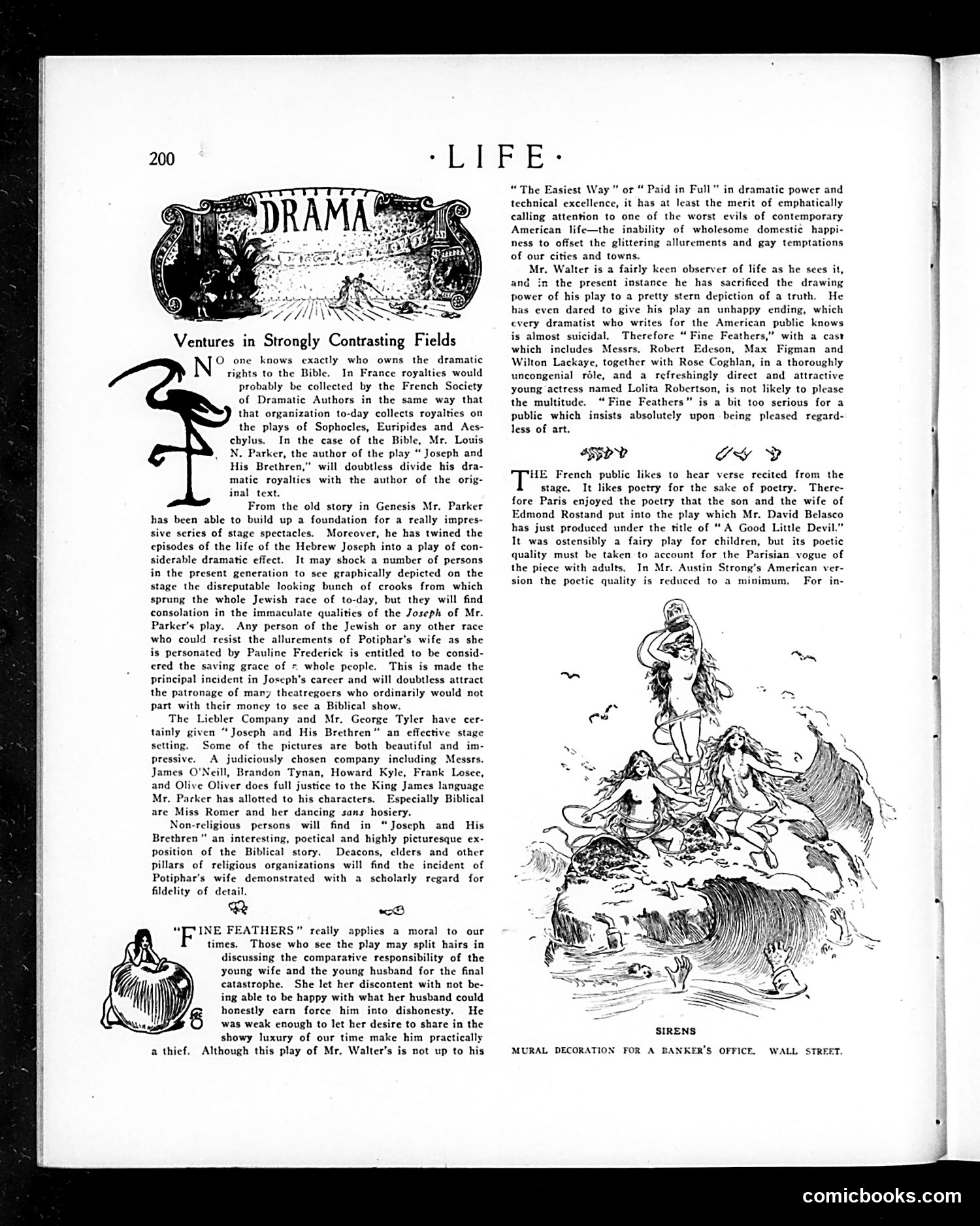
This page reviews two Broadway plays with contrasting subject matter. "Joseph and His Brethren," adapted by Louis N. Parker from the Biblical Genesis story, is praised as an impressive spectacle featuring actress Pauline Frederick as Potiphar's wife—a role the critic notes will attract audiences beyond typical religious drama patrons. The review suggests the play's appeal partly rests on Frederick's allure rather than purely artistic merit. "Fine Feathers" is critiqued as a morality play about urban temptation. The critic argues it effectively illustrates how modern consumerism and "showy luxury" corrupt domestic happiness, forcing a husband into crime to satisfy his wife's desires. The reviewer notes the playwright's courage in providing an unhappy ending—unusual for American commercial theater—though the play lacks the dramatic power of earlier works like "The Easiest Way." Both reviews reflect Progressive Era anxieties about wealth, morality, and social decay.
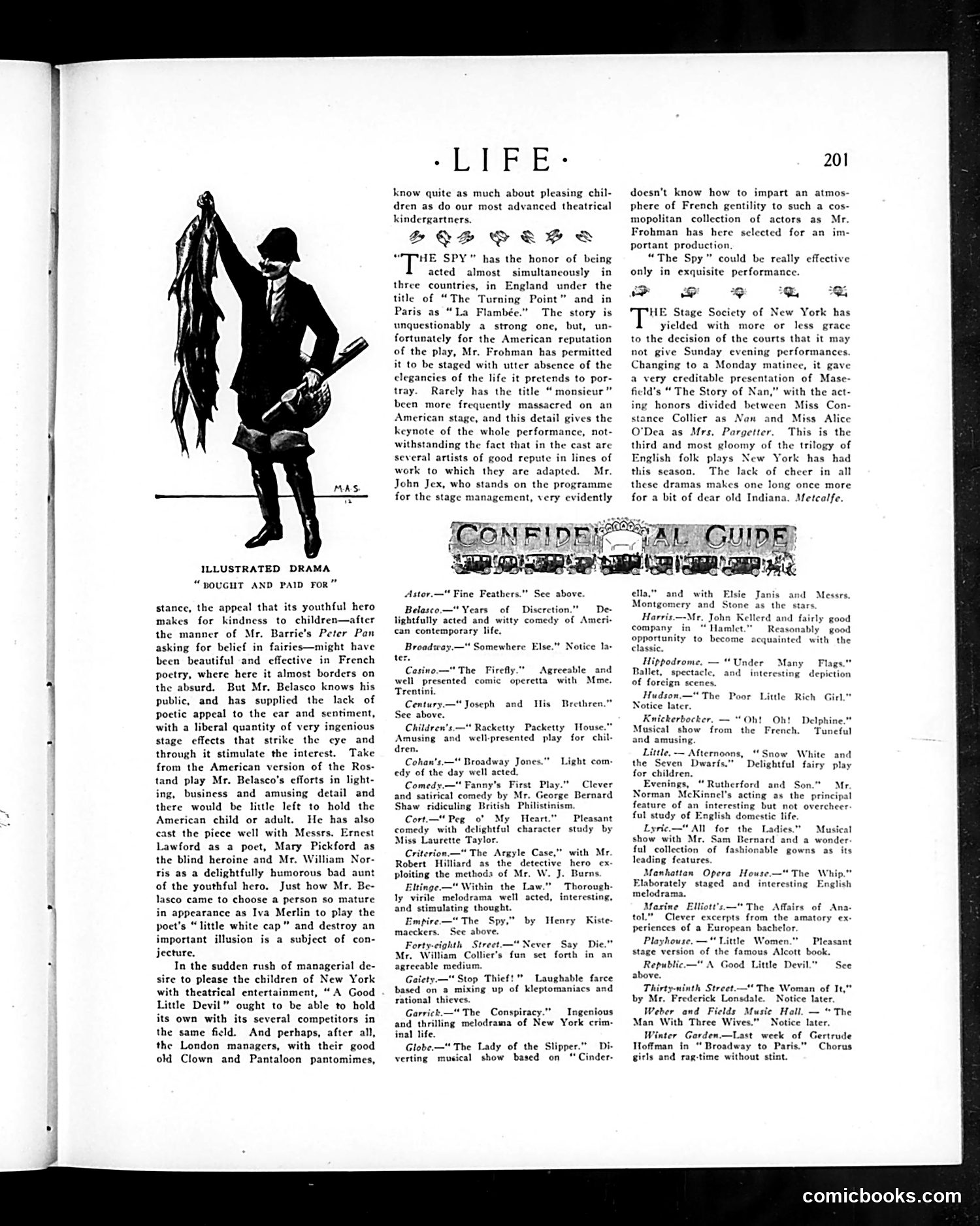
This page contains drama criticism from *Life* magazine, focused on theatrical productions. The illustrated figure on the left—a man in formal dress gesturing dramatically—accompanies a review of "Bought and Paid For," a play criticized for relying on cheap stage effects rather than genuine artistic merit. The reviews critique contemporary theater: David Belasco's adaptation of a Rostand play is dismissed as visually flashy but dramatically hollow, with actors who cannot convincingly portray French sophistication. A production of "The Spy" in three countries simultaneously is faulted for lacking elegance and proper direction. The critic also notes that recent English folk plays presented in New York are uniformly gloomy—a jab suggesting theater should entertain audiences rather than depress them. The satire targets commercial theater prioritizing spectacle and star power over substantive performance and artistic integrity.
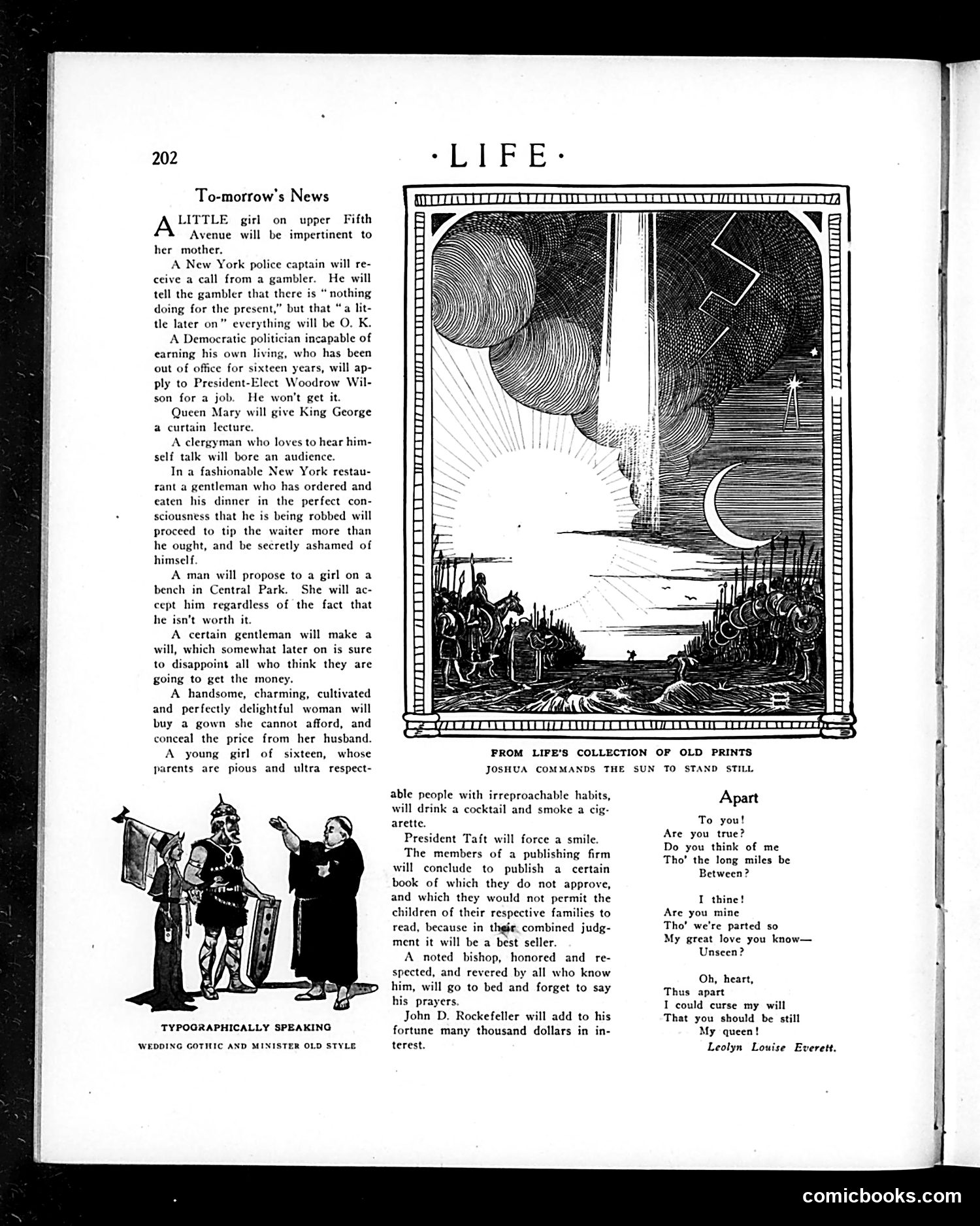
This satirical column predicts mundane human behaviors and hypocrisies expected "to-morrow," mocking universal character flaws across social classes. The humor derives from Life's cynical observations: - **Political corruption**: A jobless Democratic politician will unsuccessfully seek favor from President-Elect Woodrow Wilson (referenced as "Wilson," suggesting this is from around 1912). - **Social hypocrisy**: A gentleman robbed by a waiter will tip anyway from embarrassment; respectable parents' pious daughter will secretly smoke and drink; a bishop will forget prayers. - **Gender stereotypes**: Women buying unaffordable gowns, accepting unworthy proposals, hiding purchases from husbands. - **Institutional compromise**: Publishers will print books they morally disapprove of solely for profit. The column satirizes how supposedly moral, respectable people consistently act against their stated values through weakness, vanity, or greed. The accompanying woodcut illustration appears unrelated—depicting Joshua commanding the sun, likely a design sample ("typographically speaking").
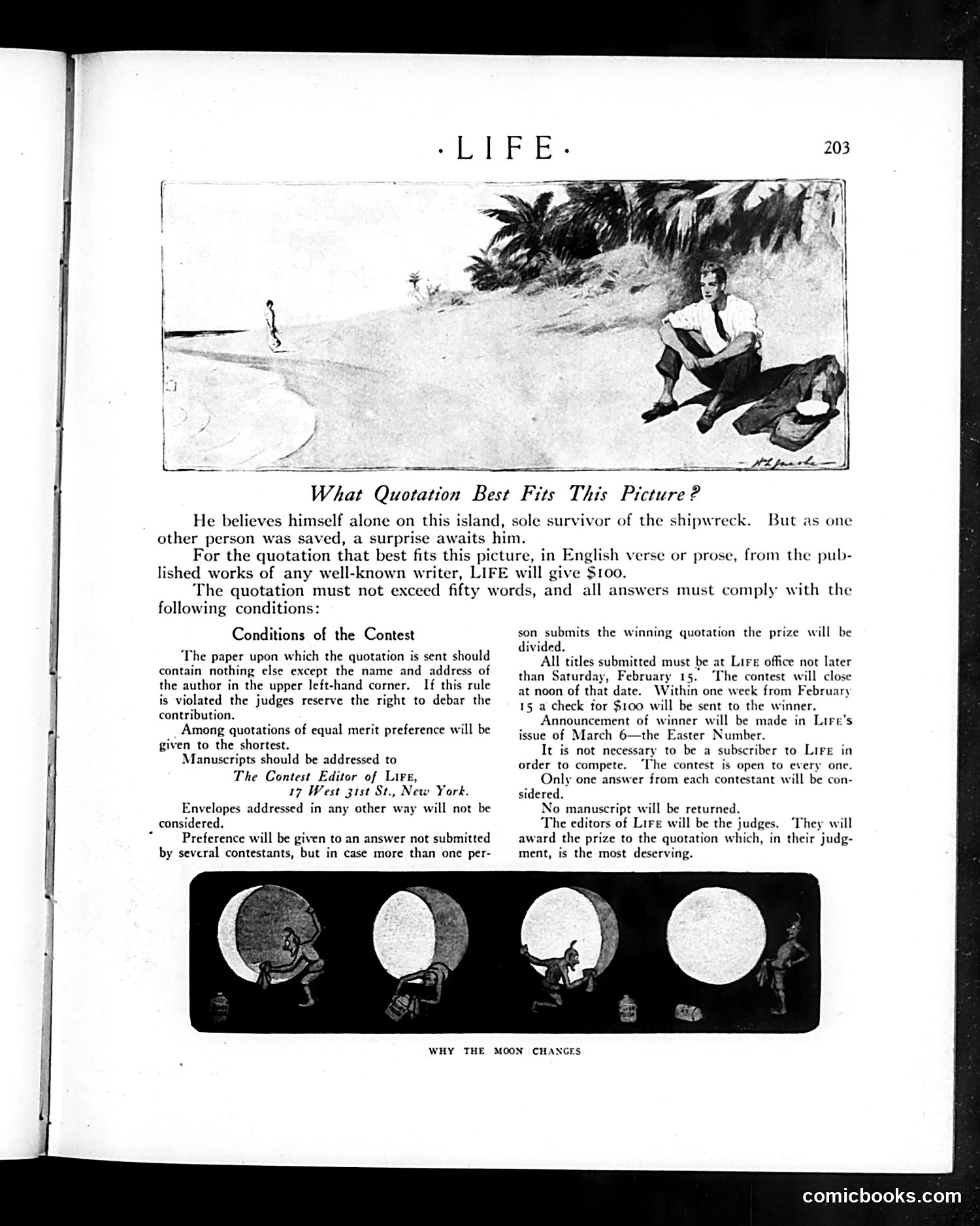
This page features a **reader-participation contest** rather than editorial satire. The main illustration shows a man on a beach believing himself the sole shipwreck survivor—until he discovers another person nearby, creating an ironic twist. Life magazine invited readers to submit literary quotations (under 50 words, from published works) that best fit this picture. The winning entry would receive $100—a substantial prize for the era. The contest rules are strictly specified: submissions must include only the quotation and author's name/address, be mailed to Life's office by February 15, with winners announced in the March 6 Easter issue. Below the contest text appears an unrelated illustration captioned "Why the Moon Changes," showing figures with progressively larger moon discs—likely a humorous scientific explanation or children's educational feature common to Life's diverse content.
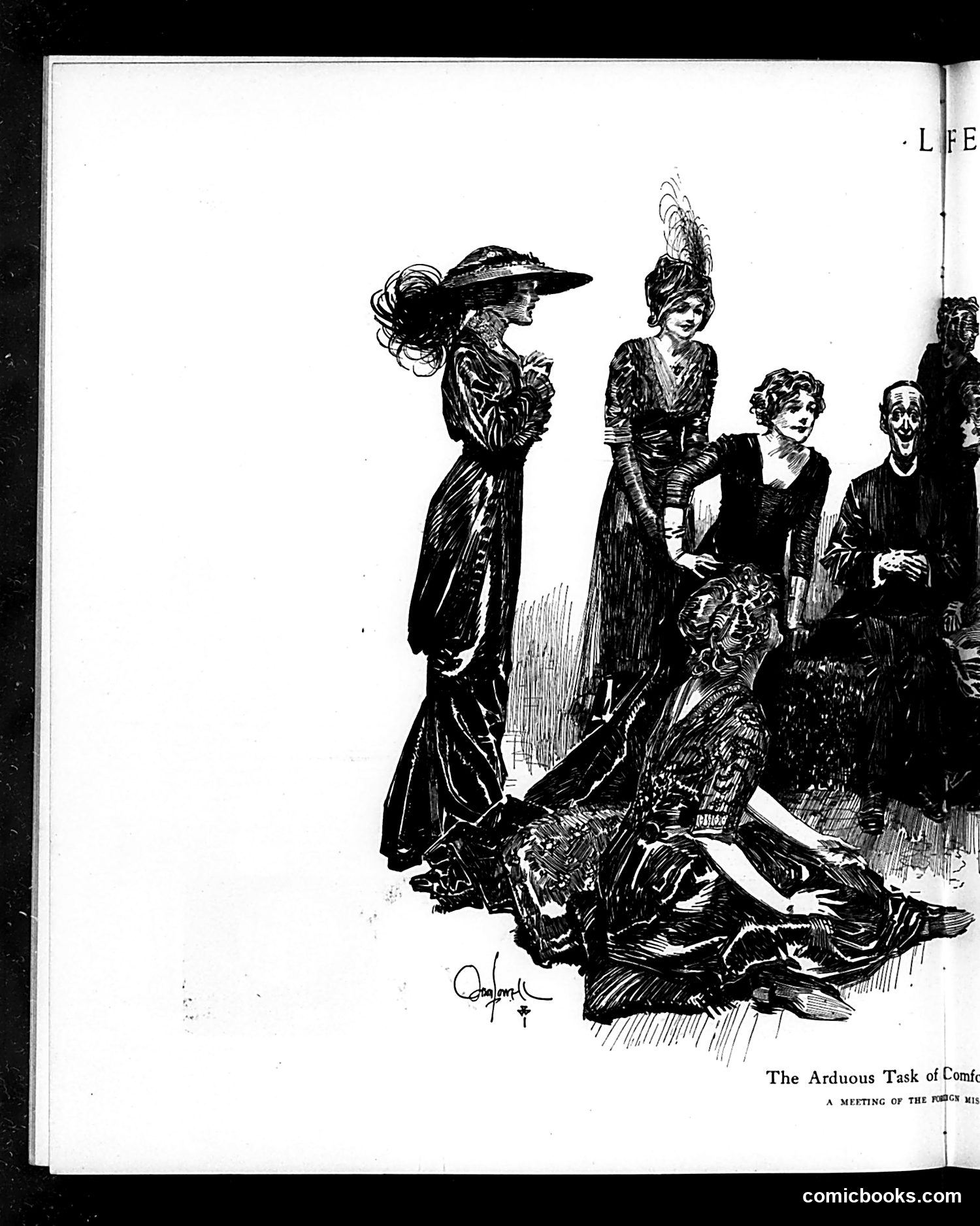
This appears to be a satirical illustration titled "The Arduous Task of Comf[ort]" depicting "A Meeting of the Forgn [Foreign] Mi[nisters]." The image shows elegantly dressed women in early 20th-century attire gathered around a seated figure in military uniform. The composition suggests a formal diplomatic meeting, but the presence primarily of fashionable women implies satire about foreign policy or international relations being conducted in social settings dominated by society women rather than serious statesmen. The illustration likely mocks either the influence of society women on foreign affairs, or satirizes diplomatic meetings as superficial social events. The artist's signature appears at bottom left, though it's not clearly legible. Without the complete caption and full context of which *Life* issue this is from, the specific political situation being satirized remains unclear.
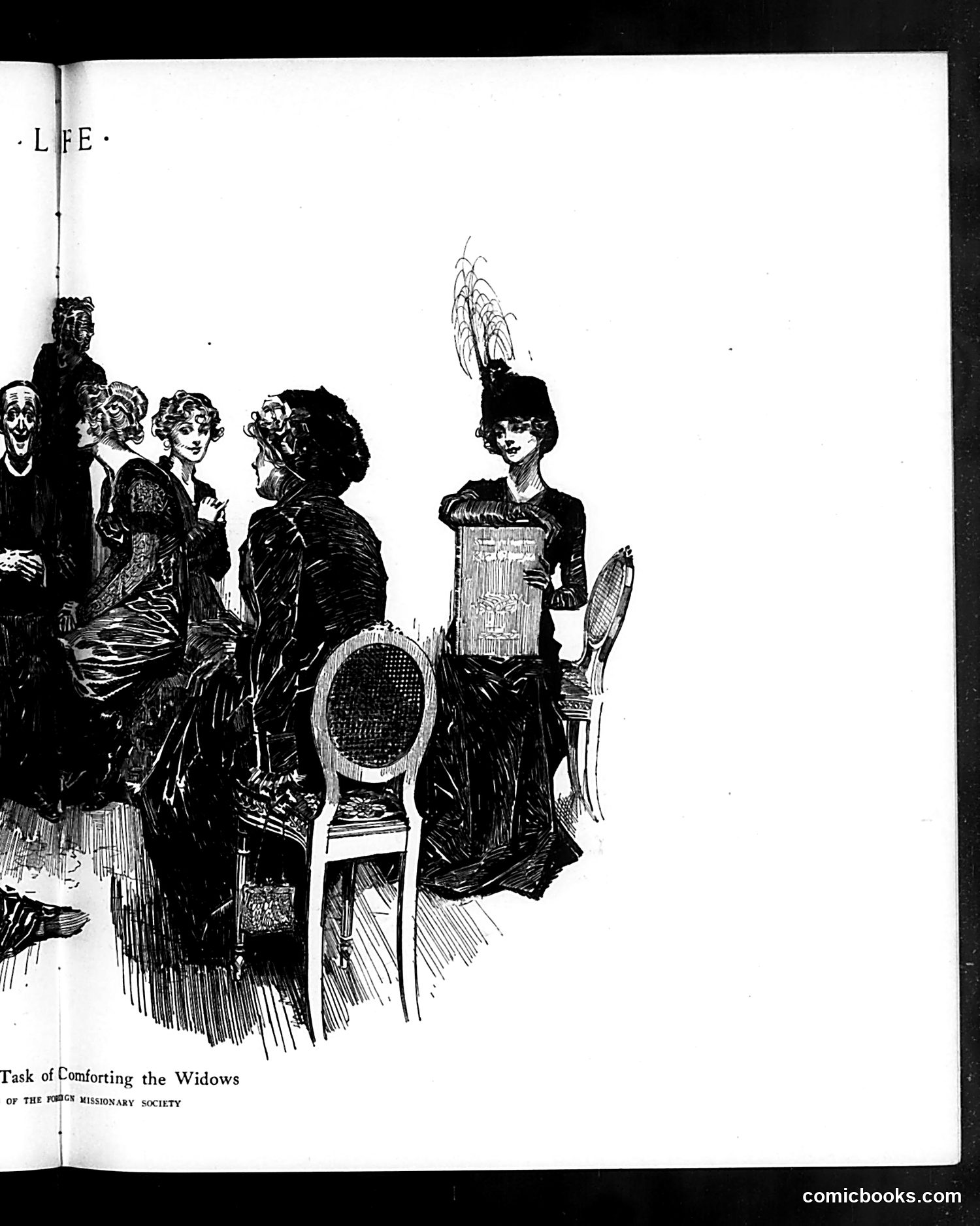
This illustration depicts the "Foreign Missionary Society" engaged in the "Task of Comforting the Widows." The image shows several well-dressed women in Edwardian-era clothing gathered together, with one woman seated prominently in the foreground. The satire appears to target wealthy philanthropic women's organizations of the early 1900s. The composition suggests these society women are performing charitable work—specifically comforting war widows—though the illustration's tone implies this may be more about the women's own social gathering and self-importance than genuine compassionate service. The elegant dress, formal poses, and decorative hat adorned with feathers suggest the satirist is mocking the pretension and superficiality of such charitable efforts among the upper class, questioning whether their "comforting" of widows is authentic benevolence or merely fashionable social performance.
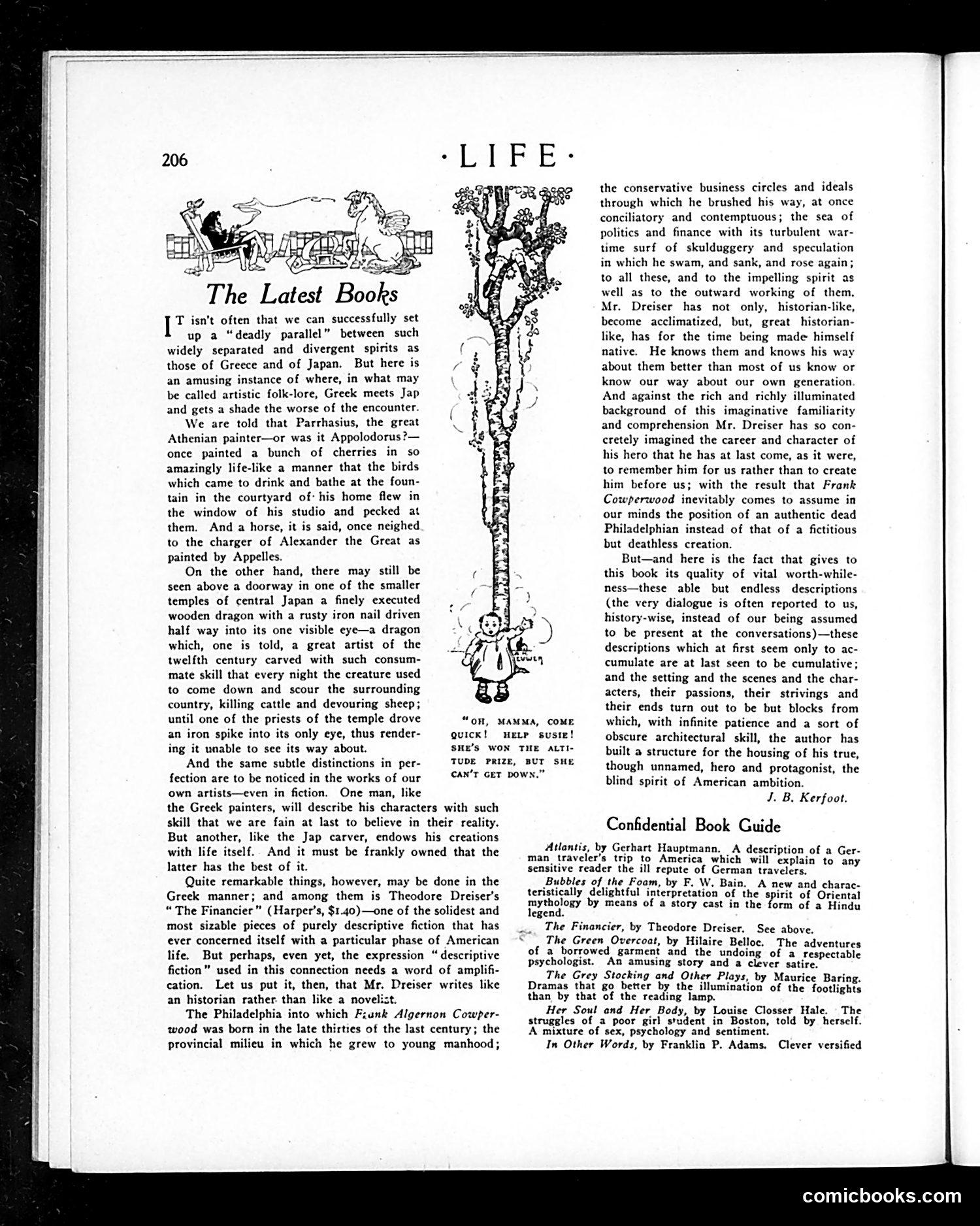
This page from *Life* magazine reviews Theodore Dreiser's novel *The Financier*. The small cartoon depicts a child who has won an "altitude prize" but cannot descend—a visual pun on the word "altitude" (height) representing the child's predicament of being stuck up high. The main text employs an extended comparison between artistic traditions. It parallels ancient Greek painters (like Parrhasius, whose cherries were so realistic birds tried to eat them) with Japanese sculptors (describing a 12th-century dragon carver whose work was so lifelike the dragon came alive at night). The reviewer uses this analogy to praise Dreiser's descriptive, historian-like approach to fiction—arguing his detailed depiction of Philadelphia's financial world and protagonist Frank Cowperwood creates such authentic verisimilitude that the fictional character feels like a real historical figure rather than invented. The satire critiques overly realistic fiction that blurs the line between invention and historical fact.
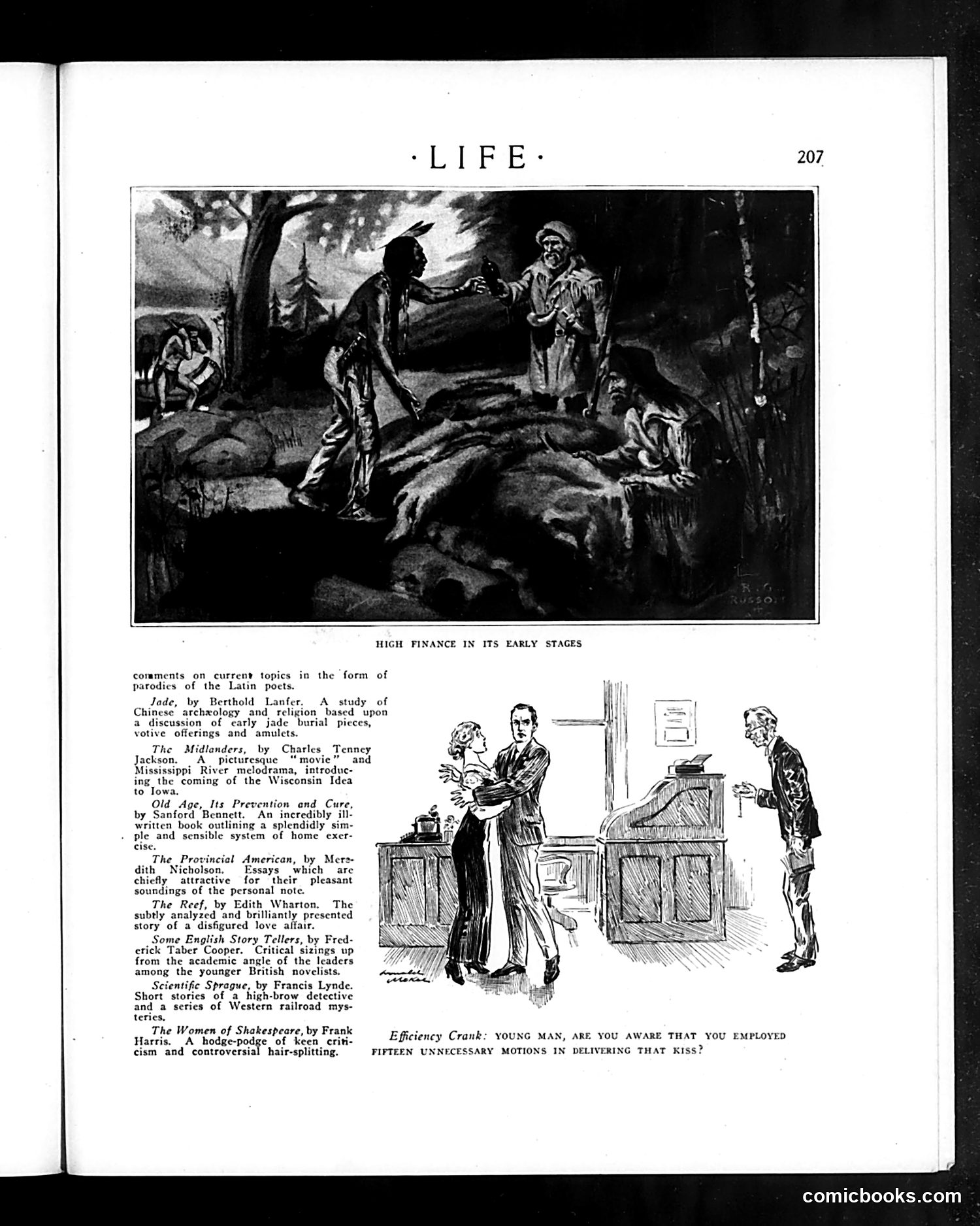
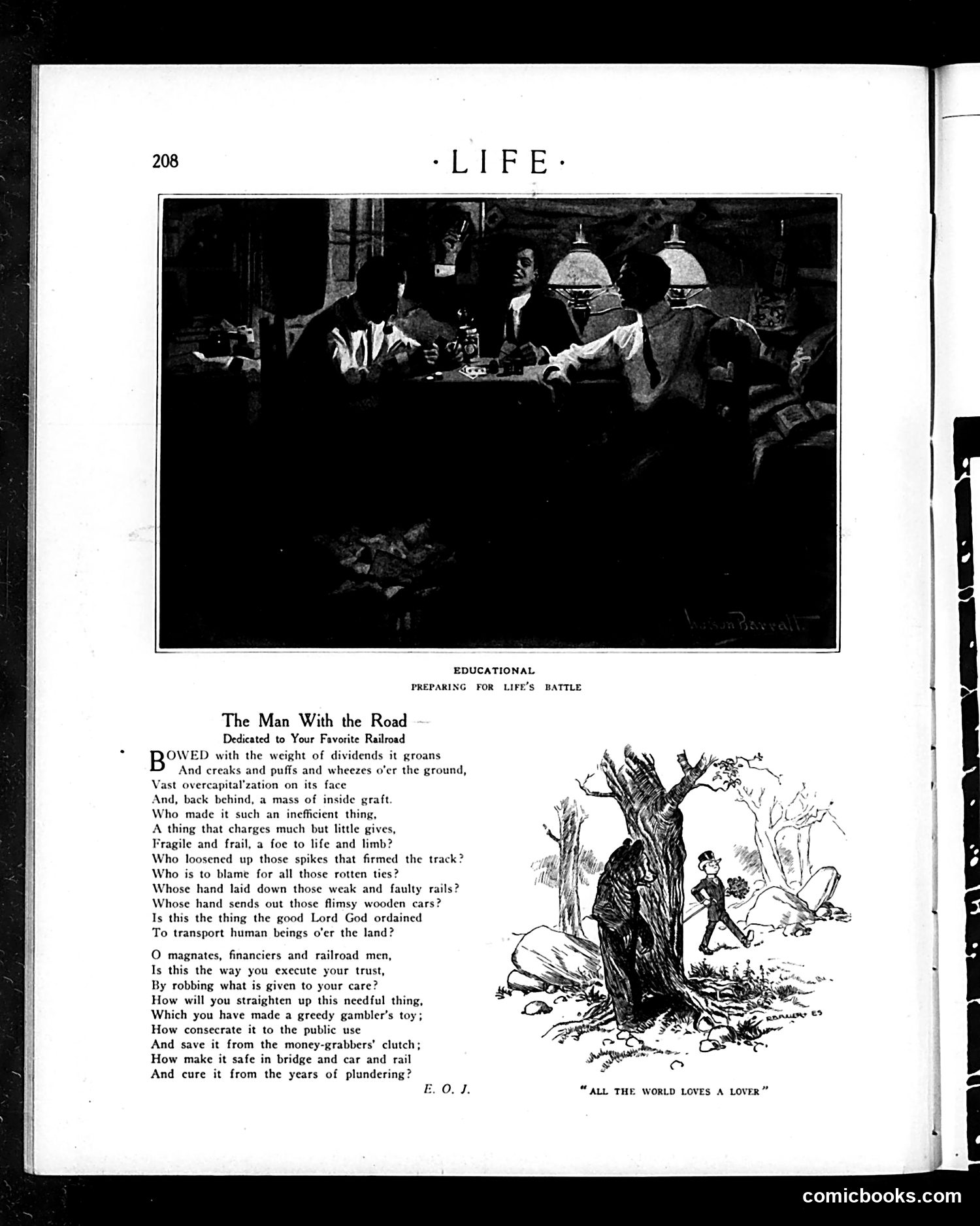
This page contains a satirical poem criticizing American railroad companies and their management practices. The top photograph shows what appears to be wealthy railroad executives dining, illustrating the luxury enjoyed by industry leaders. "The Man With the Road" attacks railroads as financially corrupt institutions. The poem accuses railroad magnates of: - Over-capitalization and watered stock ("weight of dividends") - Internal corruption and graft - Unsafe infrastructure (loose spikes, rotten ties, faulty rails, flimsy cars) - Prioritizing profit over public safety and welfare - treating the railroad as a "greedy gambler's toy" rather than a public trust The satirical thrust questions whether railroad executives can reform themselves or whether they will continue plundering the system they control. The illustration of lovers provides ironic contrast to this critique of greed and mismanagement. This reflects Progressive Era concerns about railroad monopolies and safety scandals common in early 20th-century American social commentary.
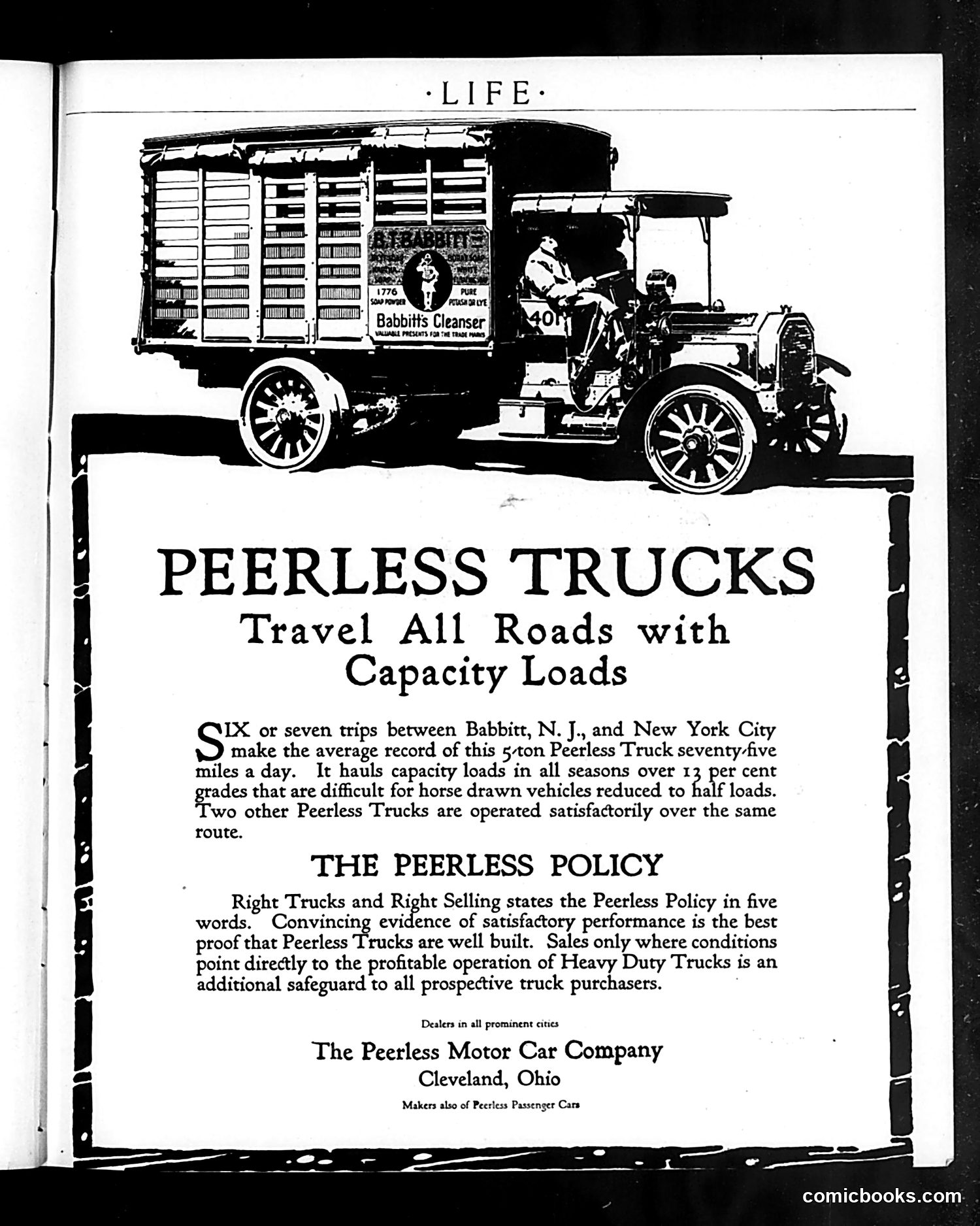
This is primarily a **product advertisement**, not satire or political commentary. The page promotes Peerless Motor Company's trucks, headquartered in Cleveland, Ohio. The illustration shows an early motorized truck (appearing to be from the 1910s-1920s era) hauling a large cargo bed, demonstrating the vehicle's capability. The ad emphasizes practical benefits: a 5-ton truck making daily runs between Babbitt, New Jersey and New York City, hauling full loads on steep grades where horse-drawn wagons would carry only half loads. The "Peerless Policy" section uses marketing language typical of the period, claiming superior build quality and selective dealer distribution as selling points. The reference to horse-drawn vehicles as comparison underscores the historical moment—motor trucks were still relatively new technology competing against established transportation methods. **For modern readers:** This represents early automotive advertising emphasizing reliability and performance specifications to convince businesses to adopt new truck technology over traditional horse transport.
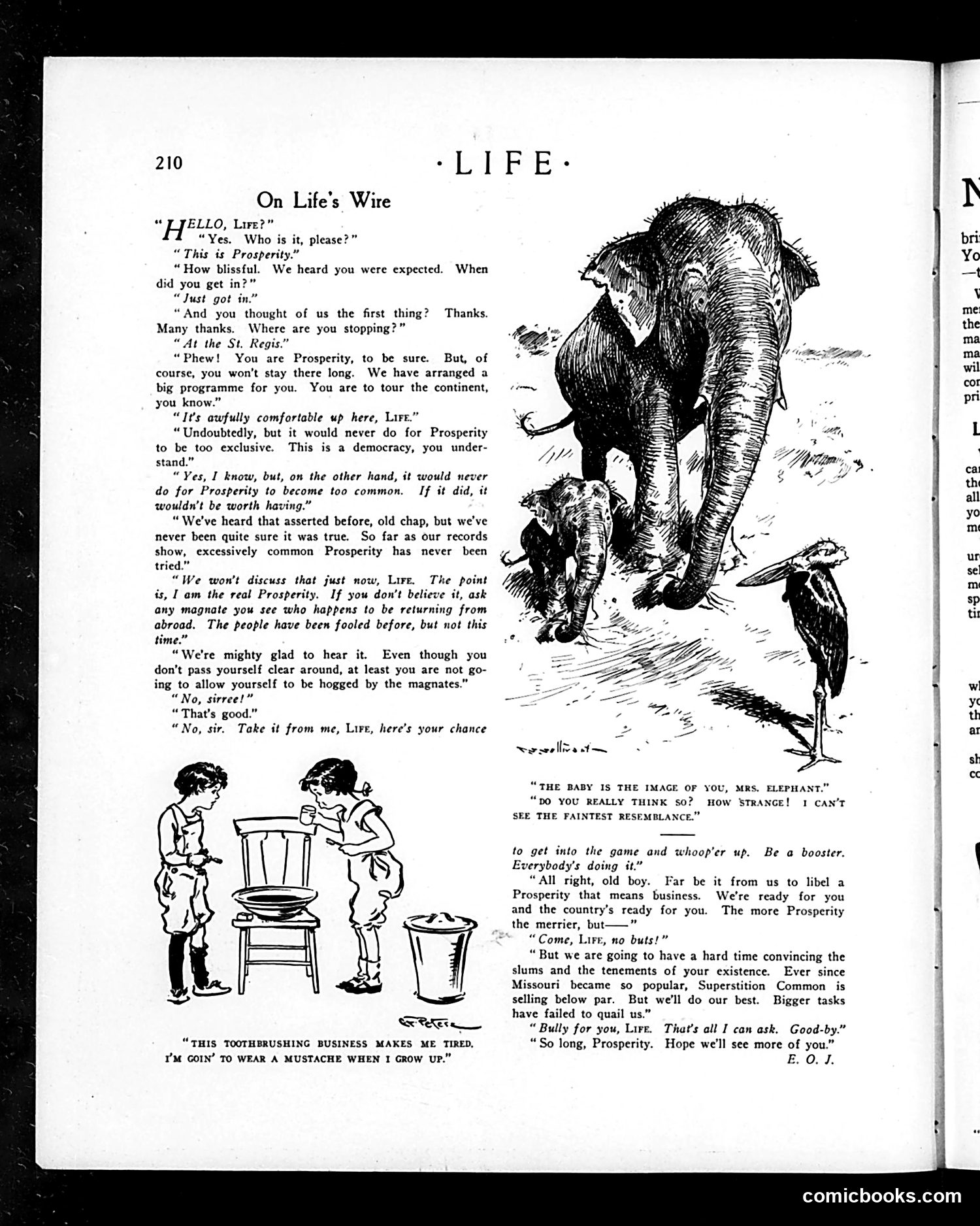
This page satirizes **post-WWI economic prosperity** through a dialogue between "Life" (the magazine, personified) and "Prosperity" (an abstract concept arriving like a visiting dignitary). **The main cartoon** mocks the era's economic inequality. Prosperity claims to be "real" and checks into the exclusive St. Regis Hotel, but Life challenges this exclusivity in a democracy. Prosperity argues it *shouldn't* become "too common" or it loses value—a pointed critique of how wealth concentrates among the wealthy while the poor remain excluded. Life's reference to "slums and tenements" and "Superstition Common selling below par" underscores that this prosperity hasn't reached ordinary Americans. **The elephant cartoon** (captioned about a baby resembling its mother) appears to be unrelated visual filler. **The children's comic** about toothbrushing is also separate humor. The satire's core message: the 1920s economic boom benefited the wealthy disproportionately, and claims of broad prosperity ring hollow for those still living in poverty.
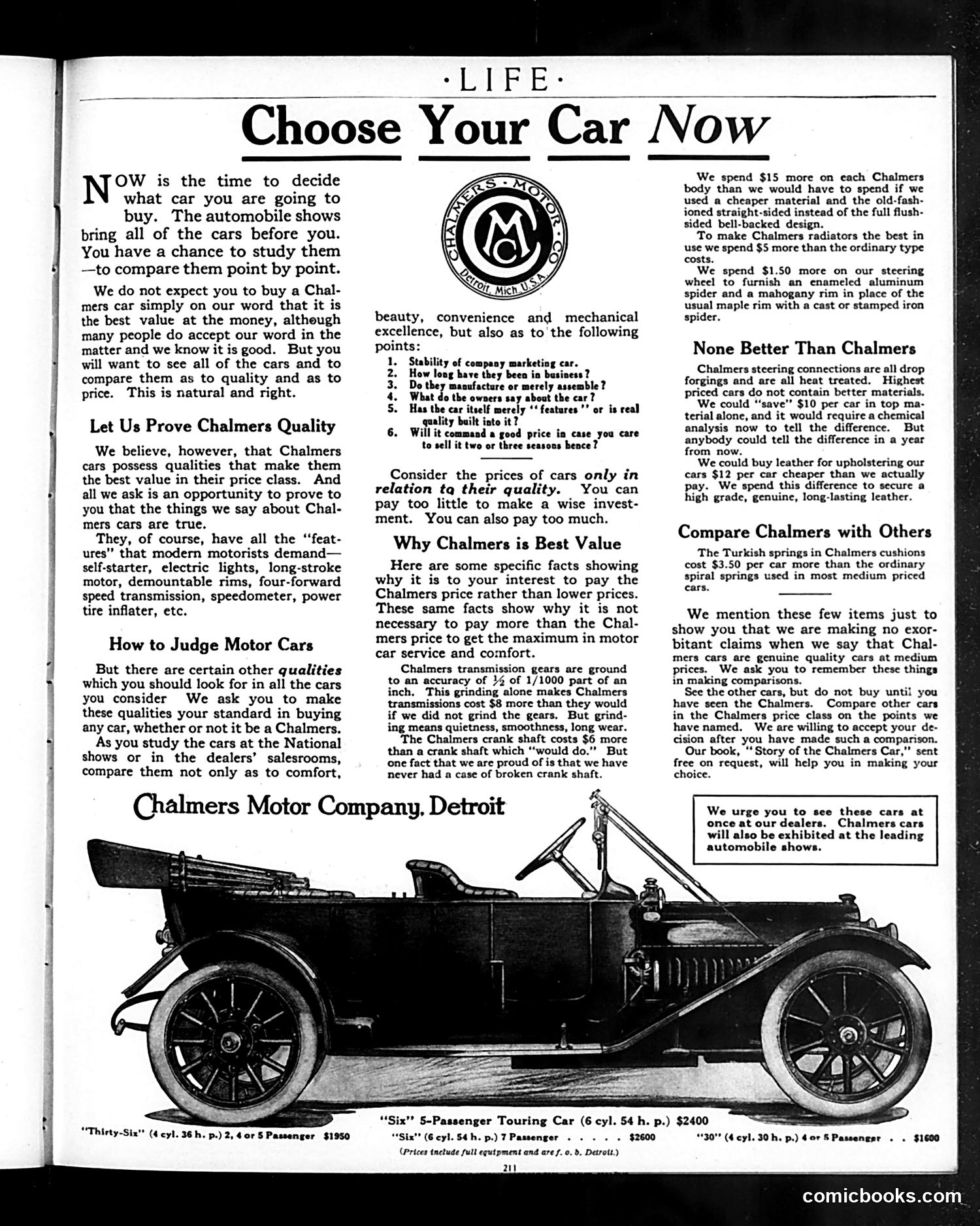
This is **not a cartoon or satire** — it's a straightforward automobile advertisement for the Chalmers Motor Company of Detroit, published in *Life* magazine. The page promotes Chalmers cars by encouraging consumers to compare them against competitors at automobile shows. Rather than asking readers to simply trust the manufacturer's claims, Chalmers presents specific technical arguments for why their cars justify their mid-range price: precision-ground transmission gears, superior crank shafts, higher-quality materials, and better craftsmanship than cheaper competitors. The advertisement includes three car models with prices ($1,950–$2,400) and emphasizes that Chalmers represents the best value in its price class — not the cheapest option, but worth the cost due to durability and quality. This reflects early-20th-century automotive marketing, when car features and manufacturing precision were novel selling points for middle-class buyers.
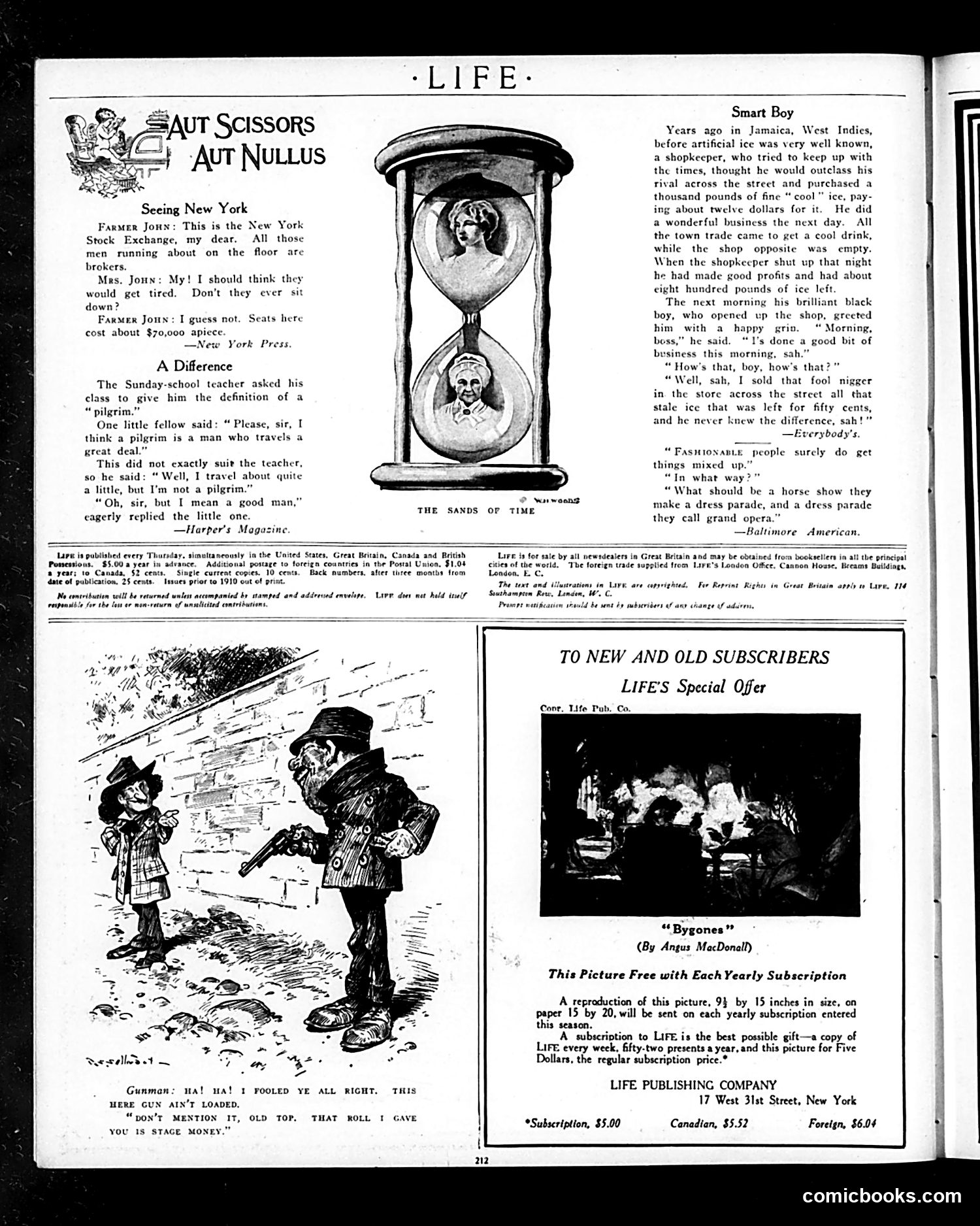
This page from *Life* magazine contains several distinct satirical pieces: **"Seeing New York"** jokes about the New York Stock Exchange's expensive seat prices ($70,000), mocking the financial world's disconnect from ordinary reality. **"A Difference"** presents a Sunday school humor piece where a boy distinguishes between a pilgrim (someone who travels) and a truly good pilgrim—a gentle, innocent joke about moral character. **"The Smart Boy"** tells a troubling anecdote set in Jamaica featuring a Black shop employee who sells stale ice to a competitor's employee, using racial slurs and depicting the scenario as clever business. This reflects the racist attitudes prevalent in early 20th-century American humor magazines. **The bottom cartoon** shows a gunman reassuring a robbery victim that the gun isn't loaded—dark humor about crime and deception. **"The Sands of Time"** illustration depicts an hourglass, likely symbolizing time's passage. The page also advertises subscriptions to *Life* magazine with a free picture reproduction included. The overall content reflects *Life's* mix of gentle social satire and humor, alongside period-appropriate racial stereotyping.
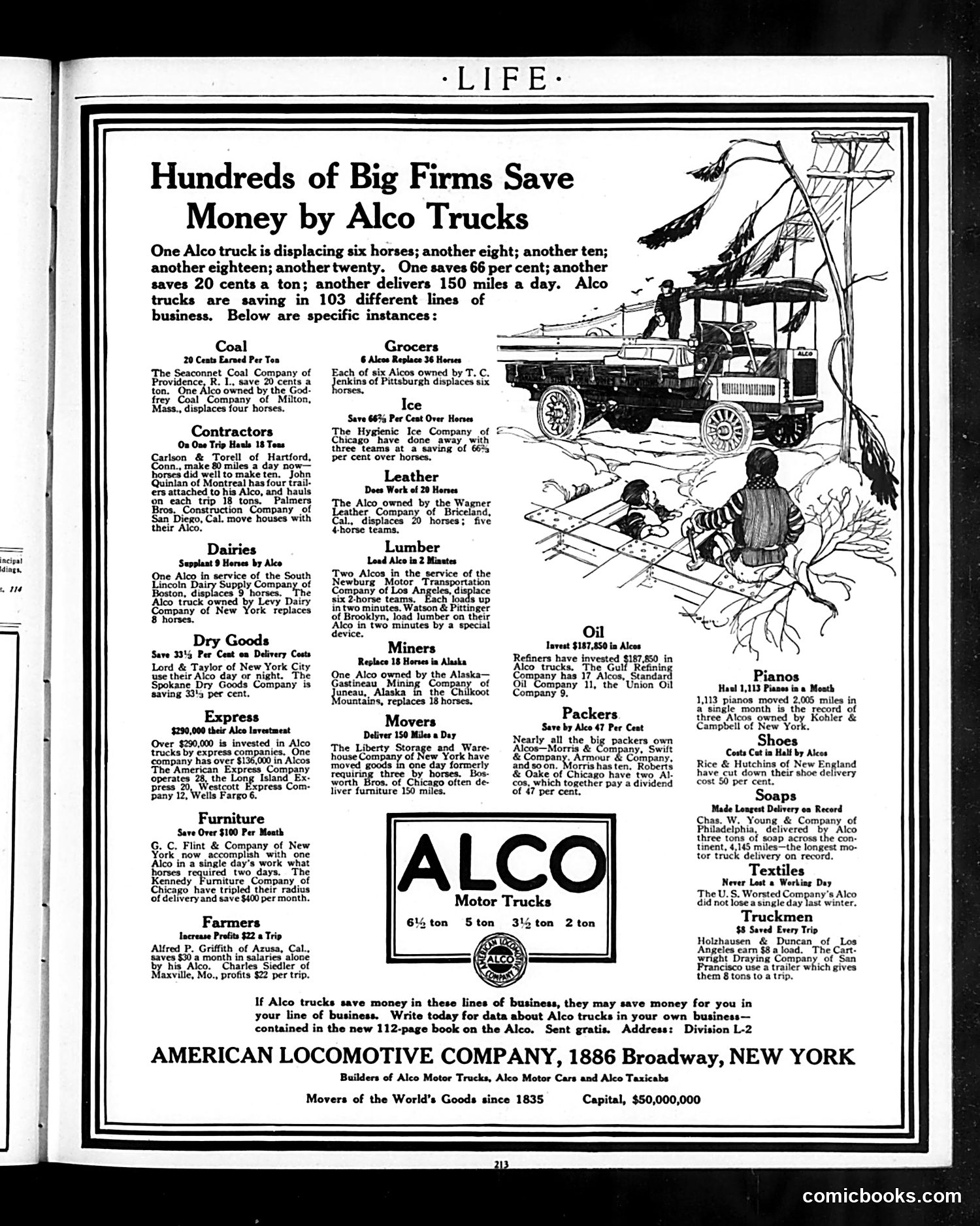
This is **not satire or a political cartoon**—it's a straightforward advertisement for Alco Motor Trucks, published in *Life* magazine circa 1910s-1920s. The page promotes trucks as replacements for horse-drawn transportation across 103 industries. Each section provides specific business examples: a coal company saves 20 cents per ton, a dairy replaces 9 horses with one truck, an ice company cuts costs 66%, etc. The accompanying illustration shows an Alco truck delivering goods while horses pull an old-fashioned wagon—a visual comparison emphasizing progress. The point is commercial persuasion: trucks are faster, cheaper, and more efficient than horses. For modern readers, this reflects a pivotal moment in industrial history when motorized transport was displacing animal labor. The ad's tone—listing concrete savings and company names—targets business owners considering mechanization during America's transition from horse to motor power.
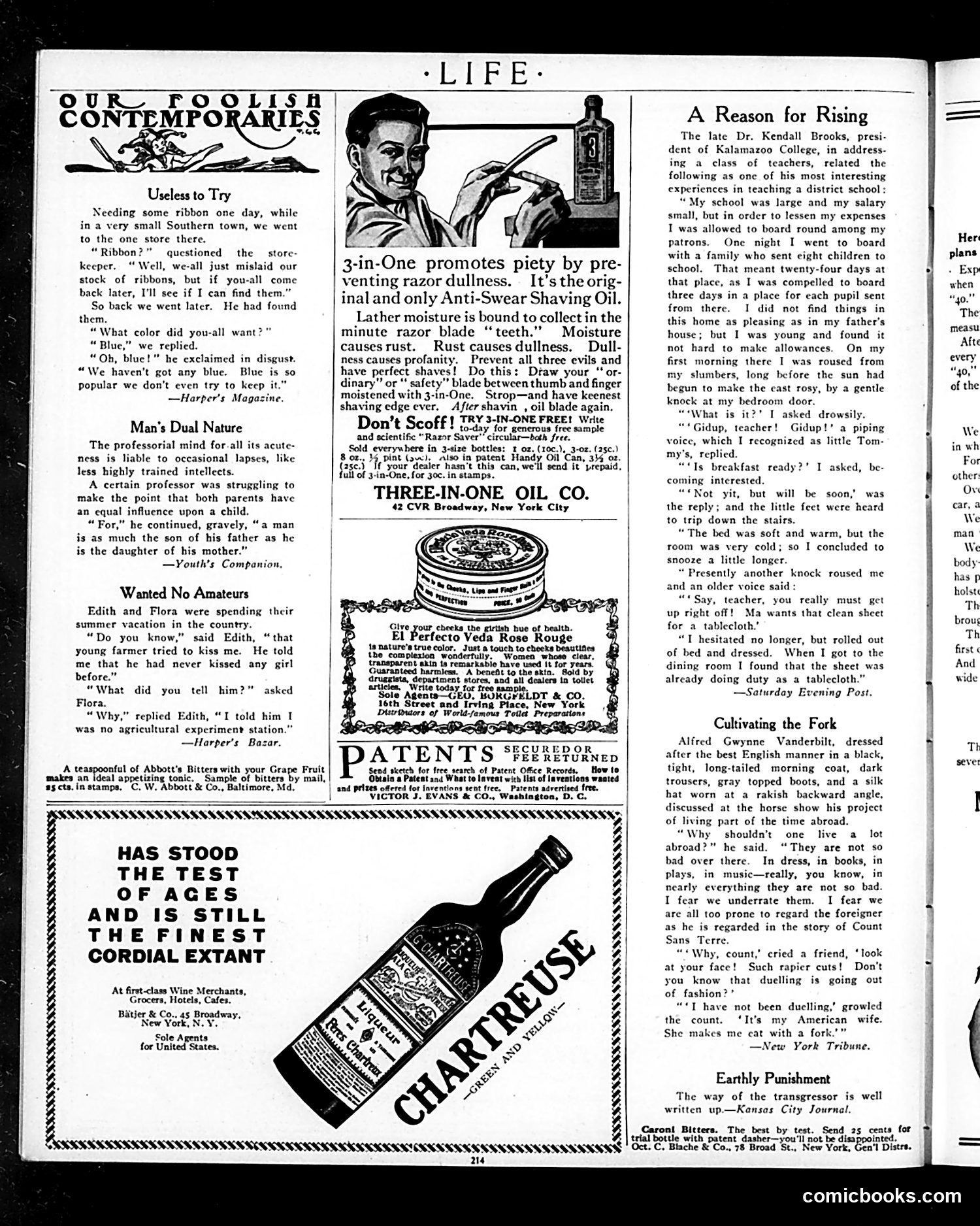
This page from *Life* magazine contains several humorous short anecdotes and advertisements typical of early 20th-century American periodicals. The cartoons and stories are genteel humor pieces with no overt political content. "Useless to Try" mocks small-town Southern inefficiency (a store clerk admits they don't stock blue ribbon because it's too popular to bother keeping). "Man's Dual Nature" plays on a professor's awkward phrasing about parental influence. "Wanted No Amateurs" presents a young woman rejecting a farmer's kiss because he's inexperienced—she humorously compares herself to a research station. The advertisements—for 3-in-One Oil, a cordial called Chartreuse, patent services, and other products—represent typical commercial content of the era. The 3-in-One ad humorously suggests that dull razor blades cause profanity, therefore requiring prevention. The "Reason for Rising" narrative appears to be an inspirational anecdote about a college president's childhood teaching experience, unrelated to satire.
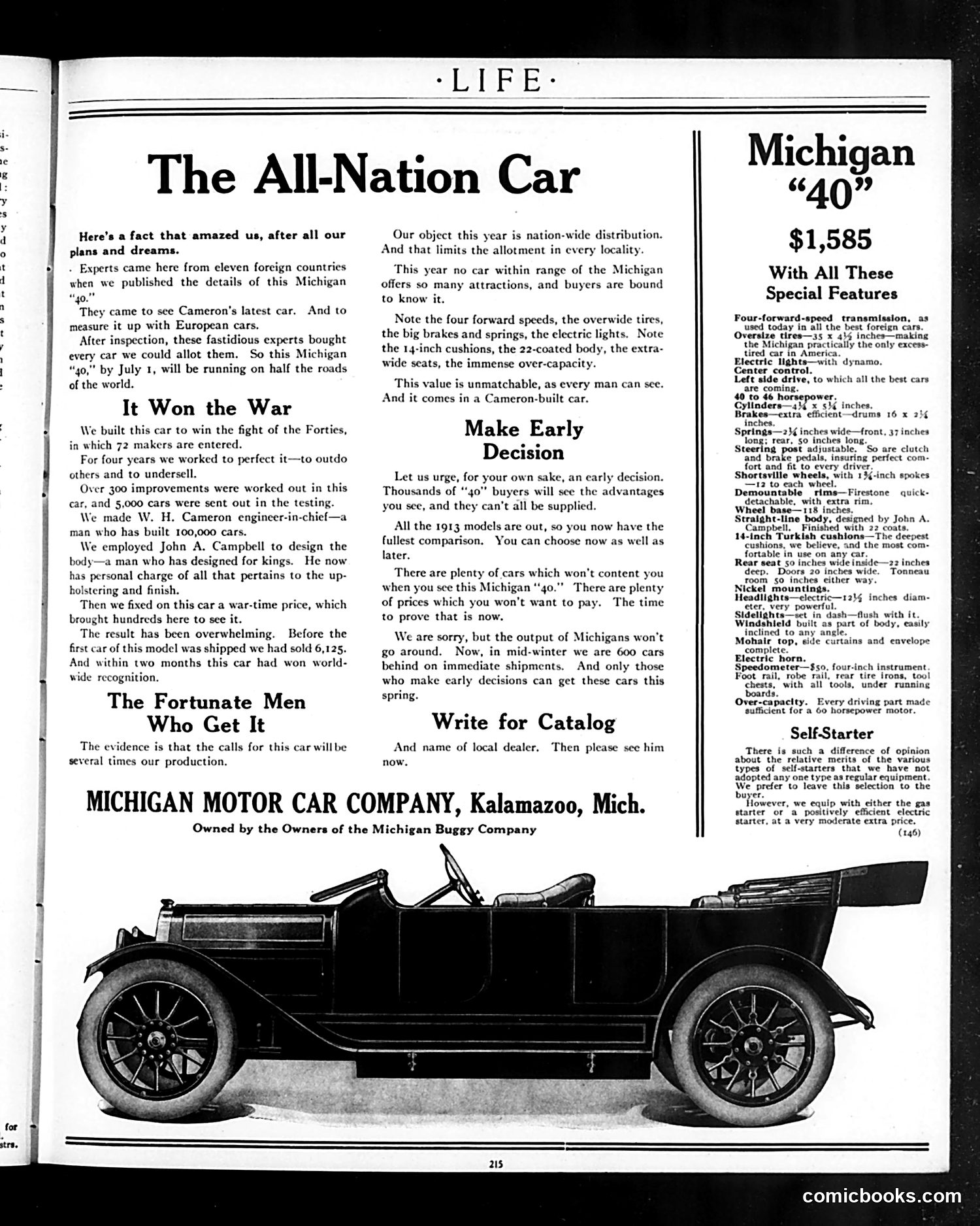
This is primarily a **car advertisement**, not satire or political commentary. The Michigan Motor Car Company promotes their "40" model ($1,585) as an exceptional vehicle. The advertisement's claims reflect early 1910s automotive competition: - **"Won the War"** refers to the competitive automotive marketplace of that era (72 manufacturers competing), not actual military conflict - **Foreign experts purchasing the car** emphasizes international quality recognition—a significant marketing point when American cars competed against European manufacturers - **Detailed technical specifications** (four forward speeds, electric lights, brakes) highlight innovations that distinguished premium vehicles The **"Make Early Decision"** urgency section admits demand exceeds supply—a common sales tactic suggesting scarcity and desirability. The page represents early automotive industry marketing, emphasizing engineering excellence, American manufacturing capability, and aspirational middle-class consumerism. There is no satirical message; Life magazine simply published paid advertising alongside editorial content.
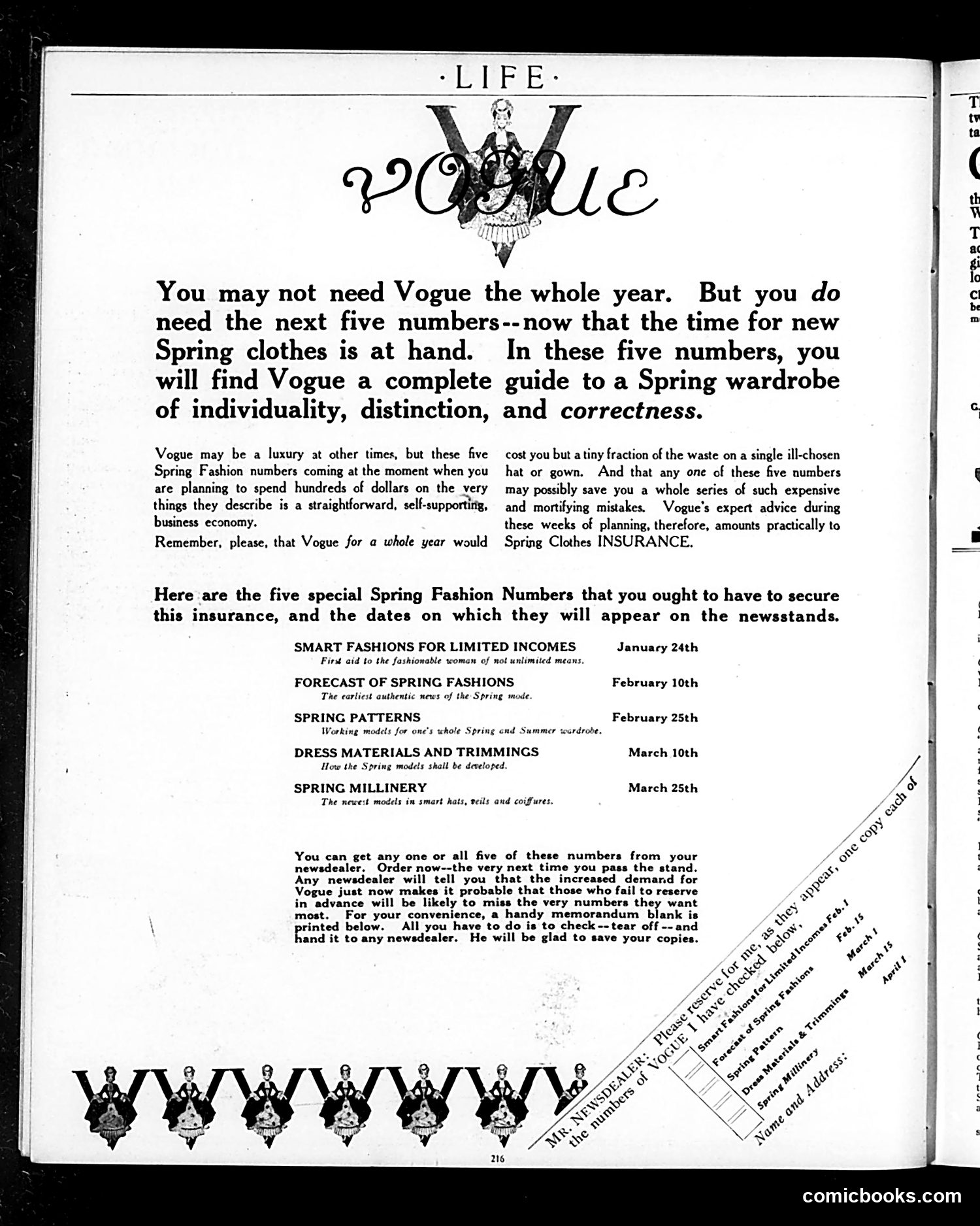
This is not a cartoon but rather an advertisement for *Vogue* magazine disguised as editorial advice. Published during the early 20th century (likely 1910s-1920s based on style), it promotes five special spring fashion issues as essential "insurance" for women planning seasonal wardrobes. The satire is subtle: *Life* magazine—a humor publication—frames purchasing multiple *Vogue* issues as practical economy rather than luxury consumption. By calling fashion guidance "insurance" against "expensive and mortifying mistakes," the ad mocks both the anxiety of fashionable women and the pretense that *Vogue* offers objective, financial wisdom rather than desire-driven consumption. The reference to "Smart Fashions for Limited Incomes" suggests irony about affordability while promoting expensive fashion magazines to women of modest means. The repeated Vogue mascot (the woman's head logo) at the bottom emphasizes branded repetition meant to drive sales through five separate purchases.
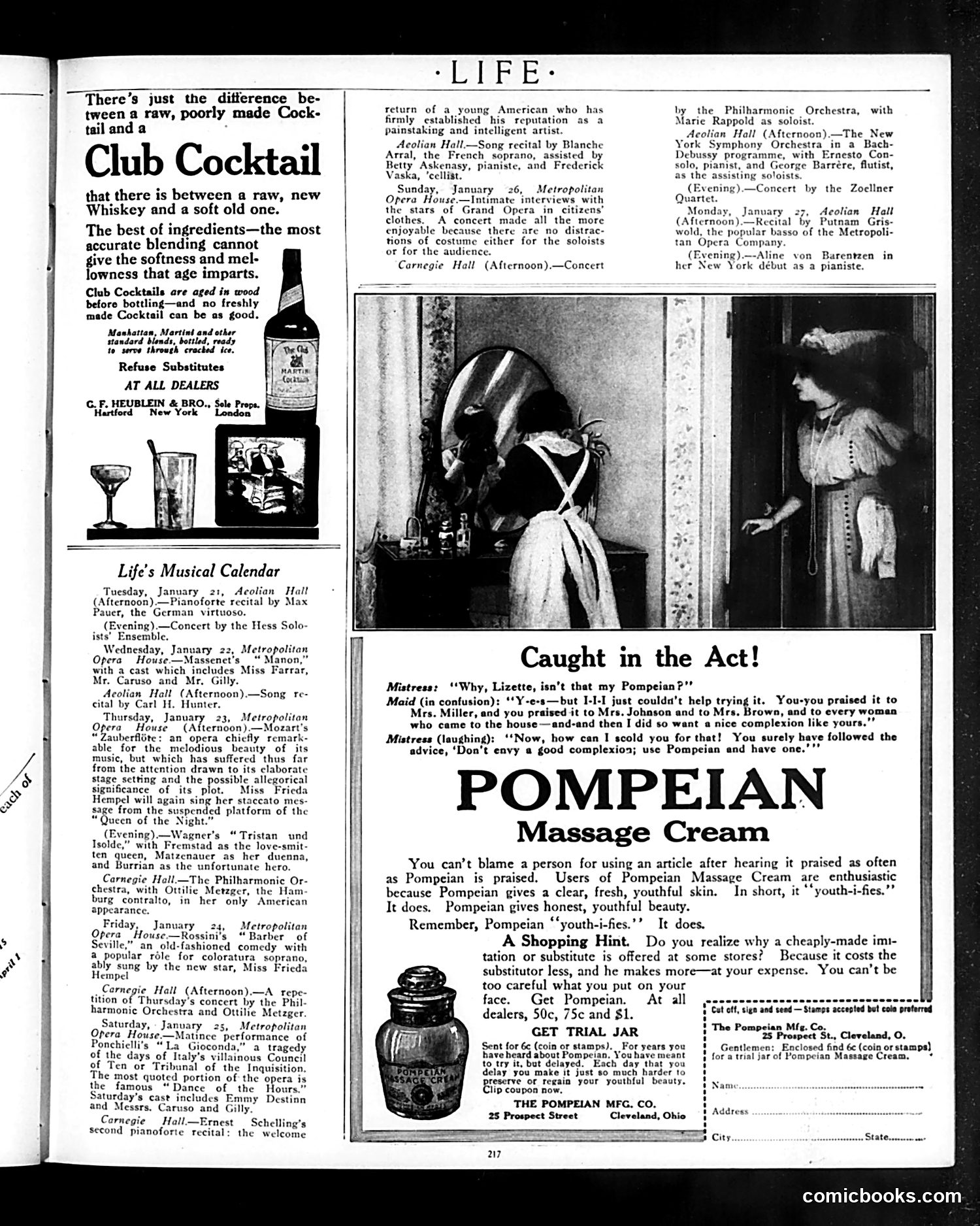
This is a comedic advertisement disguised as a cartoon. The scene depicts a maid caught red-handed using her employer's expensive Pompeian Massage Cream. The mistress discovers the maid applying the product, catching her in the act of theft or unauthorized use. The humor hinges on the maid's stammering confession: she couldn't resist trying it after hearing it praised to neighbors Mrs. Miller and Mrs. Johns. The advertisement's joke implies that Pompeian's reputation spreads so effectively through word-of-mouth that even servants are tempted to use it. The ad copy below emphasizes that Pompeian shouldn't be substituted with cheaper imitations, warning consumers that knock-offs cost less but don't perform as well—suggesting the product's desirability justifies its premium price. The advertisement frames desire for the cream as so universal that even household staff will attempt to use their employers' supply.
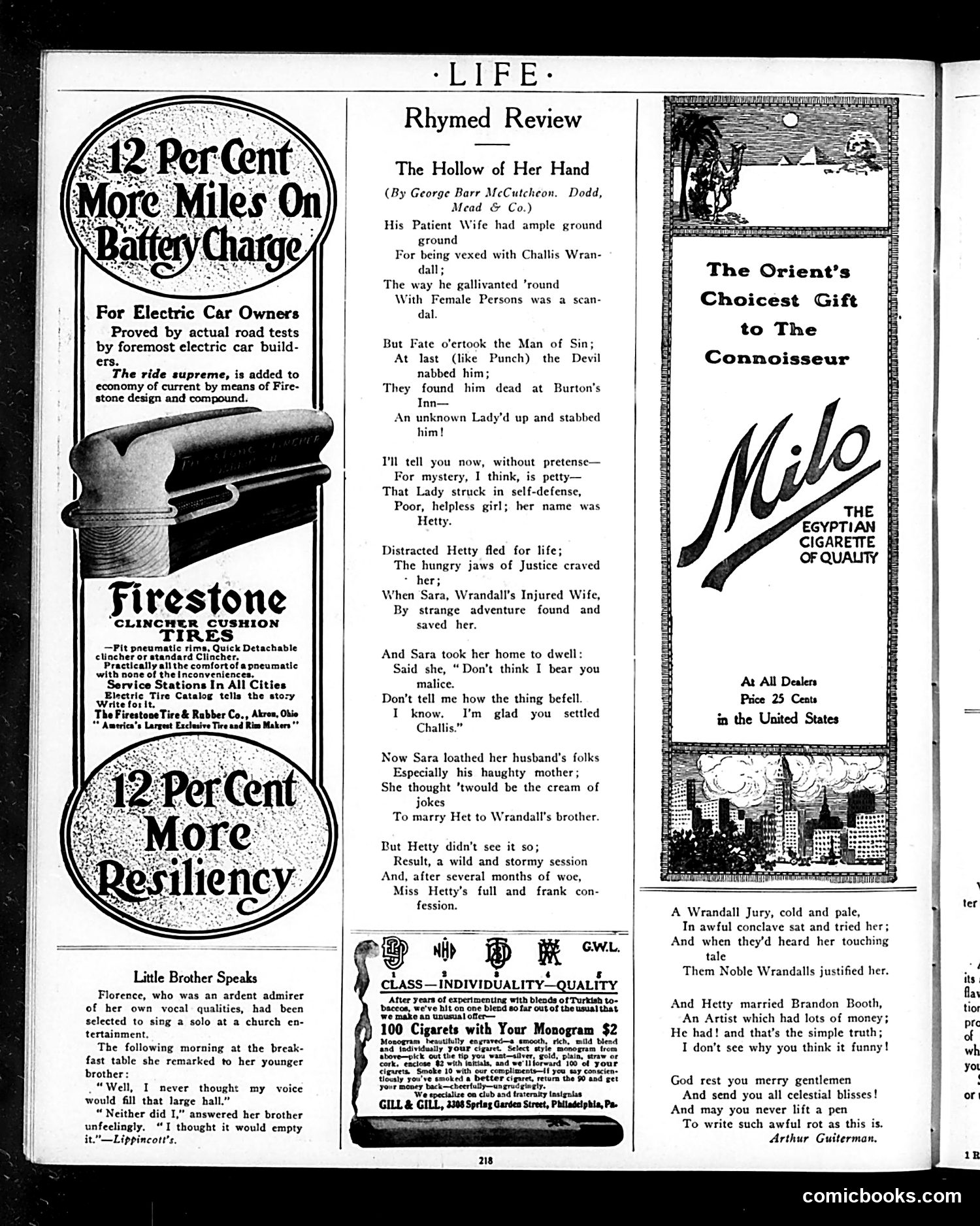
This page contains primarily **advertisements and light humor** rather than political satire. **Left side:** Firestone tire ads targeting electric car owners, emphasizing durability and service availability—reflecting early 1900s competition in the nascent automobile industry. **Center:** A "Rhymed Review" of George Barr McCutcheon's novel *The Hollow of Her Hand*, summarizing a melodramatic plot: a wronged woman (Hetty) kills an unfaithful husband in self-defense, is sheltered by his wife Sara, and eventually marries a wealthy artist. The reviewer (Arthur Guiterman) concludes sarcastically that the ending is implausible and the story poorly written—a humorous literary critique in verse form. **Right side:** Advertisement for Milo cigarettes, positioned as an Oriental luxury good for refined smokers, with a mail-order monogram service. **Bottom:** A brief humorous anecdote about a girl's poor singing voice, illustrating Life's regular humor column format. The page reflects turn-of-century concerns: automobile technology, serialized fiction, consumer goods marketing, and genteel satirical humor.
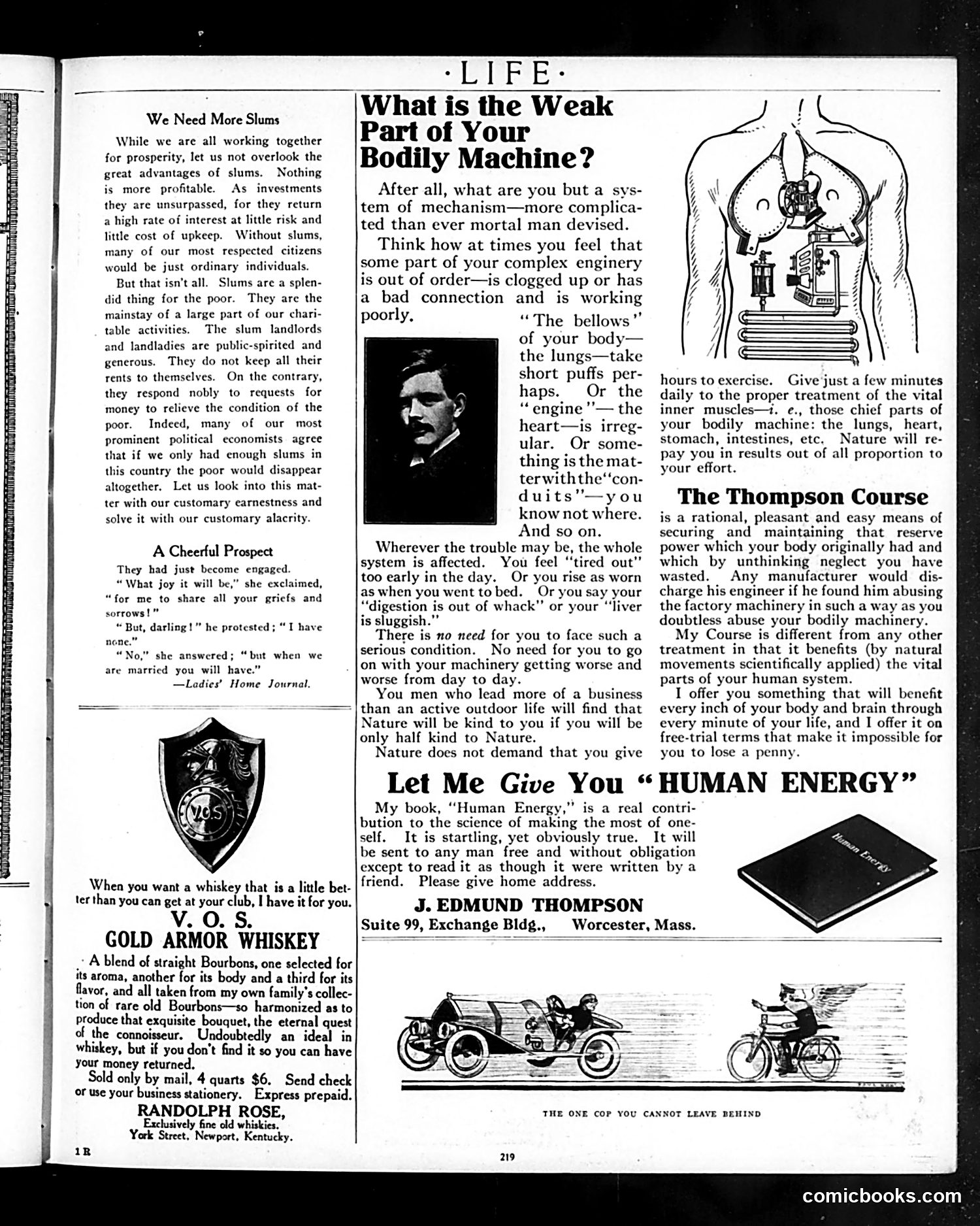
This Life magazine page contains satirical commentary and advertisements typical of early 20th-century American media. **"We Need More Slums"** uses heavy irony to critique wealthy landlords and economists who profit from urban poverty while claiming charitable motives. The piece sarcastically argues slums are "profitable investments" and benefit the poor by creating charity opportunities—exposing how the affluent rationalize inequality. **"A Cheerful Prospect"** is a brief joke about marriage, playing on the cliché that married life brings troubles. **The body-as-machine article** reflects period health pseudoscience, comparing human physiology to mechanical systems and promoting "The Thompson Course"—likely a mail-order physical fitness program. This reflects early 1900s popular wellness trends that promised rejuvenation through exercise. **Advertisements** for Gold Armor Whiskey and the Thompson Course represent common magazine revenue streams. The page primarily consists of advertising and lifestyle content rather than explicit political cartoons. Its satire targets class economics and exploitative landlord practices—relevant social criticism wrapped in period advertising conventions.
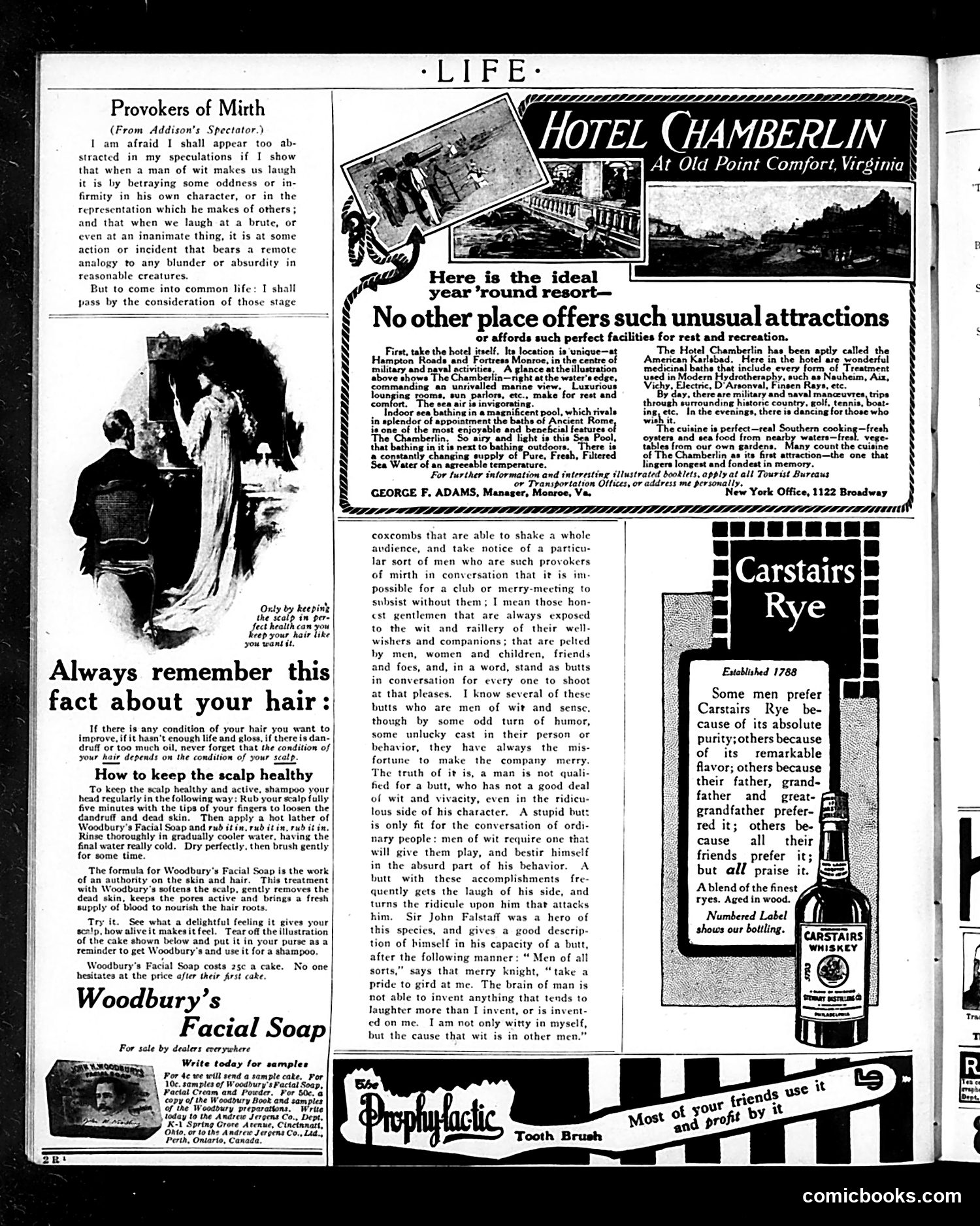
This page is primarily **advertising**, not political satire. The main content consists of three product advertisements: 1. **Woodbury's Facial Soap** (left side): A beauty advertisement with testimonial copy about scalp health and hair care, featuring illustrations of a woman's hair. This reflects early 20th-century cosmetics marketing emphasizing scientific claims about skin and scalp treatment. 2. **Hotel Chamberlin** (center/right): A resort advertisement for Old Point Comfort, Virginia, highlighting its location near military installations (Hampton Roads, Fortress Monroe) and luxury amenities like medicinal baths and a sea-water pool. 3. **Carstairs Rye Whiskey** (right): A liquor advertisement. The upper left contains a brief literary excerpt from Addison's *Spectator* about what provokes laughter—context about wit and human foibles—but this appears decorative rather than satirical commentary on the page itself. The page reflects period advertising strategies: scientific legitimacy claims, luxury appeal, and celebrity/authority endorsement.
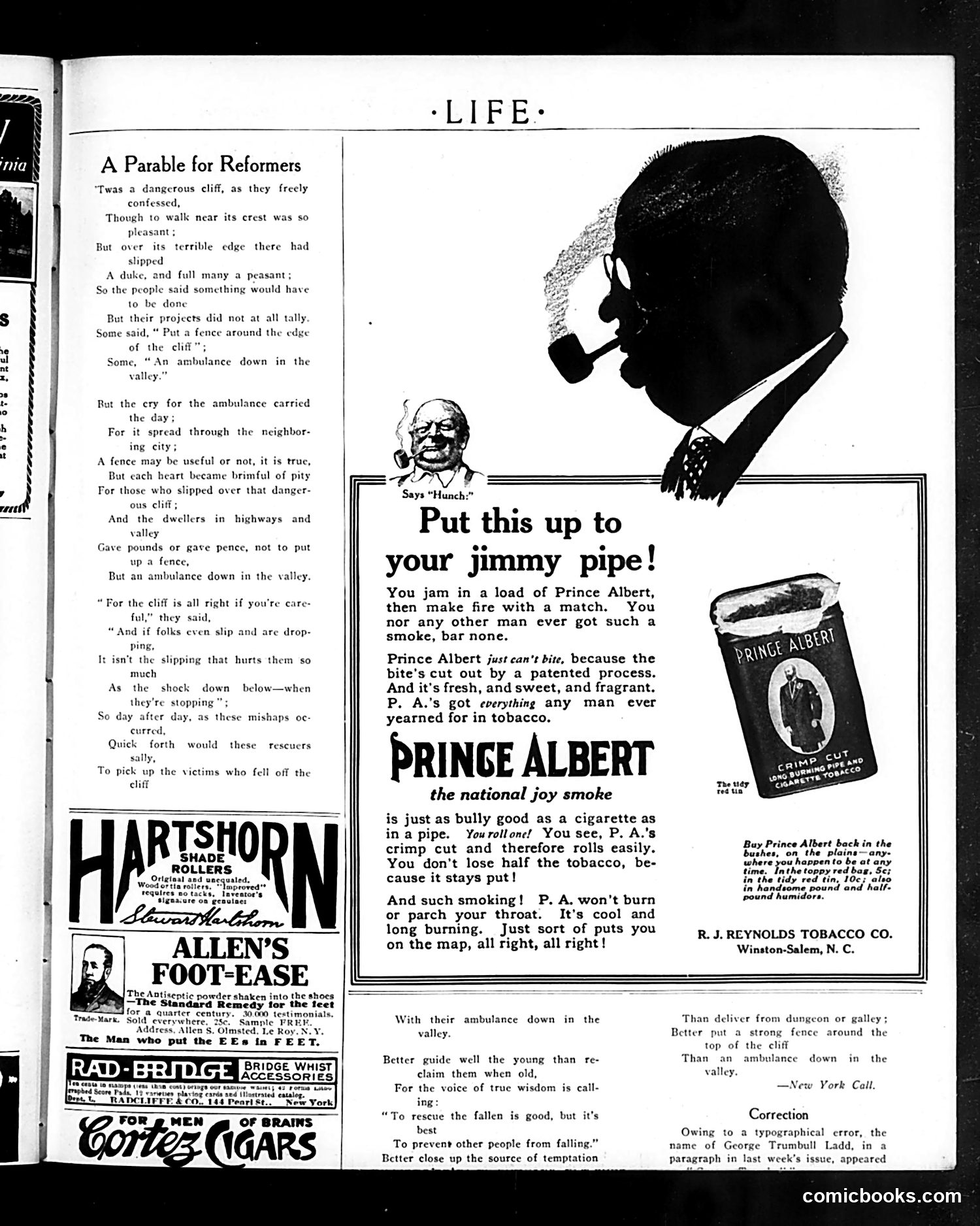
**The Main Content: "A Parable for Reformers"** This poem satirizes reactive versus preventive social reform. It contrasts two approaches to a dangerous cliff: building a fence (prevention) versus stationing an ambulance below (treating victims after the fact). The parable argues that while rescue work is noble, preventing harm at the source is superior—a critique of reformers who focus on sympathy and aid rather than eliminating root causes. **The Political Context:** This reflects early 20th-century debates between progressive reformers. The poem, credited to the *New York Call* (a socialist publication), advocates structural change over charity-based solutions. It challenges the notion that compassion alone suffices; systemic problems require systemic fixes. **The Advertisements:** The page includes period product ads (tobacco, foot powder, cigars) typical of Life's commercial model—unrelated to the editorial content.
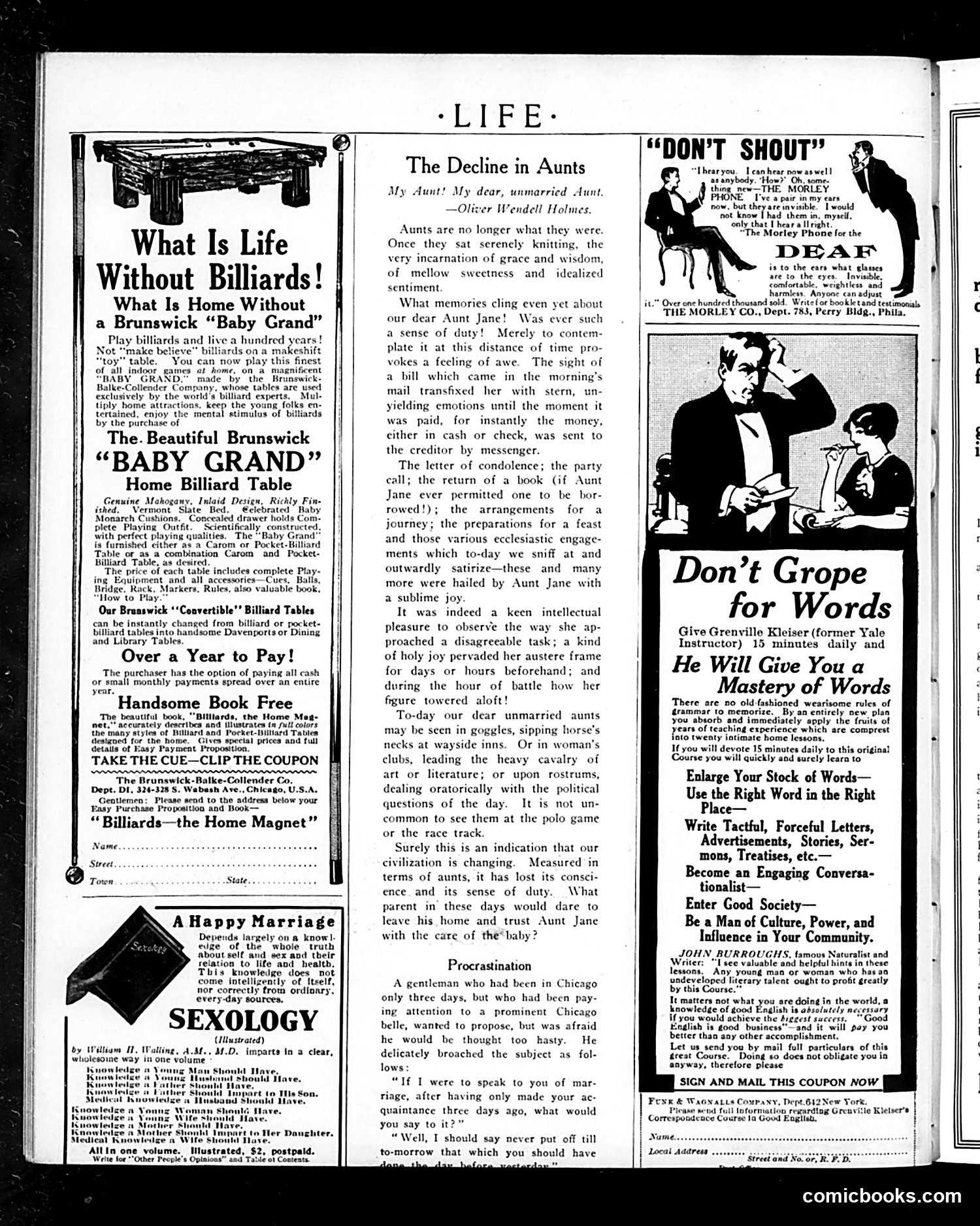
This page contains mostly **advertisements and a nostalgic essay**—not political satire. The main content is "The Decline in Aunts," a sentimental piece lamenting how unmarried aunts have changed. It recalls when aunts were dignified figures who dutifully paid bills promptly, made condolence calls, returned borrowed books reliably, and organized social/religious events with genuine pleasure. The author (quoting Oliver Wendell Holmes) suggests modern aunts lack this sense of obligation and refinement. The satire is **generational and social**, not political: it's mourning the loss of Victorian propriety and duty among women. The piece reflects early-20th-century anxiety about changing social mores. The page also advertises Brunswick billiard tables (framed as home entertainment), a book on sexology (marketed as marital advice), and a course on proper English usage—all reflecting era-specific concerns about maintaining respectability and culture.
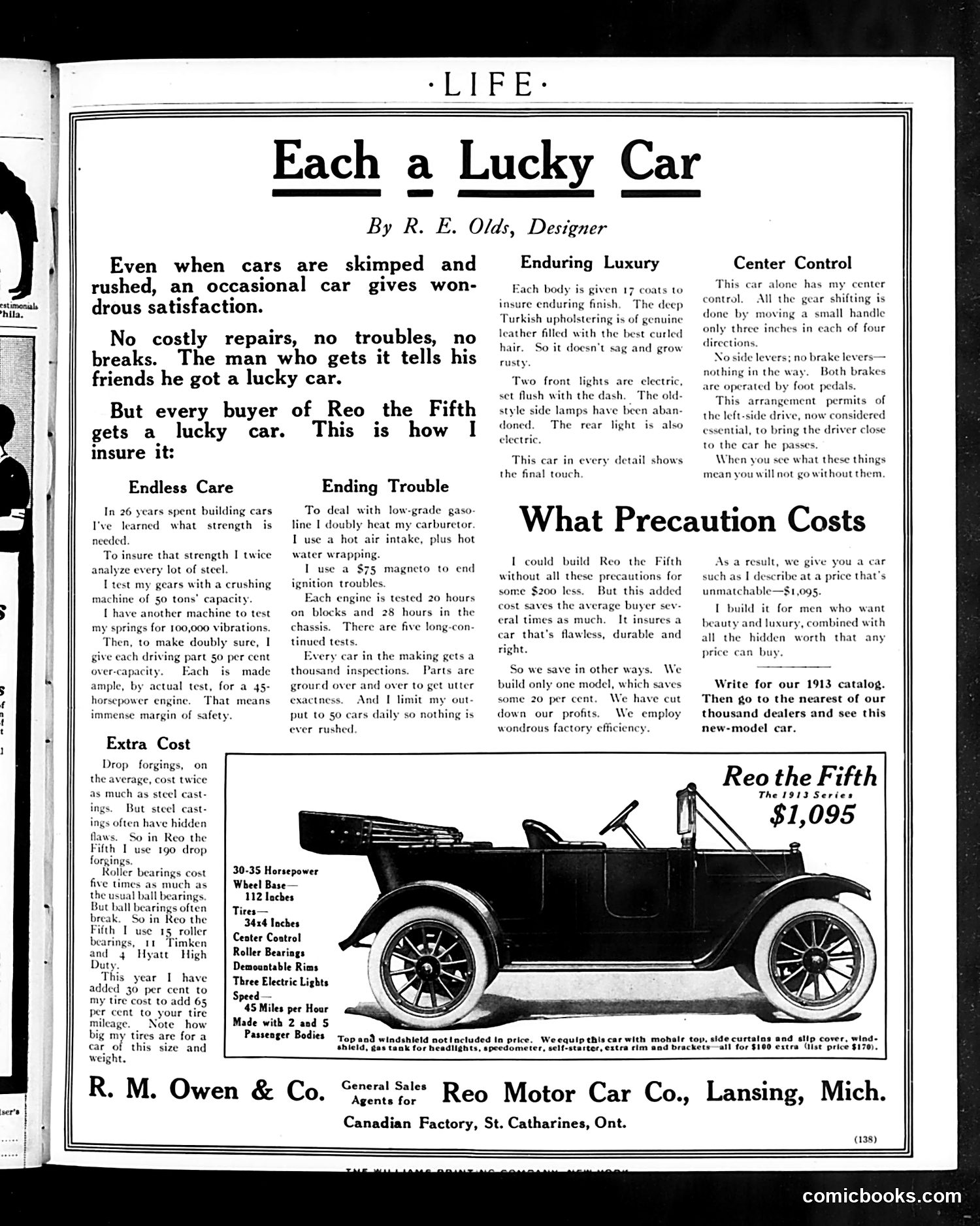
This is a **1913 automobile advertisement**, not political satire. It's a full-page ad for the Reo the Fifth motorcar, designed by R.E. Olds (founder of Reo Motor Car Company). The piece uses a first-person appeal from Olds himself, listing manufacturing quality controls to justify the $1,095 price tag. Key selling points include: - **Rigorous testing**: 50-ton crushing machines, 100,000 vibration tests - **Premium materials**: 190 drop forgings instead of cheaper castings; 15 roller bearings instead of ball bearings - **Luxury features**: 17 coats of finish, Turkish leather upholstery, electric lights - **Innovation**: Center control gear shift (left-side driving), dual brakes The "lucky car" framing—suggesting some cars are inherently lucky—is rhetorical; Olds argues his engineering *ensures* reliability rather than leaving it to chance. The ad positions the Reo Fifth as a premium product for buyers seeking quality and safety over economy.
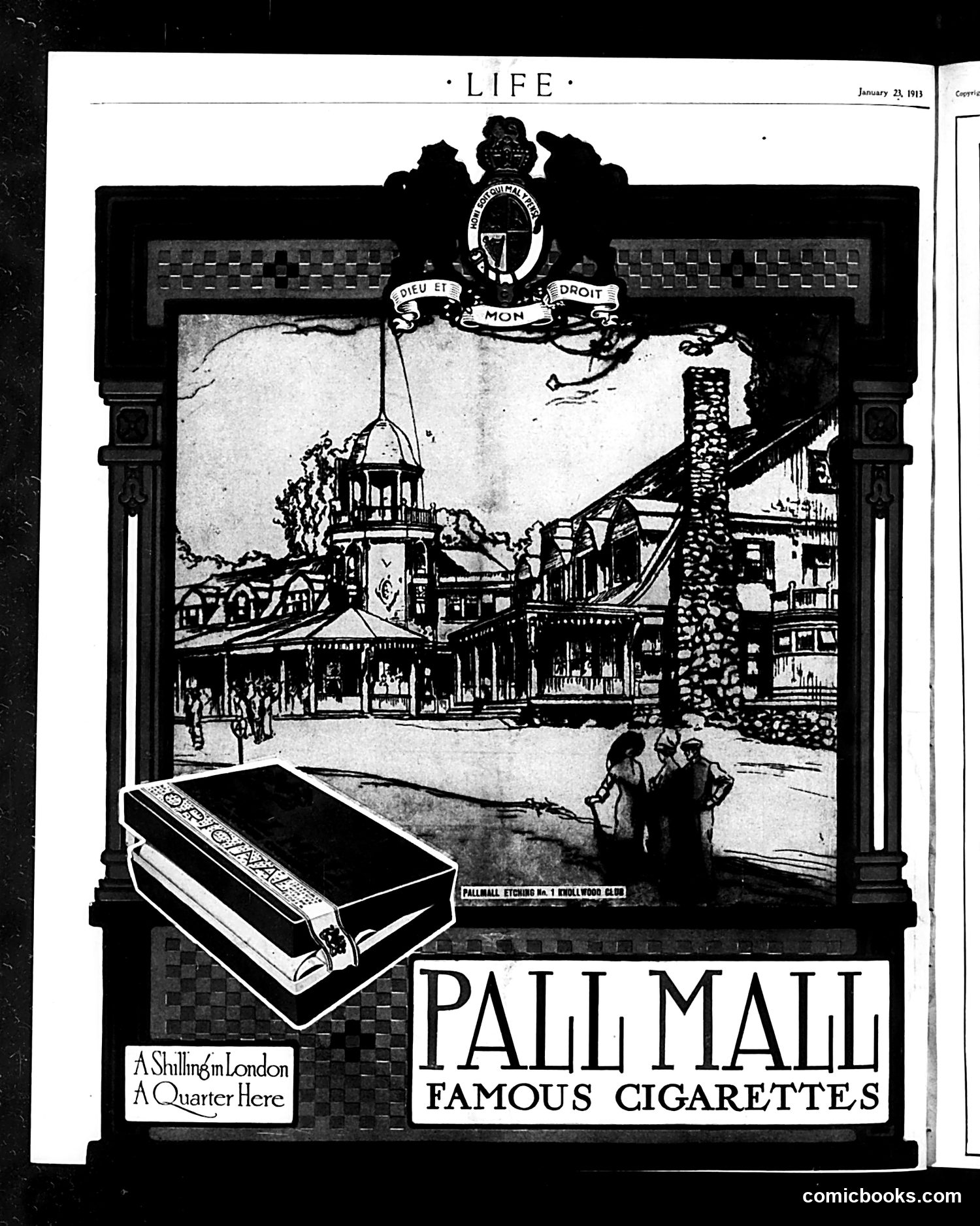
This is a **commercial advertisement**, not political satire. It's a Pall Mall cigarettes ad from Life magazine (dated January 21, 1913, visible in header). The image shows an **architectural fantasy** — a glamorous seaside resort or entertainment complex with a domed pavilion, tower, and crowds of elegantly dressed people. A package of Pall Mall cigarettes appears in the foreground. The ad's tagline reads "A Shilling in London / A Quarter Here," emphasizing the product's value and accessibility. The ornate frame with classical heraldic emblems at top suggests sophistication and prestige. This represents early 20th-century cigarette marketing, which often associated smoking with leisure, elegance, and aspirational lifestyle imagery—strategies later heavily regulated as tobacco advertising evolved.