
Life, 1913-01-23 · page 8 of 40
Life — January 23, 1913 — page 8: what you’re looking at
What you’re looking at
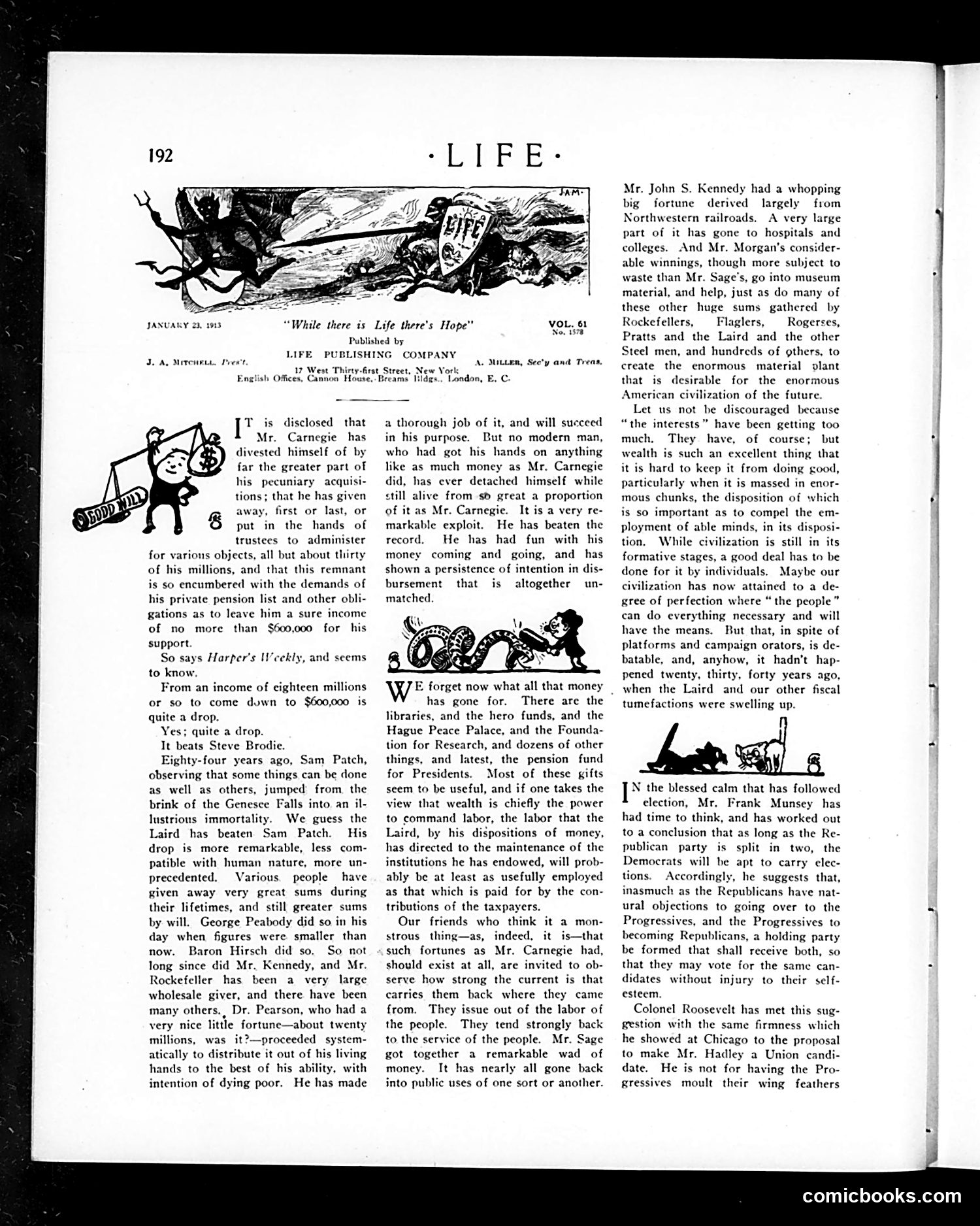
This page discusses the disposition of vast fortunes accumulated by wealthy industrialists like Andrew Carnegie and John D. Rockefeller. The article argues that despite their philanthropic gifts to libraries, research foundations, and peace initiatives, these contributions represent only a fraction of their wealth—"quite a drop" from eighteen million dollars down to $600,000. The cartoon illustrations (though small) appear to accompany commentary on how the ultra-wealthy distribute their fortunes. The satirical point is that even massive charitable donations are relatively insignificant given the scale of these men's accumulated wealth, questioning whether such giving truly represents meaningful social responsibility or merely token gestures from fortunes largely retained.
📄 Transcribed text from this page (OCR, searchable)
Machine-transcribed from the original scan — historical spelling and the odd misread are preserved.
“While there is Life there's Hope" Published by LIFE 17 West Thirty English Offices, Cannon Hor PUBLISHING COMPANY A. MILLER, See'y ant Treas, Street, New York fe. Breams Ildgs., London, E, C- [* is disclosed that Mr. Carnegie has divested himself of by far the greater part of his pecuniary acquisi- i hat he has given ay, first or last, or put in the hands of trustees to administer for various objects, all but about thirty of his millions, and that this remnant is so encumbered with the demands of his private pension list and other obli- gations as to leave him a sure income of no more than $600,000 for his support. So says Harper's Weekly, and seems to know, From an income of eighteen millions or so to come duwn to $600,000 is quite a drop. Yes; quite a drop. It beats Steve Brodie. Eighty-four years ago, Sam Patch, observing that some things can be done as well as others, jumped from. the brink of the Genesce Falls into an il- lustrious immortality. We guess the Laird has beaten Sam Patch. His drop is more remarkable, less com- patible with human nature, more un- precedented. Various. people have given away very great sums during their lifetimes, and still greater sums by will. George Peabody did so in his day when figures were smaller than now. Baron Hirsch did so. So not long since did Mr. Kennedy, and Mr. Rockefeller has been a very large wholesale giver, and there have been many others., Dr. Pearson, who had a very nice little fortune—about twenty millions, was it?—proceeded system- atically to distribute it out of his living hands to the best of his ability, with intention of dying poor. He has made a thorough job of it, and will succeed in his purpose. But no modern man, who had got his hands on anything like as much money as Mr. Carnegie did, has ever detached himself while still alive from sb great a proportion of it as Mr. Carnegie. It is a very re- markable exploit. He has beaten the record. He has had fun with his money coming and going, and has shown a persistence of intention in dis- bursement that is altogether un- matched. W forget now what all that money has gone for. There are the libraries, and the hero funds, and the Hague Peace Palace, and the Founda- tion for Research, and dozens of other things, and latest, the pension fund for Presidents. Most of these gifts seem to be useful, and if one takes the view that wealth is chiefly the power to command labor, the labor that the Laird, by his dispositions of money, has directed to the maintenance of the institutions he has endowed, will prob- ably be at least as usefully employed as that which is paid for by the con- tributions of the taxpayers. Our friends who think it a mon- strous thing—as, indeed, it is—that such fortunes as Mr. Carnegie had, should exist at all, are invited to ob- serve how strong the current is that carries them back where they came from. They issue out of the labor of the people. They tend strongly back to the service of the people. Mr. Sage got together a remarkable wad of money. It has nearly all gone back into public uses of one sort or another. Mr. John S. Kennedy had a whopping big fortune derived largely from Northwestern railroads. A very large part of it has gone to hospitals and colleges. And Mr. Morgan's consider- able winnings, though more subject to waste than Mr. Sage’s, go into museum material, and help, just as do many of these other huge sums gathered by Rockefellers, Flaglers, — Rogerses, Pratts and the Laird and the other Steel men, and hundreds of gthers, to create the enormous material glant that desirable for the enormous American civilization of the futur Let us not he discouraged because “the interests” have been getting too much, They have, of course; but wealth is such an excellent thing that it is hard to keep it from doing good, particularly when it is massed in enor- mous chunks, the disposition of which is so important as to compel the em- ployment of able minds, in its disposi- tion, While civilization is still in its formative stages, a good deal has to be done for it by individuals. Maybe our civilization has now attained to a de- gree of perfection where “ the people” can do everything necessary and will have the means. But that, in spite of platforms and campaign orators, is de- batable, and, anyhow, it hadn’t hap- pened twenty, thirty, forty years ago, when the Laird and our other fiscal tumefactions were swelling up. N the blessed calm that has followed election, Mr, Frank Munsey has had time to think, and has worked out to a conclusion that as long as the Re- publican party is split in two, the Democrats will be apt to carry elec- tions, Accordingly, he suggests that, inasmuch as the Republicans have nat- ural objections to going over to the Progressives, and the Progressives to becoming Republicans, a holding party be formed that shall receive both, so that they may vote for the same can- didates without injury to their self- esteem. Colonel Roosevelt has met this sug- gestion with the same firmness which he showed at Chicago to the proposal to make Mr. Hadley a Union candi- date. He is not for having the Pro- gressives moult their wing feathers comicbooks.com