
Life, 1913-01-23 · page 22 of 40
Life — January 23, 1913 — page 22: what you’re looking at
What you’re looking at
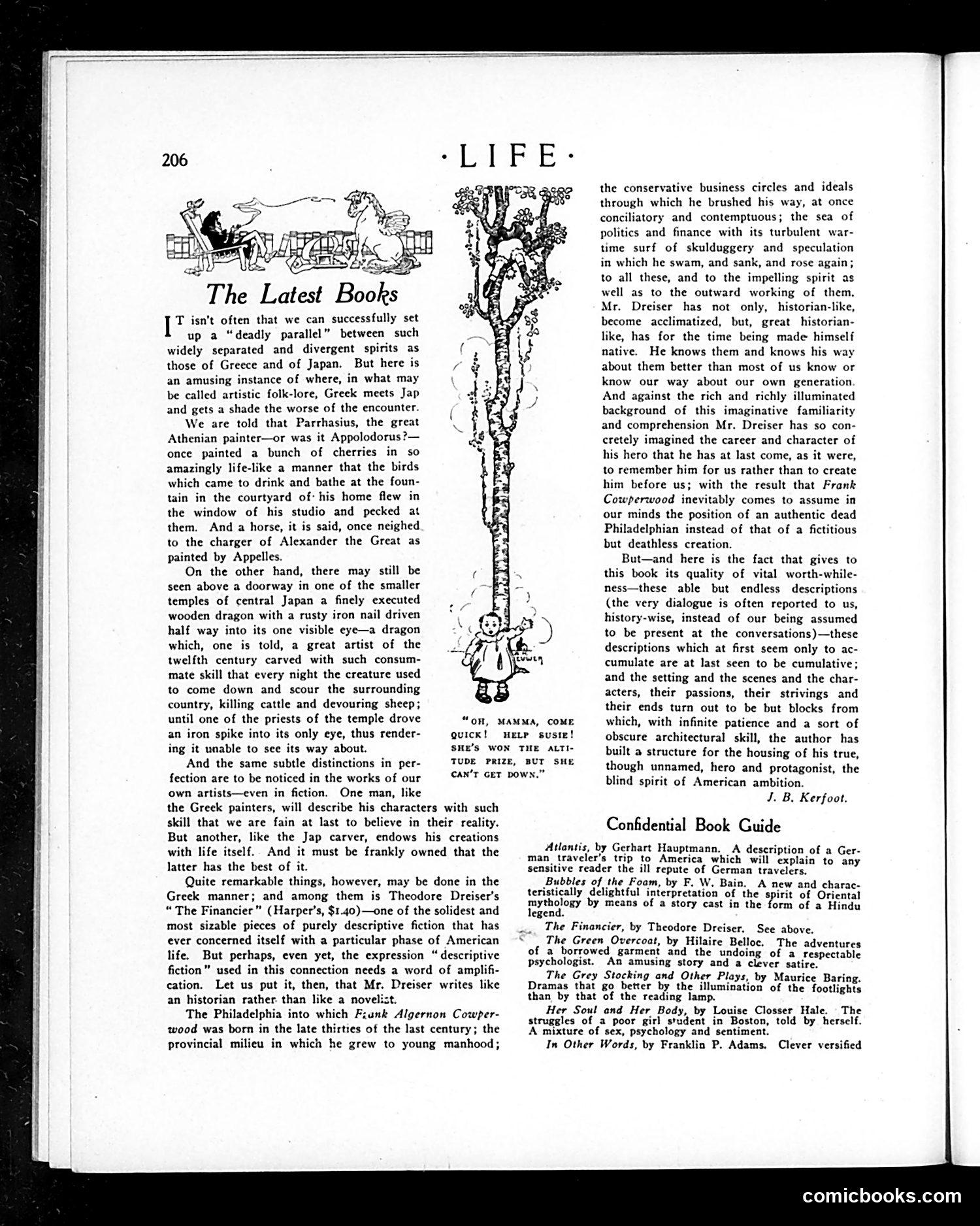
This page from *Life* magazine reviews Theodore Dreiser's novel *The Financier*. The small cartoon depicts a child who has won an "altitude prize" but cannot descend—a visual pun on the word "altitude" (height) representing the child's predicament of being stuck up high. The main text employs an extended comparison between artistic traditions. It parallels ancient Greek painters (like Parrhasius, whose cherries were so realistic birds tried to eat them) with Japanese sculptors (describing a 12th-century dragon carver whose work was so lifelike the dragon came alive at night). The reviewer uses this analogy to praise Dreiser's descriptive, historian-like approach to fiction—arguing his detailed depiction of Philadelphia's financial world and protagonist Frank Cowperwood creates such authentic verisimilitude that the fictional character feels like a real historical figure rather than invented. The satire critiques overly realistic fiction that blurs the line between invention and historical fact.
📄 Transcribed text from this page (OCR, searchable)
Machine-transcribed from the original scan — historical spelling and the odd misread are preserved.
T isn’t often that we can successfully set up a “deadly parallel” between such widely separated and divergent spirits as those of Greece and of Japan. But here is an amusing instance of where, in what may be called artistic folk-lore, Greek meets Jap and gets a shade the worse of the encounter. We are told that Parrhasius, the great Athenian painter—or was it Appolodorus?— once painted a bunch of cherries in so amazingly life-like a manner that the birds which came to drink and bathe at the foun- tain in the courtyard of: his home flew in the window of his studio and pecked at them. And a horse, it is said, once neighed to the charger of Alexander the Great as painted by Appelles. On the other hand, there may still be seen above a doorway in one of the smaller temples of central Japan a finely executed wooden dragon with a rusty iron nail driven half way into its one visible eye—a dragon which, one is told, a great artist of the twelfth century carved with such consum- mate skill that every night the creature used to come down and scour the surrounding country, killing cattle and devouring sheep; until one of the priests of the temple drove “on, an iron spike into its only eye, thus render- quick! ing it unable to see its way about. And the same subtle distinctions in per- fection are to be noticed in the works of our own artists—even in fiction. One man, like the Greek painters, will describe his characters with such skill that we are fain at last to believe in their reality. But another, like the Jap carver, endows his creations with life itself.. And it must be frankly owned that the latter has the best of it. Quite remarkable things, however, may be done in the Greek manner; and among them is Theodore Dreiser’s “ The Financier” (Harper's, $1.40)—one of the solidest and most sizable pieces of purely descriptive fiction that has ever concerned itself with a particular phase of American life. But perhaps, even yet, the expression “ descriptive fiction” used in this connection needs a word of amplifi- cation. Let us put it, then, that Mr. Dreiser writes like an historian rather. than like a novelist. The Philadelphia into which Fiunk Algernon Cowper- wood was born in the late thirties of the last century; the provincial milieu in which he grew to young manhood; amet an the ree Ox MAMMA, COME HELP susie! SHE'S WON THE ALTI- TUDE PRIZE, CAN’T GET DOWN. the conservative business circles and ideals through which he brushed his way, at once conciliatory and contemptuous; the sea of politics and finance with its turbulent war- time surf of skulduggery and speculation in which he swam, and sank, and rose again; to all these, and to the impelling spirit as well as to the outward working of them, Mr. Dreiser has not only, historian-like, become acclimatized, but, great historian- like, has for the time being made himself native. He knows them and knows his way about them better than most of us know or know our way about our own generation. And against the rich and richly illuminated background of this imaginative familiarity and comprehension Mr. Dreiser has so con- cretely imagined the career and character of his hero that he has at last come, as it were, to remember him for us rather than to create him before us; with the result that Frank Cowperwood inevitably comes to assume in our minds the position of an authentic dead Philadelphian instead of that of a fictitious but deathless creation. But—and here is the fact that gives to this book its quality of vital worth-while- ness—these able but endless descriptions (the very dialogue is often reported to us, history-wise, instead of our being assumed to be present at the conversations)—these descriptions which at first seem only to ac- cumulate are at last seen to be cumulative; and the setting and the scenes and the char- acters, their passions, their strivings and their ends turn out to be but blocks from which, with infinite patience and a sort of obscure architectural skill, the author has built a structure for the housing of his true, though unnamed, hero and protagonist, the blind spirit of American ambition. J. B, Kerfoot. Confidential Book Guide Atlantis, by Gerhart Hauptmann. A description of a Ger- man traveler's trip to America which will explain to any sensitive reader the ill repute of German travelers. Bubbles of the Foam, by F. W. Bain. A new and charac- teristically delightful interpretation of the spirit of Oriental mythology by means of a story cast in the form of a Hindu legend. The Financier, by Theodore Dreiser. See above. The Green Overcoat, by Hilaire Belloc. The adventures of a borrowed garment and the undoing of a respectable psychologist. An amusing story and a clever satire. The Grey Stocking and Other Plays, by Maurice Baring. Dramas that go better by the illumination of the footlights than by that of the reading lamp. Her Soul and Her Body, by Louise Closser Hale. The struggles of a poor girl student in Boston, told by herself. A mixture of sex, psychology and sentiment. In Other Words, by Franklin P. Adams. Clever versified BUT SHE comicbooks.com