
Life, 1913-01-23 · page 17 of 40
Life — January 23, 1913 — page 17: what you’re looking at
What you’re looking at
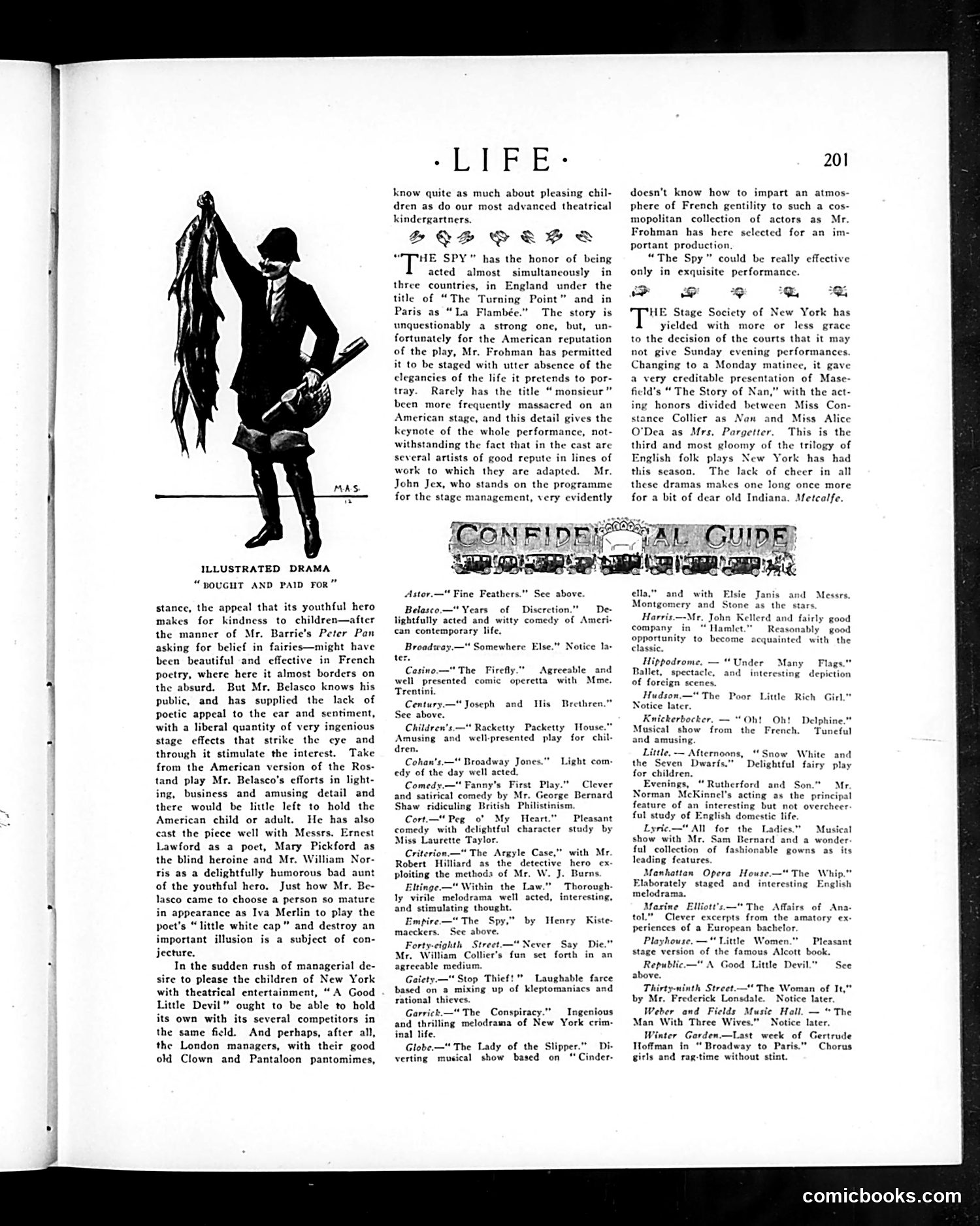
This page contains drama criticism from *Life* magazine, focused on theatrical productions. The illustrated figure on the left—a man in formal dress gesturing dramatically—accompanies a review of "Bought and Paid For," a play criticized for relying on cheap stage effects rather than genuine artistic merit. The reviews critique contemporary theater: David Belasco's adaptation of a Rostand play is dismissed as visually flashy but dramatically hollow, with actors who cannot convincingly portray French sophistication. A production of "The Spy" in three countries simultaneously is faulted for lacking elegance and proper direction. The critic also notes that recent English folk plays presented in New York are uniformly gloomy—a jab suggesting theater should entertain audiences rather than depress them. The satire targets commercial theater prioritizing spectacle and star power over substantive performance and artistic integrity.
📄 Transcribed text from this page (OCR, searchable)
Machine-transcribed from the original scan — historical spelling and the odd misread are preserved.
oe ILLUSTRATED DRAMA “BOUGHT AND PAID FoR” stance, the appeal that its youthful hero makes for kindness to children—after the manner of Mr. Barrie’s Peter Pan asking for belief in fairies—might have been beautiful and effective in French poetry, where here it almost borders on the absurd. But Mr. Belasco knows his public, and has supplied the lack of poetic appeal to the ear and sentiment, with a liberal quantity of very ingenious stage effects that strike the eye and through it stimulate the interest. Take from the American version of the Ros- tand play Mr. Belasco’s efforts in light- ing, business and amusing detail and there would be little left to hold the American child or adult. He has also cast the piece well with Messrs. Ernest Lawford as a poet, Mary Pickford as the blind heroine and Mr. William Nor- ris as a delightfully humorous bad au: of the youthful hero. Just how Mr. Be- lasco came to choose a person so mature in appearance as Iva Merlin to play the poet's “ little white cap” and destroy an important illusion is a subject of con- jecture. In the sudden rush of managerial de- sire to please the children of New York with theatrical entertainment, “ A Good Little Devil” ought to be able to hold its own with its several competitors in the same field. And perhaps, after all, the London managers, with their good old Clown and Pantaloon pantomimes, EVER know quite as much about pleasing chil- dren as do our most advanced theatrical kindergartners. BOS SRBS “THe SPY” has the honor of being acted almost simultancously in three countries, in England under the title of “The Turning Point” and in Paris as “La Flambée.” The story is unquestionably a strong one, but, un- fortunately for the American reputation of the play, Mr. Frohman has permitted it to be staged with utter absence of the clegancies of the life it pretends to por- tray. Rarely has the title “monsicur” been more frequently massacred on an American stage, and this detail gives the keynote of the whole performance, not- withstanding the fact that in the cast are several artists of good repute in lines of work to which they are adapted. Mr. John Jex, who stands on the programme for the stage management, very evidently [GENF 201 doesn't know how to impart an atmos- phere of French gentility to such a cos- mopolitan collection of actors as Mr. rohman has here selected for an im- portant production. “The Spy" could be really effective only in exquisite performance. Fo & = + 3% HE Stage Society of New York has yielded with more or less grace to the decision of the courts that it ma not give Sunday evening performances. Changing to a Monday matinee, it gave a very creditable presentation of Mase- ficld’s “ The Story of Nan,” with the act- ing honors divided between Miss Con- stance Collier as Nan and Miss Alice O'Dea as Mrs. Pargetter. This is the third and most gloomy of the trilogy of English folk plays New York has had this season. The lack of cheer in all these dramas makes one long once more for a bit of dear old Indiana. Metcalfe. le eT | Astor.—"' Fine Feathers." See above. Belesco.—" Years of Discretion.” De. lightfully acted and witty comedy of Ameri- can contemporary life, Broadway.—" Somewhere Else." Notice la- ter. Casino.—" The Firefly.” Agreeable and well presented comic operetta with Mme. Trentini, Century.—" Joseph and His Brethren.” See above. Children's.—" Racketty Packetty House." Amusing and well-presented play for chil- dren. Coh * Broadway Jones." Light com: edy of the day well acted. Comedy.—" Fanny's First Play.” Clever and satirical comedy by Mr. George Bernard Shaw ridiculing British Philistinism. —"Peg o' My Heart." Pleasant with delightful character study by Miss Laurette Taylor. Criterion. —“ The Argyle Case," with Mr Robert Hilliard as the detective hero ex- ploiting the methods of Mr. W. J. Burns Eltinge —" Within the Law.” Thorough ly virile melodrama well acted, interesting, and stimulating thought. Empire—“ The Spy,” by Henry Kiste- macckers. See above. Forty-eighth Street-—" Never Say Die.” Mr. William Collier's fun set forth in an agreeable medium. Gaiety.—" Stop Thief!" Laughable farce based on a mixing up of kleptomaniacs and rational thieves. Garrick.—" The Conspiracy.” Ingenious and thrilling melodrama of New York crim- inal life. Globe.—" The Lady of the Slipper.” Di- verting musical show based on“ Cinder- ella," and with Elsie Janis and Messrs, Montgomery and Stone as the stars. Harris.—-Mr. John Kellerd company in “Hamlet.” R nd fairly good asonably good opportunity to become acquainted with the classic, Hippodrome, — “Under Many Flags." Ballet, spectacle, and interesting depiction of foreign scenes. _Hudson.—" The Poor Little Rich Girl." Notice later. Knickerbocker. — “Oh! Oh! Delphine.” Musical show from the French. neful and amusing. Little. — Afternoons, “Snow White and the Seven Dwarfs.” "Delightful fairy play for children. Evenings, “Rutherford and Son." Mr Norman McKinnel’s acting as the principal feature of an interesting but not overcheer ful study of English domestic life. Lyric." All for the Ladies.” Musical show with Mr. Sam Bernard and a wonder ful collection of fashionable go leading features Manhattan Opera House—“ The Whip.” Elaborately staged and interesting English melodrama. Maxine Elliott’s—" The Affairs of Ana- tol” Clever excerpts from the amatory ex- periences of a European bachelor. Playhouse. —"' Little Women.” Pleasant stage version of the famous Alcott book. Republic-—" A Good Little Devil.” See above. Thirty-ninth Street.—" The Woman of It,” by Mr. Frederick Lonsdale. Notice later. Weber and Fields Musie Hall. — “The as its Man With Three Wives.” Notice later. Winter Garden.—Last week of Gertrude Hoffman in “ Broadway to Paris.” Chorus girls and rag-time without stint. comicbooks.com