
Life, 1913-01-23 · page 16 of 40
Life — January 23, 1913 — page 16: what you’re looking at
What you’re looking at
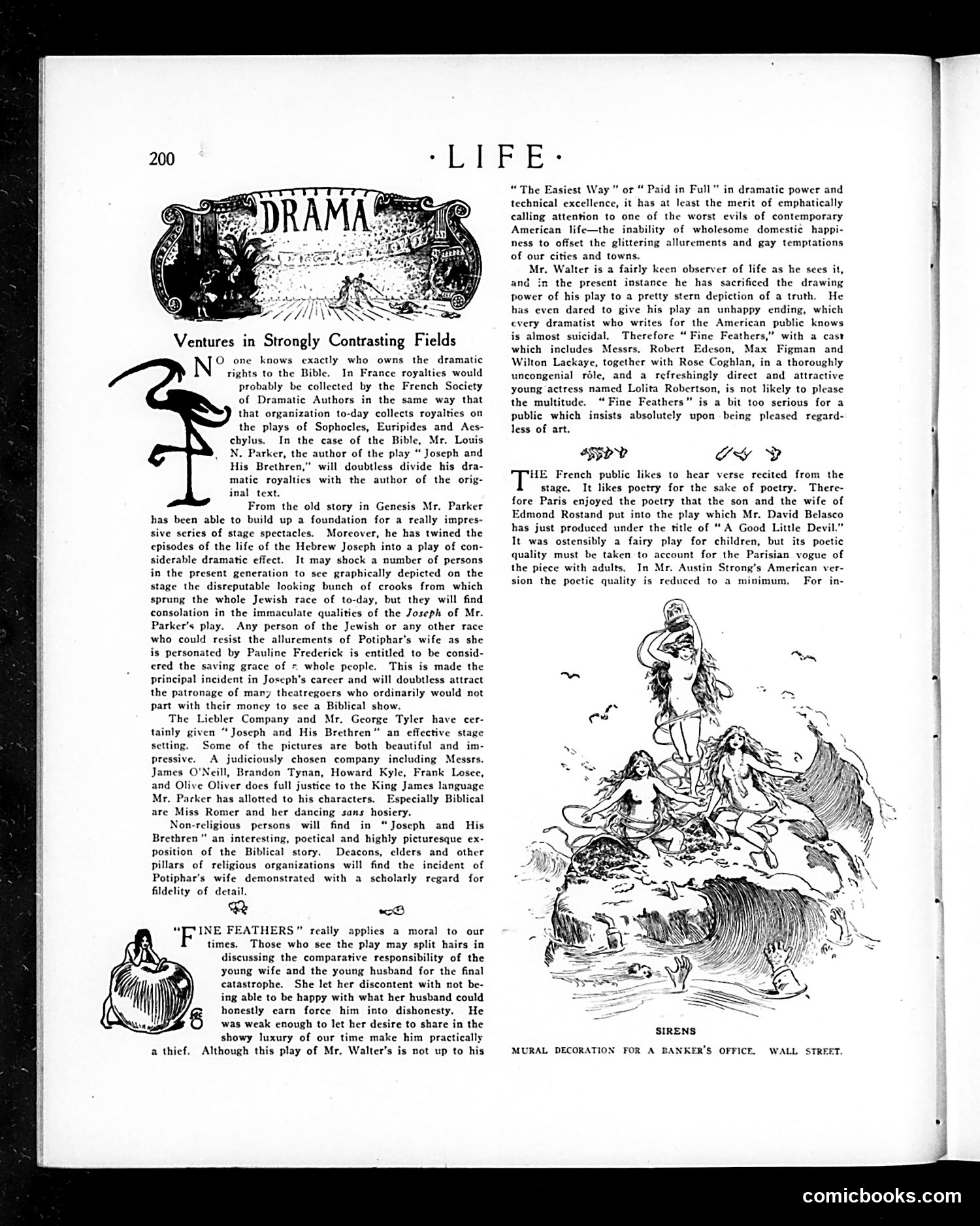
This page reviews two Broadway plays with contrasting subject matter. "Joseph and His Brethren," adapted by Louis N. Parker from the Biblical Genesis story, is praised as an impressive spectacle featuring actress Pauline Frederick as Potiphar's wife—a role the critic notes will attract audiences beyond typical religious drama patrons. The review suggests the play's appeal partly rests on Frederick's allure rather than purely artistic merit. "Fine Feathers" is critiqued as a morality play about urban temptation. The critic argues it effectively illustrates how modern consumerism and "showy luxury" corrupt domestic happiness, forcing a husband into crime to satisfy his wife's desires. The reviewer notes the playwright's courage in providing an unhappy ending—unusual for American commercial theater—though the play lacks the dramatic power of earlier works like "The Easiest Way." Both reviews reflect Progressive Era anxieties about wealth, morality, and social decay.
📄 Transcribed text from this page (OCR, searchable)
Machine-transcribed from the original scan — historical spelling and the odd misread are preserved.
Ventures in Strongly Contrasting Fields N° one knows exactly who owns the dramatic rights to the Bible. In France royalties would probably be collected by the French Society of Dramatic Authors in the same way that that organization to-day collects royalties on the plays of Sophocles, Euripides and Acs- chylus. In the case of the Bible, Mr. Louis N. Parker, the author of the play “Joseph and His Brethren,” will doubtless divide his dra- matic royalties with the author of the orig- inal text. From the old story in Genesis Mr. Parker has been able to build up a foundation for a really impres- sive series of stage spectacles. Moreover, he has twined the episodes of the life of the Hebrew Joseph into a play of con- siderable dramatic effect. It may shock a number of persons in the present generation to sce graphically depicted on the stage the disreputable looking bunch of crooks from which sprung the whole Jewish race of to-day, but they will find consolation in the immaculate qualities of the Joseph of Mr. Parker’s play. Any person of the Jewish or any other race who could resist the allurements of Potiphar's wife as she is personated by Pauline Frederick is entitled to be consid- ered the saving grace of » whole pcople. This is made the principal incident in Joseph's career and will doubtless attract the patronage of many theatregoers who ordinarily would not part with their money to see a Biblical show. The Liebler Company and Mr, George Tyler have cer- tainly given “Joseph and His Brethren” an effective stage setting. Some of the pictures are both beautiful and im- pressive. A judiciously chosen company including Messrs. James O'Neill, Brandon Tynan, Howard Kyle, Frank Losee, and Olive Oliver does full justice to the King James language Mr. Parker has allotted to his characters. Especially Biblical are Miss Romer and her dancing sans hosiery. Non-religious persons will find in “Joseph and His Brethren” an interesting, poetical and highly picturesque ex- position of the Biblical story. Deacons, elders and other pillars of religious organizations will find the incident of Potiphar’s wife demonstrated with a scholarly regard for fildelity of detail. Se <8 “F INE FEATHERS” really applies a moral to our times. Those who see the play may split hairs in discussing the comparative responsibility of the young wife and the young husband for the final catastrophe. She let her discontent with not be- ing able to be happy with what her husband could honestly earn force him into dishonesty. He 8 was weak enough to let her desire to share in the showy luxury of our time make him practically a thief. Although this play of Mr. Walter’s is not up to his Alby REE “The Easiest Way " of “ Paid in Full” in dramatic power and technical excellence, it has at least the merit of emphatically calling attention to one of the worst evils of contemporary American life—the inability of wholesome domestic happi- ness to offset the glittering allurements and gay temptations of our cities and towns. Mr. Walter is a fairly keen observer of life as he sees i and in the present instance he has sacrificed the drawing power of his play to a pretty stern depiction of a truth. He even dared to give his play an unhappy ending, which every dramatist who writes for the American public knows is almost suicidal, Therefore “Fine Feathers,” with a cast which includes Messrs. Robert Edeson, Max Figman and Wilton Lackaye, together with Rose Coghlan, in a thoroughly uncongenial role, and a refreshingly direct and attractive young actress named Lolita Robertson, is not likely to please the multitude. “Fine Feathers” is a bit too serious for a public which insists absolutely upon being pleased regard- less of art. ASV Ow DY HE French public likes to hear verse recited from the stage. It likes poctry for the sake of poetry. There- fore Paris enjoyed the poetry that the son and the wife of Edmond Rostand put into the play which Mr. David Belasco has just produced under the title of “A Good Little Devil.” It was ostensibly a fairy play for children, but its poetic quality must be taken to account for the Parisian vogue of the piece with adults, In Mr. Austin Strong's American ver- sion the poetic quality is reduced to a minimum, For in- SIRENS MURAL DECORATION FOR A BANKER’S OFFICE, WALL STREET. comicbooks.com