
Life, 1913-01-23 · page 7 of 40
Life — January 23, 1913 — page 7: what you’re looking at
What you’re looking at
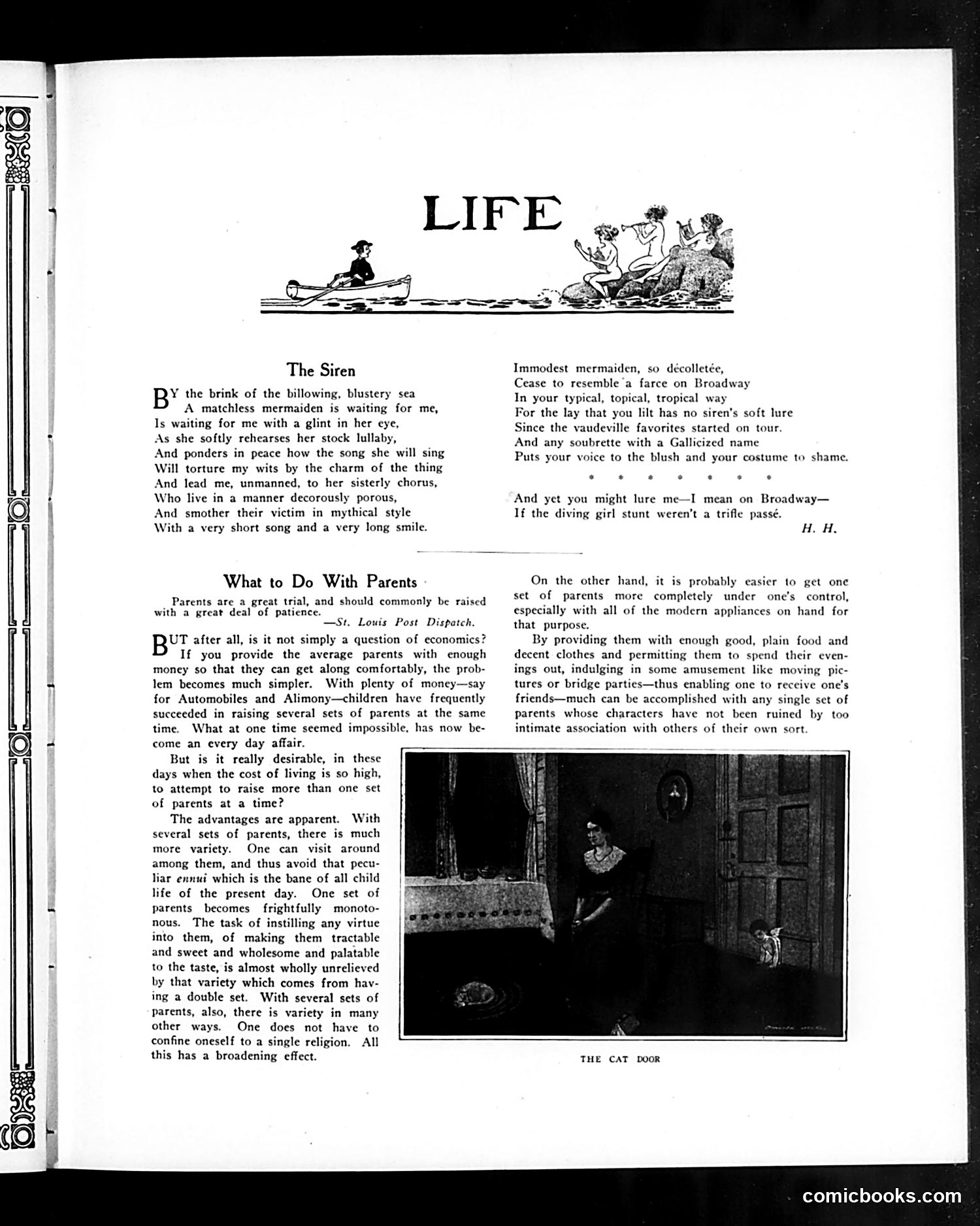
This page contains two satirical pieces: **"The Siren"** (top): A poem mocking theatrical "mermaid" performers—likely vaudeville acts popular in early 20th-century entertainment. The satire targets the absurdity of these shows, describing a mediocre performer whose "tropical, topical" appeal masks lack of genuine talent. The author (H.H.) jokes that even a diving stunt wouldn't make her performance worthwhile. This reflects Life's consistent mockery of lowbrow entertainment. **"What to Do With Parents"** (bottom): Humorous advice suggesting parents should be "raised" collectively rather than individually—a reversal of typical parent-child relationships. The piece satirizes the challenge and expense of supporting parents, ironically proposing that multiple sets provide "variety" and prevent monotony. The accompanying photograph, "The Cat Door," appears to illustrate domestic life.
📄 Transcribed text from this page (OCR, searchable)
Machine-transcribed from the original scan — historical spelling and the odd misread are preserved.
1} The Siren B Y the brink of the billowing, blustery sea A matchless mermaiden is waiting for me, Is waiting for me with a glint in her eye, As she softly rehearses her stock lullaby, And ponders in peace how the song she will sing Will torture my wits by the charm of the thing And lead me, unmanned, to her sisterly chorus, Who live in a manner decorously porous, And smother their victim in mythical style With a very short song and a very long smile. What to Do With Parents Parents are a great trial, and should commonly be raised with a great deal of patience. —St. Louis Post Dispatch. UT after all, is it not simply a question of economics? If you provide the average parents with enough money so that they can get along comfortably, the prob- lem becomes much simpler. With plenty of money—say for Automobiles and Alimony—children have frequently succeeded in raising several sets of parents at the same time. What at one time seemed impossible, has now be- come an every day affa Immodest mermaiden, so décolletée, Cease to resemble a farce on Broadway In your typical, topical, tropical way For the lay that you lilt has no siren’s soft lure Since the vaudeville favorites started on tour. And any soubrette with a Gallicized name Puts your voice to the blush and your costume to shame. os © © © © © 8 And yet you might lure me—I mean on Broadway— If the diving girl stunt weren't a trifle passé. H. A, On the other hand, it is probably easier to get one set of parents more completely under one’s control, especially with all of the modern appliances on hand for that purpos: By providing them with enough good, plain food and decent clothes and permitting them to spend their even- ings out, indulging in some amusement like moving pic- tures or bridge parties—thus enabling one to receive one’s friends—much can be accomplished with any single set of parents whose characters have not been ruined by too intimate association with others of their own sort But is it really desirable, in these [J days when the cost of living is so high, to attempt to raise more than one set of parents at a time? The advantages are apparent. With several sets of parents, there is much more variety. One can visit around among them, and thus avoid that pecu- liar ennui which is the bane of all child life of the present day. One set of parents becomes frightfully monoto- nous. The task of instilling any virtue into them, of making them tractable and sweet and wholesome and palatable to the taste, is almost wholly unrelieved by that variety which comes from hav- ing a double set. With several sets of parents, also, there is variety in many other ways. One does not have to confine oneself to a single religion. All this has a broadening effect. THE CAT DOOR comicbooks.com